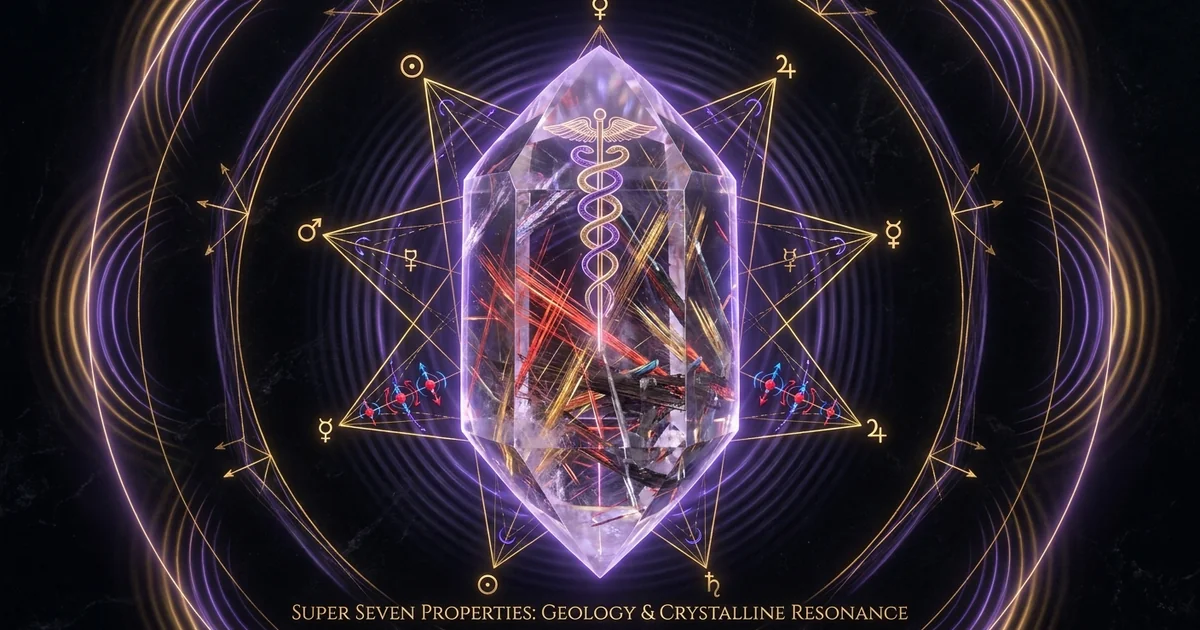
Super Seven Properties: Geology & Crystalline Resonance
Mineral Classification & Crystallographic Thesis
Polymorphic Matrix and Synergistic Phase Assemblage
The mineral assemblage commercially designated as Super Seven—also known in analytical mineralogy as the Melody Stone or the Sacred Seven composite—constitutes a complex hydrothermal paragenesis hosted within a continuous macroscopic silicate framework. Rather than existing as an aggregate of loosely bound particles, the material represents a structural heterostructure dominated by an $\alpha$-quartz host lattice. Embedded within this primary framework are seven distinct mineral phases: macroscopic clear quartz, amethyst, smoky quartz, rutile, goethite, lepidocrocite, and cacoxenite. The simultaneous crystallization and subsequent secondary alteration that yield this multi-phase paragenesis occur under tightly constrained geochemical conditions within complex granitic pegmatites.
Understanding the host requires analyzing the basic building blocks of low-temperature quartz: corner-sharing silicon-dioxide-tetrahedra, designated chemically as $\text{SiO}_4$. In the host matrix, these tetrahedra link to form an enantiomorphic, non-centrosymmetric trigonal crystal system conforming to the space-group $P3_1 21$ (or its enantiomorph $P3_2 21$). The primary matrix is not homogenous in its thermodynamic or optical behavior. Instead, the simultaneous growth of colored zoning variants reflects distinct stages of metasomatic fluid injection, localized gamma irradiation, and structural trace element substitution. Amethyst sectors develop via the substitution of trace ferric iron ($\text{Fe}^{3+}$) for silicon ($\text{Si}^{4+}$) in the tetrahedral lattice, which subsequent natural ionizing radiation oxidizes into $[\text{FeO}_4]^0$ or tetravalent iron ($\text{Fe}^{4+}$) color centers, producing optical absorption bands centered near 545 nm (Rossman, 1994). Concurrently, the smoky quartz zones emerge from the presence of trivalent aluminum ($\text{Al}^{3+}$) substituting for $\text{Si}^{4+}$, coupled with monovalent interstitial charge compensators ($\text{Li}^+$ or $\text{H}^+$), which under natural radiolysis yield paramagnetic $[\text{AlO}_4]^0$ hole centers (Deer, Howie, & Zussman, 1992).
Host Framework (Trigonal Alpha-Quartz)
├── Structural Color Variations:
│   ├── Clear Quartz: Undoped SiO2 framework
│   ├── Amethyst: [FeO4]0 / Fe4+ color centers
│   └── Smoky Quartz: [AlO4]0 hole centers
└── Crystalline Inclusions:
    ├── Rutile: Tetragonal TiO2 needles
    ├── Goethite: Orthorhombic alpha-FeO(OH) acicular blades
    ├── Lepidocrocite: Orthorhombic gamma-FeO(OH) tabular sheets
    └── Cacoxenite: Basic hydrous iron aluminum phosphate
Within this chemically active quartz substrate, the fibrous, acicular, and tabular inclusions do not represent accidental detrital matter. They formed through primary epitaxy or sequential epigenetic crystallization from iron-, titanium-, and phosphorus-rich hydrothermal fluids. The interaction of these inclusions with the host lattice alters the bulk physical characteristics of the material. Whereas pristine single-crystal quartz demonstrates a predictable Mohs-hardness of 7.0, the heterostructure displays anisotropic micro-hardness values across petrographic thin-sections, ranging from 5.5 in zones congested with soft iron phosphates and oxyhydroxides up to 7.0 in pristine quartz zones. Optical birefringence ($\Delta = 0.009$ in the quartz host) undergoes severe localized disturbance at inclusion interfaces, yielding anomalous undulatory extinction, localized optical axes rotation, and micro-strain-induced photoluminescence patterns.
Super Seven Bulk Mohs Hardness Gradient:
Zone:   [ Phosphates / Cacoxenite ] ------ [ Iron Oxyhydroxides ] ------ [ Host Matrix Quartz ]
Value:  5.5                                6.0 - 6.5                     7.0
Chemical Stoichiometry and Inter-Growth Speciation
The inter-growth speciation within this complex silicate / oxide matrix is defined by the crystallization behaviors of the four auxiliary mineral systems. Rutile ($\text{TiO}2$) crystallizes in the tetragonal system, adopting the space-group $P4_2/mnm$. It manifests predominantly as sub-micron to millimeter-scale acicular needles, oriented along the host quartz’s structural crystallographic vectors through epitaxial growth, primarily along the ${10\bar{1}1}$ rhombohedral planes. These rutile needles possess an exceptionally high refractive index ($n\varepsilon \approx 2.903$, $n_\omega \approx 2.616$), creating marked internal light scattering and distinct dielectric boundaries within the optically isotropic-to-uniaxial host matrix.
Precision X-ray powder diffraction (XRD) and high-resolution transmission electron microscopy (HRTEM) confirm the co-existence of distinct crystallographic domains within a single coherent specimen:
- Host $\alpha$-Quartz: Trigonal, space-group $P3_1 21$, unit cell dimensions $a = 4.913 \text{ \AA}$, $c = 5.405 \text{ \AA}$, cell volume $V = 113.0 \text{ \AA}^3$.
- Rutile Phase: Tetragonal, space-group $P4_2/mnm$, unit cell dimensions $a = 4.593 \text{ \AA}$, $c = 2.959 \text{ \AA}$.
- Goethite Phase: Orthorhombic, space-group $Pbnm$, unit cell dimensions $a = 4.602 \text{ \AA}$, $b = 9.956 \text{ \AA}$, $c = 3.021 \text{ \AA}$.
- Lepidocrocite Phase: Orthorhombic, space-group $Bbmm$ (or $Amam$), unit cell dimensions $a = 3.87 \text{ \AA}$, $b = 12.51 \text{ \AA}$, $c = 3.07 \text{ \AA}$.
- Cacoxenite Phase: Hexagonal, space-group $P6_3/m$, idealized formula $\text{Fe}^{3+}_{24}\text{AlO}6(\text{PO}4){17}(\text{OH}){12} \cdot 75\text{H}2\text{O}$, with massive unit cell parameter $a \approx 27.55 \text{ \AA}$, $c \approx 10.55 \text{ \AA}$. Interfacial lattice mismatch between the trigonal host and these non-congruent sub-lattices induces localized lattice strain ($\varepsilon{strain}$) exceeding $1.2 \times 10^{-3}$, generating permanent dislocation arrays and structural dipoles.
The iron oxyhydroxide polymorphs, goethite ($\alpha\text{-FeO(OH)}$) and lepidocrocite ($\gamma\text{-FeO(OH)}$), introduce distinct crystallographic symmetries into the trigonal matrix. Goethite forms compact, orthorhombic prisms and acicular needles based on hexagonally close-packed oxygen and hydroxide layers, with $\text{Fe}^{3+}$ ions occupying two-thirds of the octahedral interstices. Conversely, lepidocrocite adopts an orthorhombic layer structure with cubic close-packing, forming reflective, tabular orange-to-red platelets. These two phases often alternate along crystallographic growth zones, reflecting oscillating oxidation-reduction potentials ($E_h$) and $\text{pH}$ fluctuations within the pegmatitic hydrothermal pocket during secondary mineral entrapment (Heaney, 1994).
Cacoxenite introduces a highly complex crystal structure into the composite. As a basic hydrous iron aluminum phosphate, its presence indicates late-stage, low-temperature hydrothermal alteration where residual phosphorus-rich fluids attacked early-crystallized iron oxides. The structure forms giant cylindrical channels composed of $\text{Fe}^{3+}$-centered oxygen octahedra and phosphorus tetrahedra that run parallel to the hexagonal $c$-axis. These sub-nanometer channels house zeolitic water molecules and exchangeable cations. The physical interface between the rigid trigonal framework of corner-linked $\text{SiO}_4$ units and these bulky, water-rich phosphate channels generates localized lattice vacancies and high defect density. The resulting interfacial-strain acts as a continuous mechanical stress field, permanently perturbing the surrounding quartz lattice and stabilizing an elevated internal thermodynamic potential.
Lattice Geometry & Solid-State Physics
Trigonal Framework Anisotropy and Piezoelectric Tensors
The physics of Super Seven derives fundamentally from the crystallographic asymmetry of the $\alpha$-quartz parent crystal. Believed to reflect principles described in trigonal-lattice-hexagonal-symmetry, the space-group $P3_1 21$ lacks an inversion center (it is non-centrosymmetric), which is the absolute physical prerequisite for linear piezoelectricity. When a mechanical stress tensor ($\sigma_{jk}$) is applied across the specimen, the displacement of positive silicon cations relative to negative oxygen anions produces a direct electrical polarization ($P_i$), governed by the fundamental constitutive relation:
$$P_i = d_{ijk} \sigma_{jk}$$
where $d_{ijk}$ represents the piezoelectric strain coefficient tensor. For the trigonal point group 32 to which $\alpha$-quartz belongs, symmetry conditions reduce the independent piezoelectric coefficients to only two: $d_{11}$ and $d_{14}$. The longitudinal piezoelectric coefficient along the polar digonal $a$-axes ($x$-direction) is experimentally measured at:
$$d_{11} \approx 2.3 \times 10^{-12} \text{ C/N}$$
while the shear coefficient is:
$$d_{14} \approx -0.67 \times 10^{-12} \text{ C/N}$$
Piezoelectric Strain Response Matrix (Trigonal Class 32):
        [  d11  -d11    0    d14    0      0   ]
d_ijk = [   0     0     0     0   -d14  -2*d11 ]
        [   0     0     0     0     0      0   ]
In a pure, defect-free quartz crystal, these piezoelectric forces produce uniform surface charges when subjected to uniform mechanical loading. In the Super Seven complex silicate / oxide matrix, however, internal structural equilibrium is perpetually disturbed. The inclusions—acicular rutile, tabular lepidocrocite, and fibrous goethite—possess elastic moduli, thermal expansion coefficients, and shear parameters that diverge sharply from the quartz host. Consequently, ambient fluctuations in temperature, barometric pressure, or vibrational excitation trigger non-uniform internal stress concentrations ($\sigma_{local}$) localized precisely at the inter-phase boundaries.
These localized micro-strains continuously activate the $d_{11}$ and $d_{14}$ piezoelectric tensors, generating microscopic electrical potential gradients ($V_{internal}$) across spatial intervals as small as several unit cells. The mechanical resistance of the rigid host framework, combined with the anisotropic thermal expansion of the embedded minerals, turns every inclusion pocket into a self-charging electromechanical cell. This structural piezoelectricity couples directly into adjacent conductive and semiconductive crystal phases, converting low-amplitude background acoustic energy into localized, fluctuating electrostatic fields.
Bandgap Transitions and Dielectric Polarization in Multi-Phase Inclusions
The electronic structure of Super Seven is not governed by a single electronic band structure, but by a heterogeneous spatial mosaic of wide-bandgap insulators, transition-metal oxides, and narrow-gap semiconductors. Pristine $\alpha$-quartz is an electrical insulator with a wide bandgap ($E_g \approx 9.0 \text{ eV}$), characterized by an exceptionally low dielectric loss tangent ($\tan \delta < 10^{-4}$) and a relative dielectric-constant ($\varepsilon_r$) of approximately 4.5 parallel to the $a$-axis and 4.6 parallel to the $c$-axis. Under standard environmental conditions, quartz supports no direct conduction-band electron transport.
Alpha-Quartz Host Matrix
- Electronic Bandgap ($E_g$): $\approx 9.0 \text{ eV}$ (Wide-bandgap insulator)
- Dielectric Permittivity ($\varepsilon_r$): $4.5$ ($\parallel a$-axis), $4.6$ ($\parallel c$-axis)
- Dielectric Loss Tangent ($\tan \delta$): $< 10^{-4}$ (Ultra-low dissipation)
- Mechanical Quality Factor ($Q$): $10^5 \text{ to } 10^6$ (Exceptional acoustic sustain)
- Conduction Mechanism: Bound displacement current only; zero free-electron mobility.
Semiconducting Mineral Inclusions
- Electronic Bandgaps: Rutile ($E_g \approx 3.0 \text{ eV}$), Goethite ($E_g \approx 2.1 \text{ eV}$), Lepidocrocite ($E_g \approx 2.06 \text{ eV}$)
- Dielectric Permittivity ($\varepsilon_r$): Rutile reaches $\varepsilon_\parallel \approx 170$ and $\varepsilon_\perp \approx 86$
- Dielectric Loss Tangent ($\tan \delta$): $10^{-2} \text{ to } 10^{-1}$ (High electronic dissipation)
- Charge Transfer Mechanism: $d\text{-}d$ transitions, intervalence $\text{Fe}^{2+} \to \text{Fe}^{3+}$ charge transfer, photo-assisted hopping conduction.
When semiconductor phases are embedded directly into this low-dielectric, wide-bandgap matrix, high-contrast dielectric interfaces develop. Rutile presents one of the highest static dielectric constants known among natural minerals, exhibiting pronounced dielectric anisotropy where $\varepsilon_r$ reaches approximately 170 along the tetragonal $c$-axis and 86 perpendicular to it. The interfaces between high-$\varepsilon_r$ rutile needles or iron oxyhydroxide ribbons and the low-$\varepsilon_r$ quartz substrate form natural micro-capacitive barriers. Under external energetic stimulation, these boundaries prevent charge dissipation, leading to localized charge accumulation via Maxwell-Wagner-Sillars dielectric polarization. This polarization behavior and its influence on field phenomena is further detailed in dielectric-polarization-subtle-fields.
Furthermore, the bandgap profiles of the iron oxyhydroxides ($E_g \approx 2.1 \text{ eV}$ for goethite; $E_g \approx 2.06 \text{ eV}$ for lepidocrocite) allow for active sub-gap electronic transitions under visible light and low-energy thermal radiation. These transitions involve $d\text{-}d$ ligand-field transitions of octahedral $\text{Fe}^{3+}$ ($^6A_1 \to {}^4T_1, {}^4T_2$) alongside inter-valence charge-transfer processes ($\text{Fe}^{2+} \text{-- O – } \text{Fe}^{3+}$). The close physical coupling of narrow-bandgap semiconductors within an ultra-low-loss dielectric resonator allows Super Seven to maintain localized electronic excitations without immediate dissipative thermalization, a phenomenon central to its complex solid state crystallography.
Subtle Energetic Dynamics & Resonance Mechanics
Phonon-Polariton Coupling and Piezo-Electric Transduction
The interaction between electromagnetic waves and the collective vibrational modes of the crystal lattice gives rise to bosonic quasiparticles termed phonon-polaritons. In Super Seven, the physical dynamics of these quasiparticles diverge markedly from standard homogeneous silicates. The corner-sharing $\text{SiO}_4$ units undergo continuous optical infrared-active lattice vibrations (phonons), which couple to transverse electromagnetic modes. As an electromagnetic or subtle energetic disturbance enters the silica substrate, it couples to these optical phonons to form a hybrid excitation—a phonon-polariton wave that propagates across the internal lattice.
Propagating EM / Subtle Field
            │
            ▼
    [ Optical Phonon (SiO4 Lattice Vibrations) ]
            │
            ├─► Coupled State: Phonon-Polariton Quasiparticle
            │
            ▼
    [ Collision with Heterogeneous Inclusions (Fe/Ti Oxides) ]
            │
            ├─► Momentum Vector Redistribution (hk)
            ├─► Spin-Orbit Coupling with Unpaired d-Electrons
            └─► Non-Thermal Acoustic and Dielectric Polarization
When this polariton wavefront encounters the structural boundaries of included rutile, goethite, or lepidocrocite, its momentum vector ($k$) is altered by the local change in dielectric impedance. The presence of titanium ($3d^0$) and iron ($3d^5$) orbitals within these inclusion boundaries breaks the polariton’s symmetrical propagation. The phonon-polariton’s localized electric field vectors drive coherent spin-orbit transitions within the partially filled $d$-orbitals of the iron oxyhydroxide species. Through this mechanism, low-frequency, high-entropy acoustic or subtle vibrational perturbations are converted into non-thermal polariton excitations, channeling mechanical displacement into directed high-frequency energetic states via the rutile interfaces, as explored in rutile-inclusions-electromagnetic-coupling.
This conversion functions via a macroscopic multi-phase piezo-electric transduction network. Micro-vibrations acting upon the specimen produce localized shear strain at the quartz-rutile and quartz-cacoxenite boundaries. The difference in acoustic impedance between the phases prevents standing-wave dissipation. Instead, acoustic energy is focused within these inclusion interfaces, sustaining resonant phonon modes that modulate the local dielectric permittivity. Super Seven acts as an open, self-stabilizing acoustic-to-electromagnetic resonant cavity operating at gigahertz-to-terahertz carrier modes, while expressing lower-frequency vibrational beats across subtle operational spectrums.
Biofield Coherence and Multi-Octave Harmonic Interference
At the interface between condensed matter physics and subtle energetic phenomena, the Super Seven architecture demonstrates unusual phase-locking capabilities when coupled with external biological oscillatory fields. The human biofield operates as a non-equilibrium, electrodynamic and scalar emission matrix, dominated by low-frequency, phase-dispersed acoustic, bio-photonic, and electromagnetic signals. When these unorganized bio-oscillations interact with an unpolarized dielectric medium, they typically scatter incoherently, leading to entropy dissipation.
In Super Seven, this biological input directly excites the piezoelectric strain tensor of the $\alpha$-quartz host lattice. The resulting localized strain tensors induce phase-coherent displacement currents across the seven distinct sub-lattices. Because each phase possesses an intrinsic, geometrically determined resonant frequency—spanning from the low acoustic-shear frequencies of fibrous cacoxenite channels up to the optical phonon frequencies of rutile and quartz—the composite functions as a multi-octave harmonic comb.
This harmonic architecture realigns incoherent bio-oscillatory noise. The non-linear dielectric constants within the inclusion boundaries force disparate input frequencies to mix, generating secondary sum and difference frequencies:
$$f_{\text{sum}} = f_1 + f_2 \quad \text{and} \quad f_{\text{diff}} = |f_1 - f_2|$$
The primary quartz matrix acts as an acoustic carrier medium that stabilizes these newly unified wave modes. The interaction transforms broad-spectrum, turbulent bio-energetic inputs into an ordered array of stable scalar and electromagnetic standing waves. The crystalline assembly acts as an organic solid-state filter, transmuting disordered biological inputs into self-reinforcing energetic geometry characterized by heightened phase-conjugate coherence across macroscopic distances.
Historical Lapidary Lore & Traditional Lineage
Historical Precedents of Included Quartzes in Classical Lapidaries
The recognition of included quartz as a distinct and chemically exceptional mineral category traces deep into historical lapidary science. Classical mineralogists and natural philosophers did not evaluate quartz merely through the lens of aesthetic clarity; internal macro-inclusions were frequently scrutinized as mechanical markers of dynamic natural forces. In Theophrastus’s foundational fourth-century BCE treatise Peri Lithon (On Stones), minerals displaying internal mineralogical inclusions were classified among the “pregnant stones” (lithoi enkyoi), believed to preserve embryonic stages of telluric genesis.
This descriptive tradition reached systematic maturity in the natural histories of the Roman imperial period. Pliny the Elder, writing in Book XXXVII of his Naturalis Historia (c. 77 CE), documented transparent quartz specimens housing metallic, acicular, and fibrous inclusions, classifying them alongside anomalous phenomena like the “Ceraunia” (lightning stones) and “Iris” stones. Pliny noted that certain quartz specimens captured internal optical and geometric properties divergent from uniform macro-crystalline specimens, interpreting these inclusions not as flaws, but as energetic accretions of solar and atmospheric elements.
“The stone known as Iris is found in a certain island of the Red Sea… It is transparent, like rock-crystal, and hexangular; when struck by the rays of the sun, it reflects the colors of the rainbow, illuminating the adjacent walls with shifting hues. A similar wonder is observed in those stones that retain within their glassy bodies foreign elements—hairs of copper, needles of iron, and fibers of golden hue—which seem to live within the stone. These stones are held to possess superior powers in mitigating the pestilences of the atmosphere, drawing into their bodies the celestial fire without suffering disruption of their substance.”
Medieval and Renaissance lapidaries, including the Liber Lapidum of Marbodus of Rennes (11th century) and the mineralogical works of Albertus Magnus (De Mineralibus, 13th century), preserved the doctrine that mineral inclusions amplified a host stone’s innate astrological and elemental signatures. Composite silicates and metamorphic minerals bearing iron-based metallic threads were systematically prescribed as protective talismanic matrices, believed to stabilize volatile biological humors by combining the pure, chilling elemental water of the quartz crystal with the dynamic terrestrial fire embodied by metallic iron-oxide inclusions.
Historical Lapidary Lineage of Composite Quartzes:
4th c. BCE: Theophrastus (Peri Lithon) -> "Pregnant Stones" (Internal Telluric Matrix)
      │
77 CE:      Pliny the Elder (Naturalis Historia) -> Internal Foreign Bodies ("Iris" / "Ceraunia")
      │
11th-13th:  Marbodus & Albertus Magnus -> Synergistic elemental blending (Water + Fire)
      │
1990s CE:   Melody / Espirito Santo Discoveries -> Seven-phase paragenetic synthesis
The Modern Paragenesis: Espirito Santo Pegmatite Discoveries
The modern metaphysical mineralogical classification of this unique assembly diverged from classical single-mineral analyses during the late twentieth century, following significant pegmatitic discoveries in the Espirito Santo region of southeastern Brazil. The pegmatites of this structural province are characterized by complex granitic fractionation, where late-stage metasomatic intrusions injected incompatible elements—including titanium, phosphorus, and high concentrations of structural iron—directly into cooling, microcline-quartz cores.
In these deposits, the seven phases crystallized simultaneously or sequentially along rhythmic epitaxial growth fronts, yielding the specific material codified within esoteric literature by the lapidary researcher Melody (1995). Melody’s work, Love Is In The Earth, established a major paradigm shift within contemporary lapidary metaphysics by arguing that the specific vibrational resonance of this composite material does not simply equal the arithmetic sum of its individual components. Instead, the paragenesis of the Espirito Santo specimens was presented as a unified, evolutionary mineralogical heterostructure, fundamentally distinct from any single included quartz.
This reclassification moved subtle-field mineralogy from single-species analysis to polymorphic symbiosis. Practitioners and subtle-field researchers began categorizing the Espirito Santo deposits as solid-state networks wherein clear quartz amplifies, amethyst transmutes, smoky quartz stabilizes, rutile directs, goethite anchors, lepidocrocite elevates, and cacoxenite expands the localized energetic throughput. This conceptual architecture integrated classical observations of “pregnant stones” into modern solid-state vibrational models, recognizing Super Seven as a premier macroscopic natural multi-element resonator.
Practical Applications, Calibration & Safety Protocols
Geometric Alignment, Piezoelectric Activation, and Grid Configurations
The practical deployment of Super Seven within subtle energetic systems, vibrational calibration protocols, and advanced crystalline grids requires strict adherence to its crystallographic orientations. Because the primary piezoelectric coupling occurs along the digonal $a$-axes ($x$-axes) of the trigonal $\alpha$-quartz host framework, spatial orientation relative to local ambient fields directly controls resonant output. To maximize coherent energetic extraction, the principal optical axis ($c$-axis, $[0001]$ direction) of the specimen should be aligned parallel to local geomagnetic lines of force (magnetic North-South), placing the non-centrosymmetric $a$-axes in positions where they can effectively intercept ambient transverse electromagnetic variations.
Geomagnetic Grid Alignment:
                [ Geomagnetic North ]
                         ▲
                         │  (c-axis / [0001] Alignment)
                    ┌────┴────┐
                    │  Super  │
  Ambient Transverse│  Seven  │ Ambient Transverse
  Electromagnetic ──┼► Crystal◄┼── Electromagnetic
  Perturbations     │ Specimen│   Perturbations
  (a-axes Activation)└───┬────┘
                         │
                         ▼
                [ Geomagnetic South ]
When building crystalline grids, Super Seven functions primarily as a central master node or high-dielectric collector. Peripheral satellite stones should consist of pure single-phase silicates—such as un-included quartz oscillators or tourmaline phase-shifters—oriented to project linear vector lines directly into the inclusion-rich zones of the central stone. Piezoelectric activation is achieved not through uncontrolled destructive mechanical percussion, but through calibrated thermodynamic and acoustic modulation. Applying precise physical pressure (axial loading along the $a$-axis) or introducing coherent acoustic frequencies directly excites the internal $d_{11}$ tensor. This releases accumulated boundary charges into the surrounding subtle-field grid, without degrading the delicate internal interfacial horizons of the specimen.
Material Stability, Leaching Risks, and Toxicity Directives
The heterogeneous multi-phase architecture of Super Seven introduces significant structural instabilities and chemical risks that preclude standard handling procedures applied to pure quartz. Because the material houses orthorhombic iron oxyhydroxides and porous, hydrous phosphates along unhealed micro-fractures, it exhibits distinct internal cleavages that are mechanically vulnerable to sudden thermal differentials or mechanical shock.
DO NOT PREPARE DIRECT CONSUMABLE GEM ELIXIRS VIA AQUEOUS IMMERSION. Super Seven must never be subjected to direct immersion in aqueous solutions intended for internal human consumption. The internal boundaries housing cacoxenite ($\text{Fe}^{3+}_{24}\text{AlO}6(\text{PO}4){17}(\text{OH}){12} \cdot 75\text{H}_2\text{O}$), goethite, and lepidocrocite frequently contain microscopic fissures, sub-micron inclusions of unoxidized transition elements, and trace radioactive isotopes associated with the ionizing events that formed the amethyst and smoky quartz color centers.
- Direct contact with water promotes the rapid chemical breakdown of soluble phosphate bonds, leaching iron oxides, aluminum, and potential trace heavy metals directly into the solution.
- Water ingress into sub-micron interfacial fissures triggers microscopic hydraulic wedging under ambient thermal cycles, leading to structural spalling and catastrophic micro-cleavage along the lepidocrocite platelets.
- Direct-immersion elixirs are prohibited. Practitioners must employ the indirect method: hermetically sealing the mineral specimen inside an inert borosilicate or pure fused quartz glass ampoule before placing it into the receiving liquid medium.
Cleaning and structural maintenance must avoid chemical reagents. Acids, ionic solvents, and ultrasonic cleaning systems will rapidly compromise the material. Ultrasonic frequencies directly shear the phase boundaries between the low-impedance phosphate inclusions and the high-impedance quartz matrix, causing irreversible internal clouding or structural detachment of delicate acicular rutile needles. Cleaning must be restricted to mechanical wiping with dry optical-grade micro-fiber surfaces, complemented by low-entropy vibrational and acoustic recalibration techniques.
Frequently Asked Questions: Crystallographic & Vibrational Dynamics
Microscopic Verification of All Seven Phases
A frequent point of debate among mineralogists and lapidary researchers concerns the physical presence of all seven mineral phases within every macroscopic hand specimen. Macroscopic inspection often fails to reveal the complete phase suite; a specimen may present broad zones of smoky quartz and amethyst with visible rutile and lepidocrocite, while exhibiting no readily identifiable acicular goethite or yellow fibrous cacoxenite to the naked eye.
Macro vs. Micro Phase Distribution:
Visual Field (Naked Eye):
  [ Dominant: Amethyst / Smoky Quartz / Flakes ] ──┐
                                                    │ Distinct Crystallographic
Petrographic / Raman Spectroscopy Scale:           ▼ Continuity Maintained
  ├── Sub-micron Rutile needle swarms              │ throughout bulk volume.
  ├── Cryptocrystalline Goethite precipitates      │
  └── Nanoscale Cacoxenite channel arrays   ───────┘
Analytical petrography, electron-probe microanalysis (EPMA), and confocal micro-Raman spectroscopy reveal that even when phases appear visually absent in macroscopic hand samples, the sub-micron nucleation centers and trace chemical precursors remain dispersed along internal growth boundaries. Fluid inclusion channels within the quartz host typically house cryptocrystalline precipitates of the missing oxide or phosphate phases at nanometer scales. From a subtle field perspective, the coherent morphogenetic and vibrational signature of the paragenesis remains intact throughout the bulk volume. The entire crystal functions as a unified field node, provided the specimen was extracted from a contiguous pegmatitic pocket demonstrating the complete seven-phase paragenetic sequence.
Comparative Field Integrity: Raw Versus Polished Specimens
The energetic divergence between raw, naturally terminated specimens and lapidary-fashioned stones stems from the physical state of the crystal boundary. Natural crystal terminations express the primary morphological habit of the trigonal class, complete with alternating positive and negative rhombohedral faces ($r$ and $z$ faces) that reflect the internal symmetry of the unit cells. These natural crystal faces present pristine, un-cleaved dielectric boundary surfaces that minimize the scattering of exiting phonon-polariton excitations.
Comparative Dynamic Metrics:

Natural Terminated Specimen:
  - Surface Geometry: Hexagonal prism with {10-11} / {01-11} rhombohedra.
  - Lattice Continuity: Unbroken, terminating in natural atomic layers.
  - Energy Dynamic: Highly directional, coherent vector emissions along [0001].

Polished Specimen (Cabochon, Sphere, or Wand):
  - Surface Geometry: Artificially smoothed, amorphous Beilby layer.
  - Lattice Continuity: Mechanically fractured at sub-micron interface.
  - Energy Dynamic: Isotropic, broad-angle subtle field scattering.
Conversely, lapidary intervention—sawing, grinding, and polishing—mechanically fractures the surface unit cells, introducing a sub-micron amorphized surface skin known as the Beilby layer. While mechanical polishing disrupts localized surface piezoelectric tensors, it also exposes internal inclusion planes—such as deeply buried lepidocrocite plates or cacoxenite clusters—directly to incoming light and external electromagnetic fields. Consequently, while raw crystals provide directional precision and coherent vector emissions along the crystallographic $c$-axis, polished forms provide broad-angle subtle field dispersion, facilitating ambient dielectric coupling across wider spatial environments.
Thermodynamic Degradation and Lattice Restoration
Thermal stability remains a core consideration in preserving the solid-state integrity of Super Seven. The primary host matrix consists entirely of low-temperature $\alpha$-quartz, which maintains structural stability only up to 573°C (846 K) at standard atmospheric pressure. Exceeding this critical temperature boundary triggers a displacive, second-order phase transition into the high-temperature hexagonal $\beta$-quartz polymorph (space-group $P6_2 22$ or $P6_4 22$):
$$\alpha\text{-Quartz } (P3_1 21) \xrightarrow{573^\circ\text{C}} \beta\text{-Quartz } (P6_2 22)$$
During this transition, the corner-sharing $\text{SiO}4$ tetrahedra rotate without bond breakage, gaining a center of inversion symmetry along the $c$-axis projection and permanently extinguishing the linear piezoelectric $d{11}$ tensor.
Thermodynamic Phase Inversion:
Alpha-Quartz (Trigonal, P3_1 21) ─────────► Beta-Quartz (Hexagonal, P6_2 22)
(Piezoelectric, Asymmetric)       > 573°C    (Inversion Symmetry Gained, Non-Piezoelectric)
                                             *Catastrophic Lattice Failure*
Thermal alteration of the specimen begins long before reaching the 573°C inversion threshold. At temperatures between 250°C and 400°C, the unstable $[\text{FeO}_4]^0$ and $[\text{AlO}_4]^0$ color centers that generate the amethyst and smoky quartz zoning destabilize, as free electrons re-occupy the localized hole centers, bleaching the distinct optical zones into an undifferentiated pale yellow or clear state. Simultaneously, hydrous cacoxenite undergoes irreversible structural dehydroxylation, collapsing its hexagonal channel networks, while lepidocrocite oxidizes into maghemite or anhydrous hematite ($\alpha\text{-Fe}_2\text{O}_3$).
If an intact specimen undergoes low-entropy vibrational degradation or internal dielectric fatigue—induced by high ambient electrosmog or severe mechanical resonance—the host lattice can be cleared without introducing thermal strain. Restoring coherent resonance requires precise acoustic excitation rather than destructive heat.
To clear trapped electrostatic charge distributions and recalibrate the interfacial strain vectors within the Super Seven matrix:
- Isolate the specimen within a magnetically shielded or low-electrosmog environment, resting it upon an unpolished wooden or ceramic base.
- Strike an unweighted medical or acoustic-grade tuning fork calibrated to fundamental harmonic intervals—preferably 432 Hz (acoustic ground state) or 528 Hz (molecular coherence standard).
- Bring the stem of the vibrating fork into firm, mechanical contact with the basal pinacoid or termination tip of the primary quartz crystal along its polar $a$-axis.
- Allow the mechanical shear wave to propagate directly through the host lattice for the complete acoustic decay envelope. Repeat three times per crystallographic axis. This purely mechanical acoustic excitation activates the natural piezoelectric $d_{14}$ shear tensor, dislodging trapped interfacial boundary dipoles and restoring low-entropy ground states across all seven phases without exposing the material to thermal inversion risks.
Super Seven represents a complete, macroscopic multi-mineral resonator. Through the physical interplay between its trigonal $\alpha$-quartz parent lattice and the embedded orthorhombic, tetragonal, and hexagonal sub-lattices, it functions as a natural multiferroic system. Bridging solid-state physics, interfacial crystallographic strain, and subtle vibrational mechanics, the stone converts chaotic acoustic, electromagnetic, and biofield inputs into a coherent, multi-octave harmonic resonance.