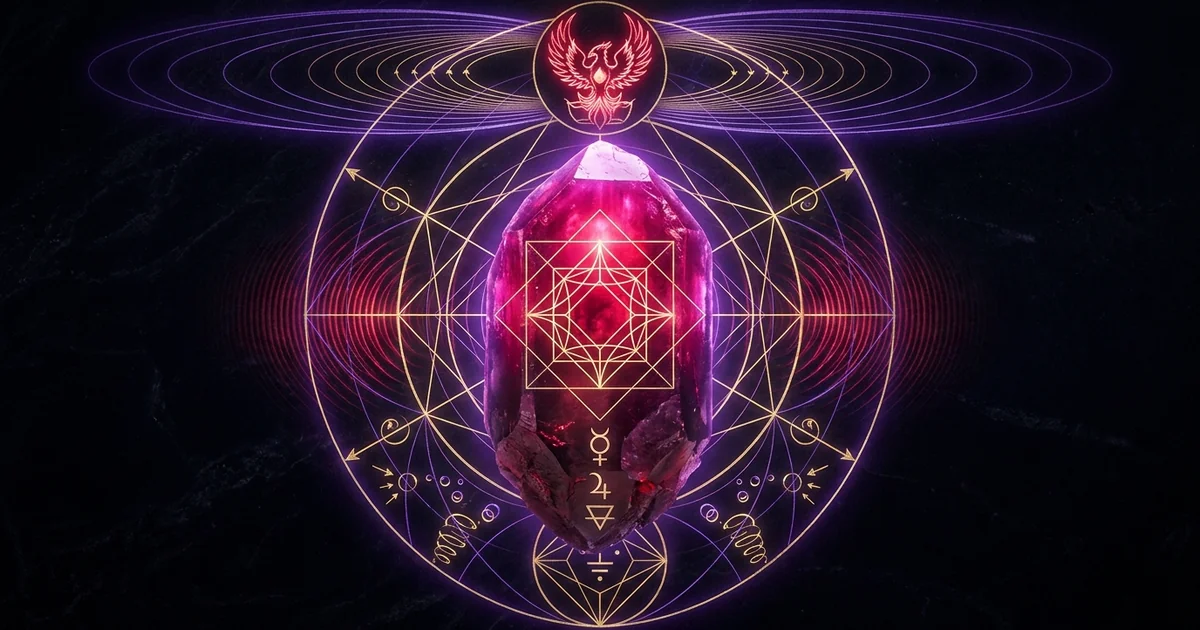
Tugtupite Properties: Geology & Crystalline Resonance
Mineral Classification & Crystallographic Thesis
Stoichiometry and the Ilímaussaq Alkaline Complex
Tugtupite ($\text{Na}_4\text{AlBeSi}4\text{O}{12}\text{Cl}$) is a rare, beryllium-bearing tectosilicate that occupies a singular position within solid-state mineralogy and subtle field physics. Discovered in the remote, hyper-agpaitic pegmatites of the Ilímaussaq alkaline complex in South Greenland, the mineral crystallizes under geochemical regimes defined by extreme silica undersaturation, an agpaitic index markedly exceeding unity ($\text{Na} + \text{K} / \text{Al} > 1.2$), and an exceptional concentration of volatile halogens and incompatible light elements. While historically classified alongside sodalite due to stoichiometric and dimensional parallels, tugtupite departs sharply from the conventional sodalite group through the systematic, ordered inclusion of beryllium into the primary silicate structural skeleton. The crystallization pressure-temperature regime—situated within late-stage hydrothermal albite-analcime veins cutting through lujavrites and naujaites—mandates an ordered atomic distribution where beryllium does not merely act as an interstitial impurity, but as an indispensable architect of the solid-state matrix.
The presence of the Ilímaussaq intrusive suite provides the unique petrological crucible necessary for this lattice stabilization. Within these peralkaline rocks, the crystallization sequences force beryllium—an element typically concentrated in granitic pegmatites—into dynamic interplay with hyper-alkaline sodic fluids saturated with chlorine. The resulting complex silicate / oxide matrix crystallizes at relatively low temperatures ($400^\circ\text{C}$ to $250^\circ\text{C}$) during the final consolidation stages of the intrusion. In this geochemical environment, the mineral avoids the higher structural symmetry characteristic of simpler feldspathoids, locking its constituents into a rigid, electronically polarized framework that is fundamental to both its macroscopic properties and its metaphysical energetic signatures.
[Tugtupite Unit Cell: Tetragonal I-4]
   a = 8.637 Å, c = 8.870 Å | Z = 2
   (AlO4)5- <--- O ---> (BeO4)6- <--- O ---> (SiO4)4-
        |                   |                  |
     [Na+]               [Cl-]              [Na+]
      \                   /                  /
       +--- Interstitial Cage Cavity --------+
Acentric Symmetry: Tetragonal System and Space Group I-4
The core crystallographic anomaly of tugtupite lies in its crystallographic space-group symmetry. Unlike prototypical sodalite, which conforms to the cubic space group $P\bar{4}3n$, tugtupite crystallizes in the acentric tetragonal system, operating precisely within the non-centrosymmetric space group $I\bar{4}$ (point group $\bar{4}$). The lower symmetry of this acentric lattice arises directly from the ordered substitution of beryllium and aluminum within what would otherwise be a degenerate tetrahedral sub-lattice. In tugtupite, the fundamental translation unit is defined by lattice parameters $a = 8.637\text{ \AA}$ and $c = 8.870\text{ \AA}$, creating an anisotropic unit cell volume of approximately $V = 661.7\text{ \AA}^3$ with $Z = 2$ formula units per cell.
The absence of an inversion center ($\bar{1}$) within the $I\bar{4}$ space group exerts profound consequences on the material’s solid-state physical characteristics. In centrosymmetric crystals, macroscopic electric dipole moments are neutralized by spatial inversion symmetry; conversely, the acentric symmetry of tugtupite permits permanent and stress-induced internal polarization fields. The displacement of the central cations relative to their coordinating oxygen polyhedra induces a directional lattice vector that remains uncompensated by opposing crystalline sites. Consequently, this non-centrosymmetric configuration serves as the structural foundation for the simultaneous manifestation of high-order piezoelectricity and non-linear optical susceptibilities. These phenomena bridge conventional solid-state physics with subtle-body biophysical entrainment protocols.
Primary Structural Determination: Sørensen, H. (1962). The Tugtupite (Beryllosodalite) Occurrence at Tugtup agtakôrfia, South Greenland. Meddelelser om Grønland, 169(2), 1-38.
- Chemical Formula: $\text{Na}_4\text{AlBeSi}4\text{O}{12}\text{Cl}$
- Crystal System: Tetragonal
- Space Group: $I\bar{4}$ (No. 82)
- Unit Cell Dimensions: $a = 8.637(2)\text{ \AA}$, $c = 8.870(2)\text{ \AA}$, $c/a = 1.027$
- Unit Cell Volume ($V$): $661.7\text{ \AA}^3$
- Formula Units per Cell ($Z$): 2
- Calculated Density ($\rho_\text{calc}$): $2.36\text{ g/cm}^3$
- Optical Indices: Uniaxial (+), $n_\omega = 1.496(1)$, $n_\epsilon = 1.502(1)$, Birefringence $\delta = 0.006$
- Mechanical Hardness: Mohs 4.0; brittle tenacity with distinct ${101}$ cleavage
The Solid-State Tectosilicate Matrix and Beryllium Substitution
The solid state crystallography of tugtupite is dominated by an interconnected, three-dimensional framework of corner-sharing tetrahedra. While classical tectosilicates feature frameworks comprised exclusively of silicon-dioxide-tetrahedra modified by trivalent aluminum substitutions (forming standard aluminosilicate cages), tugtupite integrates divalent beryllium into these structural nodes. The primary framework is therefore an ordered beryllio-alumino-silicate network consisting of $[\text{SiO}_4]^{4-}$, $[\text{AlO}_4]^{5-}$, and $[\text{BeO}_4]^{6-}$ units linked through shared oxygen bridging ions ($\text{Si-O-Al}$ and $\text{Si-O-Be}$ linkages).
The small ionic radius of $\text{Be}^{2+}$ ($0.27\text{ \AA}$) relative to $\text{Al}^{3+}$ ($0.39\text{ \AA}$) and $\text{Si}^{4+}$ ($0.26\text{ \AA}$) introduces substantial localized strain fields within the tetrahedral bonds. To maintain electrostatic neutrality and structural integrity across the three-dimensional array, the $\text{Be-O}$ distances compress to approximately $1.64\text{ \AA}$, whereas $\text{Al-O}$ and $\text{Si-O}$ distances stabilize at approximately $1.75\text{ \AA}$ and $1.61\text{ \AA}$, respectively. This divergence in bond lengths disrupts the isotropic cubic framework seen in typical sodalites, forcing an anisotropic tetragonal distortion along the $c$-axis.
Within this covalently bound cage framework lie large interstitial cavities centered around chlorine anions. Each chlorine ion is tetrahedrally coordinated by four sodium ($\text{Na}^+$) cations, which in turn interface with the peripheral oxygen rings of the framework cages. These interstitial sodium-chlorine clusters ($\text{Na}_4\text{Cl}$) are not passive observers within the lattice; rather, they interact dynamically with the rigid beryllosilicate superstructure. The combination of covalent tetrahedral framework bonding and ionic cage stabilization provides the mineral with its unique structural resilience, despite displaying a moderate mechanical scratch resistance evaluated at 4.0 on the Mohs hardness scale. The structural configuration of this complex silicate / oxide matrix underpins its capacity to host dynamic, light-reactive electronic defects.
Lattice Geometry & Solid-State Physics
Tenebrescence and F-Center Color Dynamics
The most visually striking solid-state phenomenon observed in tugtupite is its intense, reversible photochromism, known mineralogically as tenebrescence. When extracted from subterranean formations or shielded from ionizing optical frequencies, tugtupite typically presents as an off-white, light pink, or nearly colorless crystalline mass. However, upon exposure to electromagnetic radiation within the ultraviolet spectrum—specifically shortwave UV ($\lambda \approx 254\text{ nm}$) and to a slightly lesser extent longwave UV ($\lambda \approx 365\text{ nm}$)—the crystal undergoes an instantaneous, deep chromatic shift to an intense crimson, carmine, or magenta coloration. This saturated state remains metastably locked in the matrix until bleached by exposure to visible light photons ($\lambda \approx 500\text{–}600\text{ nm}$) or thermal excitation exceeding $200^\circ\text{C}$.
The physical mechanism driving this tenebrescent process is governed by point defects within the crystal lattice, specifically the creation and activation of color centers, or f-center-defect sites. As characterized by Nassau (2001) and further refined in mineralogical studies by Darragh and Sanders (1976), the tugtupite lattice contains native point defects within its interstitial cages. Primarily, these consist of halide vacancies: sites within the $\text{Na}4\text{Cl}$ clusters where a chlorine anion is missing from the interstitial framework ($V\text{Cl}^\bullet$). Surrounding this vacancy are four positively charged sodium cations, generating a localized electrostatic potential well:
$$V_\text{Cl}^\bullet + e^- \xrightarrow{h\nu_{\text{UV}}} [V_\text{Cl}^\bullet \cdot e^-] \quad (\text{F-Center Creation})$$
$$[V_\text{Cl}^\bullet \cdot e^-] \xrightarrow{h\nu_{\text{Vis}} \text{ or } \Delta T} V_\text{Cl}^\bullet + e^- \quad (\text{Bleaching Cycle})$$
When incoming ultraviolet photons strike the lattice, electrons are liberated from nearby donor centers (typically trace multivalent iron, sulfur impurities, or oxygen framework atoms) and are captured by these chlorine vacancies. The trapped electron, localized within the tetrahedral potential well of the four sodium cations, establishes quantized electronic energy levels analogous to a three-dimensional particle-in-a-box. The allowed electronic transitions within this trapped state absorb strongly across the blue-green to green-yellow optical bands ($480\text{–}580\text{ nm}$), leaving the red and violet transmissions unabsorbed. This differential transmission generates the characteristic deep red-violet hue. The reverse transition—optical bleaching—occurs when lower-energy visible light provides the requisite activation energy ($E_a \approx 1.2\text{–}1.5\text{ eV}$) to detrap the electron from the cavity, returning it to its parental ground state and restoring optical transparency.
Tugtupite ($\text{Na}_4\text{AlBeSi}_4\text{O}_{12}\text{Cl}$)
- Lattice Symmetry: Non-centrosymmetric Tetragonal ($I\bar{4}$).
- Cage Composition: Ordered Beryllosilicate Framework ($[\text{BeO}_4]$ and $[\text{AlO}_4]$ ordering).
- Electron Trap Mechanism: High-rigidity chlorine vacancy ($V_\text{Cl}^\bullet$) stabilized by compressed $\text{Na}_4$ coordination.
- Optical Kinetics: Requires shortwave UV ($254\text{ nm}$) for full saturation; displays remarkable resistance to immediate passive daylight bleaching.
- Metastable Half-Life: Darkened crimson state persists for weeks in dark ambient conditions due to deep localized potential wells.
Hackmanite ($\text{Na}_8\text{Al}_6\text{Si}_6\text{O}_{24}(\text{Cl}_2,\text{S})$)
- Lattice Symmetry: Centrosymmetric Cubic ($P\bar{4}3n$).
- Cage Composition: Standard Aluminosilicate Framework ($[\text{AlO}_4]$ and $[\text{SiO}_4]$ only).
- Electron Trap Mechanism: Disordered sulfur radical anion ($\text{S}_2^{2-}$ or $\text{S}_3^-$) adjacent to chlorine vacancies.
- Optical Kinetics: Excitable across broad UVA/UVB; rapidly bleaches under standard visible solar exposure within minutes to hours.
- Metastable Half-Life: Low activation barrier yields rapid thermal decay to the bleached white state at room temperature.
Dielectric Polarizability and Piezoelectric Tensors ($d_{ij}$)
The non-centrosymmetric space group $I\bar{4}$ of tugtupite introduces profound anisotropy into its electrical polarizability and electromechanical response. Solid-state crystallography dictates that crystals belonging to point group $\bar{4}$ possess non-zero third-rank piezoelectric tensor components ($d_{ijk}$). For point group $\bar{4}$, symmetry constraints dictate that the independent, non-zero piezoelectric strain coefficients are:
$$d = \begin{pmatrix} 0 & 0 & 0 & d_{14} & d_{15} & 0 \ 0 & 0 & 0 & -d_{15} & d_{14} & 0 \ d_{31} & -d_{31} & 0 & 0 & 0 & d_{36} \end{pmatrix}$$
This tensor distribution indicates that hydrostatic pressure alone does not induce a longitudinal dielectric displacement along every axis. Instead, shear stresses ($\sigma_{4}$, $\sigma_{5}$, and $\sigma_{6}$) and anisotropic transverse stresses induce substantial electrical polarization ($P_i$). When mechanical stress is applied to the tugtupite lattice along the $[100]$ or $[001]$ axes, the differential displacements of the $\text{Be}^{2+}$, $\text{Al}^{3+}$, and $\text{Si}^{4+}$ cations relative to the oxygen network generate a rapid macroscopic electric charge separation. For further reading on tensor symmetry across related networks, see our Piezoelectric Silicates Guide.
The dielectric polarizability ($\alpha_D$) of tugtupite, assessed through Shannon and Fischer’s empirical methodology (Shannon & Fischer, 2006), indicates an anomalously high dielectric-constant ($\kappa$) across high-frequency bands ($10^6\text{ to } 10^9\text{ Hz}$). The empirical polarizability is derived by summing the constituent ionic polarizabilities:
$$\alpha_D(\text{tugtupite}) = 4\alpha(\text{Na}^+) + \alpha(\text{Al}^{3+}) + \alpha(\text{Be}^{2+}) + 4\alpha(\text{Si}^{4+}) + 12\alpha(\text{O}^{2-}) + \alpha(\text{Cl}^-)$$
Because the $\text{Be}^{2+}$ ion features an exceptionally high charge density coupled to a small ionic radius, the $\text{Be-O}$ bonds exhibit marked directional covalency. This high covalency counteracts the loose ionic displacements of the interstitial $\text{Na}^+$ ions, generating a unique dielectric environment characterized by an extremely low loss tangent ($\tan \delta$) alongside rapid dielectric relaxation. When subject to high-frequency vibrational or acoustic stimulation, tugtupite operates as a natural solid-state transducer, converting coherent mechanical stress directly into electromagnetic field gradients without significant thermal dissipation.
Optical Birefringence and Vibronic Lattice Couplings
As a uniaxial tetragonal crystal, tugtupite exhibits an optical birefringence ($\delta = n_\epsilon - n_\omega$) that differentiates it from optically isotropic sodalite. With refractive indices measured at $n_\omega = 1.496$ and $n_\epsilon = 1.502$, tugtupite presents a low, yet positive, birefringence of $\delta = +0.006$. This weak birefringence indicates that light propagating through the lattice encounters differential phase velocities depending on its polarization orientation relative to the primary crystallographic $c$-axis.
This optical anisotropy is linked to the fundamental vibronic lattice couplings within the mineral. Raman and Fourier-Transform Infrared (FTIR) spectroscopy reveal sharp, high-frequency vibrational modes centered between $900\text{ cm}^{-1}$ and $1100\text{ cm}^{-1}$, corresponding to asymmetric $\text{Si-O-Si}$ and $\text{Si-O-Al}$ stretching modes. Crucially, tugtupite features distinctive intermediate bands situated between $650\text{ cm}^{-1}$ and $800\text{ cm}^{-1}$, which crystallographic analyses assign to internal deformation modes of the $[\text{BeO}_4]$ tetrahedra.
Because the beryllium framework is light, its vibrational states (phonons) operate at significantly higher frequencies than those of classical iron-, magnesium-, or calcium-bearing silicates and metamorphic minerals. When electromagnetic photons intersect with the lattice, strong phonon-photon coupling (polariton formation) occurs. This vibronic coupling facilitates non-radiative energy transfer across the framework, routing external thermal and vibrational inputs directly into the electronic states of the color centers. Detailed spectroscopic analysis of these transitions can be reviewed in our treatise on F-Center Photochromism in Minerals.
Subtle Energetic Dynamics & Resonance Mechanics
Coherent Biophotonic Emission via Excited Color Centers
Beyond the domain of classical solid-state physics, tugtupite serves as a frequency transducer within subtle energy disciplines. The mechanism linking its physical matrix to subtle energetic structures resides in the interaction between its metastable F-center defects and biophoton-emission profiles. Biophotons—ultra-weak electromagnetic emissions within the optical and near-optical spectrum ($200\text{–}800\text{ nm}$) emitted by living biological systems—regulate internal coherence, cellular signaling, and biofield morphogenesis. In living organisms, biophotonic emission is marked by a high degree of quantum coherence, functioning akin to a biological laser operating at vanishingly low intensities.
When tugtupite is activated into its tenebrescent crimson state, millions of trapped electrons reside within metastable potential wells across its interstitial cages. As these electrons slowly relax back to the ground state via ambient room-temperature thermal agitation or exposure to visible stray photons, they do not release their energy solely as heat. Instead, they discharge an ultra-low-density flux of non-thermal photons primarily concentrated in the red and near-infrared bands ($620\text{–}720\text{ nm}$).
[ hν (SWUV 254nm) ]
                                          |
                                          v
   +--------------------------------------------------------------------------+
   |                        TUGTUPITE CRYSTAL MATRIX                          |
   |                                                                          |
   |   [ Cl- Vacancy ] + e-  -->  [ Active F-Center Trap ]                    |
   |                                       |                                  |
   |                                       | (Metastable Intermediate State)  |
   |                                       v                                  |
   |   [ Vibronic Polariton ]  <--  [ Non-Radiative Decay ]                   |
   |            |                                  |                          |
   +------------|----------------------------------|--------------------------+
                v                                  v
       [ Piezo-Transient ]              [ Coherent Biophotons ]
   (d14/d36 Shear Polarizations)             (620 - 720 nm)
                \                                 /
                 \                               /
                  v                             v
           +-------------------------------------------+
           |       TOROIDAL BIOFIELD ENTRAINMENT       |
           |   Phase Conjugation & Cardiac Meridian    |
           +-------------------------------------------+
Because these emissions stem from an ordered, crystalline acentric framework, the resulting photonic discharge exhibits an elevated degree of spatial and temporal coherence. When placed within the proximate auric field or biological interface of a human operator, this coherent emission acts as an optical entrainment carrier wave. The cellular matrix of the biological subject receives these coherent wave packets, which counteract localized entropic decoherence within biological tissues. The decaying color centers of tugtupite thus act as a solid-state bio-photonic amplifier, transferring structured electromagnetic packets into the biofield.
Torsional Biofield Coupling and Dielectric Transduction
The integration of piezoelectric tensors ($d_{14}, d_{36}$) with the high dielectric polarizability of the tugtupite framework yields a capable transducer for non-Hertzian, torsional energy fields. Torsional fields—theorized in subtle energetic frameworks as spin-polarization waves that propagate through physical spacetime without classical energetic attenuation—interact strongly with materials displaying high spatial chirality or non-centrosymmetric crystallographic structures. Because tugtupite crystallizes in the acentric point group $\bar{4}$, its internal electronic distribution lacks mirror planes along the primary axes, imparting a natural structural handedness to its electrodynamic response.
As ambient environmental acoustic vibrations, atmospheric pressure shifts, and human somatic micro-tremors impact the mineral, its internal piezoelectric network translates this mechanical kinetic input into microscopic electric potentials across the crystal facets. Simultaneously, the dielectric-constant of the beryllium-oxygen and silicon-oxygen frameworks modulates the phase and velocity of the localized subtle field. The resulting field dynamics can be mapped using Toroidal Biofield Harmonics.
This process generates a continuous, low-amplitude, high-frequency scalar potential gradient around the specimen. Rather than discharging as localized electrostatic shock, this energy wraps into a toroidal subtle field geometry centered upon the stone. When introduced to a biological biofield, this standing toroidal wave phase-conjugates with the human organism’s subtle dielectric sheath. Through this mechanism, chaotic, disorganized environmental electromagnetic interference (electrosmog) is transduced through the crystal’s acentric matrix, re-emerging as organized, highly structured subtle vibrational resonance.
Heart-Mind Meridian Oscillation (High-Harmonic Resonance)
Within classical esoteric mineralogy and esoteric anatomy, tugtupite is classified not merely as a decorative gem, but as a Master Conduit for the primary vibrational centers. While conventional pink and green minerals (such as rose quartz, rhodonite, and green tourmaline) resonate predominantly with the fundamental, lower emotional harmonics of the anahata (fourth, or heart) chakra, tugtupite exhibits an intensely high-frequency vibrational spectrum that connects the heart center directly with the higher cranial and transpersonal chakras—specifically the ajna (third eye), sahasrara (crown), and the soma vortex situated above the brow.
The metaphysical driver for this trans-meridian connectivity is found in the physical presence of beryllium within its tectosilicate skeleton. Beryllium-bearing minerals consistently exhibit a rapid, highly penetrating subtle frequency signature due to the extreme light mass and charge density of the beryllium nucleus. In tugtupite, this beryllium-driven energetic velocity combines with the expansive, emotionally grounding resonance of the sodium-halide clusters:
$$\Psi_{\text{Resonance}} = \nu_0 \left( \frac{\text{Be}^{2+}{\text{Covalent}}}{\text{Cl}^-{\text{Interstitial}}} \right) \cdot \oint \vec{P}_{\text{Piezo}} , d\Omega$$
This harmonic synthesis enables the stone to penetrate deeply calcified emotional blockages located within the cellular memory of the cardiac matrix. Practitioners working with subtle energy anatomies note that whereas traditional stones gradually dissolve emotional stagnation through passive resonance, tugtupite initiates an energetic catharsis.
It generates a sudden, high-gradient vibrational entrainment that forces suppressed psycho-spiritual holding patterns into conscious awareness, transmuting them via the “fire” of its crimson optical and subtle vibration. The stone serves as an alchemical furnace, operating across the bridge between physical heart rhythms (affecting heart rate variability via autonomic nervous entrainment) and the supra-physical, transpersonal mind.
Historical Lapidary Lore & Traditional Lineage
Inuit Mythos of Tutu: The Blood of Reindeer and Fire
Long before Western mineralogy mapped the unique lattice parameters of the Ilímaussaq intrusive complex, the indigenous Inuit communities of southern Greenland held profound oral traditions surrounding this luminescent stone. In their language, the stone was known as Tutu, directly derived from the Greenlandic Inuit word for the reindeer (Tuttu). Indigenous mythology records that the mineral is the solidified essence of life-force and celestial flame, intimately woven with the legend of Tutu, the reindeer girl.
According to oral folklore transmitted through generations around the Tunugdliarfik Fjord, Tutu ventured deep into the desolate, wind-swept mountains to give birth. During her sacred labor and subsequent cosmic congress with the elemental forces of the Arctic sky, drops of her vital maternal blood fell upon the barren, ancient metamorphic and intrusive rocks. Wherever these droplets of pristine, warm blood touched the cold stone, they seeped deep into the fractures, fusing with the rock to emerge as tugtupite.
The legend explicitly accounts for the mineral’s tenebrescent nature: indigenous people claimed that the stone, seemingly pale and dormant during periods of isolation and emotional coldness, would burst forth into brilliant, fiery crimson whenever held against the warm skin of true lovers or touched by the ardent rays of the sun. The mineral was venerated as a talisman of deep affection, emotional renewal, and passionate vitality, capable of preserving spiritual warmth through dark, hostile polar winters.
Archival Ethnographic Record: Collected Oral Testimonies of the Tunugdliarfik Inuit Communities during the 1957–1962 Geological Survey of Greenland expeditions.
“The elders speak of the Aumit—the glowing embers in the mountain—born of Tutu’s sacrifice. It is told that the angakkut [shamans] carried small, fractured pebbles of the blood-stone tucked inside their seal-skin medicine pouches. When an individual within the settlement was stricken by the cold-heart sickness—where their mind walked alone, estranged from the clan, and their eyes turned pale like ice—the angakkuq would place the stone directly upon the bare breast, beneath the sternum. They sang the calling-songs to Tutu until the stone turned from the gray of winter fog into the deep, shining red of fresh seal blood. The warmth that returned to the stone was said to melt the interior ice of the body, drawing out the malevolent spirits of isolation and reviving the fire of life within the marrow.”
Modern Discovery in Kvanefjeld and Geological Isolation
The formal transition of tugtupite from arctic folklore to empirical academic science occurred in the mid-twentieth century. In 1957, during an intensive geological investigation of the Ilímaussaq alkaline intrusion directed by the renowned Danish mineralogist Henning Sørensen, anomalous pink-white tectosilicate veins were identified at the coastal locality of Tugtup agtakôrfia, on the northern shore of the Tunugdliarfik Fjord. Initially designated as “beryllosodalite” due to early chemical analyses revealing substantial beryllium and a sodalite-like chemistry, subsequent rigorous structural determinations published in 1962 demonstrated conclusively that its distinct space-group symmetry and ordered stoichiometry warranted unique species status.
Subsequent geological exploration revealed that the highest-grade, most intensely tenebrescent deposits of tugtupite were concentrated within the Kvanefjeld plateau, an elevated, hyper-mineralized zone overlooking the town of Narsaq. The Kvanefjeld deposit remains one of the most chemically complex and extreme pegmatitic formations on Earth, heavily enriched in uranium, thorium, rare-earth elements, zirconium, and lithium.
Because tugtupite forms almost exclusively within late hydrothermal albite veins and analcime-bearing alteration zones cutting through radioactive naujaites and lujavrites, its macroscopic extraction is fraught with severe logistical and environmental hurdles. The extreme geographical isolation of South Greenland’s fjords, combined with the short Arctic field season and the delicate matrix in which the crystals are embedded, established tugtupite as one of the rarest, most sought-after mineral curiosities in the modern era. Outside of Greenland, only minor, non-gemological occurrences have ever been reported (such as the Lovozero and Khibiny massifs of the Kola Peninsula in Russia), cementing the Ilímaussaq complex as the sole true source of macroscopic, gem-grade material.
[ ILÍMAUSSAQ INTRUSIVE COMPLEX ]
                                 |
           +---------------------+---------------------+
           |                                           |
           v                                           v
[ Coastal Tugtup agtakôrfia ]               [ Elevated Kvanefjeld Plateau ]
- Discovery Outcrop (1957)                 - High-grade gem-quality veins
- Paragenesis: Albite-Analcime              - Associated with lujavrite/naujaite
- Saturated hydrothermal pegmatites         - Intense radiogenic & REE trace matrix
Evolution from Mineralogical Anomaly to Lapidary Relic
Following its scientific validation, tugtupite swiftly traversed a trajectory from an arcane crystallographic oddity to one of the most treasured lapidary relics in esoteric gemology. Lapidaries initially faced significant challenges when working the material: with a Mohs hardness of only 4.0, distinct ${101}$ cleavage directions, and brittle tenacity, cutting and polishing the mineral required gentle lap speeds, non-heating laps, and water-based lubricants to prevent thermal shock and catastrophic fracturing.
Despite these technical liabilities, fine cabochons displaying the rapid photochromic transition achieved revered status among connoisseurs of rare gemstones. Concurrently, esoteric lapidaries recognized that the cut and polished gems retained their complete crystallographic behavior: a properly cut cabochon of tugtupite, exposed to ambient sunlight or UV stimulation, shifted its optical hue throughout the day, operating as a dynamic visual and vibrational talisman. The stone rapidly acquired the moniker “King of the Tenebrescents,” fundamentally eclipsing hackmanite in both rarity and saturation of chromatic response. Within high-tier metaphysical circles, tugtupite evolved from an arctic curiosity into a premiere foundational anchor for advanced heart-matrix alchemy, celebrated for its unique ability to hold dynamic, dual states of crystalline transparency and chromatic fire.
Practical Applications, Calibration & Safety Protocols
Toxicity Thresholds: Beryllium Content and Chemical Handling
From the dual perspectives of material safety and subtle-energy engineering, tugtupite presents critical occupational and operational hazards that mandate rigid adherence to safety guidelines. The mineral’s stoichiometric formulation contains approximately $5.4\text{ wt%}$ beryllium oxide ($\text{BeO}$). Beryllium is a category-1 human carcinogen and a hazardous chemical agent; inhalation of microscopic particulate matter generated during sawing, grinding, or polishing poses a severe risk of inducing Chronic Beryllium Disease (CBD)—an incurable, granulomatous lung condition characterized by progressive fibrotic respiratory failure.
CRITICAL MATERIAL SAFETY MANDATES:
- Strict Prohibition of Ingestion/Elixirs: Under no circumstances should tugtupite ever be used in direct aqueous elixirs, crystal infusions, or internal tinctures. The interstitial sodium and chlorine matrix can undergo surface leaching in low-pH environments, mobilizing microscopic beryllium ions into solution. For biofield infusions, only indirect methods (hermetically sealed secondary glass containers with zero fluid contact) are legally and physiologically permissible. Review the comprehensive Beryllium Mineral Safety Handbook before handling unsealed specimens.
- Lapidary Inhalation Hazard: Dry cutting, carving, sandblasting, or polishing of tugtupite is strictly forbidden. Any mechanical alteration must occur under constant flood lubrication within a dedicated negative-pressure HEPA-filtered wet containment chamber, accompanied by personal respiratory protection (NIOSH-rated N100 or PAPR).
- Physical Fragility: Demonstrating a Mohs hardness of 4.0 and distinct ${101}$ cleavage planes, the structural integrity of the stone is easily compromised by mechanical impacts, ultrasonic cleaning, and acidic exposure. Store solely in soft, dry, lined cases.
Because of these toxicity thresholds, specimens intended for metaphysical healing protocols or auric interaction must either be completely stable, sealed macroscopic roughs or fully polished, fissure-free cabochons. Handling intact polished specimens with bare hands is safe, provided the stone is not subjected to mechanical abrasion that generates dust. If handling raw, friable, or unpolished pegmatitic specimens directly from the Ilímaussaq matrix, practitioners should exercise basic laboratory hygiene, wearing protective nitrile gloves and washing hands thoroughly following subtle field sessions to prevent inadvertent mucosal transfer.
Optical Photostimulation and Cleansing Protocols
To sustain the peak tenebrescent responsiveness and vibrational throughput of tugtupite, the crystal requires structured cycles of photostimulation and subtle energetic cleansing. Over prolonged exposure to chaotic electromagnetic backgrounds or extended containment in total darkness, the F-center electronic traps can fully bleach, leaving the lattice in an energetically quiescent, resting state.
[ CALIBRATION CYCLE ]
                                          |
        +---------------------------------+---------------------------------+
        |                                                                   |
        v                                                                   v
 [ Phase 1: UV Charge ]                                            [ Phase 2: Rest & Bleach ]
 - Expose to 254nm / 365nm UV                                      - Low-lux white solar light
 - 60 to 180 seconds saturation                                    - Slow photonic detrapping
 - Color shifts: Off-white --> Crimson                             - Lattice phonon stabilization
The energetic calibration protocol commences with an optical charge phase:
- Photostimulation Saturation: Expose the dry, clean specimen to an engineered shortwave ultraviolet light source ($\lambda = 254\text{ nm}$) or high-output longwave ultraviolet source ($\lambda = 365\text{ nm}$) for precisely 60 to 180 seconds. Observe the chromatic transformation as the colorless matrix saturates into a vivid crimson-magenta. This process repopulates the vacant halide cages with coherent, trapped electrons, establishing the active $[V_\text{Cl}^\bullet \cdot e^-]$ color-center configuration.
- Thermal Stabilization: Permit the stone to sit quiescently at room temperature ($20^\circ\text{C}\text{ to }22^\circ\text{C}$) for five minutes, allowing localized vibronic thermal oscillations induced by the UV exposure to achieve thermodynamic equilibrium with the ambient environment.
- Passive Solar Discharging: Following intense metaphysical applications, the mineral must be cleared of entropic subtle imprints by exposing it to natural, indirect early-morning sunlight (rich in the green-blue visible spectrum, $500\text{–}550\text{ nm}$) for 30 to 45 minutes. The visible photons gently detrap the color centers, releasing accrued somatic memory via coherent photonic decay.
- Proscription of Corrosive Agents: Never submerge tugtupite in salt water, acidic solutions, or ultrasonic cleaning tanks. The ionic bonding of the interstitial sodium-chlorine cavities is susceptible to saline-induced degradation, and ultrasonic cavitation can split the fragile ${101}$ cleavage planes. Cleansing must remain purely optical, dry, and vibrational.
Geometric Matrix Pairing and Biofield Grid Integration
Due to its pronounced acentric symmetry and high-frequency vibrational transduction, tugtupite operates with exceptional efficacy when placed into sacred geometric crystal grids alongside synergistic mineral allies. Its role within an integrated energetic circuit is consistently that of an active central ignition core: a high-voltage, bio-photonic driver that energizes adjacent, more passive silicate matrices.
                         [ Phenakite (Top Apex) ]
                                    /\
                                   /  \
                                  /    \
     [ Danburite (Left Anchor) ] <======> [ Danburite (Right Anchor) ]
                                  \    /
                                   \  /
                                    \/
                         [ Tugtupite (Central Core) ]
                                    ||
                       [ Clear Quartz (Ground Base) ]
- Phenakite Integration: Pairing tugtupite with phenakite ($\text{Be}_2\text{SiO}_4$) creates a high-velocity beryllium-resonance axis. Phenakite acts upon the uppermost transpersonal vortexes ($8\text{th through }12\text{th}$ chakras), while tugtupite anchors this high-frequency energy directly into the cardiac matrix (anahata). This circuit accelerates the clearing of deep ancestral trauma and opens high-gradient perceptual faculties.
- Danburite Integration: Danburite ($\text{CaB}_2\text{Si}_2\text{O}_8$) provides an essential structural buffer. Its gentle, coherent boron-silicate framework softens the sharp, cathartic intensity of tugtupite’s piezoelectric discharges. Placed adjacent to tugtupite within a hexagonal or star-tetrahedral grid array, danburite guides the emotional fire of tugtupite into heart-centered coherence, preventing sensory over-saturation in electro-sensitive biological operators.
- Pure Quartz Transmission: Utilizing natural, single-terminated clear quartz points directed outward from a central tugtupite core establishes a directional subtle laser pipeline. The piezoelectric nature of the quartz points couples with the $d_{14}$ and $d_{36}$ shear polarizations of the central tugtupite, casting an expansive scalar shield that clears environmental spaces of geopathic and artificial electromagnetic disruptions.
Frequently Asked Questions
Authenticity Verification: Differentiating Tugtupite from Hackmanite
Due to marked visual similarities in their bleached and tenebrescent states, distinguishing genuine tugtupite from hackmanite (the sulfur-bearing photochromic variety of sodalite) is a common diagnostic challenge. Mineralogical authentication relies on optical emission spectroscopy and core physical diagnostics:
+--------------------------+---------------------------------+-----------------------------------+
| Physical Parameter       | Genuine Tugtupite               | Photochromic Hackmanite           |
+--------------------------+---------------------------------+-----------------------------------+
| SWUV Fluorescence (254nm)| Intense Salmon / Cherry-Red     | Bright Orange-Yellow              |
| Crystal System           | Tetragonal (Space Group I-4)    | Cubic (Isometric, Space Group P-43n)|
| Optical Character        | Uniaxial Positive (Birefringent)| Isotropic (No Birefringence)      |
| Specific Gravity         | 2.36 g/cm³                      | 2.15 – 2.30 g/cm³                 |
| Hardness (Mohs)          | 4.0                             | 5.5 – 6.0                         |
| Chemical Marker          | Presence of Beryllium (Be ~5%)  | Presence of Disulfide (S2, S3)    |
+--------------------------+---------------------------------+-----------------------------------+
The primary diagnostic differentiator remains the shortwave ultraviolet (SWUV) fluorescence signature. Under $254\text{ nm}$ radiation, tugtupite fluoresces with an unmistakable, brilliant cherry-red to vivid salmon-pink glow, accompanied by a delayed, deep-red phosphorescence. Hackmanite, conversely, emits an intense fluorescent orange to creamy yellow hue under identical excitation, driven by its internal disulfide radical ($\text{S}_2^-$) centers. Furthermore, using a standard gemological refractometer or polariscope, tugtupite demonstrates distinct uniaxial positive birefringence ($\delta = 0.006$), whereas cubic hackmanite remains completely dark (isotropic) under crossed polarizers.
Reversibility of the Tenebrescent Shift
A persistent inquiry among collectors and subtle practitioners concerns the temporal stability and mechanical wear-out of the tenebrescent photochromic cycle. In synthetic photochromic polymers or organically doped materials, prolonged exposure to ultraviolet radiation induces photochemical degradation (photobleaching fatigue), eventually destroying their color-shifting capacity.
In natural tugtupite, the tenebrescent cycle is theoretically infinite and fully reversible, exhibiting zero lattice degradation over thousands of transitions. Because the process is governed exclusively by electron transitions within inorganic structural point defects (the physical capture and release of electrons by chlorine vacancies, $V_\text{Cl}^\bullet$) rather than the cleavage or synthesis of chemical bonds, the underlying crystallographic architecture remains unchanged.
The color will repeatedly emerge upon excitation and completely dissipate upon optical bleaching, provided the stone is not subjected to extreme thermal abuse ($T > 450^\circ\text{C}$), which can destroy the point defects by permanently collapsing the framework cages, or prolonged industrial gamma irradiation, which can induce irreversible macroscopic radiation damage. Under all standard environmental and metaphysical operating parameters, tugtupite remains a perpetually renewable solid-state photo-luminescent frequency transducer.
Safe Energetic Integration for Sensitive Resonators
Because tugtupite operates via an acentric space group that couples high-gradient piezoelectric outputs directly into human biophotonic systems, sensitive operators frequently report sensations of physiological overstimulation, cardiac acceleration, or sudden emotional disequilibrium when first introducing the stone to their biofield. To circumvent bio-energetic shock, practitioners should deploy a graduated, stepped calibration protocol.
STEPPED BIOFIELD INTEGRATION PROTOCOL:
- Initial Indirect Alignment: For the first three to five days of working with a freshly activated specimen, position the stone at a minimum distance of three meters from your biological field (e.g., placed on an altar space or secondary grid). Do not sleep in the immediate proximity of the active mineral.
- Tactile Calibration: Once ambient familiarity is established, hold the unheated, pale (bleached) stone in the non-dominant palm during seated meditation for precisely three to seven minutes. Observe the subtle energetic flow through the arm’s meridian systems to the chest.
- Photonic Transduction Phase: Induce full tenebrescent activation via UV photostimulation. Hold the saturated, crimson-glowing stone over the upper chest (thymus/higher heart axis) for a duration not exceeding ten minutes. Immediately ground the lower energetic centers post-session by placing smoky quartz, black tourmaline, or shungite at the base of the spine or soles of the feet.
- Maintenance of Harmonic Equilibrium: If somatic agitation, spontaneous crying, or insomnia emerges, suspend direct interaction for 72 hours, allowing the biological nervous system to integrate the elevated subtle frequencies before reinitiating contact.
By honoring both the hard condensed matter physics of its non-centrosymmetric beryllosilicate framework and the profound subtle-field harmonics of its resonant color centers, the practitioner navigates the threshold where modern solid-state mineralogy integrates with the energetic traditions of esoteric lineage. Tugtupite stands validated not merely as a rare arctic mineralogical curiosity, but as a robust, solid-state bridge between physical lattice mechanics and vibrational biofield coherence. :::