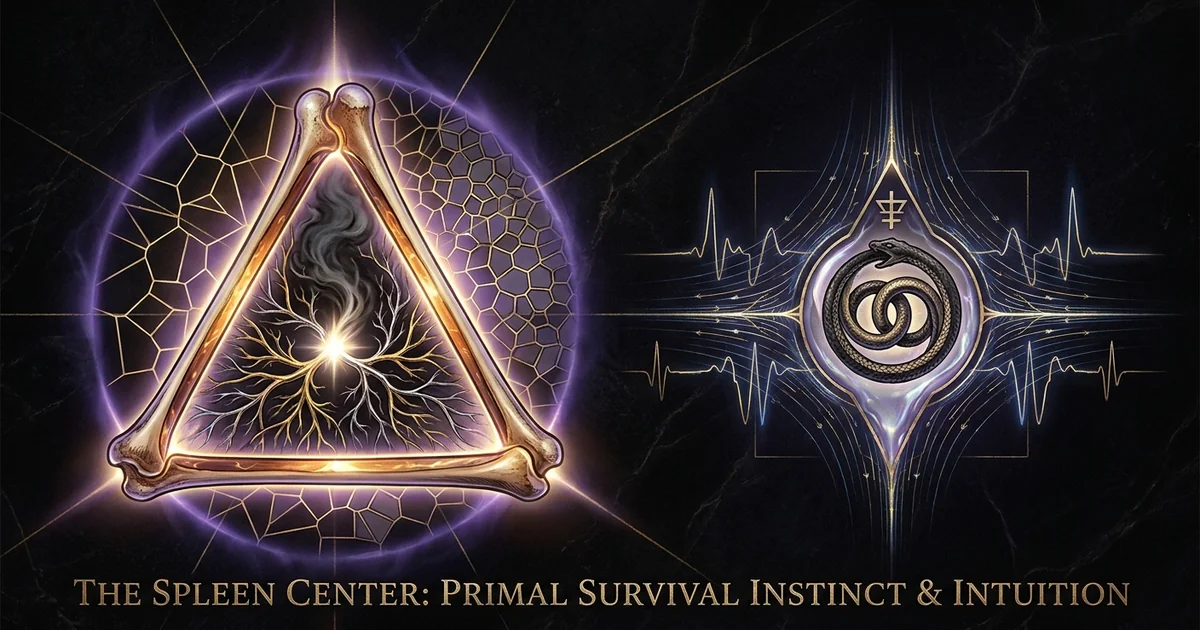
The Spleen Center: Primal Survival Instinct & Intuition
Archetypal Thesis & Systemic Paradigm: The Primal Architecture of Splenic Awareness
Phylogeny of Awareness: From Reptilian Brainstem to Lymphatic Vigilance
Within the architecture of the /human-design/nine-centered-bodygraph-mechanics, the Spleen Center represents the primary evolutionary foundation of consciousness. Long before the neo-cortical calculations of the /human-design/ajna-center-conceptual-mind codified prospective realities, and well before the Solar Plexus mutated into an undulating emotional awareness, the mammalian bodygraph relied on a singular, cold-blooded imperative: survival. This awareness center is not psychological, speculative, or synthetic. It is directly tied to the evolutionary biology of the reptilian brainstem, the enteric plexus, and the distributed lymphatic network.
The Spleen Center functions as the organism’s ancient surveillance platform, continuous with mammalian evolutionary heritage. The phylogenetic trajectory of awareness begins in the wet, chemical substrate of cellular integrity. While mental consciousness calculates possibilities and emotional consciousness rides a chemical wave of personal resonance, splenic consciousness operates purely via existential immediacy. It is an evolutionary continuum that stretches back to the earliest biological lifeforms discerning environmental toxicity from nutritive safety. In the human design matrix, this center is the biological seat of instinct, intuition, and taste—visceral modalities hardwired into the body to ensure that biological form endures long enough to reproduce and fulfill its differentiated purpose. The spleen center human design survival instinct intuition immunity nexus is thus not a conceptual metaphor; it is the raw mechanics of staying alive in a world governed by biological predation and environmental entropy.
The Present-Moment Paradox: Non-Repeating Somatic Computation
The core operational paradox of splenic awareness is its complete temporal boundness. The Spleen is exclusively existential; it operates strictly within the infinitesimal slice of the real-time now. It executes computations at a frequency that bypasses the cerebral cortex entirely. Because it exists to safeguard the immediate physical vehicle from instantaneous spatial-temporal hazards, its communications do not linger. The Spleen produces an ephemeral acoustic ping, an instinctive olfactory recoil, or a momentary visceral kinetic shudder.
Crucially, splenic awareness never repeats itself. If an individual fails to honor the subtle, instantaneous somatic ping delivered by the Spleen Center, the center does not amplify its voice, nor does it engage in dialectical debate with the mind. It operates once, dynamically updating in response to shifting environmental matrices. When the rational mind steps in to demand justification—asking why an exit must be made, why an individual feels unsafe, or why a pristine meal induces subtle revulsion—the window of genuine splenic awareness has already elapsed. Mental delay is often fatal to biological survival; hence, the Spleen computes, executes, and dissolves its warnings instantaneously. This distinguishes it structurally from the undulating frequency of the /human-design/solar-plexus-emotional-authority, which requires continuous cycles through time to distill experiential clarity.
Immunological Discernment: The Cellular Threshold Between Self and Non-Self
Biologically, the Spleen Center governs the lymphatic system, the white blood cell populations (macrophages, T-cells, B-cells), and the physical spleen. It represents the somatic threshold between self and non-self. At the molecular scale, survival is not an intellectual concept; it is an immunological interrogation. Every microsecond, the lymphatic network samples circulating fluids to distinguish host tissue from pathological antigens, toxic compounds, and cellular mutations.
[ Ambient Environment / Pathogen ]
               │
               ▼
[ Lymphatic Nodes & Macrophages ] ──► (Molecular Recognition)
               │
               ▼
[ Enteric & Autonomic Signaling ] ──► (Somatic Marker Activation)
               │
               ▼
[ Splenic Ping / Visceral Impulse ] ──► (Action: Aversion or Attunement)
This biological architecture informs the macrocosmic phenomenon of human instinct. Spontaneous survival consciousness is the macro-scale expression of microscopic immunological defense. When the immune system is overwhelmed, toxic non-self elements breach biological integrity, precipitating pathology. Similarly, when the splenic warnings of the BodyGraph are overridden by intellectual compromises or emotional dependencies, the individual permits destructive environmental conditions, parasitic social bonds, and toxic environments to invade their auric field. The physical health of the human vehicle and the integrity of its splenic discernment are identical systems expressed at different scales.
“The somatic-marker hypothesis posits that decision-making processes are critically assisted by covert, subcortical bioregulatory signals originating in visceral and vascular neural maps. These markers guide behavior prior to the engagement of conscious, propositional thought.” — Antonio Damasio, Descartes’ Error: Emotion, Reason, and the Human Brain (1994)
“Neuroception represents a neural process that enables humans and other mammals to engage in social and environmental risk assessment without conscious awareness. Subcortical structures evaluate the autonomic markers of safety, danger, and life threat, instantly configuring physiological state long before the neocortex forms a semantic narrative.” — Stephen W. Porges, The Polyvagal Theory: Neurophysiological Foundations of Emotions, Attachment, Communication, and Self-Regulation (2011)
Classical Provenance & Textual Lineage: Visceral Intelligence and I Ching Hexagrams
From the Yellow Emperor to the BodyGraph: Recontextualizing the Visceral Spirits
To comprehend the Spleen Center’s cartography, one must observe how ancient cosmological systems mapped visceral awareness. In Classical Chinese Medicine, as articulated in the Huangdi Neijing (The Yellow Emperor’s Classic of Medicine), the physical Spleen (Pi) is paired with the Stomach, assigned to the Earth element, and regarded as the seat of the Yi—the psycho-spiritual intent, ideation, and digestive transformation of both nourishment and thought. However, the Human Design BodyGraph realigns this topography. The intellectual aspect of processing form is situated in the Ajna Center, while the BodyGraph’s Spleen absorbs the defensive, alert, and instinctual functions that Classical Chinese Medicine largely distributed across the Zang-Fu organs: the defensive Wei Qi of the Lung, the instinctual will (Zhi) of the Kidneys, and the tactical assessment (Hun) of the Gallbladder and Liver.
This modern synthesis clarifies evolutionary biology within an esoteric coordinate system. By consolidating mammalian survival mechanics into a single somatic center, the BodyGraph reveals the unified nature of lymphatic surveillance, sensory discrimination, and existential fear. The classical Chinese concept of Wei Qi—the defensive energy circulating on the periphery of the body to repel exogenous pathogenic factors—serves as an exact functional analogue to the splenic auric shield that alerts the native to physical and psychic hazards in real time.
The Rave Biology Transcripts: Ra Uru Hu’s Synthesis of Immunological Mechanics
In his foundational 1998 lectures on Rave Biology, Ra Uru Hu explicated the empirical, somatic underpinning of the Spleen Center, explicitly detaching it from esoteric abstraction. He mapped the seven gates of the Spleen directly into the biochemical mechanisms of the human immune response. Rather than viewing intuition as an ethereal or spiritual visitation, Ra demonstrated that the Spleen Center functions as a liquid, acoustic sensory organ embedded within the intercellular matrix.
“The Spleen is our oldest awareness center. It is pure animal awareness. The splenic system is not mental. It does not think. It is an acoustic and lymphatic tracking mechanism that communicates through the water of the body. The white blood cells, the T-cells, the B-cells—they do not have meetings to discuss whether a foreign body is dangerous. They act instantly upon acoustic and chemical recognition. Gate 57 is the root of this entire center; it is the ear of the body, tuning into the vibration of the environment at a frequency that neocortical awareness cannot even hear. When the Spleen signals, the whole lymphatic architecture responds in a fraction of a microsecond. If you miss that ping, the mind takes over, and the survival advantage is lost.”
This biocentric perspective is vital for metaphysical investigators. Intuition is not a product of cognitive synthesis; it is the immediate somatic translation of biochemical and acoustic anomalies processed by the lymphatic system biology.
The Hexagrams of the Spleen: Archetypes of Fear, Values, and Preservation
The seven gates of the Spleen Center correspond to seven foundational hexagrams of the I Ching, as translated by Wilhelm and Baynes (1950). In the mechanics of the BodyGraph, each of these hexagrams represents an ontological survival fear transformed into an acute faculty of awareness:
[Gate 48: Hexagram 48 - The Well]       ──► Fear of Inadequacy (Depth)
[Gate 57: Hexagram 57 - The Gentle]     ──► Fear of the Future (Acoustic Intuition)
[Gate 44: Hexagram 44 - Coming to Meet] ──► Fear of the Past (Olfactory Instinct)
[Gate 50: Hexagram 50 - The Cauldron]   ──► Fear of Responsibility (Tribal Values)
[Gate 32: Hexagram 32 - Duration]       ──► Fear of Failure (Continuity/Adaptation)
[Gate 28: Hexagram 28 - Preponderance]  ──► Fear of Death/Purposelessness (Struggle)
[Gate 18: Hexagram 18 - Work on Decay]  ──► Fear of Imperfection (Correction)
Hexagram 57 (Sun, The Gentle, Wind) serves as the primary acoustic anchor of the Spleen. As Richard Wilhelm noted, the wind penetrates everywhere, subtle and invisible, exerting influence through imperceptible, persistent movement. In the BodyGraph, gate-57-gentle represents the archetypal root of intuition: the acute, sub-audible perception of environmental frequency. It is the capacity to hear underlying atmospheric disruptions, vocal inflections, and infrastructural cracks before physical manifestations crystallize. Through these seven hexagrams, primal human terror is mechanically transformed into the sophisticated tools of survival, communal preservation, and evolutionary adaptability.
Structural Mechanics & Symbolic Geometry: Circuitry, Gates, and the Anatomy of Survival
The Seven Splenic Gates: Ontological Fears and Instinctive Vectors
The Spleen Center’s internal architecture comprises seven distinct vectors, each responsible for transmuting a primal mammalian fear into a specific survival faculty. These gates dictate how the human form processes threat:
- Gate 48 (The Well - Fear of Inadequacy): Anchored in the Collective Understanding Circuit, this gate evaluates depth, technical mastery, and resource viability. Its underlying fear is that one lacks the foundational skills or tools to meet systemic demands. Transmuted, it yields instinctive taste and profound systemic solutions.
- Gate 57 (The Gentle - Fear of the Future): Operating as the acoustic core of the Individual Knowing Circuit, this gate processes clear auditory data. Its terror is the unknown trajectory of upcoming events. Transmuted, it generates instantaneous intuition that guides the physical vehicle safely through immediate environments.
- Gate 44 (Coming to Meet - Fear of the Past): Rooted in the Tribal Ego Circuit, Gate 44 tracks ancestral patterns, cellular memory, and tribal history. Its fear is that the deprivations, failures, or predators of the past will return to decimate the collective. Transmuted, it governs cellular instinct and olfactory recognition, discerning whether someone’s energetic frequency is healthy or predatory.
- Gate 50 (The Cauldron - Fear of Responsibility): The legislative core of the Tribal Defense Circuit, Gate 50 preserves the continuity of communal life. Its fear is that failing to assume responsibility will destabilize the vulnerable (the young, old, or sick). Transmuted, it establishes tribal values, ethical frameworks, and the distribution of care.
- Gate 32 (Duration - Fear of Failure): Positioned in the Tribal Ego Circuit facing the Root Center, Gate 32 monitors material continuity, economic change, and structural viability. Its terror is bankruptcy, material collapse, and the extinction of the line. Transmuted, it assesses what can safely transform versus what must remain preserved, identifying enduring value in personnel and systems.
- Gate 28 (Preponderance of the Great - Fear of Death and Purposelessness): A crucial component of the Individual Centering Circuit, Gate 28 engages with the boundary of mortal vulnerability. Its fear is that life will terminate before revealing subjective meaning. Transmuted, it recognizes which struggles are worth biological investment and unlocks the courage to confront danger for existential purpose.
- Gate 18 (Work on What Has Been Spoiled - Fear of Imperfection): Situated in the Collective Understanding Circuit, Gate 18 is the critical eye directed toward structural integrity. Its fear is that inherited corruption, human error, or systemic decay will invalidate the collective pattern. Transmuted, it generates the capacity for diagnostic correction, restoring corrupted matrices to balance.
Sensory Attunements Across Circuits: Taste, Smell, and Acoustic Intuition
Splenic intelligence does not perceive through a singular sensory modality; its mechanisms are differentiated across the primary bodygraph-circuitry streams.
[ Individual Circuitry ] ──► Acoustic Resonance (Gate 57) ──► Vibrational Frequency
[ Tribal Circuitry ]     ──► Olfactory Memory (Gate 44)   ──► Chemical Pheromones
[ Collective Circuitry ] ──► Critical Taste (Gate 48/18)   ──► Aesthetic & Pattern Scrutiny
In the Individual Circuitry, splenic awareness is fundamentally acoustic. Operating primarily through Gate 57, it monitors the micro-vibrations of sound, tone, and atmospheric resonance. It evaluates the integrity of an environment or an entity by the subtle harmonic frequencies embedded within the acoustic spectrum.
In the Tribal Circuitry, the Spleen operates through smell and chemical recognition. Governed by Gate 44 (the nose of the BodyGraph) and Gate 50, survival is dictated by pheromonal, immunogenetic compatibility. The phrase “I smell a rat” or the visceral revulsion to another individual’s biological scent is an unvarnished Tribal splenic computation. It determines who belongs to the tribe, who carries pathology, and who can be trusted to share the collective fire.
In the Collective Circuitry, splenic intelligence is expressed as taste and critical pattern evaluation. Gate 48 operates as the physiological and energetic palate, assessing whether an experience, concept, or substance is nutritious or toxic. Simultaneously, Gate 18 scans patterns for structural flaws, using an innate aesthetic and logical judgment to identify rot before it compromises the collective whole.
The Mechanics of Definition: Energetic Fixedness Versus Open Conditioning
The operational reality of the Spleen Center diverges completely depending on whether it is defined or undefined in the individual design.
Defined Spleen: Consistent Somatic Immunity
- Mechanics: Fixed, continuous internal immune protocol; consistently broadcasts somatic survival alerts through personal channels.
- Conscious Experience: Innate, unshakeable sense of bodily security, spontaneous timing, and physical self-trust.
- Pathological Shadow: False invulnerability; tendency to override physical warning signs, ignore minor infections, or remain oblivious to external toxicity until sudden somatic failure occurs.
Undefined/Open Spleen: Variable Somatic Sensitivity
- Mechanics: Porous, receptive lymphatic architecture lacking fixed survival protocols; directly samples, absorbs, and amplifies the ambient fears and biological frequencies of surrounding auras.
- Conscious Experience: Fluctuating physical vitality; susceptibility to sudden spikes of dread, hypochondria, and existential anxiety when navigating public or compromised spaces.
- Evolutionary Gift: Acute somatic diagnostic wisdom; capacity to accurately assess the physical health, energetic imbalances, and systemic safety of others when unattached to personal identification.
Psychological Dynamics & Operational Praxis: Navigating Splenic Authority and Deconditioning
Operating as a Splenic Being: Decoding the Spontaneous Somatic Ping
When the Spleen Center is defined and linked to the motor centers or Throat without interference from the emotional system, it acts as the primary inner guide: splenic-authority. Navigating life under Splenic Authority requires radical, moment-to-moment surrender to the body’s spontaneous survival intelligence.
[ Environmental Stimulus ]
                                            │
                                            ▼
                           [ Somatosensory / Lymphatic Input ]
                                            │
                                            ▼
                          [ Subcortical Alert (Splenic Ping) ]
                                            │
                       ┌────────────────────┴────────────────────┐
                       ▼                                         ▼
            [ Immediate Surrender ]                    [ Mental Interception ]
                       │                                         │
            [ Action / Relocation ]                    [ Rationalization Loop ]
                       │                                         │
           [ Somatic Homeostasis ]                     [ Pathological Clinging ]
Splenic Authority bypasses intellectual rationale. It does not provide reasons; it provides instantaneous vector modifications. A splenic command manifests as an immediate aversion, a sudden pivot away from an intended path, or an inexplicable revulsion toward an otherwise attractive proposition.
To honor Splenic Authority, an individual must be willing to abandon social expectations, conceptual consistency, and mental logic in real time. If the Spleen signals that a space is compromised, the native must exit without pausing to compose an acceptable social justification. If a Splenic being waits to rationalize the impulse, the rational mind will dismantle the warning through logic, exposing the physical vehicle to harm. Cultivating Splenic Authority is a discipline of radical subcortical obedience.
The Not-Self Strategy: Clinging to What Is Not Good for You
The undefined Spleen Center experiences deep psychological and behavioral conditioning (undefined-spleen-conditioning). Because an open Spleen lacks a fixed internal sense of security and physical well-being, it experiences immediate relief when entering the aura of a person with a defined Spleen. The defined Spleen acts as an energetic stabilizer, temporarily grounding the open Spleen’s ambient anxiety and projecting an intoxicating sense of safety and health.
Consequently, the core Not-Self strategy of the undefined Spleen is: holding on to what is fundamentally detrimental.
This dynamic manifests in:
- Chronic retention of abusive, dead, or parasitic relationships purely for the physiological comfort of the partner’s auric security.
- Retention of toxic professions, hazardous living environments, and debilitating habits because the familiar terror of the known feels safer than the visceral dread of the open void.
- Clinging to outdated medicines, dietary regimens, and psychological frameworks that compromise the vehicle’s vitality.
The open Spleen becomes addicted to the auric anesthesia provided by defined others. The native misidentifies this borrowed immune stability as love, loyalty, or belonging, remaining bound in dynamics that steadily degrade their health.
Deconditioning Protocols: Reclaiming Autonomic Sovereignty from Intellectual Tyranny
Deconditioning the undefined Spleen is a process of somatic differentiation. The native must understand that the fears coursing through their autonomic nervous system rarely belong to them. When an open-splenic individual experiences a sudden spike of survival dread, panic regarding the future, or an urgent impulse to secure their material position, the foundational question must be: Is this fear mine, or am I amplifying the survival panic of the surrounding environment?
Deconditioning protocols require the native to:
- Sleep in Unbroken Auric Spaces: The open Spleen must regularly evacuate other human auric fields (maintaining a minimum distance of two arm-lengths or separate rooms) to allow the lymphatic architecture and enteric nervous system to discharge absorbed stress patterns.
- Cultivate Somatic Detachment: When sudden fear arises, the individual must train the intellect to observe the biological sensations—elevated pulse, adrenal surge, visceral tightening—without immediately transmuting them into narratives or taking reactive physical actions.
- Release False Loyalties: Systematically audit relationships and commitments to identify where the native remains out of fear of losing safety. The open Spleen must learn to abide in existential groundlessness, recognizing that its biological vulnerability is not a structural defect, but a diagnostic receptor.
Philosophical Synthesis & Macrocosmic Correspondence: Hermetic Vigilance and Somatic Teleology
The Principle of Correspondence: Microscopic Antigen Recognition and Macrocosmic Fate
The Hermetic axiom As above, so below; as within, so without finds its concrete, biological validation in the Spleen Center. The microscopic warfare executed within the lymph nodes directly mirrors the native’s capacity to navigate existential hazards in the macroscopic world.
       [ Microcosm: Lymphatic System ]          [ Macrocosm: Auric Architecture ]
 Macrophage Phagocytosis (Antigen Destruction) ◄──► Auric Repulsion of Toxic Entities
 Cellular Self vs. Non-Self Discrimination     ◄──► Intuitive Sorting of Relationships
 Adaptive Antibody Production                  ◄──► Transmutation of Fear into Mastery
An individual whose cellular immune apparatus is perpetually suppressed by chronic inflammation, environmental toxins, and systemic stress will inevitably exhibit degraded intuitive discernment. Their capacity to recognize macrocosmic danger is systematically blunted. Conversely, an individual who honors splenic timing cultivates a finely calibrated biological radar. The immune cells and the macrocosmic navigational apparatus operate as a single, indivisible defensive intelligence, ensuring that the physical vehicle remains situated in environments that support its genetic purpose.
The Economy of Fear: Transmuting Primal Terror into Existential Presence
Within modern culture, fear is widely pathologized as a psychological aberration to be subdued, bypassed, or medicated into silence. Human Design dismantles this conceptual error by restoring fear to its rightful evolutionary status: fear is the indispensable, intelligent precursor to awareness.
Without the foundational fears of the seven splenic gates, mammalian life would perish instantly under environmental pressures. Fear is the biological currency of preservation:
- The fear of the future (Gate 57) generates exquisite acoustic attunement.
- The fear of inadequacy (Gate 48) drives the development of mastery and depth.
- The fear of the past (Gate 44) preserves vital cultural and biological memory.
- The fear of failure (Gate 32) preserves material and structural continuity.
When these fears are experienced through the spontaneous survival consciousness of the present moment, they are not neuroses; they are clean somatic cues. The sickness of modern consciousness emerges when the rational mind intercepts these cues, detaches them from real-time environmental stimuli, and constructs chronic narratives of dread. Splenic awareness liberates the native from anxiety by metabolizing raw biological terror into instantaneous presence.
The Biological Bodhisattva: Cultivating the Diagnostic Spleen in the Open Form
When an undefined Spleen Center completes its deconditioning process, it ceases to function as a reservoir of amplified fear and transforms into a clear diagnostic instrument. The open Spleen possesses an unparalleled capacity to feel, identify, and understand the health, illnesses, and systemic pathologies of others.
This is the emergence of the “Biological Bodhisattva.” The open Spleen, completely unattached to personal security, moves through the collective world with absolute physical receptivity. It registers the exact point where another organism is breaking down, where an organization’s values have decayed, or where an environment is harboring toxicity. It does not absorb these states as an identity; it samples them as informational data. In this mature, differentiated state, the open Spleen realizes its evolutionary potential: serving as an objective, non-reactive mirror for the physical health of the collective form.
| Gate | I Ching Hexagram | Amino Acid Codon | Circuit Stream | Sensory Modality | Transmuted Fear |
|---|---|---|---|---|---|
| 18 | Hexagram 18 (Work on Decay) | Alanine | Collective Understanding | Visual/Pattern Taste | Correction of structural corruption |
| 28 | Hexagram 28 (Preponderance) | Asparagine | Individual Centering | Visceral Kinetic | Recognition of existential purpose |
| 32 | Hexagram 32 (Duration) | Isoleucine | Tribal Ego | Tactile/Material Instinct | Preservation of viable resources |
| 44 | Hexagram 44 (Coming to Meet) | Glutamic Acid | Tribal Ego | Olfactory Instinct | Historical/Cellular discrimination |
| 48 | Hexagram 48 (The Well) | Alanine | Collective Understanding | Gustatory/Taste Depth | Application of practical mastery |
| 50 | Hexagram 50 (The Cauldron) | Phenylalanine | Tribal Defense | Somatosensory Value | Preservation of tribal integrity |
| 57 | Hexagram 57 (The Gentle) | Alanine | Individual Knowing | Acoustic Intuition | Penetrating present awareness |
Frequently Asked Questions: Advanced Mechanics of the Splenic Consciousness
Distinguishing Splenic Intuition from Emotional Turbulence and Mental Anxiety
A central mechanical challenge in human praxis is the accurate phenomenological differentiation between splenic intuition, mental anxiety, and the emotional wave. These three awareness centers register within the conscious vessel with distinct signatures, temporal flows, and physiological manifestations:
[ Center ]        [ Temporal Signature ]       [ Somatic Mechanics ]
Ajna Center   ──► Prospective / Continuous ──► Mental tension, conceptual loops, rationalization
Solar Plexus  ──► Undulating Wave Patterns ──► Visceral chemical surges, moods, emotional charge
Spleen Center ──► Instantaneous / Fleeting ──► Subtle acoustic ping, physical recoil, quiet alert
The Ajna Center produces mental anxiety. It operates prospective calculations, debates possibilities, projects hypothetical futures, and produces verbal rationalizations. It speaks loudly, continually cycling through arguments: What if this occurs? What is the contingency plan? Mental anxiety is discursive, anxious, and perpetual.
The Solar Plexus Center produces emotional turbulence. It operates mechanically via a biochemical, undulating wave governed by neurotransmitters, hormones, and systemic cycles. It carries emotional charge: euphoria, melancholy, passion, and dread. Emotional awareness contains no present-moment certainty; it requires experiential immersion across time to distill clarity.
The Spleen Center produces instantaneous intuition. It carries zero emotional charge, never offers rational explanations, and speaks at the dynamic volume of a whisper. It does not argue, debate, or explain. It communicates through a sudden, cold kinetic certainty, an acute physical flinch, a quiet acoustic knowing, or an instinctive aversion. It arrives unbidden in the present microsecond, delivers its verdict once, and dissolves. If an internal voice is explaining why something is dangerous, that is the Ajna mind. If an internal impulse is accompanied by a swell of passion or emotional panic, that is the Solar Plexus. If the awareness is cold, quiet, immediate, and free of conceptual justification, it is the voice of the Spleen.
The Mechanical Vulnerabilities of the Undefined Spleen in Auric Proximity
When an individual with an undefined Spleen Center steps into the auric perimeter of someone with a defined Spleen, a profound energetic and physiological conditioning occurs. The defined Spleen constantly broadcasts a consistent, fixed immune and intuitive frequency. To the undefined Spleen, this frequency acts as a biological tonic. The diffuse, porous lymphatic network of the open-splenic being is suddenly anchored by the defined auric field, generating a sensation of physical vitality, safety, and systemic grounding.
The primary mechanical vulnerability of this dynamic is the loss of somatic autonomy. The undefined Spleen feels physically stronger, more secure, and less anxious simply by standing near the defined Spleen. Consequently, the open Spleen easily becomes trapped within the gravitational pull of individuals who are structurally unhealthy, toxic, or dangerous for them. The open Spleen confuses the sensation of borrowed biological stability with personal safety and relational correctness.
Furthermore, when this auric contact is broken, the open-splenic individual experiences a rapid drop in biological security, which often presents as acute somatic dread or hypochondria. To mitigate this vulnerability, the undefined Spleen must refuse to outsource its authority to this feeling of borrowed comfort, recognizing that the feeling of safety is an auric artifact rather than a clean indicator of alignment.
Splenic Hits Over Non-Physical Distance: Aura, Electromagnetic Fields, and Space
A critical question in contemporary metaphysical cartography is whether splenic awareness functions across non-physical distances, digital communications, and disembodied vectors. The mechanical answer, rooted in the evolutionary physics of the BodyGraph, is unequivocal: true splenic awareness operates strictly within the physical auric field, which extends approximately two arm-lengths in every direction from the physical vehicle.
Because the Spleen Center is biological, lymphatic, and acoustic, its computational apparatus relies on subtle, physical sensory inputs:
- Real-time acoustic variations in the micro-environment.
- Airborne chemical signaling via pheromones and volatile compounds.
- Direct electromagnetic interactions between physical bodies.
When humans communicate over digital networks, cellular phones, or teleconferencing platforms, the primary somatic triggers of the Spleen are mechanically severed. Digital communication strips away the pheromonal signatures processed by Gate 44, compresses and distorts the acoustic overtones needed by Gate 57, and completely eliminates the living energetic exchange of the lymphatic fields.
What individuals frequently characterize as a “splenic hit” over a digital connection is usually mental pattern-recognition from the Ajna Center or an empathetic emotional wave through the Solar Plexus. Splenic survival awareness is localized, somatic, and immediate. It is designed to navigate the living terrain of the physical world, maintaining the integrity of the living human form in real time, in physical space, and nowhere else.