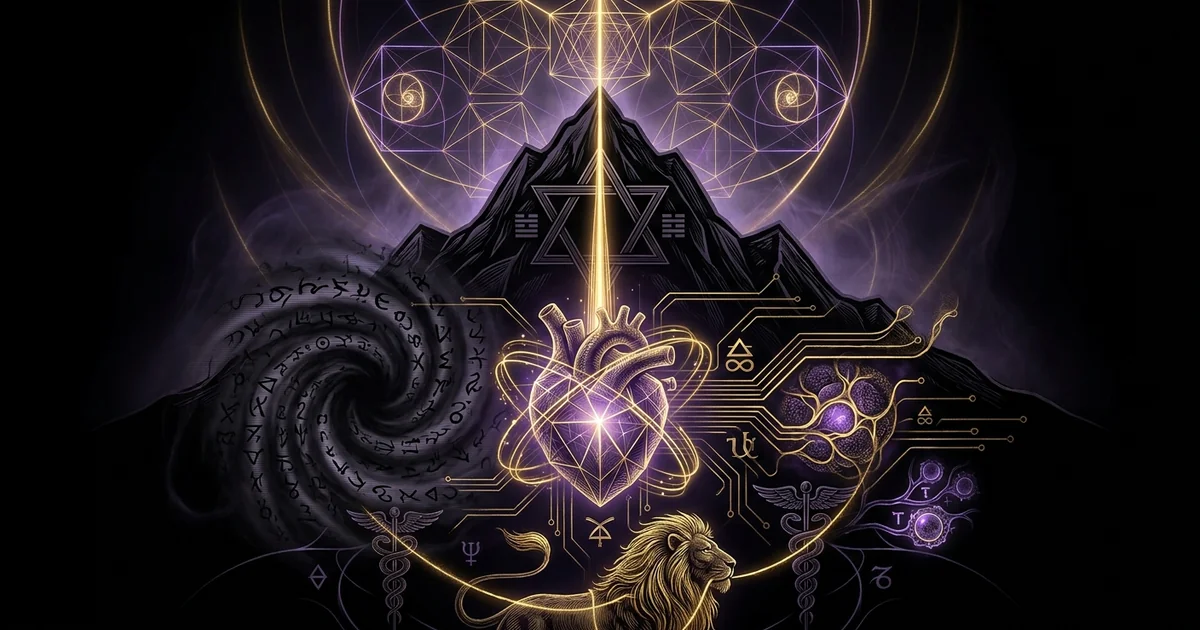
Human Design Gate 26 (The Taming Power of the Great):
Archetypal Thesis & Systemic Paradigm: The Energetic Capacitor of Tribal Consciousness
Human Design Gate 26 (The Taming Power of the Great), situated within the biological infrastructure of the heart-ego-center, functions as an energetic capacitor that regulates tribal survival through thermodynamic efficiency and informational distillation. Operatively linked via the Channel of Surrender (44–26) to the splenic memory archive, gate 26 energetics transmute raw historical instinct into marketable transmission, utilizing the minimum expenditure of kinetic will to achieve maximal evolutionary impact. By contrasting its tribal conservation mechanisms against the pressure dynamics of the Head Center and the cycles of collective abstract circuitry, Hexagram 26 emerges as the master regulator of institutional memory, persuasion, and metabolic integrity.
                  HEXAGRAM 26: DA CHU (THE TAMING POWER OF THE GREAT)
                                  Upper: Gen (Mountain, Stillness)
                                  ▅▅▅▅▅▅▅
                                  ▅▅   ▅▅
                                  ▅▅   ▅▅
                                  Lower: Qian (Heaven, Creative Force)
                                  ▅▅▅▅▅▅▅
                                  ▅▅▅▅▅▅▅
                                  ▅▅▅▅▅▅▅
Thermodynamic Efficiency and the Ego Center
The Heart (Ego) Center is not an engine of continuous, generative kinetic output. Unlike the Sacral Center, which operates as an inexhaustible vortex of reproductive and mechanical energy, the Ego Center is an intermittent, motoric pump operating on finite reserves of metabolic fuel. In the topological map of the BodyGraph, Gate 26 sits as the outward-facing aperture of this metabolic engine, facing the Splenic awareness system. Its primary systemic function is not the relentless execution of physical work, but the conservation of energy through strategic leverage. Gate 26 operates on a strict economic equation: minimal kinetic effort yielding maximal material yield. It represents the evolutionary triumph of intellectual and tactical posturing over raw brute labor.
Within tribal-ego-circuitry, the survival of the kinship group demands that resources are not squandered in futile combat or endless agrarian toil when psychological dominance or clever negotiation can secure the same survival thresholds. Here, Gate 26 acts as a capacitor, charging its biological battery during long stretches of apparent indolence, only to discharge its concentrated willpower at the precise historical inflection point where the transaction matters most. This metabolic rhythm explains why individuals with an activated Gate 26 demonstrate an innate aversion to unnecessary physical exertion; to the uninitiated observer, this biological conservation appears as lethargy, yet it constitutes a sophisticated thermodynamic strategy designed to prevent cardiovascular and immune exhaustion.
The mechanics of this gate govern the boundary conditions between internal biological reserve and external tribal utility. When the tribe requires defense, trade, or expansion, Gate 26 steps forward to command the exchange, relying on its reputation, its linguistic dexterity, and its perceived strength. The mechanical architecture of the Heart Center demands rest cycles; without systemic periods of biological recalibration, the motor collapses. Thus, Gate 26 does not work; it negotiates, it contracts, it packages, and it transmits, ensuring that the material vessel remains intact while securing the collective continuity of the genetic line.
The Transmutation of Physical Force into Symbolic Capital
The true evolutionary genius of Gate 26 lies in its capacity to convert physical vulnerability into symbolic authority. Survival in ancestral environments was dictated by caloric intake versus caloric burn. The organism that expended four thousand calories to secure three thousand calories of nutrition faced systemic extinction. Gate 26 emerged as the genetic answer to this thermodynamic deficit: by mastering the semiotic realm, it learned to substitute the display of strength for the actual exertion of strength. This is the origin of marketing, diplomacy, statecraft, and brand identity.
Through its integration with the Splenic stream of instinct, Gate 26 accesses the historical ledger of what has preserved or threatened the lineage across deep time. It packages this raw archival intuition into myth, propaganda, salesmanship, and institutional creed. Instead of going to war, Gate 26 asserts an intimidating narrative of invulnerability that convinces the adversary to surrender without conflict; instead of laboring manually in the fields, it negotiates the terms of the harvest, capturing surplus value through administrative and rhetorical manipulation.
This systemic transmutation is reflected in the classical designations of this gate across esoteric literature. Ra Uru Hu explicitly classified Gate 26 as the “Gate of the Egoist,” an appellation often misunderstood through moralistic lenses. The egoism of Gate 26 is not a psychological defect, but an evolutionary requirement: it is the unapologetic assertion of individual and tribal sovereignty over material conditions. It asserts the value of the self and the tribe, demanding that the environment yield its riches in exchange for the intangible capital of vision, security, and organizational leadership.
“Heaven within the mountain: The image of the taming power of the great. Thus the superior man acquaints himself with many sayings of antiquity and many deeds of the past, in order to strengthen his character thereby… A creative power is held back by a keeping still; this produces a great accumulation of power. It is a question of a firmly established creative power that is held back by a resting force, and thus attains great firmness and endurance.” — Richard Wilhelm and Cary F. Baynes, The I Ching or Book of Changes (Bollingen Series XIX, 1950).
Systemic Resistance and the Vector of Surrender
The energetic dynamic of Gate 26 cannot be understood in isolation; it exists in perpetual tension with the Splenic Center across the channel-of-surrender. The splenic gate, Gate 44, senses the threat of the past—ancestral debt, genetic vulnerability, and the terror of extinction. Gate 26 takes this existential splenic dread and neutralizes it through the medium of the contract. The vector of surrender within this channel is twofold: it represents both the tribe’s surrender to the material authority of the Ego, and the Ego’s surrender to the spontaneous, non-rational intelligence of the Spleen.
When operating correctly within its mechanical constraints, Gate 26 does not invent narratives out of thin air; it surrenders its deliberate, calculated willpower to the cellular instinct of Gate 44. This alignment dissolves systemic resistance within the tribal matrix. Persuasion ceases to be a clumsy act of coercion and becomes an inevitable transmission of evolutionary truth. The resistance that an individual encounters when attempting to manifest or sell arises when Gate 26 acts disconnected from the Spleen, attempting through brute mental intention to force outcomes that have no backing in ancestral memory or current physical viability.
In the broader context of the Rave BodyGraph, Gate 26 stands as the final barrier before resource distribution. It is the gatekeeper of the tribal treasury. It resists any external demand that does not guarantee an adequate return on energetic investment. This refusal to yield to unreciprocated demands is its evolutionary mandate. It protects the heart from catastrophic depletion, refusing to commit its limited motoric pulses to any endeavor that fails to elevate the material status, health, or territorial security of the tribal collective.
Classical Provenance & Textual Lineage: From Zhouyi Divination to BodyGraph Epistemology
The systemic roots of human design gate 26 the taming power of the great anchor directly into the deep strata of ancient Chinese mantic traditions, specifically the Zhouyi. To decipher its operational mechanics in modern somatic cartography, one must trace the structural morphology of its constituent trigrams, historical commentaries, and metaphysical evolution over three millennia.
                    HEXAGRAM GEOMETRY & TRIGRAM DYNAMICS

                       ▅▅▅▅▅▅▅  Line 6 (Yang): The Way of Heaven
        Upper: Gen     ▅▅   ▅▅  Line 5 (Yin): The Tamed Boar's Tusk
       (Mountain)      ▅▅   ▅▅  Line 4 (Yin): The Headboard of the Bull
      ─────────────────────────────────────────────────────────────
                       ▅▅▅▅▅▅▅  Line 3 (Yang): Good Horse Follows
        Lower: Qian    ▅▅▅▅▅▅▅  Line 2 (Yang): Axletrees Removed
        (Heaven)       ▅▅▅▅▅▅▅  Line 1 (Yang): Obstacle Confronted
The Zhouyi Hexagram 26: Mountain over Heaven (Gen over Qian)
The hexagram structure of Da Chu (大畜) presents a fascinating geometric paradox: the trigram Gen (Mountain, Stillness) sits atop the trigram Qian (Heaven, Pure Creative Energy). In classical cosmogony, Heaven represents the boundless, upward-rushing kinetic drive of pure Yang. It is relentless, potent, and fundamentally uncontained. Mountain, by contrast, represents the ultimate principle of immobility, boundary, and the cessation of motion. In Hexagram 26, the mountain does not merely block Heaven; it encloses it, contains it, and forces that vast cosmic vitality into structural containment.
This architecture reveals the mechanics of “taming.” The great is not destroyed, diminished, or suppressed; rather, it is corralled, concentrated, and stored within the subterranean vaults of the mountain. In the King Wen sequence, Hexagram 26 immediately follows Hexagram 25 (Wu Wang - Innocence / The Unexpected), indicating that after the spontaneous, uncalculated manifestations of pure action have occurred, civilization requires the deliberate accumulation and consolidation of power. In ancient China, this hexagram was tied to the ritual domestication of dangerous beasts—wild bulls and fierce boars—signifying the technology by which wild, catastrophic natural forces are channeled into domesticated, productive instruments of statecraft.
The King Wen sequence systematically unfolds this containment across the six lines. The lower trigram Qian shows the creative impulse attempting to charge forward, only to be systematically checked and redirected by the mountain’s immovable architecture:
- Line 1 (Yang): Confronts the initial obstacle, recognizing that uncalculated advancement invites disaster.
- Line 2 (Yang): The carriage detaches its axletree; kinetic drive voluntarily surrenders its momentum.
- Line 3 (Yang): The energy is refined through disciplined training, walking alongside a noble steed.
- Line 4 (Yin): The headboard is placed upon the young bull’s brow; destructive instinct is prevented before it can manifest.
- Line 5 (Yin): The tusk of a castrated boar; aggressive force is neutralized at the root, transforming a lethal threat into domestic peace.
- Line 6 (Yang): The mountain opens to reveal the heavenly path itself; containment reaches its teleological climax, where total restraint becomes effortless, sovereign authority.
Historical Codification: From Rulers’ Grain Stores to Mercantilism
Historically, Hexagram 26 was directly associated with the grand grain elevators, state storehouses, and strategic reserves maintained by the Zhou rulers. The ability of an imperial sovereign to rule was contingent upon the physical accumulation of grain, dried meat, weapons, and silver. In times of drought or external siege, the kingdom that lacked storage perished. The taming power of the great was thus synonymous with the capacity to delay gratification—to halt immediate consumption in favor of long-term strategic resilience.
As Chinese civilization shifted from early agrarian monarchies toward sophisticated merchant economies during the Warring States period and the subsequent Song dynasty, the interpretation of Da Chu expanded to encompass commerce, logistics, and rhetorical diplomacy. The stored grain of the ancient rulers evolved into the merchant’s working capital, the diplomat’s reservoir of precedent, and the scholar’s exhaustive mastery of classical aphorisms. The text of the Image specifically highlights this transition: “The superior man acquaints himself with many sayings of antiquity and many deeds of the past, in order to strengthen his character thereby.”
The historical codification of this hexagram demonstrates that true authority does not stem from immediate reaction, but from historical literacy and resource retention. The individual who possesses Gate 26 retains the cultural archive, knowing precisely which historical levers to pull in the present moment to influence the decisions of the marketplace. This historical shift mirrors the transition within the Human Design BodyGraph from primal biological survival to the sophisticated manipulation of trade networks, branding, and tribal alliances.
The mechanical tension between Trigram Gen (☶, Mountain, Keeping Still) and Trigram Qian (☰, Heaven, The Creative) embodies the core psychodynamic of Gate 26:
- Upper Trigram Gen (Somatic Boundary): Enforces conservation, spatial limits, strategic patience, and the capacity to say “no” to wasteful kinetic expenditures.
- Lower Trigram Qian (Volitional Drive): Supplies the boundless engine of Yang willpower, raw ambition, and the hunger to dominate the material plane.
- Systemic Synthesis: Qian provides the intense pressure of personal ego and willpower, while Gen restrains this fire within structural bounds, producing the tactical mastery necessary for long-range material victory.
The Synthesis of Rave Cosmogony and Hermetic Transmission
When Ra Uru Hu synthesized the I Ching within the Rave BodyGraph under the auspices of the 1987 voice transmission, Hexagram 26 underwent an epistemic shift into mechanical biophysics. It was anchored specifically into the Heart Center, aligned with the Codon Ring of Light, and designated as the definitive mechanism for the transmission of tribal memory. Ra emphasized that Gate 26 is inherently manipulative—not in a pejorative moral sense, but in the mechanical sense of shaping, packaging, and delivering information to ensure tribal coherence and survival.
This modern transmission recontextualizes the Hermetic maxim of solve et coagula—dissolve and coagulate. Gate 26 takes the dissolved, intuitive, transient fear-frequencies of the Splenic Center (Gate 44) and coagulates them into durable forms: contracts, advertisements, dogmas, and promises. It functions as the metaphysical merchant who stands at the crossroads between the unseen, primal terrors of the void and the structured, legalistic realities of material civilization.
Through this Rave epistemological lens, Hexagram 26 is stripped of traditional Confucian moralizing. The ancient text’s admonition to “not eat at home” and that “it is advantageous to cross the great water” translates mechanically into the operational truth of the Heart Center: Gate 26 must step out of purely domestic, self-absorbed spheres to engage the public sphere. It must direct its salesmanship, its strategic reserves, and its executive authority outward toward the broader world to draw resources back into the tribal domain.
Structural Mechanics & Symbolic Geometry: Circuitry, Anatomy, and Biological Vectors
Within the architectural topography of the Rave BodyGraph, human design gate 26 the taming power of the great operates as a bridge between the motoric will of the Ego and the primal, sensory intelligence of the lymphatic-splenic infrastructure. To master its mechanics requires mapping its circuitry, cellular biology, and systemic vectors.
Channel 44–26 (The Channel of Surrender: Design of a Transmitter)
Gate 26 joins with Gate 44 (Coming to Meet) to form the Channel of Surrender, formally subtitled “The Design of a Transmitter.” This channel represents the primary marketing and management pathway of the tribal defense system. Gate 44 sits in the Spleen, operating through the olfactory sense—the capacity to “smell” what is safe, who is trustworthy, and what past patterns threaten the tribe’s survival. It is the repository of ancestral lineage memory, carrying an instinctual terror of physical failure, poverty, and biological collapse.
Gate 26 receives this pre-rational, olfactory data from Gate 44 and translates it into acoustic, visual, and conceptual frameworks that can be transmitted across the tribal matrix. If Gate 44 senses an ancient genetic danger, Gate 26 constructs the insurance policy, the firewall, or the defense treaty to mitigate it. If Gate 44 smells an opportunity for material prosperity in an alliance, Gate 26 drafts the contractual language, delivers the pitch, and closes the transaction. This dynamic is mapped directly through the mechanics of the /human-design/channel-44-26-surrender.
The term “surrender” in this channel refers to the evolutionary necessity of the Ego to yield to instinct. The Heart Center, driven by the personal ego’s desire to prove itself, can easily succumb to delusions of omnipotence. However, when paired with Gate 44, the transmitter must surrender its personal agenda to the survival needs of the collective lineage. Persuasion achieves structural efficacy only when the transmitter sells what is genuinely healthy and viable for the organism.
Biological Resonance: The Thymus Gland, T-Cells, and Immune Sovereignty
The somatic mapping of the Rave BodyGraph assigns Gate 26 to the thymus gland, situated within the anterior superior mediastinum, resting directly behind the sternum. The thymus is the immunological heart of the human organism, serving as the specialized maturation academy for T-lymphocytes (T-cells). These cells are responsible for cell-mediated immunity—the critical biological capacity to distinguish between “self” and “non-self,” neutralizing foreign pathogens, viruses, and mutant cellular growths that threaten the organism’s structural integrity.
IMMUNOLOGICAL & SOMATIC CORRESPONDENCE
            [ Thymus Gland / Retrosternal Space ]
                           │
           ┌───────────────┴───────────────┐
           ▼                               ▼
   [ T-Cell Maturation ]          [ Somatic Boundary ]
   Distinguishes "Self"            Enforces Energetic Sovereignty:
   versus "Non-Self"               Regulates What Enters the Body
           │                               │
           └───────────────┬───────────────┘
                           ▼
        [ Heart-Ego Center Metabolic Gatekeeper ]
        Cardiovascular Protection via Strategic Rest</code></pre>
This biological resonance illuminates the operational mechanics of Gate 26. Just as the thymus trains T-cells to identify, engage, or tolerate molecular configurations, Gate 26 acts as the behavioral and social immune system of the tribe. It determines which outsiders are admitted to the clan and which must be repelled; which commercial propositions are biologically sustainable and which represent toxic liabilities. Gate 26 is the ultimate somatic gatekeeper of /human-design/heart-ego-center-mechanics.
When an individual’s Gate 26 is subjected to chronic conditioning—compelled to work relentlessly without rest, or forced to defend continuous, unaligned promises—the biological toll registers directly upon the thymus-cardiovascular axis. Chronic stress downregulates thymic hormone production, accelerating thymic involution and leaving the physical body vulnerable to autoimmune disorders or infectious decline. The physical health of Gate 26 is contingent upon its ability to maintain its boundaries, execute its willpower in short, devastating bursts, and retire behind its mountain of rest to allow its immunological defenses to replenish.
Differential Circuit Dynamics: Tribal Ego vs. Collective Abstract Circuitry
To comprehend the specialized operation of gate 26 energetics, it is essential to map its systemic differentiation from the adjacent streams of the BodyGraph, particularly the collective abstract circuitry. The tribal ego stream, within which Gate 26 is embedded, operates on a closed feedback loop of mutual obligation: “You scratch my back, I scratch yours.” It is not interested in universal truths, global human rights, or abstract experiences for the sake of learning. It is concerned with the immediate support and material survival of the bloodline.
In stark contrast, the collective abstract stream (such as the Sensing Circuit governed by the Channel of Mutation and channels like 35–36 or 64–47) moves through evolutionary spirals of desire, crisis, and experiential reflection, as explored in the /human-design/collective-abstract-circuitry-overview. The abstract collective seeks to expand human experience across the species through cycles of trial and error; it welcomes crisis as the catalyst for philosophical wisdom.
Gate 26 rejects unnecessary crisis. It evaluates proposals through a binary lens of material return on investment (ROI). It does not engage in an endeavor to discover universal philosophical truths, but to secure concrete resources, protect territory, and maximize metabolic leverage. Where the collective abstract circuit surrenders to the chaos of the experiential river, Gate 26 builds the dam, measures the water pressure, and charges a toll to anyone seeking passage.
Circuitry Contrast: Tribal Conservation versus Abstract and Mental Streams
The functional distinction between Gate 26 and other systemic pressure vectors within the BodyGraph must be analyzed with clinical rigor. Most structural dysfunctions in human behavior occur when mental or experiential circuits co-opt the limited, highly specific motoric resources of the Heart Center.
Tribal Ego Circuitry (Gate 26 / Channel 44–26)
- Energetic Fuel: Intermittent motoric willpower; finite metabolic bursts requiring cyclical, recuperative rest.
- Core Driver: Tribal preservation, material accumulation, physical security, resource dominance, and biological lineage continuity.
- Relationship to Time: Opportunistic and contractual; leverages ancestral memory to extract maximum immediate and future material security.
- Vulnerability / Shadow: Manipulation, unprincipled salesmanship, megalomania, broken promises, cardiovascular collapse, and thymic exhaustion.
Collective Abstract Circuitry (Channel 35–36 / Sensing)
- Energetic Fuel: Emotional wave dynamics; cycles of surging hormonal desire shifting into emotional exhaustion and crisis.
- Core Driver: Experiential exploration for the whole of humanity; collection of historical narrative; learning through subjective trial and error.
- Relationship to Time: Cyclic and retrospective; driven forward by anticipation of future experience, processed only through post-crisis reflection.
- Vulnerability / Shadow: Chronic emotional instability, perpetual dissatisfaction, seeking crisis for its own sake, existential disillusionment.
Energetic Economy: The Heart Center versus the Head Center Pressure
A core mechanical error observed in holistic analysis is the conflation of the mental pressure originating in the Head Center with the motoric capacity of the Heart Center. The Head Center (housing the Pineal and cortical pressure networks) operates through fuel-less inspiration. Its pressure is epistemic, demanding resolution to doubt, confusion, or mystery. When this mental pressure bypasses operational Strategy and Authority to drive the physical vehicle, it inevitably commands the Heart Center to prove something.
Gate 26 does not exist to solve intellectual puzzles or placate cortical anxieties. When a person with an activated Gate 26 allows their mind to dictate their life, the mind weaponizes the Ego’s inherent will-to-power, driving the vehicle into endless commitments designed to prove its intellect, value, or capability. The Head Center cannot run out of ideas; the Heart Center, however, can run out of heartbeats. The biological heart muscle, the coronary arteries, and the thymus gland pay the physical price for this mental hubris.
Gate 26 energetics are calibrated to reject theoretical cogitation unless that cogitation serves an immediate, tangible function for the tribe’s survival. The mountain (Trigram Gen) over Heaven (Trigram Qian) provides the definitive template: the restless mental sky must be checked by somatic stillness. Gate 26 waits in silence until the Splenic instinct sounds an alert; only then does its willpower fire, delivering its persuasive power with absolute precision, entirely divorced from the noisy anxieties of the mental plane.
Experiential Desire versus Tribal Survival: Contrasting the Abstract Stream
The tension between Gate 26 and the collective abstract stream highlights the fundamental dialectic of human civilization: the clash between institutional conservation and the drive for novel experience. The abstract stream, fueled by the Solar Plexus, is driven by hunger—hunger for change, for emotional depth, for the novel encounter that deepens the collective human story. This stream accepts poverty, suffering, and crisis as acceptable costs for the realization of experiential progress.
Gate 26 views this appetite with deep biological suspicion. To the conservative, taming architecture of Hexagram 26, the pursuit of novelty for its own sake represents a dangerous expenditure of tribal reserves. The abstract stream asks: “What new world can we discover?” Gate 26 asks: “How much will the expedition cost, who is financing the provisions, what is our percentage of the cargo, and will our people survive the voyage?”
This conflict is played out daily in corporate boardrooms and governance councils. The creative visionaries of the abstract circuitry present expansive projects designed to revolutionize human culture; the Gate 26 executive listens with an impassive countenance, checking the axletree of the carriage (Line 2), evaluating the contractual liabilities, and declining to invest tribal willpower until the venture demonstrates structural viability and a concrete yield.
The Dual Axis of Will and Memory
The integration of Gate 26 within tribal-ego-circuitry establishes a dual axis between memory and will. Memory, in this systemic context, is not an academic filing system; it is a tactical weapon. As detailed in the classical exegesis of /iching/hexagram-26-da-chu, the mastery of past deeds and ancestral sayings is cultivated specifically to tame and direct current kinetic impulses.
Gate 26 possesses an instinctive understanding of human psychology, knowing that human beings are fundamentally motivated by their primal instincts, memories, and insecurities. By manipulating these registers, Gate 26 wields the power to sway crowds, establish enduring commercial dynasties, and construct mythologies that bind entire nations together. This is the dual axis of will and memory: memory supplies the raw structural blueprint, and the Ego’s will supplies the unyielding, charismatic pressure necessary to manifest that blueprint into physical form.
When this axis becomes corrupted by Not-Self conditioning, Gate 26 devolves into historical revisionism, pathological gaslighting, and the peddling of snake oil. It weaponizes the tribal fear of the past to sell fraudulent panaceas. Conversely, when grounded in splenic integrity, this same axis produces the great statesmen, ethical financiers, and master negotiators who preserve communities through unprecedented historical storms, leveraging their deep comprehension of the past to construct impregnable sanctuaries for the future.
Psychological Dynamics & Operational Praxis: The Archetype of the Trickster and the Master
The psychological landscape of human design gate 26 the taming power of the great is dominated by one of the oldest figures in the human collective unconscious: the Mercurial Trickster, the divine intermediary who operates between the worlds of the gods and the underworld of mortal necessity.
“The trickster is a collective shadow figure, a summation of all the inferior traits of character in individuals. And since the individual shadow is never absent as a component of personality, the collective figure can construct itself out of it again and again… He is a forerunner of the saviour, and, like the saviour, he is a figure of shape-shifting, half animal and half divine, who uses his cunning to subvert established hubris and restore biological equilibrium to a psyche frozen in rigidity.” — Carl Gustav Jung, The Archetypes and the Collective Unconscious, CW 9i (1959).
                 PSYCHIC STRATIFICATION OF GATE 26 (GENE KEYS)

                 ┌───────────────────────────────────────────┐
                 │       SIDDHI: INVISIBILITY               │
                 │  Pure Will Transcending Personal Identity  │
                 │  Total Dissolution of the Egoic Actor     │
                 └─────────────────────┬─────────────────────┘
                                       ▲
                                       │ (Transmutation)
                 ┌─────────────────────┴─────────────────────┐
                 │       GIFT: ARTFULNESS                    │
                 │  Thermodynamic Persuasion & Efficiency     │
                 │  Ethical Translation of Primal Instinct   │
                 └─────────────────────┬─────────────────────┘
                                       ▲
                                       │ (Transmutation)
                 ┌─────────────────────┴─────────────────────┐
                 │       SHADOW: PRIDE                       │
                 │  Pathological Manipulation & Inflation    │
                 │  Cardiovascular Depletion via Not-Self    │
                 └───────────────────────────────────────────┘
The Shadow of Pride and Manipulation: Pathologies of the False Ego
At the frequency of its lowest systemic integration, Gate 26 manifests as the Shadow of Pride, as elucidated by Richard Rudd in The Gene Keys (2009). The Shadow of Pride is the direct consequence of the Ego Center operating in disconnection from the Splenic awareness system. When the ego forgets that its power is borrowed—that its motor exists solely to serve the larger biological and spiritual continuum—it inflates into classical hubris. The Not-Self Gate 26 becomes obsessed with its own reflection, measuring its value exclusively through material domination, status signifiers, and the deceptive control of others.
In this pathological state, Gate 26 utilizes its linguistic mastery and psychological insight to exploit the vulnerabilities of the tribe. It becomes the quintessential con artist, the predatory marketer, the corrupt politician who promises peace while securing personal enrichment. The tragedy of this shadow dynamic is that it ultimately turns against its own host organism. The false ego, desperate to maintain the illusion of its omnipotence, takes on commitments it cannot sustain. It works relentlessly, boasting of its endurance, refusing to rest.
The biological retribution is swift and mechanical. The thymus gland atrophies under continuous cortisol saturation; the coronary arteries constrict under the perpetual pressure to maintain appearances; the immune system collapses. The Trickster, believing it has tricked everyone, ends by tricking itself into physical illness. The shadow of Gate 26 demonstrates the ancient biological law: any organ that attempts to claim total sovereignty over the rest of the body becomes a malignancy, and the system inevitably purges it.
The Gift of Artfulness: Precision, Persuasion, and Energetic Economy
When the frequencies of Gate 26 are refined through operational deconditioning, the shadow of pride transmutes into the Gift of Artfulness. Artfulness is the conscious, ethical deployment of the Trickster’s natural genius. It is the realization that reality is largely an interpretive, narrative construct, and that the person who shapes the narrative shapes the material architecture of civilization. The artful practitioner of Gate 26 does not lie; rather, they present the truth in its most compelling, elegant, and thermodynamically potent form.
Artfulness is characterized by total energetic economy. An artful individual does not argue, bluster, or apply brute force. They study the structural tension of the situation—the “mountain” enclosing the “creative”—and find the precise lever that alters the entire system with the touch of a finger. This is the master diplomat who de-escalates a war with a single phrase, the copywriter who captures the spirit of an entire movement in a single brand identity, the executive who secures millions in funding through a fifteen-minute presentation because they spoke directly to the core survival needs of their audience.
In this gift frequency, Gate 26 operates in service to the collective lineage. It assumes its rightful role as the ethical transmitter of Gate 44’s instinctual wisdom. It protects the tribe’s resources, shields its vulnerable members, and ensures that the material rewards of enterprise are brought back to nourish the community. The pride that once consumed the false self is transformed into legitimate self-respect—an unshakeable somatic confidence that requires no external validation because it is grounded in actual operational capability.
The Siddhi of Invisibility: Pure Will Devoid of Personal Identity
At the transpersonal peak of its evolutionary potential, Gate 26 dissolves into the Siddhi of Invisibility. In traditional esoteric cartography, the Siddhi of Invisibility does not refer to the physical disappearance of the organic form, but to the complete evacuation of the personal ego from the theater of action. When pure will is emptied of personal vanity, personal ambition, and the need to be acknowledged as the author of deeds, the actor becomes completely transparent.
In the state of Invisibility, the individual accomplishes monumental material works, yet leaves no personal shadow upon the world. They operate like the wind, or like the silent, structural base of the mountain itself: everything is moved, organized, and elevated by their presence, but no one can point to an ego demanding credit. This is the archetype of the secret master, the invisible hand behind the throne, the anonymous benefactor whose systemic interventions shape civilizations across generations without their name ever appearing in the history books.
Here, the classical Taoist paradox is fully realized: by taming the great creative force completely, the individual ceases to exist as an isolated, grasping entity. The willpower of the small self is surrendered into the will of the cosmic order. The transmitter transmits nothing of its own, becoming a clear, unobstructed lens through which the organic evolution of the universe unfolds its material design. Persuasion is no longer necessary, for the actions taken are in perfect synchronicity with the underlying currents of reality itself.
Philosophical Synthesis & Macrocosmic Correspondence: The Codon Ring of Light
To complete the psycho-cosmological investigation of human design gate 26 the taming power of the great, we must ascend from the somatic mechanics of the individual BodyGraph to the macrocosmic coordinates of genetic architecture and stellar cartography.
- Genetic Codon Ring: The Ring of Light.
- Constituent Hexagrams: Gate 26 (The Taming Power of the Great / Da Chu) and Gate 11 (Peace / Tai).
- Biochemical Vector: Regulates the amino acid Threonine and associated nonsense (Stop) codon sequences.
- Systemic Polarity:
- Gate 11 (Ajna Center / Visual Ideation / Light of Concepts).
- Gate 26 (Heart Center / Material Willpower / Light of Manifestation).
- Macrocosmic Teleology: The continuous structural descent of pure archetype (Gate 11) into tangible, institutional, and thermodynamic form (Gate 26).
                     THE CODON RING OF LIGHT (THREONINE)

                     [ GATE 11: AJNA CENTER ]
                     Visual Archetype / Conceptual Imagery / Peace
                                      │
                                      │  (Descent of Light into Matter)
                                      ▼
                     [ GATE 26: HEART CENTER ]
                     Material Containment / Tamed Power / Distribution
The Ring of Light: Genetic Architecture of Gate 26 and Gate 11
The Rave Genetic Code groups the sixty-four hexagrams into twenty-one chemical clusters known as Codon Rings. Gate 26 belongs to the Ring of Light, where it forms an intimate chemical and metaphysical alliance with Gate 11 (Peace / Tai). While Gate 26 resides in the Heart Center, governing willpower, immune defense, and material transmission, Gate 11 resides in the Ajna Center, governing visual ideation, sensory light, philosophical concepts, and the accumulation of collective historical memory.
This genetic pairing reveals the profound polarity between the conceptual image of light and its physical condensation into matter. Gate 11 is the conceptual visionary; it is filled with archetypal ideas, philosophical systems, and expansive dreams of peace, but it has no motoric energy to manifest them. It can only generate images for others to consider. Gate 26 provides the physical, motoric counterpart to this mental illumination: it takes the conceptual light of Gate 11 and condenses it into actionable, commercial, and structural reality.
Biochemically, through their regulation of Threonine and stop codons, this ring enforces boundary conditions within protein synthesis. Just as a stop codon halts the continuous translation of a messenger RNA sequence to allow the newly formed peptide chain to fold into its proper structural shape, Gate 26 halts the boundless ideation of the mind and the runaway kinetic drive of the ego, forcing energy to fold into durable, functional material form. Without the taming restraint of Gate 26, the ideational light of Gate 11 would dissolve into infinite, impractical daydreams; without the visionary light of Gate 11, the material will of Gate 26 would operate in the dark, driven solely by blind survival instinct.
Macrocosmic Correspondence: Stellar Cartography and the Will-to-Form
In the sidereal and tropical zodiacs, Gate 26 spans the late degrees of the sign of Sagittarius, transitioning toward the winter solstice threshold of Capricorn. This celestial corridor marks the precise moment in the solar cycle where the light of the sun reaches its deepest descent into darkness in the northern hemisphere. It is the season of extreme conservation, where nature withdraws all kinetic life from the branches of the trees and forces the sap deep into the roots below the frozen soil.
This macrocosmic alignment mirrors the geometric posture of Mountain over Heaven. The cosmic fire (Sagittarius/Heaven) is buried deep within the earth (Capricorn/Mountain). To survive the winter, humanity was historically compelled to enact the exact virtues of Hexagram 26: counting the stores, salting the meat, rationing the grain, and gathering around the hearth to recount the mythic deeds of the ancestors. The macrocosmic will-to-form is not an aggressive thrust into the world; it is the strategic holding of the line, the deliberate enclosure of life force so that it can emerge intact when the seasonal cycle turns.
Through this stellar cartography, Gate 26 reveals itself as the cosmic architect of endurance. It represents the structural discipline that prevents the entropy of the universe from dissolving the material achievements of civilization. It is the stone wall of the fortress, the legal constitution of the state, the cellular wall of the organic unit—the necessary boundary that preserves life against the void.
Hermetic Axiom: As Above, So Below in the Realm of Material Resource
The classical Hermetic axiom—Quod est superius est sicut quod est inferius (That which is above is like that which is below)—finds its most concrete economic expression in Gate 26. In the spiritual hierarchies, the creative logos descends through subtle energetic states until it crystallizes into dense physical matter. On the human plane, Gate 26 enacts this exact metaphysical condensation in the realm of material resources.
Money, contracts, institutions, and brands are not merely secular instruments of trade; they are talismanic concretizations of psychic energy. A banknote or a digital balance is nothing more than stored human willpower, frozen in symbolic form to be released at a future time. Gate 26 is the master alchemist of this symbolic plane. It understands that whoever controls the symbols controls the flow of physical energy throughout the collective human body.
When the practitioner of esoteric mechanics decodes Gate 26, they pierce the veil of modern materialism. They perceive that the global marketplace is not a chaotic, accidental collision of blind forces, but a massive psycho-cosmological ritual governed by the laws of energy conservation and transmission. In this ritual, the Heart Center serves as the primary sacrificial altar. Those who understand the taming power of the great conserve their life force, anchor themselves in splenic truth, and direct the light of consciousness into enduring form; those who do not are consumed by their own pride, their metabolic fuel burned away in the furnace of unaligned ambition.
Frequently Asked Questions: Analytical Diagnostics of Gate 26
Biogenetic and Energetic Misconceptions
Does Gate 26 possess a sustainable motoric capacity for continuous manual or creative labor?
No. Gate 26 is an activation within the Heart (Ego) Center, which is an intermittent, biological motor calibrated for brief, intense discharges of willpower, followed by mandatory periods of rest and metabolic recovery. It possesses no continuous generative capacity. Conflating the tactical, persuasive will of Gate 26 with the sustainable creative drive of the Sacral Center is the primary cause of cardiovascular exhaustion, hypertension, and thymic immune collapse in individuals who possess this activation.
Is the salesmanship and marketing nature of Gate 26 inherently manipulative or deceptive?
Mechanically, Gate 26 is designated as the transmitter, which naturally seeks to present information, products, or identities in the most compelling possible light to secure tribal survival. This capacity is not inherently unethical; it is an evolutionary technology designed to maximize thermodynamic efficiency. Manipulation becomes pathological only when Gate 26 operates out of the Not-Self shadow of pride, entirely decoupled from the survival intelligence of the Splenic Center (Gate 44). Grounded in its proper mechanical context, Gate 26 communicates evolutionary necessity with precision, ensuring that vital resources reach the tribal collective.
Circuitry and Center Differentiation
How do gate 26 energetics mechanically intersect with intellectual pressure from the Head Center?
The Head Center exerts non-motoric mental pressure to resolve intellectual doubt, conceptual confusion, or existential questions. When an individual possesses an open Head Center alongside an activated Gate 26, the mind often hijacks the Ego’s will, attempting to force the physical vehicle to work, produce, and prove its intellectual validity to appease mental anxiety. Gate 26 has no organic interest in abstract philosophy or mental certainties; its mechanical mandate is exclusively focused on tribal health, territorial security, and material resource management. True deconditioning requires allowing the Head Center to remain an observer of ideas while preserving the Ego’s limited pulses of will exclusively for commitments verified by one’s operational Strategy and Authority.
                    CIRCUIT DIAGNOSTIC COMPARISON

           [ Head Center ] ──────────────► Mental / Epistemic Pressure
           (Doubt / Confusion)             Non-Motoric / Fuel-less Inspiration

           [ Gate 26 (Ego) ] ────────────► Material / Metabolic Action
           (Willpower / Rest)              Intermittent Motoric Discharge
What distinguishes the material drive of Gate 26 from the experiential cycles of collective abstract circuitry?
Collective abstract circuitry is driven by emotional desire and the cyclical pursuit of novel human experience for the evolutionary learning of the entire species, accepting emotional crises and material instability as natural costs of the journey. Gate 26, embedded within tribal-ego-circuitry, rejects experiential crisis entirely. It operates through cold, calculated survival instinct and resource efficiency: it will not commit energy to an experience unless there is a clear, tangible return on investment that reinforces the material strength and immunological integrity of the kinship group.
Deconditioning and Operational Strategy
What are the diagnostic markers of an undefined Heart Center with Gate 26 activated versus a completely open Heart Center?
An individual with a completely open Heart Center (no activations whatsoever) experiences no innate, consistent sense of self-worth or willpower, constantly attempting to prove their value to others through overachievement and endless work. An individual with an undefined Heart Center who holds Gate 26 as a dormant gate possesses the specific latent potential for the Trickster/Transmitter archetype, but lacks consistent, independent motoric fuel to back it up.
When conditioned, this dormant Gate 26 will make grand promises, attempt to sell itself, or adopt an aggressive, boastful posture to prove it has nothing to fear from the past. The diagnostic marker of deconditioning for this configuration is the total cessation of making competitive commitments: allowing the salesmanship to emerge purely as an advisory or occasional capacity when correctly recognized and invited by external energy fields, without attaching its survival to the outcome of the pitch.
How should a practitioner with a defined Gate 26 navigate commercial and professional commitments?
The operational protocol for a defined Gate 26 requires rigorous adherence to the rhythm of the mountain (Trigram Gen):
- Enforce Absolute Rest Cycles: Professional arrangements must be structured around deliverables and results rather than continuous, clock-based hourly labor. Extended periods of rest and apparent inaction are biologically mandatory to safeguard cardiovascular and immune health.
- Consult the Splenic Sense: Before deploying willpower, the practitioner must verify that the commitment smells right and honors ancestral somatic intelligence, rejecting any proposal that triggers gut-level aversion regardless of its financial promise.
- Execute with Decisive Artfulness: When the aligned threshold arrives, strike with maximal focus, linguistic mastery, and administrative precision, packaging the transaction for complete material delivery before returning behind the boundaries of recuperation.