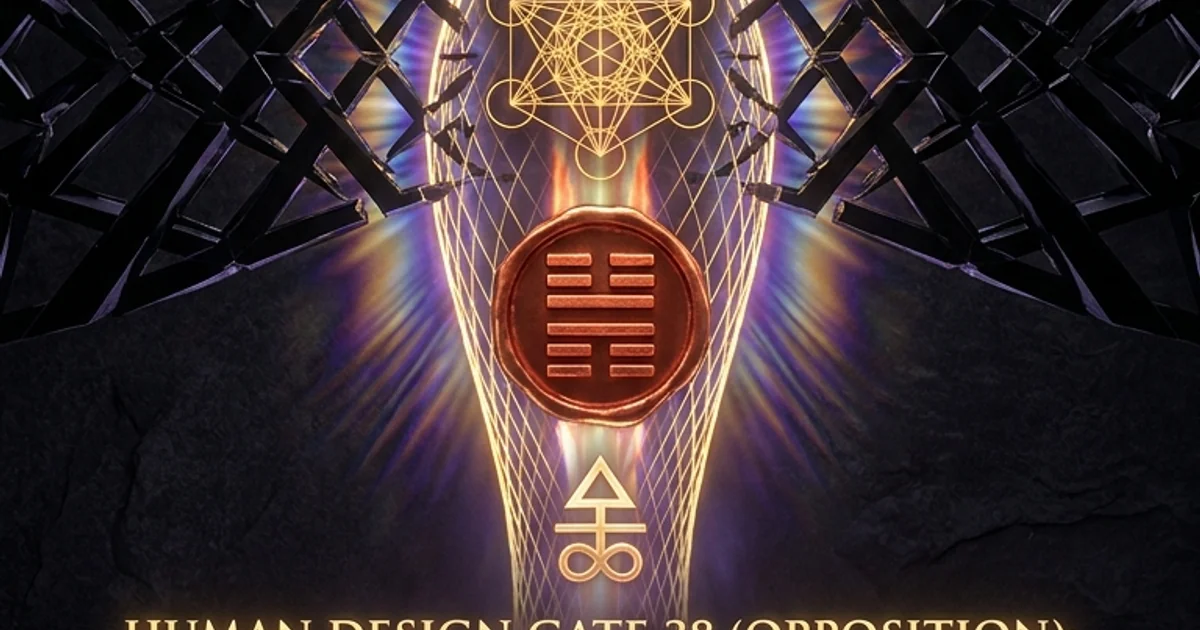
Human Design Gate 38 (Opposition): Archetypal Energy
Archetypal Thesis & Systemic Paradigm: The Adrenal Drive for Meaning
Teleological Combat: Gate 38 as the Archetypal Fighter
Within the psycho-cosmological architecture of Human Design, Gate 38—termed the Gate of Opposition and classically derived from the thirty-eighth hexagram of the I Ching (睽, Kuí)—functions as an existential entropy filter. Far from indicating mere interpersonal belligerence or reflexive contrarianism, the energetic signature of human design gate 38 opposition governs the archetypal struggle for individuation. Located in the adrenal pressure center of the BodyGraph, this gate transmutes raw kinetic and metabolic stress into an epistemological inquiry: Does this life, this pursuit, or this encounter possess intrinsic, evolutionary meaning? In the absence of this pressure, consciousness defaults toward passive assimilation, succumbing to the homogenizing gravity of tribal and collective conditioning. Gate 38 is the psychic warrior that refuses to submit to existence as a mere sequence of biological maintenance tasks; it demands an authentic teleological prize worth the expenditure of biological vitality.
The fundamental posture of Gate 38 is adversarial, yet this stance serves an indispensable evolutionary purpose. When consciousness encounters phenomena, Gate 38 interrogates the target through a lens of acute skepticism, evaluating whether engaging with it will advance or degrade the sovereign integrity of the spirit. The combat enacted by Gate 38 is not fundamentally aimed at the external destruction of an enemy; rather, it mounts a structural defense of individual mutative truth against the totalizing pressures of the status quo. In this sense, gate 38 energetics represent the individual’s refusal to be swallowed by mass psychology. It operates as an existential threshold guardian, compelling the subject to struggle against external forces until meaning is extracted, or until the adversary is revealed as an illusion unworthy of combat.
“Individuation does not shut one out from the world, but gathers the world to oneself… The confrontation with the archetypal collective unconscious is an arduous task that requires severe combat with the dragon of collective consensus. The hero must fight for his own distinctive existence against the regressive drag of tribal identity; without this opposition, the Self remains an unactualized potentiality, dissolved within the primordial mass.” — Carl Gustav Jung, Aion: Researches into the Phenomenology of the Self (Collected Works Vol. 9, Part 2), Princeton University Press, 1951.
Thermodynamic Pressure: Root Center Adrenal Mechanics
Mechanically, Gate 38 is situated on the somatic perimeter of the Root Center, operating as one of three distinct pressure gates that fuel the mutative, individual currents of the body. The Root Center is not an awareness center; it is a pressurized motor, biologically linked to the adrenal glands, synthesizing adrenaline, noradrenaline, and regulating cortisol production within the hypothalamic-pituitary-adrenal (HPA) axis. Consequently, Gate 38 does not possess innate cognitive clarity or emotional stability. Instead, it generates a visceral, physical surge of tension that must be properly channeled. Unlike the emotional instability and wave dynamics generated by the solar plexus center, the motor output of Gate 38 is episodic, sharp, and physically destabilizing if kept sedentary.
This adrenal tension acts as an internal combustion engine driving the organism into friction with its environment. When the Root pulses, Gate 38 experiences an immediate surge of defensive adrenaline, which the conscious mind frequently misinterprets as an imperative to find something—or someone—to resist. The physiology of Gate 38 is calibrated to endure extreme hardship, provided that the hardship serves a perceived purpose. If the somatic pressure is directed incorrectly, it manifests as chronic, unproductive biological inflammation, systemic neuroendocrine exhaustion, and purposeless interpersonal hostility. However, when aligned with authentic inner authority, this adrenal motor provides the stamina required to withstand collective ostracization, physical deprivation, and psychological isolation in defense of an evolutionary mutation.
Individual Knowing versus Collective Homogenization
The positioning of Gate 38 within the Individual Knowing Circuit differentiates its mechanical operation from both the Tribal and Collective circuitry. While Tribal circuitry struggles for communal survival, material security, and the preservation of bloodlines, and the Collective circuitry struggles for systemic patterns, historical continuity, and societal progress, the Individual Knowing Circuit is explicitly dedicated to structural mutation. Mutation, by its very nature, is offensive to the collective order. The collective demands uniformity, predictable patterns, and adherence to social contracts to maintain systemic stability. The individual, conversely, operates under the unpredictable acoustic laws of sudden melancholy, spontaneous mutation, and radical differentiation.
Gate 38 operates as the primary psychic immune mechanism protecting this mutative capacity. Without the stubborn, oppositional stance of Gate 38, the individual would easily be subsumed by the homogenizing forces of the collective. The gate maintains a perpetual baseline of acoustic friction, ensuring that the individual remains distinct from their surroundings. This mechanical insulation protects the emergence of novel cognitive insights, unconventional behavioral modes, and unique spiritual alignments. The opposition embodied by this gate is an evolutionary absolute: without this targeted adrenal friction to resist collective pressure, human consciousness would settle into an entropic, homogenous stasis, devoid of the necessary variance that drives evolutionary advancement.
Classical Provenance & Textual Lineage: Hexagram 38 (Kuí) and Cosmological Divergence
Fire Above, Lake Below: The Energetic Polarities of Trigram Li and Trigram Dui
The systemic architecture of Gate 38 is rooted in the structural mechanics of Hexagram 38 of the I Ching, designated as 睽 (Kuí), translated alternately as “Opposition,” “Estrangement,” or “Divergence.” The internal cosmological tension of this hexagram is revealed through the fundamental physics of its constituent trigrams: the upper trigram is 離 (Lí), representing Fire, and the lower trigram is 兌 (Duì), representing the Lake or open Water. In Chinese natural philosophy, the essential vector of Fire is to flame upward (炎上, yán shàng), while the essential vector of Water is to seep downward (潤下, rùn xià). Consequently, Hexagram 38 presents two elemental forces sharing a single field of relational space yet moving in diametrically opposed directions.
       ======  Line 6 (Yin/Broken)
       ------  Line 5 (Yang/Solid)   Upper Trigram: 離 (Lí - Fire)
       ======  Line 4 (Yin/Broken)
       ---------------------------
       ------  Line 3 (Yang/Solid)
       ------  Line 2 (Yang/Solid)   Lower Trigram: 兌 (Duì - Lake)
       ======  Line 1 (Yin/Broken)
This structural configuration does not depict a violent, mutual annihilation, such as water being poured directly onto fire. Instead, it portrays an essential spatial divergence. The elements do not integrate, nor can they merge into a synthetic unity; their inherent physical trajectories compel them to separate. The lake settles into the planetary depression, cool and receptive, while the flame reaches into the celestial void, radiant and consuming. The energetic lesson of Hexagram 38 is that divergence is an irreducible condition of the manifest universe. Opposition is not an anomaly to be eradicated through forced consensus; it is the ontological precondition for distinct phenomena to perceive and define one another across an unbridgeable distance.
“THE JUDGMENT: OPPOSITION. In small matters, good fortune. THE IMAGE: Above, fire; below, the lake: The image of OPPOSITION. Thus amid all fellowship The superior man retains his individuality… When two people are at variance, they cannot carry out any big undertaking in common; their points of view are fundamentally too different. In such cases one should not attempt big things, but in small matters one may still achieve good fortune. Opposition enables the recognition of differences, while identity loses all distinction.” — Richard Wilhelm & Cary F. Baynes, The I Ching or Book of Changes, Bollingen Series XIX, Princeton University Press, 1950.
The Wilhelm-Baynes Rendering: Estrangement, Isolation, and the Sovereign Will
The philosophical commentary preserved within the Wilhelm-Baynes rendering of Hexagram 38 provides critical insights into the operational mechanics of Gate 38. The text underscores that under the conditions of Kuí, “in small matters, good fortune” is attainable, but foundational, monumental enterprises requiring communal accord are structurally doomed to collapse. When opposition governs the field, attempting to enforce uniformity or orchestrate mass consensus produces systemic failure. The sovereign actor must recognize that divergence cannot be bridged by emotional pleading or logical coercion; the distance separating the polarized parties is structural, absolute, and necessary.
The King Wen sequence embeds a profound systemic progression by positioning Hexagram 38 immediately following Hexagram 37 (家人, Jiā Rén / The Family). Hexagram 37 establishes structural unity, domestic hierarchy, tribal coherence, and internal mutual affinity. Yet, the cosmic cycle dictates that perfect tribal cohesion inevitably generates its direct opposite: Hexagram 38, the estrangement from the family. The moment the collective unit solidifies its boundaries, the individual within the clan feels the existential urge to differentiate, break rank, and assert an autonomous identity. Hexagram 38 represents the child departing the tribal hearth, willing to endure the cold of total isolation rather than allow their sovereign nature to dissolve within collective conformity.
The Rave I Ching Translation: Ra Uru Hu’s Recontextualization of the Warrior
When Ra Uru Hu synthesized the mechanical framework of the Human Design System in 1987, Hexagram 38 was systematically transcribed into the Rave BodyGraph as the Gate of the Fighter, situated on the adrenal edge of the Root Center. In the Rave I Ching, Ra preserved the classical cosmological essence of Kuí while translating its archaic moral philosophy into somatic mechanics. He stripped the hexagram of conventional notions of good and evil, characterizing the oppositional impulse not as an ethical failing or character defect, but as a biological imperative for individual preservation.
Ra posited that Gate 38 provides the necessary adrenal fuel for the individual to fight for their survival, identity, and existential purpose. In the Rave cosmology, Gate 38 is the warrior archetype whose primary adversary is meaningless death and collective assimilation. The gate is mechanically engineered to resist any external pressure that does not resonate with its internal knowing. Through the Rave translation, the archetypal “fighter” is recognized not as an external warmonger, but as a somatic guardian of the spirit, designed to conserve its combustible adrenal fuel until it identifies an authentic challenge worthy of engagement.
Structural Mechanics & Symbolic Geometry: Circuitry, Channel 38–28, and Genetic Codons
Circuit Mechanics: Individual Knowing Circuitry vs. Collective Abstract Circuitry
To understand the precise mechanical behavior of Gate 38, its placement within the Individual Knowing Circuit must be contrasted with adjacent structural pathways, particularly the Collective Abstract Circuitry. The Collective Abstract Circuit (Sensing) processes experiential reality chronologically, governed by the format of Gate 53 (Development) and Gate 42 (Increase). The Abstract Circuit demands that the human being cycle through experiences, gather historical data, interpret the past, and contribute to the collective bank of cultural knowledge through emotional reflection. Its baseline imperative is social cohesion and communal learning through shared human vulnerability.
Individual Knowing Circuit (Mutative / Acoustic / Solitary)
[Root: Gate 38] ====== Pulse =====> [Spleen: Gate 28] -> Mutation

Collective Abstract Circuit (Experiential / Wave-Based / Social)
[Root: Gate 53] ~~~~~~ Cycle ~~~~~> [Sacral: Gate 42] -> Experience
Conversely, the Individual Knowing Circuit, containing Gate 38, operates on completely different principles. It does not function through continuous cycles, nor does it seek experiential consensus. Its mechanics are driven by the acoustic, pulse-based rhythm of the individual Root. Mutation occurs within a vacuum of timelessness; it appears spontaneously, accompanied by bouts of melancholic silence and non-linear shifts in perception. Gate 38 generates an oppositional field that deliberately disrupts collective cycles. While the Collective Abstract Circuit seeks to pull the individual into historical experiences to benefit the herd, Gate 38 pushes back, refusing to participate in any shared experience that lacks personal existential significance.
The Harmonic Nexus: Channel 38–28 (Struggle) Bridging the Root and Spleen
Gate 38 does not operate in mechanical isolation; it forms half of the Channel 38–28, designated as the Channel of Struggle, a Design of Stubbornness. This channel creates an electromagnetic bridge between the adrenal motor of the Root Center and the lymphatic, primal survival consciousness of the Splenic Center. The harmonic partner to Gate 38 is Gate 28 (The Game of Life / Hexagram 大過, Dà Guò - Great Preponderance), situated in the Spleen. Gate 28 carries the existential fear that life will pass without meaning—a somatic dread of purposeless mortality.
When these two gates connect, a powerful dynamic emerges. Gate 38 supplies the raw adrenal pressure to struggle, while Gate 28 provides the instinctual, moment-by-moment splenic awareness to discern whether the struggle is genuinely worth the risk to physical survival. If Gate 38 operates without the harmonic integration of Gate 28, the individual possesses the motor drive to fight, but lacks the instinctual guidance to know which battles are truly worthwhile. Conversely, if Gate 28 operates without Gate 38, the individual suffers from an acute awareness of mortality and existential dread, yet lacks the adrenal fuel to fight against the circumstances threatening to render their life meaningless. Together, they form an archetypal synthesis: the warrior (38) informed by the survival instincts of the game player (28).
Biochemical Mapping: Hexagram 38, Aspartic Acid, and Epigenetic Stress
The integration of Human Design with molecular biology, initially mapped through the structural insights of Dr. Martin Schönberger and later expanded within the mechanics of the Rave genetic matrices, links the sixty-four hexagrams directly to the sixty-four codons of the universal genetic code. Hexagram 38 belongs to the biochemical family designated as the Codon Ring of Fate, sharing genetic architecture with hexagrams that govern the deep somatic realities of destiny, limitation, and mortality. Specifically, Gate 38 corresponds directly to the codons encoding the amino acid Aspartic Acid (alongside Gate 39).
Codon Ring of Fate Architecture:
---------------------------------------------------------
Amino Acid:        Aspartic Acid (Asp / D)
Codons:            GAU, GAC
Associated Gates:  Gate 38 (Root - Opposition)
                   Gate 39 (Root - Provocation)
Biological System: Hypothalamic-Pituitary-Adrenal (HPA) Axis
Primary Function:  Excitatory neurotransmission / Stress response
Aspartic Acid plays a central role in the human body as an excitatory neurotransmitter within the central nervous system, serving as a biological precursor to other essential amino acids and participating in the urea cycle. Within neuroendocrine pathways, aspartate facilitates the transmission of high-frequency stress signals, functioning as a metabolic trigger for physical exertion. At the genetic level, Gate 38 translates psychological and environmental tension into direct epigenetic pressure. When the organism encounters an existential threat or ideological impasse, the biochemical cascade linked to Hexagram 38 initiates an intense stress response, altering cellular transcription and conditioning the somatic vehicle to endure prolonged strain. Struggle is thus revealed not as an abstract philosophical dilemma, but as an ancient cellular mechanism that spurs evolutionary adaptation through physical resistance.
Microcosmic Sub-Structure: The Six Line Transitions of Gate 38
The six lines of Hexagram 38 detail the evolutionary progression of the oppositional impulse, moving from basic, internal survival mechanics to complex transpersonal expressions. Each line represents a distinct stage in how the individual navigates friction, manages isolation, and conserves adrenal vitality.
- Zodiacal Span: 08°45’00" Capricorn to 14°22’30" Capricorn
- Decanate: Second Decan of Capricorn (Governed by Taurus / Venusian sub-frequency)
- Primary Archetype: The Earth-bound Architect under Saturnian structure, moderated by Venusian somatic endurance
- Hexagram Center: Root Center (Pressure / Motor)
- Harmonic Partner: Gate 28, Spleen Center (23°45’00" Scorpio to 29°22’30" Scorpio)
Lines 1 to 3: The Foundational Mechanics of Resistance and Estrangement
Line 1: Qualification (資質)
Somatic Orientation: The initial assessment of engagement. The first line represents the foundation of the hexagram, establishing the boundary conditions under which opposition is warranted. Here, the individual must develop an instinct for strategic retreat. The line dictates that before an individual commits their adrenal energy to combat, they must evaluate whether the opponent or situation possesses genuine merit. In its exalted aspect (often guided by Mars), it manifests as the wisdom to recognize that not all opposition demands engagement: if an opponent is beneath notice, conflict is an inefficient expenditure of life force. In its detriment, the individual engages indiscriminately with every adversarial signal, dissipating vital energy in minor squabbles and degrading their capacity to withstand true existential crises.
Line 2: Politeness (客氣)
Somatic Orientation: Strategic compromise and social maneuvering. The second line navigates opposition through tactical diplomacy. Recognizing that perpetual outward confrontation leads to premature destruction, Line 2 incorporates the social lubricant of politeness. This is not genuine submission to collective dogma, but a protective facade that allows the individual to operate within adversarial spaces without triggering unnecessary conflict. Exalted by Venus, it manifests as the ability to maintain internal resistance while remaining outwardly courteous, thereby preserving energy for battles that matter. In its detriment, dominated by the Moon, politeness deteriorates into an insincere, passive-aggressive compliance that blurs the individual’s boundaries, causing them to lose sight of their authentic stance.
Line 3: Alliance (結盟)
Somatic Orientation: The danger of mistaken identity and physical obstruction. Line 3 marks the transition from internal calibration to external entanglement. As the trial-and-error threshold of the lower trigram, it frequently misidentifies allies as enemies and enemies as allies. Classical texts describe a traveler whose wagon is dragged backward, their oxen halted, and their hair and nose cut off. This evocative imagery conveys the profound friction experienced when an individual enters unaligned alliances. Exalted by the Sun, the individual perseveres through misunderstandings, recognizing that friction is an inevitable consequence of entering worldly relationships. In its detriment, influenced by Mars, the individual turns their frustration inward or lashes out with unprovoked violence, escalating trivial misunderstandings into destructive, protracted conflicts.
Lines 4 to 6: Transpersonal Alliances, Misunderstood Isolation, and the Wolf
Line 4: Investigation (調查)
Somatic Orientation: The search for genuine mutative companions. As the hexagram transitions into the upper trigram, opposition shifts toward transpersonal awareness. Line 4 possesses the acute awareness that one cannot survive prolonged existential isolation entirely alone; it actively scans the environment for an authentic companion with whom to share the burden of opposition. In its exalted state (driven by Pluto), the individual maintains their solitary vigil until they identify an ally whose foundational values align with their mutative drive, forging an unbreakable bond forged in shared struggle. In its detriment, marked by Jupiter, the individual settles for superficial alliances out of a fear of loneliness, compromising their integrity to avoid the discomfort of standing alone.
Line 5: Alienation (疏離)
Somatic Orientation: Receptivity to the hidden ally. The fifth line carries the universalizing projection of the hexagram. Here, the individual is frequently projected upon by the collective as an enemy, an outsider, or a radical threat to community stability. The opposition is intense, systemic, and inescapable. However, the fifth line possesses the capacity to pierce through this mutual distrust. Exalted by the Moon, the individual possesses the psychological maturity to recognize that someone who initially appears as an opponent may actually harbor the precise key needed for their mutation. In its detriment, influenced by Neptune, alienation breeds deep paranoia. The individual retreats behind an impenetrable psychological wall, rejecting genuine overtures of support and ultimately succumbing to self-imposed exile.
Line 6: Misunderstanding (誤解)
Somatic Orientation: The apex of paranoia transformed into prophetic clarity. The culmination of Gate 38 presents one of the most volatile archetypal dynamics in the Rave I Ching: the archetype of the lone wolf wandering through the mist, mistaking a wagon filled with friendly travelers for a company of demons. The extreme pressure of the sixth line can manifest as deep existential paranoia, where every gesture from the collective is perceived as a direct threat to the individual’s survival. Exalted by Pluto, the individual moves through the illusion of hostility, lowers their weapon, and discovers that the supposed enemy is, in truth, an ally carrying sustenance. In its detriment, fueled by Mars, the individual fires their weapons before confirming the identity of the approaching party, slaughtering their potential saviors in a tragic, self-destructive fit of defensive panic.
Psychological Dynamics & Operational Praxis: Transmuting Struggle into Purpose
Shadow Dynamics: Chronic Belligerence and the Unproductive Battle
When an individual operates from the homogenized Not-Self, the adrenal mechanics of human design gate 38 opposition become deeply dysregulated. Rather than functioning as a discerning filter for authentic existential struggle, the gate descends into chronic belligerence. The individual becomes addicted to friction, generating conflicts over mundane household, workplace, or ideological matters. Every interpersonal encounter is treated as a zero-sum struggle for dominance, alienating potential allies and leaving the individual physically and emotionally depleted.
+-------------------------------------------------------------------------+
|                  THE PATHOLOGICAL NOT-SELF CASCADE                     |
+-------------------------------------------------------------------------+
|                                                                         |
|  [ Undefined/Conditioned Solar Plexus ]                                 |
|         │                                                               |
|         │ (Absorbs & Amplifies Collective Emotional Turmoil)            |
|         ▼                                                               |
|  [ Unregulated Adrenal Pressure in Gate 38 ]                            |
|         │                                                               |
|         │ (Fires Without Splenic Awareness or Mechanical Authority)     |
|         ▼                                                               |
|  [ Purposeless Interpersonal Combat ]                                   |
|         │                                                               |
|         │ (Adrenaline Exhaustion, Hypercortisolemia, Moral Defeat)      |
|         ▼                                                               |
|  [ Somatic Collapse: Burnout, Chronic Systemic Inflammation ]           |
|                                                                         |
+-------------------------------------------------------------------------+
This shadow expression frequently stems from a profound terror of purposelessness. When individuals lack an authentic creative, intellectual, or spiritual quest worthy of their life energy, the pressurized Root Center does not simply turn off. Instead, it discharges its pent-up adrenaline into the immediate environment, picking fights over trivial issues to manufacture an artificial sense of aliveness. This reactive combat is a tragic misuse of the archetype: the individual exhausts their biological vitality fighting battles that yield no lasting meaning, ensuring that when a genuine, mutative evolutionary struggle finally arrives, their somatic reserves are completely spent.
Not-Self Expression: Reactive Belligerence
- Indiscriminate combativeness triggered by minor daily frictions
- Adrenal exhaustion, hypercortisolemia, and chronic systemic inflammation
- Projects paranoia onto benign social dynamics; mistakes allies for adversaries
- Conflates tribal consensus defense with personal existential meaning
- Combative discharge without long-term teleological purpose
Differentiated Mastery: Strategic Individuation
- Patient conservation of adrenal fuel; deliberate non-engagement with triviality
- Somatic vitality preserved for high-stakes mutative thresholds
- Discernment of authentic allies through tested pressure and shared struggle
- Capacity to endure profound social isolation in defense of individual truth
- Complete transformation of struggle into an evolutionary bridge for meaning
Somatic Calibration: Spleen-Root Awareness and Adrenal Regulation
The successful operational mastery of Gate 38 requires conscious somatic calibration. Because Gate 38 is an adrenal pressure gate rather than an awareness center, the mind must not be permitted to dictate when and where the individual fights. The rational mind is hopelessly ill-equipped to direct the forces of the Root Center; it inevitably manufactures intellectual justifications for what is fundamentally a raw hormonal pulse.
Alignment is achieved when Gate 38 is subordinated to Strategy and Authority, and specifically sensitized to the instinctual intelligence of the Splenic Center (whether defined directly via Gate 28, or operating through wider bodygraph mechanics). The individual must learn to recognize the physical sensations of their adrenal surges:
- The sudden tightening of the solar plexus and diaphragm
- The rush of vascular heat to the extremities
- The acoustic hypersensitivity that accompanies the impulse to defend
Instead of immediately discharging this somatic pressure through verbal or physical hostility, the practitioner must learn to contain the charge, allowing the adrenal wave to crested and subside without an immediate behavioral reaction. By holding this tension within the body, the individual can discern whether the situation represents an authentic threat to their evolutionary path, or merely the ambient noise of a conditioned world.
Deconditioning the Not-Self: Disentangling Opposition from Emotional Drama
A particularly volatile mechanical configuration occurs when Gate 38 operates within a chart possessing an undefined solar plexus center. The open Solar Plexus is biologically wired to absorb and amplify the emotional waves of the environment, frequently experiencing an intense, irrational fear of confrontation and truth. When an individual combines an open Solar Plexus with a defined Gate 38, a dangerous internal schism develops. The open Solar Plexus will go to extraordinary lengths to avoid immediate emotional conflict, placating others and swallowing its own truth. Meanwhile, the defined Gate 38 in the Root Center continues to build massive, unexpressed adrenal pressure against this very compliance.
This pressure inevitably reaches a breaking point. When the tension can no longer be contained, Gate 38 erupts in an explosive display of rage and opposition, catching everyone off guard with its intensity. The individual then experiences severe emotional guilt and shame—amplified once again by their undefined Solar Plexus—and retreats back into dysfunctional compliance, beginning the pathological cycle anew. Deconditioning this dynamic requires the individual to separate their adrenal pressure from the emotional turbulence around them. They must realize that the urge to oppose is not an invitation to engage in emotional warfare, but a somatic boundary warning that their sovereign space has been compromised.
Philosophical Synthesis & Macrocosmic Correspondence: Hermetic Polarity and Individuation
The Principle of Polarity: The Hermetic Axiom of Opposites Reconciled
The archetypal mechanics of Gate 38 represent a pristine systemic manifestation of the Fourth Hermetic Principle: The Principle of Polarity. As articulated in classical Hermetic doctrine, polarity establishes that everything is dual; everything has poles; everything has its pair of opposites; opposites are identical in nature, yet different in degree. The apparent discord between two opposing forces is not an ultimate cosmological error, but the dynamic tension that sustains the universe itself.
“Thesis and antithesis are identical in nature, but different in degree; opposites are the same, differing only in their vibration; the pairs of opposites may be reconciled; extremes meet; everything is and isn’t at the same time; all truths are but half-truths; every truth is half-false; there are two sides to everything.” — Three Initiates, The Kybalion: A Study of the Hermetic Philosophy of Ancient Egypt and Greece, The Yogi Publication Society, 1908.
When mapped onto the cosmological geometry of Hexagram 38, the Principle of Polarity clarifies why Fire and Lake, despite moving in opposite directions, are irrevocably tied to one another. The upward ascent of the flame requires the downward depth of the lake to define its verticality; the luminous heat of Fire requires the reflective coolness of Water to render its radiance visible. Gate 38 operates precisely at this inflection point of polarity. It embodies the existential friction through which consciousness becomes aware of itself by striking against that which it is not. Without the resistant boundary provided by opposition, consciousness remains diffuse, unformed, and incapable of self-reflection.
Cosmic Teleology: Why Nature Demands the Heretic and the Outlier
From a macrocosmic and evolutionary perspective, nature maintains an absolute, non-negotiable demand for the outlier, the heretic, and the fighter. If evolutionary biology were governed entirely by collective and tribal imperatives—exemplified by the structural cohesion of the Collective Abstract Circuitry—species would inevitably stagnate. The collective impulse optimizes for the mean; it preserves historical patterns, defends systemic equilibria, and rewards compliance with the established norm. While this preserves stability in static environments, it renders a species exceptionally vulnerable when facing sudden, catastrophic disruptions.
Gate 38 is nature’s structural safeguard against evolutionary obsolescence. By encoding a baseline of stubborn, irreducible opposition into a specific subset of the population, life ensures that there will always be individuals who refuse to walk the beaten path, accept consensus narratives, or surrender to collective mandates. These are the individuals who, driven by the existential need for meaning, wander into the wilderness, challenge ossified tribal dogmas, and endure severe personal hardship to test alternative paths forward. Even when their opposition appears illogical to their contemporaries, their stubborn resistance preserves the genetic, cognitive, and spiritual variance necessary for human consciousness to survive systemic shocks and make the leap to new evolutionary epochs.
The Evolutionary Function of Channel 38–28 in the Global Cycle Transition
As humanity approaches the structural culmination of the current evolutionary epoch—marked in the Human Design cosmological timeline by the closing of the Cross of Planning (1615–2027)—the mechanics of the Channel of Struggle (38–28) assume an unprecedented global importance. The Cross of Planning has been characterized by the institutional codependence of the tribal 37–40 (Community) and the collective 16–48 (Talent and Depth), an era marked by the proliferation of vast social contracts, welfare structures, institutional dependencies, and globalized supply chains.
The dissolution of this global cycle signals the progressive decay of collective safety nets and institutional authority. In the emerging era, characterized by the individualizing mechanics of the Sleeping Phoenix, individuals who rely on external institutions for purpose, security, and spiritual validation will face profound existential disorientation. In this demanding landscape, the individual knowing fueled by Gate 38 emerges as a vital evolutionary capacity. The capacity to stand entirely alone, resist mass panic, and wage an uncompromising campaign for personal meaning will no longer be an eccentric psychological trait; it will become the indispensable baseline requirement for the preservation of human spiritual sovereignty.
Frequently Asked Questions: Decoding Gate 38 Mechanics
Distinguishing Gate 38 Opposition from Gate 39 Provocation
While both Gate 38 and Gate 39 are individual pressure gates situated within the Root Center, their functional mechanisms, energetic targets, and somatic pathways are fundamentally distinct.
+--------------------------------------------------------------------------+
|            GATE 38 (OPPOSITION)  vs.  GATE 39 (PROVOCATION)              |
+--------------------------------------------------------------------------+
|  Circuitry:        Individual Knowing       Individual Centering         |
|  Target Center:    Spleen Center (Gate 28)  Solar Plexus Center (Gate 55)|
|  Somatic Vector:   Kinetic / Adrenal        Acoustic / Emotional Spirit  |
|  Core Drive:       To find meaningful       To tease out emotional       |
|                    struggle; preserve       resonance; test the          |
|                    individual autonomy      authenticity of the spirit   |
|  Behavior:         Stubborn boundary        Dynamic, provocative teasing |
|                    defense; fighting        or prodding of the other's   |
|                    against assimilation     emotional baseline           |
+--------------------------------------------------------------------------+
Gate 39 (Hexagram 蹇, Jiǎn - Obstacle) resides in the Individual Centering Circuit, projecting its adrenal pressure toward Gate 55 (Abundance) in the Solar Plexus Center. Its mechanism is acoustic, emotional, and provocative; it uses energetic prodding and deliberate agitation to test the spirit of the other, evaluating whether their emotional frequency is authentic or superficial.
In contrast, gate 38 energetics belong to the Individual Knowing Circuit, projecting motor pressure toward Gate 28 in the Spleen Center. Gate 38 does not seek to provoke emotional waves in others, nor does it care about testing another person’s spirit. Rather, it is a structural, survival-based motor that uses friction to establish firm boundaries against collective encroachment. Gate 39 uses provocation to discover who resonates with its frequency; Gate 38 uses opposition to defend what is worth fighting for, even if it must stand entirely alone in the process.
Navigating Gate 38 in Undefined versus Defined Root Centers
The psychological and somatic expression of Gate 38 is radically altered by the configuration of the Root Center within the individual BodyGraph.
Defined Root Center with Gate 38:
-------------------------------------------------------------------------
[Defined Root]  == Consistent Adrenal Pressure ==>  [Gate 38: Regulated]
Characteristics: Predictable, constant access to fighting vitality;
                 inherent stamina; stubbornness is a fixed, enduring trait;
                 danger lies in becoming rigid, chronic contrarians.
Undefined Root Center with Gate 38:
[Open Root]     == Absorbs Environmental Stress ==> [Gate 38: Irregular]
Characteristics: Fluctuation in physical stamina; volatile eruptions of
resistance; susceptible to intense adrenal burnout;
must learn to avoid adopting everyone else's battles.
In a defined Root Center, Gate 38 operates with a steady, predictable supply of adrenal pressure. The individual has continuous, lifelong access to the energy required to struggle, withstand opposition, and assert their boundaries. Here, the challenge is not a lack of stamina, but the danger of becoming a chronic, inflexible contrarian who exhausts others through an unyielding refusal to compromise.
In an undefined Root Center, Gate 38 operates inconsistently. The individual possesses the inherent psychological appetite to fight for meaning, but lacks a steady, internal supply of adrenal fuel. Instead, their open Root absorbs and amplifies the ambient stress, deadlines, and adrenal pressures of their environment. Consequently, their oppositional drive can erupt in sudden, disproportionate bursts of resistance, followed by prolonged periods of physical exhaustion and adrenal burnout. For the open Root individual with Gate 38, wisdom lies in recognizing that while their drive to protect what matters is authentic, their energy to fight is limited; they must be extraordinarily selective regarding when to step into the ring.
The Interplay Between Gate 38 and Open Solar Plexus Conditioning
When a defined Gate 38 operates within a BodyGraph that features an undefined solar plexus center, the individual must navigate a profound split between their physical boundaries and emotional conditioning. The open Solar Plexus is vulnerable to the emotional atmosphere of its surroundings, absorbing emotional tension and reacting with a compulsive desire to keep the peace. This leads to a persistent behavioral pattern of people-pleasing, emotional evasion, and swallowing of personal boundaries simply to avoid interpersonal friction.
However, Gate 38 sits directly beneath this dynamic in the Root Center, mechanically engineered to stand its ground and push back. This creates an unsustainable internal contradiction:
- The open Solar Plexus smiles, agrees to unreasonable demands, and projects an image of pliant cooperation to avoid an uncomfortable emotional scene.
- Concurrently, Gate 38 feels violated and compromised, steadily accumulating adrenal pressure within the somatic tissues.
Eventually, the pressure breaches the suppressive efforts of the open Solar Plexus, resulting in sudden, volcanic eruptions of defiance. The individual often lashes out with devastating force over seemingly trivial matters, stunning those who had grown accustomed to their compliance. True integration for those with this configuration requires anchoring in their Strategy and Authority. They must learn to tolerate the temporary emotional discomfort of setting immediate, firm boundaries, allowing the healthy, protective opposition of Gate 38 to express itself calmly and clearly before the adrenal pressure builds into an uncontrolled explosion.