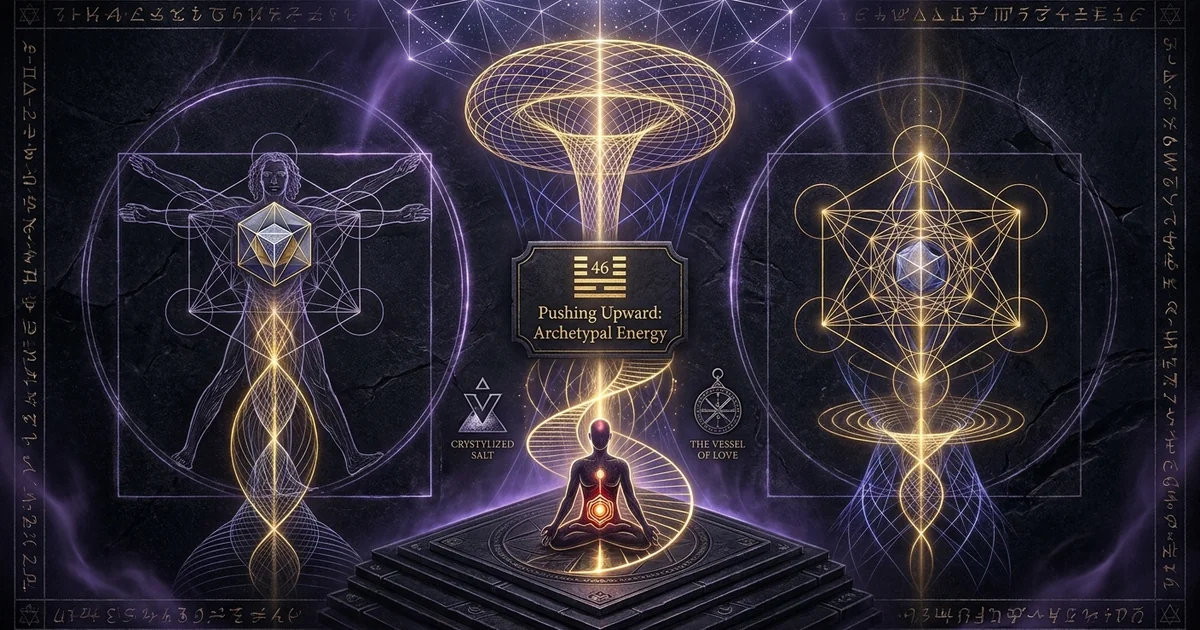
Human Design Gate 46 (Pushing Upward): Archetypal Energy
Archetypal Thesis & Systemic Paradigm: The Somato-Cosmic Vector of Gate 46
Somatic Immanence versus Spiritual Transvaluation
Within the psycho-cosmological topography of the BodyGraph, Gate 46—designated classical-esoterically as Shêng (Pushing Upward)—operates not merely as an arbitrary vector of colloquial good fortune, but as the trans-somatic transducer within the Collective Sensing Circuit. It anchors the high-frequency trans-personal potentials of the G-Center directly into the dense biological medium of the physical form. Classical spirituality habitually commits an error of dualistic transvaluation: it treats the mammalian carbon vehicle as an impediment, an ontological fallen state, or a crude prison from which the discarnate nous or atman must engineer its escape.
Gate 46 dismantles this ascetic bifurcation. The gate asserts the absolute ontological primacy of somatic immanence. In the architecture of Human Design, consciousness is not a disembodied abstraction drifting above the material plane; it is an emergent property of cellular, biological immersion. When human design gate 46 pushing upward is active, the vehicle demonstrates that spiritual awakening cannot bypass somatic crystallization.
To attempt an ascent toward the celestial through the rejection of the corporeal is, within this mechanical paradigm, to induce severe psycho-somatic fragmentation. The flesh is the cosmic altar. The physical form serves as the primary instrument through which the universe encounters its own sensory manifestness. Awareness achieves self-reflection not away from, but strictly inside, the biological constraints of blood, tissue, and cellular memory.
                  HEXAGRAM 46: SHÊNG / PUSHING UPWARD

                             ===   ===  Line 6 (Yin)
                             ===   ===  Line 5 (Yin)  TRIGRAM: K'UN (Earth)
                             ===   ===  Line 4 (Yin)
                             -----------------------
                             =======    Line 3 (Yang)
                             =======    Line 2 (Yang)  TRIGRAM: SUN (Wood/Wind)
                             ===   ===  Line 1 (Yin)
The Geometry of the Right Place at the Right Time
Colloquial interpretations frequently trivialize Gate 46 as the gate of serendipity or arbitrary luck. This misapprehension arises from a fundamental misunderstanding of how the G-Center governs direction, spatial geometry, and love within the matrix of the Magnetic Monopole. The apparent miracle of being in the right place at the right time is not an accidental stroke of fate; it is a structural consequence of geometric alignment.
When the passenger consciousness surrenders the illusion of mental steering and entrusts orientation entirely to the somatic intelligence of the Sacral Center and the Magnetic Monopole, the physical body occupies its authentic spatial trajectory across the space-time manifold. Serendipity is merely the experiential symptom of zero resistance within a moving biological coordinate.
The phenomenon colloquially experienced as luck is the mathematical synchronization of the body with experiential geometry. The moment the individual ceases cognitive interference with the vehicle’s trajectory, the somatic vector naturally intersects with persons, environments, and crises optimized for its evolutionary progression. Gate 46 establishes that spatial correctness is inherently temporal correctness; space and time collapse into a unified kinesthetic actuality where the physical form moves frictionlessly through life.
Thermodynamic Feedback in Collective Abstract Circuitry
The Abstract or Sensing Circuit operates according to an experiential imperative: humanity learns through retrospection, cyclically plunging into experiential immersion without an intellectual guarantee of the outcome. In this current, Gate 46 serves as the primary thermodynamic regulator of experiential kinetic energy. Positioned directly opposite Gate 29 in the Sacral Center, Gate 46 transforms raw reproductive, generative force into evolutionary upward progression.
The heat of somatic friction generated by entering into an experience whole-heartedly must be captured, contained, and digested by the G-Center’s spatial orientation. Without this transductive capacity, the generative vitality of the sacral center burns out through uncoordinated, chaotic movements.
Gate 46 energetics introduce a cooling, directional cohesion. By holding the vehicle steadfastly within the experiential crisis without premature retreat, Gate 46 forces the organism to absorb the thermodynamic impact of experience. This transforms raw sensory shock into evolutionary biological memory. The collective relies upon this mechanism to distill existential wisdom from somatic trial, ensuring that the historical trajectory of the species remains rooted in sensory evidence rather than speculative idealism.
- Genetic Codon Assignment: Codon for Glycine (GGA, GGC, GGG, GGT), bridging the fundamental structural synthesis of proteins with cyclical bio-kinetic movement.
- Astrological Coordinates: 18°45’00" Libra to 24°22’30" Libra, residing squarely within the Western sign of dynamic interpersonal calibration and equilibrium.
- Seasonal Positioning & Quarter: Quarter of Duality (Form and Relationship), emphasizing the physical vehicle as the instrument of contact.
- Harmonic Circuit Axis: Forms the harmonic channel across the G-Center and the Sacral Center, interfacing with Gate 29 (Hexagram K’an, The Abysmal).
Classical Provenance & Textual Lineage: From Shêng to Somatic Discovery
Exegesis of Hexagram 46 in the Wilhelm-Baynes Tradition
To comprehend the systemic mechanics of Gate 46, one must examine its classical origin in the I Ching, translated by Richard Wilhelm as Shêng / Pushing Upward. The classical text delineates an organic, inexorable ascent: “Pushing upward has supreme success. One must see the great man. Fear not. Departure toward the south brings good fortune.” The image is fundamentally botanical and terrestrial. Unlike Hexagram 51 (The Arousing / Thunder), which ascends via catastrophic, disruptive shock, Shêng denotes an invisible, steady accumulation of mass and height. It is the tree germinating beneath heavy soil, pushing slowly upward toward the sunlight through persistent, non-violent, structural growth.
“Pushing upward has supreme success. One must see the great man. Fear not. Departure toward the south brings good fortune… Within the earth, wood grows: The image of Pushing Upward. Thus the superior man of devoted character heaps up small things in order to achieve something high and great.” — Richard Wilhelm and Cary F. Baynes, The I Ching or Book of Changes (1950), Hexagram 46
The directional imperative—“Departure toward the south brings good fortune”—holds profound significance within esoteric cartography. In classical Chinese cosmology, the South is associated with the element of Fire, the zenith of the sun, maximum illumination, and the full manifest visibility of forms on the terrestrial plane. To move south is not a geographic migration; it is an evolutionary trajectory toward actualization, clarity, and temporal maturation. The text advises that one must “see the great man” without fear, representing an unreserved willingness to submit the ego to higher structural laws.
Within the Human Design system, the “great man” is the higher somatic authority—the somatic vehicle directed by the Monopole—to which the conditioned mental faculties must submit. This classical image establishes that upward movement cannot be fabricated through ambition; it occurs through the compounding of microscopic biological concessions to immediate reality.
The Trigrammatic Physics of K’un over Sun (Earth Arising from Wood)
The energetic physics of Hexagram 46 are revealed through its component trigrams: the upper trigram is K’un (Earth, the Receptive), while the lower trigram is Sun (Wood, Wind, the Gentle Penetration).
Upper Trigram: K'un (Earth)       ===  ===
                                  ===  ===
                                  ===  ===
                                  --------
Lower Trigram: Sun (Wood/Wind)    ========
                                  ========
                                  ===  ===
This structural configuration represents wood growing quietly within the interior of the earth. Wood beneath earth does not split the ground through violent seismic upheaval; rather, its root systems pierce the soil with gentle, continuous adaptability. The Receptive above yields unconditionally to the steady vegetative pressure below.
This dynamic provides the exact mechanical formula for human design gate 46 pushing upward. Sun is adaptive flexibility, biological resilience, and intuitive penetration. K’un is density, gravity, form, and material space. The somatic intelligence does not fight against the density of physical reality. It accepts the material world as its nourishing soil. The lower trigram slowly converts the inert minerals of material constraint into the living vertical architecture of the trunk and canopy. Evolutionary growth is rooted in patience: the organism respects temporal pacing, allowing the biological vehicle to expand along the lines of least psychic, yet most resilient physical, resistance.
Ra Uru Hu’s Synthesis: The Vessel of Love and Physical Form
When Ra Uru Hu mapped the hexagrams onto the BodyGraph, he repositioned classical virtue ethics as an energetic, mechanics-based architecture. Gate 46 was recognized as one of the four cardinal pillars of the Vessel of Love, sitting alongside Gate 25 (Universal Love), Gate 15 (Love of Humanity/Extremes), and Gate 10 (Love of Self/Behavior). Within this cross, Gate 46 is explicitly designated as the Love of the Body or Love of Physical Form.
Ra transfigured the classical notion of “supreme success” through somatic embodiment. Success in the abstract sensing circuitry is not material accumulation or social status; it is the capacity of the passenger consciousness to love its biological containment unconditionally, irrespective of pain, aesthetic limitation, or mortality.
By situating the Love of the Body within the G-Center—the center of identity, orientation, and higher love—Ra decoupled the physical vessel from the mere survival mechanics of the Spleen or the reproductive drives of the Sacral. In this framework, to inhabit the body fully is an act of spiritual love.
The body ceases to be an instrument used by the mind to extract validation from the exterior world; it becomes the direct manifestation of the divine trajectory. Ra asserted that an individual who possesses Gate 46 must learn that the physical vehicle itself is their ultimate destiny. How one treats, inhabits, and honors the biological form dictates their operational frequency within the collective matrix.
Structural Mechanics & Symbolic Geometry: Circuitry, Lines, and the 29-46 Channel
The Channel of Discovery (46-29): A Design of Succeeding Where Others Fail
Gate 46 does not function in energetic isolation; its biological and existential potentials reach systemic maturation when bridged with Gate 29 in the Sacral Center, forming the Channel of Discovery (46-29). Gate 29—K’an (The Abysmal / The Saying Yes)—supplies the unreserved, generative drive to commit to an experiential process without cognitive foresight. It throws the organism headlong into the depths of life. Gate 46 acts as the spatial rudder and somatic shock absorber for this kinetic force. Together, they form the archetypal design of “Succeeding Where Others Fail.”
The signature success of this channel is not achieved through strategic calculation, but through somatic absorption. Where other configurations panic, strategize mentally, and abandon the trajectory during crises, the 46-29 channel commits entirely to the physical reality of the experience. The channel succeeds precisely because the body remains within the trial long enough to complete the evolutionary loop. The individual may not know why they are in the experience, nor can they determine its temporal termination; their sole responsibility is somatic endurance and absolute presence within the vehicle until the kinetic cycle discharges.
Hexagram Sub-Structure: Line Progression from Earthly Root to Celestial Crown
The six lines of Hexagram 46 illustrate the progressive calibration of the somatic vehicle as it climbs from raw instinctual embodiment to temporal mastery:
- Line 1: Being Discovered. The foundational base of the hexagram represents somatic receptivity in its purest state. Here, upward advancement is dependent on external recognition; the form simply exists in its innate capacity, waiting for the evolutionary field to discover its viability. The individual cannot push forward; they must be pulled upward by the environment.
- Line 2: The Metro. Governed by an inner, subterranean rhythm. This line possesses an internal biological momentum that operates independently of rational logic. It reflects the willingness to travel within the dark tunnels of an experiential process, trusting that the somatic tracks will emerge into the light at the correct coordinate.
- Line 3: Projection. The transition from the lower to the upper trigram. Here, the vehicle risks projecting its somatic capacity outward without structural grounding, leading to energetic overextension or premature advancement. The challenge is recognizing when the physical vessel is prepared for the next tier of stress and when it requires recalibration.
- Line 4: Impact. Moving into the upper trigram of K’un, the line of trans-personal realization. The somatic vehicle makes conscious, impactful contact with the collective environment. This is physical discipline and presence converted into tangible societal or relational transformation.
- Line 5: Pacing. The line of universalization. It represents the supreme virtue of somatic modulation. The body knows when to accelerate, when to decelerate, and when to pause. It avoids both exhaustion and stagnation through an innate synchronization with the biological circadian cycles and cosmic timing.
- Line 6: The Architect / The Pushing Upward in the Dark. The trans-personal ceiling. The individual pushes upward into the unmapped void. It can manifest as blind, obsessive exertion if driven by the mind, or as absolute somatic faith when surrendered to Strategy and Authority. It is the capacity to hold structural integrity even when external sensory feedback is absent.
Polarity and Axis: The Trans-Dimensional Bridge to Gate 25 (The Universal Spirit)
Across the wheel of the Rave Mandala, Gate 46 stands directly opposite Gate 25—Wu Wang (Innocence / The Universal Spirit), located in the Quarter of Initiation. This axis constitutes the trans-dimensional polarity of the Vessel of Love.
Gate 25 represents the formless, wounded, unconditioned spirit of cosmic love: the capacity to love the totality without attachment to outcome. Gate 46 represents the dense, conditioned, bounded container of the body: the capacity to love the localized, temporal form.
These two gates form an ontological circuit of mutual necessity. Gate 25 without Gate 46 is a disembodied cosmic ghost, prone to mystical escapism, incapable of anchoring its universal compassion into sensory reality. Conversely, Gate 46 without the polarity of Gate 25 degenerates into sheer physical obsession, hypochondria, athletic vanity, or crushing biological materialism.
The spirit (25) must take on flesh (46) to know itself as an experiential agent; the flesh (46) must be sanctified by spirit (25) to realize that its pain, labor, and pleasures are expressions of an indivisible cosmic process. The 25-46 axis embodies the incarnation code: the Word made Flesh.
Psychological Dynamics & Operational Praxis: Somatic Calibration and the Not-Self Shadow
The Shadow of Somatic Estrangement: Gate 46 Not-Self Distortion
When an individual operates under the governance of the conditioned Not-Self mind, human design gate 46 pushing upward generates distinct psycho-somatic pathologies. The primary distortion of this gate is somatic estrangement—the psychic dissociation of the mind from the physical vehicle. When the mind attempts to drive the life, it treats the body as an inconvenient animal that must be coerced, starved, hyper-trained, or beautified to satisfy conceptual standards of worth.
This produces two divergent psychological neuroses:
- Somatic Paranoia and Hypochondria: The individual obsesses over biological vulnerability. The mind continually misinterprets normal somatic sensations, metabolic shifts, and energetic fluctuations as catastrophic pathologies. Fearful of bodily degradation, the individual constructs elaborate regimens to preserve the vessel, ironically severing the intuitive somatic feedback loops that maintain biological health.
- Somatic Abandonment and Recklessness: The individual ignores the sensory intelligence of the body altogether. They enter into relationships, careers, and environments that are physiologically toxic, driving the vehicle to adrenal exhaustion. The mind insists on fulfilling abstract ideals, forcing the body to endure conditions it has rejected.
In both instances, the subjective experience is that of catastrophic “bad luck.” The individual finds themselves repeatedly at the wrong place at the wrong time, encountering failures, illnesses, and interpersonal dead-ends. They lament their misfortune, failing to recognize that their spatial trajectory was chosen by a disconnected mind rather than the visceral navigation of the somatic vehicle.
“Synchronicity does not denote an esoteric property of the universe, but an acausal connecting principle wherein an inner psychic state and an outer material event correspond meaningfully without a linear causal link… This convergence occurs most profoundly at the threshold where consciousness ceases its one-sided rational striving and permits the unconscious psychoid reality to synchronize with the spatial-temporal coordinates of the physical environment.” — Carl Gustav Jung, Synchronicity: An Acausal Connecting Principle (1952)
Acausal Dynamics: Reinterpreting ‘Good Luck’ through Jungian Synchronicity
To rescue Gate 46 from the realm of superstitious folk-fortune, its mechanics must be contextualized through Carl Jung’s theory of synchronicity and Marie-Louise von Franz’s operationalization of the psychoid archetype. In his 1952 treatise, Jung posited that synchronistic events are not random strokes of chance, but the intersection of physical space-time with the archetypal unconscious. The psychoid stratum of the psyche is that liminal zone where mind and matter cease to be separate entities, functioning instead as a unified continuum (unus mundus).
Gate 46 operates directly within this psychoid threshold. What the human observer calls “luck” is simply the external manifestation of internal somatic alignment. When the physical body is allowed to respond kinesthetically to its immediate environment without mental intervention, it naturally aligns with the archetypal matrix of the field.
Von Franz (1980) observed in On Divination and Synchronicity that divinatory systems register qualitative, rather than quantitative, time. Gate 46 is a detector of qualitative spatial-temporal coordinates. It does not think its way to success; it moves the body into the exact qualitative space where the individual’s psychological development matches the macrocosmic environment. The “luck” of Gate 46 is the direct mathematical consequence of non-resistance to the physical-psychic reality of the present moment.
Clinical Stratagems for Body Alignment and Experiential Release
For the Human Design practitioner and somatic analyst, working with Gate 46 requires tangible deconditioning stratagems aimed at restoring biological authority. The client with this gate active must be guided out of the mental traps of expectation and temporal impatience.
+--------------------------------------------------------------------------+
|                  SOMATO-COGNITIVE DECONDITIONING PROTOCOL                 |
+--------------------------------------------------------------------------+
|  1. DE-INTELLECTUALIZATION: Cease cognitive narrative projection during  |
|     the active cycle. Inhabit physical sensations without diagnosis.     |
|                                                                          |
|  2. SPATIAL HONESTY: Assess somatic responses to physical environments.  |
|     Notice biological constriction (rejection) vs. expansion (presence). |
|                                                                          |
|  3. RETROSPECTIVE HARVESTING: Review completed experiences purely for    |
|     evolutionary cellular wisdom, releasing blame, regret, and outcome.  |
+--------------------------------------------------------------------------+- The Cessation of Expectation: The Abstract circuit runs on the cycle of Desire -> Experience -> Retrospective Reflection. Gate 46 must learn to enter experiences devoid of expectations concerning the outcome. The practitioner must train the client to notice when the mind says, “I will commit to this physical process so that I can achieve X.” The moment an outcome is demanded, Gate 46 is corrupted; the body can no longer discover what it was meant to encounter, and the experience will feel like a failure.
- Somatic Auditing of the Environment: Because Gate 46 is deeply linked to spatial geometry, the physical environment is of absolute importance. The client must be instructed to monitor the somatic baseline in their home, workspace, and immediate geographic location. Is the body relaxing, breathing deeply, and dropping its muscular armor? Or is there subtle visceral tension, digestive shutdown, and shallow respiration? If the body rejects the room, no amount of mental rationalization can make it the right space.
- Experiential Retrospective Processing: The client must be forbidden from evaluating an experience while they are still in the middle of it. Gate 46 cannot know whether an experience was successful until the biological cycle has fully terminated. Only when the vehicle has moved through the trial can it look back from a place of somatic stillness and distill the wisdom of the journey.
Philosophical Synthesis & Macrocosmic Correspondence: Hermetic Immanence and Evolutionary Teleology
The Principle of Correspondence: ‘As Within, So Without’ in Cellular Architecture
The Hermetic axiom Quod est inferius est sicut quod est superius (“That which is below is like that which is above”) finds its mechanical proof within the somato-cosmic architecture of Gate 46. Hermetic philosophy has historically warned against the bifurcation of the macrocosm and the microcosm. Martin Schönberger, in his groundbreaking 1973 work The I Ching and the Genetic Code, demonstrated that the sixty-four hexagrams of the I Ching are mathematically homologous to the sixty-four codons of human DNA. The genetic machinery that builds, sustains, and evolves our cellular architecture is structurally identical to the archetypal laws governing the cosmic order.
Gate 46: Pushing Upward (Love of the Body)
- Center & Circuitry: G-Center; Collective Abstract Sensing Circuit.
- Existential Mandate: Absolute surrender to the physical vehicle and the sensory experiential process; non-linear, cyclical progression.
- Attitudinal Orientation: Love of the cellular container, flesh, spatial placement, and physical vulnerability; the body as an instrument for collective discovery.
- Phenomenological Signature: Experiential serendipity (“Right Place at the Right Time”), somatic immersion, visceral endurance.
- Distortion / Shadow: Somatic paranoia, hypochondria, mechanical dissociation from the vessel, pushing relentlessly into burnout.
Gate 10: Treading (Love of the Self)
- Center & Circuitry: G-Center; Individual Centering Circuit / Integration Network.
- Existential Mandate: Differentiation of unique personal behavior; unwavering fidelity to idiosyncratic personal truth regardless of others.
- Attitudinal Orientation: Love of the Self, personal conviction, authentic conduct, and existential self-referential elegance.
- Phenomenological Signature: Awakening to personal correctness, pristine behavioral integrity, unshakeable individual identity.
- Distortion / Shadow: Arrogance, narcissistic behavioral obsession, deep self-hatred, defensive non-conformity.
Gate 46 embodies this correspondence. It demonstrates that the cellular vehicle is not merely an analogy for cosmic truth; it is the cosmic truth materialized. When an individual pushes upward through the somatic integration of Gate 46, they are not simply improving their personal biological health; they are acting as an evolutionary node through which the universe grounds its transcendent principles into material density.
The micro-movements of cellular regeneration, the pumping of blood, and the mechanical firing of neuromuscular pathways are macrocosmic physics operating on a localized scale. To dishonor the physical container is to reject the cosmic matrix that constructed it.
The Abstract Sensing Wave: The Evolution of Collective Memory through Flesh
Within the evolutionary teleology of the Human Design System, the human species is engaged in an ongoing project: the transcribing of experiential movement into collective genetic and cultural memory. This process is governed by the Collective Sensing Circuit. It is not enough for human beings to have abstract ideas about morality, divinity, or progress; those concepts must be stress-tested through the crucible of physical embodiment.
Gate 46 is the physical scribe of this evolutionary process. It archives history in the flesh. Every trauma survived, every physical landscape traversed, every sensory threshold crossed by an individual with Gate 46 becomes an enduring contribution to the collective pool of human resilience.
This circuit demonstrates that humanity does not advance via linear intellectual logic. It advances through an experiential wave: jumping into the dark, enduring the somatic crisis of the experience, hitting the rock bottom of the abyss, and emerging upward into the light with somatic wisdom etched into its cellular substrate. Gate 46 ensures that collective consciousness remains tethered to what has been physically lived, protecting humanity from the hubris of untested intellectual ideologies.
Frequently Asked Questions: Analytical Inquiries into Gate 46
Decoupling Fortune from Mechanics in Gate 46
A persistent question among analysts and students is why classical Human Design texts persistently refer to Gate 46 as the gate of “good fortune” or “luck,” when clinical experience demonstrates that individuals with this gate experience significant physical hardships, accidents, and failures.
The resolution lies in understanding that “good fortune” in the Rave I Ching is not an absolute promise of comfort, pleasure, or mundane success. It is an index of evolutionary viability.
The good fortune of Gate 46 is the capacity to emerge from challenging experiences with one’s form, awareness, and spiritual integrity intact—to have succeeded where others fail by virtue of sheer somatic resilience. When a person with Gate 46 stops assessing their life through mental notions of winning and losing, they discover that their “luck” is their capacity to be perfectly placed for their next stage of development.
The only true “bad luck” for Gate 46 is the mental refusal to inhabit the present physical condition. By letting go of intellectual expectations, the gate reveals its operational mechanics: it protects the vehicle by keeping it unified with its natural spatial-temporal environment.
The Dynamic of the Undefined G-Center with Gate 46 Hanging
When Gate 46 appears as a dormant, hanging gate in an undefined G-Center, its functional dynamics require precise navigational awareness:
[ Sacral Center: DEFINED ]
       │
       ▼ (Consistent Energy Stream)
[ Gate 29: Activated ] ──(Electromagnetic Pull)──> [ Gate 46: Dormant in UNDEFINED G-CENTER ]
                                                              │
                                                              ▼
                                              [ Highly Conditioning-Sensitive ]
                                              [ Vulnerable to Spatial Misalignment ]
                                              [ Dependent on Environmental Correctness ]
An individual with an undefined G-Center has no consistent, fixed sense of identity or geographic trajectory; their internal compass is porous, reflecting the environments and people around them. With Gate 46 hanging in this open center, the individual possesses a consistent drive to love and inhabit the physical form, yet they are susceptible to environmental conditioning.
If this individual enters an incorrect physical environment, their Gate 46 absorbs the spatial distortions of that space, manifesting somatic distress: physical tension, sudden somatic exhaustion, or digestive turbulence. For such an individual, environmental correctness is a prerequisite for biological health. They must not rely on their mind to assess a location; they must allow their undefined G-Center to sample the physical space. If the body feels heavy, resistant, or uneasy, they must immediately remove themselves. When they locate a physical space that honors their biological presence, their hanging Gate 46 will naturally unlock the serendipitous dynamics of the right place at the right time.
Navigating the Experiential Crash of Channel 46-29
The abstract sensing wave operates on a thermodynamic cycle: it charges with generative enthusiasm, plunges into the crisis of experience, and inevitably faces an energetic crash when the kinetic fuel of the Sacral Center is exhausted. For those carrying the full Channel of Discovery (46-29), this crash can be an acute existential crisis.
The crash occurs when the Sacral energy has completed its commitment, but the mind looks around at the wreckage of the experience and concludes that the endeavor was a catastrophic failure. This mental judgment plunges the individual into exhaustion, despair, and somatic depression.
To master this dynamic, the individual must recognize the mechanical rhythm of the Sensing stream:
- The Commitment Phase: Gate 29 says “yes,” throwing the body into the experiential cycle. Mind cannot control this movement; the physical form is fully committed.
- The Immersion Phase: Gate 46 anchors the vehicle inside the physical reality of the experience. The individual must remain physically present without obsessing over the outcome.
- The Termination Phase: The Sacral motor runs out of fuel. The experience terminates. The individual feels an energetic vacuum or “crash.”
- The Retrospective Phase: The individual must honor the stillness. They must rest the physical form unconditionally. No new commitments may be made. In this resting phase, the G-Center extracts the abstract wisdom of the journey, transforming somatic exhaustion into refined, collective perspective.
Burnout occurs exclusively when the conditioned mind panics during the crash, refuses to allow the biological vehicle to rest, and forces the body into premature commitments to evade the discomfort of emptiness. By surrendering to the natural rhythm of the Channel of Discovery, the somatic vehicle completes its cycle, regenerating its vitality to prepare for its next upward movement through the material world.