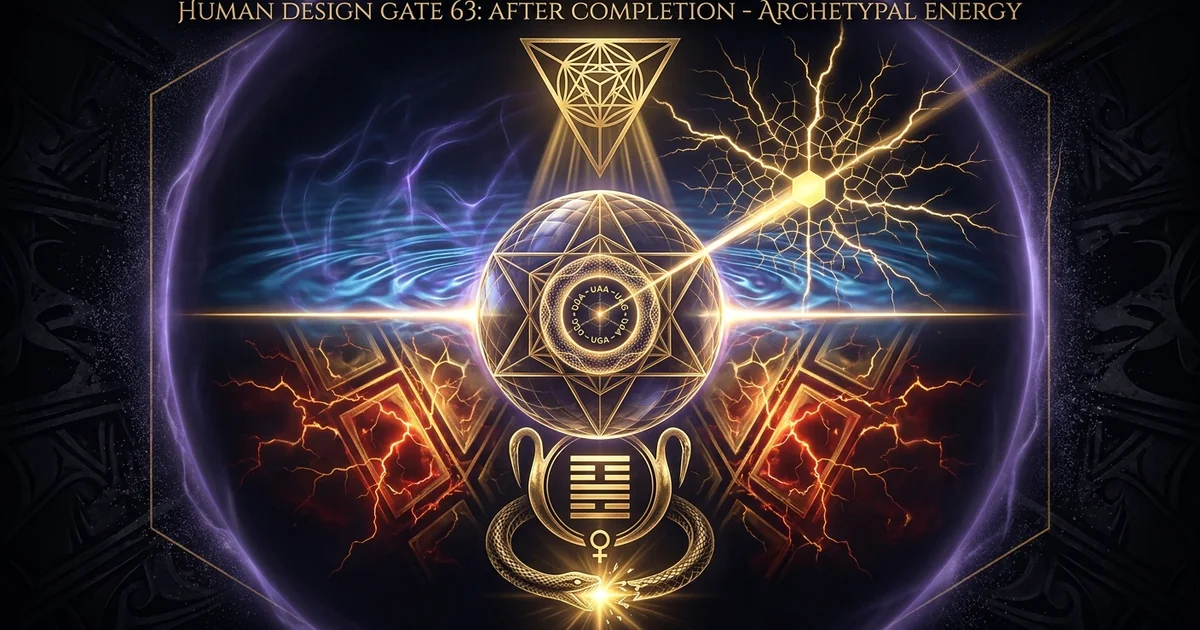
Human Design Gate 63 (After Completion): Archetypal Energy
Archetypal Thesis & Systemic Paradigm: The Logic of Critical Doubt
Epistemic Entropy: The Paradox of Completion
In the formal architecture of psycho-cosmological mechanics, human design gate 63 after completion occupies a paradoxical position within the epistemic apparatus of human consciousness. Derived from the sixty-third hexagram of the I Ching (既濟, Ji Ji), this energetic archetype marks the exact structural moment at which order reaches its absolute zenith, triggering an immediate and inevitable descent into entropy. The structural geometry of Hexagram 63 presents an idealized equilibrium: every line occupies its correct energetic polarity—yin lines in yin positions, yang lines in yang positions—symbolizing a closed, perfected system. Yet, within systemic cybernetics and classical metaphysics alike, total equilibrium is functionally indistinguishable from thermodynamic death. A system that has resolved all internal contradictions possesses zero capacity for further adaptation, rendering it acutely vulnerable to environmental volatility.
Gate 63 resolves this thermodynamic threat by mutating completion into an epistemic engine. Rather than solidifying certainty, the energetic footprint of this gate introduces an intrusive, non-negotiable skepticism into the human cognitive architecture. The psychological state of absolute completion is fundamentally unstable; equilibrium inevitably breeds cognitive blindness unless an active falsification vector intervenes. Gate 63 serves as this precise vector, acting not as an indicator of satisfaction, but as the primordial origin of questioning within the Collective Logic Circuit. It challenges the assumption that because a paradigm has brought a cycle to successful fruition, it remains eternally valid.
This dynamic corresponds directly to Karl Popper’s criterion of falsifiability: no amount of historical empirical success can permanently substantiate a general theory, as a single contradictory instance can invalidate the premise. Gate 63 injects this Popperian imperative directly into the human nervous system. Operating through the mechanics of the Head Center mechanics, the gate refuses to allow historical patterns to calcify into unexamined dogma. It does not celebrate the conclusion of a sequence; it interrogates its structural durability, searching relentlessly for the structural fracture that could precipitate civilizational or systemic collapse.
The Head-to-Ajna Vector in Collective Circuitry
Within the mechanical circuitry of the BodyGraph, Gate 63 is positioned in the Head Center, looking downward toward the Ajna. It represents the fuel of logic, specifically the neurological and cognitive pressure to question. As an unmotorized pressure node, Gate 63 does not execute action, nor does it formulate conceptual solutions. Its sole energetic currency is the raw, unadorned tension of the question itself. This pressure is projected across the Channel 63–4 Logic toward Gate 4 (Youthful Folly) in the Ajna Center, which is tasked with generating mental formulas, hypotheses, and potential answers to discharge the pressure established by the sixty-third gate.
The systemic purpose of this vector is strictly collective. Collective circuitry operates on the premise of sharing patterns that ensure the safety, survival, and evolutionary progression of the species as a whole. This is categorically distinct from tribal circuitry, which functions through communal loyalty, tactile support, and emotional resonance. Where tribal circuitry protects the continuity of bloodlines and traditional pacts regardless of empirical validity, the Collective Logic Circuit demands absolute objective verification. Gate 63 energetics disregard sentimentality; a pattern is either logically consistent and replicable, or it is dangerous to the collective future.
Consequently, the doubt generated by Gate 63 is inherently depersonalized. When functioning according to its authentic design, it does not doubt the self, nor does it evaluate personal emotional worth. Instead, it directs its analytical spotlight outward onto collective processes, methodologies, scientific frameworks, and institutional claims. The tragedy of the unconditioned human experience occurs when this macrocosmic falsification engine is turned inward, transforming the pressure to verify external patterns into an acute, paralyzing self-loathing.
Thermodynamic Pressure vs. Mental Resolution
The mechanical distinction between the Head Center and the Ajna Center is critical for understanding gate 63 energetics. The Head Center operates as an endocrine and energetic pressure chamber, driven by pineal and cortical feedback loops that register cognitive friction. Gate 63 generates an ambient state of epistemic unease—a persistent awareness that the current model of reality is incomplete, inaccurate, or decaying. This thermodynamic pressure is not intended to be resolved within the Head Center itself. It is a catalyst meant to stimulate the interpretive faculties of the Ajna.
[ Head Center ]
             |
          (Gate 63)  <-- Pressure / Fuel of Doubt
             |
      [ Channel 63-4 ]
             |
          (Gate 4)   <-- Formularization / Hypothesis
             |
       [ Ajna Center ]
When an individual lacks awareness of this mechanical division, they routinely mistake the mental pressure of Gate 63 for a condition requiring immediate behavioral action. This misattribution compels the individual to force a premature manifestation through the Throat Center manifestation pathways, bypassing the necessary processing stages of hypothesis generation (Gate 4), organizational structuring (Gate 17), and empirical articulation (Gate 62). The result is the vocalization of raw anxiety masquerading as logical inquiry.
Furthermore, the pressure of Gate 63 is invariant; it does not abate upon the discovery of an answer. Because it is tied to the cyclical nature of logic—which requires constant testing and re-testing against new environmental variables—the resolution of one inquiry merely exposes the foundational premise of the next. To inhabit Gate 63 is to accept an existence of perpetual cognitive agitation, wherein certainty is understood not as an ultimate destination, but as a temporary, unstable plateau between necessary iterations of doubt.
Classical Provenance & Textual Lineage: From Ji Ji to Modern Cybernetics
The Zhouyi Canon: Water over Fire (Kan over Li)
The structural genesis of Gate 63 resides within the sixty-third hexagram of the Zhouyi (I Ching), known as Ji Ji (After Completion). In classical Chinese cosmology, the spatial arrangement of the trigrams reveals the acute tension latent within this archetype. Hexagram 63 is composed of the trigram Kan (Water, the Abysmal) positioned above the trigram Li (Fire, the Clinging). This juxtaposition constitutes one of the most dynamic interactions in the entire sixty-four hexagram sequence.
Trigram Kan (Water)  ☵  [ Upper: Abyss / Danger / Epistemic Depth ]
                      --
                      --
Trigram Li (Fire)    ☲  [ Lower: Radiance / Clarity / Combustion ]
Water naturally descends, flowing toward the lowest point, while Fire naturally ascends, its flames leaping upward. When Water is placed above Fire, their energetic trajectories intersect directly: the downward movement of the water meets the upward heat of the fire, creating steam, driving engines, and cooking nourishment. In this specific configuration, work is accomplished, and the elemental forces exist in intimate, productive relationship. However, this productive thermodynamic state contains the seeds of its own dissolution. If the fire burns too hot, the water boils away into vapor; if the water is too vast, the fire is permanently extinguished.
“Water over fire: the image of the condition in After Completion. Thus the superior man takes thought of misfortune and arms himself against it beforehand. When water is above fire, the two elements stand in intimate relation and can accomplish work, but as soon as the work is done, the equilibrium is disrupted; order reverts to disorder unless vigilance is perpetually maintained.”
The classical Chinese commentary explicitly notes that while all six lines are in their “correct” places—firm lines in odd positions (1, 3, 5) and yielding lines in even positions (2, 4, 6)—this mathematical perfection is inherently transient. The Tuan Zhuan (Commentary on the Decision) stresses that at the beginning there is good fortune, but at the end, disorder reigns. The archetype warns that the absolute attainment of form is the exact threshold of decay. Thus, the ancient diviner approached Ji Ji not with triumphant celebration, but with profound trepidation and structural vigilance.
Wang Bi and Cheng Yi: The Inevitability of Decay Post-Perfection
The exegetical traditions of Neo-Daoism and Neo-Confucianism developed this mechanical paradox into a profound philosophical methodology. Wang Bi (226–249 CE), in his commentary on the Yijing, observed that perfection of structure inevitably invites the cessation of movement. When a state reaches total order, any subsequent movement threatens that order. Therefore, Wang Bi argued that preservation of the state achieved in Ji Ji requires a continuous, micro-adjusting awareness of failure. To maintain balance, one cannot rest in the illusion of achievement; one must perceive the incipient chaos within the apparent order.
Centuries later, the Song Dynasty Neo-Confucian master Cheng Yi (1033–1107 CE) expanded this observation into a comprehensive sociopolitical warning in his Yichuan Yizhuan. Cheng Yi noted:
“When one has completed the crossing of a great river, the danger has seemingly passed, but it is precisely when danger is perceived to have passed that people relax their vigilance, leading to catastrophe. The condition of After Completion is one in which the potential for decay is highest because human psychology naturally succumbs to complacency.”
Cheng Yi identified that the primary vulnerability of Ji Ji is not external aggression, but internal epistemic rot. The moment an administrative, philosophical, or spiritual system declares that it has arrived at the definitive truth, it ceases to observe the subtle environmental shifts that render its doctrines obsolete. For Cheng Yi, Hexagram 63 demands proactive suspicion toward established order rather than passive preservation. One must act as an epistemic sentinel, inspecting every joint of the systemic architecture for the microscopic fractures that precede macroscopic collapse.
Transmission into Ra Uru Hu’s Synthesis
When Robert Alan Krakower (Ra Uru Hu) synthesized these ancient structural dynamics into the Human Design System in 1987, he preserved the exact mathematical and archetypal integrity of Hexagram 63 while translating its moralistic and divinatory language into the precise vernacular of biological mechanics. In Krakower’s cosmology, the traditional “superior man” who arms himself against misfortune becomes the mechanical firing of a cognitive pressure center designed to preserve the collective genetic pool.
Ra Uru Hu stripped Gate 63 of its historical connotations of karmic judgment or moral duty, contextualizing it instead as an immutable mechanical circuit. In The Definitive Book of Human Design, Krakower establishes that the human design gate 63 after completion operates as the indispensable spark of the logical mind. He posited that without Gate 63’s unrelenting skepticism, humanity would succumb to superstitions, untested assumptions, and terminal cognitive complacency. The historical advice of the Zhouyi—to remain vigilant when the work is finished—is revealed in the Human Design synthesis as an evolutionary adaptation hardwired into the neurobiology of the Head Center.
This modern transmission recontextualizes ancient prophetic wisdom as cybernetic feedback loops. The “misfortune” anticipated by the Zhouyi sages is nothing less than the failure of an untested pattern. Gate 63 does not look back at the past with nostalgia; it looks at the historical completion of a cycle and asks, with cold analytical detachment: Is this truly sustainable for the future? The classical transition from Ji Ji to the sixty-fourth hexagram, Wei Ji (Before Completion), forms the perpetual engine of human consciousness—a dynamic that Krakower mapped directly to the neural architecture spanning the human skull.
Structural Mechanics & Symbolic Geometry: Codons, Centers, and Lines
Molecular Epigenetics: The Stop Codon Architecture
The systemic elegance of the Human Design System becomes extraordinarily pronounced at the intersection of the I Ching hexagram matrix and the sixty-four codons of the universal genetic code. Gate 63 maps precisely to one of the three molecular termination signals—specifically the UAA (Ochre) stop codon in messenger RNA transcription. The molecular research articulated by Gunther S. Stent in The Coming of the Golden Age: A Narrative of the End of Progress and the Logic of the Genetic Code provides an indispensable conceptual parallel to this esoteric mapping.
Hexagram 63: Ji Ji (Water over Fire / Trigram Kan over Trigram Li)
Genetic Codon: UAA / Ochre (Termination Codon)
Center: Head Center (Inspiration / Pressure)
Circuit: Collective Logic (Understanding Circuit)
Channel: 63–4 (Logic: A Design of Mental Ease Mixed with Doubt)
Opposing Gate: Gate 64 (Before Completion / Head Center Abstract Pressure)
In molecular biology, a stop codon does not code for an amino acid; rather, it signals the ribosome to halt the translation of the polypeptide chain. The stop codon introduces a biochemical boundary condition, ensuring that the protein being synthesized terminates at the exact structural point required for functional folding. If a termination codon fails to execute its function, the ribosome continues transcription indiscriminately, yielding aberrant, elongated, and dysfunctional proteins that precipitate cellular pathology or oncogenesis.
Gate 63 functions identically within the cognitive and linguistic domain. It is an epistemic stop codon. It halts the uncritical replication of conceptual structures, saying to the cognitive apparatus: Halt translation; verify the sequence before this structure is released into the systemic physiology. By operating as a genetic stop signal, Gate 63 prevents cognitive “aberrant proteins”—in the form of dogma, false conclusions, and unverified assumptions—from entering the bloodstream of collective understanding. It interrupts the cycle of synthesis to enforce structural quality control.
Trigram Dynamics and Line Permutations (Lines 1 through 6)
The developmental trajectory of gate 63 energetics unfolds across its six discrete line levels, moving from foundational mechanical stability to the total dissolution of structural integrity at the sixth line:
[ Line 6: ☵ Yin ] -- Over-reaching / Sinking the Head (Collapse of Perspective)
[ Line 5: ☵ Yang] -- Superficiality / The Ox Slaughtered (Ritual vs. Substance)
[ Line 4: ☵ Yin ] -- Memory / The Wadded Clothes (Proactive Preparedness)
----------------- Trigram Boundary (Kan / Li)
[ Line 3: ☲ Yang] -- Continuation / The Attack on Guifang (Exhaustion through Effort)
[ Line 2: ☲ Yin ] -- Critical Restraint / The Lost Veil (Patience under Scrutiny)
[ Line 1: ☲ Yang] -- Composure / Braking the Wheels (Incipient Hesitation)
Line 1: Composure (Braking the Wheels)
The entry point of the gate mirrors the classical image of a chariot driver applying the brakes while crossing a threshold. Here, the doubt manifests as an instinctive, foundational hesitation. Line 1 recognizes that momentum is the primary enemy of precision. In the logic circuit, this represents the vital capacity to pause at the inception of a pattern, verifying the structural integrity of the first principles before committing resources to mental formulation.
Line 2: Critical Restraint (The Lost Veil)
Operating through yin receptivity, Line 2 embodies the discipline of waiting for the appropriate timing to voice skepticism. The classical motif of a woman losing her carriage veil suggests a temporary loss of external protection; the strategy here is not to scramble aggressively to reclaim it, but to remain composed. In practical cognition, this is the capacity to hold doubt internally without succumbing to the anxiety of needing immediate confirmation or validation from the external world.
Line 3: Continuation (The Attack on Guifang)
Here, the fire of the lower trigram reaches its peak, threatening to boil over into reckless action. The classical reference recalls King Wu Ding’s three-year campaign against the northern demon territory (Guifang), an exhausting endeavor that yielded minimal real value. Line 3 warns of the exhaustion that occurs when doubt is treated as a battle to be won through brute mental force. It represents the chronic over-exertion of trying to solve every uncertainty through endless, obsessive intellectual combat.
Line 4: Memory (The Wadded Clothes)
Crossing the threshold into the upper trigram of Water, Line 4 confronts the vulnerability of the vessel. The image is that of a boat that has developed leaks, requiring the traveler to pack rags and wadded clothes into the seams to keep the craft afloat. Line 4 possesses the structural foresight to anticipate systemic decay. It utilizes the memory of past failures to prepare pragmatic, immediate defenses against the coming chaos, acting as a preventative maintenance mechanism within the collective paradigm.
Line 5: Superficiality (The Ox Slaughtered)
Line 5 captures the tension between elaborate external performance and genuine internal substance. The Zhouyi compares the lavish slaughtering of oxen by the eastern neighbor to the modest, sincere offering of the western neighbor. In Gate 63, Line 5 cautions against masking deep epistemic anxiety behind elaborate, complex intellectual systems that possess no practical utility. It demands that logic strip away ornate theoretical pretensions and return to raw, functional efficacy.
Line 6: Over-reaching (Sinking the Head)
The apex of the hexagram depicts the traveler who, having successfully crossed the waters, wades so deeply into the shallows that the water rises above their head. This is the complete collapse of perspective. Line 6 represents the existential hazard of hyper-skepticism—doubt that has become so detached, recursive, and absolute that it drowns the observer in cognitive nihilism. It is skepticism that has forgotten its collective, protective purpose and has instead become an instrument of universal destruction.
The 63–4 Polarity: The Channel of Logic (Abstract Invariance)
Gate 63 cannot be understood in isolation; its teleological purpose is entirely dependent upon its partnership with Gate 4 in the Ajna Center, forming the Channel of Logic (often termed the Channel of Mental Ease Mixed with Doubt). This channel constitutes the primary spine of the collective-logic-circuit. Where Gate 63 provides the pressure of the unanswerable question, Gate 4 provides the mechanical capacity to project potential solutions.
This dynamic creates an essential energetic polarity. Gate 63 is invariant, pure, and insatiable: it demands absolute, empirical truth. Gate 4, however, operates through the medium of formulas and hypotheses. A hypothesis is not the ultimate truth; it is merely an intellectual construct that serves as a provisional framework until a better model emerges. Therefore, the tension within Channel 63–4 is the perpetual dialogue between the infinite question (63) and the finite, temporary answer (4).
This collective dynamic stands in sharp, uncompromising contrast to the operations of tribal-circuitry. Tribal circuitry relies on allegiance, blood ties, and communal preservation, which often demand the suppression of doubt to maintain social cohesion. In tribal structures, to doubt the elder, the creed, or the covenant is an act of treason. Conversely, in the Collective Logic Circuit anchored by Gate 63, to withhold doubt is an act of evolutionary negligence. The 63–4 polarity systematically dismantles nepotism, emotional comfort, and unearned authority in its singular quest to establish patterns that can survive empirical stress-testing for the collective benefit of humanity.
Psychological Dynamics & Operational Praxis: Transmuting Mental Anxiety
The Shadow of Intrusive Skepticism: Self-Directed vs. Pattern-Directed Doubt
The psychological landscape of gate 63 energetics is defined by its acute susceptibility to inversion. Because the Head Center operates at a neurochemical level via mental pressure, an individual bearing a defined Gate 63 experiences a continuous, humming undercurrent of cognitive tension. In the unawakened or unconditioned state, the ego-mind—seeking desperately to rationalize this physiological pressure—attaches the doubt to the nearest subjective object: the self.
[ GATE 63 ENERGETICS ]
                 |
      -----------------------
      |                     |
 [ Inverted Shadow ]   [ Objective Praxis ]
      |                     |
 Self-Directed Doubt   Pattern-Directed Doubt
 Identity Paralysis    Methodological Testing
 Existential Anxiety   Empirical Refinement
 Tribal Disruption     Collective Evolution
When this inversion occurs, the healthy falsification engine of the collective becomes an internal instrument of psychological torment. The individual begins to question their own competence, their strategic direction, their moral validity, and their inherent worthiness. Questions such as “What is wrong with this system?” become mutated into “What is wrong with me?” This internalized doubt generates severe decision paralysis, obsessive over-thinking, and a chronic inability to settle into any life circumstance without immediately hunting for its imminent failure.
Dysfunctional / Shadow Dynamic
Internalized self-doubt, leading to chronic decision paralysis; projecting epistemic uncertainty onto personal relationships and tribal loyalty; premature attempts to force the Throat Center into vocalizing unresolved Head Center pressure.
Integrated / Functional Praxis
Objective pattern falsification; depersonalized testing of scientific, societal, and mathematical systems; patient delegation of doubt through the Ajna for methodological formulation before public communication.
Furthermore, when this internalized skepticism is projected outward into interpersonal relationships, it corrodes social structures. The individual may begin to subject their partners, friends, and family members to rigorous, prosecutorial interrogation, demanding absolute logical proof for emotional commitments that belong properly to the tribal or individual circuitry. The shadow of Gate 63 attempts to use logic where logic has no jurisdiction, destroying organic intimacy through an inappropriate demand for mechanical perfection.
Clinical Integration: Moving Doubt from Identity to Methodology
In clinical, psychotherapeutic, and Human Design consulting contexts, the strategic intervention for an individual grappling with Gate 63 tension involves an uncompromising process of depersonalization. The practitioner must guide the individual to recognize that the doubt humming within their cranium is not a personal pathology; it is an impersonal, evolutionary frequency passing through their neurobiology.
To achieve this integration, the client must be trained to separate identity from methodology:
- Epistemic Disidentification: The client learns to observe the pressure of Gate 63 as a biological weather pattern within the Head Center, actively refusing to allow the question “Is this true?” to morph into “Am I enough?”
- Externalization of the Vector: The analytical faculty is deliberately redirected outward toward external systems, crafts, research methodologies, organizational logistics, or scientific phenomena. The doubt is granted its proper status as a diagnostic tool rather than an existential verdict.
- Cultivation of Intellectual Patience: The client must be educated on the mechanics of the unmotorized Head Center. They must realize that possessing the question does not mean they are equipped to provide the answer; their role may simply be to articulate the critical flaw that others are designed to solve.
Through this clinical shift, the individual transforms from an anxious neurotic plagued by obsessive questioning into a skilled epistemologist. They become capable of offering high-level critical appraisal to their communities, businesses, and scientific domains without attaching their personal stability to the outcome of the analysis.
The Mechanics of Channeling Logic Toward the Throat Center
A primary mechanical error observed in chart analysis is the premature attempt to speak the pressure of Gate 63 directly through the Throat Center. The Head Center has no direct acoustic or motor connection to the Throat. For an insight originating in Gate 63 to reach clear, authoritative manifestation in the world, it must traverse a complex downstream architectural sequence:
[ Gate 63: Head ]
       ↓ (Channel 63-4: Pressure converted to Hypothesis)
[ Gate 4: Ajna ]
       ↓ (Internal Ajna Processing: Structural Evaluation)
[ Gate 17: Ajna ]
       ↓ (Channel 17-62: Organizational Structuring)
[ Gate 62: Throat ]
       ↓ (Acoustic Articulation of Verified Patterns)
[ Manifestation in the World ]
When an individual attempts to skip these intermediate processing centers—attempting to manifest directly from Gate 63 without the structural formulations of Gate 4 and the linguistic codification of Gate 62—the communication manifests as disjointed, anxious blurt-outs. The individual speaks from a place of ungrounded mental pressure, presenting chaotic uncertainties that confuse the collective rather than clarifying the pattern.
True operational mastery of Gate 63 requires honoring the mechanical constraints of the collective circuit: doubt must wait for the proper organizational framework to emerge before it is shared. When an individual respects this pathway, their vocalizations through the Throat Center carry immense transformative weight. Rather than sounding like alarmist paranoia, their assessments land as calm, surgically precise diagnoses of system vulnerabilities, allowing the collective to refine its path forward with confidence.
Philosophical Synthesis & Macrocosmic Correspondence: Hermetic Polarities
The Hermetic Principle of Rhythm: The Pendulum between 63 and 64
In the wider context of Western esotericism, Gate 63 functions as a profound manifestation of the Hermetic Principle of Rhythm. As articulated in The Kybalion, “The measure of the swing to the right is the measure of the swing to the left; rhythm compensates.” Within the Head Center architecture, Gate 63 (After Completion) sits directly opposite Gate 64 (Before Completion). These two gates represent the ultimate archetypal pendulum of human cognition.
[ THE HERMETIC COGNITIVE POLARITY ]
   Gate 63 (After Completion)
       |  - Water over Fire (Order → Entropy)
       |  - Collective Logic (Doubt & Verification)
       |  - Future-Oriented Structural Stress-Testing
       |
       ~  THE PENDULUM OF CONSCIOUSNESS  ~
       |
   Gate 64 (Before Completion)
       |  - Fire over Water (Chaos → Coherence)
       |  - Collective Abstract (Memory & Reflection)
       |  - Past-Oriented Retrospective Synthesis</code></pre>
Hexagram 63 embodies the logical mind looking toward the future, seeking to prevent catastrophe by critically analyzing the structures inherited from the past. Hexagram 64, conversely, embodies the abstract, experiential mind looking backward into the past, processing chaotic memories to harvest collective wisdom. Gate 63 begins where everything is completed and order reigns; Gate 64 begins where nothing is completed and chaos is paramount.
Together, they form an unbreakable macrocosmic feedback loop. The logical doubt of Gate 63 dismantles calcified paradigms, plunging consciousness into the rich, unstructured chaos of Gate 64. Through Gate 64’s artistic, historical, and reflective integration, a new coherence is gradually assembled, which eventually crystallizes into a new structure of absolute completion—which is immediately seized upon once again by the relentless skepticism of Gate 63. This is the eternal wheel of epistemic evolution: the rhythmic pulsation between cosmic crystallization and creative dissolution.
Jungian Archetypal Active Imagination and the Epistemic Scribe
Through the lens of Jungian depth psychology, as articulated by Marie-Louise von Franz in Number and Time: Reflections Leading toward a Fundamental System of Divination and the Synchronicity of Number, the sixty-four hexagrams correspond to objective archetypal configurations within the collective unconscious. Within this framework, Gate 63 embodies the Archetype of the Epistemic Scribe or the Inquisitor-Chronicler.
“No psychic value can be preserved unless it continuously undergoes transformation. Whenever an archetype achieves absolute conscious completion, it petrifies into a dogma, thereby invoking its own shadow—an autonomous dynamic of doubt designed to dismantle the calcified structure.”
In Jungian active imagination, the figure that emerges from the energetic field of Gate 63 is the severe, impassive auditor of the unconscious. This archetypal figure refuses to be charmed by the ego’s triumphant declarations of individuation or moral victory. It stands at the gates of the newly built conscious temple, carrying the plumb line, checking for the slightest tilt in the foundation. It serves as an autonomous compensatory dynamic against the inflation of the Senex (the calcified wise old man who believes he possesses absolute knowledge).
The Scribe does not operate out of malice; its role is one of profound psychological hygiene. If the conscious mind is allowed to settle permanently into an unassailable dogma, the vitality of the psychic energy (libido) is choked off, leading to neurosis and the autonomous rebellion of the rejected unconscious contents. Gate 63 ensures that psychic dogma is systematically exposed to the solvent of doubt, keeping the unconscious-conscious dialogue porous, dynamic, and perpetually alive.
Macrocosmic Cycles: Epistemological Evolution and Paradigm Collapse
At the macrocosmic level of civilizational history, human design gate 63 after completion represents the inevitable crisis that strikes every golden age, scientific consensus, or imperial hegemony. Thomas Kuhn’s concept of the “paradigm shift” in The Structure of Scientific Revolutions provides the ideal sociopolitical model for Gate 63 mechanics.
A scientific paradigm begins in the open-ended exploration of the abstract circuit, solidifies through institutional codification, and reaches a state of “normal science”—a historical epoch in which all observations are expected to conform neatly to the established theoretical model. This is the historical instantiation of Ji Ji: every line is in its correct place; the science is declared settled; the empire’s borders are secure; the work is finished.
Yet, it is precisely at this civilizational peak that gate 63 energetics awaken. Minor anomalies—empirical observations that refuse to fit into the established paradigm—are suddenly illuminated by the critical doubt of the collective logic circuit. Initially, the institutional orthodoxy attempts to suppress these doubts, viewing them as heretical or chaotic threats to order. However, because Gate 63 represents an immutable stop codon in the collective neurobiology, the questions refuse to dissolve. The skepticism mounts, the pressure builds within the collective Head Center, until the theoretical model collapses under the weight of its own internal inconsistencies, giving birth to a new scientific epoch. Gate 63 is the cosmic immune response against the petrification of human civilization.
Frequently Asked Questions: Analytical Distinctions in Gate 63
Resolving Cognitive Misconceptions: Doubt vs. Suspicion
A persistent semantic and mechanical confusion in BodyGraph analysis is the conflation of the doubt of Gate 63 with the suspicion found in other areas of the BodyGraph, particularly within tribal-circuitry or individual splenic awareness.
Collective doubt (Gate 63) is non-personalized, structural, and methodological. It does not ask: “Can I trust this person?” or “Are they plotting against me?” Those questions belong strictly to the survival and integrity matrices of tribal and individual survival mechanics (such as the Splenic Spleen Center and the emotional Solar Plexus). Collective doubt asks: “Does this formula hold true across one million iterations?” and “Is this bridge engineered to withstand unprecedented seismic strain?”
When an analyst misidentifies Gate 63 as personal suspicion, they reinforce the shadow dynamic of the gate. Clients must be taught that doubt is an intellectual instrument for collective safeguarding, whereas suspicion is an instinctual survival reaction to interpersonal dynamics. Conflating the two leads individuals to weaponize a scientific instrument within their private emotional relationships.
Tribal vs. Collective Boundaries in Human Design Analysis
To properly locate Gate 63 within a chart reading, the practitioner must draw a rigorous demarcation between the requirements of collective logic and the demands of tribal survival. In tribal circuitry, the highest currency is loyalty, cohesion, and mutual support. The tribe operates through pacts: “I will share my food with you, provided you honor our customs, our gods, and our bloodline.” The introduction of unvarnished Gate 63 logic into a pure tribal dynamic is almost universally perceived as betrayal.
If an individual brings the surgical, falsifying doubt of Gate 63 home to their family dinner table, challenging the traditional religious or cultural dogmas of their clan, the tribe will inevitably respond with defensive hostility. The tribe does not care if its mythologies are scientifically replicable; it cares whether those mythologies maintain tribal solidarity. The analyst must emphasize that Gate 63 is built for the collective stage—for academia, engineering, institutional auditing, societal reform, and empirical research. It must be wielded where objective truth is the mandate, and held in conscious abeyance where relational loyalty and emotional communion are the operating currencies.
Transmutation of Head Center Pressure in Chart Interpretation
When interpreting a BodyGraph featuring an undefined Head Center with a defined Gate 63 hanging, unique conditioning dynamics emerge. An individual with an undefined Head Center possesses an open biological receptacle for cognitive pressure. When Gate 63 is activated as a dormant gate within this undefined center, the individual amplifies the collective doubts of the world around them, absorbing the ambient uncertainties of their environment and interpreting them as their own personal mental crisis.
[ UNDEFINED HEAD CENTER ]
                  |
     Amplifies Ambient Epistemic Noise
                  |
         [ HANGING GATE 63 ]
                  |
      Funnels Chaotic Pressures into
       Acute, Hyper-Focused Self-Doubt
                  |
     [ STRATEGIC INTERVENTION ]
                  |
       1. Identify external source
       2. Release personal identification
       3. Treat as diagnostic tool
In such cases, the analytical guidance must be uncompromising:
- The individual must recognize that the intense pressure to understand, resolve, or eliminate doubt does not belong to them. They are functioning as an antenna for the collective questions of their era.
- They must refuse to allow their open mental apparatus to be conscripted into solving problems that have no direct bearing on their Strategy and Authority.
- They should utilize their hanging Gate 63 as a diagnostic instrument, observing what the surrounding culture is questioning without adopting the burden of generating the answers.
By shifting from an identified participant to a detached, objective witness of epistemic pressure, the individual transfigures the potential agony of a chaotic, ungrounded Head Center into an exquisite, highly refined sensitivity to the structural vulnerabilities of the modern world. In this state of mechanical clarity, human design gate 63 after completion fulfills its ultimate evolutionary design: preserving the future of the human collective through the merciless, compassionate application of transcendent doubt.