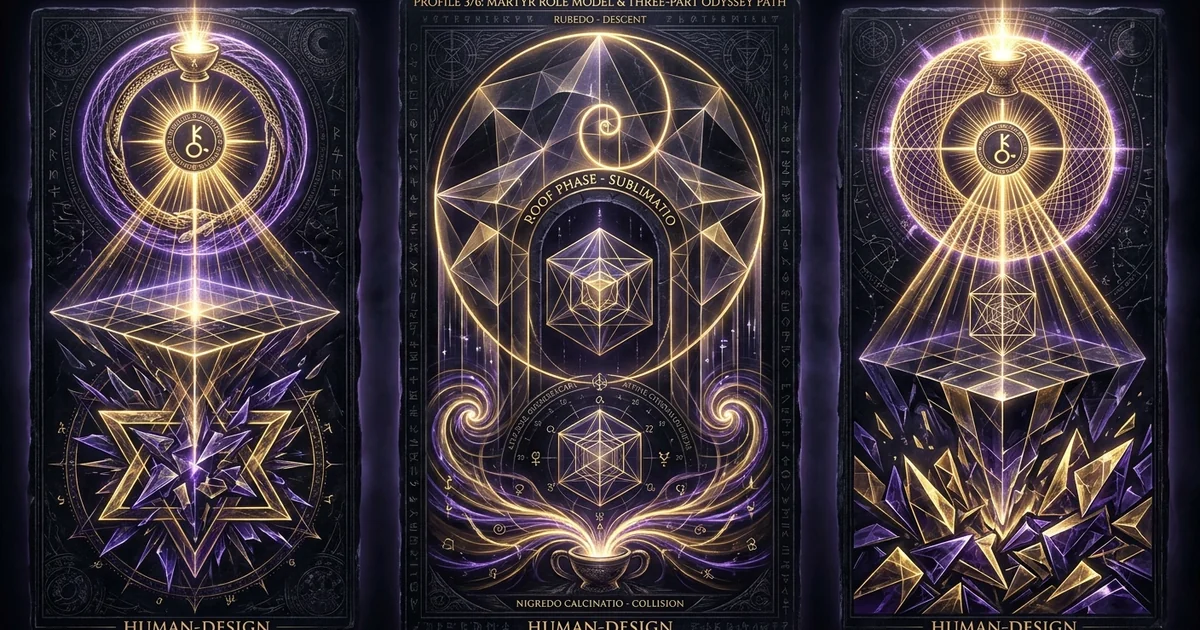
Profile 3/6: Martyr Role Model & Three-Part Odyssey Path
Archetypal Thesis & Systemic Paradigm: The Cybernetic Mechanics of the 3/6 Geometry
Dialectic of the Conscious Martyr and Unconscious Role Model
In the mechanics of the Rave Mandala, the 3/6 profile occupies a structurally anomalous and strategically vital position within evolutionary cartography. Operating across an ontological divide, this profile pairs the conscious personality of the 3rd line—the archetype historically termed the Martyr—with the unconscious design of the 6th line, the Role Model. This structural juxtaposition establishes a permanent, dynamic tension between lower-trigram-mechanics and upper-trigram-mechanics. The conscious 3rd line operates within the immediate, personal, and tangible domain of the lower trigram (lines 1, 2, and 3), grounding the native in direct tactile engagement, material friction, and baseline reality testing. Conversely, the unconscious 6th line represents the ultimate threshold of the upper trigram (lines 4, 5, and 6), embodying transpersonal awareness, systemic transition, and a teleological longing for perfection.
The resulting psychic constitution is neither wholly immersed in the mundane trenches of life nor entirely elevated above them. Instead, the native manifests as a living paradox: an individual whose waking ego-consciousness is continually propelled into trial, collision, and systemic disruption, while their genetic, unconscious substratum remains anchored in the detached vantage point of a cosmic auditor. The conscious Mind perceives its life path as an unrelenting sequence of unexpected ruptures, severed alliances, and physical collisions. Yet, running beneath this conscious turbulence, the biological vehicle moves along a precise geometric trajectory toward ultimate exemplarity.
To comprehend the profile 3 6 martyr role model human design configuration requires abandoning moralistic judgments of failure or dysfunction. The dialectic between the conscious 3 and the unconscious 6 is not a structural defect, but a sophisticated bio-cognitive mechanism. The personality must directly experience material fragility, error, and vulnerability through the 3rd line to prevent the unconscious 6th line from degenerating into ivory-tower aloofness, spiritual arrogance, or detached hypocrisy.
The conscious 3rd line ensures that the native’s eventual transpersonal wisdom is not derived from abstract theory, but forged through sustained empirical contact with systemic faults. By grounding the lofty systemic audit of the 6th line within the blood, dust, and wreckage of empirical experimentation, the 3/6 profile produces an authority that is unassailable precisely because it has survived and cataloged every conceivable permutation of failure.
The Genetic Error-Correcting Mechanism of the Third Line
The mechanics of the 3rd line, detailed within the foundational research of hexagram line mechanics, operate as an evolutionary error-correcting algorithm. Line 3 is the culmination of the lower trigram, representing the completion of foundational self-absorption and the inevitable collision with the external world. It functions as an empirical stress-test against existing frameworks, protocols, and materials. Where the 1st line investigates foundational truth and the 2nd line operates in natural, unselfconscious projection, the 3rd line discovers what is unstable, corrupt, or operationally unviable.
In the standardized lexicon of the Human Design System, this line dynamic is characterized as “bonds made and broken,” an operational law that governs both social dynamics and material encounters. The 3rd line personality does not stumble into error through ignorance or moral deficiency; rather, its genetic coding draws it into direct contact with the weakest link in any system. Whether examining a scientific paradigm, a mechanical structure, an ideological schema, or an interpersonal relationship, the conscious 3rd line instinctively identifies the breaking point. The conscious personality experiences this as sudden disruption: a business partnership collapses, an apparatus breaks, an ideology reveals an irreconcilable paradox.
+-------------------------------------------------------------------------+
|                  THE 3/6 DIALECTICAL TENSION MATRIX                     |
+-------------------------------------------------------------------------+
| Line 3 (Conscious Personality)     | Line 6 (Unconscious Design)        |
| - Lower Trigram Culmination        | - Upper Trigram Apex / Roof        |
| - Tactile, Empirical, Frictional   | - Transpersonal, Systemic, Aloof   |
| - Immediate Material Collision     | - Panoramic Evolutionary Overview  |
| - Bonds Made and Broken Mechanics  | - Trust, Disillusionment, Exemplar |
| - Uncovers What Does Not Work      | - Demands Absolute Perfection      |
+-------------------------------------------------------------------------+
When filtered through societal conditioning, this dynamic induces defensive guilt, existential exhaustion, and chronic imposter syndrome. However, viewed from the vantage point of species survival, the 3rd line serves as the immune system of humanity. It tests hypotheses through visceral, kinetic encounter. The 3rd line is the genetic mechanism that tastes the poisonous berry so the rest of the tribe does not perish; it pulls the structural beam until it fractures to expose architectural flaws before the roof is constructed. In the 3/6 profile, this trial-and-error crucible is explicitly harnessed to serve a broader transpersonal destiny, ensuring that any model the native ultimately legitimizes has been ruthlessly stress-tested against the material world.
Transpersonal Teleology: From Empirical Mutation to Exemplary Authority
The evolutionary vector of the 3/6 profile moves from the specific to the universal, from subjective catastrophe to objective, differentiated leadership. This teleological trajectory distinguishes the 3/6 from its lower-trigram sibling, the 3/5 profile. While the 3/5 utilizes its empirical discoveries to universalize practical solutions for a projecting collective, the 3/6 is not concerned with mere pragmatism. Governed by the transition mechanics of the 6th line, the 3/6 operates under an evolutionary mandate to establish a standard of being rather than a strategy of doing.
This shift represents the classic mutation analyzed in trigram geometry and mutation. The 6th line sits above the hexagram proper; it is not merely the final stage of a situation, but the transitional bridge to the initial line of the subsequent hexagram on the Rave Mandala wheel. Consequently, the unconscious design of the 3/6 profile holds an intrinsic memory of the broader mandala architecture. It seeks an authentic, incorruptible truth—an existential perfection capable of enduring systemic collapse.
During the arduous initial decades of life, this transpersonal longing for perfection is repeatedly battered by the experiential reality of the conscious 3rd line. The native witnesses systemic failure at every turn, which fosters acute cynicism. Yet it is precisely through the systematic destruction of false models that the 3/6 fulfills its teleological design. By exhausting all invalid trajectories, the native systematically isolates what is durable, coherent, and pure.
When the 3/6 finally emerges into its mature, late-stage realization, it steps forward not as a theoretician, but as an exemplary elder. The authority of the 3/6 is unshakeable because it is fundamentally visceral; having survived and assimilated the structural failure of human systems, the native embodies an existential resilience that demands nothing, projects nothing, and serves as a living template of authentic, differentiated individuation.
In the biomechanics of Human Design, the 3rd line corresponds directly to the stop/start codon boundary configurations within genetic translation, operating as an interrupted sequence that demands immediate structural adaptation or terminal mutation. Conversely, the 6th line functions as a trans-hexagram bridge, correlating with the spatial transition zones of the Rave Mandala. In the 3/6 profile, this creates a biological apparatus designed to break current genetic patterns (Line 3) in service to the next evolutionary iteration of consciousness (Line 6).
Classical Provenance & Textual Lineage: From the King Wen Hexagrams to Rave Epistemology
Trigram Culmination: Line 3 as the Threshold of Material Crisis in the I Ching
The mechanics of the 3/6 profile find deep historical and philosophical grounding within the King Wen sequence of the I Ching (Book of Changes). In classical Taoist cosmogony, as preserved and analyzed in the Wilhelm/Baynes translation, the hexagram is not a static glyph, but a layered, dynamic field of energetic tension. The six lines represent distinct stations of temporal and moral unfolding, divided into an inner (lower) trigram and an outer (upper) trigram. Within this classical geometry, the third line occupies a position of notorious instability: it is the apex of the inner world, the threshold of transition, and the site where inward cultivation collides violently with outward manifestation.
“The third place is that of the transition from the lower to the upper trigram. It is the place of crisis… The lines here are often perilous, for they are on the point of passing beyond the realm of the subjective into that of the objective. He who is here easily falls into excess; he is no longer in the inner realm, yet he has not completely entered the outer realm. Hence, danger and misfortune frequently attach to this position unless extreme caution and adaptability are exercised.”
Classical commentators repeatedly emphasize that the third line is inherently fraught with peril (li) and remorse (lin). It is the place where energy has accumulated to its maximum density within the subjective sphere and must either break through the boundary or collapse under its own momentum. The Duke of Zhou’s commentaries consistently describe the third line as being tempted toward rash advancement, exposed to unexpected adversity, or subjected to intense social scrutiny.
When mapped onto the human psyche, the third line represents the structural inevitability of conflict: the moment an idealized schema meets the unyielding resistance of material physics. It is the crucible where innocence is burned away by friction. In Rave epistemology, this classical “crisis of transition” is recognized not as an ethical failure or an omen of poor character, but as an empirical necessity. Without the crisis of the third line, consciousness remains trapped within the solipsistic projections of lines 1 and 2, unable to interface with transpersonal reality.
The Transition Line: Line 6 as the Beyond and the Exhaustion of the Archetype
If the third line represents the material crisis of the inner trigram, the sixth line occupies an even more paradoxical station within classical I Ching exegesis: the state of exhaustion, detachment, and transcendence. Classical commentaries refer to the sixth line as being “beyond the situation.” It has traversed all the stages of the hexagram’s internal logic—from initial emergence (line 1) through political maneuvering (line 4) and sovereign leadership (line 5)—to reach a state where the archetype itself has been completely lived out.
In the Da Zhuan (The Great Treatise), the sixth place is characterized as elevated, detached, and frequently cold. It represents the sage who has retired from active governance to sit upon the periphery, observing the cyclical rises and falls of the world with dispassionate clarity. When a sixth line is out of alignment, classical texts warn of the “arrogant dragon” (Hexagram 1, Line 6) that has climbed too high and must inevitably suffer a fall, or the isolated ascetic who has detached so thoroughly from human concerns as to become sterile. When aligned, however, the sixth line transforms into the ultimate evolutionary witness: the consciousness that evaluates the entire hexagram from above, diagnosing its limitations and anticipating the dawn of the next cosmic phase.
In the 3/6 profile, this classical archetype is embedded within the unconscious design. This creates a perpetual internal tension: while the conscious personality is actively consumed by the material crisis and kinetic friction of the third line, the body’s vehicle maintains the aloof, dispassionate vantage point of the classical sage. The native experiences an innate, unconscious yearning for absolute detachment and cosmic order, even while their conscious arms and legs are dragging them through the trenches of experiential crisis.
The 1987 Ibiza Transmission and the Evolutionary Differentiation of the Sixth Line
The synthesis of these classical lineages underwent a paradigm shift in January 1987 through the transmission received by Ra Uru Hu on the island of Ibiza. In this modern formulation, synthesized in The Line Companion and The Definitive Book of Human Design, the classical line archetypes were integrated with neutrino physics, the genetic code, and planetary chronobiology. The most radical theoretical rupture with classical I Ching commentary concerned the mechanics of the sixth line.
+-------------------------------------------------------------------------+
|                  THE HISTORICAL MUTATION OF LINE 6                      |
+-------------------------------------------------------------------------+
| Classical I Ching (Seven-Centered)  | Modern Rave Epistemology          |
| - Fixed archetype throughout life   | - Dynamic Three-Phase Life Path   |
| - Sage on the threshold / ascetic   | - Pseudo-3 -> The Roof -> Exemplar|
| - High risk of sterile detachment   | - Chiron-mediated somatic descent |
| - Static philosophical position     | - Evolutionary shift from 1781    |
+-------------------------------------------------------------------------+
Ra Uru Hu posited that with the advent of the nine-centered being in 1781—coinciding with Sir William Herschel’s discovery of Uranus—humanity transitioned from a seven-centered Saturnian life cycle (governed by a roughly 30-year developmental horizon) to a nine-centered Uranian life cycle (governed by an 84-year celestial arc). Under this expanded temporal architecture, the sixth line ceased to be a static archetype of aloof wisdom or ascetic retirement. Instead, it mutated into a dynamic, triphasic ontogenetic sequence.
The sixth line could no longer simply occupy the “beyond” from birth to death; rather, it was required to undergo an arduous experiential alchemy, moving from immersive material chaos through developmental detachment, culminating in embodied, somatic re-entry. In this context, the 3/6 profile was re-conceptualized not as an unfortunate collision of volatile lines, but as a primary vehicle for the evolutionary differentiation of human consciousness, transmuting the raw trial-and-error of the lower trigram into the living, transpersonal authority of the nine-centered Role Model.
Structural Mechanics & Symbolic Geometry: The Three-Part Odyssey and Planetary Chronobiology
The operational life path of the profile 3 6 martyr role model human design is fundamentally governed by a three-phase chronological metamorphosis. This sequence is not an arbitrary psychological evolution; it is an uncompromising mechanical requirement dictated by the planetary cycles of Saturn and Chiron. Each phase imposes a distinct shift in perceptual geometry, somatic resilience, and social engagement.
Phase I: The 0–30 Empirical Crucible and the Pseudo-3/3 Phenotype
From birth until the Saturn Return (approximately age 28.5 to 30), the 6th line in the unconscious design does not operate with its native detachment or transpersonal wisdom. Instead, during this introductory developmental epoch, the 6th line behaves functionally as a 3rd line. The native operates as a phenotypic double-3rd-line configuration: a conscious 3rd line paired with an unconscious, pseudo-3rd line. This produces what Ra Uru Hu characterized as one of the most volatile, chaotic, and collision-dense developmental phases in the entirety of the Human Design System.
During the third line first thirty years, the native is repeatedly thrust into an unremitting gauntlet of material friction, systemic instability, and experiential trial-and-error. The conscious personality is engaged in making and breaking bonds with ideas, institutions, and individuals, while the unconscious design is simultaneously drawing the physical vehicle into kinetic disruptions, accidents, systemic failures, and relational ruptures.
The young 3/6 cannot avoid these collisions; they are drawn toward structural weaknesses like a heat-seeking missile. In their educational paths, early careers, romantic attachments, and creative endeavors, the native repeatedly experiences the collapse of forms that had appeared stable.
+-------------------------------------------------------------------------+
|              PHASE I PHENOMENOLOGY: THE PSEUDO-3/3 GAUNTLET             |
+-------------------------------------------------------------------------+
| Conscious Personality (Line 3)      | Unconscious Design (Pseudo-Line 3)|
| - Mental anxiety over failures      | - Kinetic bodily collisions       |
| - Skepticism and early cynicism     | - Sudden physical/relational ruptures|
| - Constant breaking of bonds        | - Deep biological stress          |
| - Internalization of societal blame | - Inability to find stable ground |
+-------------------------------------------------------------------------+
Because societal conditioning pathologizes trial-and-error, labeling the breakdown of relationships or enterprises as moral or psychological failure, Phase I often inflicts deep psychological scarring upon the 3/6. The native is told to settle down, maintain consistency, and avoid making mistakes. However, attempting to impose 1st-line foundational permanence or 4th-line social stability onto a young 3/6 damages their biological vehicle.
The purpose of this first phase is the systematic collection of negative data: the experiential discovery of what is false, hypocritical, non-functional, and vulnerable to corruption. Every failure during this period is an essential evolutionary deposit into the unconscious reservoir of the vehicle. Yet, by the approach of the third decade, the sheer kinetic exhaustion of these relentless collisions frequently leaves the 3/6 profoundly disillusioned, deeply cynical, and on the precipice of somatic burnout.
Phase II: The Saturnian Withdrawal and the Mechanics of the ‘Roof’ Phase
The arrival of the Saturn Return—occurring between the ages of 28.5 and 30—acts as a structural circuit breaker in the life of the 3/6. Under the stern, boundary-defining frequency of Saturn, detailed in planetary cycles: saturn and chiron, the unconscious 6th line undergoes a radical phase shift. It abruptly ceases to function as a pseudo-3rd line and assumes its authentic frequency: aloofness, objective elevation, and systemic observation. This transition initiates the second major epoch of the 3/6 journey: the on the roof phase, which spans roughly from age 30 to age 50.
During this 20-year cycle, the geometry of the native’s life alters dramatically. The unconscious vehicle pulls back from the frontline of material collision, climbing metaphorically “onto the roof” of the world to survey humanity from a safe, objective distance. The urgent compulsion to dive headlong into every experiential trial dissolves.
In its place emerges a detached curiosity, an overarching analytical drive, and a requirement for physical, emotional, and social space. The native becomes the ultimate observer of the collective drama. From this elevated vantage point, the 3/6 processes, metabolizes, and synthesizes the chaotic data gathered during the bruising trials of Phase I.
+-------------------------------------------------------------------------+
|                    THE THREE CHRONOBIOLOGICAL EPOCHS                    |
+-------------------------------------------------------------------------+
| Phase 1: The Crucible (0–30)       | Phase 2: On the Roof (30–50)       |
| - Functional 3/3 phenotype         | - True 6th-line aloofness emerges  |
| - Kinetic material collision       | - Detached systemic observation    |
| - Accumulation of negative data    | - Convalescence and synthesis      |
+-------------------------------------------------------------------------+
                                     │
                                     ▼
+-------------------------------------------------------------------------+
| Phase 3: The Descent & Exemplar (50+)                                   |
| - Chironic return forces re-entry into the world                        |
| - Transpersonal wisdom integrated with somatic vulnerability            |
| - Embodiment of the authentic, differentiated Role Model                |
+-------------------------------------------------------------------------+
However, the 3/6 profile carries a unique mechanical nuance during this middle epoch that distinguishes it from its upper-trigram counterpart, the Profile 6/2 (Role Model / Hermit). While the 6/2 enjoys the double-aloofness of an unconscious 2nd-line Hermit coupled with a 6th-line roof perspective, the 3/6 retains a conscious 3rd line. Consequently, the 3/6 is never permitted total isolation.
Even while sitting on the roof, the conscious personality remains an empirical, error-discovering martyr. The personality continues to notice what is broken, continues to experience the friction of bonds made and broken, and continues to be drawn into tactical, trial-and-error investigations. Yet, the physical vehicle no longer sustains the devastating bodily impacts that characterized Phase I. The roof phase provides a 20-year sanctuary of systemic analysis, allowing the native to develop intellectual and philosophical mastery while convalescing from early trauma.
Phase III: The Chironic Re-emergence and the Embodiment of the Exemplary Elder
The culmination of the 3/6 odyssey arrives with the Chiron Return, occurring between the ages of 49 and 51. In evolutionary astrology and Rave mechanics alike, Chiron is the archetype of the Wounded Healer, the rainbow bridge linking the inner personal planets (Saturn) to the outer transpersonal forces (Uranus, Neptune, Pluto). At the Chiron Return, the protective shelter of the roof phase is systematically dismantled. The evolutionary program demands that the six line exemplary elder descend from the ivory tower of detached observation and re-enter the material world.
This re-emergence is rarely comfortable. It represents an existential vulnerability that many 3/6 natives actively resist. To sit on the roof observing the foolishness of the world is safe; to step down into the dust of the arena, exposing oneself to the projections, demands, and crises of humanity, carries immense somatic risk. The descent demands that the 3/6 embody the wisdom they accumulated on the roof. They can no longer simply critique systems from afar; they must manifest as the living proof of differentiation.
+-------------------------------------------------------------------------+
|                THE CHIRONIC INTEGRATION DIALECTIC (AGE 50+)             |
+-------------------------------------------------------------------------+
| Phase 1 Residue:   Empirical scars and deep knowledge of what fails     |
| Phase 2 Residue:   Objective, panoramic sight and transpersonal clarity |
| Phase 3 Synthesis: Visceral authority embodied within the world         |
+-------------------------------------------------------------------------+
In Phase III, the conscious 3rd line and the unconscious 6th line finally operate in unified, harmonic coherence. The 3rd line provides deep somatic resilience, an inability to be deceived by dogma, and a visceral humility born of extensive collision. The 6th line provides transpersonal vision, uncompromised integrity, and an aura of effortless authority.
The mature 3/6 does not lead by proselytizing, proselytizing being the domain of the 5th line; they lead through existential presence. They are sought out because they have survived the underworld of material failure, surveyed the landscape of human potential from the heights of wisdom, and returned to walk among humanity as an authentic, differentiated individual.
Psychological Dynamics & Operational Praxis: Navigating Collision, Cynicism, and Differentiation
Cognitive Re-framing of Error: Overcoming the Conditioning of Failure and Guilt
The primary psychological obstacle confronting the 3/6 across its developmental lifespan is the severe conditioning surrounding the concept of “error.” In homogenized culture, life paths are expected to follow linear, predictable trajectories. Success is equated with unbroken stability: continuous career trajectories, lifelong monistic partnerships, and uninterrupted ideological loyalty. Under these homogenized rubrics, the native carrying a conscious 3rd line is inevitably branded as erratic, unstable, clumsy, or fundamentally broken.
This conditioning generates deep psychological trauma during the formative years. When a project collapses, a relationship ends, or a business endeavor fails, the not-self mind of the 3rd line internalizes the event as a moral failure: “I am defective; I cannot sustain anything; I always break what I touch.” This internalized guilt leads directly to premature, defensive cynicism. The native closes their heart to the world, adopting a protective stance of intellectual nihilism to shield against the pain of further collisions.
Not-Self Expression
Phase I (0–30):
- Internalizes collision as personal pathology and unworthiness.
- Paralyzed by guilt, shame, and perceived failure.
- Clings desperately to dysfunctional systems to prove stability.
Phase II (30–50):
- Escapes into bitter, aloof, and intellectualized cynicism.
- Total disengagement masked as spiritual superiority.
- Compulsive fear of intimacy and vulnerability.
Phase III (50+):
- Refuses to descend from the roof due to acute fear of judgment.
- Hypocritical existence: preaches perfection while hiding fragility.
- Disconnected from the material world, ending in somatic decay.
Differentiated True-Self Expression
Phase I (0–30):
- Embraces trial-and-error as essential empirical testing.
- Releases guilt through the science of differentiation.
- Views the collapse of broken systems as evolutionary success.
Phase II (30–50):
- Cultivates detached, objective, and panoramic systemic vision.
- Convalesces somatically while cataloging human patterns.
- Engages selectively using Strategy and Authority.
Phase III (50+):
- Descends courageously into somatic, embodied leadership.
- Living exemplar of resilience, authenticity, and objective truth.
- Demands nothing; projects nothing; embodies differentiated authority.
Deconditioning requires a radical cognitive re-framing rooted in the foundational laws of the Human Design System. The 3/6 must realize that for a 3rd line, failure is merely the discovery of what does not work. It is an empirical datum of the highest order.
The collapse of a dynamic is not a mistake; it is the natural consequence of an unsustainable structure meeting an incorruptible testing mechanism. When the 3/6 native ceases to identify with the wreckage left in their wake, the neurotic guilt evaporates. Cynicism is then transmuted into discernment, and the native steps into their role as a fearless researcher of the material plane.
The Dynamics of ‘Bonds Made and Broken’ Across Relational Cycles
The relational arena is often the most turbulent sector of the 3/6’s existence, dictated by the mechanical imperative of “bonds made and broken.” The conscious 3rd line is designed to enter bonds with speed and intensity, only to hit an unexpected limitation, flaw, or betrayal, which then triggers an immediate biological impulse to sever the connection and pull away. When combined with the unconscious 6th line’s innate demand for the “soulmate” or the immaculate ideal, early relationships for the 3/6 are frequently destabilizing.
+-------------------------------------------------------------------------+
|                  RELATIONAL DYNAMICS: BONDS MADE & BROKEN               |
+-------------------------------------------------------------------------+
| [ Encounter / Bond Formation ]                                          |
|                │                                                        |
|                ▼                                                        |
| [ Collision with Inherent Flaw / Limitation ]                           |
|                │                                                        |
|                ▼                                                        |
| [ Mechanical Impulse to Sever / Withdraw ]                              |
|                │                                                        |
|   ┌────────────┴────────────────────────┐                               |
|   ▼                                     ▼                               |
| (Not-Self: Guilt, Ghosting,        (Differentiated: Conscious Respite,  |
|  Total Relational Destruction)      Honoring Space, Structural Renewal) |
+-------------------------------------------------------------------------+
In Phase I, this dynamic wreaks havoc. The 3/6 falls in love with an ideal (unconscious 6), plunges into the relationship, and within weeks or months, the conscious 3rd line uncovers the partner’s flaws, neuroses, or structural incompatibilities. The unconscious vehicle pulls back violently; the bond breaks. The 3/6 is labeled uncommitted, fickle, or emotionally avoidant.
During Phase II, relational dynamics shift. As the native moves onto the roof, they require immense physical space. Many 3/6s during their thirties and forties opt for radical relational autonomy, living alone or demanding separate bedrooms and frequent periods of uninterrupted solitude.
For a 3/6 to maintain a functional, enduring partnership across all three phases, both the native and their partner must understand the mechanical nature of this dynamic:
- The breaking of the bond is rarely a personal indictment; it is a bio-energetic necessity for spatial reset.
- A bond does not always need to be severed permanently; it can be broken temporarily to allow the 3/6 to recalibrate their aura before reconnecting.
- If a partner can grant the 3/6 absolute freedom to break the bond without guilt—allowing them to step away, retreat to their cave, and return on their own timeline—the relationship can thrive indefinitely.
The partner must not demand an idealized, unbroken devotion that violates the 3/6’s genetic coding, but instead offer a resilient container capable of withstanding periodic disruptions.
Somatic Deconditioning: Strategy and Authority as the Sole Anchor for Trial
Given the turbulent nature of the 3/6 life path, intellectual understanding alone is insufficient to protect the native from physical exhaustion and psychological ruin. The only mechanism that can safely guide the 3/6 through the violent collisions of Phase I, the detached isolation of Phase II, and the vulnerable descent of Phase III is the strict operational praxis of strategy and authority.
When a 3/6 operates from the not-self mind, their trial-and-error mechanics become haphazard and destructive. The mind initiates actions out of anxiety, fear, or a desire to prove worth, throwing the physical body into arbitrary, damaging collisions that yield no evolutionary value.
These are not correct mistakes; they are traumatic distractions. The unconscious 6th line vehicle is battered unnecessarily, leaving the native depleted long before they reach the sanctuary of the roof phase.
+-------------------------------------------------------------------------+
|                THE EMBODIED NAVIGATION MECHANISM                        |
+-------------------------------------------------------------------------+
| Not-Self Mind Initiates       --> Trauma, Exhaustion, Bitter Cynicism   |
| Strategy & Authority Governs  --> Correct Collisions, Empirical Truth,  |
|                                   Somatic Resilience, Transpersonal Realization |
+-------------------------------------------------------------------------+
When the 3/6 operates strictly from their mechanical Strategy and Inner Authority (whether Emotional, Sacral, Splenic, or otherwise), the nature of the collision fundamentally shifts:
- The native enters only those experiences that their specific vehicle is genetically equipped to confront.
- The inevitable breakdown of the endeavor still occurs, but it does not shatter the native.
- The failure is cleanly metabolized as empirical wisdom.
- Strategy and Authority acts as a somatic gyroscopic stabilizer: it ensures that every bond made, every trial initiated, and every subsequent rupture serves the ultimate individuation of the Role Model.
Through this praxis, the 3/6 stops trying to orchestrate an artificial perfection and allows their body to serve as an intelligent, self-regulating instrument of evolutionary experimentation.
Philosophical Synthesis & Macrocosmic Correspondence: Hermetic Transmutation and Individuation
The Alchemical Nigredo to Rubedo Arc: The 3/6 as Living Philosopher’s Stone
The three-part odyssey of the 3/6 profile corresponds directly to the classical stages of Western Hermetic Alchemy. In the alchemical Magnum Opus, the transformation of base lead (prima materia) into the sovereign Philosopher’s Stone is achieved through three indispensable operations: Nigredo (the blackening), Albedo (the whitening), and Rubedo (the reddening). This esoteric framework mirrors the chronobiological metamorphosis of the 3/6.
+-------------------------------------------------------------------------+
|                 HERMETIC-ALCHEMICAL CORRESPONDENCE                      |
+-------------------------------------------------------------------------+
| Phase I: Nigredo (0–30 Years)                                           |
| - Putrefaction, mortification, violent friction, and dissolution.       |
| - The naive ego-identity is pulverized through collision.               |
|                                                                         |
| Phase II: Albedo (30–50 Years)                                          |
| - Purification, distillation, spiritualization, and solar reflection.   |
| - The soul retreats from base matter to achieve crystalline vision.    |
|                                                                         |
| Phase III: Rubedo (50+ Years)                                           |
| - Coagulation, incarnational embodiment, and sovereign kingship.       |
| - The purified spirit re-enters the dense material world as gold.      |
+-------------------------------------------------------------------------+
Phase I is the somatic and existential Nigredo. It is the stage of putrefaction, mortification, and dissolution. The young 3/6 is thrown into the crucible of matter to have their naive ego-projections systematically burned away. Every collision, every failure, and every severed bond acts as an alchemical solvent, breaking down the rigid illusions of the conditioned self. It is a period marked by blackness and despair, an indispensable descent into the underworld (katabasis) without which no true transmutation can occur.
Phase II mirrors the Albedo. Here, the blackened, dissolved matter is washed, purified, and sublimated. The native climbs onto the roof, disengaging from the base heat of material reaction. It is a lunar phase of cooling, contemplation, and intellectual clarification. The chaotic experiences of the Nigredo are distilled into pristine, objective frameworks.
Phase III represents the glorious Rubedo: the royal coagulation of spirit and matter. The native does not remain an ethereal, white spirit elevated on the roof; they must undergo the ultimate alchemical operation: the descent of the gold into the earth. The Chiron return marks this reddening, where the purified transpersonal consciousness of the 6th line is somatically embodied within the blood, bone, and clay of the 3rd line. The 3/6 becomes the living Philosopher’s Stone: an entity capable of transmuting systemic chaos into evolutionary order simply by existing in alignment with its nature.
Jungian Individuation: The Shadow of Empirical Chaos Meeting the Self
From the analytical perspective of Carl Gustav Jung, the trajectory of the 3/6 profile outlines an extraordinary pathway of radical individuation. The lifelong struggle of the 3/6 can be diagnosed as the gradual, often painful reconciliation between the experiential Persona (the conscious 3rd line) and the transcendent Archetype of the Self (the unconscious 6th line).
“The circumambulatio of the Self is never a straight line; it is an erratic, paradoxical spiral that incorporates the reality of error, suffering, and regression… The Self does not become conscious through intellectual illumination alone, but through the profound, agonizing integration of the Shadow, wherein the individual is forced to acknowledge their own empirical fallibility and material reality before any transpersonal realization can be achieved.”
In the initial stage of life, the 3/6’s Persona is continually battered by encounters with the Shadow. The Shadow for the 3/6 is not merely personal repressed material; it is the fundamental fallibility, corruption, and instability of the human condition itself. The conscious ego wants to be good, stable, and successful, but the vehicle is driven into collisions that reveal human brokenness.
During the roof phase, the native attempts to escape the Shadow through intellectual detachment, identifying with the lofty archetype of the Senex or the transcendent Sage. Yet, as Jung noted, true individuation forbids permanent detachment in the clouds.
At the Chiron Return, the unconscious Self demands the total integration of the Shadow. The native must reconcile the pristine ideals of their 6th line with the empirical scars, errors, and disruptions of their 3rd line. Individuation for the 3/6 is achieved when the native realizes that their holiness does not reside in pristine flawlessness, but in their capacity to hold the tension of the opposites: to be simultaneously the fallen martyr who knows the reality of pain and the transcendent elder who perceives the divine architecture of the cosmos.
Dissipative Structures: Prigogine’s Non-Equilibrium Thermodynamics Applied to Archetypal Evolution
The mechanics of the 3/6 profile can also be evaluated through the lens of modern complexity theory and cybernetics, specifically Ilya Prigogine’s Nobel Prize-winning theory of dissipative structures. Prigogine demonstrated that open, non-equilibrium systems maintain their organization and evolve to higher states of complexity not by resisting environmental fluctuations, but by absorbing perturbations and dissipating the resulting entropy. When entropy reaches a critical threshold—known as a bifurcation point—the system either collapses into chaos or spontaneously reorganizes at a higher level of structural order.
+-------------------------------------------------------------------------+
|                  THE PRIGOGINIC EVOLUTIONARY SPIRAL                     |
+-------------------------------------------------------------------------+
| Steady State Equilibrium (Fragile, Static)                              |
|                │                                                        |
|                ▼                                                        |
| [Line 3 Kinetic Perturbation / Structural Failure]                      |
|                │                                                        |
|                ▼                                                        |
| Influx of High Entropy (Chaos, Crisis, Dissolution)                     |
|                │                                                        |
|                ▼                                                        |
| [BIFURCATION POINT] ───(Failure/Not-Self)───> Systemic Collapse         |
|                │                                                        |
|     (Strategy & Authority / Differentiation)                            |
|                │                                                        |
|                ▼                                                        |
| Reorganization at Higher Ontological Complexity (Role Model Authority)  |
+-------------------------------------------------------------------------+
The 3/6 profile is the human embodiment of a dissipative structure. Closed, fragile systems attempt to insulate themselves from error, clinging to a false sense of equilibrium that is shattered by unexpected stress. The 3/6, driven by its conscious 3rd line, actively imports systemic entropy through relentless trial, collision, and disruption. The native is an open cybernetic engine that constantly introduces fluctuations into rigid, homogenized structures.
During Phase I, the entropy absorbed by the 3/6 appears catastrophic. The system is continually pushed toward bifurcation points where old forms—careers, beliefs, relationships—collapse.
However, during Phase II and Phase III, the cybernetic payoff of this lifelong dissipation becomes manifest. Having absorbed and survived massive systemic perturbations, the 3/6 reorganizes at a higher level of ontological complexity. They develop dynamic, adaptive resilience.
While static, seven-centered systems shatter under black swan events, the mature 3/6 remains structurally sound. They have integrated the entropy of life; their authority is derived from having passed through countless bifurcation points and emerged reorganated as an exemplary, antifragile beacon for the collective.
Frequently Asked Questions: Analytical and Clinical Inquiries on the 3/6 Profile
Common Misconceptions Surrounding the ‘Roof Phase’
A prevalent misconception in pop-Human Design literature is that the “roof phase” constitutes a literal, hermit-like retirement from the world. Practitioners frequently misinform clients that upon turning thirty, their trials will cease entirely and they will enter a state of tranquil, undisturbed bliss.
This error stems from conflating the 6th-line roof dynamic with the 2nd-line Hermit mechanic. The 6th line retreats to a high vantage point to observe systemic patterns, not to hide in a secluded cave.
Furthermore, in the 3/6 profile, the conscious personality remains an empirical 3rd line. The 3rd line never retreats to the roof; it is mechanically incapable of doing so. The conscious mind of the 3/6 will continue to collide with things, discover systemic errors, and experience the sudden making and breaking of bonds throughout its thirties and forties.
What changes at the Saturn Return is the somatic vulnerability of the vehicle. The unconscious body is no longer pulled into catastrophic physical and structural trauma. The collisions of the 3rd line become intellectual, observational, and tactical experiments rather than life-threatening disasters.
The roof phase is not an escape from reality; it is an energetic elevation that allows the native to metabolize experiential data into clear, objective perspective without suffering systemic biological breakdown.
Navigating the Vulnerability of Coming Off the Roof at Chiron
The descent from the roof at the Chiron Return (approximately age 50) is often experienced as an existential crisis. Having spent twenty years in the relative safety and intellectual detachment of the roof, the native is suddenly confronted with the raw, chaotic demands of the material plane. The unconscious 6th line is exposed to the direct projections of others, who demand that the native step forward and lead, mentor, or embody a higher standard.
+-------------------------------------------------------------------------+
|                  THE CHIRONIC TRANSITION CRISIS (AGE 50)                |
+-------------------------------------------------------------------------+
| The Trap:           Retreating into defensive aloofness; preaching      |
|                     theoretical wisdom while avoiding somatic exposure. |
|                                                                         |
| The Challenge:      Vulnerability, fear of judgment, physical exposure.|
|                                                                         |
| The Mechanics:      Conscious 3rd line provides battle-tested resilience|
|                     to protect the unconscious 6th line's integrity.   |
|                                                                         |
| The Culmination:    Somatic re-entry; embodiment of unshakeable, living |
|                     differentiation.                                    |
+-------------------------------------------------------------------------+
The clinical challenge during this phase is the acute fear of hypocrisy. Because the 3/6 knows how easily things break, they are terrified that if they descend from the roof, their own lives, bodies, or teachings will be exposed as flawed. This can trigger a defensive reaction where the native clings to the roof, becoming an increasingly bitter, disconnected critic.
Navigating this transition requires surrendering to somatic vulnerability. The native must understand that the collective is not seeking an infallible, godlike entity; they are desperate for an authentic human being who has walked through the fire, bears the scars of empirical reality, and yet remains whole.
The unconscious 6th line is protected during this descent by the conscious 3rd line. The 3rd line has spent an entire lifetime learning how to fall down and get back up. When the 3/6 integrates these dynamics, the fear of descent vanishes, replaced by a grounded, fearless authority.
Differentiating the 3/6 from the Inverted 6/3 Profile
While the 3/6 and the 6/3 profiles share the same genetic line mechanics, their experiential architecture is fundamentally inverted. The distinction lies in the placement of the conscious personality and the unconscious design, which radically alters the subjective phenomenology of the native.
+-------------------------------------------------------------------------+
|                    STRUCTURAL PROFILE COMPARISON                        |
+-------------------------------------------------------------------------+
| Metric            | Profile 3/6                 | Profile 6/3           |
+-------------------+-----------------------------+-----------------------+
| Conscious Focus   | Trial & Error (Line 3)      | Sage / Roof (Line 6)  |
| Unconscious Drive | Transpersonal / Sage (Line 6)| Kinetic Body (Line 3) |
| Mental Experience | "I am always breaking things"| "Why does my body run |
|                   |                             | into chaos?"          |
| Roof Perception   | Aware of continuing trials  | Shocked by ongoing    |
|                   | through conscious sight     | bodily collisions     |
| Core Trauma       | Guilt and perceived failure | Betrayal by chaotic   |
|                   |                             | physical vehicle      |
+-------------------+-----------------------------+-----------------------+
In the 3/6 profile, the 3rd line is conscious. The native is consciously aware of their own trial-and-error process. They deliberately experiment, consciously notice structural flaws, and intentionally break bonds when something is unviable. Their unconscious 6th line operates as a quiet, stabilizing background program that longs for perfection and eventually lifts them onto the roof. The 3/6 experiences their life as an intentional, albeit bruised, research expedition.
Conversely, in the 6/3 profile, the 6th line is conscious and the 3rd line is unconscious. The personality views itself as an aloof, pristine, and detached sage from an early age, while its unconscious physical vehicle acts as an anarchic battering ram. The conscious mind of the 6/3 sits in horrified observation as their body walks into accidents, disrupts social settings, and unpredictably breaks material bonds.
While the 3/6 suffers from internalized guilt (“I keep failing”), the 6/3 suffers from profound existential disorientation (“Why does life keep happening to me?”). Understanding this structural inversion is critical for clinical analysis: whereas the 3/6 must learn to forgive their conscious mind for its necessary experiments, the 6/3 must learn to accept and surrender to the chaotic, somatic wisdom of an unconscious body that refuses to stay safely isolated on the roof.