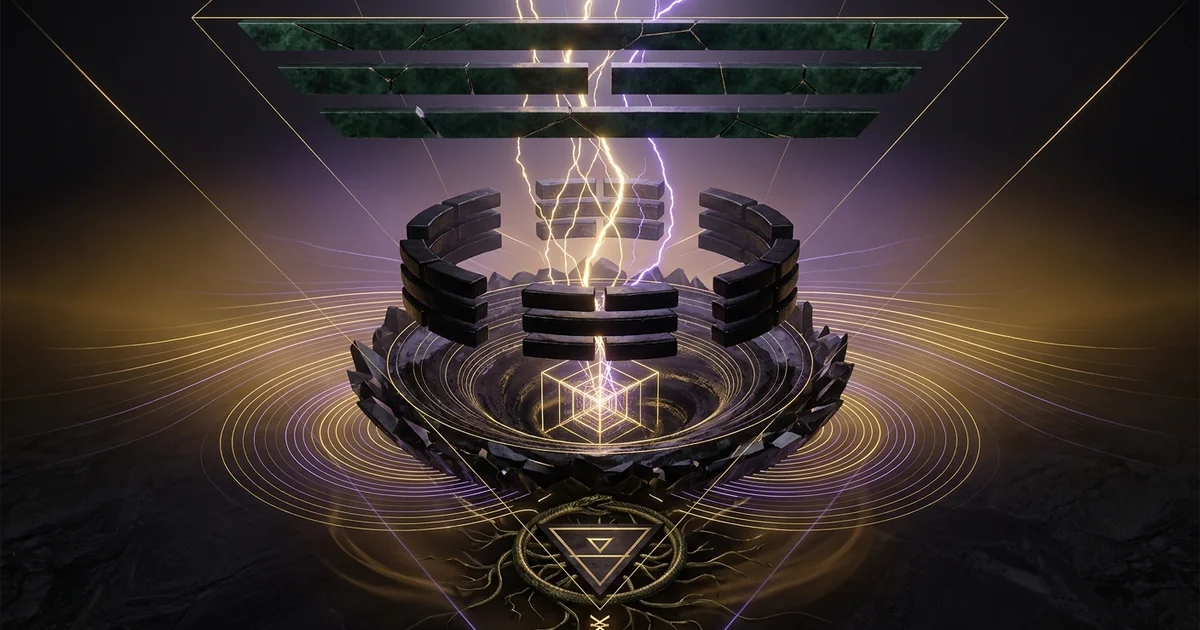
Trigram Kun: Receptive Devotion of Terrestrial Earth
Archetypal Thesis & Systemic Paradigm: The Thermodynamics of Pure Receptivity
The Dissipative Substrate of Consciousness
Within the psycho-cosmological matrix of the I Ching, Trigram Kun (☷) functions not as an inert, submissive void, but as the primary dissipative ground state of manifest reality. Traditional readings frequently fall into the trap of conceptualizing Yin as mere privation—a passive absence of light, heat, or masculine initiative. Viewed through the lens of modern non-equilibrium thermodynamics and complex systems theory, however, Kun emerges as the high-capacity thermodynamic sink and operational medium without which active kinetic work cannot register or cohere. In physical systems, an energetic emission without an absorbing substrate produces entropic degradation rather than structural organization. As the unadulterated expression of the pure Yin trigram, Kun provides the open topological boundary layer that receives, dampens, and organizes the unmitigated, high-frequency kinetic transmissions of Trigram Qian: The Creative Heaven.
Consciousness itself requires this architecture: an uninterrupted signal produces cognitive saturation and catastrophic white noise unless bounded by a receptive field capable of metabolic processing. Kun is precisely this receptive architecture. It serves as the psycho-spiritual substrate where non-differentiated energetic potential undergoes phased deceleration, transitioning from volatile ideation into structural, biological, and institutional form. By embodying the radical principle of yielding, Kun constitutes the dissipative medium that catches the pure vector of Heaven and converts raw force into sustained life.
+-------------------------------------------------------------------------+
|                  THERMODYNAMIC COUPLING OF THE POLARITIES               |
|                                                                         |
|   Qian (☰) [Unbounded Potential / Vector Force / High Frequency]        |
|                                   │                                     |
|                                   ▼                                     |
|   Kun  (☷) [Dissipative Substrate / Open Boundary / Deceleration Field] |
|                                   │                                     |
|                                   ▼                                     |
|   Manifest System [Biological Stability / Structured Form / Coherence]  |
+-------------------------------------------------------------------------+
Ontological Distinction Between Inertia and Dynamic Yielding
The central philosophical imperative in comprehending the trigram kun earth receptive devotion iching framework lies in disentangling genuine receptivity from pathological inertia. Static inertia represents mechanical resistance—a friction-heavy, obstinate stagnation that opposes change by remaining paralyzed in place. Conversely, the dynamic yielding of Kun (shun, 順) denotes frictionless topological compliance. It is an intentional, hyper-aware surrender of localized egoic friction to accommodate the broader systemic vector of the Dao. This dynamic yielding does not imply weakness or moral subservience; it represents the structural intelligence of water conforming perfectly to the contours of a canyon, or the tectonic mantle yielding to planetary torque.
When the conscious subject adopts the operational posture of Kun, personal agency is not eradicated; rather, it shifts from an assertive, broadcast mode (teleological thrust) to a receptive, scanning mode (contextual navigation). In this state, devotion is not an act of psychological self-effacement before an external tyrant, but total structural alignment with natural law. It provides the unresisting resistance that permits form to accrete organically. Form cannot crystallize within an environment dominated by frantic kinetic disturbance. Kun stabilizes the ambient conditions, generating a quiet energetic perimeter within which delicate morphogenetic fields can construct living tissue, nuanced thought, and lasting social frameworks.
Kun as the Cosmological Matrix and Ground State
In depth psychology, Kun operates as the maternal uroboros and the ego-negating container that facilitates psychic individuation. The human ego naturally identifies with the heroic, penetrating solar consciousness of Qian. However, this solar vector invariably reaches a point of neurosis and psychological inflation if it cannot return to the chthonic womb of the unconscious for fundamental reconstitution. Within the architecture of the psyche, Kun represents the vast, impersonal unconscious ground state—the matrix of ancestral memory, instinctual somatic rhythms, and archetypal images that quietly underwrite the transient operations of the waking mind.
Individuation requires the conscious mind to periodically experience a voluntary catabasis, descending into the dark, fertile soil of Kun to be dismantled, nourished, and regenerated. Without the containment of this Terrestrial Mother, the individual fragments under the unmediated pressure of celestial archetypes. Kun acts as the maternal vessel that absorbs psychic shock, processes unintegrated shadow material, and metabolizes trauma into rich psychological humus. This chthonic baseline guarantees that higher spiritual ascent does not degenerate into ungrounded psychosis, anchoring transcendent aspiration firmly within physiological and environmental reality.
“The feminine principle of the unconscious, represented in its purest form by the trigram Kun, is not a mere passive absence of the masculine logos, but an autonomous, form-giving matrix. In the I Ching, Kun represents the receptive substrate without which the creative impulse of Qian would disperse into empty infinity. The operation of synchronicity itself depends upon this receptive field; meaningful coincidence requires an acausal, maternal ground—a continuum of absolute readiness wherein events can coalesce according to meaning rather than linear causality.” — C.G. Jung, Foreword to the Wilhelm/Baynes Translation of the I Ching (1950)
Classical Provenance & Textual Lineage: From Neolithic Divination to the Ten Wings
The Shuo Gua Cartography: Southwest Alignment and Terrestrial Bearing
The canonical lineage of Trigram Kun spans millennia, shifting from archaic bronze inscriptions and oracle-bone records into the sophisticated metaphysical exegesis preserved within the Ten Wings (Shi Yi), specifically the Shuo Gua (Discussion of the Trigrams). In these classical texts, Kun is systematically disentangled from the mere physical soil of the agricultural field. The Han dynasty commentators and the classical compilers of the Great Treatise (Xi Ci Zhuan) established Kun as an ontological category: the metaphysical capacity to sustain, carry, and nourish the ten thousand things without moral preference or exclusionary bias.
Within the Shuo Gua, Kun is systematically mapped to spatial, temporal, and somatic coordinates, establishing its role as an omnipresent dimension of cosmic manifestation:
“Kun is the earth, the mother, the cloth, the cauldron, frugality, the level, the cow with calf, the large wagon, the pattern, the multitude, the handle. In relation to the body, it is the belly. Among horses, it is the mare. Among fields, it is black soil. It is the vessel that holds all things without spilling, the capacity that brings forth nourishment without exhaustion.” — Shuo Gua Zhuan (Eighth Wing), translated in Wilhelm/Baynes, The I Ching or Book of Changes (1950)
The classical spatialization of Kun embeds profound phenomenological wisdom. In this symbolic taxonomy, the attribution of the “belly” (fu) designates the body’s internal visceral laboratory—the enteric nervous system and digestive core where external reality is chemically absorbed, broken down, and integrated into living tissue. The “large wagon” (da yu) emphasizes sheer load-bearing capacity: the Earth carries the weight of all phenomena, including decay and violence, without collapsing or passing moral judgment. The “cloth” (bu) implies woven continuity, an unembroidered fabric of being that clothes the naked impulses of spiritual intent. Kun’s alignment with frugality (lin) does not signify miserliness, but rather absolute thermodynamic conservation; the Earth squanders zero energy, recycling every spent organism back into its base elements to seed future cycles of growth.
+--------------------------------------------------------------------------+
|                       KUN'S MULTI-TIERED CARTOGRAPHY                     |
|                                                                          |
|   PHENOMENOLOGICAL REALM     CORRESPONDING ATTRIBUTION                   |
|   Cosmic / Terrestrial   --> Vast Open Field, Black Soil, Cauldron       |
|   Somatic / Visceral     --> The Belly (Enteric Core), Digestive Matrix  |
|   Functional Agency      --> The Large Wagon (Load-Bearing Capacity)     |
|   Thermodynamic Mode     --> Frugality (Perfect Energy Recycling)        |
|   Zoological Vector      --> The Mare (Responsive, Enduring Direction)   |
+--------------------------------------------------------------------------+
The Mare Metaphor: Docility, Endurance, and Directed Force
The canonical association of Kun with the mare (pin ma) in Hexagram 2: Kun (The Receptive) constitutes one of the most sophisticated animal allegories in ancient literature. Rather than selecting an immobile, sedentary animal like the tortoise to depict the Earth, King Wen chose the mare—a creature characterized by focused mobility, immense kinetic endurance, and responsive docility. This selection explicitly shatters the erroneous view that the receptive devotion of Kun implies physical inertia or passive immobility.
The mare moves across the terrestrial plane with great power, yet her movement remains synchronized with the subtle intentional shifts of the rider. The mare does not initiate the trajectory; she realizes it. Her power lies in her capacity to traverse vast distances without collapsing, embodying tireless kinetic endurance under the guidance of a directing vector. This relationship demonstrates that Kun possesses active force, but that this force is teleologically guided by an external or overarching principle. To cultivate the nature of the mare is to develop an engine of extraordinary capacity that refuses to operate as an isolated, rogue will. It is dynamic power brought under complete, conscious restraint, dedicated entirely to carrying the manifest world upon its back.
Neo-Confucian Exegesis: Wang Bi and Zhu Xi on Substantive Emptiness
The evolution of Chinese philosophy brought rigorous metaphysical refinement to Trigram Kun, particularly through the apophatic commentary of Wang Bi (226–249 CE) during the Wei-Jin era. Wang Bi fundamentally restructured I Ching hermeneutics by rejecting the rigid, mechanistic cosmology of the Han dynasty commentators, choosing instead to interpret the trigrams through the lens of Xuanxue (“Dark Learning” or Neo-Daoism). For Wang Bi, Kun is not physical earth, but the purest manifestation of Wu (Non-Being, Original Emptiness) functioning as the foundational substance of the cosmos.
+------------------------------------------------------------------------+
|                EVOLUTION OF KUN'S METAPHYSICAL EXEGESIS                |
|                                                                        |
|   Han Dynasty Mechanists   --> Rigid structural & ominal cosmology     |
|              │                                                         |
|              ▼                                                         |
|   Wang Bi (Wei-Jin Period) --> Xuanxue / Pure Apophatic Non-Being      |
|              │                                                         |
|              ▼                                                         |
|   Zhu Xi (Song Dynasty)    --> Dialectic of Principle (Li) & Qi        |
+------------------------------------------------------------------------+
Wang Bi argued that Kun achieves its all-sustaining capacity precisely because it has no fixed self-nature, no aggressive self-assertion, and no rigid form. Because it is completely empty of self-will, it can accommodate any form; because it claims no primacy, all things gladly rely upon it.
Centuries later, during the Song dynasty, Zhu Xi (1130–1200 CE) synthesized this apophatic vision into Neo-Confucian orthodoxy through the dialectic of Li (Principle) and Qi (Vital Material Force). In Zhu Xi’s architecture, while Qian represents the pure issuance of Li, Kun represents the initial condensation of Qi into substantial density. Zhu Xi warned that any attempt by Kun to lead—any assertion of the Receptive ahead of the Creative—produces immediate cosmic and psychological disorder, historically symbolized by the ominous image of “dragons fighting in the meadow” (the top line of Hexagram 2). True devotion requires the matter-substrate to remain transparent to principle, ensuring that the vessel never distorts the spiritual wine poured into it.
Structural Mechanics & Symbolic Geometry: Anatomy of the Broken Lines
The Three Broken Lines (Yin Yao) as Open Topological Gaps
The geometric architecture of Trigram Kun consists of three broken lines (yin-yao), producing an arrangement of six discrete, balanced segments:
$$\begin{matrix} -\ -\ \ -\ -\ \ -\ -\ \end{matrix}$$
This structural geometry is not arbitrary. While the unbroken line of Qian (—) represents absolute closure, structural solidity, and continuous energetic projection, the broken line represents an open aperture, a receptive gap, or an energetic valve. The three broken lines stacked atop one another form an open channel—a porous topological pathway through which energetic currents pass without obstruction.
+--------------------------------------------------------------------------+
|                     GEOMETRIC TOPOLOGY OF THE TRIGRAMS                   |
|                                                                          |
|   Qian (☰) [Unbroken / Solid]  ==> Continuous Energetic Vector / Barrier |
|                                                                          |
|   Kun  (☷) [Broken / Divided]  ==> Central Open Cavity / Porous Conduit  |
+--------------------------------------------------------------------------+
In the symbolic language of sacred geometry, Kun is an open vessel, a vertical conduit of emptiness. There is no solid core to deflect impact; every tier of the trigram features a central gap. This spatial structure directly explains Kun’s archetypal capacity for absorption. Incoming forces do not collide with a rigid barrier; they enter an open cavity where their momentum is gradually, harmlessly diffused across the divided line segments. The broken lines can be mathematically modeled as an array of coupled damping circuits that systematically dissipate kinetic spikes, converting chaotic linear velocity into balanced internal potential energy.
Fu Xi (Earlier Heaven) vs. King Wen (Later Heaven) Spatial Mechanics
The operational role of Kun undergoes a profound shift when analyzed through the dual spatial configurations of the bagua: the Earlier Heaven (Xian Tian, attributed to Fu Xi) and the Later Heaven (Hou Tian, attributed to King Wen).
In the Earlier Heaven Sequence, which depicts the primordial, archetypal order of cosmic forces prior to physical manifestation, Kun is positioned at the absolute North (or the Nadir in a three-dimensional spherical projection). Here, it sits directly opposite Trigram Qian at the South (Zenith). This polar axis (Qian-Kun) establishes the fundamental vertical axis of the cosmos, mirroring the hermetic polarity of Heaven and Earth. In this primordial arrangement, Kun represents the deep well of potential existence—the zero-entropy baseline from which all energetic excitation arises and to which it must inevitably return.
In the Later Heaven Sequence, which models the temporal, cyclic unfolding of energetic forces within physical space-time, Kun is shifted from the polar north to the Southwest. This directional placement corresponds to the temporal intersection between late summer and early autumn. In agricultural and climatic terms, this is the season of maximum maturation, humid warmth, and the heavy ripening of crops—the precise moment when vegetative growth ceases its upward expansion and begins its downward condensation into fruit, seed, and root.
By relocating Kun to the Southwest, King Wen demonstrated that within the manifest world, pure receptivity does not remain isolated in frozen northern stasis; it functions as the transitional crucible that receives the blazing solar fire of Li (South) and tempers it, allowing the metal of Dui and Qian (West and Northwest) to solidify. Kun is the transformative soil that prevents the high Yang energy of summer from consuming itself, guiding it into harvest and containment.
Binary Mechanics: 000 in Algorithmic and Information States
The computational elegance of the I Ching reached Western mathematics when Gottfried Wilhelm Leibniz discovered the structural isomorphism between the 64 hexagrams and binary arithmetic in the early 18th century. In this binary mapping, an unbroken line represents the bit 1, while a broken line represents the bit 0. Consequently, Trigram Kun corresponds to the binary sequence 000.
In modern algorithmic theory and computational state-space mechanics, the state 000 is the cleared register—the ground-state clearing of memory buffers without which no new algorithmic execution can take place. The zero is not non-existence in the sense of absolute nullity; it is the essential positional placeholder that defines mathematical architecture. In quantum computing, the system must undergo precise calibration to return qubits to their baseline ground state before an operation can be reliably performed. Kun represents this structural zero: the baseline informational canvas.
Far from being an absence of information, 000 is the prerequisite for all digital complexity. If the register retains residual bits (spurious Yang lines), subsequent computational procedures become corrupted by noise. Trigram Kun provides the radical informational silence required for the pure signal of the cosmos to be inscribed without distortion.
Psychological Dynamics & Operational Praxis: The Vessel of Devotion and Containment
The Terrestrial Mother Archetype: Nurturing Matrix vs. Devouring Void
In psychological practice, Trigram Kun represents the archetype of the Terrestrial Mother, a psychic structure containing both profound creative potential and severe pathology. When properly integrated within the personality, the Kun archetype establishes an internal psychological vessel capable of holding intense emotional affect, shadow content, and somatic distress without premature defensive reactions. This represents the mature capacity for negative capability—the psychological stamina to remain in states of uncertainty, doubt, and darkness without frantic reaching after rational resolution. An individual possessing strong Kun integration can quietly anchor chaotic interpersonal fields, offering an unshakeable presence that absorbs projection, de-escalates conflict, and provides the psychological containment required for others to integrate their neuroses.
+--------------------------------------------------------------------------+
|                  ARCHETYPAL CONTINUUM OF TRIGRAM KUN                     |
|                                                                          |
|   PATHOLOGICAL SHADOW    INTEGRATED PRAXIS       PATHOLOGICAL SHADOW     |
|   (Under-bounded Void)  (Dynamic Receptivity)    (Over-bounded Grip)     |
|                                                                          |
|   Abulia / Inertia   <── Receptive Devotion ──> Devouring Uroboros      |
|   Passivity, paralysis,  Somatic containment,   Engulfment, smothering,  |
|   refusal of boundaries  frictionless yielding  infantilizing matrix     |
+--------------------------------------------------------------------------+
However, the shadow manifestations of Kun are exceptionally destructive. When the Yin principle becomes severed from its conscious pairing with Qian, it polarizes into one of two primary pathological distortions:
- The Devouring Uroboros (Over-bounded Grip): In this configuration, the maternal matrix degenerates into a psychic swamp. The receptive vessel becomes a black hole that refuses to allow individual forms to emerge, separate, and individuate. In family systems, this manifests as the smothering, narcissistic mother who infantilizes her offspring, devouring their emergent autonomy under the guise of endless care. The open soil becomes quicksand, trapping the emerging ego in a regressive, dependent state.
- The Abulic Void (Under-bounded Dissolution): Here, the archetype collapses into complete psychic inertia, depression, and severe abulia. The individual abdicates all personal responsibility, adopting a posture of chronic helplessness, emotional parasitism, and paralysis. Boundaries dissolve entirely, leaving the psyche undefended against toxic environmental dynamics.
Pathological Yin Inertia (Collapsed State)
- Mechanical Stagnation: Unmoving resistance characterized by friction, torpor, and psychic paralysis.
- Passive Resentment: Conforming outwardly while harboring covert hostility and chronic victimhood.
- Diffusion of Will: The total absence of purpose; an inability to establish boundaries or protect integrity.
- Psychic Engulfment: Trapping dynamic systems in unresolved emotional entanglement and regressive dependency.
Dynamic Kun Devotion (Operational Praxis)
- Frictionless Compliance: Dynamic yielding (shun) that aligns with systemic vectors without mechanical friction.
- Conscious Receptivity: Intentional surrender of ego-assertion to clearly perceive real-world conditions.
- Elastic Containment: The capacity to sustain immense energetic loads through a flexible, porous baseline.
- Metabolic Grounding: Transforming raw kinetic projection into sustainable biological and social structures.
Somatic Grounding: Kun in Internal Alchemy (Neidan) and Biofield Work
Within the esoteric tradition of Daoist Internal Alchemy (Neidan), Kun provides the indispensable foundation for all energetic transmutations. The human body is understood as an energetic microcosm where specific trigrams govern distinct somatic fields. Qian governs the upper furnace, the Niwan (the pineal center and upper cinnabar field), associated with spirit (Shen) and celestial consciousness. Kun, conversely, directly corresponds to the Lower Dantian (Xia Dantian), the pelvic vessel, and the perineal base (Huiyin).
+-------------------------------------------------------------------------+
|                  NEIDAN SOMATIC POLARITY ARCHITECTURE                   |
|                                                                         |
|   [ Niwan / Upper Furnace ]    --> Qian (☰) [Shen / Fire / Ascending]   |
|               │                                                         |
|               ▼  (Circulation of the Golden Elixir)                     |
|               │                                                         |
|   [ Lower Dantian / Vessel ]   --> Kun  (☷) [Jing / Water / Grounding]  |
+-------------------------------------------------------------------------+
A core principle of Daoist inner cultivation warns against premature meditation upon the upper centers. Cultivating the fire of Qian without first establishing the earthen vessel of Kun produces pathological somatic manifestations: energetic deviation (zou huo ru mo), vascular hypertension, psychological dissociation, and severe grounding failures. The practitioner must first cultivate the somatic vessel of Kun by establishing deep, diaphragmatic breathing that drops the center of gravity directly into the pelvic basin. The pelvic floor and lower abdomen must become heavy, open, and utterly relaxed.
This somatic grounding establishes the low-impedance biological base capable of safely absorbing and anchoring the intense, ascending energetic currents activated during the circulation of the Microcosmic Orbit (Xiao Zhou Tian). In biofield therapies and somatic experiencing, this translates into somatic tracking of visceral sensations in the gut, anchoring autonomic nervous system regulation within the ventral vagal complex, and maintaining somatic presence regardless of psychological volatility.
Operational Divination: Navigating Changing Lines and Hexagram Polarity
When Trigram Kun dominates an I Ching consultation—either as an autonomous trigram within the constituent nuclear structures or multiplied upon itself as Hexagram 2: Kun (The Receptive)—it delivers an unmistakable operational directive: autonomous ego-assertion must yield entirely to environmental feedback. The querent is explicitly warned that taking the initiative, attempting to command circumstances, or forcing a premature conclusion will result in loss of direction and strategic failure (“If it strives to lead, it goes astray; if it follows, it finds guidance”).
The tactical posture demanded by Kun is peripheral awareness and strategic patience. The individual must adopt the stance of an expert navigator observing the tides rather than the captain attempting to sail directly into a storm. It requires what systems theorists term environmental scanning: gathering empirical data, noting systemic blockages, and identifying emerging patterns before committing energetic resources.
When lines begin to change within Kun, they indicate that this pure potentiality is reaching maximum systemic density. The broken line, having reached its ultimate thermodynamic limit (designated by an old Yin value of 6), becomes unstable and collapses inward, preparing to spontaneously phase-shift into its polar opposite: the solid Yang line of Qian. The operative art of divination consists in knowing precisely when the earthen vessel is full, signaling that the phase of receptive listening is complete and the moment of manifest, active realization is at hand.
Philosophical Synthesis & Macrocosmic Correspondence: Hermetic, Genetic, and Astrological Parallels
Hermetic Salt and the Alchemical Prima Materia
The conceptual architecture of Trigram Kun transcends cultural boundaries, aligning precisely with the central tenets of Western esotericism. In the core framework of Hermetic philosophy, specifically the Hermetic Principles of Gender and Polarity, reality is sustained through the continuous interaction of two eternal energetic poles: the Projective and the Receptive. Within Western laboratory alchemy, this dynamic is expressed through the Tria Prima (Sulfur, Mercury, and Salt). While Sulfur represents the active, combustive soul (Qian), and Mercury represents the fluid, transmutative spirit, Hermetic Salt corresponds directly to Trigram Kun.
+--------------------------------------------------------------------------+
|                  CROSS-TRADITIONAL CORRESPONDENCE MATRIX                 |
|                                                                          |
|   METAPHYSICAL AXIS        YANG / PROJECTIVE      YIN / RECEPTIVE        |
|   I Ching Paradigm     --> Qian (☰)            --> Kun (☷)               |
|   Hermetic Tria Prima  --> Alchemical Sulfur   --> Alchemical Salt       |
|   Alchemical Substrate --> Sol / Aurum         --> Prima Materia         |
|   Genetics             --> Activating Codons   --> Scaffolding / Non-Cod |
|   Astrological Forces  --> Mars / Sun / Solar  --> Saturn / Taurus Earth |
+--------------------------------------------------------------------------+
Salt is the principle of fixation, coagulation, and materialization. It is the heavy, crystallizing agency that arrests the volatile, evaporative tendencies of Mercury and Sulfur, binding them into enduring physical compounds. Without the fixative power of Salt, spiritual essence remains an ephemeral vapor, unable to interact with the material world.
Similarly, Kun is isomorphic with the Prima Materia—the primordial, unformed chaos-matter described by the medieval alchemists as virgo terra (virgin earth). This matter is universally despised and cast into the street by the uninitiated because it appears dark, base, and inert. Yet, the masters recognize it as the sole substance capable of receiving the alchemical seed and gestating the Lapis Philosophorum (the Philosopher’s Stone). Kun is this virgin earth: the radical ground of reality waiting patiently to be quickened by spirit.
- I Ching Coordinate: Trigram ☷ (Earth, Southwest/North), Hexagram 02 (Field of Pure Yin).
- Western Hermetic Correlates: The Salt Principle; Alchemical Coagulation (Coagula); The Prima Materia.
- Kabbalistic Attributions: Malkuth (The Kingdom / Shekhinah) as the physical ground plane; the pathway of Tav (The Great Cross of Reality connecting Yesod to Malkuth).
- Tarot Arcanum Synthesis: The Empress (Arcanum III) representing generative, reproductive terrestrial abundance; coupled with the hidden containment of The High Priestess (Arcanum II).
- Human Design Integration: The G-Center Vessel of Love, specifically Gate 2: The Gate of the Direction of the Self (The Receptive), located within the magnetic center that holds the human illusion of separateness together.
Genetic Codon Geometries: Kun as the Termination / Initiation Matrix
The profound structural parallel between the 64 hexagrams of the I Ching and the 64 codons of universal messenger RNA (mRNA) has been extensively documented since the preliminary insights of Martin Schönberger and Marie-Louise von Franz. In molecular genetics, the dynamic translation of DNA into functional proteins relies upon an alphabet of four nitrogenous bases: Adenine (A), Uracil (U), Cytosine ©, and Guanine (G). These are read in triplet sequences known as codons.
When mapped systematically against the binary geometry of the hexagrams, Hexagram 2—composed of the doubling of Trigram Kun (a six-line array of broken lines, 000000)—corresponds to the non-coding scaffolding arrays and structural termination/initiation boundaries within the genomic architecture. Just as biological protein synthesis cannot occur as an unbroken, continuous chain of amino acids without lethal cellular anomalies, the genetic transcript requires clear operational gaps:
+--------------------------------------------------------------------------+
|                      GENOMIC AND INFORMATION BASIN                       |
|                                                                          |
|   Poly-U / Receptive Scaffold   ==> Baseline Matrix for Translation       |
|                                                                          |
|   Structural Termination Points ==> Prevents Indiscriminate Transcription|
|                                                                          |
|   Open Chromatin Ground         ==> The Epigenetic Soil (Kun Substrate)  |
+--------------------------------------------------------------------------+
These codons provide the necessary punctuation marks, signaling the ribosome to cease translation and release the newly folded peptide chain. Furthermore, the structural, non-coding regions of DNA (historically mislabeled as “junk DNA”) operate precisely as Kun: providing the essential spatial architecture, regulatory chromatin loops, and topological bedding that allow transcription factors to bind to their respective genes. Kun is the cellular silence that makes genetic speech intelligible.
Wuxing Earth Mechanics and the Planetary Saturn/Taurus Axis
In traditional Chinese elemental theory (Wuxing), Kun is the macrocosmic governor of the Earth phase (Wuxing-Earth, 土, Tu). Unlike the other four phases (Wood, Fire, Metal, Water), which reign over the four cardinal seasons and four cardinal directions, Earth occupies the central throne. It is the pivot around which all other elements rotate, returning to the center during the final eighteen days of every season to recalibrate energetic balance. Kun is the tangible manifestation of this stabilizing central soil. It anchors the volatile expansion of Fire, allows the crystallization of Metal, preserves the fluid depth of Water, and provides root space for the dynamic expansion of Wood.
Astrologically, this macrocosmic function bridges two planetary principles: Saturn (Chronos) and fixed-earth Taurus (Venus Terrestre). From Saturn, Kun derives its structural realism, boundary-definition, endurance, and uncompromising respect for physical limitation and time. Kun honors the law of entropy: forms require time to grow, structures require patience to build, and reality cannot be bypassed through imaginative bypassing. From Taurus, Kun inherits its sensuous fertility, chthonic nourishment, and bodily wisdom. It is the rich, dark soil that patiently takes the seed, encases it in protective darkness, and yields a bountiful harvest across historical epochs. This dual planetary correspondence cements Kun’s reputation as the ultimate anchor of existence, safeguarding cosmic evolution against entropic dispersion.
Frequently Asked Questions
How does Kun differ ontologically from pure passivity or weakness?
Pure passivity represents an involuntary absence of agency—a state of flaccid, unconscious capitulation to external pressures born from psychic exhaustion or structural deficiency. In stark contrast, Trigram Kun represents dynamic receptivity (shun), a state of heightened conscious awareness and voluntary, operational devotion.
Within the computational and systemic architecture of the I Ching, dynamic receptivity is the deliberate suspension of isolated, linear intention in order to comprehend and align with the total macrocosmic field. It requires immense internal strength to withhold egoic reaction, maintain an open, non-judgmental space, and absorb systemic volatility without retaliating. Passivity is crushed by circumstance; Kun absorbs circumstance, metabolizes its kinetic momentum, and shapes it into an enduring, physical foundation.
Why is the mare, rather than a sedentary animal, chosen as Kun’s primary zoological symbol?
The choice of the mare (pin ma) in the judgment of Hexagram 2 specifically prevents the misinterpretation of Kun as static immobility. A sedentary animal, such as a hibernating bear or an unmoving tortoise, would incorrectly imply that the Receptive principle remains passive within physical reality.
The mare, however, embodies focused kinetic energy, immense physical stamina, and dynamic locomotion. She is fully capable of traversing vast distances across rugged terrain, yet her movements remain responsive to the subtle directional guidance of the rider. The mare does not refuse to run; she simply does not dictate the destination. By choosing this animal, the ancient sages demonstrated that Kun represents dynamic, tireless force functioning in service to a transcendent principle.
How should one interpret a divination result dominated by changing Yin lines in Kun?
Encountering a pattern dominated by changing Yin lines (lines with a numerical value of 6, represented by an X that converts into a solid Yang line) within Trigram Kun signals that the receptive ground state has reached peak thermodynamic density. In systemic terms, the open vessel has been filled to capacity; the period of passive incubation, metabolic absorption, and structural listening is concluding.
Because extreme Yin invariably generates its polar opposite, changing Yin lines in Kun reveal that the situation is preparing to phase-shift into the active, projective, and generative potency of Trigram Qian: The Creative Heaven. The querent is advised that while the foundational, preparatory work had to be conducted through total yielding and strategic patience, the internal pressure of this accumulated potentiality will soon demand conscious manifestation, visible initiative, and direct executive action.