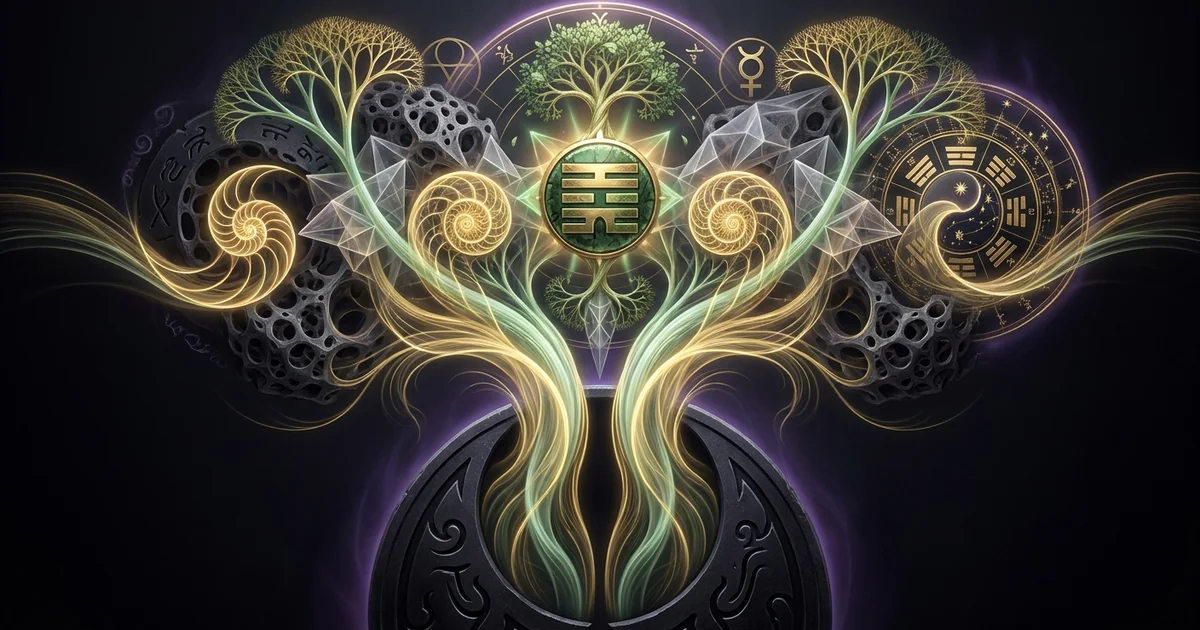
Trigram Xun: Gentle Penetrating Wind & Wood Growth
Archetypal Thesis & Systemic Paradigm: The Cybernetics of Pervasive Dispersion
Trigram Xun (☴, 巽), designated within the Yijing canon as The Gentle, the Penetrating, and the Wind, formalizes the cybernetic mechanism of pervasive, sub-threshold infiltration and organic, self-similar morphogenesis. Operating as an energetic modality distinct from the explosive discharge of its polar counterpart, Trigram Zhen (Thunder), Xun models how macrocosmic patterns inform localized material matrices without inducing catastrophic structural rupture. In the psycho-cosmological topology of the Zhouyi, systemic evolution rarely proceeds through sheer brute kinetic confrontation; rather, enduring civilizational, psychic, and biological shifts occur through persistent, laminar flow that circumvents dynamic friction. Xun represents precisely this thermodynamic efficiency: an unbroken, continuous vector that matches the contours of the resistance it encounters, gradually reconfiguring the structural substrate from within.
☴ Xun (Wind / Wood)
———  Line 3: Upper Solid Yang (Dispersion / Global Saturation)
———  Line 2: Middle Solid Yang (Focused Intent / Penetration)
— —  Line 1: Lower Broken Yin (Compliant Base / Non-Resistance)
Xun as Sub-Threshold Dynamic Infiltration
The operational efficacy of Xun lies in its sub-threshold dynamic infiltration. In thermodynamic and cybernetic state-spaces, dynamic systems possess homeostatic thresholds designed to identify and repel acute energetic shocks. A high-amplitude kinetic perturbation—such as an overt ideological attack, an abrupt trauma, or a sudden metabolic shock—immediately activates the defensive parameters of the target organism, crystallizing its boundary mechanisms. Trigram Xun circumvents these reactionary feedback loops entirely by operating below the threshold of sensory and systemic alarm. Like the persistent gentle wind that permeates every fissure of an architectural edifice, or microscopic root systems that expand through subterranean strata, Xun exploits existing structural gradients to establish its locus of agency.
This mode of penetration is non-violent yet inexorable. It does not smash the stone; it locates the pre-existing microscopic fissure, introduces moisture and micro-root capillarity, and executes a slow volumetric expansion that eventually dislodges monoliths. The dynamic of the trigram xun wind gentle penetrating iching archetype demonstrates that influence is optimized when resistance is rendered moot. By synchronizing its frequency with the ambient properties of the medium it seeks to transform, Xun achieves complete permeation, establishing what dynamic systems theory recognizes as an ambient asymptotic equilibrium.
The Eldest Daughter (Chang Nü) Archetype as Receptive Progenitor
Within the familial cosmogony delineated in the Shuo Gua (Discussion of the Trigrams), Xun is designated as the Eldest Daughter (Chang Nü, 長女). This categorization is foundational to its operational mechanics. The generation of the three daughters arises from the initial cosmological intercourse between Qian (Pure Yang, the Creative Father) and Kun (Pure Yin, the Receptive Mother). In the genealogical mechanics of the Yijing, the nature of an offspring trigram is dictated by the solitary, minority line. Xun receives the initial, bottom line of Kun—a single yin stroke—over which two solid yang lines from Qian are situated.
As the eldest daughter trigram, Xun represents the primal descent of the initial yin receptivity into the descending fire of yang intentionality. Unlike the Youngest Daughter (Dui, Lake), whose receptivity resides at the communicative aperture of the top line, or the Middle Daughter (Li, Fire), whose receptive center is encased between protective yang walls, Xun places her yielding openness directly at the root. The Eldest Daughter is therefore the receptive progenitor: she accepts the initial generative impulse of the Earth, yet channels the undiluted upward striving of the dual yang lines. She does not demand structural dominion through patriarchal decree; instead, she guides the manifestation of form through maternal endurance, tactile patience, and flexible compliance. She is the fertile womb that shapes cosmic breath (qi) into somatic reality.
State-Space Equilibrium Between Supple Substrate and Ascending Force
From the perspective of advanced psycho-cosmology, Xun demonstrates how an adaptable substrate can support high-velocity ascending momentum. The lower broken line acts as an open thermodynamic port, allowing the entire trigram to yield dynamically to external environmental pressures. Because Line 1 offers no rigid surface against which an opposing force can impact, incoming kinetic energy passes cleanly through the system or is absorbed into its internal circulation. Meanwhile, the upper dual yang lines (Lines 2 and 3) supply unwavering structural directionality, clarity of vector, and continuous vegetative expansion.
In state-space dynamics, this configuration functions as a continuous low-amplitude attractor. Rather than attempting to restructure an entire phase space through a singular, disruptive phase shift, Xun introduces micro-perturbations along lines of least resistance. Over iterative temporal cycles, these micro-perturbations alter the phase space’s topological topography, bending the system’s trajectories toward a new attractor basin without triggering compensatory counter-oscillations.
“The unconscious does not smash its way into consciousness unless consciousness has walled itself off into an untenable, neurotic fortress. Where the psychic threshold remains porous, the unconscious percolates upward like a fine mist or a creeping root network, altering the baseline of conscious orientation without eliciting ego-defense mobilizations. This is the precise psychological equivalent of Trigram Xun: the subtle, non-violent infiltration of the ego’s rigid habitus by transpersonal archetypal contents.” — Marie-Louise von Franz, Archetypal Dimensions of the Psyche (1999) / Contextualizing C.G. Jung’s Foreword to the I Ching (1950)
Classical Provenance & Textual Lineage: The Tenth Wing and Early Cosmologies
The canonical architecture of Trigram Xun requires rigorous historical and philological contextualization to recover its operational nuances from romanticized misreadings. The Ten Wings (Shi Yi, 十翼), the foundational corpus of early Han commentary attributed to the Confucian school, situates Xun within an intricate matrix of functional predicates, naturalistic metaphors, and administrative protocols. To comprehend Xun is to grasp how early Chinese metaphysicians synthesized meteorology, vegetative biology, and political statecraft into a coherent ontological system.
The Shuo Gua Exegesis: Wind, Wood, and Ubiquitous Presence
The primary locus for the exegesis of Trigram Xun is the Shuo Gua (Eighth Wing / Discussion of the Trigrams), an indispensable hermeneutic treatise preserved within the classical redactions of Wilhelm & Baynes (1950) and analyzed in Wang Bi’s 3rd-century CE commentary (Zhouyi Zhu). In Chapter 7 of the Shuo Gua, the core dynamic of Xun is distilled into a single definitive operational verb: ru (入), meaning “to enter,” “to penetrate,” or “to infiltrate.” The text explicitly contrasts this with the other trigrams: while Qian acts, Kun yields, Zhen arouses, and Kan plunges, Xun enters. It penetrates the interstices of all manifest things precisely because it lacks a rigid spatial front.
Shuo Gua Functional Dynamic Matrix:
┌─────────────────┬──────────────────────┬────────────────────────┐
│ Trigram         │ Dynamic Action       │ Macrocosmic Vector     │
├─────────────────┼──────────────────────┼────────────────────────┤
│ Qian (乾)       │ Jian (健) - Strong   │ Celestial Elevation    │
│ Kun (坤)        │ Shun (順) - Yielding │ Terrestrial Absorption │
│ Zhen (震)       │ Dong (動) - Arousing │ Explosive Ascension    │
│ Xun (巽)        │ Ru (入) - Penetrating│ Pervasive Infiltration │
└─────────────────┴──────────────────────┴────────────────────────┘
The commentary attributes a deliberate multiplicity of naturalistic and societal images to Xun: it is the wind (feng), which blows across the earth leaving nothing untouched; it is wood (mu), which grows slowly and silently toward the light while sinking its roots into the deep; it is the straight line, the carpenter’s chalk-line (sheng), establishing moral rectitude not through dogmatic decree, but by demonstrating an unswerving internal plumb-line. Furthermore, the Shuo Gua identifies Xun with the rooster (han), whose dawn crow penetrates the liminal veil between night and day, signaling the initial dispersion of darkness; the thigh (gu), which anchors flexibility and kinetic transference in human locomotion; and the pursuit of commercial profit (shi), specifically threefold gain, modeling the compounding return that emerges from the patient, subtle circulation of resources.
“Xun manifests as entering (入). Xun is the wind, it is wood; it is the eldest daughter; it is the chalk-line; it is work; it is the straight; it is the long; it is the high; it is the advance and retreat; it is the undecided; it is the odor. Among human beings, it is those with broad brows, those with much white in their eyes, those who are skilled in the pursuit of close calculations, making a three-fold profit in the market. Finally, it is the trigram of vehement, resolute striving.” — Translated in Wilhelm, R., & Baynes, C. F. (1950), The I Ching or Book of Changes, Bollingen Series XIX, Princeton University Press.
Epigraphical Shifts: From Shang Oracle Bones to Mawangdui Silk Manuscripts
Epigraphical research illuminates the transformation of the glyph Xun across archaeological strata. In Shang dynasty oracle bone script (jiaguwen) and Western Zhou bronze inscriptions (jinwen), the character Xun (巽) depicts two kneeling human figures positioned above an altar or coffer—a graphic ideogram representing mutual deference, yielding ritual submission, and the presentation of ancestral offerings. The primordial semantic field was anchored in non-confrontational alignment, the deliberate bending of the individual will before the numinous order of Heaven.
By the time of the 1973 excavation of the Mawangdui Han tombs, which yielded silk manuscripts (boshu) dating to circa 168 BCE, Trigram Xun was deeply intertwined with physiological and agricultural systems. In the Mawangdui recension, the trigram is frequently transcribed with phonetic and conceptual variants signifying the breath (qi), vegetative sap, and the subtle circulation of atmospheric winds necessary for agrarian fertility. The silk manuscripts demonstrate that before Xun was elevated to high-order metaphysical governance, it served as an empirical description of natural respiration: the atmospheric exchange whereby the earth exhales mist and the heavens descend as nourishing, dispersing air. This philological arc reveals that Xun never lost its fundamental tactile nature: it is compliance transformed into an instrument of ultimate ingress.
The Song Dynasty Cartography: Xun’s Shift from Xiantian to Houtian Bagua
The spatial and temporal orientation of Trigram Xun underwent an essential realignment during the Song Dynasty Renaissance, primarily articulated through the cosmography of Shao Yong (1011–1077 CE) in his seminal work, Huangji Yingshi Shu (Supreme World Ordering Principles). Shao Yong formalized the profound distinction between the Earlier Heaven (Xiantian, 先天) arrangement, attributed to the legendary culture hero Fuxi, and the Later Heaven (Houtian, 後天) arrangement, attributed to King Wen.
Spatial Re-alignment:
Xiantian (Earlier Heaven)     -->     Houtian (Later Heaven)
Position: Southwest (South-facing)     Position: Southeast
Dynamic: Nascent Cosmic Polarity       Dynamic: Active Vernal Maturation
Axis: Polar balance with Dui (Lake)    Axis: Transitional gateway Spring->Summer
In the Earlier Heaven arrangement, which models the noumenal, timeless symmetry of cosmic forces prior to physical manifestation, Xun is situated in the Southwest, directly opposing Trigram Dui (Lake) in the Southeast. Here, Wind and Lake form a primordial pair of fluid dynamic forces: Xun disperses moisture into the atmosphere, while Dui collects and concentrates it into terrestrial basins. This Earlier Heaven axis represents the conservation of cosmic fluids and gases in balance.
Conversely, in the Later Heaven arrangement—which models phenomenal, temporal succession, cyclical thermodynamics, and seasonal change—Shao Yong positions Xun in the Southeast. To explore this cartographic transition in depth, see the comparative treatise on Bagua Earlier and Later Heaven Arrangements. In this southeastern coordinates, Xun mediates the vital seasonal pivot between late spring and early summer. It receives the raw, explosive vernal awakening initiated by Zhen in the East and translates it into the steady, sustaining warmth of Li (Fire) in the South. In the Houtian framework, the wood bagua phase reaches its operational apex: it is no longer the subterranean seed cracking its husk (Zhen), but the emergent canopy of branches, leaves, and vine networks actively photosynthesizing, processing atmospheric light, and driving organic growth.
Structural Mechanics & Symbolic Geometry: Line Topography and Elemental Phase Dynamics
The internal logic of Trigram Xun cannot be understood purely through descriptive metaphor; it demands topological and systemic analysis. The trigram operates as an energetic circuit, its unique properties emerging directly from the mathematical and spatial arrangement of its individual lines.
Topological Anatomy: The Open Yin Base Beneath Dual Yang Cores
The architecture of Xun consists of a divided, broken yin line at the base (Line 1, initial position), surmounted by two continuous, solid yang lines (Line 2, central position; Line 3, upper position). In the structural grammar of the Zhouyi, the lowest line of any trigram represents its foundation, its point of contact with reality, and its primary mode of engagement with the external matrix.
Because Line 1 is yin, it possesses zero topological resistance. It is receptive, pliable, and open-ended. When Trigram Xun encounters an external impediment, it does not strike the obstacle with an unyielding face; it yields instantly at the point of contact. This dynamic yielding eliminates the kinetic rebound that typically degrades advancing forces. However, this compliance is fundamentally distinct from structural weakness or total collapse. Mounted directly upon this pliable yin base are the two solid yang lines—representing concentrated volition, unyielding structural coherence, and relentless forward projection.
This specific combination creates a unique functional dynamic: the lower yin line allows the trigram to slide effortlessly beneath the defense perimeters of an environment, whereupon the two upper yang lines assert their structural agency, steadily filling the interior space with their presence. Wang Bi observed in the Zhouyi Zhu that while the yang lines provide the substance of the movement, it is the solitary yin line that “rules” the trigram, because it grants the yang lines their operational mobility. Without the receptive base, the two yang lines would constitute an abrasive, blunt kinetic force that generates immediate systemic friction; with the yin root, they become an invisible, ubiquitous presence.
Wuxing Mechanics: Yin Wood (Yin Mu) and Vegetative Capillarity
Within the paradigm of the Wuxing Five Elements Cosmology, Xun corresponds explicitly to Yin Wood (Yin Mu, 乙木). This categorization creates an essential systemic dialectic with Trigram Zhen, which embodies Yang Wood (Jia Mu, 甲木). Yang Wood is the rigid, unbending tree trunk, the vertical pillar of timber that resists mechanical stress through static structural strength until it reaches its breaking threshold. Yin Wood, by contrast, is the creeping vine, the willow branch, the winding creeper, and the microscopic capillary architecture of the vegetative vascular system.
Wuxing Wood Phase Dichotomy:
┌──────────────────────────────┬──────────────────────────────┐
│ Trigram Zhen (Yang Wood)     │ Trigram Xun (Yin Wood)       │
├──────────────────────────────┼──────────────────────────────┤
│ Forest Timber / Oak Trunk    │ Creeping Vine / Capillary    │
│ Kinetic Rupture / Fracture   │ Fluid Bending / Osmosis      │
│ High-Amplitude Initial Burst │ Asymptotic, Steady Expansion │
│ Directional, Linear Vector   │ Ubiquitous, Omnipresent Flow │
└──────────────────────────────┴──────────────────────────────┘
The physical mechanics of Yin Wood rely on hydraulic pressure, osmotic action, and cellular capillarity. A climbing ivy plant does not shatter the brick wall it encounters; it finds the microscopic indentations, adheres to the surface through chemical and physical rootlets, and climbs incrementally toward solar illumination. If it meets a steel barrier, it bends effortlessly around the perimeter, resuming its upward trajectory on the other side. This is the profound physical reality of Xun’s persistent gentle wind and wood growth: it possesses infinite formal flexibility in the micro-moment, wedded to an unalterable macro-trajectory over geological or biological time. It demonstrates that supple organic adaptability invariably outlasts, outmaneuvers, and eventually dismantles brittle structural rigidity.
Hexagram Transmutations: Hexagram 57 (Xun Doubled) and Nuclear Polarities
When Trigram Xun is doubled upon itself, it generates Hexagram 57: Xun (The Penetrating / The Gentle). In this hexagrammatic doubling, the cybernetic principle of recursive percolation reaches its highest operational clarity. Hexagram 57 demonstrates what occurs when gentle penetration becomes an iterative, programmatic discipline. The Judgment of Hexagram 57 states:
“The Gentle. Success through small things. It furthers one to have somewhere to go. It furthers one to see the great man.”
The necessity of having “somewhere to go” underscores that Xun cannot function in an informational vacuum; without a conscious vector, pervasive energy degenerates into erratic dispersion, aimless wavering, and structural indecision.
Hexagram 57 (Xun over Xun)
——— Line 6: Upper Yang (Xun Upper)
——— Line 5: Central Yang (Xun Upper)
— — Line 4: Yielding Yin (Base of Upper Xun)
——— Line 3: Upper Yang (Xun Lower)
——— Line 2: Central Yang (Xun Lower)
— — Line 1: Yielding Yin (Base of Lower Xun)
The nuclear hexagram (hu gua, 互卦)—the interior structural core derived from lines 2, 3, 4 and lines 3, 4, 5 of Hexagram 57—is Hexagram 38, Kui (Opposition / Alienation). This structural reality reveals a profound esoteric mechanics: beneath the outward appearance of smooth, compliant, and harmonious infiltration, the internal core of Hexagram 57 is wrestling with deep-seated systemic friction, polarity, and divergence. Xun does not emerge within environments of natural, pre-existing unity; it is deployed precisely when an environment is fractured by irreconcilable ideological or structural opposition. The gentle infiltration of Xun is the only systemic method capable of neutralizing the oppositional tension of Kui without triggering defensive warfare.
Psychological Dynamics & Operational Praxis: The Archetype of Gentle Penetration in Consultation
In clinical psychoanalysis, analytical psychology, and esoteric cartography, the appearance of Trigram Xun signals a critical diagnostic shift. It indicates that the conscious ego has arrived at an impasse that cannot be resolved through the application of sovereign will, moralistic strain, or confrontational assertion.
Tactical Non-Confrontation and the Dissolution of Ego Rigidity
When an individual attempts to eradicate an entrenched psychological complex, an archaic behavioral pattern, or an external interpersonal blockage through direct force, the psychic mechanism predictably responds with compensatory defense. The Freudian resistance or Jungian shadow complex thrives upon direct opposition; the harder the conscious ego pushes against the neurotic symptom, the more heavily fortified the symptom becomes, drawing psychic libido directly from the conflict.
Trigram Xun instructs the practitioner in the tactical art of dynamic non-confrontation. Rather than engaging the shadow complex in frontal psychic warfare, the individual must adopt the stance of the wind: yielding to the complex’s defensive maneuvers, validating its structural reality, and gently circulating around its perimeters. The practitioner introduces small, nearly imperceptible micro-habits and subtle re-framings into the daily somatic routine. Like an ambient draft moving through an old home, these interventions alter the psychic climate of the patient. Over time, the energy that sustained the neurotic fortress is siphoned away; the complex dissolves not because it was attacked and conquered, but because its supporting environmental conditions have been restructured beneath it.
Differentiating Dynamic Drives: Zhen (Seismic Rupture) vs. Xun (Laminar Infiltration)
A primary diagnostic failure in esoteric consultation involves conflating the two expressions of the Wood phase: Zhen and Xun. Both trigrams are instruments of systemic liberation and developmental progression, yet their dynamic mechanics are diametrically opposed. Confusing their applications leads to profound therapeutic and operational errors.
Trigram Zhen (Thunder / Shock / Yang Wood)
- Energetic Polarity: Pure yang awakening bursting from beneath dual yin surfaces (☳).
- Kinetic Profile: High-amplitude, instantaneous, seismic discharge; deliberate structural rupture.
- Temporal Modality: The lightning strike, the sudden awakening, the radical break with history.
- Strategic Intent: Overcoming systemic paralysis through therapeutic shock, dynamic confrontation, and the disruption of stagnant equilibrium.
- Pathological Deviation: Manic agitation, trauma-induction, reckless devastation of vulnerable vessels.
Trigram Xun (Wind / Gentle Infiltration / Yin Wood)
- Energetic Polarity: Yielding yin receptivity at the root, directing dual ascending yang lines (☴).
- Kinetic Profile: Low-amplitude, continuous, pervasive, laminar fluid dispersion.
- Temporal Modality: The seasonal transition, the steady growth of rings within an ancient oak, continuous respiration.
- Strategic Intent: Transforming complex systems through sub-perceptual micro-adjustments, diplomatic nuance, and organic permeation.
- Pathological Deviation: Evasive duplicity, chronic indecisiveness, passive-aggressive paralysis, debilitating ambiguity.
Where Trigram Zhen breaks stagnation through electric, disruptive confrontation, Xun achieves an identical teleological end through ambient permeation. Zhen breaks the seal of the tomb; Xun slowly oxidizes the lock until the gate swings open on its own hinges.
Hermeneutic Praxis: Resolving Indecision and Over-Scrutiny in Oracular Interpretation
In divinatory consultations governed by the mechanics of Jungian Synchronicity and the I Ching, the presence of Xun carries distinct cautionary vectors. Because the wind possesses no fixed permanent vessel and constantly alters its velocity to accommodate topography, an excess of Xun energy degenerates into chronic indecisiveness (jin tui, 進退, the classical symptom of “advancing and retreating” noted in the Shuo Gua). The querent, hyper-attuned to every subtle nuance, social current, and shifting variable in their environment, becomes trapped in a state of terminal paralysis through analysis.
The psychological remedy for pathological Xun is the deliberate anchoring of its fluid, receptive base in an external principle of order. The yielding lower line must not be permitted to degenerate into evasive spinelessness or moral accommodation. In hermeneutic praxis, when a client receives Xun heavily modified by moving lines, the analyst must determine whether the querent is executing subtle strategy, or merely hiding behind an ambiguous veil to avoid the responsibility of self-definition. Pervasive dispersion without an unbending internal spine ceases to be the work of the wind; it becomes mere dissipation.
Philosophical Synthesis & Macrocosmic Correspondence: Hermetic Vectors and Cybernetic Feedback
The psycho-cosmological map of Trigram Xun reaches far beyond classical Sinological frameworks, establishing precise isomorphisms with Western Hermetic philosophy, non-equilibrium thermodynamics, and modern molecular morphogenesis.
Morphogenetic & Hermetic Equivalences:
┌────────────────────┬──────────────────────┬──────────────────────┐
│ Trigram Xun (☴)    │ Hermetic Philosophy  │ Systems Biology      │
├────────────────────┼──────────────────────┼──────────────────────┤
│ Yin Wood Base      │ Prima Materia / Salt │ Structural Matrix    │
│ Pervasive Flow     │ Spiritus / Mercury   │ Epigenetic Signaling │
│ Ascending Yang Core│ Teleological Sulfur  │ Genetic Transcription│
└────────────────────┴──────────────────────┴──────────────────────┘
Hermetic Macro-Microcosmics: The Anima Mundi as Atmospheric Pneuma
In the Western Hermetic tradition, the macrocosm and microcosm are unified through the agency of the Spiritus Mundi—the subtle, pneumatic vapor that mediates between the transcendent realm of pure archetypal forms (Mens) and the dense, crystallized realm of physical matter (Corpus). Trigram Xun is the exact structural analogue of this Hermetic Pneuma. It corresponds to the alchemical principle of Philosophical Mercury operating in its gaseous, volatilizing phase: that which enters every dense body, breaks down its metallic rigidity through gentle dissolution (solutio), and renders it permeable to spiritual illumination.
Xun embodies the maxim of the Tabula Smaragdina: “The Wind carried it in its belly.” The wind is the vehicle of the generative seed; it is not the seed itself, but the universal vector of dissemination. Without the subtle carrier-medium of Xun, the celestial decrees of Qian would remain abstract, unmanifest mathematical coordinates, unable to bridge the ontological gulf to take root in the terrestrial loam of Kun.
Chronobiological and Seasonal Rhythms: The Southeast Axis and Circadian Awakening
In chronobiology and natural cycles, the Southeastern orientation of Xun in the Later Heaven arrangement governs the crucial metabolic transition from repose to hyper-metabolism. Seasonally, it maps to the late vernal gate—the intercalary solar terms of Qingming (Pure Brightness) and Guyu (Grain Rain), stretching across the transition between the astrological markers of the Dragon (Chen) and the Snake (Si).
Circadian rhythms display the same structural mechanic: Xun corresponds to the morning window between 07:00 and 11:00 AM, the biological window during which the human organism undergoes elevated cortisol-driven awakening, arterial dilation, and the rapid uptake of glucose into the cellular matrix. It is the time when atmospheric mist lifts from the valleys, driven upward by the warming solar rays. This circadian phase is not characterized by the abrupt shock of the alarm clock (which belongs to Zhen), but by the progressive, laminar acceleration of the metabolic baseline, preparing the organism for the focused, radiant midday exertion of the Fire phase (Li).
Biochemical Isomorphisms: Genetic Codon Transcription and Fluid Morphogenesis
At the biological frontier where cybernetic information theory intersects with physical life, Trigram Xun mirrors the subtle dynamics of gene transcription and cellular differentiation. In modern epigenetic biology, structural phenotypic expression is rarely determined by the brute presence or absence of a genetic sequence. Rather, it is governed by transcription factors, micro-RNAs, and chromatin remodeling complexes that weave their way through the structural architecture of the DNA molecule.
These epigenetic factors operate exactly like the persistent gentle wind of Xun: they do not break or re-sequence the DNA strand; they gently bind to histone tails, loosen microscopic coils, and permit the deep informational code of life to be transcribed into physical proteins. Morphogenesis is an osmotic, fluid event—a delicate dance of chemical concentration gradients, tensional integrity, and spatial infiltration. Form is breathed into cellular space via laminar pathways, demonstrating that at the molecular level of physical life, reality conforms to the geometric mechanics mapped by the ancient cartographers of the Zhouyi.
| Ontological Category | Universal Correspondence Coordinates |
|---|---|
| Trigram Glyphs & Lines | ☴ (Bottom: Broken Yin, Middle: Solid Yang, Top: Solid Yang) |
| Chinese Name | 巽 (Xùn) — The Gentle, The Penetrating, Wind, Wood |
| Five Phases (Wuxing) | Yin Wood (Yin Mu, 乙木) — Flexible, Capillary, Vegetative |
| Cardinal Direction (Houtian) | Southeast (Transition from East/Spring to South/Summer) |
| Cardinal Direction (Xiantian) | Southwest (Polar counterweight to Dui/Lake in the Southeast) |
| Chronobiological Window | 07:00 – 11:00 AM / Late Spring (Chen and Si branches) |
| Somatic & Anatomical Focus | Thighs (Gu), Breath/Respiratory tract, Hepatic/Biliary system |
| Zoological Archetype | The Rooster (Han), Crane, Winding Serpents |
| Familial Association | Eldest Daughter (Chang Nü, 長女) |
| Alchemical / Hermetic Vector | Spiritus Mundi / Volatile Philosophic Mercury / Pneuma |
| Western Tarot Resonance | Knight of Swords (Swift Intellectual Vector) / King of Wands (Emergent Fire via Wood) |
| Cybernetic Dynamic | Laminar sub-threshold infiltration, Low-amplitude attractor |
Frequently Asked Questions: Advanced Hermeneutic Inquiries
Why is Xun Classified as Yin when it Contains Two Yang Lines?
A foundational premise of Yijing line hermeneutics, formulated definitively by Wang Bi in his Zhouyi Lue Li (General Outline of the Classic of Changes), is that the ontological identity of a trigram or hexagram is governed by the minority line:
$$\text{Ruler of the Gua} \propto \frac{1}{\text{Line Frequency}}$$
Because yang lines represent absolute fullness and light, while yin lines represent space, receptivity, and emptiness, the appearance of a single yin line within an otherwise unified field of yang draws the entire structure toward itself. In Trigram Xun, the dual yang lines are identical in their upward striving; they have no differentiating feature. It is the solitary, yielding yin line at the base that establishes the trigram’s operational capacity, acting as the dynamic pivot through which the yang lines express their influence.
Line Polarity Dynamic:
——— Yang (Action)       —┐
——— Yang (Intent)       —┴--> Dependent on the base for transmission
— — Yin (Porous Root)  -----> The governing line (Ruler) that dictates the mode of action
Furthermore, in traditional line mechanics, the lowest line represents the genesis of an energetic movement. Because the initial movement of Xun is yielding, receptive, and compliant, the entire trigram is phenomenologically categorized as an expression of the Receptive Yin principle. It is Yin in its mode of operation, utilizing Yang as its energetic fuel.
How Does Xun Function in Hexagram 18 (Gu / Remedying Decay)?
In Hexagram 18, Gu (Work on What Has Been Spoiled / Decay), Trigram Xun serves as the lower, internal trigram, situated beneath the static weight of Trigram Gen (Mountain) above. This spatial relationship provides a diagnostic masterclass in pathology and systemic stagnation.
Hexagram 18: Gu (Mountain over Wind)
——— Line 6: Gen Upper
— — Line 5: Gen Middle
— — Line 4: Gen Lower
——— Line 3: Xun Upper
——— Line 2: Xun Middle
— — Line 1: Xun Lower
When wind blows freely beneath the open sky, it purifies the atmosphere and disperses noxious vapors. However, when the wind (Xun) is trapped beneath an immovable mountain (Gen), the air cannot circulate. The laminar flow is choked; organic growth is arrested in the dark, damp subterranean enclosure; and vegetative matter rots, breeding parasites and decay (gu).
In this structural context, Xun models how the unexpressed, stagnant breath of a family lineage or ancestral matrix degenerates into unconscious, neurotic decay. The operational directive of Hexagram 18 is to restore circulation to the wind. The querent must enter into the stagnant decay with the conscious, discerning penetration of Xun, locate the original ancestral complexes that blocked the life-force, and consciously re-open the conduits so that the wind may blow clear once again.
What Distinguishes Xun’s Penetration from Subversive Manipulation?
The distinction between authentic archetypal penetration (ru) and machiavellian manipulation is a central ethical concern of the Zhouyi. The boundary between these two states is determined by the presence or absence of alignment with cosmic order (Dao).
When Xun is deployed by the conscious, integrated individual (the Junzi), its gentle penetration is entirely free from ego-centric grasping. Like the wind, which nourishes the meadow and pollinates the forest without demanding ownership or recognition, the gentle penetration of the sage is entirely transparent. It aligns with the pre-existing environmental gradients of the target system, seeking nothing other than the system’s own optimal organic growth and equilibrium. It does not force its agenda; it merely liberates the latent evolutionary possibilities inherent within the situation.
Conversely, when Xun is co-opted by an unintegrated ego, it degenerates into insidious psychological subversion: gaslighting, covert passive-aggression, evasive duplicity, and the weaponization of false modesty. The manipulator uses the porous yin base of Xun not to attune to reality, but to disguise predatory intent, sliding beneath the target’s psychic defenses to inject toxic, destabilizing suggestions.
The Yijing repeatedly warns that this pathological manipulation inevitably collapses under its own weight. Because it lacks a genuine celestial vector (the true, unbending plumb-line of Line 2 and Line 3), the manipulator’s deceitful wind eventually encounters the immovable judgment of cosmic thermodynamics, transforming into the chaotic squalls and self-destructive dispersion that characterize the lowest vibrations of the wood phase. Authentic Xun penetrates to bring life and light into dark recesses; manipulation infiltrates solely to exploit and control.