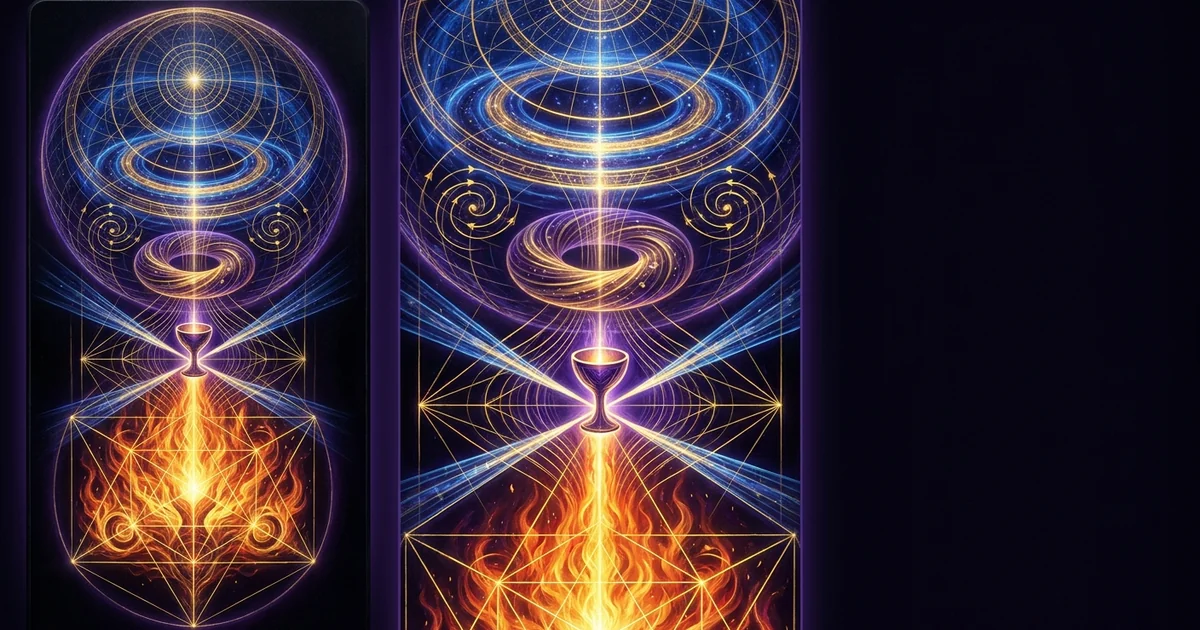
Hexagram 13 Fellowship with Men (Tóng Rén): I Ching
Archetypal Thesis & Systemic Paradigm: The Architecture of Universal Fellowship
Hexagram 13, designated in the received King Wen sequence as Tóng Rén (Fellowship with Men), encodes the structural and psycho-cybernetic transition from insular tribal cohesion to universalized, trans-personal communion. Within the cosmological mechanics of the Yijing, Tóng Rén emerges directly from the structural collapse of Hexagram 12 (Pǐ / Standstill). Where Standstill witnesses the total entropic divergence of heaven ascending away from earth—resulting in social petrification, institutional decay, and the severance of vital communication—Hexagram 13 introduces an inverted vector field. Here, the lower trigram Lí (Fire/Luminosity) ascends naturally toward the upper trigram Qián (Heaven/The Creative), initiating a dynamic reconnection between localized consciousness and the unconditioned cosmic field. This dynamic defines the structural core of the hexagram 13 fellowship with men iching meaning.
The systemic movement from Pǐ to Tóng Rén constitutes a thermodynamic reversal: the chaotic dissipation of psychic energy under stagnation is arrested and concentrated through the intentional cultivation of non-clannish alignment. This is not the passive assembly of homogeneous bodies, but an active, negentropic organization. In the language of cybernetics, Tóng Rén introduces an overarching feedback loop capable of regulating disparate, self-interested agents into a coherent superordinate system without extinguishing their idiosyncratic computational agency. The tóng rén hexagram represents the operational blueprint for an open-system architecture, wherein the entropy of isolated ego-complexes is neutralized through alignment with universal ontological principles.
Thermodynamic Dispersion and the Reversal of Stagnation
The structural failure of Hexagram 12 is rooted in systemic disjunction: Heaven operates in its transcendental altitude while Earth drifts downward into unmediated materiality, precipitating an absolute cessation of systemic dialogue. Tóng Rén repairs this metaphysical fissure by replacing Earth (Kūn) with Fire (Lí) in the lower station. Thermodynamically, fire is an ascending phenomenon; its physical vector aligns identically with the transcendent motion of heaven. When fire burns beneath the celestial sphere, its heat and radiance do not disperse into entropic void, but rise systematically toward the radiant canopy of heaven.
This structural coupling of heaven over fire generates an ascending resonance. Rather than dissipating energy outward into horizontal friction, the flame interiorizes and sublimates its caloric force, striving upward to meet its macrocosmic archetype. The stagnation of Pǐ, characterized by factionalism, paranoid retrenchment, and the withdrawal of noble principles, is dissolved by Lí’s clarity. Luminosity exposes the false boundaries manufactured during the epoch of decay, liberating the system from localized entropic dead-ends.
The Trans-Personal Mandate: Moving Beyond Kinship Dynamics
The primary anthropological obstacle addressed by Hexagram 13 is the regression into kinship-bound, exclusionary tribalism. When systems fracture, human consciousness historically retreats into the biological security of the bloodline, the clan, or the ideological faction. The judgment of Tóng Rén directly challenges this regressive instinct by proclaiming the mandate of yě—the open field, the untamed wilderness. True fellowship cannot be forged within the claustrophobic confines of the ancestral compound, where affinity is coerced through genetic or cultural obligation.
To actualize the trans-personal mandate, consciousness must step beyond the familiar perimeter of the clan and engage the other in the vulnerability of the open plain. Parochial affinity is an evolutionary dead-end; it secures immediate survival at the expense of comprehensive integration. By demanding that fellowship occur under the neutral illumination of the open sky, the hexagram enforces a radical ethical transparency. Kinship gives way to affinity based on shared adherence to cosmic law, decoupling community from the primitive reflexes of xenophobic preservation.
Cybernetic Feedback Loops in Collective Consciousness
From the perspective of systems theory, the tóng rén hexagram formalizes the conditions required for multi-agent self-organization. An autonomous collective system falls victim to destructive feedback loops when internal communication channels are dominated by local noise, sectarian competition, and asymmetric information hoarding. Lí, occupying the internal position of the hexagram, provides the necessary sensor apparatus: cognitive clarity, diagnostic discernment, and cultural illumination.
When internal clarity informs external action (Qián), the collective develops self-correcting regulatory circuits. Agents within the network adjust their behavioral parameters not through centralized coercion, but through mutual attunement to a shared macrocosmic coordinate space. The feedback loop established between human insight (Lí) and cosmic order (Qián) transforms a chaotic multitude into a synchronized collective consciousness, enabling the structural execution of civilizational tasks that exceed the capacity of isolated components.
Classical Provenance & Textual Lineage: From Zhou Ritual to Neo-Confucian Exegesis
The textual archaeology of Hexagram 13 demonstrates a consistent philosophical evolution: moving from ancient Zhou covenant rituals performed in wilderness borderlands to sophisticated Song Dynasty treatises on metaphysical impartiality. In early Western Zhou society, covenants (méng) with neighboring polities or estranged lineages required formal assembly in uncultivated territorial margins, physically removing participants from the sanctified influence of their respective ancestral temples. This ritual geography guaranteed that the oaths taken were witnessed not by localized lineage spirits, but by the impartial canopy of Heaven (Tiān).
“Fellowship with Men in the open: Success. It furthers one to cross the great water. The perseverance of the noble person furthers.” — Wilhelm/Baynes, The I Ching or Book of Changes (1950), Judgment of Hexagram 13
“When Lí unites with Qián, clarity joins with strength. The yielding finds its place in the center, and the six lines respond to it. This means fellowship in the wilderness… Only the noble person is able to unite the wills of all under heaven.” — Wang Bi, The Classic of Changes (3rd Century CE, trans. Lynn, 1994)
The King Wen Judgment and the Open Field (Yě)
The archaic core text opens with an uncompromising spatial directive: Tóng Rén yú yě (Fellowship with Men in the open/wilderness). The locative particle yě denotes uncultivated land, terrain beyond the sovereign boundaries of the city walls (yì) and the cultivated agricultural suburbs (jiāo). In this wilderness space, the artificial hierarchical safeguards, hereditary privileges, and defensive fortifications of the polis cease to function. Entry into the open field strips the individual of structural pretenses, demanding an encounter grounded solely in existential integrity.
The judgment declares that under these conditions, “It furthers one to cross the great water” (lì shè dà chuān). Crossing the great water is an archetypal formula throughout book of changes divination denoting high-risk, consequential collective mobilization. One does not navigate treacherous, non-linear oceanic thresholds through fragmented, suspicious factions. The wilderness covenant creates the psycho-spiritual buoyancy required to brave the perilous, metamorphic crossings of history.
The Dà Xiàng (Great Commentary): Lineage and Clan Transmutation
The Dà Xiàng (Great Image commentary) articulates the administrative and ethical obligations imposed by the hexagram’s structural components: “Heaven along with Fire: The image of Fellowship with Men. Thus the noble person categorizes the clans and differentiates things” (jūn zǐ yǐ lèi zú biàn wù). This formulation represents a sophisticated philosophical paradox. To establish authentic fellowship, the superior individual does not homogenize humanity into a uniform, undifferentiated mass; rather, one introduces precise taxonomy, categorical discernment, and structural differentiation.
The verb lèi (to categorize or classify) alongside biàn (to distinguish or discriminate) establishes that true harmony (hé) is diametrically opposed to mere uniformity (tóng in the pejorative Confucian sense of unprincipled conformity). By understanding the distinct nature, capacities, and psychological lineages of all entities, the noble person assigns each element its appropriate functional locus within the systemic whole. Universal fellowship is achieved not through the erasure of specificity, but through the harmonious orchestration of distinct variations under an overarching cosmic purpose.
Wang Bi vs. Cheng Yi: Ontological Principle Versus Ethical Praxis
The intellectual reception of Tóng Rén reveals a profound dialogue between the Neo-Daoist Xúanxué (School of Mysterious Learning) of Wang Bi and the Neo-Confucian Lǐxúe (School of Principle) represented by Cheng Yi. Wang Bi grounds his commentary in the radical metaphysical agency of Six-in-the-second. As the sole receptive yin line within a field of five vigorous yang lines, Wang Bi interprets this line not as a weak passive subject, but as the supreme ontological pivot:
Wang Bi posits that the solitary yin line represents the metaphysical principle of Emptiness (xū). Because it does not contend, all five yang lines gravitate toward it. Its power is not coercive, but evocative; it draws disparate, potentially combative elements into cohesion through its receptive vacancy. Fellowship is not an aggressive act of unification, but an effortless ontological attraction mediated by non-being.
Conversely, the Northern Song master Cheng Yi shifts the focus from ontological emptiness to social and civic justice (yì). For Cheng Yi, fellowship in the open field signifies absolute public impartiality (gōng). The second line resides in its correct, central position, demonstrating that legitimate communion must emanate from rectitude and structural resonance with the fifth line (the sovereign). Cheng Yi warns that if the second line associates only with its assigned partner (Line 5) out of private affection or reciprocal obligation, it degenerates into nepotism. True fellowship must be transcendent, extending identical equity to all who assemble under Heaven.
Structural Mechanics & Symbolic Geometry: Trigram Dyads and Line Transitions
The internal physics of Hexagram 13 relies upon the systemic dialogue between its constituent trigrams and the unique balance of polar lines. The lower trigram is Lí (☲, Fire), representing internal discernment, consciousness, and perceptual clarity. The upper trigram is Qián (☰, Heaven), embodying external strength, systemic law, and evolutionary momentum. This composite structure—heaven over fire (Tiān Huǒ Tóng Rén)—configures an energetic field characterized by absolute clarity internally supporting unwavering integrity externally.
- Upper Trigram: Qián (☰ - Heaven, Creative, Dynamic) | Lines 4, 5, 6
- Lower Trigram: Lí (☲ - Fire, Clinging, Luminous) | Lines 1, 2, 3
- Nuclear Upper Trigram: Qián (☰ - Heaven) | Lines 3, 4, 5
- Nuclear Lower Trigram: Xùn (☴ - Wind, Gentle Penetration) | Lines 2, 3, 4
- Combined Nuclear Hexagram: Hexagram 44 (Gòu / Coming to Meet)
- Primary Operational Polarity: Six-in-the-second (Receptive Center) responding to Nine-in-the-fifth (Creative Center).
The presence of the nuclear hexagram Gòu (Hexagram 44) buried within the interior lines (2 through 5) provides a structural diagnostic. Nuclear Gòu signifies an unexpected, powerful encounter with an autonomous element. It warns that within any collective assembly, subterranean vectors of desire, unconscious attraction, and latent power struggles are invariably activated. The clarity of Lí must penetrate the soft, infiltrating wind of nuclear Xùn to preserve the enduring order of Qián.
Trigram Vector Analysis: Heaven over Fire (Tiān Huǒ)
The dynamic equilibrium of Hexagram 13 is exceptionally stable due to the non-combative vector alignment of its inner and outer components. In hexagrams where elemental vectors clash—such as Water over Fire (Hexagram 64, Fire rising, Water sinking)—structural tension threatens catastrophic systemic rupture. In Tóng Rén, the physical properties of fire and heaven are harmonious. Fire is the terrestrial reflection of celestial luminosity; its natural kinematic imperative is to ascend.
Heaven, occupying the upper seat, continues its inexorable upward and expansive course. Lí follows directly in Qián’s wake, bathing the base of heaven in light, while Qián provides an infinite, unconditioned expanse within which the flames of Lí can burn without self-consuming combustion. The mind (Lí) grounds its cognitive models in objective metaphysical reality (Qián), preventing intellectual fragmentation.
The Hegemony of the Second Line: Central Yielding Ruler
The primary operational key to the entire hexagram is the nature and placement of Six-in-the-second. It is the sole yielding line in the hexagram, making it the definitive structural ruler (zhǔ guǐ). Line 2 is central (zhōng), correct (zhèng), and occupies its proper yin seat in the middle of the lower trigram Lí. Because of its singular receptive nature in a matrix of five solid lines, every yang line naturally seeks an alliance with it.
However, Six-in-the-second possesses a legitimate, formal counterpart in Nine-in-the-fifth, the central and correct yang ruler of the upper trigram. This structural axis between Line 2 and Line 5 forms the core nervous system of Tóng Rén. The danger lies in how the intermediate yang lines—specifically Lines 3 and 4—react to this central affinity. These lines act as potential points of structural resistance, threatening to intercept, monopolize, or forcibly seize the receptive grace of the second line, introducing factional friction into what should be a universal continuum.
Sequential Vector Mechanics: Moving Lines 1 through 6
Top — — —  Line 6 (Nine): Fellowship at the meadow. No remorse.
    —————  Line 5 (Nine): Fellowship first weeps, then laughs. Great armies meet.
    —————  Line 4 (Nine): Climbs the wall; cannot attack. Auspicious.
    —————  Line 3 (Nine): Hides weapons in the thicket; climbs hill. Three years dormant.
    — — —  Line 2 (Six):  Fellowship within the clan. Humiliation.
Base —————  Line 1 (Nine): Fellowship at the gate. No blame.
Line 1 (Nine at the Beginning): Fellowship at the Gate (Tóng Rén yú mén)
The movement initiates at the threshold. The lowest yang line has just emerged into the hexagram and has not yet entered into private, entangling alliances. The “gate” (mén) marks the exit from the private domestic interior into the public sphere. By initiating fellowship at this boundary point, the agent avoids early sectarian commitments. There is no historical baggage, no clandestine collusion; hence, the oracle assigns “No blame” (wú jiù). Consciousness meets the collective world in pristine neutrality.
Line 2 (Six in the Second): Fellowship within the Clan (Tóng Rén yú zōng)
Here lies the systemic pathology of the hexagram’s structural ruler. Six-in-the-second, overcome by the intensity of the surrounding yang forces, retreats into the safety of the lineage or domestic clan (zōng). Instead of radiating its receptive capacity to the entire collective, it directs its attention exclusively toward its legitimate partner, Nine-in-the-fifth, or retreats into insular nepotism. This structural constriction represents an ideological failure; it replicates the regressive tribalism that the hexagram is designated to overcome. The result is humiliation (lìn), for the open wilderness has been reduced to an exclusionary club.
Line 3 (Nine in the Third): Hiding Weapons in the Thicket (Fú róng yú mǎng)
Nine-in-the-third represents yang energy in excess, sitting at the energetic transition between the lower and upper trigrams. It lacks central balance and harbors covert ambitions to claim Six-in-the-second for itself, thereby blocking its communion with Line 5. Recognizing that it lacks the moral legitimacy and systemic authority of the fifth line, Line 3 resorts to guerrilla tactics: hiding armaments in the dense undergrowth and ascending a high promontory to survey the landscape. Yet, paralyzed by the sheer interior clarity of the lower trigram Lí, it cannot execute its strike. For “three years” (sān suì)—a full cycle of systemic time—it remains paralyzed by its own distrust and tactical paranoia.
Line 4 (Nine in the Fourth): Climbing the High Wall (Chéng qí yǒng)
Nine-in-the-fourth occupies the lowest station of the upper trigram Qián. Like Line 3, it is tempted to intercept the flow toward fellowship through force. It builds fortifications and ascends the defensive walls of its private fortress (yǒng), contemplating an assault upon the lower structures. However, being inherently strong, noble, and situated in the celestial trigram Qián, it undergoes a sudden ethical awakening. It recognizes that unprovoked aggression violates the transcendent mandate of fellowship. It abandons its siege engines, stands down its defenses, and yields to the inevitable harmony of the whole. This voluntary self-restraint results in good fortune.
Line 5 (Nine in the Fifth): Tears Preceding Exultant Laughter (Xiān háo táo ér hòu xiào)
Nine-in-the-fifth is the supreme sovereign line, occupying the throne of Heaven. Its trans-personal fellowship with Six-in-the-second is absolute, grounded in cosmic resonance and structural correctness. However, this union is physically and topologically obstructed by the armed, factional forces of Lines 3 and 4. The journey toward authentic fellowship demands tragic suffering; the sovereign tears of separation (háo táo) reflect the agonizing friction of history. Ultimately, the irresistible systemic resonance between the centers dissolves the obstruction. Great armies assemble to crush the remaining factional barriers, culminating in the triumphant laughter (xiào) of restored macrocosmic integration.
Line 6 (Nine at the Top): Fellowship in the Meadow (Tóng Rén yú jiāo)
The uppermost line has traversed the entire experiential arc of the hexagram and now stands outside the active social arena. The “meadow” or agricultural suburb (jiāo) represents the outermost perimeter, bordering the wild lands. At this altitude, Nine-in-the-top has exhausted the passionate, dynamic urgency for fellowship; it no longer possesses the fiery drive to organize, unify, or direct collective endeavors. It enjoys an aloof, non-committal peace with the world. While this cool detachment lacks the world-transforming ecstasy of the fifth line’s triumph, it avoids all structural complications and historical entanglements. There is “no remorse” (wú huǐ), merely the serene quietude of a consciousness hovering at the frontier of the collective matrix.
Psychological Dynamics & Operational Praxis: Individuation in the Social Arena
When decoded through the lens of archetypal psychology, Hexagram 13 provides an exacting operational protocol for collective individuation. Jungian theory emphasizes that genuine sociality is fundamentally impossible so long as the individual remains embedded in an unreflective, archaic participation mystique with the collective. When individuals are not psychologically differentiated, the group ceases to be an authentic fellowship; it mutates into a herd, dominated by the lowest common denominator of unconscious instinct, shared projections, and mutual shadow exploitation.
“Individuation does not shut one out from the world, but gathers the world to oneself… A whole person who has integrated their shadow cannot be possessed by collective hysteria; their very presence acts as an objective, non-contagious sanctuary within the inflamed body politic.” — Carl Gustav Jung, Archetypes and the Collective Unconscious (CW 9i, 1959)
“In divination, the mechanism of synchronicity bridges the internal psychic state and the physical arrangement of the universe. Hexagram 13 operates as an archetypal mirror: it forces the querent to confront where their identification with their faction is merely a covert projection of their unintegrated shadow.” — Marie-Louise von Franz, On Divination and Synchronicity (1980)
Overcoming the Shadow of In-Group Tribalism (Us vs. Them)
The core psychological malady addressed by Hexagram 13 is the projection of the collective shadow onto out-groups. The human mind naturally bifurcates reality into an idealized, sanitized “Us” (the clan, the party, the in-group) and an inherently contaminated, untrustworthy “Them” (the stranger, the competitor, the foreign entity). This binary is an infantile defense mechanism against existential anxiety. Under the sway of this dynamic, the individual unburdens their conscious self by dumping all repressed hostility, greed, and moral cowardice onto the external collective.
Tóng Rén demands the complete withdrawal of these unconscious projections. By shifting the locus of fellowship to the wilderness (yě), the archetypal architecture deprives the ego of the sanitizing validation provided by tribal approval. In the open field, one can no longer demonize the outsider to affirm one’s own belonging. The individual is forced to realize that the “weapons in the thicket” (Line 3) and the “parapet of the high wall” (Line 4) are psychological defenses constructed by their own internal paranoia, shielding them from the vulnerability required for profound trans-personal encounter.
Projection, Transference, and the Autonomous Affinity of Souls
Authentic fellowship (Tóng Rén) relies upon the activation of what Jung designated as trans-personal individuation. One cannot truly connect with the other until one has secured internal differentiation. So long as I relate to you through the lens of my unconscious expectations—demanding that you mirror my parental archetypes, soothe my unhealed wounds, or reinforce my ideological dogma—you do not exist for me as an autonomous subject. You are merely a prop in my intrapsychic drama.
The lower trigram Lí is the psychological light of self-reflection. It burns away the adhesive film of archaic transference. By achieving self-illumination internally, the individual stops consuming the psychic energy of others. Only then can the soul recognize another soul across the topological expanse of society. This affinity is not governed by genetic continuity, geographical proximity, or commercial utility, but by an autonomous, synchronistic alignment of values under the canopy of an objective, higher order (Qián).
Consultation Dynamics: Navigating Alliances and Crossing the Great Water
In practical divinatory consultation, the reception of Hexagram 13 delivers an exacting, radical operational directive. The Yijing instructs the querent to step completely out of backroom cabals, secret alliances, and insular safe spaces. If the querent is contemplating an enterprise, negotiation, or socio-political maneuver, the hexagram warns that any attempt to rely on nepotistic connections or factional advantage will trigger the humiliation warned of in Line 2.
The divinatory mandate to “cross the great water” underscores the necessity of bold, transparent initiatives. Querents are counseled to publish their manifestos, broadcast their intentions, and seek collaborators across established historical, ideological, or institutional divides. The hexagram dictates that success is predicated on complete transparency: agreements must be capable of withstanding the scrutiny of the open field. Paranoia, covert operational compartmentalization, and preemptive strikes (Lines 3 and 4) will systematically poison the field of endeavor.
Philosophical Synthesis & Macrocosmic Correspondence: Hermetic Axioms and Systemic Coherence
The structural elegance of the Yijing is revealed in its global architecture, wherein hexagrams operate not as isolated aphorisms, but as dynamic complementary pairs within a total cosmic matrix. Hexagram 13 stands in reciprocal, rotational inversion to Hexagram 14 (Dà Yǒu / Possession in Great Measure). Together, these two figures govern the thermodynamic relationship between human community and sovereign resource distribution.
Hexagram 13: Fellowship with Men (Tóng Rén)
- Trigram Configuration: Heaven (☰) over Fire (☲)
- Vector Dynamic: Internal clarity striving upward toward universal law
- Structural Ruler: Six-in-the-second (Receptive agent in the earthly sphere)
- Ontological Focus: Collective coherence, dismantling of in-group bias, transparency
- Actional Imperative: Venture into the wilderness; cross the great water through unified will
Hexagram 14: Possession in Great Measure (Dà Yǒu)
- Trigram Configuration: Fire (☲) over Heaven (☰)
- Vector Dynamic: Cosmic illumination radiating downward across the material expanse
- Structural Ruler: Six-in-the-fifth (Receptive sovereign commanding cosmic resources)
- Ontological Focus: Manifestation, stewardship of abundance, moral containment
- Actional Imperative: Suppress evil, further the good, align with the benign will of heaven
The Polar Complement: Hexagram 14 (Dà Yǒu - Great Possession)
The pair formed by 13 and 14 represents the complete sociopolitical and energetic lifecycle of high civilizations. In Hexagram 13, human beings assemble in the open field, purging themselves of factionalism and forging a coherent collective will under the illumination of Lí beneath Qián. This social cohesion generates immense systemic capital: mutual trust, reduced transaction costs, and coordinated creative momentum.
This accumulated cultural and psychic energy flows directly into Hexagram 14 (Dà Yǒu), where the trigrams invert: Fire now burns above Heaven (Huǒ Tiān Dà Yǒu). In Hexagram 14, clarity is no longer an internal striving; it has become an elevated, celestial sun radiating across the entire manifest empire. The solitary yielding line has ascended from the subordinate second position to the sovereign fifth position. Hexagram 13 provides the egalitarian ethical foundation without which the immense sovereign power and material wealth of Hexagram 14 would instantly degenerate into tyrannical exploitation and hubris.
Human Design and Genetic Codon Architecture: Gate 13 (The Listener)
Within the neo-divinatory framework of the Human Design System, which maps the 64 hexagrams onto the 64 genetic codons of human DNA, Hexagram 13 manifests as Gate 13 (The Gate of the Listener). Located in the G-Center (the biological and metaphysical locus of identity, love, and direction), Gate 13 operates as the receptive repository of human experiential memory.
Biochemically, Gate 13 forms a structural nexus with the amino acid Glutamine, serving as an organizational antenna that gathers the disparate narratives of human history. The listener does not impose directional bias; rather, like Six-in-the-second in Tóng Rén, it provides an open, non-judgmental field within which others can discharge their historical trauma, secrets, and evolutionary insights. By listening without projecting, Gate 13 synthesizes the collective past, purifying the tribal narrative and converting raw historical debris into the programmatic wisdom necessary to chart humanity’s future path.
Hermetic Resonance: The Transmutation of Solar and Mercurial Currents
From the vantage point of Western Hermeticism, Hexagram 13 traces the operational transmutation of the Solar and Mercurial intelligences. Trigram Qián corresponds to the Solar principle: the Central Spiritual Sun, the Logos, the unyielding, luminous Father whose will organizes the cosmos. Trigram Lí corresponds to the purified Mercurial fire: intellect, perception, cognitive luminescence, and the alchemical ignis vegetabilis that burns within human consciousness.
The Hermetic axiom of “As Above, So Below” is enacted with functional precision in Tiān Huǒ Tóng Rén. The Mercurial flame in the microcosm (Lí) does not usurp or combat the Solar authority of the macrocosm (Qián); it ascends to merge with it. This represents the Great Work of Hermetic communion: the alignment of the human mind with the Divine Mind. When the individual’s inner flame of awareness reflects the pure celestial laws of the macrocosm, false boundaries of separation evaporate. Fellowship is revealed not as an arbitrary moral construct, but as an inescapable hermetic reality: the realization of the absolute unity of the All through the harmonious attunement of its fragmented reflections.
Frequently Asked Questions: Technical and Hermeneutic Clarifications
Resolving Interpersonal Enquiries vs. Spiritual Calling
When querying the Yijing regarding romantic attachments or business partnerships, receiving Hexagram 13 often provokes interpretive confusion. Novice querents frequently mistake the term “Fellowship” for an unconditional affirmation of immediate romantic or financial union. Hermeneutically, this is an error. Tóng Rén operates primarily in the trans-personal and civic realms. When Hexagram 13 appears in relational contexts, it demands that the relationship be consecrated to an objective higher purpose that transcends mere emotional co-dependency or mutual financial security.
If two individuals seek connection under the aegis of Tóng Rén, their alliance must be capable of existing in the “open field.” It cannot survive as a cloistered, symbiotic retreat from the world. The hexagram challenges the querents: What is the collaborative mission of this union beyond the satisfaction of private ego desires? If the relationship cannot serve as an open, transparent vehicle for broader communal or spiritual service, it risks collapsing into the structural humiliation of Line 2—fellowship degenerating into a self-obsessed, defensive clique.
Deciphering the Warning of Hidden Ambush in Line 3
The imagery of Nine-in-the-third is among the most structurally evocative warnings in the Book of Changes: “He hides weapons in the thicket; he mounts his high hill. For three years he does not rise up.” Querents are often alarmed by this apparent manifestation of overt hostility. In both divinatory practice and psychological diagnosis, this line does not necessarily denote an external physical enemy lying in wait. More profoundly, it exposes the presence of acute psychological projection driven by underlying insecurity.
Because Nine-in-the-third lacks the natural centrality and legitimacy to claim true authority within the fellowship, it assumes that everyone else operates with the same covert, predatory intentions it secretly harbors. It projects its own repressed aggression onto its environment, convincing itself that the world is fraught with invisible traps. Consequently, it hoards defenses (“hides weapons”) and retreats to an isolated, emotionally aloof vantage point (“mounts his high hill”). The “three-year” paralysis emphasizes that paranoia is fundamentally an energetic prison: until the individual abandons their hidden weapons and descends from their defensive watchtower, they are structurally barred from participating in life’s living currents.
The Paradox of Differentiation within Unity
A critical point of hermeneutic failure in interpreting Hexagram 13 is the conflation of fellowship (tóng) with absolute homogenization. The Great Image commentary explicitly states that the noble person establishes fellowship through categorical differentiation: “categorizing the clans and distinguishing things.” Why does the establishment of unity require the reinforcement of categorical distinctions?
In ancient systemic cosmology, authentic unity (tóng) is utterly dependent on structural harmony (hé), which can only exist between distinct, differentiated entities. If an orchestra consisted solely of instruments tuned to the exact same pitch playing the exact same note, the result would not be music, but a deafening, monocultural drone. Uniformity eradicates identity, creating brittle, totalitarian structures that collapse under stress.
True fellowship demands that every element within the system be thoroughly itself. The noble person clarifies boundaries, honors varying functional capacities, and assigns distinct roles based on ontological realities. Only when the warrior is permitted to be a warrior, the artisan an artisan, and the scholar a scholar—each working in concert under the overarching authority of cosmic truth—can human fellowship achieve the robust, resilient perfection mirrored in the boundless expanse of Heaven over Fire.