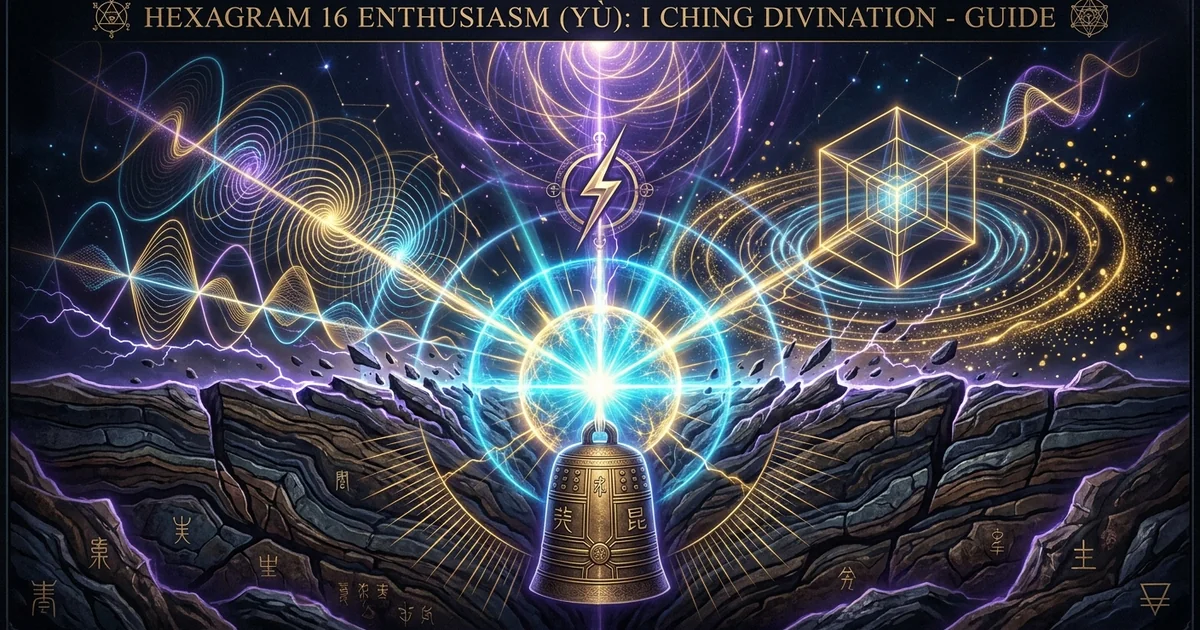
Hexagram 16 Enthusiasm (Yù): I Ching Divination - Guide
Archetypal Thesis & Systemic Paradigm: The Dynamic Field of Thunder over Earth
Hexagram 16 (豫, Yù), rendered classically as Enthusiasm, Harmony, or Excess, formalizes the cybernetic mechanics of collective phase transitions within the morphogenetic field of the I Ching. Moving beyond exoteric characterizations of subjective excitement or psychological optimism, the architecture of the yù hexagram maps the precise operational conditions under which an undifferentiated, unpolarized substrate undergoes spontaneous macroscopic organization. This phenomenon is governed by the polarity between its constituent trigrams: the upper trigram Zhèn (震, Thunder, Movement, the Arousing) situated above the lower trigram Kūn (坤, Earth, Receptive Dielectricity). In the cosmological cartography of the Book of Changes, this topology models the thermodynamic release of kinetic resonance into a compliant physical or psychological matrix.
Acoustic Kineticism and the Electro-Magnetic Release of Zhèn
The structural mechanics of thunder over earth describe an acute thermodynamic disequilibrium resolving through acoustic transmission. Trigram Zhèn consists of a solitary sovereign Yang line at its base, bounded and catalyzed by two yielding Yin lines above. It embodies the vector of primary ignition—the subterranean spark that breaches the surface of physical latency. When positioned above the pure Yin continuum of Trigram Kūn, Zhèn acts as an alternating current discharge into a ground state. The acoustic shockwave of thunder does not merely dissipate into empty space; it reverberates directly against the dense, yielding crust of the terrestrial sphere.
In divinatory cybernetics, this kinetic event signifies the sudden transition from potential systemic energy to dynamic kinetic dissipation. Within the larger structural progression of the Book of Changes, this energetic dynamic finds an essential cyclical antecedent in /iching/hexagram-24-fu-return, where the solitary Yang line awakens beneath the five yielding Yin planes of Earth. In Hexagram 16, however, that primary germinal impulse has migrated into the upper realm, discharging its stored tension downward and outwards across the surface of the collective. The eruptive signature of Zhèn is inherently oscillatory, demanding an interpretive framework rooted in harmonic oscillation rather than linear mechanical force.
Kūn as the Unresisting Dielectric Medium of Inscription
Trigram Kūn constitutes the base of Hexagram 16, providing an unbroken three-line foundation of pure structural receptivity (represented in binary code as 000). Within classical Taoist metaphysics, Kūn possesses no autonomous teleological trajectory; it operates as the unresisting, maternal dielectric matrix that receives, sustains, and manifests form. When overlaid by the dynamic vector of Zhèn, Kūn does not resist the acoustic shockwave. Instead, it absorbs the oscillatory frequency and conforms to its geometric imperatives, demonstrating principles explored in /esoteric-physics/cymatics-vibrational-morphogenesis.
Because the Earth offers zero structural friction to the descending impulse, the kinetic waveform travels with near-zero impedance. In systemic terms, Kūn represents the unindividuated collective consciousness, the social body, the mass psychological base, or the cellular substrate awaiting an inductive signal. If the activating signal lacks structural purity, Kūn’s sheer permeability risks mass contagion; conversely, if the inductive frequency aligns with harmonic cosmic law, Kūn serves as the ground through which divine liturgy, seasonal labor, and societal governance achieve coherence.
Phase Locking and Collective Coherence in the Affective Field
The macrocosmic synthesis of Thunder over Earth delineates the biological and sociological phenomenon of entrainment, or phase locking. When multiple independent oscillators share a weakly coupled physical or psychological medium, their phase states naturally synchronize toward the dominant frequency vector. The hexagram 16 enthusiasm iching meaning hinges entirely on this principle of collective resonance: the spontaneous alignment of discordant micro-behaviors into a singular, unified macroscopic wave.
In this context, Yù is not a state of personal affective euphoria, but an objective condition of system-wide harmonic capture. The solitary initiating Yang vector acts as the master clock or tuning fork, broadcasting a unifying frequency across the passive Yin matrix. The entire systemic apparatus begins to oscillate at an identical wavelength, yielding the immense energetic leverage required to mobilize standing armies, execute monumental public works, or perform state-level ancestral rituals. It is the precise threshold where individual ego-boundaries dissolve into collective archetypal movement.
Classical Provenance & Textual Lineage: The Zhouyi Codices and the Ten Wings
The codification of Hexagram 16 across the Zhouyi and the subsequent philosophical treatises of the Ten Wings (十翼, Shi Yi) demonstrates a shift from primitive divinatory omenology to sophisticated statecraft and liturgical cosmology. In the canonical arrangement, Yù follows Hexagram 15 (謙, Qiān, Modesty). The structural sequence is absolute: profound internal equilibrium and egoless humility must precede the release of collective mobilization. Without the moral anchor forged in /iching/hexagram-15-qian-modesty, the kinetic release of Hexagram 16 collapses into psychological inflation and socio-political catastrophe.
Tuan Zhuan: “Yù: The firm finds response, and its will is carried out. Action in accordance with the time, movement in harmony with devotion: this is Yù. Heaven and Earth operate with devotion, and thus the sun and moon do not err, and the four seasons do not deviate from their courses. The holy sages utilized devotion and harmony; hence their punishments were clear and their people submitted. Great indeed is the significance of the time of Yù!”
Daxiang Zhuan: “Thunder issues forth resounding from the Earth: the image of Yù. Thus the ancient kings performed sacred music to honor supreme virtue, offering it with the utmost devotion to the Supreme Deity, so as to share it with their ancestral forebears.”
The Tuan Zhuan (Commentary on the Decision) and Sacrificial Liturgy
The Tuan Zhuan contextualizes the energetic dynamics of Hexagram 16 by asserting that cosmic law itself operates through the functional mechanics of Yù. The phrase shùn ér dòng (順而動)—“moving in accordance with devotion” or “action through yielding compliance”—unpacks the exact relationship between the inner trigram Kūn (devotion/yielding) and the outer trigram Zhèn (movement). The commentary explicitly anchors this dynamic in macrocosmic cycles: the sun, moon, and the four seasons do not deviate because their movements are organically attuned to the underlying rhythm of the Dao.
When extended to human systems, the Tuan Zhuan bridges natural rhythms with judicial and military administration. The classical lineage of book of changes divination treats enthusiasm as the prerequisite for legitimate structural authority. Sages do not command compliance through raw coercion; rather, by tuning their edicts to the natural sentiments and seasonal readiness of the populace, governance functions through harmonic resonance. The mobilization of feudal levies and the enforcement of penal statutes (xíng fá) cease to be arbitrary impositions and become organic extensions of seasonal necessity.
The Daxiang Zhuan: The Ancestral Music of the Ancient Kings
The Daxiang Zhuan (Commentary on the Great Symbolism) elevates the acoustic reality of Thunder over Earth into the liturgical technology of sacred music (zuò yuè, 作樂). The ancient sovereigns recognized that the phenomenon of Zhèn erupting from Kūn was an acoustic blueprint for civilizational coherence. Music, in the classical Zhou worldview, was not mere aesthetic diversion; it was an applied metaphysical science of geometric acoustic ordering.
By designing complex pentatonic ritual instruments—heavy bronze bells (biānzhōng), sonorous stone chimes (biānqìng), and silk strings—the ancient rulers mirrored the tonal architecture of the cosmos. When struck in the ancestral temple, these instruments generated low-frequency vibrational fields that physically and psychically unified the assembly. This acoustic field served as a bidirectional trans-dimensional antenna: it honored the Supreme Deity (Shangdi) while simultaneously establishing a somatic resonance corridor connecting the living community with the ancestral field. Music served as the cybernetic feedback loop through which Heaven’s mandate was internalized by the socio-political collective.
Wang Bi’s Ontological Synthesis of Subservient Yin Lines
The third-century scholar Wang Bi (王弼), in his seminal commentary on the Zhouyi, transformed the structural analysis of Hexagram 16 from superstitious divination into an ontological examination of the dialectic between the One and the Many. As preserved and expanded in modern scholarship by Richard John Lynn (1994), Wang Bi isolated the solitary fourth line (Nine at the Fourth) as the absolute ontological axis of the hexagram. Wang Bi posed the fundamental metaphysical question: How is it that five receptive, heavy Yin lines are compelled into collective obedience and joyful harmony by a singular Yang line situated not on the throne of the fifth line, but in the ministerial station of the fourth?
Line Configuration for Hexagram 16 (豫 - Yù):
- -  Line 6 (Yin): Deluded Enthusiasm
- -  Line 5 (Yin): Chronic Resistance
---  Line 4 (Yang): Sovereign Vector / The Conductor
- -  Line 3 (Yin): Hesitant / Servile Dependence
- -  Line 2 (Yin): Unyielding Discernment / Rock-like Neutrality
- -  Line 1 (Yin): Narcissistic Flaunting
Wang Bi demonstrated that the Yin lines do not surrender to Nine at the Fourth out of subjugation, but through spontaneous, structural self-interest. In Wang Bi’s ontological economy, the One represents the primordial organizing core of being, whereas the Many represent phenomenal diversity. The five Yin lines, being inherently fragmented, receptive, and structurally passive, lack the agency to orchestrate their own coherence. Nine at the Fourth acts as the singular, dynamic node that resolves their collective indeterminacy. The subservience of the Yin lines is effortless precisely because the fourth line provides the teleological direction they fundamentally crave.
Cheng Yi (ca. 1099), writing nearly eight centuries later in his Yichuan Yizhuan, reinforced this structural principle while underscoring its inherent moral peril. Cheng Yi argued that while Nine at the Fourth effortlessly commands the devotion of the entire hexagram, its location in an exterior, ministerial position makes it susceptible to arrogance and demagogic manipulation if it fails to maintain absolute rectitude.
Structural Mechanics & Symbolic Geometry: Line Dynamics and the Nuclear Core
Hexagram 16 presents a crystalline, asymmetrical architecture. Occupying the coordinates 000100 in binary hexagram notation (reading from line 1 at the base to line 6 at the apex), Yù is classified within structural taxonomy as a “Single-Yang Hexagram” (yī yáng guà). The topological behavior of the entire hexagram is dictated by the distribution of mechanical forces around this lone Yang intruder at the fourth station.
- Hexagram Configuration: Thunder (Zhèn) over Earth (Kūn)
- Binary Vector:
000100(Base line = 0, Top line = 0) - Nuclear Trigrams:
- Lower Nuclear (Lines 2, 3, 4): Trigram Gèn (艮, Mountain,
001) - Upper Nuclear (Lines 3, 4, 5): Trigram Kǎn (坎, Water/Abyss,
010)
- Lower Nuclear (Lines 2, 3, 4): Trigram Gèn (艮, Mountain,
- Nuclear Hexagram: Hexagram 39 (蹇, Jiǎn, Obstacle / Halting Limp,
001010) - Sovereign Ruler: Nine at the Fourth (九四), occupying the place of the Minister.
Nine at the Fourth: The Solitary Dynamic Vector and Cosmic Conductor
Nine at the Fourth is the undisputed Sovereign Ruler (zhǔ guà) of Hexagram 16. In classical line-theory, the fourth position belongs to the high minister or chief executive—the transitional portal between the inner matrix of personal cultivation and the outer arena of socio-historical deployment. Because the fifth line (the traditional seat of the Emperor) is weak, yielding, and occupied by a Yin line, Nine at the Fourth carries the entire operational burden of the collective.
Line 6: [ -   - ] Upper Trigram: Zhèn (Thunder / Dynamic Release)
Line 5: [ -   - ]
Line 4: [ ----- ] <-- NINE AT THE FOURTH (Sovereign Organizing Pole)
-----------------
Line 3: [ -   - ] Lower Trigram: Kūn (Earth / Yielding Receptivity)
Line 2: [ -   - ]
Line 1: [ -   - ]
This single solid line serves as the focal point of the total energetic circuit. It is the electro-acoustic transducer. Downward, it exerts an inductive magnetic pull on the three Yin lines of Trigram Kūn, lifting them out of inert stasis. Upward, it supports and drives the Yin lines of Trigram Zhèn, transforming explosive atmospheric tension into focused social momentum. Wilhelm and Baynes (1950) translate the judgment of this line as: “The source of enthusiasm. He achieves great things. Doubt not. You gather friends around you as a hair clasp gathers the hair.”
The metaphor of the hair clasp (péng kòu) is structurally brilliant: an inert mass of loose hair (the fragmented Yin lines) is gathered, bound, and held in an elegant, operational form by a single, rigid pin (Nine at the Fourth).
The Nuclear Substructure: Hexagram 39 (Jiǎn) as the Latent Impedance
To understand the latent thermodynamic friction within Hexagram 16, one must compute its inner nuclear core. As documented in foundational studies on /iching/nuclear-hexagrams-structural-mechanics, lines 2, 3, and 4 form the lower nuclear trigram Gèn (艮, Mountain), while lines 3, 4, and 5 form the upper nuclear trigram Kǎn (坎, Water/Danger). The synthesis of these two internal trigrams generates Hexagram 39 (蹇, Jiǎn, Obstacle / Halting Limp).
The presence of Hexagram 39 at the genetic center of Hexagram 16 delivers a vital systemic warning: within every state of collective enthusiasm lies the latent architecture of an insurmountable barrier.
The surface manifestation of Yù is uninhibited motion, charismatic authority, and sweeping collective action; however, its nuclear core is Mountain beneath Water—an archetype of paralysis, cold danger, and severe thermodynamic impedance. This reveals that enthusiasm is not a perpetual-motion machine. It is a high-voltage response to deep underlying tension. If the conductor at line 4 ignores the nuclear reality of Jiǎn, the momentum will abruptly strike the internal mountain and drown in the abyssal waters of systemic collapse.
True mastery of Hexagram 16 requires the practitioner to manage the nuclear obstacle beneath the euphoric surface, using the wave of mobilization to bypass or dismantle structural friction before entropy reasserts itself.
Sequential Transitions: The Line Progression from Vanity to Delusion
The six lines of Hexagram 16 map the precise degeneration states of collective affect when subjected to varying degrees of consciousness and self-control:
Six at the Beginning (初六)
Position: Baseline of Kūn. Weak, yielding, lacking self-mastery.
Diagnosis: Narcissistic pre-emption. Connected by sympathetic resonance to Nine at the Fourth, this line proclaims its association with power before having accomplished any structural work. The Zhouyi declares: “Enthusiasm that expresses itself brings misfortune.” It is the voice of the groupie, the ideological partisan who rides the coattails of charismatic leadership, mistaking proximity to creative momentum for individual attainment.
Six in the Second Place (六二)
Position: Central and correct within the Kūn matrix.
Diagnosis: The sovereign fulcrum of unshakeable discernment. “Firm as a rock. Not waiting until the end of the day. Perseverance brings good fortune.” Because it sits directly between the vanity of the first line and the servile dependence of the third, Six in the Second maintains radical neutrality. It is completely immune to the seductive mass hysteria generated by Nine at the Fourth. It sees the subtle teleological vectors (jī, 機—the embryonic beginnings of movement) and preserves its individuation, acting before systemic collapse manifests.
Six in the Third Place (六三)
Position: Apex of Trigram Kūn, transitional boundary.
Diagnosis: Servile hesitation and parasitic dependence. “Enthusiasm that looks upward creates remorse. If there is hesitation, there comes remorse.” This line lacks the central purity of Six in the Second. It gazes upward at Nine at the Fourth with sycophantic longing, paralyzed between autonomous action and total submission to the charismatic center.
Nine at the Fourth (九四)
Position: Base of Trigram Zhèn; Sovereign Ruler.
Diagnosis: The primary energetic inductor. “The source of enthusiasm. He achieves great things. Doubt not.” The entire hexagram’s structural integrity rests here. It must remain free of self-serving bias, operating purely as a transparent conduit for cosmic necessity.
Six in the Fifth Place (六五)
Position: Sovereign locus occupied by a weak Yin line. Under pressure from Nine at the Fourth.
Diagnosis: Chronic systemic constriction. “Persistently ill, yet does not die.” The fifth line represents the nominal ruler who is overshadowed and boxed in by the charismatic power of the minister at line 4. Caught in an energetic field it cannot command, it suffers chronic systemic friction. Yet, because it occupies the central position of the upper trigram, it does not perish; the structural crisis remains stabilized in chronic tension.
Top Six (上六)
Position: Terminus of Trigram Zhèn; ultimate culmination of enthusiasm.
Diagnosis: Deluded, psychopathic inflation. “Deluded enthusiasm. But if after completion one changes, there is no blame.” The acoustic momentum of Zhèn has reached its boundary, decoupling completely from material reality. It is the state of mass psychosis, ideological hysteria, or the manic phase of a bipolar cycle. Only an immediate, structural phase-shift (bian) away from the delusion can avert catastrophic systemic collapse.
Psychological Dynamics & Operational Praxis: Jungian Archetypes and Divinatory Diagnostics
From the analytical perspective of Carl Gustav Jung (1950) and Marie-Louise von Franz (1980), the I Ching operates as an empirical instrument for mapping real-time configurations of the collective unconscious. Divinatory mechanics do not predict pre-deterministic trajectories; rather, they register moments of acausal ordered reality—synchronicity—wherein internal psychological archetypes mirror external geopolitical or physical states.
“The archetype, when constellated, brings about a condition of emotional mobilization, an altered state of consciousness akin to an autonomous complex… Wherever an archetype succeeds in expressing itself in a mass movement, it carries with it that peculiar dynamic quality which we designate as numinous. It seizes upon the individual with irresistible force, dragging him along in its wake… This is the secret of mass psychology: enthusiasm is contagious because it activates the dormant layers of the collective unconscious.” — C.G. Jung, Collected Works, Vol. 11: Psychology and Religion: West and East
Collective Archetypal Inflation and Affective Entrainment
In Jungian diagnostics, Hexagram 16 maps the explosive constellation of an autonomous archetype within the collective psyche. When an archetypal image (represented by the kinetic voltage of Zhèn) pierces the collective unconscious (the unresisting substrate of Kūn), it produces an altered psychic state characterized by high affect, hyper-arousal, and a breakdown of critical ego barriers.
This is the psychological blueprint of psychic inflation (Aufgeblasenheit). When a group or individual enters the field of Hexagram 16, the ego erroneously identifies with the numinous energy of the constellated archetype. The charismatic leader (Nine at the Fourth) is immediately perceived through the projection of the Mana-personality—the hero, the savior, the cosmic visionary.
Simultaneously, the populace (the Yin lines) succumbs to mass identification, forfeiting personal moral agency in exchange for the intoxicating euphoria of collective oceanic belonging. The danger of this state cannot be overstated: when an archetype captures the collective psyche without the counter-balancing weight of individual differentiation, it predictably generates the fanatical delirium described in Top Six.
Six in the Second Place: The Bedrock of Unyielding Discernment
Against this backdrop of mass contagion stands the psychological ideal of the individuation process: Six in the Second Place. Confucius, in the Xici Zhuan (Great Treatise), singled out this line for extensive psychological exegesis:
“To know the seeds (jī, 機)—that is divine indeed! The noble person sees the seeds and acts immediately; he does not wait an entire day… The seeds are the first imperceptible beginnings of movement, the trace of good fortune or misfortune that is about to appear. The noble person sees them and acts at once, without waiting for the day to end.”
Six in the Second achieves this level of operational clarity because it maintains internal stillness within the very heart of the collective matrix. While the first line is blinded by vanity and the third line by longing, the second line is anchored in the bedrock of conscious individuation. It understands that collective enthusiasm is inherently temporary and prone to entropic decay.
By operating with absolute perceptual objectivity, Six in the Second is never caught off guard by the rising tide of affective contagion. It neither opposes the movement destructively nor drowns within its currents; it tracks the subtle, early markers of the trajectory and shifts its stance long before the crowd recognizes that the wave has crested.
Divinatory Interpretation Protocols for Operational Decisions
When Hexagram 16 emerges within an operational consultation, the diviner must apply a rigorous, multi-tiered diagnostic framework:
[Divinatory Inquiry: Hexagram 16 Deployed]
  │
  ├─ Phase 1: Signal Authentication
  │    └─ Test motive: Ego inflation vs. Objective systemic necessity
  │
  ├─ Phase 2: Structural Grounding
  │    └─ Interrogate line 2: Does an unyielding anchor exist?
  │
  └─ Phase 3: Friction Analysis
       └─ Evaluate Hexagram 39: Map latent obstacles beneath momentum
- Phase 1: Signal Authentication. Interrogate the nature of the prevailing momentum. Is the proposed venture, movement, or emotional state propelled by genuine alignment with systemic cycles, or is it a manic defense against underlying dread (Hexagram 39)? If the enthusiasm relies entirely on hyper-dopaminergic stimulation, mass consensus, or performative vanity (Line 1), immediate tactical disengagement is mandated.
- Phase 2: Structural Grounding. Hexagram 16 is exceptionally favorable for establishing enterprise structures, launching strategic campaigns, appointing high commanders, and mobilizing collective capital—provided a singular, competent organizing authority (Nine at the Fourth) exists. If this sovereign conductor is absent, the enthusiasm will dissipate into chaotic factionalism.
- Phase 3: Friction Mapping. The divination demands the simultaneous assessment of latent obstacles. The operator must prepare logistical contingencies before the initial surge of morale expires. Every strategic plan initiated under Yù must possess an exit strategy for the inevitable arrival of Top Six delusion.
Philosophical Synthesis & Macrocosmic Correspondence: Hermetic Cymatics and Human Design
The macrocosmic architecture of Hexagram 16 reflects the Hermetic Principle of Vibration: “Nothing rests; everything moves; everything vibrates.” The dynamic interaction between Zhèn and Kūn is an ancient Chinese formalization of the fundamental physical law governing how invisible acoustic waveforms sculpt passive material substrates into geometrical form.
Authentic Archetypal Resonance
- Grounded in the humility of Hexagram 15.
- Directed by a singular, disciplined organizing vector (Nine at the Fourth).
- Calibrated by the unyielding discernment of Six in the Second.
- Yields long-term collective cohesion, artistic mastery, and harmonic order.
- Overcomes the nuclear impedance of Hexagram 39 via tactical endurance.
Shadow Inflation / Contagion
- Bypasses internal purification; roots itself in narcissism (Line 1).
- Degenerates into demagogic manipulation and messianic posturing.
- Characterized by uncritical ego-surrender and psychological contagion.
- Culminates in ideological delirium, burnout, and catastrophic dissolution (Top Six).
- Crashes directly into the nuclear obstacle of Hexagram 39, generating paralysis.
Acoustic Metaphysics: Cymatic Organization of Biological Matter
In physical acoustics, cymatics reveals that when a metal plate covered with particulate matter (such as sand or lycopodium spores) is subjected to pure sound frequencies, the particles do not scatter randomly. Instead, they migrate away from the nodal regions of maximum vibration toward lines of acoustic stillness, forming intricate geometric mandalas.
This physical dynamic directly mirrors the metaphysics of Hexagram 16. Kūn is the powder resting upon the Chladni plate; Zhèn is the sonic frequency propagated across the material. When the frequency is erratic or distorted, the matter dissolves into chaotic static; when the frequency is pure and sustained, the matter organizes into coherent, operational architecture.
In this light, the ancient kings’ creation of music was an applied engineering discipline. By attuning the human nervous system to harmonious tonal ratios, societal coherence was engineered non-coercively. The cultural and biological matrix was physically aligned through the harmonic field.
Human Design Gate 16: The Channel of Wavelength and Harmonic Mastery
In the contemporary syncretic mapping of the Human Design System, Hexagram 16 corresponds directly to Gate 16 (The Gate of Skills / Enthusiasm), situated in the biological matrix of the Throat Center. The Throat Center operates as the bodygraph’s primary mechanical pressure valve for physical manifestation, communication, and action.
Within this coordinate system, Gate 16 forms one half of the Channel of Wavelength (16–48), linking the splenic awareness of Gate 48 (The Well, Depth, Systemic Intuition) directly to the somatic expression of the Throat. This alignment reveals the vital mechanical reality detailed in /human-design/gate-16-skills-enthusiasm:
- Gate 16 represents the raw talent, vocal mastery, and technical enthusiasm required to bring an archetype into the physical world.
- However, isolated from Gate 48’s splenic depth, Gate 16 degenerates into superficial performance, technical vanity, and ungrounded experimentation.
- Enthusiasm without foundational depth is mere theatrical posturing.
- True mastery (skills) requires obsessive repetition over extended temporal cycles until the physical apparatus becomes a frictionless instrument for the creative frequency.
The Codon Architecture: Genetic Transcription and the Harmonic Field
At the molecular and biological tier of esoteric cartography, the 64 hexagrams correspond directly to the 64 genetic codons that transcribe human life. Hexagram 16 maps to a specific chemical codon coordinate, reflecting the biological imperative for selective activation. In cellular transcription, a gene remains inert (pure Kūn) until a transcription factor binds to the promoter region (the sovereign Yang signal of Line 4), triggering the synthesis of messenger RNA (the kinetic release of Zhèn).
This biological parallel reinforces the core metaphysical premise of Yù: unbounded potentiality is sterile without an organizing vector. Life does not exist in an undifferentiated vegetative state; it requires periodic energetic shocks—catalytic inputs—to force biological systems across thermodynamic thresholds into higher levels of evolutionary complexity. Enthusiasm is the subjective phenomenological sensation of the organism upgrading its energetic throughput to meet an organizing evolutionary command.
Frequently Asked Questions: Advanced Divinatory and Structural Inquiries
Navigating the Polarity Between Hexagram 15 (Modesty) and Hexagram 16 (Enthusiasm)
The sequential pairing (Xù Guà) between Hexagram 15 (謙, Qiān) and Hexagram 16 (豫, Yù) represents one of the most critical structural axes in the Zhouyi. In Hexagram 15, Trigram Gèn (Mountain) resides under Trigram Kūn (Earth). The immense, towering peak of personal attainment intentionally places itself beneath the low ground of the collective, producing absolute stability, balance, and egoless containment.
Only when the psychic apparatus has been stabilized by this humility can the polarity reverse into Hexagram 16, where Trigram Zhèn (Thunder) breaks above Trigram Kūn (Earth). If an individual or organization attempts to harness the explosive mobilization of Hexagram 16 without first integrating the ego-nullification of Hexagram 15, the kinetic discharge inevitably mutates into disastrous messianic inflation. Modesty creates the deep gravitational well; Enthusiasm is the star that ignites within it. Without Modesty, Enthusiasm becomes a brief, destructive supernova followed by systemic collapse.
The Danger of Nine at the Fourth: Sovereign Leader or Demagogue?
In advanced divinatory consultations, the arrival of Nine at the Fourth presents acute diagnostic ambiguity. Because this line is the solitary source of momentum for five passive Yin lines, the line wields intoxicating, asymmetrical power over the collective field. The line marks the tipping point between an inspiring visionary and a psychopathic demagogue.
To determine which expression is active, the analyst must evaluate three diagnostic metrics:
- Correspondence to Line 5: Does the fourth line honor the legitimate, quiet sovereignty of the yielding ruler at Line 5, or does it attempt to undermine and usurp the throne? A demagogue operates through self-aggrandizement; a legitimate conductor functions transparently on behalf of the whole.
- Integration of Nuclear Lineage: Does the leader account for the structural friction of nuclear Hexagram 39 (Jiǎn)? The authentic leader acknowledges obstacles, prepares logistics, and demands rigorous discipline. The demagogue dismisses material constraints, offering hysterical euphoria as a substitute for operational architecture.
- Purity of Resonance: Does the mobilization elevate the agency of the participants, or does it reduce them to reactive, dependent sycophants (as warned in Line 3)?
Remediating Negative Line Transmutations in Operational Consultations
When consulting the I Ching during acute organizational, psychological, or strategic crises, receiving the degenerate lines of Hexagram 16—specifically Six at the Beginning and Top Six—demands immediate operational remediation.
- Remediating Six at the Beginning (初六):
This line indicates that the querent is broadcasting intentions prematurely, indulging in vanity, or relying on social proximity to power rather than personal capability. The remedy is absolute silence and strategic invisibility. The querent must sever emotional reliance on the approval of the charismatic center, cease public announcements, and ground themselves in the foundational labor of Trigram Kūn. - Remediating Top Six (上六):
This line indicates that a project, belief system, or emotional fixation has entered terminal inflation. The initial wave of legitimate enthusiasm has mutated into an ungrounded, manic echo chamber. The remedy is an intentional, conscious phase-shift (biàn). The operator must execute a controlled collapse of the enterprise or narrative before external reality enforces a catastrophic one. This demands breaking collective groupthink, stepping off the operational treadmill, and retreating immediately into meditative containment to clear systemic dopamine toxicity. By identifying the delusion at the apex of its arc, blamelessness is preserved, clearing the ground for structural rebirth. :::