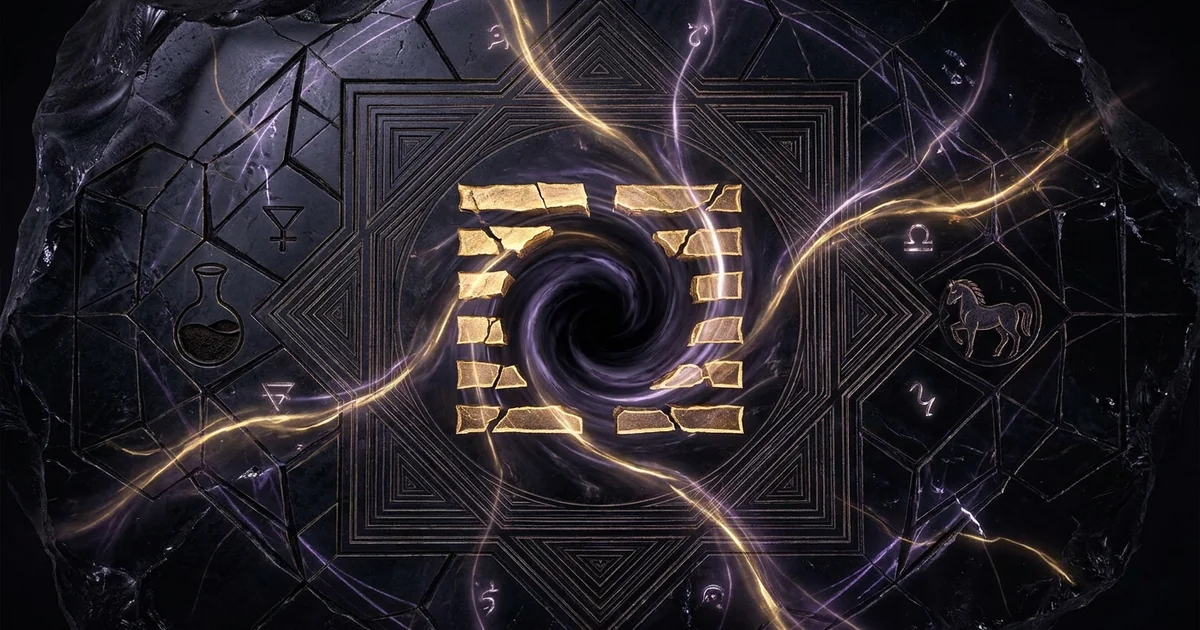
Hexagram 2 The Receptive (Kūn): I Ching Divination
Archetypal Thesis & Systemic Paradigm: The Primordial Yin Matrix
Within the binary cosmology of the Yijing, Hexagram 2 (Kūn, ䷁), conventionally rendered as “The Receptive,” serves as the indispensable ontological ground for all manifest existence. Where its complementary predecessor, Hexagram 1 (Qián), designates the pure, dimensionless vector of creative volition, Kūn supplies the spatial matrix, somatic substrate, and energetic capacitance required for form to precipitate into time and space. Far from representing inert passivity or vacuous absence, Kūn constitutes an active, dissipative architecture of supreme responsiveness. In the analytical nomenclature of the Zhouyi, this hexagram models the self-organizing dynamic whereby unformed psychic and physical energies achieve structural coherence through yielding, non-teleological receptivity. It is the chthonic womb, the fertile black earth, and the cosmic continuum that absorbs the unmitigated downward stroke of pure Yang without fracturing, transmuting kinetic impulse into systemic endurance.
Hexagram 2: ䷁ (Kūn / The Receptive)
Structure: Six broken lines (Earth over Earth)
Binary Coordinates: 000000
Complementary Counterpart: Hexagram 1 (Qián / The Creative, 111111)
Kūn as the Generative Field of Ontological Spacetime
In cosmogonic terms, the primordial yin-yang-polarity must not be misconstrued through the moralized dualisms of Western post-Enlightenment philosophy, where light and active assertion are privileged over dark and quiescent absorption. In the systemic paradigm of Chinese metaphysics, Kūn represents spatialization itself. Without the open field of the receptive matrix, the concentrated spark of Qián possesses neither arena for deployment nor medium through which its archetypal light can become visible. Kūn provides the gravitational well, the ontological density that decelerates the blinding, dimensionless radiance of pure spirit into the tangible fabric of mineral, plant, animal, and human forms.
This generative field functions through complete, unreserved emptiness—an emptiness that must be understood not as nihilistic void, but as pure potentiality. Just as a vessel’s utility resides precisely in its hollow capacity, the kūn hexagram operates as the infinite container within which the “ten thousand beings” (wanwu) are conceived, gestated, and sustained. By maintaining an internal pressure of zero resistance, Kūn exerts an immense, silent drawing power. It is an attractant field that invites energy to settle, condense, and organize itself according to its intrinsic nature, undisturbed by external coercion or premature teleological demands.
The Cybernetics of Yielding: Receptivity versus Inertia
From a cybernetic perspective, the core operational principle of Hexagram 2 is yielding (shùn), a term frequently mistranslated as submission or compliance. Within dynamic systems theory, yielding represents an advanced feedback mechanism characterized by high systemic compliance, low internal friction, and rapid energetic dissipation. When a perturbation encounters an unyielding, rigid boundary, the incoming kinetic force causes either elastic recoil or structural fracture. Conversely, when a perturbation strikes a dissipative medium governed by Kūn, the force is distributed across the entire systemic matrix, neutralizing destructive amplitude and converting violent momentum into localized equilibrium.
Understanding the hexagram 2 the receptive iching meaning requires discarding the conceptual conflation of receptivity with inertia. Inertia is the static refusal of matter to accelerate without external force; receptivity is the hyper-attuned state of dynamic tracking and adaptation. Kūn does not resist incoming vectors; it maps them, internalizes their trajectories, and wraps around their contours with liquid precision. In cybernetic systems, this constitutes the ultimate negative feedback loop: an architecture capable of dampening high-entropy shocks through an absolute, fluid elasticity, thereby preserving the macro-integrity of the organism through local micro-adjustments.
The Mare Metaphor: Directed Energy within Chthonic Containment
The classical judgment of Hexagram 2 anchors its archetypal dynamism in the zoomorphic image of the mare (pinma). While Qián is explicitly linked to the celestial, ascending dragon, Kūn takes as its sacred beast the terrestrial, female equine. The mare embodies a specific operational paradox: tremendous kinetic power and muscular endurance yoked completely to docility, guidance, and horizontal navigation of the earth. Unlike the stallion, whose energetic expenditure is self-directed and territorial, the mare moves across vast expanses of terrain without exhausting her generative reserves, possessing the capacity to carry burdens, nurture progeny, and sustain sustained exertion under the direction of an external compass.
This metaphor underscores that pure Yin does not lack kinetic force; rather, it refuses to generate its own teleological trajectory. The mare moves willingly, indefatigably, but she follows the contour of the landscape and the subtle promptings of the cosmic rider. In analytical psychology, this reflects the ego’s necessary surrender to the objective psyche. When consciousness adopts the posture of the mare, it ceases its frantic, autogenous attempts to dominate circumstances, choosing instead to lend its robust somatic and cognitive faculties to the evolutionary movement of the deeper Self.
Hexagram 1: Qián (The Creative)
- Ontological Mode: Pure Yang Vector (111111); dimensionless time, initiation, celestial fire.
- Teleological Motion: Ascending, centrifugal, self-generating, penetrating, directional.
- Systemic Function: Primary source code; introduces novelty, perturbation, and metaphysical imperative.
- Psychological Correlate: Ego-consciousness, the solar animus, transpersonal will, heroic differentiation.
- Pathological Deviation: Tyrannical hubris, ungrounded exhaustion, combustion, systemic fragmentation.
Hexagram 2: Kūn (The Receptive)
- Ontological Mode: Pure Yin Matrix (000000); spatialized extension, gestation, chthonic earth.
- Teleological Motion: Descending, centripetal, self-yielding, containing, cyclical.
- Systemic Function: Materializing substrate; provides spatial capacitance, nourishment, and stabilization.
- Psychological Correlate: The unconscious matrix, the chthonic anima/mother, somatic intelligence, containment.
- Pathological Deviation: Enmeshment, vegetative inertia, boundary collapse, formless dissolution.
Classical Provenance & Textual Lineage: The Canonical Exegesis of Kūn
The canon of the Zhouyi treats Kūn not as an incidental secondary stage, but as the co-equal primordial foundation of the cosmos, establishing the baseline dialectic of the King Wen sequence. While historical layers of the text accumulated over millennia—from Western Zhou divination records to the philosophical hermeneutics of the Han and Song dynasties—the central canonical core preserved the radical, unconditional primacy of the earth-principle as the guarantor of cosmic manifestation.
The King Wen Sequence and the Tuan Zhuan (Commentary on the Decision)
In the structural progression of the King Wen sequence, Hexagram 2 follows Hexagram 1 as the inevitable spatial concretization of temporal potential. The Tuan Zhuan (Commentary on the Decision), traditionally attributed to Confucius, extols Kūn with an exordium matching the praise bestowed upon Qián: “Great indeed is the sublimity of the Receptive! All beings owe their birth to it, for it receives heaven into itself with yielding nature.” The commentary meticulously qualifies the nature of its success: whereas Qián generates through initiating (yuan), Kūn brings to fruition through devotion and holding (heng, li zhen).
The King Wen Judgment contains a cryptic yet critical geographic directive: “It is favorable to find friends in the southwest, and to lose friends in the northeast.” Classical commentators unpick this spatial orientation through the arrangement of the Later Heaven (King Wen) bagua. The southwest represents the sector of pure Yin, associated with the trigrams Kūn (Earth), Dui (Lake), and Xun (Wind)—the realm of peers, collaborators, and shared labor. The northeast, dominated by Gen (Mountain), marks the gate of demarcation, solitude, and the masculine pivot toward spiritual dawn. To “find friends in the southwest” instructs the practitioner to seek mutual support, community, and communal nourishment during periods governed by Kūn; to “lose friends in the northeast” demands the surrender of horizontal alliances when the moment requires solitary alignment with the vertical mandate of heaven.
The Judgment: “The Receptive brings about sublime success, furthering through the perseverance of a mare. If the superior man undertakes something and tries to lead, he goes astray; but if he follows, he finds guidance. It is favorable to find friends in the southwest, to forego friends in the northeast. Quiet perseverance brings good fortune.”
The Great Image: “The earth’s condition is receptive devotion. Thus the superior man who has breadth of character carries the outer world.” (Wilhelm & Baynes, 1950, Bollingen Series XIX)
Wang Bi’s Neo-Daoist Ontological Grounding of Pure Emptiness (Wu)
The brilliant third-century commentator Wang Bi revolutionized the exegesis of the Book of Changes divination by shifting the interpretative lens away from the rigid, omen-heavy cosmological categorizations (xiangshu) of the Han Dynasty toward an ontological, Neo-Daoist reading (yili). In his commentary on Kūn, Wang Bi posited that the physical earth was merely a macroscopic metaphor for the deeper metaphysical reality of Wu (Non-Being or Original Emptiness). According to Wang Bi, Kūn does not signify a solid block of physical dirt, but rather the utter absence of self-assertion that allows the myriad things to stand forth without hindrance.
Wang Bi asserted that Kūn’s virtue of yielding (shùn) is absolute precisely because it claims no sovereignty. In his Zhouyi Luzhi, he articulated that if Kūn possessed even the slightest trace of proprietary agency or teleological bias, it would instantly become a competing entity alongside other entities, thereby forfeiting its capacity to contain and nourish all things universally. It is only because Kūn remains thoroughly “empty” of selfhood that it can become the exhaustive vessel for the cosmic order. Its power lies entirely in its absolute ontological hospitality.
Cheng Yi and Zhu Xi: Neo-Confucian Ethics of Devotion and Rectitude
A millennium after Wang Bi, the Song Dynasty Neo-Confucian renaissance re-anchored Kūn in the terrestrial realities of moral psychology, statecraft, and social duty. Cheng Yi, in his seminal Yichuan Yizhuan, shifted the focus from Daoist non-being to the ethical imperative of cheng (sincerity) and righteous compliance. For Cheng Yi, Kūn provides the universal archetype for the minister, the subject, the child, and the wife—not within a framework of subjugation, but within an architecture of reciprocal, differentiated harmony. Cheng Yi argued that Kūn represents the highest grade of human virtue: the capacity to execute another’s vision with total fidelity, rectitude, and without the corrupting infiltration of personal vanity.
Zhu Xi synthesized this perspective within his grand cosmological schema, insisting on the mutual dependence of Li (Principle) and Qi (Material Force). If Qián is the unmanifest Li dictating the lawful blueprint of the cosmos, Kūn is the primordial Qi, dense and plastic, that gathers around Li to give it structural reality. Zhu Xi warned extensively against the decay of Kūn into excessive softness. He noted that the earth must remain firm in its center (zhongzheng); if the Receptive is merely amorphous and yielding without internal moral rectitude, it degenerates into chaotic mud, incapable of supporting the weight of civilization or maintaining the boundaries of personal integrity.
Structural Mechanics & Symbolic Geometry: Six Broken Lines in Coordinate Space
The structural configuration of Hexagram 2 is an extraordinary anomaly within the sixty-four hexagram system. Composed entirely of broken, divided lines (represented numerically as sixes, the old Yin numbers), the hexagram displays an internal symmetry of complete open-endedness. Each line contains an intrinsic central fracture, an aperture through which external influence can permeate.
Line 6: - -  (Top: Dragons fight in the meadow)
Line 5: - -  (Yellow lower garment: supreme fortune)
Line 4: - -  (Tied-up sack: no blame, no praise)
Line 3: - -  (Hidden lines: enduring perseverance)
Line 2: - -  (Straight, square, great: without purpose)
Line 1: - -  (Initial: Treading on frost, solid ice approaches)
Hexagram Metric: Doubled Earth Trigram (☷ over ☷)
Doubled Trigram Kūn: The Mechanics of Earth over Earth
The architecture of Hexagram 2 is constructed by stacking the primary trigram-kun (☷) upon itself: Earth over Earth. In the spatial grammar of the bagua, the lower trigram represents the inner, subjective realm of the psycho-somatic organism, while the upper trigram represents the outer, environmental field. When Earth rests upon Earth, there is zero tension between the internal state and external reality. The inner space is vast, quiescent, and weight-bearing; the outer environment is stable, leveled, and deeply grounded.
This doubled configuration produces an energetic condition known as maximum gravitational capacitance. There is no elemental friction: unlike Earth meeting Fire (Hexagram 36) or Earth meeting Water (Hexagram 7), Earth over Earth indicates a state where the boundaries of the self and the environment have achieved complete isobaric equilibrium. The structural danger inherent to this doubled trigram is the accumulation of static density. Without the catalytic intervention of a Yang line, the doubled earth can drift into deep lethargy, a state wherein the system becomes so completely compliant that it absorbs toxic entropy from its environment without activating natural immune responses or boundary defenses.
The Six Line Trajectories: From Autumn Frost to Dragons Battling
The vertical trajectory of the six-changing-lines within Hexagram 2 traces the entropic cycle of pure Yin as it deepens from its initial, delicate precipitation into a profound, enclosed interiority, culminating in an inevitable and violent systemic reckoning when its capacity to yield is pushed beyond its ontological threshold.
Line 6: 0  ==> Overextension of Yin; clash with heaven's dragon
Line 5: 0  ==> Supreme integration; yellow core, passive mastery
Line 4: 0  ==> Strategic silence; withdrawal of psychic exposure
Line 3: 0  ==> Concealment of talent; work without claiming credit
Line 2: 0  ==> Central equilibrium; natural perfection without striving
Line 1: 0  ==> The first cold snap; intuitive recognition of cyclic entropy
- Initial Six (Line 1): “Treading on frost, solid ice is approaching.” This foundational line serves as a sensory early-warning system. Yin begins at the moment of peak Yang; the first autumn frost is an infallible omen that the deep, impenetrable freeze of winter is mathematically inevitable. The practitioner is instructed to attend to the subtlest, earliest micro-indicators of systemic decay or cooling rather than waiting for macro-manifestation.
- Six in the Second Place (Line 2): “Straight, square, great. Without purpose, yet nothing remains unfurthered.” This line occupies the position of central balance in the lower trigram and represents the purest, most elevated realization of Kūn. It requires no conscious exertion, calculation, or strategic maneuvering (wu cheng). Like the geometric stability of a square, it simply abides in its intrinsic nature, fulfilling all developmental mandates effortlessly through sheer presence.
- Six in the Third Place (Line 3): “Hidden lines. One is able to remain persevering. If you are in the service of a king, seek not works, but bring to completion.” Positioned at the apex of the inner trigram, this line stands on the threshold of public visibility. The mandate here is radical concealment of competence (han zhang). To parade one’s brilliance at this juncture triggers envy and destabilizes the hierarchy; one must let the credit accrue to the systemic authority while quietly anchoring the structural work.
- Six in the Fourth Place (Line 4): “A tied-up sack. No blame, no praise.” The transition into the outer trigram brings dangerous environmental exposure. Here, the receptive matrix must seal itself hermetically. By offering zero surface area to the world, the individual escapes both the entanglements of praise and the retaliations of blame. It is the tactical preservation of psychic energy through deliberate, unreadable neutrality.
- Six in the Fifth Place (Line 5): “A yellow lower garment brings supreme good fortune.” Occupying the sovereign seat of the upper trigram, Line 5 expresses high authority through extreme cultural humility. Yellow is the median color of the central earth; the lower garment symbolizes foundational support rather than imperial display. True command within Kūn is exercised not through edicts, but by silently embodying the moral and structural gravity of the entire system.
- Top Six (Line 6): “Dragons fight in the meadow. Their blood is black and yellow.” At the culmination of the hexagram, pure Yin commits the fatal error of trying to occupy the supreme initiating role. Having reached its absolute structural limit, Yin refuses to yield further and challenges the descending Yang. The resulting conflict is cataclysmic: celestial dragons descend to the terrestrial meadow, and the cosmic order suffers mutual degradation. The black blood of heaven and the yellow blood of earth spill together, illustrating the ruin that ensues when the container attempts to usurp the content.
In formal computational ontology and binary representations of the I Ching—first recognized by Gottfried Wilhelm Leibniz and later expanded in modern bio-cosmological models (Schönberger, 1973)—Hexagram 2 corresponds precisely to the binary state 000000. It marks the absolute zero baseline of the 6-bit phase space.
Where Hexagram 1 (111111) represents maximum potential energy, unexpressed latency, and infinite instruction sets, Hexagram 2 (000000) represents maximum capacity, ground-state entropy, and absolute receptivity to programming. In the codon mapping of molecular biology, Kūn aligns with the genetic stop codons or initiation polarities that bookend the expressive transcription of DNA.
When an authentic consultation generates an all-changing Hexagram 2 (all six lines moving simultaneously), the text provides an explicit meta-aphorism found nowhere else except in Hexagram 1: “Furthest perseverance brings advantage.” In this extraordinary phase transition, the complete collapse of 000000 transforms instantaneously into 111111 (Qián). The absolute horizon of yielding suddenly flips into the unmitigated lightning-stroke of pure, initiating creation, proving that at their absolute extremes, the poles of Yin and Yang undergo instantaneous enantiodromia.
Psychological Dynamics & Operational Praxis: The Receptive in Consultation
Within the clinical framework of archetypal psychology and psycho-cosmological divination, consulting the I Ching constitutes an engagement with an objective synchronicity-engine. When an individual casts Hexagram 2, the oracle renders a precise structural diagnosis: the conscious ego is currently over-leveraged, hyper-teleological, or locked in a counterproductive struggle with circumstances that cannot be dominated through direct force.
Divinatory Polarity Diagnosis:
Ego State: Hyper-active, initiating, resistant, anxious (Displaced Yang)
Systemic Reality: Unyielding, gestational, slow, non-negotiable (Deep Yin Matrix)
Strategic Mandate: Yield agency, track emergence, provide somatic vessel, wait
Ego Surrender and the Anima: Jungian Integration of the Primordial Vessel
In his monumental foreword to the Wilhelm/Baynes translation of the I Ching, Carl Gustav Jung noted that the Chinese mind did not inquire about deterministic mechanical causality, but rather observed the quality of the moment: the acausal, synchronistic field wherein inner psychological states and outer material events mirror one another (Carl Jung and Synchronicity). In this context, Hexagram 2 designates an encounter with the archetypal Feminine—not as a sociological construct, but as the primordial unconscious itself, the Uroboric Vessel, the Great Mother in her transpersonal, nourishing, and enclosing aspects.
For the modern Western ego, which is historically over-identified with the solar, linear, heroic virtues of Hexagram 1, the appearance of Kūn demands a systemic ego-death. The ego must step down from its self-appointed position as the sole author of destiny and become the recipient of psychic processes originating in the objective psyche. This requires conscious cultivation of the receptive anima—the psychological capacity to allow dreams, somatic sensations, and synchronistic patterns to emerge without immediately organizing them into rational schemas or operational agendas. To resist this descent into Kūn produces deep neurosis: an anxious, frantic busyness that masks a profound fear of the dark, formless depths of the psyche.
Diagnostic Decoding: Moving Lines and Navigating Over-Accommodation
When interpreting the hexagram 2 the receptive iching meaning within a practical consultation, the presence of specific moving lines illuminates the exact point of psychic leverage or distortion. The primary pathology of the Yin state is not aggression, but over-accommodation, codependency, and the loss of personal form through excessive boundary porosity.
If the consultation produces changing lines at the lower positions (Lines 1 and 2), the client is usually grappling with intuitive sensitivity and the fundamental orientation toward life. Line 1 warns that an unconscious dynamic is beginning to crystallize; immediate, quiet boundary-setting is required before the “frost” becomes an insurmountable glacier. Moving lines in the middle positions (Lines 3 and 4) address social and professional dynamics: the client is likely experiencing institutional friction and is urged to practice deliberate obscurity, suppressing their egoic need for validation to avoid becoming a target for ambient hostility. A moving sixth line constitutes a red alert: the client has slipped into passive-aggressive martyrdom or is attempting to dominate an interpersonal dynamic under the guise of “serving,” which will inevitably trigger a devastating, bloody confrontation.
Strategic Non-Initiation: Operational Application in High-Entropy Systems
In systemic consulting, corporate strategy, and geopolitical conflict, Hexagram 2 dictates an operational protocol of absolute non-initiation. When a system is characterized by hyper-turbulence, volatility, and high entropy, any direct, initiating intervention by an actor simply introduces further chaotic noise into the system, accelerating systemic collapse.
The practitioner operating under the mandate of Kūn suspends all programmatic initiatives. Instead of pushing forward an agenda, they map the field. They observe which projects naturally attract resources, which alliances form organically, and where structural failure is already thermodynamically inevitable. By refusing to lead, the strategist allows their competitors or collaborators to overextend themselves, exposing their underlying trajectories. When the appropriate moment arrives, the Kūn strategist does not push; they merely step into the vacuum created by the shifting tides of the situation, guiding the unfolding momentum with the lightest touch of the bridle.
Philosophical Synthesis & Macrocosmic Correspondence: Hermetic and Astrological Mirrors
The metaphysical architecture of Hexagram 2 is not unique to the Chinese intellectual tradition; it finds profound, isomorphic parallels across the great esoteric mapping systems of antiquity. Whether examined through the Daoist canon, the Hermetic Kabbalah, Western esoteric cartography, or modern energetic maps, Kūn continually emerges as the sacred archetype of formative containment.
Daoist Wu Wei and the Dissipative Thermodynamics of Earth
In the Daodejing, Laozi repeatedly emphasizes that the supreme power of the Dao is modeled on the behavior of the valley, the feminine, and the dark uncarved block: “Know the male, but keep to the female; be the ravine of the world.” Hexagram 2 is the formal Yijing codification of wu wei (effortless action, or action through non-imposition). Wu wei is not inaction; it is the thermodynamic mastery of moving exclusively with the grain of nature (Ziran).
From the perspective of non-equilibrium thermodynamics, Kūn operates as an open dissipative structure. An open system maintains its internal organization not by barricading itself against its environment, but by continually exchanging energy and matter, absorbing entropy and exporting it through fluid, regenerative pathways. The Earth element is the supreme thermodynamic dissipator: it absorbs the searing solar radiation of Heaven, metabolizes it through moisture and biology, and produces lush, diversified ecosystems. To embody Kūn is to become a dissipative sanctuary capable of processing intense environmental chaos into quiet, organized complexity.
Cross-System Coordinates: Binah, The Empress, and Human Design Gate 2
When projected onto the Tree of Life in the Hermetic Kabbalah, Hexagram 2 maps with mathematical precision to the third Sephira, Binah (Understanding), situated at the summit of the Pillar of Severity. While Chokmah represents the raw, bursting, uncontained energy of pure Yang (Hexagram 1), Binah is the Great Cosmic Mother (Aima), the celestial palace that receives the flash of Chokmah and weaves it into the geometric fabric of structural reality. Binah is the sanctum of form, limitation, and spatialization—the throne that gives birth to the universe through sacrificial containment.
I Ching: Kūn (Hexagram 2)
- Element: Doubled Earth (Kūn / Kūn).
- Archetype: The Mare, The Fertile Soil, Devotion.
- Structural Dynamic: Pure receptive capacity; allows Heaven to penetrate; anchors the ten thousand things.
- Coordinate: Pure zero-state (000000); center-point of yielding.
Kabbalah & Western Cartography
- Sephira: Binah (Understanding / Primordial Mother).
- Tarot Key: The Empress (III) / The Great Mother.
- Structural Dynamic: Restriction (Tzimtzum) that generates form; weaving the unmanifest light into concrete existence.
- Coordinate: Saturnian containment meeting Venusian gestation.
Human Design System
- Location: Gate 2 (Direction of the Self), G Center.
- Archetype: The Keeper of the Keys / Higher Knowing.
- Structural Dynamic: Pure magnetic monopole attraction; sets the geometric trajectory for all life expression.
- Coordinate: The most receptive gate; navigating destiny through alignment rather than effort.
In the Tarot’s Major Arcana, this dynamic splits across Key III, The Empress, and Key II, The High Priestess. The High Priestess preserves the virgin, unyielding, contemplative silence of Kūn’s upper lines, holding the scroll of divine law; the Empress expresses Kūn’s earthly, pregnant abundance, reclining among wheat fields, channeling celestial love into organic fruition.
In the Human Design System, derived directly from the Yijing’s structural matrix, Hexagram 2 becomes Gate 2, located at the absolute center of the G Center (the core of identity, love, and directional navigation). Known as the “Gate of the Direction of the Self,” Gate 2 represents the seat of the Magnetic Monopole—the transpersonal entity that holds the illusion of our separateness together and pulls humanity through its evolutionary trajectory in spacetime. Intriguingly, Gate 2 is recognized as the most receptive gate in the entire bodygraph: it does not decide the direction through mental will; it simply knows the trajectory through surrendered, somatic listening to the geometry of the universe.
Synchronicity, Chronobiology, and the Cyclic Return to Formlessness
In chronobiological and cosmological mapping, Kūn presides over the profound transitions of the macrocosmic cycle. In the calendar of the twelve sovereign hexagrams (xiaoxi gua), Hexagram 2 is assigned to the tenth lunar month (late autumn/early winter, roughly November), immediately preceding the rebirth of the single Yang line at the Winter Solstice in Hexagram 24 (Fù, Return). It represents midnight in the circadian rhythm, the deep dreamless sleep (sushupti) in Yogic psychology, and the post-mortem bardo of clear light in Tibetan eschatology.
It is the necessary, non-negotiable phase of universal dissolution. Before a new creative cycle can be initiated, the debris, forms, and worn-out ego-structures of the previous epoch must be fully dissolved and recycled back into the undifferentiated humus of the earth. Hexagram 2 is the quiet compost of the cosmos: the rich, dark, decay-phase wherein dead forms surrender their minerals to the unformed ground, ensuring that when the spark of Qián strikes again, the soil is prepared to receive it.
“The unconscious does not calculate mechanically; it operates through archetypal field dynamics where qualitative numbers and coordinate positions mirror states of energy. In the I Ching, the pure Yin matrix of Kūn represents the absolute baseline field—the acausal condition of psychic and material readiness. Synchronicity depends upon this receptive openness; an event can only cross from the psychoid realm into material visibility when an observer or system provides an unconditioned spatial capacitance capable of holding the miraculous without conceptual distortion.” (von Franz, Marie-Louise. On Divination and Synchronicity: The Psychology of Meaningful Chance. Inner City Books, 1980, pp. 45–48)
Frequently Asked Questions: Analytical Clarifications on Kūn
Resolving the Misconception of Weakness in Pure Yin
A pervasive error among contemporary practitioners is the assumption that because Hexagram 2 is characterized by broken lines and yielding devotion, it represents a condition of spiritual, psychological, or operational weakness. This misunderstanding stems from the patriarchal projection of linear, martial aggression onto the metaphysical architecture of reality.
In structural engineering and dynamic systems, absolute rigidity is the primary cause of catastrophic structural failure. A concrete skyscraper that cannot sway in hurricane-force winds will snap at its foundation; a steel bridge that cannot flex under resonance will collapse. Kūn represents supreme tensile strength and inexhaustible energy absorption. It is the earth that absorbs earthquakes, volcanic eruptions, and industrial exploitation, outlasting all surface convulsions through silent, geological patience. Kūn’s “softness” is the softness of deep water or tectonic mantle: it yields to everything, yet there is no engine, force, or weapon in the cosmos capable of fracturing it. To consult Kūn is to be invited into this invincible, quiet endurance.
Interpreting the Catastrophic Clashing at Line 6
The violent and alarming imagery of Line 6—dragons clashing in the wilderness, bleeding black and yellow—often strikes consultants as incongruous within a hexagram dedicated to peaceful receptivity. Why does the ultimate realization of yielding terminate in an apocalyptic struggle?
This dynamic highlights the absolute, dialectical rigor of the I Ching. Yin is sacred and generative only so long as it preserves its functional polarity as the receptive matrix. When a receptive system becomes arrogant, seeking to monopolize the field, it inevitably begins to imitate the initiating, assertive functions of Yang. This constitutes an ontological perversion: the earth attempting to act as the sky, or the container attempting to dictate the content. The top line marks the boundary where Yin has overreached its organic domain. Heaven is forced to descend in violent defense of the cosmic balance, resulting in a brutal, mutual exhaustion of both principles. For the consultant, Line 6 serves as a severe warning: you have pushed accommodation into a covert bid for control; back away from the edge immediately, or you will provoke a devastating systemic clash that destroys both you and your adversary.
Actionable Protocols When Hexagram 2 Appears Static versus Dynamic
The operational application of Hexagram 2 diverges dramatically depending on whether the hexagram is cast as a static, unchanging structure or as an evolving matrix filled with active, changing lines:
Consultation Topology:
Static Hexagram 2 (No moving lines):
- Action: Total tactical cessation, somatic integration, active listening.
- Mandate: Do not initiate, do not correct, do not decide. Settle into the substrate.

Dynamic Hexagram 2 (With moving lines):
- Action: Micro-navigation across the line thresholds.
- Mandate: Track the specific line dynamics (e.g., conceal competence at Line 3,
  seal boundaries at Line 4) to navigate local entropy without triggering Line 6.
When Hexagram 2 is received completely static (an uncommon and profound occurrence), the oracle’s instruction is unequivocal: complete, radical stillness. The matter under inquiry is entirely beyond the ego’s jurisdiction. Any attempt to intervene, steer, clarify, or catalyze the situation will result in failure. The consultant must adopt the posture of pure soil: absorb whatever is occurring, say nothing, allow others to reveal their positions, and wait for the seasons to shift organically.
When Hexagram 2 arrives with dynamic, moving lines, the operational imperative becomes one of exquisite micro-calibration. The consultant must not generalize receptivity into a blanket passivity. If Line 1 is moving, they must sharpen their detection of subtle omens; if Line 3 is moving, they must intentionally camouflage their achievements; if Line 5 is moving, they must lead invisibly through selfless, moral presence. In the dynamic mode, Kūn becomes a complex, undulating dance—a masterclass in navigating high-stakes environments through absolute, yielding alignment with the Tao.