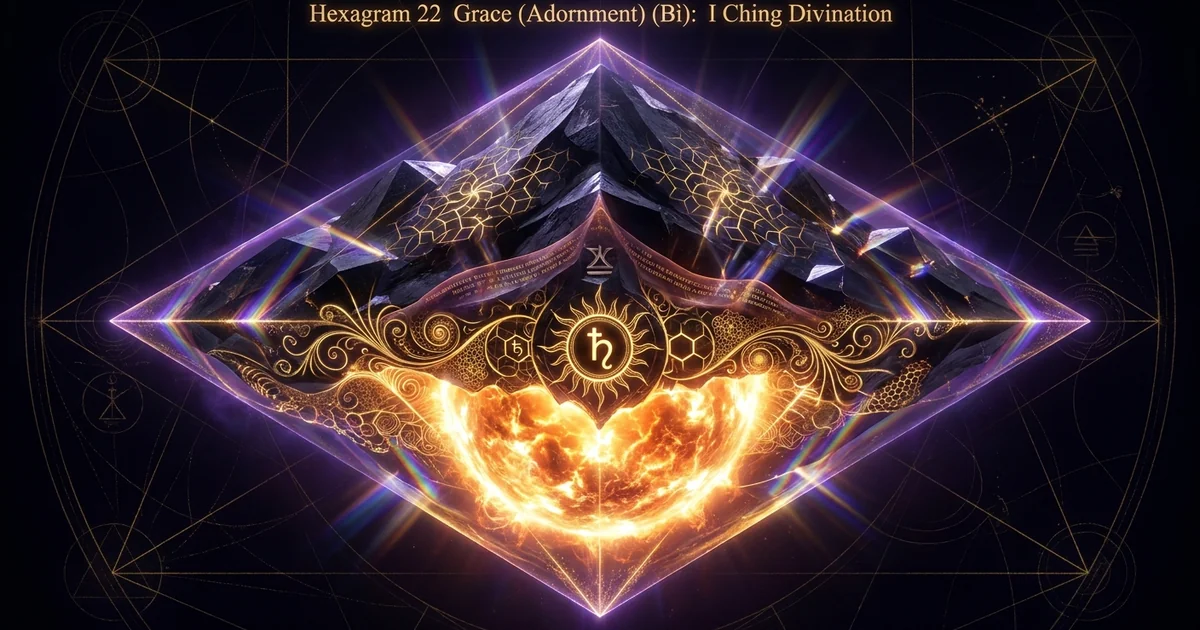
Hexagram 22 Grace (Adornment) (Bì): I Ching Divination
Archetypal Thesis & Systemic Paradigm: The Cybernetics of Aesthetic Mediation
The Dialectic of Phenomenological Form and Noumenal Core
Hexagram 22 (賁, Bì), traditionally translated as Grace, Adornment, or Luxuriance, stands within the Zhouyi as the definitive epistemological treatise on the dialectic between phenomenological appearance and ontological substance. Far from positing surface aesthetics as a cosmetic surplus or an arbitrary distraction, the architectural arrangement of the hexagram articulates that unmediated reality—the raw, volcanic noumenon—is intrinsically unassimilable to the human perceptual apparatus. Within the conceptual taxonomy of the Book of Changes divination system, form functions as an evolutionary and semiotic imperative. The unmediated real, characterized by high-entropy thermodynamic flux and instinctual volatility, would rupture consciousness were it not structured by morphological boundaries.
The systemic dynamic operating across the hexagram establishes that aesthetic mediation is the precise mechanism through which raw instinctual energy is transmuted into intelligible symbolic communication. The lower trigram, Li (Fire), generates an intense kinetic luminosity that radiates upward; yet, this solar-combustive radiance is arrested, enclosed, and dignified by the upper trigram, Gen (Mountain). This spatial organization indicates that luminance cannot achieve structural permanence through expansion alone; it must encounter a barrier that bounds its dissipation. Consequently, Bì asserts that the role of ornamentation is not to disguise lack, but to render the underlying substrate communicable without annihilating the observer. In the context of hexagram 22 grace (adornment) iching meaning, beauty is an ontological filter that translates transcendent chaos into cultural coherence.
Semiotic Filtering: Ornamentation as Perceptual Boundary
Viewed through dynamic systems theory, Bì functions as an impedance-matching interface between interior high-entropy turbulence and exterior low-entropy sociolinguistic matrices. If an energetic system transmits its output without a modulating terminal resistance, signal degradation or systemic burnout occurs. In human social, cultural, and psychological architectures, this boundary function is fulfilled by formal structures: ritual (li), etiquette, linguistic rhetoric, and artistic morphology. These formal filters protect the fragile coherence of the collective consciousness from being overwhelmed by the primitive, undifferentiated contents of the instinctual drive.
However, Hexagram 22 simultaneously contains an inherent warning regarding semiotic inversion. This phase-shift occurs when the ornament decouples from the ontological ground that originally generated it. When signifiers undergo runaway self-replication—divorcing themselves from the signified reality—the aesthetic filter degenerates into idolatry, simulation, and systemic deceit. The hexagram documents the precise boundary where aesthetic calibration ceases to serve as an authentic vehicle for the interior flame and becomes an autonomous veneer that suffocates the light within. The cybernetic feedback loops embedded across the line structure trace this exact tension: showing how ornamentation must ultimately consume its own excess to return to the structural purity of the blank, white slate.
“The persona is a complicated system of relations between individual consciousness and society, fittingly a kind of mask, designed on the one hand to make a definite impression upon others, and, on the other, to conceal the true nature of the individual… fundamentally the persona is nothing real: it is a compromise between individual and society as to what a man should appear to be. He takes a name, earns a title, exercises a function, he is this or that. In a certain sense all this is real, yet in relation to the essential individuality of the person it is only a secondary reality, a compromise formation, in making which others often have a greater share than he.” — C.G. Jung, The Relations between the Ego and the Unconscious (Collected Works, Vol. 7, §245–246)
Within analytical psychology, this dynamic precisely mirrors the structural necessity of the persona archetype. As Marie-Louise von Franz noted in her examinations of divinatory mechanisms, an ego lacking an adequate persona collapses under the direct impact of unconscious collective currents or sociological collisions. The persona is the structural skin—the aesthetic boundary—that facilitates relational exchange while safeguarding the internal fire of the self.
Classical Provenance & Textual Lineage: The Zhouyi to the Ten Wings
The Tuanzhuan Commentary on Cultural Cultivation (Wenhua)
The textual core of the Zhouyi records a laconic and seemingly counter-intuitive oracle for Hexagram 22: “Grace brings success. In small matters it is favorable to undertake something.” The operational parameter here is explicitly restrictive: Bì governs the micro-adjustments of form rather than the macro-initiatives of imperial or structural conquest. To clarify this qualification, the Tuanzhuan (Commentary on the Judgment), preserved within the canonical Ten Wings, offers an expansive philosophical unpacking of the trigrammatic interactions.
THE JUDGMENT: Grace has success. In small matters it is favorable to undertake something.
THE IMAGE: Fire at the foot of the mountain: The image of GRACE. Thus does the superior man proceed When clearing up current affairs. But he dare not decide controversial issues in this way. (Bollingen Series XIX, pp. 90, 494)
The Tuanzhuan explains that the interpenetration of the soft (Yin) and the hard (Yang) creates the aesthetic patterns of the cosmos: “Looking at the patterns of the heavens, we observe the changes of the seasons; looking at the patterns of humanity (renwen), we transform and civilize the world (tianxia).” This formulation is the etymological and philosophical matrix of the Chinese concept of culture (wenhua, literally “transformation through pattern/refinement”). Culture is not constructed via mechanical coercion; it arises through the pedagogical display of proportional form. Where raw power enforces compliance through dread, cultural adornment elicits organic resonance. The Tuanzhuan qualifies this mechanism by highlighting that aesthetic form can clarify only secondary matters (xiaoli), because an over-reliance on surface harmony obscures underlying judicial and ethical contradictions.
Wang Bi’s Hermeneutics: Clarifying Image (Xiang) to Access Meaning (Yi)
In his Zhouyi Zhu (Commentary on the Zhou Changes), the third-century Neo-Daoist philosopher Wang Bi (226–249 CE) leveraged Hexagram 22 as a premier epistemological case study to articulate his famous doctrine of “forgetting the image after grasping the meaning” (deyi wangxiang). For Wang Bi, the structural danger of Bì lies in the reification of the signifier. Adornment represents the manifest image (xiang), whereas the ontological root represents the essential meaning (yi).
Wang Bi observed that when human beings evaluate forms, their gaze tends to become arrested by the brilliant variegation of the surface. If one remains fixated on the decorative apparatus of the hexagram—the gilded carriage, the braided beard, the embellished ornaments of the lower lines—one remains blind to the ultimate meaning, which is realized only in the austerity of the top line: White Grace. Following this lineage, the Song Dynasty Neo-Confucian master Cheng Yi, alongside Zhu Xi, posited that the structural evolution of the hexagram models the dialectic between authenticity (cheng) and outward decorum (li). Ornamentation that flows spontaneously from genuine internal virtue illuminates the community; conversely, ornamentation applied extrinsically to mask an absence of virtue degenerates into hollow hypocrisy.
Hexagram 22 (Bì / Grace)
Traditional Hexagram Graph:

— —  Line 6 (Top Nine): White Grace, unadorned simplicity (Gen)
- -  Line 5 (Six at the fifth): Hillside garden grace; plain silk bundle
- -  Line 4 (Six at the fourth): White horse, winged; bridal sincerity
— —  Line 3 (Nine at the third): Moist with grace; persistent rectitude (Li)
- -  Line 2 (Six at the second): Adorning the beard; bound to superior
— —  Line 1 (Initial Nine): Adorning the toes; abandoning the carriage
Structural Mechanics & Symbolic Geometry: Mountain Over Fire (Gen Over Li)
Trigrammatic Polarity: Kinetic Luminescence Contained by Telluric Stillness
The systemic physics of Hexagram 22 are rooted in the asymmetric thermodynamic relationship between its constituent trigrams: Trigram Li (☲, Fire/Light) below, and Trigram Gen (☶, Mountain/Stillness) above. The primary visual archetype generated by this stacking is “Fire burning at the base of the Mountain” (山下有火).
Li is inherently expansive, luminous, combustible, and entropy-accelerating; its natural vector is vertical ascent. Gen, conversely, is static, ponderous, boundary-defining, and entropy-stabilizing; its vector is terminal stillness. When fire burns inside an open sky, it disperses into non-localized radiant energy. When fire burns within a mountain cavern or at its rocky base, its illumination is refracted by the stone facets, casting deliberate shadows and highlighting structural contours. The mountain provides the containment architecture that transforms an otherwise destructive wildfire into a stable lantern.
This geometrical balance reveals that elegance is fundamentally an act of structural containment. Form exists precisely because the kinetic drive of life meets the boundary conditions of material reality. In the absence of Gen’s rocky resistance, the luminescence of Li remains blind, uncalibrated force. In the absence of Li’s incandescent core, Gen remains a cold, inert pile of mineral detritus.
Hexagram Vector Dynamics: The Line Progression from Ornament to Asceticism
The operational mechanics of the six individual lines chart an inverted teleological vector. While vulgar assumptions presume that refinement moves from crude simplicity to complex ornamentation, Bì demonstrates that true refinement moves from superficial complexity to structural absolute purity.
- Initial Nine: “He lends grace to his toes, leaves the carriage, and walks.” The base of the lower trigram (Li) corresponds to the lowest bodily extremity: the feet. The initial impulse of the ego is to decorate its contact point with the earth. However, by choosing to walk rather than ride in a status-conferring carriage, the agent retains bodily autonomy and self-reliant integrity, demonstrating that form must emerge from authentic personal movement rather than social apparatus.
- Six at the Second: “Lends grace to the beard on his chin.” Situated in the middle of the lower trigram, this Yin line is structurally affixed to the Yang line above it (Nine at the third), just as a beard moves only when the jaw moves. Here, ornamentation has no independent volition; it is subordinated to a higher structural authority.
- Nine at the Third: “Graceful and moist. Constant perseverance brings good fortune.” Occupying the apex of the lower trigram Li, this line represents the maximum concentration of radiant warmth and brilliance. It is saturated with charm, aesthetic appeal, and emotional valence. The danger at this vector point is seductive indulgence; hence the oracle appends an admonition toward unbending constancy lest the agent drown in sensory intoxication.
- Six at the Fourth: “Grace or simplicity? A white horse comes as if on wings. He is not a robber; he will woo at the right time.” Moving into the upper trigram Gen, the hexagram undergoes a structural crisis of purpose. The question emerges: should one maintain elaborate decorative strategies, or strip down to absolute candor? The white horse represents the first emergence of Bai (Whiteness). Formality gives way to the vulnerability of authentic relationship; the approaching figure comes not to plunder through seductive guile, but to seek genuine communion.
- Six at the Fifth: “Grace in hills and gardens. The roll of silk is meager and small. Humiliation, but in the end, good fortune.” The fifth line occupies the ruler position within Gen. Here, the lavish courtly adornments of civilization are abandoned for the austere beauty of mountains and cultivated gardens. The ceremonial gift—a modest roll of raw silk—appears embarrassingly inadequate according to worldly standards of extravagance. Yet, because the gesture is anchored in interior sincerity rather than theatrical display, the ultimate systemic outcome is auspicious.
- Nine at the Top: “White Grace. No blame.” The terminal line of the upper trigram achieves the teleological resolution of the entire sequence. Having ascended through the variegated spectrum of colors, stylistic masks, and social posturing, the hexagram transcends the signifier entirely. White (Bai) is not the absence of color, but the synthesis of all light before refraction. Grace strips off its cosmetic skin to reveal naked geometry.
Crucially, an examination of the Hujia (nuclear hexagrams) reveals the covert psychic engine operating within Bì. The nuclear trigrams (lines 2–3–4 yielding Trigram Kan/Water, and lines 3–4–5 yielding Trigram Zhen/Thunder) form Hexagram 40, Xie (Deliverance/Liberation). This reveals that the covert teleology of aesthetic containment is the release of inner tension. Grace does not exist to domesticate the spirit; its containment serves to safely discharge psychic volatility, ultimately delivering consciousness from compulsive theatricality into pristine presence.
Psychological Dynamics & Operational Praxis: Persona Calibration and Shadow Integration
Navigating the Persona Matrix in Analytical Psychology
In Jungian clinical consultation, Hexagram 22 operates as a diagnostic mirror for the state of the Querent’s persona matrix. When this hexagram appears, it points directly to the interface where the ego presents itself to the social collective. The analytical task is to determine whether the persona is operating as a flexible, translucent membrane that communicates the authentic light of the Self, or as an ossified, defensive armor constructed to conceal a disowned Shadow.
Hexagram 21: Shì Hé (Biting Through)
- Structural Vector: Yang dynamic assertion; forceful penetration of an obstacle.
- Trigram Mechanics: Thunder (Zhen) beneath Fire (Li) — explosive dynamism cracking resistance.
- Sociopolitical Function: Penal code, judicial retribution, structural surgical excision.
- Psychological Operant: Direct confrontation with the Shadow; aggressive integration of neurosis through radical, painful truth.
- Operational Horizon: Decisive, comprehensive, transformative overhauls of macro-systems.
Hexagram 22: Bì (Grace / Adornment)
- Structural Vector: Yin containment and moderation; aesthetic refinement of manifest surfaces.
- Trigram Mechanics: Fire (Li) beneath Mountain (Gen) — solar brilliance held in quietude.
- Sociopolitical Function: Cultural education (wenhua), ritual propriety (li), diplomatic modulation.
- Psychological Operant: Persona calibration; aesthetic transmutation of raw instinct into functional social currency.
- Operational Horizon: Calibrating micro-adjustments; restructuring secondary processes; halting overreach.
When the ego over-identifies with the persona—a pathology endemic to individuals embedded in status-driven social matrices—the inner fire of Trigram Li is smothered by the stony shell of Trigram Gen. The subject becomes an empty mannequin: socially impeccable, outwardly decorated, yet internally frozen and psychologically sterile. Conversely, if an individual possesses no functional persona, their inner fire vents violently outward, scorching interpersonal relations and inciting defensive hostility from the collective. Hexagram 22 mandates the deliberate calibration of the persona: it must be polished until it achieves the condition of a crystalline lens, neither drawing attention exclusively to its own surface nor blocking the interior radiance from illuminating the surrounding room.
The Hexagram 21/22 Inversion: Biting Through vs. Aesthetic Harmonization
The canonical sequence of the I Ching pairs Hexagram 22 with Hexagram 21 (Biting Through / Shì Hé) as an interdependent, non-separable structural dyad. Hexagram 21 represents the rigorous, uncompromising application of justice: the energetic jaw snapping down to sever an obstruction, operating through penal clarity and severe execution.
Hexagram 22 is the direct compensatory inversion of 21. Where Shì Hé establishes that the social fabric will fracture if legal justice and structural boundaries are not aggressively enforced, Bì recognizes that a society governed solely by penal severity collapses into sterile, totalitarian terror. Law establishes the non-negotiable skeleton of the social organism; grace supplies the living tissue, the warmth, the manners, and the artistic spaces that make communal existence bearable. In the psychological economy of the individual, 21 is the analytical scalpel that excises an intrapsychic complex, while 22 is the restorative, integrative diplomacy that heals the wounded ego-boundary through beauty, ritual, and self-respect.
Hexagram 21 (Shì Hé - Biting Through):
  Trigrams: Li (Fire) above, Zhen (Thunder) below
  Dynamic: Explosive, judicial, surgical penetration

Hexagram 22 (Bì - Grace):
  Trigrams: Gen (Mountain) above, Li (Fire) below
  Dynamic: Contained, aesthetic, diplomatic harmony
Divinatory Protocol: Distinguishing Vital Reality from Seductive Mirage
Within divinatory consultations utilizing the Book of Changes divination protocol, receiving Hexagram 22 provides a clear, actionable directive: Do not mistake surface completion for infrastructural foundation.
When a client requests counsel concerning a major enterprise—such as a corporate acquisition, the launch of a high-risk venture, a structural marriage commitment, or a major litigation—and Hexagram 22 is drawn as the primary indicator, the oracle delivers a sharp deceleration. The enterprise is marked as favorable “in small matters only” (xiao li). The querent is being seduced by the optical elegance of the blueprint, the charismatic presentation of the counterpart, or the romanticization of the projected narrative. The structural mechanics indicate that while the styling, branding, diplomatic approach, and exterior formalisms are immaculate, the venture lacks the requisite load-bearing capacity to support a massive ontological weight. The practitioner must instruct the querent to restrict their operational scope to the calibration of presentation, the refinement of communication protocols, and the correction of minor procedural details, while strictly deferring all irrevocable decisions until structural substance catches up to aesthetic promise.
Philosophical Synthesis & Macrocosmic Correspondence: Hermetic Aesthetics and System Dynamics
Alchemical Coagulatio: Solar Splendor Encased in Saturnian Form
Across the Western hermetic and alchemical lineages, the spatial mechanics of Hexagram 22 find a direct correspondence in the operation of coagulatio—the process whereby volatile, pneumatic, and astral forces are crystallized, stabilized, and bound within corporeal density. The lower trigram, Li, corresponds precisely to Alchemical Sulfur: hot, dry, active, luminous, and carrying the divine solar impulse of conscious aspiration. The upper trigram, Gen, corresponds to Alchemical Salt: cold, fixed, structural, telluric, and expressive of the Saturnian principle of boundary, form, and material crystallization.
When Sulfur operates without Salt, it manifests as ungrounded mania, ideological fanaticism, and entropic conflagration. It burns through its fuel without precipitating a lasting vehicle. In the operations of the Great Work, the alchemist must take this volatile solar essence and encase it within the vessel of the stone. Hexagram 22 models this exact coagulation: the mountain does not extinguish the fire; rather, it absorbs its heat and radiates it across the landscape as steady, reflected warmth. The Saturnian boundary lends durability to the solar light, transforming transient mystical illumination into enduring structural virtue.
Human Design Gate 22 (Grace / Openness) and Genetic Codon Codification
Within the cybernetic synthesis of the Human Design System, Hexagram 22 maps onto Gate 22 (The Gate of Openness / Grace), situated precisely within the Solar Plexus Center (the emotional motor). Operating within the Individual Knowing Circuit via the 12–22 Channel of Openness (linking the Solar Plexus to the Throat Center), Gate 22 governs the acoustic, emotional modulation of individual awareness.
- Human Design Architecture: Gate 22 (The Gate of Openness); Center: Solar Plexus; Circuitry: Individual (Knowing Circuit); Channel: 12–22 (Openness: A Design of Social Availability).
- Astrological Dignities: Governs the sign of Pisces (specifically the third decanate), mediated by the dual rulership of Jupiter (expansive social resonance) and Neptune (archetypal aesthetic dissolving into the transcendent void). Additional structural tension with Saturn (Gen / containment).
- Qabalistic Vector: The descent of Tiphereth (Solar Beauty/Harmony) into Yesod (The Foundation / Astral Mirroring / Form-Building), guarded by the stern boundary of Geburah.
- Genetic Codon Architecture: Mapped to Codon group Proline/Threonine, regulating the folding envelopes of complex structural protein chains—demonstrating how geometric morphology governs biological viability.
Gate 22 is an acoustic, emotional pressure gate. When the individual is in an expansive, high-frequency emotional state, this gate emits an auditory charm and aesthetic receptivity that disarms the social matrix, allowing profound, melancholic mutations to be articulated through voice and poetry without provoking panic in the tribe. However, when the emotional wave is in a trough, Gate 22 manifests as anti-grace: social volatility, petulant dishonor, and emotional brutality. This precisely verifies the sinological truth of Bì: grace is not an absolute moral constant, but a delicately calibrated state of behavioral resonance that can only communicate truth when the internal emotional conditions are clear.
Biophysically, the structural folding of peptide chains mirrors the movement of the hexagram: a raw linear sequence of amino acids (the unornamented code) must fold into precise tertiary and quaternary geometric envelopes (aesthetic adornment) before it can execute any functional enzymatic task in the cellular architecture. Without formal adornment, the biological program remains non-functional, proving that life itself realizes agency solely through the discipline of structural form.
Frequently Asked Questions: Epistemological and Divinatory Disambiguations
Deconstructing the Admonition: Why Bì Is Unfavorable for Monumental Enterprise
The classical core of Hexagram 22 contains a strict, non-negotiable systemic boundary: “In small matters it is favorable to undertake something” (xiao you fu li), which carries the implicit converse that in monumental enterprises (da shi), undertaking action is unfavorable. The structural reason for this limitation lies in the division between structural load-bearing capacity and semiotic calibration.
Monumental undertakings—such as initiating warfare, overhauling political constitutions, executing irreversible corporate transformations, or entering into irrevocable spiritual oaths—demand the kinetic breakthrough capacity of Hexagram 51 (Zhen / Shock) or the profound structural foundation of Hexagram 1 (Qian / The Creative). Hexagram 22, by contrast, is an operational phase of formal adjustment. It is an editorial, diplomatic, and aesthetic filter. When the universe presents a condition governed by Bì, it indicates that the macro-parameters are already fixed; what remains to be tuned are the relational nuances, the stylistic interface, the public rhetoric, and the tactical presentation. Attempting to force a massive existential breakthrough under the auspices of Hexagram 22 is an operational category error: one is attempting to drive an iron spike with an illuminated paint brush.
The Hermeneutics of ‘White Grace’ (Bái Bì) at the Terminal Line
The culmination of Hexagram 22 in the Nine at the Top—“White Grace. No blame” (白賁,无咎)—presents one of the most sublime philosophical paradoxes within the entire Zhouyi. The line occupies the highest point of the upper trigram Gen (Mountain), the terminal threshold where the hexagram is on the verge of collapsing into Hexagram 23 (Bo / Splitting Apart / Stripping Away).
   Line 6 (Nine at the Top):  ———  (Reaches the peak: dissolves color into pure light)
   Line 5 (Six at the fifth): - -  (Simplicity of the hillside garden)
   Line 4 (Six at the fourth): - - (The white winged steed)
   Line 3 (Nine at the third): ——— (Peak of sensory ornamentation)
   Line 2 (Six at the second): - - (Subordinated decoration)
   Line 1 (Initial Nine):      ——— (Adorning the toes)
Throughout the lower registers of the hexagram, Grace is achieved through chromatic variegation, stylistic composition, and the deliberate tension of colors and manners. However, as the consciousness of the hexagram ascends to its absolute peak, it discovers that the highest form of refinement is not the accumulation of complex ornamentation, but the radical subtraction of the superfluous. “White Grace” (Bái Bì) represents the moment where the aesthetic filter has accomplished its evolutionary task: it has refined the crude instinctual drives to such a degree of transparency that the form no longer needs to declare itself.
The color white in the ancient Chinese world-view is associated with the West, Autumn, metal, mourning, and the purity of unworked jade. It is the unadorned surface that holds all possibilities within itself. When the practitioner or querent achieves White Grace, they operate with an effortless authenticity that has discarded all calculated theatricality. There is no longer any discrepancy between the mask and the face; the persona has dissolved back into the luminous core of the Self.
Differentiating Functional Aesthetic Form from Pathological Deception
A frequent crisis within practical divinatory consultation is distinguishing whether the presence of Hexagram 22 validates the querent’s current stylistic presentation as healthy diplomatic tact, or diagnoses it as a pathological defense mechanism masking a toxic underlying condition. To resolve this diagnostic impasse, the investigator must analyze the direction of the moving lines and examine the condition of the inner fire (Trigram Li).
Functional aesthetic form maintains a direct, uninterrupted conduit of energetic transmission between the inner core (Li) and the outer boundary (Gen). In functional grace, manners, beauty, and decorum are utilized to clarify communication, establish mutual safety, and honor the sacredness of the encounter without distorting the underlying truth. The form serves the truth. Pathological deception, by contrast, occurs when the upper trigram Gen acts not as a stabilizing frame for the fire, but as a leaden sarcophagus designed to smother it.
If the divination yields changing lines that destabilize the balance—such as Nine at the Third becoming over-saturated with sensory indulgence, or an afflicted Six at the Fifth hiding barren inadequacy behind hollow formalities—it signals that the querent or their counterpart is employing aesthetic calibration to evade necessary accountability. The definitive diagnostic question to place before the querent is this: If all the aesthetic harmony, polite language, and strategic branding were stripped away from this situation right now, what objective structural reality remains standing on the ground? If the answer is void or deceit, then the Grace being exhibited is not the radiant reflection of virtue, but the seductive mirage of a decaying system attempting to postpone its inevitable reckoning.