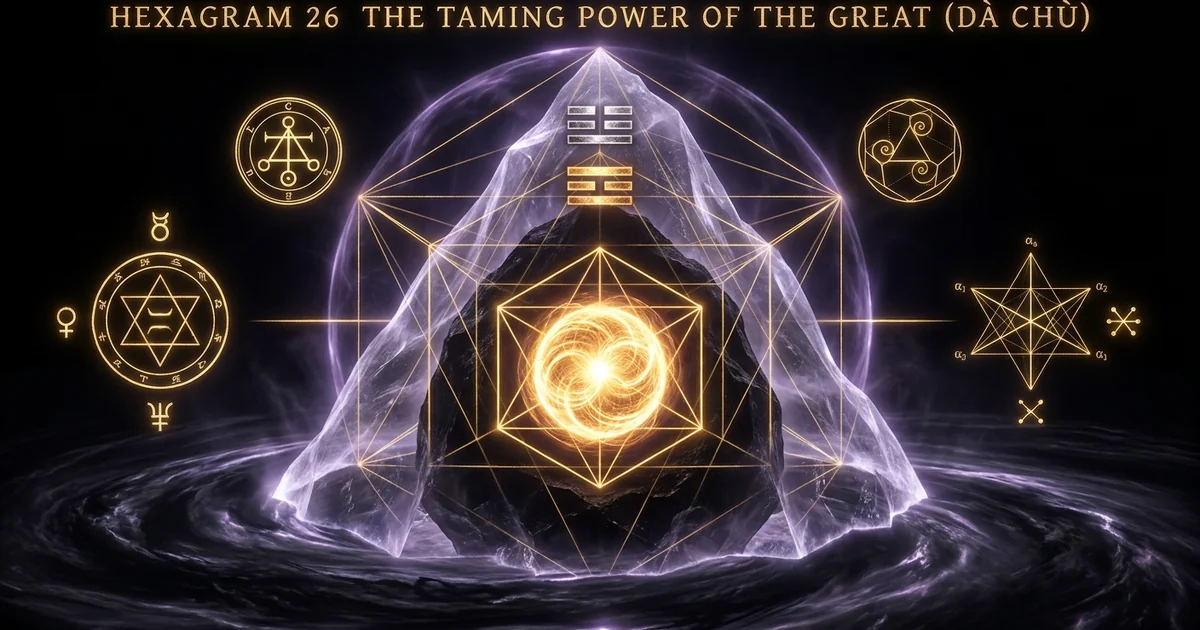
Hexagram 26 The Taming Power of the Great (Dà Chù): I Ching
Archetypal Thesis & Systemic Paradigm: The Cybernetics of Restraint and Containment
Hexagram 26, Dà Chù (大畜), articulates a critical thermodynamic threshold within the psycho-cosmology of the I Ching. Rather than interpreting restraint as passive paralysis or moralistic self-denial, the systemic architecture of the King Wen sequence models this hexagram as a high-density cybernetic containment vessel. In this topological configuration, dynamic, boundless, creative kinetic energy is systematically interiorized, captured, and regulated by immobility. Dà Chù demonstrates how a complex adaptive system manages runaway entropy: by interposing an unyielding boundary against pure kinetic drive, it forces raw energetic potential to compress, undergo phase transformation, and consolidate into sovereign psychic authority.
Hexagram 26: Dà Chù (大畜)
Upper Trigram: Gen (☶ - Mountain)
Lower Trigram: Qian (☰ - Heaven)
Thermodynamic Containment: The Sublimation of Dynamic Kinetic Energy
From a thermodynamic perspective, unconstrained kinetic energy is inherently entropic; dissipated into an unbounded vacuum, the creative impulse expends itself without leaving structural residue. In the hexagram 26 the taming power of the great iching meaning, this entropic dissipation is arrested through the imposition of systemic resistance. The lower trigram, the qian-trigram (☰, Heaven), represents absolute, primordial creative propulsion—an isotropic outward vector of raw power. Left unmodulated, this force generates catastrophic overextension. However, Dà Chù places this volatile propulsion directly beneath the gen-trigram (☶, Mountain), the cosmological principle of termination, resting, and spatial boundary.
The immediate result of this structural collision is energetic compression. Just as a gaseous medium subjected to isothermal compression absorbs work and increases its internal energy, the psychic apparatus, when denied immediate motor or behavioral discharge, accumulates latent potential. In psychological terms, this operates as the foundational mechanism of psychic sublimation. The boundless libido-jungian ceases to act outward upon phenomenal reality; instead, it rebounds against the boundary of the upper trigram, charging the internal state-space of the psyche with monumental pressure. The hexagram illustrates that civilizational achievements, philosophical constructs, and sovereign individuation are not produced by uninhibited self-expression, but rather by the strategic impediment of raw force within an unbreakable container.
Psycho-Spiritual Topography: Gen Over Qian as the Crucible of Consciousness
The spatial arrangement of mountain over heaven generates a stark psycho-spiritual topography. In traditional natural philosophy, the heavens arch infinite and sublime over the terrestrial earth, towering mountains, and deep ravines. Hexagram 26 inverts this cosmic phenomenology: here, the massive, silent weight of the mountain rests atop heaven itself. This apparent paradox is precisely what charges the dà chù hexagram with its profound esoteric gravity. The infinite is housed within the finite; the eternal is bounded within the temporal crucible of concrete, incarnate form.
This inverted geometry acts as an archetypal crucible. The ego-consciousness of the initiate, historically habituated to projecting desire and forward volition onto the world, encounters a stone wall. The mountain does not negotiate; it merely is. Under this immovable terminus, the instinctual and spiritual drives of the lower trigram are driven inward toward self-reflection. Consciousness ceases to be a passive witness to its own desires and becomes an active accumulator of structural virtue. The wild, incandescent light of heaven is subterranean, burning within the deep caves of the mountain, crystallizing raw coal into diamond through steady, unrelenting pressure.
Classical Provenance & Textual Lineage: Historical Exegesis of Dà Chù
To excavate the authentic operational mechanics of Dà Chù, one must step beyond simplistic, moralized translations and recover its philological roots. The naming and positioning of Hexagram 26 within the early Zhou divination records preserve an agricultural, political, and spiritual technology designed to preserve dynastic coherence amidst existential volatility.
Etymological Parsing of Chù: Nourishment, Domestication, and Accumulation
The character Chù (畜) possesses an intricate, bifurcated etymology that informs the systemic duality of the hexagram. In its most archaic epigraphic representations on oracle bones and bronze vessels, the glyph portrays a field or pasture (田, tián) tethered to or combined with bundles of harvested silk or animal traces (幺 or 玄), signifying the confinement, rearing, and domesticating of wild livestock. Over time, the character diverged into two distinct tonal readings and semantic fields: chù, meaning livestock, beasts of burden, or that which is bred; and xù, meaning to store up, to rear, to accumulate, to sustain, or to nourish.
Consequently, the dà chù hexagram must be read simultaneously as “The Great Accumulation” and “The Taming Power of the Great.” The “Great” (Dà, 大) explicitly denotes the yang principle—the noble, the profound, the sovereign creative drive of the qian-trigram. The compound term does not imply a violent subjugation of the wild by an external master; rather, it describes the conscious domestication of massive, instinctual, and spiritual power by bringing it within the boundaries of an estate or temple compound. This etymological nuance establishes historical memory and moral capacity not as passive archives, but as living, pastured reservoirs. To accumulate virtue (dé, 德) is to herd the wild forces of the cosmos into an integrated internal commonwealth.
The King Wen and Duke of Zhou Commentary: Not Eating at Home and the Great River
The received Judgment attributed to King Wen sets forth the strategic and political mandates governing this energetic phase-state: “The Taming Power of the Great. Perseverance furthers. Not eating at home brings good fortune. It furthers one to cross the great water.” In his foundational third-century commentary on the Zhouyi, the Neo-Daoist philosopher Wang Bi (circa 249 CE) elucidates the phrase “not eating at home” (bù shí jiā, 不食家) not as an abandonment of kinship, but as a deliberate rejection of insular, parochial self-preservation.
“THE JUDGMENT: THE TAMING POWER OF THE GREAT. Perseverance furthers. Not eating at home brings good fortune. It furthers one to cross the great water… THE IMAGE: HEAVEN WITHIN THE MOUNTAIN: The image of THE TAMING POWER OF THE GREAT. Thus the superior man acquaints himself with many sayings of antiquity and many deeds of the past, in order to strengthen his character thereby.” — Richard Wilhelm and Cary F. Baynes, The I Ching or Book of Changes (1950)
Wang Bi observed that when internal accumulation reaches critical saturation, the individual is summoned to enter the broader public sphere. The phrase indicates that the practitioner is sustained not by private resources, but by public office or systemic integration: their nourishment derives from their function within the macrocosm. The sovereign character, rigorously forged through the containment of Heaven beneath Mountain, is no longer vulnerable to corrupting external currents. It is precisely this unyielding stability that justifies the hazardous undertaking: “It furthers one to cross the great water.” In the semiotics of the Book of Changes, crossing the great water denotes high-risk systemic transition—a structural leap, the initiation of war, the overturning of an obsolete dynasty, or the traversal of the abyss between ego-consciousness and the Self. Only an energetic architecture that has mastered internal containment possesses the dynamic reserve to survive the turbulence of uncharted waters without disintegrating.
Structural Mechanics & Symbolic Geometry: Trigram Vector Dynamics and Line Architecture
The profound utility of the Book of Changes divination relies upon its strict mathematical and geometric parameters. Dà Chù is an asymmetric, dynamic lattice governed by two opposing trigram fields and an evolutionary progression of six line positions that outline the exact methodology for binding, transmuting, and releasing force.
Hexagram 26 Line Configuration:
Line 6: ─── (Nine at the Top)     Trigram: Gen (Mountain / Stillness)
Line 5: ─ ─ (Six in the Fifth)
Line 4: ─ ─ (Six in the Fourth)
─────────────────────────────────
Line 3: ─── (Nine in the Third)   Trigram: Qian (Heaven / Creative)
Line 2: ─── (Nine in the Second)
Line 1: ─── (Nine at the Beginning)
Trigram Vector Field: Lower Heaven (☰) Entering the Interior of Upper Mountain (☶)
The spatial vector dynamics of Dà Chù emerge from an intrinsic mechanical conflict. The lower trigram, Qian, consists of three solid, undivided yang lines, indicating an absolute upward vector. Qian is inherently expansive, luminous, and relentlessly kinetic. The upper trigram, Gen, comprises two broken yin lines surmounted by a single solid yang line; its structural vector is inherently descending and stable, acting as a geological ceiling that brings movement to an absolute standstill.
When Qian ascends into the cavernous base of Gen, it is met with profound absorption. The lower yin lines of Gen (lines Four and Five) act as an elastic, yielding receiving chamber that does not combat Qian with equivalent aggressive force, but instead encapsulates it, while the top yang line of Gen (line Six) caps the structure with impenetrable granite solidity. The vector field therefore creates a non-equilibrium steady state. The creative force of the lower heaven is completely swallowed by the mountain, resulting in an extraordinary density of potential energy. The mountain does not crush the heavens; it acts as a subterranean reliquary, holding the primary spark of existence until its volatility matures into indestructible form.
Line Trajectories: From the Restrained Axle-Straps to the Firm Path of Heaven
The sequential movement across the six line positions articulates an explicit engineering protocol for subduing and directing unruly power:
- Nine at the Beginning: “There is danger. It is advantageous to halt.” Here, the raw impulse toward movement first manifests. The initiate senses the dynamic vigor of Qian and instinctually seeks to erupt forward. However, the line is directly opposed by the distant wall of Gen. To advance is to crash against the mountain; wisdom demands absolute self-arrest.
- Nine in the Second Place: “The axle-straps are taken from the carriage.” In this stage, containment becomes systemic and mechanical. The axle-straps (fù, 輻) bind the wheel hub to the body of the cart. By intentionally decoupling the drive mechanism, the conscious ego voluntarily paralyzes its own transport system. It is an act of calculated self-inhibition, acknowledging that the time for external traversal has not arrived.
- Nine in the Third Place: “A good horse that follows others. Awareness of danger, with perseverance, furthers. Practice daily in chariot driving and armed defense. It furthers one to have somewhere to go.” The energetic pressure has now broken through the initial paralysis. Movement begins, but not as chaotic license. The force must be disciplined like a prized stallion through rigorous, continuous training in defensive mastery and precision driving. The containment shifts from absolute static immobility to dynamic, self-policing control.
- Six in the Fourth Place: “The headboard of a young bull. Great good fortune.” As the hexagram transitions into the upper trigram of Gen, containment transforms from mechanical inhibition to preventive instinctual intervention. A headboard (gù, 梏) is fastened across the brow of an adolescent bull before its horns have developed sharp, lethal points. The animal is domesticated before its destructive aggression can mature, demonstrating the mastery of neutralizing hazard at its latent root.
- Six in the Fifth Place: “The tusks of a castrated boar. Good fortune.” This line presents an even more refined paradigm of bio-energetic transmutation. A wild boar’s tusks are weapons of ferocious, unrestrained violence. Rather than attempting to shatter the tusks of an enraged adult beast, the ancient masters altered the internal hormonal economy of the animal through castration (fén, 豶). Its instinctual aggression is dissolved from the inside out; the tusks remain, but the homicidal impetus is extinguished. The libido is neutralized and transformed into docile, heavy strength.
- Nine at the Top: “One attains the way of heaven. Success.” The boundary of the mountain has performed its developmental task; its structural resistance dissolves. The accumulated energy, fully cultivated and shorn of unmodulated volatility, breaks through the apex into universal agency. The path of heaven is opened, and the contained sovereign force flows out to govern the cosmos without friction.
Comparative Polarity: Dà Chù (26) versus Xiǎo Chù (9)
The systemic architecture of Dà Chù cannot be fully appreciated without analyzing its structural sibling, Hexagram 9, Xiǎo Chù (小畜), The Taming Power of the Small. The two hexagrams define distinct operational scales of energetic management within the I Ching.
Hexagram 26: Dà Chù (The Taming Power of the Great)
- Trigram Architecture: Mountain over Heaven (☶ / ☰).
- Containment Nature: Rigid, tectonic, structural, and subterranean.
- Operative Mechanism: Complete kinetic arrest, isothermal compression, deep libidinal castration, and long-range accumulation.
- Systemic Outcome: The generation of a massive energetic reservoir capable of hazardous macrocosmic undertakings (“Crossing the Great Water”).
- Behavioral Manifestation: Complete self-mastery, integration of ancestral wisdom, and dynamic transformation of instinct into statecraft.
Hexagram 9: Xiǎo Chù (The Taming Power of the Small)
- Trigram Architecture: Wind over Heaven (☴ / ☰).
- Containment Nature: Pliant, atmospheric, surface-level, and temporal.
- Operative Mechanism: Gentle deflection, micro-adjustments, diplomatic conditioning, and ideological refinement.
- Systemic Outcome: Temporary atmospheric saturation (“Dense clouds, no rain from our western borders”), holding force in suspense without structural transfiguration.
- Behavioral Manifestation: Tactful evasion, rhetorical finesse, polite social boundaries, and the patience of holding space during petty interference.
Where /iching/hexagram-9-xiao-chu-small-taming deploys the wind to subtly steer the creative impulse of heaven, Dà Chù slams an entire mountain down upon it. Xiǎo Chù is the art of diplomatic finesse, rhetorical mitigation, and soft intervention; Dà Chù is the art of thermodynamic transmutation, structural containment, and civilizational memory.
Psychological Dynamics & Operational Praxis: Individuation and Libidinal Economy
Viewed through the lens of analytical and depth psychology, Hexagram 26 serves as an exact schematic for the management of the libido-jungian and the structural maturation of the ego-Self axis. It speaks directly to the threshold where the developing ego must transition from juvenile omnipotence and manic acting-out to reflective, contained psychological sovereignty.
The Holding Vessel: Jungian Containment and the Archetype of the Ego-Self Axis
In archetypal psychology, premature action is a catastrophic defense mechanism against psychic tension. When the unconscious floods the psyche with raw numinosity or archaic instinctual drives, the unseasoned ego attempts to discharge this energy immediately through outward projections, ideological fanaticism, or manic somatic activity. In this context, Hexagram 26 functions as the alchemical vas hermeticum—the securely sealed vessel inside which the base matter of raw instinct is heated and refined without allowing the vapor to escape.
“Psychic energy is an extraordinarily volatile substance… Only when raw drive encounters an insurmountable obstacle—a moral, structural, or archetypal prohibition—can that energy be deflected into indirect, symbolic pathways. The damming up of instinct creates the psychodynamic reservoir from which all higher cultural creation, ethical intentionality, and self-reflective consciousness emerge. Without containment, libido remains mere nature; with containment, it transforms into spirit.” — Carl Gustav Jung, Symbols of Transformation (1952), CW 5
As explored extensively in /archetypal-psychology/jung-symbols-transformation, the process of individuation demands that the ego develop the holding capacity to sustain severe energetic tension without fracturing. In Hexagram 26, the gen-trigram represents this structural capacity of the ego. The mountain is the psychic architecture capable of enduring the upward volcanic surge of the qian-trigram—the instinctual, archetypal Self. If the ego is too fragile, it either collapses into neurosis or inflates, falsely identifying itself with the divine creative power. If the containment holds, a dynamic integration occurs: the instinctual drive loses its primitive, autonomous nature and becomes available to the conscious personality as grounded willpower, ethical clarity, and emotional equilibrium.
Deciphering Instinctual Force: The Headboard of the Young Bull and the Gelded Boar
The animalian metaphors embedded in the Fourth and Fifth lines offer acute clinical insights into behavioral modification and shadow integration. The image of the young bull with a wooden headboard highlights the critical psychological concept of preventive boundary installation. In depth psychology, wrestling with an autonomous complex when it is fully activated in a state of emotional inundation is almost always futile; the archaic drive will overpower the rational ego. Wisdom lies in detecting the structural emergence of the drive while it is still nascent—attaching the headboard to the horns before they can pierce. This corresponds to the conscious establishment of cognitive, emotional, and behavioral boundaries long before the complex is provoked into eruption.
The metaphor of the gelded boar in line Five penetrates even deeper into the psychic economy. Traditional spiritual approaches often prescribe repression—an aggressive, violent attempt to bludgeon, deny, or sever instinctual desire. This is equivalent to wrestling an enraged, tusked wild boar; the repression inevitably fails, resulting in violent unconscious eruptions or psychosomatic illness. The I Ching suggests systemic modification: through deep psychological inquiry, the initiate neuters the core affective hook of the complex. By removing the unconscious emotional payoff that feeds the drive, the aggressive dynamic is peacefully disarmed. The primal energy ceases to seek violent, destructive outlets, and its immense power is repurposed toward steady, creative industry.
Divinatory Protocol: Navigating Frustration and Strategic Inaction
In the operational praxis of divination with the Classic of Changes, receiving Hexagram 26 is an absolute mandate for strategic cessation. For the querent driven by frantic ambition or an obsessive demand for resolution, this oracle often arrives as a shock. The modern psyche equates stillness with failure, delays with loss, and restraint with impotence. Dà Chù radically re-evaluates these assumptions.
When Hexagram 26 appears, the diagnostic assessment is unequivocal: the querent’s current energetic momentum is dangerous, untamed, and unsuited for direct application. The proper divinatory protocol requires the immediate suspension of outward ventures:
- Arrest of Momentum: The carriage axles must be decoupled; the conscious will must halt all efforts to enforce an outcome upon external systems.
- Epistemic Consolidation: As instructed by the Image, the initiate must withdraw into study, acquainting themselves with the deep sayings and deeds of the past. The querent is commanded to feed upon cultural, philosophical, and genealogical memory rather than their own transient impulses.
- Endurance of Frustration: The querent must deliberately cultivate the capacity to hold unresolved tension. Frustration is recontextualized not as an external obstruction, but as the friction of energetic accumulation within an expanding psychological vessel.
The crossing of the great water will come, but only when the holding vessel has performed its structural work. To rush the water while the axle-straps are unfastened is to court annihilation.
Philosophical Synthesis & Macrocosmic Correspondence: Hermetic Axioms and Genetic Codes
The architecture of Hexagram 26 extends beyond individual psychology into macrocosmic correspondence. Its geometry reflects fundamental laws of informational physics, biological programming, and esoteric taxonomy, demonstrating that the structural containment of force is an invariant pattern across reality.
- King Wen Sequence Position: Hexagram 26 (Preceded by Hexagram 25: Wú Wàng / Innocence; Succeeded by Hexagram 27: Yí / Nourishment).
- Human Design / Genetic Coordinate: Gate 26 (The Taming Power / The Egoist), located in the Heart/Ego Center.
- Biocosmological Correspondence: Amino Acid Leucine; Universal Codon Stop / Transfer dynamics (specifically mapped to the informational codon TTA / CTA sequences within specific bio-divinatory systems of
codons-iching). - Hermetic Principle: The Principle of Polarity and Rhythm; Stasis as the Coiled Equilibrium of Infinite Motion.
- Astrological Correspondence: Fixed Earth meeting Cardinal Fire/Air; Saturnian crystallization operating upon Promethean/Solar kinetic propulsion.
Human Design and Biocosmology: Gate 26 (The Taming Power / Egoist) in the Heart Center
In the cross-disciplinary framework of Human Design, Hexagram 26 maps precisely to /human-design/gate-26-the-taming-power, situated within the heart-center-human-design (the Ego Center). This bio-energetic node governs will, commercial authority, physical resource allocation, and the physiological survival of the tribe. True to its I Ching provenance, Gate 26 is archetypally designated as the “Gate of the Egoist” or the “Taming Power of the Great.”
Within this biocosmological framework, Gate 26 acts as a biological capacitor. It governs the immune system’s T-cells and the cardiovascular rhythm, managing the conservation and release of physical life-force. Individuals carrying this activation are biologically structured not for ceaseless, grueling labor, but for concentrated, highly efficient bursts of willpower followed by extended cycles of deep rest and structural preservation. The shadow expression of this gate manifests as manipulative posturing or exhaustion of the heart through unchecked pride. Its transcendent expression, however, is pure custodial authority: the capacity to wield immense ego-will for the nourishment and physical security of the collective, holding vast material resources in trust without succumbing to possessive attachment.
The Hermetic Principle of Polarity and Rhythm: Stasis as Coiled Kinetic Equilibrium
Hermetically, Dà Chù illustrates the dynamic interplay between the Principle of Polarity and the Principle of Rhythm. The axiom “as above, so below” demands that macrocosmic stability rest upon microscopic containment. In physics, potential energy is not the absence of kinetic energy, but its coiled, stored, and tensioned counterpart. A suspended pendulum at the peak of its oscillation is momentarily static; its velocity is zero, yet its potential energy is absolute.
Hexagram 26 reveals that stasis is the ultimate governor of motion. The stillness of the mountain is not dead inertia, but the focused stabilization of celestial fury. By embodying the Hermetic law of rhythm, the initiate learns to master the pause between the in-breath and the out-breath of the cosmos. In that pregnant gap, raw vitality is freed from the tyranny of linear time and drawn down into the central axis of being. The initiate who masters Dà Chù masters the pivot point of the universal engine, holding absolute power in absolute stillness.
Frequently Asked Questions: Decoding Dà Chù in Divinatory Practice
What does ‘it furthers one to cross the great water’ mean if the hexagram commands holding back?
This apparent paradox is resolved once the practitioner grasps the sequential logic of the king-wen-sequence. The command to “cross the great water” does not authorize an immediate, impulsive plunge into hazardous ventures. Rather, it defines the ultimate teleology of the containment phase. Restraint is never an end in itself; it is the strategic gathering of dynamic resources.
To cross a vast, turbulent river requires extraordinary momentum, structural integrity, and logistical preparation. Attempting to ford the torrent with an empty vessel, an undisciplined crew, or decoupled axles results in disaster. The text establishes that the crossing of the great water is made possible only because the individual has endured the rigorous discipline of “not eating at home” and accumulated virtue beneath the mountain. Holding back is the energetic loan; the successful crossing is the downstream dividend.
How does Dà Chù distinguish between pathological suppression and conscious containment?
The demarcation line between neurotic suppression and conscious containment is the central diagnostic concern of Dà Chù. Pathological suppression is an unconscious, dissociative defense mechanism: the ego, terrified of the volcanic power of the shadow or instinctual drives, attempts to deny their existence, banishing them into the unconscious underworld. This creates an unstable, high-pressure fault line that inevitably breaches as neurosis, physical disease, or explosive projection.
In contrast, the containment of Dà Chù is a fully conscious, dignified, and loving domestication. The animal is not beaten or starved in darkness; it is brought within the royal pastures, reared, and actively nourished (Chù). The bull’s horns are gently bounded while young; the boar’s instinctual drives are surgically unhooked from petty triggers. In Dà Chù, consciousness never loses contact with the dynamic power it restrains. It honors the power of Heaven, recognizing that this very fire will one day illuminate the universe once the mountain has taught it the structural architecture of time.
What is the prognostic significance of Hexagram 26 transforming into Hexagram 25 (Wu Wang)?
When Hexagram 26 transitions into /iching/hexagram-25-wu-wang-innocence (Innocence / The Unexpected), typically through structural shifts in the upper trigram where Gen (Mountain) dissolves into Qian (Heaven), it marks an extraordinary spiritual evolution.
In this transformation, the rigid, conscious containment, discipline, and historical accumulation of Dà Chù have fulfilled their systemic function. The training wheels of structural resistance fall away. What was once achieved through effort, discipline, and constant restraint now operates with pure, unforced spontaneity. The individual transitions from the conscious self-mastery of the warrior-sage to the divine simplicity of Wú Wàng—acting without calculation, without ulterior motive, and in absolute, innocent alignment with the natural flow of the Tao. The wild force, having been domesticated, is now granted ultimate freedom, because its nature has been permanently unified with the cosmos.