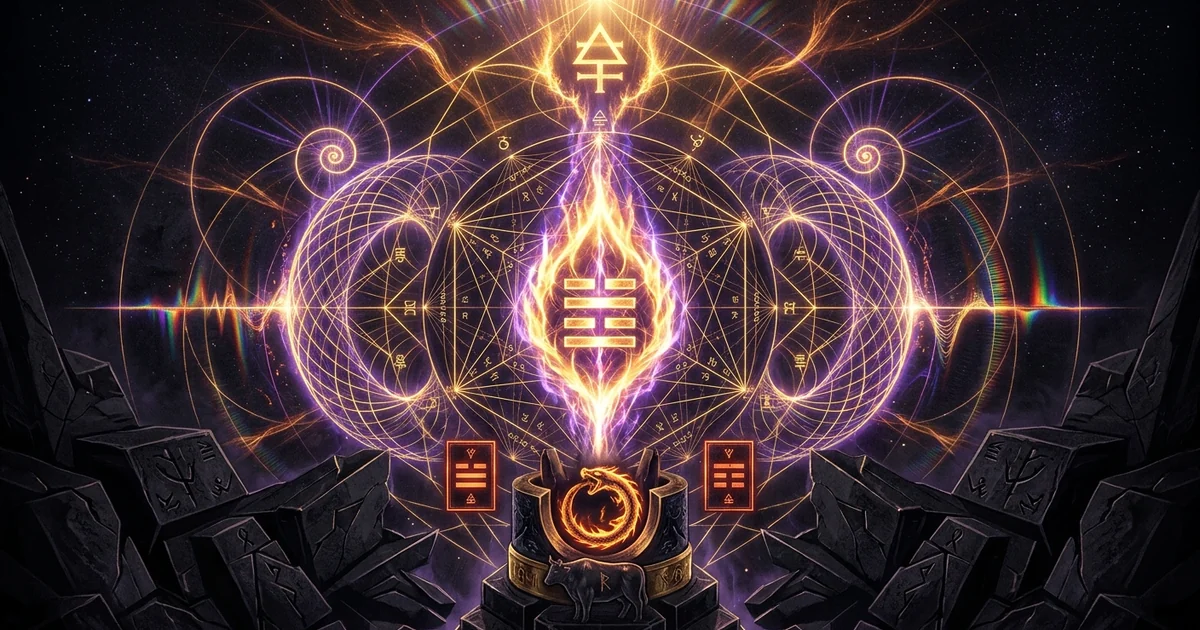
Hexagram 30 The Clinging (Fire) (Lí): I Ching Divination
Archetypal Thesis & Systemic Paradigm: The Thermodynamics of Consciousness
Hexagram 30 (Lí, 離), denominated as “The Clinging” or “Radiance,” models awareness not as an autonomous, self-subsistent entity, but as an emergent thermodynamic phenomenon of combustion contingent upon continuous adhesion to an ontological substrate. In the architecture of the Yijing, the hexagram is constituted by the repetition of the trigram Lí (☲) over itself: double fire, luminous yet devoid of autonomous corporeal mass. In classical Chinese natural philosophy, flame possesses no independent spatial morphology; it exists exclusively as an active energetic translation occurring at the boundary layer between a combustible body and ambient oxygen. Consequently, Hexagram 30 functions as an axiomatic cybernetic state-space representing the absolute interdependence of illumination (lucidity, cognition, spiritual vision) and structural attachment (somatic mass, ethical restraint, ecological fuel).
When addressed through non-equilibrium thermodynamics, Lí exemplifies the behavior of dissipative-structures. As formulated by physical chemist Ilya Prigogine, a dissipative structure maintains its ordered, coherent organization far from thermodynamic equilibrium solely through the perpetual throughput of matter and energy. Consciousness, within this operational framework, is precisely such an open, entropy-exporting process. If the flow of fuel is severed, the coherence collapses into stillness; if the thermal output accelerates beyond the structural limits of the material container, the system experiences runaway entropy through total thermal annihilation. The hexagram warns that the intellect, divorced from its grounded somatic vessel, consumes its own infrastructure, turning visionary lucidity into psychic ash.
::: diagram Thermodynamics of Hexagram 30


    Combustible Substrate: Nourishing Receptivity / The Cow
    Combustion Zone: Dual Yin Line Nuclei
    Radiant Luminescence: Metacognitive Lucidity / Lí
    Dissipative Risk: Unbounded Yang Inflation


:::
Combustion as Ontological Metaphor: The Clinging Nature of Flame
The central dynamic of Hexagram 30 rests upon the physics of combustion as an epistemological model. Fire is bright, transformative, and ascendant, yet it is utterly helpless without that which it consumes. The Chinese character lí contains within its archaic semantic field the twin concepts of “to cling to” and “to separate from,” capturing the exact ontological dilemma of the flame: it can only sustain its individual identity as light by cleaving indissolubly to the dark, inert matter of its fuel. This establishes a profound psycho-cosmological coordinate: consciousness is entirely conditional. It cannot exist as an unconditioned absolute within the manifested realm; it must adhere to the physical apparatus of the nervous system, the socio-linguistic matrix of culture, and the ethical boundaries of relational life.
The hexagram asserts that any attempt by the ego to declare absolute autonomy from its material or instinctual foundations results in immediate catastrophic extinguishing. The flame that refuses to cling to wood is snuffed out by the wind; the intellect that refuses to honor the body descends into psychosomatic dissociation. In this state-space, clarity of insight is functionally inseparable from the discipline of conservation. The operational mandate of Hexagram 30 is therefore not the frantic generation of heat, but the fastidious maintenance of the thermodynamic interface where energy transforms into intelligible perception without destroying the carrying matrix.
The Doubled Trigram ☲: Spatial Luster and Cybernetic Feedback
The structural morphology of Hexagram 30—the doubled trigram-li (Fire over Fire)—generates an ontological condition markedly distinct from the solitary trigram. When fire is set upon fire, light reflects light, establishing a recursive, self-referential loop of perception. In cybernetic terms, this represents second-order observation: the system does not merely see the world; it observes its own process of seeing. This recursive optical geometry corresponds to the emergence of metacognition. Whereas /iching/hexagram-29-kan-the-abysmal-water presents the recursive depth of the instinctual, gravitational unconscious through repeated abyssal chasms, Hexagram 30 presents the blinding, recursive clarity of hyper-illumination.
This doubled radiance carries radical systemic consequences. In a closed cognitive loop, unfiltered recursive perception can destabilize the observer. Without an external reference point, the mind enters a hall of mirrors where every thought illuminates another thought in an accelerating cascade of intellectual excitation. The doubled fire illuminates the four quarters of the cosmos, yet its very brilliance threatens to bleach out the subtle nuances of shadow required for psychological differentiation. The hexagram shows that metacognitive lucidity must be tempered by deliberate temporal pacing; otherwise, the recursive feedback loop generates a systemic overload, culminating in manic cognitive fragmentation.
The Cow as Rooted Docility: Sustaining the Perceptive Matrix
To mitigate the catastrophic entropic hazard inherent in doubled fire, the Judgment of Hexagram 30 introduces a specific zoomorphic counter-weight: “Perseverance furthers; it brings success. Care of the cow brings good fortune.” In the symbolic zoology of the Yijing, the horse corresponds to the pure creative initiative of Qian (Heaven), rapid and fiery, whereas the cow corresponds to the yielding, grounded, and nourishing receptivity of Kun (Earth). The cow represents the docile, ruminant, maternally stabilized body—the somatic infrastructure capable of metabolizing coarse material into sustained, life-supporting milk.
The mandate to exercise “care of the cow” is an injunction to systematically cultivate yielding docility and somatic integration. If consciousness (fire) is to shine without devouring its own base, the subject must actively tend to the unglamorous, heavy, rhythmic needs of the instinctual vessel. The cow grazes patiently; it digests slowly; it moves with deliberate gravity close to the earth. To care for the cow while navigating Hexagram 30 is to anchor high-voltage cognitive, visionary, or divinatory insight within the steady, unhurried constraints of ethical duty, physical embodiment, and mundane domestic discipline. It is the direct psychological antidote to the promethean hubris that mistakes the brilliance of the psychic flame for absolute self-sufficiency.
Classical Provenance & Textual Lineage: From King Wen to Wang Bi
The textual transmission of Hexagram 30 reveals a profound evolution from archaic bronze inscriptions and sacrificial divination to the sophisticated ontological hermeneutics of Neo-Daoism. In the Zhouyuan oracle bone cache and early Western Zhou bronze texts, the glyph for Lí carries multiple conflicting resonances that illuminate its paradoxical functional mechanics. Classical commentators grappled continuously with the grammatical and metaphysical elasticity of the character, which functions simultaneously as a noun describing a radiant creature, a verb indicating the act of clinging, and an antonymous verb denoting detachment, departure, or partition.
Understanding the historical lineage of Lí requires charting its movement through the King Wen editorial layer, the ethical codification within the Confucian Ten Wings (Shi Yi), and the radical 3rd-century CE philosophical rupture initiated by Wang Bi. Across this thousand-year developmental arc, Hexagram 30 shifted from an agricultural and sacrificial oracle concerning avian omens and solar alignments into a comprehensive manual for statecraft, personal ethics, and the cultivation of clear consciousness through radical internal emptiness.
“That which is bright clings to the cold substance; what is light clings to what is dark. Thus sun and moon cling to heaven, and grain, grass, and trees cling to the earth. Double light clings to what is right, and thereby can transform and perfect the world.” (Wang Bi on Hexagram 30, trans. Richard John Lynn, 1994).
The Zhouyuan Oracle: Etymology of Lí (Departing, Clinging, Net)
Paleographical analysis of the character Lí (離) reveals an intricate synthesis of archaic significations. In the earliest oracle bone and seal script variants, the graph is composed of two primary components: the radical for a bird—specifically identified in classical lexicons as the yellow oriole (cang gao), celebrated for its brilliant, iridescent plumage—and a phonetic/semantic element depicting a net (luo). This pairing unites the concept of radiant beauty with the instrument designed to capture and hold it. Hence, the etymological root of Lí contains both the luminous creature that flies free (departure, separation) and the woven mesh that restrains it (clinging, adhesion, entanglement).
In the divinatory praxis of the Western Zhou, this duality yielded precise practical applications. The oracle spoke to conditions wherein value, clarity, or talent was transient and needed to be bound to a permanent structure if it were to survive. The net catches the bird; the wick catches the fire; the social institution captures and preserves the fleeting epiphany of the visionary. The text inherently acknowledges that lucidity is naturally evasive; like the oriole darting through the canopy, radiant perception departs the moment vigilance slackens. Divination rituals involving Lí were frequently conducted to determine whether an alliance, a seasonal migration, or an ancestral sacrifice could successfully bind the fleeting favor of Heaven to the terrestrial altar of the King.
The Wings of Confucius: The Daxiang and Xiaoxiang Traditions
With the composition of the Ten Wings, particularly the Daxiang (Great Image Commentary) and the Tuanzhuan (Commentary on the Judgment), the Confucian school transposed the physical thermodynamics of fire into a normative paradigm for civilizational perpetuation. The Daxiang formulates the socio-ethical imperative with crystalline economy:
“Brightness doubled makes the Clinging: The great man, by perpetuating this brightness, illuminates the four quarters of the world.”
Here, the Confucian editors resolve the entropic problem of fire through institutional succession. A single fire burns down as its wood is exhausted; but if that fire is systematically communicated to a secondary log before the first expires, the flame survives indefinitely. The “great man” does not rely upon idiosyncratic personal genius, which is inherently mortal. Instead, he institutionalizes wisdom through the pedagogical chain, ethical traditions, and social rituals. The doubled light (ming liang) is thus decoded as the intergenerational transmission of virtue (de). In the Xiaoxiang (Lesser Image Commentary), the individual lines are systematically calibrated against the hierarchical responsibilities of the gentleman (junzi), transforming what was once an inquiry into raw physical combustion into an examination of proper civil loyalty, moderate ambition, and emotional rectitude.
Wang Bi’s Neo-Daoist Exegesis: Light Emerging from Emptiness
In the 3rd Century CE, the prodigy commentator Wang Bi radically revolutionized Yijing scholarship by sweeping away the rigid, mechanical Han Dynasty systems of seasonal correspondences (gua qi) in favor of a profound metaphysical parsing based on Xuanxue (Neo-Daoism). For Wang Bi, the mechanics of Hexagram 30 are determined not by the hard, luminous Yang lines, but by the soft, empty Yin lines occupying the central positions: line 2 in the lower trigram and line 5 in the upper trigram.
Wang Bi pointed out that fire can only radiate because its internal core is hollow and non-substantive. The inner structure of the trigram Lí (☲) consists of a receptive broken line enclosed by two solid lines. If the center of the flame were dense, solid, and self-full, it would choke upon itself; combustion would cease, and illumination would be extinguished. Thus, fire radiates precisely because it is internally empty (wu). The light that clings to outer reality is entirely contingent upon this internal void accommodating external fuel. Wang Bi’s exegesis inverted the classical understanding: brilliance is not a property of assertive strength (Yang), but an emergent property of radical yielding receptivity (Yin) sitting at the center of the energetic matrix. To illuminate the cosmos, the consciousness of the sage must remain internally empty, utterly devoid of self-assertive preconceptions, allowing external reality to enter, ignite, and reveal its intrinsic nature.
Structural Mechanics & Symbolic Geometry: Line Vector Dynamics
Hexagram 30 occupies a uniquely balanced station within the sixty-four hexagram matrix. It is the final hexagram of the Upper Canon (Hexagrams 1–30), serving as the culmination of the cosmogonic sequence that opened with Hexagram 1 (Qian, Pure Yang/Heaven) and Hexagram 2 (Kun, Pure Yin/Earth). The Upper Canon begins with the primordial dualism of force and form, and terminates with the dual dynamic of water (Hexagram 29, Kan) and fire (Hexagram 30, Lí)—the two physical agents through which heaven and earth interact dynamically.
Hexagram 30 Structural Breakdown:
Upper Trigram: Lí ☲ (Fire, Sun, Clinging)
Lower Trigram: Lí ☲ (Fire, Sun, Clinging)
Binary Sequence: 101101 (where Yin=0, Yang=1)
Nuclear Hexagram (Huxian): Hexagram 28, Da Guo (Critical Mass / Preponderance of the Great)
Rulers of the Hexagram: Six in the Second Place, Six in the Fifth Place
The geometry of Lí is thoroughly symmetrical yet internally dynamic. Composed of two identical trigrams, each containing an internal Yin line bounded by two Yang lines, it generates a structure of double containment. The outer Yang perimeters project force, heat, and visual acuity outward into the phenomenological field, while the internal Yin cores maintain the gravitational, receptive pull that stabilizes the structure.
In the molecular correspondence models pioneered by Martin Schoenberger (1973), Hexagram 30 (101101) aligns structurally with specific informational transitions in the universal genetic code, functioning analogously to termination and initiation punctuation sequences in transcription. In the spatial cartography of the Later Heaven Sequence (Houtian-Bagua), Lí is transposed from its primordial vernal position in the Earlier Heaven (Xiantian, East) to the absolute South—the meridian culmination of the solar arc, marking the summer solstice and the maximum conscious expansion of cosmic Yang.
Nuclear Core Analysis: Hexagram 28 (Great Preponderance) as Hidden Tension
The structural integrity of any hexagram is profoundly informed by its inner nuclear hexagram (Huxian), extracted by taking lines 2, 3, 4 as the lower nuclear trigram, and lines 3, 4, 5 as the upper nuclear trigram. In the case of Hexagram 30, this extraction yields:
- Lower Nuclear Trigram (lines 2, 3, 4): Sun (☴, Wind/Wood)
- Upper Nuclear Trigram (lines 3, 4, 5): Dui (☱, Lake/Joy)
When combined, these nuclear trigrams form /iching/hexagram-28-da-guo-preponderance-of-the-great (☱ over ☴). This structural revelation carries immense analytical significance. Hexagram 28 represents a critical state of extreme mechanical stress: the ridgepole sags to the breaking point under an excess of internal weight. This proves that Hexagram 30, despite its outward display of glorious radiance, harbors an interior condition of severe structural tension.
The doubled fire of Lí is sustained by the wood of the lower nuclear trigram (Sun) feeding the flame, while the upper nuclear trigram (Dui) introduces an element of expressive dissipation. The hidden danger inside Hexagram 30 is precisely that of Hexagram 28: the danger that the intensity of consciousness, the relentless demands of visionary insight, and the sheer heat of psychic processing will exceed the load-bearing capacity of the material and psychological infrastructure. The flame threatens to buckle the very hearth that holds it.
Line Vector Progressions: From Initial Agitation (Line 1) to Sovereign Rectification (Line 6)
The six lines of Hexagram 30 track the systemic lifecycle of combustion through psychological and operational development, charting the path from raw initial ignition to ultimate systemic integration.
Line 6: Nine at the top: The king uses him to march forth and chastise. Honor brings victory; decapitate the leader, spare the followers. No blame.
Line 5: Six in the fifth place: Tears in floods, sighing and lamenting. Good fortune.
Line 4: Nine in the fourth place: Its coming is sudden; it flames up, dies down, is thrown away.
Line 3: Nine in the third place: In the light of the setting sun, men beat the pot and sing, or loudly bewail the approach of old age. Misfortune.
Line 2: Six in the second place: Yellow light. Supreme good fortune.
Line 1: Nine at the beginning: The footprints run crisscross. If one turns one's mind to reverence, no blame.
Nine at the beginning captures the moment of awakening—the dawn of consciousness or the initiation of a creative enterprise. Footprints crisscross in the early morning; the mind is flooded with sensory inputs and chaotic possibilities. The kinetic energy of the early Yang line threatens to scatter directionlessly. The text counsels reverence (jing): conscious, deliberate focus that reins in chaotic agitation before action is committed.
Six in the second place occupies the central and correct position of the lower trigram. Yellow is the color of the earth, signifying the central, balanced mean. This is the tempered flame: not the wild firestorm, but the steady, golden light of the hearth or the noonday sun. The yielding Yin line remains receptive to the fuel beneath it, producing maximum illumination with zero mechanical distortion. It represents the psychological equilibrium of an ego perfectly aligned with its somatic reality.
Nine in the third place marks the transition between trigrams, representing the precarious twilight hour: the setting sun. The individual confronts the reality of temporal finitude and systemic decay. Here, the immature psyche bifurcates into extreme neuroses: either manic, hedonistic denial (“beating the pot and singing”) or paralyzed, nihilistic depression (“loudly bewailing old age”). Both postures fail because they refuse to accept the rhythmic, cyclical nature of the fire.
Nine in the fourth place embodies the catastrophic entropic hazard of the hexagram. Rising aggressively out of the transition, this Yang line is ungrounded, hyperactive, and disconnected from the central Yin rulers. It represents the sudden, blinding flash: the meteor, the creative manic explosion, the catastrophic electrical short-circuit. It consumes its fuel instantly, flares violently, burns out, and is discarded by the cosmos. It is the signature of profound psychological inflation devoid of grounding mass.
Six in the fifth place occupies the supreme seat of authority. Here, the sovereign ruler of the hexagram realizes the immense existential grief inherent in holding consciousness within a fragile, mortal world. The tears and sighing represent the profound melancholia of awakened awareness: the recognition of systemic suffering and the fragility of light. Because this Yin ruler is soft, centered, and fully open to this existential reality, the text pronounces “Good fortune.” Illumination has softened into compassion.
Nine at the top represents consciousness weaponized as structural clarity. The fire has ascended to its highest point; it must now be applied to preserve systemic order. The king marches forth to eliminate structural corruption. The surgical precision of this line is critical: “Decapitate the leader, spare the followers.” The illuminated intellect cuts directly to the root source of pathology (the ringleader) without engaging in indiscriminate, scorched-earth destruction against the secondary symptoms (the followers).
The Dual Centered Lines: Yin in Line 2 and Line 5 as Cosmic Equilibrium
The dynamic equilibrium of Hexagram 30 is entirely maintained by its two rulers: Six in the second place and Six in the fifth place. In the systemic grammar of the Book of Changes, these two broken lines represent the cold, dark, receptive centers of the lower and upper flames. They prevent the four surrounding Yang lines from degenerating into an uncontrolled conflagration.
Line 2 anchors the personal, internal light within the vessel of bodily health and daily discipline. Line 5 anchors the transpersonal, collective light within the vessel of ethical governance and empathic relatedness. If these lines were solid (Yang), the hexagram would transmute into Hexagram 1 (Pure Qian), an unremitting blast of raw energy devoid of visual contrast. Because they are broken (Yin), they provide the essential refractive medium through which energy becomes visible as form. They embody the profound esoteric principle that light can only be known, sustained, and directed by virtue of the darkness that cradles it.
Psychological Dynamics & Operational Praxis: Archetypal Amplification
Transposed into the architecture of analytical psychology, Hexagram 30 serves as the primary map for the functioning and pathologies of the ego-self-axis. The fire of Lí corresponds to the illuminating power of consciousness, the lumen naturae of the medieval alchemists amplified extensively by Carl Gustav Jung. Consciousness is solar, differentiating, and discerning; it splits the undifferentiated, oceanic darkness of the unconscious into discernable, nameable categories.
“The synchronistic factor in divination rests upon an alignment of conscious focus with unconscious archetypal constellations. In Hexagram 30, the principle of consciousness itself becomes the object of reflection; the fire must not consume its own altar, lest illumination invert into unconscious possession.”
Divinatory consultations yielding Hexagram 30 invariably point to an acute situation involving the expenditure, direction, or depletion of psychic energy (libido). When an individual receives this oracle, the primary psychological question is not “How can I see more clearly?” but rather “What is currently sustaining my perception, and am I burning down my somatic house to power my intellectual light?” It requires an immediate assessment of the querent’s grounding vessel to prevent manic dissociation.
The Jungian Eye: Active Imagination and the Solar Complex
In the praxis of archetypal active-imagination-jung, Hexagram 30 corresponds to the confrontation with the Solar Complex. The solar archetype represents the heroic, illuminating aspect of the psyche—the urge to ascend, to understand, to cast out shadow, and to achieve supreme intellectual mastery. However, if this drive operates without an awareness of its compensatory unconscious counterweight, it develops into what Marie-Louise von Franz classified as the “scorched earth” syndrome of the intellect.
The individual caught in this complex experiences an irresistible compulsion toward hyper-lucidity. They dissect their own psyche, their relationships, and their creative impulses with merciless, dry analytical heat. The unconscious responds to this continuous drying out with acute somatic symptoms: insomnia, autonomic nervous system exhaustion, and profound emotional sterility. Active imagination within the field of Hexagram 30 requires descending from the blinding solar apex into the cool, dark waters of the unconscious, shifting the psychological focus from active conceptualization to receptive, docile containment.
Differentiating Illumination from Inflation: Line 4 vs. Line 2
The psychological differentiation between authentic cognitive illumination and psychotic or manic inflation is precisely mapped by the contrast between Six in the second place and Nine in the fourth place.
:::: comparison Diagnostic Contrast: Line 2 vs. Line 4
::: column [Line 2: Six in the Second Place (Yellow Light)]
Psychological State: Tempered, integrated lucidity.
Energetic Signature: Homeostatic, steady, sustainable warmth.
Relationship to Soma: Fully anchored in physical reality and somatic feedback.
Clinical Presentation: Insight accompanied by emotional calm and grounded ethical action.
Pathological Risk: None; represents perfect structural stabilization of the ego.
:::
::: column [Line 4: Nine in the Fourth Place (Sudden Flash)]
Psychological State: Hypomanic inflation, creative megalomania.
Energetic Signature: Hyperbolic, explosive, rapidly dissipating heat.
Relationship to Soma: Total dissociation; borrows energy violently from future reserves.
Clinical Presentation: Rapid ideation, prophetic delusion, sudden catastrophic crash.
Pathological Risk: Complete nervous breakdown; psychic exhaustion and burnout.
:::
Nine in the fourth place represents the tragic trajectory of the Puer Aeternus who seeks the blinding flash of transcendent genius without submitting to the mundane discipline of craftsmanship. The individual believes they have unlocked the ultimate secret of the universe, producing manic bursts of frantic activity that leave behind only scattered fragments and spent vitality. Six in the second place, by contrast, accepts the discipline of the “yellow light”—the moderate, patient application of consciousness that respects the speed of the body and the limits of the material medium.
The Yellow Cow Praxis: Somatic Grounding in Divinatory Consultation
When Hexagram 30 appears in a divinatory consultation, the operational advice to the querent must prioritize somatic and ethical grounding over intellectual analysis. If the querent is seeking advice on a profound spiritual insight, an ambitious business venture, or an intense creative breakthrough, the oracle issues a clear caveat: the brilliance of the concept is not in question; what is radically uncertain is the endurance of the fuel supply.
The “yellow cow” operational praxis requires the querent to institute concrete protocols of embodied containment:
- Halting Cognitive Acceleration: Deliberately slowing the rate of ideation through practices that disengage the conceptual apparatus (e.g., manual labor, physical craft, walking in natural landscapes).
- Nutritional and Somatic Stabilization: Prioritizing the dense, slow-burning physical requirements of the organism—regular sleep rhythms, heavy and grounding nourishment, and the cessation of synthetic stimulants that artificially accelerate psychic combustion.
- Containment of Expression: Resisting the urge to immediately broadcast, market, or externalize emerging insights. The energy must be allowed to circulate internally, warming the vessel rather than burning off as external luminescence.
- Ethical Devotion to the Mundane: Recommitting to simple, non-negotiable domestic and relational obligations. Caring for the “cow” means attending to the ordinary, unspiritual tasks that maintain the continuity of biological and social existence.
Philosophical Synthesis & Macrocosmic Correspondence
Beyond the parameters of personal psychology, Hexagram 30 operates as a comprehensive cosmogonic cipher, detailing the structural laws that govern radiant systems across multiple metaphysical frameworks. The dynamics of Lí can be mapped systematically onto Western Hermeticism, the Kabbalistic Tree of Life, and the modern synthesis of Human Design. Across each of these systems, the archetype of doubled fire consistently articulates the identical paradox: the highest reach of spiritual perception is perpetually bound to the dense inertia of the material plane.
Macrocosmic Coordinate Matrix for Hexagram 30:
┌─────────────────────────┬───────────────────────────────────────────────────────┐
│ System                  │ Structural / Symbolic Attribution                     │
├─────────────────────────┼───────────────────────────────────────────────────────┤
│ Western Alchemy         │ Calcinatio (Purification by sustained thermal flux)   │
│ Hermetic Cabala         │ Equilibrium of Netzach (Desire) and Hod (Intellect)   │
│ Human Design            │ Gate 30 (Gate of Recognition / Clinging Fire)         │
│ Biological Substrate    │ Codon for Glutamine / Amino Acid Metabolic Pathways   │
│ Macrocosmic Phenomenon  │ The Solar Meridian / The Midsummer Zenith             │
└─────────────────────────┴───────────────────────────────────────────────────────┘
Hermetic Polarity: The Sol-Luna Dynamic within Pure Fire
In the Hermetic tradition, Hexagram 30 presents a structural mirror of the central alchemical operation: calcinatio. Calcinatio is the application of intense, steady fire to crude, dense matter in order to consume its volatile impurities and reduce the substance to a pure, incorruptible white ash. However, alchemical treatises rigorously distinguish between the destructive, raging wildfire (ignis gehennalis) and the gentle, philosophic fire (ignis lentus).
The doubled fire of Lí must be operated strictly as ignis lentus. The outer Yang lines supply the heat, but the inner Yin lines supply the alchemical Luna—the moist, cooling, receptive counter-agent that prevents the crucible from cracking. If the alchemist increases the thermal pressure without sufficient moisture, the vessel shatters, and the work is ruined. The Hermetic axiom solve et coagula (dissolve and coagulate) is reflected precisely in the dual nature of Lí: the fire dissolves physical matter into energetic light (solve), while the clinging matrix of the cow coagulates the light into coherent form (coagula).
Comparative Cosmogony: Lí and the Kabbalistic Hod-Netzach Synthesis
Within the Kabbalistic Tree of Life, Hexagram 30 corresponds to the energetic vector operating between the Sephira Netzach (Eternity/Victory—governed by Venus, representing raw instinctual drive, passion, and the life-fire) and the Sephira Hod (Splendor/Glory—governed by Mercury, representing the analytical intellect, structural articulation, and cognitive reflection). When these two operational modes are balanced, they channel their combined current upward into Tiphereth (the Solar Center of Christic/Solar consciousness) and downward into Yesod (the Formative Foundation).
Hexagram 30 demonstrates what happens when the fiery lust of Netzach is processed through the differentiating prisms of Hod. The flame of raw instinctual desire is transformed into the articulated light of cognitive lucidity. If Hod dominates completely, the fire becomes cold, dry, and hyper-critical; if Netzach breaks free of Hod’s structural vessel, it degenerates into a wild, untamed inferno of blind passion. The hexagram encapsulates the exact equilibrium point where the emotional energy of desire is transmuted into the crystal-clear illumination of spiritual truth without losing its vital warmth.
Human Design Parallel: Gate 30 (The Clinging Fire / The Gate of Recognition)
In the systemic architecture of Human Design, which incorporates the Yijing hexagrams directly into a sixty-four-gate somatic mandala, Hexagram 30 maps to gate-30-the-clinging-fire, designated as the “Gate of Recognition” or the “Gate of Feelings.” Located in the solar-plexus-center—the emotional motor center of the body—Gate 30 represents the raw, combustive energy of human desire within the Feeling Stream (the channel of Recognition linking Gate 30 to Gate 41).
:::: comparison Macrocosmic Fire: Hexagram 30 vs. Gate 30
::: column [Hexagram 30: Lí (The Clinging)]
Constitutive Geometry: Doubled ☲ (Fire over Fire).
Primary Injunction: Tend the fuel; care for the docile cow.
Core Metaphysical Dynamic: Non-equilibrium dissipative structures.
Operational Level: Cosmological, metacognitive, statecraft, divination.
:::
::: column [Gate 30: The Gate of Recognition]
Constitutive Geometry: Emotional Solar Plexus Gate, Root of the Sensing Stream.
Primary Injunction: Accept the limitations of fate; surrender to feeling.
Core Metaphysical Dynamic: Burning desire meeting biological incarnation.
Operational Level: Somatic, emotional motor dynamics, interpersonal desire.
:::
Biochemically linked to the codon encoding the amino acid Glutamine, Gate 30 carries the heavy energetic burden of human yearning. It is the fire that burns within the solar plexus: the desperate, fiery longing for new experience, for transformation, for emotional transcendence. Yet, true to its Yijing roots, Gate 30 is fundamentally bound by limitations. It is the gate of “fated desire.” It teaches that while the human mind can envision infinite emotional possibilities, the biological form can only experience them one moment at a time within the strict limits imposed by destiny.
To live Gate 30 correctly is to surrender the demand that life conform to the idealized projections of the burning mind. The individual must allow the fire of desire to burn through them as a purely internal experience of emotional recognition, without recklessly acting out every flare-up in the physical plane. This mirrors with absolute fidelity the Judgment of Hexagram 30: the cow (the biological limitation of the form) must be accepted, honored, and tended, transforming what would otherwise be a destructive firestorm of emotional turbulence into the serene, radiant light of profound empathy.
Frequently Asked Questions: Decoding Hexagram 30 in Consultation
Interpreting Hexagram 30 as an Unchanging (Static) Hexagram
When Hexagram 30 appears in a divinatory consultation as a static, unchanging hexagram (no moving lines), it indicates a totalized ontological condition of hyper-clarity where immediate outward action is strictly counter-indicated. The situation is fully exposed; there are no hidden variables, no subconscious machinations that have not yet reached the light, and no further informational gathering required. The querent already sees the situation with clinical, unobstructed lucidity.
However, the static condition warns that the querent is operating at the absolute limit of their current energetic capacity. The double fire is sustaining its equilibrium, but there is zero surplus fuel available for expansion, confrontation, or new operational initiatives. The sole mandate of an unchanging Hexagram 30 is structural conservation. The querent must direct all available energy inward toward stabilizing their health, tending to institutional or familial infrastructures, and refusing to be drawn into active external conflicts. It is a moment for holding the light steady, maintaining vigilant presence, and allowing existing situations to burn through their natural cycles without interference.
The Paradox of Line 3: Laughing with the Goblet vs. Weeping at Dusk
Line 3 presents one of the most psychologically evocative vignettes in the entire Yijing:
“In the light of the setting sun, men either beat the pot and sing, or loudly bewail the approach of old age. Misfortune.”
This line captures the profound crisis of the ego when it first confronts the inexorable law of entropy and the temporal transience of its own brilliance. The “setting sun” symbolizes the declining phase of an enterprise, the physical aging of the body, or the inevitable waning of an intense creative epoch. In response to this twilight, the unintegrated psyche swings violently between two equally disastrous neuroses.
On one hand, the ego engages in frantic, forced hedonism—“beating the pot and singing.” This is the psychological strategy of manic denial: the aging individual desperately performing youth, the bankrupt entrepreneur spending lavishly to project false prosperity, or the artist desperately attempting to replicate the spontaneous brilliance of their youth through chemical stimulation. On the other hand, the ego collapses into paralyzing existential self-pity—“loudly bewailing the approach of old age.” This is depressive nihilism: resigning prematurely, abandoning all responsibility, and drowning in bitter despair because the high noon of life could not be permanently arrested.
The text pronounces unambiguous “Misfortune” on both reactions. The sage, navigating the transition of Line 3, embraces neither the manic drum nor the depressive wail. Recognizing that the setting sun is a natural cosmogonic progression, the sage quietly gathers the remaining embers, prepares the hearth for the coming night, and rests in the serene knowledge that dawn is a thermodynamic inevitability within the greater cyclic architecture of the cosmos.
Distinguishing Hexagram 30 (Lí) from Hexagram 14 (Ta Yu - Fire Over Heaven)
Hexagram 30 (Lí, Fire over Fire) and /iching/hexagram-14-ta-yu-possession-in-great-measure (Ta Yu, Fire over Heaven) both feature the trigram Lí prominently, yet they govern profoundly different operational and energetic territories. Discerning the boundary between these two states of light is critical for divinatory accuracy.
:::: comparison Structural Divergence: Hexagram 30 vs. Hexagram 14
::: column [Hexagram 30: The Clinging (Lí)]
Constitutive Geometry: Fire over Fire (☲ over ☲).
Nature of the Light: Recursive, self-referential, illuminating.
Structural Hazard: Burnout, rapid fuel depletion, manic inflation.
Core Requirement: Docility, somatic grounding, continuous fuel replenishment.
Sovereign Quality: The contemplative sage observing universal reality.
:::
::: column [Hexagram 14: Possession in Great Measure (Ta Yu)]
Constitutive Geometry: Fire over Heaven (☲ over ☰).
Nature of the Light: Expansive, sovereign, omni-directional radiance.
Structural Hazard: Arrogance, tyrannical exertion of will, energetic waste.
Core Requirement: Benevolent stewardship, alignment with transcendent law.
Sovereign Quality: The king dispensing abundant resources across the empire.
:::
In Hexagram 14, the fire of Lí is positioned above Qian (Heaven). Heaven represents boundless, inexhaustible creative energy; therefore, the fire in Hexagram 14 is powered by an infinite celestial fuel source. This manifests as supreme abundance, expansive influence, and magnificent material or spiritual possession. The danger in Hexagram 14 is not that the fuel will run out, but that the individual will mismanage their vast wealth through pride or greed.
In Hexagram 30, however, fire is placed over fire. There is no celestial dynamo of Qian beneath it; there is only another flame, which is equally dependent upon a finite, material fuel supply. Consequently, Hexagram 30 possesses none of the effortless, unshakeable wealth of Hexagram 14. Lí is precarious, high-maintenance, and radically conditional. While Hexagram 14 issues instructions on how to magnanimously distribute immense energetic power to the world, Hexagram 30 commands the practitioner to draw back, retreat to the hearth, and feed the gentle cow, ensuring that the light of consciousness survives the fragile conditions of its material existence. ::::