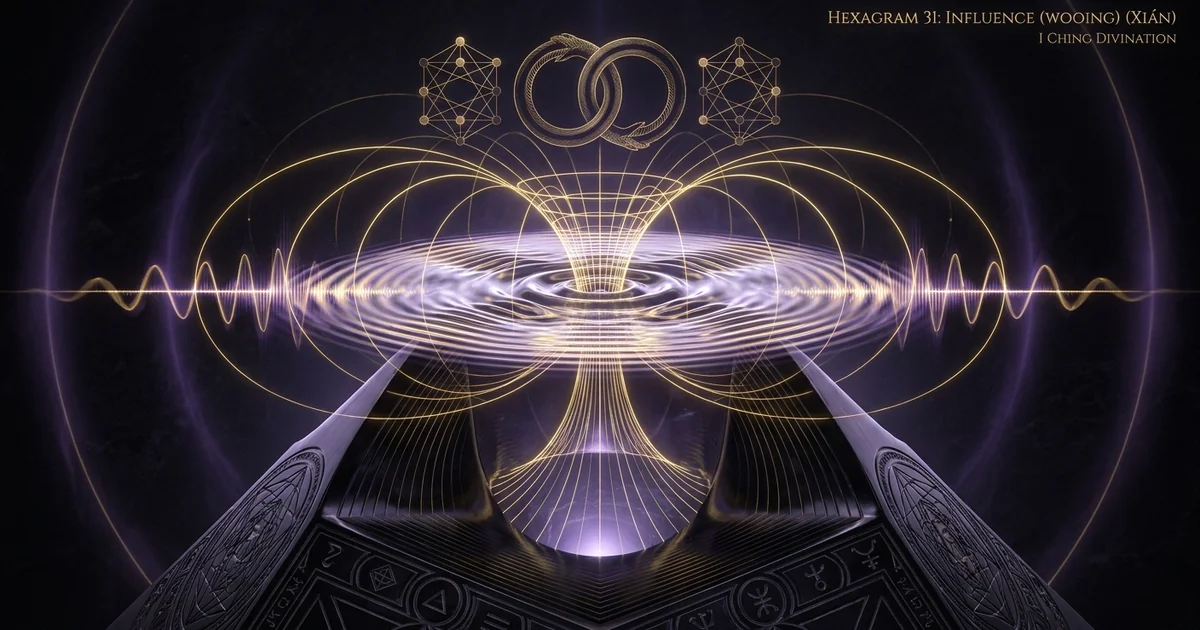
Hexagram 31 Influence (Wooing) (Xián): I Ching Divination
Archetypal Thesis & Systemic Paradigm: The Mechanics of Mutual Resonance
Hexagram 31 (咸, Xián), traditionally rendered as “Influence,” “Wooing,” or “Mutual Resonance,” constitutes the structural pivot of the I Ching’s cosmogonic architecture. It demarcates the precise threshold where primordial metaphysical principles cross over into applied phenomenological manifestation. In the traditional King Wen sequence, the Upper Canon terminates with the systemic exhaustion and sublimation of fire and water in Hexagrams 29 (Kǎn) and 30 (Lí). The Lower Canon opens with Hexagram 31, formally shifting the analytical axis from foundational cosmogony—the interplay of Heaven (Qián) and Earth (Kūn)—to the psychodynamic and social structures of human civilization. In the structural economy of the Book of Changes, Xián operates as the generative matrix of relational existence, establishing the psycho-spiritual laws governing how disparate entities achieve reciprocal equilibrium without coercive force.
=== HEXAGRAM 31 (咸, XIÁN) ===
Line 6: - -  (Six on Top)       [Dui: Jaws, Cheeks, Tongue]
Line 5: ---  (Nine in Fifth)     [Dui: Spine, Nape]
Line 4: ---  (Nine in Fourth)    [Dui: Heart, Core Torso]
---------------------------------
Line 3: ---  (Nine in Third)     [Gen: Thighs, Hips]
Line 2: - -  (Six in Second)     [Gen: Calves, Shins]
Line 1: - -  (Six at Beginning)  [Gen: Big Toe]
=================================
Upper Trigram: ☱ Dui (Lake, Joy, Youngest Daughter)
Lower Trigram: ☶ Gen (Mountain, Stillness, Youngest Son)
Nuclear Hexagram: ䷫ Hexagram 44 (Gòu / Coming to Meet)
The systemic operational mechanism of the xián hexagram is grounded in the classical Chinese doctrine of ganying (感應), an untranslatable conceptual synthesis of stimulus-response, sympathetic resonance, and mutual induction. Rather than relying on a linear, Newtonian sequence of dynamic push-and-pull, ganying presumes an ontological field where all phenomena are fundamentally contiguous, interconnected through a continuous, non-substantial medium of qì. Within this paradigm, influence is not an act of sovereign dominion exerted by an active agent upon a passive recipient. It is an act of phase-locking between resonant frequencies. The structural configuration of Hexagram 31—composed of the upper trigram Dui (Lake) situated over the lower trigram Gen (Mountain)—embodies this principle through elemental mechanics. The lake sits atop the mountain, percolating moisture into the rock’s porous strata, while the mountain anchors and contains the volatile waters of the lake.
The psychological foundation of the archetype demands an egoless spatial clearance. For an entity to exert true influence within the framework of Hexagram 31 influence (wooing) iching meaning, it must first establish an internal vacuum. The mountain yields its peak to hold the moisture of the lake; the young man (Gen) places himself beneath the young maiden (Dui), subverting traditional patriarchal hierarchy to initiate relational harmony. This paradox of receptive attraction reveals that non-coercive vectoring is infinitely more potent than overt kinetic pressure. Seduction, conquest, and tyrannical imposition generate friction and systemic backlash, but the structural emptiness of Xián enables external forces to move effortlessly into alignment with the center. It is an energetic posture that bridges classical Daoist wúwéi (non-contriving action) with Jung’s concept of active imagination and acausal synchronicity.
“The Chinese universe was an orderly whole, an organic system in which every part was linked to every other part by a continuous resonance (ganying)… Phenomena did not happen primarily by mechanical cause and effect, but because things were linked in a kind of vast cosmic matrix where a change in one quarter provoked a corresponding response in another, much as a vibrating lute-string sets other strings humming nearby.” — Joseph Needham, Science and Civilisation in China, Vol. 2: History of Scientific Thought (Cambridge University Press, 1956), p. 281.
“The resonance of the hexagrams does not address the rational intellect via mechanical cause; it addresses the unconscious via meaningful coincidence. Hexagram 31 captures the pure dynamic of the psyche entering into communion with the outer objective reality through sympathetic attunement.” — Carl Gustav Jung, Foreword to The I Ching or Book of Changes (Bollingen Series XIX, 1950), p. xxiv.
Classical Provenance & Textual Lineage: Etymological and Hermeneutic Transmission
The epigraphic morphology of the character Xián (咸) presents one of the most structurally revealing etymological anomalies in the canon of the book of changes divination. In early bronze inscriptions and oracle bone scripts, the graph depicts an axe or halberd (gē, 戈) combined with a mouth (kǒu, 口), traditionally signifying a unanimous, unforced coordination of voices—“all together,” “unison,” or “universal.” Crucially, Xián in the received text of Hexagram 31 deliberately lacks the heart/mind radical (xīn, 心). In classical Chinese linguistics, when the heart radical is appended to xián, it forms gǎn (感), meaning conscious feeling, emotional affection, or deliberate sentiment.
The intentional omission of the heart radical in the naming of Hexagram 31 preserves an indispensable philosophical insight: the influence described here is pre-reflective, somatic, and cosmic, occurring prior to the intervention of the calculating, ego-bound heart-mind. The ancient redactors understood that once the heart radical (xīn) is introduced, influence degenerates into calculation, emotional coercion, and sentimentality. In its pristine form, Xián operates as a totalizing, visceral resonance that sweeps through the physical and psycho-spiritual architecture of an organism without passing through the cognitive filters of the conscious will. It is the spontaneous response of the instrument to the musician, the prompt turning of the tides under lunar gravitas, and the involuntary somatic shiver that precedes cognitive comprehension.
“咸,感也。柔上而剛下,二氣感應以相與,止而說,男下女,是以亨利貞,取女吉也。天地感而萬物化生,聖人感人心而天下和平;觀其所感,而天地萬物之情可見矣!” “Xián means influence (resonance). The yielding ascends and the firm descends; the two primary forces stimulate and respond to each other, entering into mutual relation. Stillness combined with joyful pleasure; the male places himself beneath the female. Thus: ‘Prevalence. It is advantageous to be steadfast. To take a wife brings good fortune.’ Heaven and Earth stimulate each other, and all things transform and are born. The sage stimulates the hearts of men, and the world achieves peace and harmony. If one observes that which stimulates them, the true nature and inclinations of Heaven, Earth, and the myriad phenomena can be seen!” — Tuan Zhuan (Commentary on the Decision), synthesized from Wilhelm/Baynes and Richard John Lynn’s The Classic of Changes as Interpreted by Wang Bi.
In his epochal third-century commentary, Wang Bi dismantled the prevailing Han-dynasty cosmological interpretations of the text, which had flattened the hexagram into superstitious omens, omens of auspicious marriages, and crude physical portents. Wang Bi elevated Xián into an ontological treatise on emptiness (wú, 無) and non-being. He posited that the mountain is capable of receiving the moisture of the lake only because its interior chambers are thoroughly hollowed out by caves and fissures. If the mountain were an impenetrable, solid monolith, the waters of Dui would simply run off its precipices, leading to erosion rather than integration. Wang Bi’s hermeneutic argues that true power resides in stillness (Gen), which commands movement not by stepping into the world to seize it, but by remaining unmoving so that the world has no choice but to settle into it. Influence is thus reframed: to affect the cosmos, one does not project will outward; one hollows out an internal clearing into which cosmic forces naturally descend.
During the Song Dynasty, Neo-Confucian philosophers Cheng Yi and Zhu Xi incorporated Wang Bi’s metaphysics into a rigorous ethical framework. In his Yichuan Yizhuan, Cheng Yi underscored the moral vulnerability of the hexagram. Because Xián governs the open conduits of feeling and interpersonal reception, it contains the constant danger of descending into opportunistic manipulation and hedonism. Cheng Yi noted that human beings, unlike Heaven and Earth, possess private agendas (sī, 私). When the pure resonance of ganying is refracted through selfish desire, the natural polarity between the sexes and between sovereign and minister degenerates into political seduction and transactional flattery. Zhu Xi, in his Original Meaning of the Yijing, reaffirmed that the virtue of the lower trigram Gen—stillness and boundary integrity—must consistently govern the joyful, communicative expression of the upper trigram Dui. If stillness fails to hold the base, the joy of Dui dissolves into the frantic dissipation of integrity.
Structural Mechanics & Symbolic Geometry: Trigram Topography and Somatotopic Progression
The geometric architecture of Hexagram 31 is formed by the dynamic synthesis of two opposing yet structurally complementary trigrams: ☱ Dui (Lake) as the upper, external trigram, and ☶ Gen (Mountain) as the lower, internal trigram. In the elemental taxonomy of the Eight Trigrams (Bāguà), Dui corresponds to the element Metal, the direction of the West, the season of Autumn, and the archetype of the Youngest Daughter (shàonǚ). Gen corresponds to the element Earth, the direction of the Northeast, the threshold between Winter and Spring, and the archetype of the Youngest Son (shàonán).
Hexagram 31 Structural Topography:

Trigram Position   Element   Trigram Archetype       Dynamic Vector
-----------------------------------------------------------------------
Upper: ☱ Dui       Metal     Youngest Daughter / Lake   Downward percolation of moisture
Lower: ☶ Gen       Earth     Youngest Son / Mountain    Upward supportive containment
The dynamic polarity between these two forces creates an energetic circuit of tremendous density. Dui is an open, receptive basin characterized by a broken yin line atop two solid yang lines; its vector of energetic release moves downward, as water inevitably follows gravity to penetrate porous terrain. Gen is characterized by a solid yang line resting upon two broken yin lines; its vector of manifestation moves upward, lifting mass toward heaven while maintaining an immovably grounded base. When Lake is situated over Mountain, the two lines of force converge in absolute mutuality: the mountain provides the structural container that prevents the lake from dispersing across the plains, while the lake provides the nourishing moisture that prevents the mountain from becoming a barren heap of dry rock. In familial symbolism, the youngest son sits lower than the youngest daughter. He subjects his masculine, expansive pride to the feminine, receptive joy of his partner, executing the classical posture of the wooer who kneels to win the heart of the maiden.
The six lines of Hexagram 31 trace an ascending somatic trajectory. It constitutes an explicit somatotopic map, plotting the migration of resonance through the psycho-physiological vessel of the human body, proceeding from the lowest extremities to the highest communicative orifices.
At Line 1 (Six at the beginning), the resonance is felt merely in the “big toe” (xián yú mǔ, 咸其拇). This is peripheral, incipient kinetic activation. The intention has formed within the unconscious strata, but external movement has not yet materialized; it is harmless, provided the subject does not act prematurely. At Line 2 (Six in the second place), the resonance climbs into the “calves” (xián yú fēi, 咸其腓). Here, the impulse is characterized by impetuous, unreflective momentum; to advance unilaterally portends disaster, and only by remaining still within the mountain’s shelter can the querent avoid catastrophe. At Line 3 (Nine in the third place), the influence occupies the “thighs” (xián yú gǔ, 咸其股). The thighs follow the movement of the feet automatically; this line signifies a humiliating loss of autonomic sovereignty, where the individual blindly pursues external desires, enslaved to the sensory objects that stimulate it.
Line 4 (Nine in the fourth place) reaches the “heart” (xīn, 心)—the biological and emotional epicenter of the human organism. Here, the text warns: “Perseverance brings good fortune. Regret vanishes. If a man is agitated in mind, and his thoughts wander to and fro, only those friends on whom he fixes his conscious thoughts will follow him.” Line 4 represents the crisis of conscious reflection. The moment resonance hits the heart, the calculating intellect attempts to control the spontaneous field of ganying, resulting in neurotic vacillation, anxiety, and a drastic narrowing of influence to a tiny circle of ideological partisans. At Line 5 (Nine in the fifth place), the influence ascends past the turbulent heart into the “flesh along the spine” or the “nape of the neck” (xián yú méi, 咸其晦). The back is the locus of involuntary autonomic stability, entirely free from the frantic visual and cognitive desires of the front of the body. Here, resonance achieves its most noble, non-attached expression: a quiet, unshakeable verticality that influences the environment without saying a word. Finally, Line 6 (Six at the top) terminates in the “jaws, cheeks, and tongue” (xián yú fǔ jiá shé, 咸其輔頰舌). Divorced from the rooted depths of the lower body and the sovereign alignment of the spine, resonance degrades into shallow performative eloquence, hollow persuasion, and theatrical demagoguery.
Underlying this somatotopic progression is the hexagram’s nuclear core (hùguà). By extracting lines 2, 3, 4 and lines 3, 4, 5, we uncover the hidden engines of the dynamic: the inner lower nuclear trigram is ☴ Xùn (Wind/Wood), and the inner upper nuclear trigram is ☰ Qián (Heaven). Together, they synthesize Hexagram 44 (Gòu / Coming to Meet). This reveals that beneath the serene, tender surface of Xián’s reciprocal wooing lies the volatile, primal power of Gòu—the archetype of an abrupt, potent encounter with an intoxicating feminine power that must not be casually embraced without supreme conscious discernment. The sweetness of the Lake resting on the Mountain is structurally stabilized only because it successfully integrates the formidable, eruptive masculine potency of Qián moving beneath the subtle, penetrative influence of Xùn.
Psychological Dynamics & Operational Praxis: Archetypal Influence vs. Coercion
In analytical and archetypal psychology, Hexagram 31 serves as the foundational structural blueprint for the therapeutic container, mapping the dynamics of transference, countertransference, and the realization of the Jungian coniunctio. When the psyche encounters an external presence capable of provoking profound inner realignment, it experiences the archetype of Xián. The therapeutic encounter requires the analyst to embody the lower trigram Gen—the Mountain. The analyst must maintain absolute psychic containment, structural boundaries, and emotional stillness. If the analyst reacts with personal, egoic desire or projective identification, the containment ruptures. Only when the analytic vessel remains completely still and porous can the patient’s upper trigram Dui—the Lake of fragmented affects, joy, grief, and communicative vulnerability—pour its contents safely downward without causing a destructive psychological landslide.
Egoic Seduction & Coercion
- Intentionality: Predicated on conscious calculation, tactical agendas, and the desire to control external outcomes.
- Energetic Expenditure: High kinetic friction; requires continuous expenditure of willpower and projective force.
- Somatic Locus: Concentrated in Line 4 (anxious cognitive-emotional heart) and Line 6 (performative jaw, cheeks, and tongue).
- Systemic Stability: Fragile and unstable; induces compensatory resistance, paranoia, and unconscious counter-will in others.
Daoist Resonant Influence (Xián)
- Intentionality: Predicated on egoless emptiness (wú), atmospheric attunement, and absolute spatial clearance.
- Energetic Expenditure: Frictionless; relies on wúwéi and the magnetic drawing-power of structural stillness.
- Somatic Locus: Anchored in Line 5 (the autonomic verticality of the spine) held firmly by the immovable base of Gen.
- Systemic Stability: Organic, permanent, and self-reinforcing; phenomena spontaneously gravitate toward the created vacuum.
The structural pathologies delineated in the line texts expose the primary failure modes of human relational interaction. When an individual operates from the afflictions of Line 3 (the thighs), they are locked in a pattern of hysterical reactivity, blindly tethered to the moods, impulses, and demands of external figures. This is the condition of absolute codependency, wherein the individual possesses no inner psychic core and moves merely because they are stimulated from the outside. Conversely, an individual afflicted by the pathology of Line 6 (the jaws and tongue) relies entirely upon charismatic rhetoric, superficial flattery, and intellectualized posturing. In modern clinical settings, this represents the narcissistic or histrionic defense: communication is divorced from somatic truth, the spine is absent, the heart is bypassed, and speech becomes an instrument designed purely to manipulate the sensory impressions of the room.
In the operational praxis of divinatory consultation, encountering Hexagram 31 demands an immediate diagnostic interrogation of the querent’s locus of motive. The consultant must evaluate whether the querent is attempting to manipulate their environment through the calculated maneuvers of a dysregulated ego, or whether they are cultivating the magnetic receptivity that permits phenomena to crystallize organically. When a querent receives Hexagram 31, the strategic prescription is rarely to execute an aggressive frontal assault upon circumstances. Rather, it commands the querent to withdraw from the realm of verbal persuasion, still their internal anxieties, and step into the receptive emptiness of the mountain. One does not pursue the lake; one forms the basin, and the waters inevitably arrive.
Philosophical Synthesis & Macrocosmic Correspondence: Trans-Systemic Matrix
The cybernetic mechanics of Hexagram 31 transcend the boundaries of human sociality, establishing profound structural correspondences across multiple esoteric, physical, and metaphysical mapping systems. Within macrocosmic physics and systems theory, Xián can be understood as an early, intuitive modeling of non-linear field theories, phase entrainment, and quantum non-locality. When two physical oscillators are placed within physical proximity on a shared substrate, their frequencies spontaneously lock into unified temporal alignment—a phenomenon first observed in mechanical clocks by Christiaan Huygens in 1665. The hexagram formalizes this dynamic: the mountain acts as the shared physical medium through which the rhythmic pulsations of the lake are conducted, demonstrating that influence is not an act of substance traveling across space, but rather the structural entrainment of two dynamic systems sharing a singular continuous field.
Trans-Systemic Matrix of Influence (Hexagram 31):

System                Mapping / Locus                        Operational Function
--------------------------------------------------------------------------------------------------
I Ching Canon         Hexagram 31 (Xián)                     Inauguration of Lower Canon / Mutual Attunement
Trigram Polarity      Dui (Lake / Joy) over Gen (Mountain)   Downward fluid moisture over upward stillness
Human Design          Gate 31 (Gate of Leading)              Throat Center; Channel of the Alpha (31-7)
Western Alchemy       The Conjunctio                         Marriage of the Fixed (Earth) and Volatile (Water)
Astrology             Mid-Leo / Fixed Fire (Tropical)        Radiant, authentic transpersonal leadership
Biology               Codon Translation                      Initiation of protein synthesis via cellular reception
In the architecture of the Human Design System, Hexagram 31 translates directly into Gate 31: The Gate of Leading, located within the Throat Center. Gate 31 belongs to the Collective Understanding Circuit and forms half of the Channel of the Alpha (31–7), the design of leadership “for good or ill.” Strikingly consistent with the classical textual commentary of the I Ching, Gate 31 does not lead through autocratic decree, brute physical domination, or self-appointed supremacy. Its fundamental keynote is “I lead because I am elected by the collective.” It can only exert authentic influence when it is pulled into expression by the magnetic summons of the collective field (Gate 7 in the G-Center).
If an individual with an activated Gate 31 attempts to force leadership through aggressive will, they meet immediate systemic resistance, embodying the dysfunctional rhetoric of Line 6 or the anxious calculations of Line 4. Authentic leadership within this gate functions only when it reflects the collective will back to itself from a place of neutral, spinal stability (Line 5), vocalizing the direction that the collective consciousness has already organically determined.
Within molecular biology and genetic mapping, Hexagram 31 corresponds to the genetic codons governing essential points of cellular transcription. Just as the I Ching demarcates the transition from the cosmic to the human at Hexagram 31, the biological machine utilizes specific nucleotide sequences not to construct matter directly, but to signal the start and stop of genetic expression—influencing cellular mechanics via receptive conformational shifts rather than energetic force.
Astrologically, the hexagram maps to the transition between the expressive sovereignty of mid-Leo and the somatic refinement of Virgo, bridging the gap between individual radiant being and humble, functional containment. In Western Hermetic alchemy, this geometry captures the ultimate goal of the Opus Magnum: the Chymical Wedding or Conjunctio, wherein the fixed red King (the terrestrial Mountain, sulfurous stability) yields to and unites with the volatile white Queen (the mercurial Lake, dissolving lunar moisture), generating the Philosopher’s Stone from the unforced integration of polarized opposites.
Frequently Asked Questions: Analytical Clarifications on Hexagram 31
Systemic Differentiation between Hexagram 31 (Xián) and Hexagram 32 (Héng)
In the structural progression of the King Wen sequence, Hexagram 31 (Xián) and Hexagram 32 (Héng / Duration) form an indissoluble operational dyad, functioning as the two foundational pillars of the Lower Canon. While both hexagrams delineate the energetic dynamics of relationship, their structural mechanics, temporal orientations, and elemental configurations are precisely inverted. Hexagram 31 is composed of Lake (Dui) over Mountain (Gen), capturing the volatile, incandescent spark of initial mutual induction, courtship, and receptive resonance. It is a dynamic state of heightened receptivity, operating in the immediate phenomenological present. It is the moment of attraction before form has solidified, characterized by absolute openness, aesthetic sensitivity, and non-attached responsiveness.
Hexagram 32 (Héng), by contrast, represents Thunder (Zhèn) over Wind (Xùn). Here, the initial spark of wooing has ended, and the relationship has entered the institutionalized continuity of linear time. Héng is the endurance of structural bonds through cyclic constancy and perpetual renewal; it is marriage rather than courtship, the long-term maintenance of the social fabric rather than the spontaneous electric fusion of two souls. Where Xián achieves its power through deep stillness and the creation of an internal vacuum, Héng achieves its power through continuous, dynamic self-renewal within an unchanging moral framework. Without the receptive, pristine resonance of Xián, any attempt at Héng descends into petrified, sterile stagnation; without the enduring structural discipline of Héng, the magical attraction of Xián evaporates into fleeting, meaningless sentimental dissipation.
Therapeutic and Mantic Interpretation of an Unchanging Hexagram 31
When Hexagram 31 is received in an unchanging state during divination (a static cast without moving lines), it diagnoses a situation whose outcome is entirely governed by the atmospheric conditions of the psychic field, entirely devoid of any warrant for external kinetic action. An unchanging Xián indicates that the lines of force are already perfectly arranged in latent equilibrium; the lake is resting squarely upon the mountain, and the moisture is penetrating downward through its natural gravity. Any attempt by the querent to force a breakthrough, orchestrate a dramatic confrontation, or manufacture artificial progress will instantly shatter the receptive vacuum and collapse the resonant field.
In therapeutic practice, an unchanging Hexagram 31 suggests that the unconscious material is ready to cross the threshold into conscious integration, but it requires the ego to adopt an attitude of supreme, non-interfering stillness. The querent must become the mountain: immovable, silent, patient, and deeply grounded. The querent must verify that their internal chambers are hollowed out—free from defensive rationalizations, frantic anxieties, and transactional expectations. The advice of an unchanging Xián is absolute trust in the acausal mechanics of ganying. The querent is advised to hold their position with dignified integrity, allowing the external party, circumstance, or insight to be drawn inward by the inexorable pull of psychic gravitation.
The Evolutionary Function of the Missing Heart Radical in Classical Epigraphy
The deliberate absence of the heart radical (xīn, 心) in the earliest iterations of the character Xián reveals the ancient cosmological understanding of intelligence as a distributed, whole-body phenomenon rather than an isolated cognitive function. In modern Western psychology, influence and communication are routinely conceptualized as cerebrally mediated events—the deployment of rhetoric, psychological framing, or calculated behavioral incentives. The classical authors of the Zhouyi fundamentally rejected this premise, structuring Xián to demonstrate that the most transformative operations of influence bypass the conscious mind entirely.
By stripping the heart radical from the character, the early redactors preserved the radical purity of mutual resonance as an involuntary, visceral event. The human organism is presented not as an intellectual sovereign dictating terms to an external universe, but as a biological resonator that responds to subtle shifts in the metaphysical weather long before the cognitive mind articulates an interpretation. The missing heart radical ensures that Xián remains an archetype of ontological innocence. It is the profound capacity of living matter to recognize, yield to, and unite with its complementary opposite without the distorting interference of egoic ambition, fear, or deliberate design. Influence, in its highest metaphysical distillation, is the universe effortlessly falling in love with its own reflection. :::