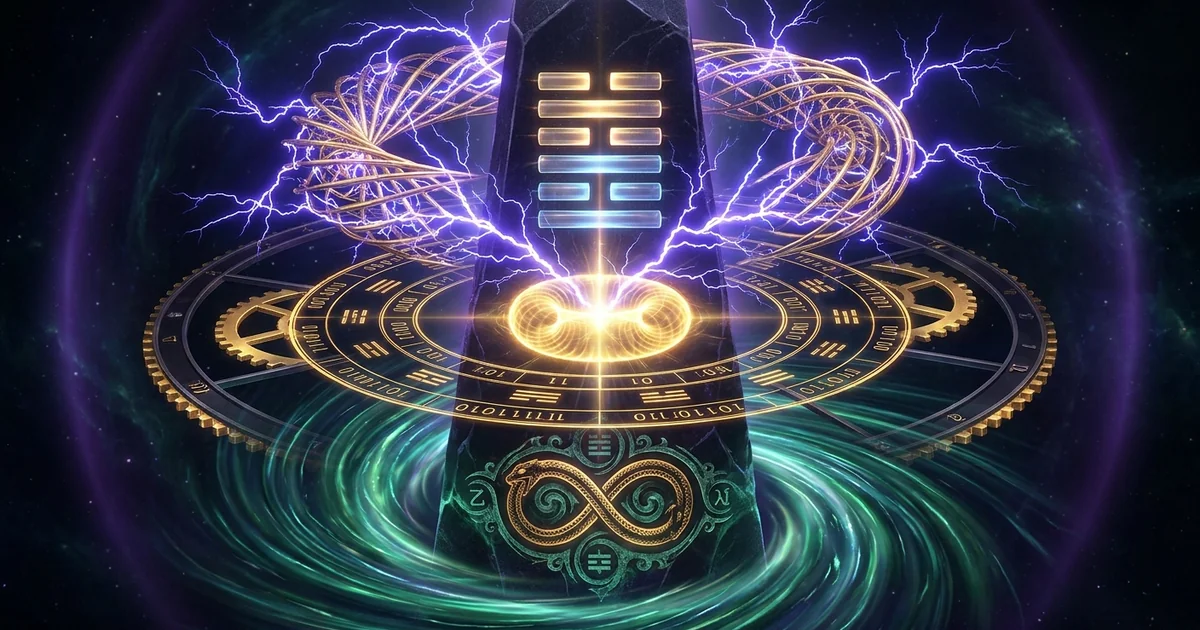
Hexagram 32 Duration (Constancy) (Héng): I Ching Divination
Archetypal Thesis & Systemic Paradigm: The Dynamic Equilibrium of Héng
Hexagram 32 (Héng / Duration) models constancy not as an ossified, entropic arrest of motion, but as homeodynamic equilibrium sustained through perpetual, rhythmic self-renewal. In the psycho-cosmological coordinate framework of the I Ching, permanence is fundamentally non-static. Rather than denoting immutable crystalline substance or structural inertia, duration represents a phase-space trajectory whose operational parameters remain invariant precisely because its localized components undergo continuous cyclical transformation. In classical Chinese cosmology, that which refuses transformation perishes; true endurance is the structural capacity of an open system to continuously metabolize environmental perturbation without forfeiting its organizing teleology.
The hexagram achieves this dynamic synthesis through the energetic coupling of its constituent trigrams: trigram-zhen (The Arousing / Thunder) situated in the upper, exterior station, and trigram-xun (The Gentle / Wind/Wood) situated in the lower, interior station. Thunder over wind establishes a coupled oscillatory vector. Thunder expands upward and outward in explosive energetic bursts, while wind penetrates inwardly, dispersing and yielding with adaptive elasticity. This pairing produces a cybernetic feedback loop wherein initiating dynamism is tethered to rooted, flexible receptivity. In this topological field, duration emerges as an unbroken continuity of process rather than an immobilized state of being, offering a systemic model for navigating entropic decay in both cosmological and psychological architectures.
Hexagram 32: Héng (Duration)
Line 6: ——— (Yang)
Line 5: ——— (Yang)
Line 4: — — (Yin)
Line 3: — — (Yin)
Line 2: ——— (Yang)
Line 1: — — (Yin)
Static Rigidity (Gù / 固)
- Thermodynamic Mode: Closed-system entropy maximization; energy dissipation through resistance to perturbation.
- Psychological Expression: Dogmatic fixation, neurotic repetition compulsion, brittle ego-defenses, and fossilized persona structures.
- Vector Mechanics: Fixed, immovable coordinate points; structural brittleness culminating in catastrophic shear under mechanical stress.
- Temporal Modality: Linear arrest; an attempt to freeze subjective time against irreversible temporal flow, generating acute existential dissonance.
Dynamic Duration (Héng / 恆)
- Thermodynamic Mode: Open-system negentropy; dissipative structures maintaining order via rhythmic metabolic exchange with the environment.
- Psychological Expression: The ego-Self axis exhibiting
homeodynamics; resilient individuation sustained across shifting life circumstances. - Vector Mechanics: Resonant orbital trajectory; dynamic equilibrium mediated by
trigram-zhen(outer expansion) overtrigram-xun(inner penetration). - Temporal Modality: Cyclical periodicity; conscious alignment with macrocosmic rhythms, enabling perpetual auto-regeneration.
Homeodynamics Versus Static Rigidity
Within general systems theory, homeostasis defines a static regulatory paradigm wherein internal variables are held strictly within an invariant parameter band through direct negative feedback. In contrast, the concept of homeodynamics recognizes that living, complex adaptive systems sustain operational stability only through continuous systemic reorganization and variable set-points. Hexagram 32 represents the archetypal geometry of homeodynamics. The hexagram asserts that any entity attempting to survive through absolute immobility inevitably confronts structural failure. When an organism, institution, or psychic complex fixes its parameters against dialectical change, it creates internal shear stress against the unceasing momentum of the Dao.
The character Héng (恆) historically portrays a boat moving between two banks, or the heart (心) positioned between two bounds—an emblem of dynamic navigation across a moving continuum. The hexagram warns that mechanical inflexibility, often mistaken for virtue or strength, is an illusion born of cognitive petrification. When an individual interprets constancy as dogmatic adherence to outward forms, the inner vitality of the psychic structure collapses. The authentic preservation of an archetype requires the ongoing transformation of its symbolic vessels. By locating continuity in the systemic logic rather than the physical vessel, Héng distinguishes between vitality sustained through cyclical alignment and the pathological mortification of the living psyche.
The Vector Field of Thunder Over Wind
The topological disposition of thunder over wind generates a specific kinetic field. Zhèn operates via rapid, disruptive ascendance; it is electrical, kinetic, and disruptive—the awakening pulse of early spring that ruptures dormant earth. Xùn operates via subtle, laminar influx; it is atmospheric, vegetative, and molecular—the gradual, imperceptible penetration of tree roots into bedrock or seasonal breezes across continental expanses. When thunder roars above and wind blows below, their vectors do not cancel each other out; they establish a self-reinforcing atmospheric cycle. The electrical discharge of thunder alters atmospheric ionization and pressure, directing the movement of the wind, while the moisture-laden drafts of the wind feed the thermal gradients necessary for thunderous discharge.
This thermodynamic engine models how higher-order psychic processes coordinate with subconscious instincts. The interior trigram Xùn provides deep roots, flexible humility, and psychological receptivity. Because the root is infinitely yielding, the exterior trigram Zhèn can expend enormous energetic force without toppling the core structure. The system absorbs seismic shocks because its foundation bends without snapping. In contrast to configurations where an unyielding exterior masks an internal void, the internal elasticity of wind grants external action its endurance. The external kinetic pulse is grounded by internal organic cohesion, transforming chaotic discharge into coherent rhythmic manifestation.
Cybernetic Feedback and Temporal Coherence
From a cybernetic perspective, temporal coherence relies on continuous error-correction mediated by recursive informational loops. Hexagram 32 serves as a symbolic blueprint for this dynamic regulation. The internal lines continuously transmit environmental data to the external station, which recalibrates its actions to preserve systemic alignment. In classical divinatory inquiry, receiving Héng does not indicate that the querent must freeze their current position; it signals that the governing principle under inquiry possesses systemic viability only if the querent continuously adjusts their behavioral vectors in harmony with temporal shifts.
Psychologically, this represents the maintenance of the ego-Self axis against the corrosive effects of psychological entropy. C.G. Jung noted that psychic stability demands continuous engagement with unconscious archetypal contents. If the ego identifies completely with a static persona, dissociation occurs. The constancy depicted in the héng hexagram demands that the conscious personality remain dialectically open to the unconscious, allowing archaic symbols to be integrated into progressive life situations. Constancy is therefore measured not by unvarying behavior, but by unyielding fidelity to an internal moral and psychological invariant: the teleological trajectory of individuation.
Classical Provenance & Textual Lineage: Historical Transmissions of Duration
The systemic placement of Héng within the architecture of the Zhouyi is deliberate. In the sequence codified by King Wen, Hexagram 32 immediately succeeds Hexagram 31 (Xián / Mutual Influence/Attraction). While Xián initiates the second canonical division (the Lower Canon, dealing with human relationships, ethics, and earthly manifest forms) through the acute, spontaneous energetic attraction between mountain and lake (the youngest son and youngest daughter), Héng consolidates this dynamic into enduring socio-cosmic institutions through the union of thunder and wind (the eldest son and eldest daughter). The transition from Xián to Héng traces the developmental continuum from initial erotic or energetic resonance to structural, long-term stabilization.
The Judgment (King Wen): 恆:亨,无咎,利貞,利有攸往。 Héng: Success. No fault. It furthers one to be persevering. It furthers one to have somewhere to go.
The Great Symbolism (Daxiang): 雷風,恆;君子以立不易方。 Thunder and wind: the image of Duration. Thus the noble person stands firm and does not change their direction.
King Wen’s Judgment and the Duke of Zhou’s Line Texts
The canonical Judgment framed by King Wen asserts four structural attributes: Success (Hēng), Freedom from Blame (Wú Jiù), the Efficacy of Perseverance (Lì Zhēn), and the Efficacy of Having Somewhere to Go (Lì Yǒu Yōu Wǎng). The co-occurrence of Lì Zhēn (correctness/perseverance) and Lì Yǒu Yōu Wǎng (having a deliberate destination) resolves an apparent paradox: duration requires directional movement. If endurance meant immobility, having a direction or destination to go toward would undermine constancy. Yet the King Wen judgment insists that duration is realized precisely through purposeful movement. Linearity and circularity converge: the cyclical orbit moves inexorably forward through space-time.
The Duke of Zhou’s line texts track the morphogenetic failure modes and masteries of this principle across the six stations of the hexagram. The texts examine the danger of attempting to force duration prematurely at the beginning, the virtue of maintaining inner alignment in the central positions, and the catastrophic fatigue of continuous manic agitation at the terminal stage. Each line elucidates a phase-state in the maturation of constancy, providing empirical diagnoses of how consciousness either integrates with or deviates from the macrocosmic order.
The Ten Wings: Tuan Zhuan and Daxiang Interpretations
The Tuan Zhuan (Commentary on the Judgment) offers an ontological elevation of Héng, positioning it alongside cosmic laws that govern planetary and seasonal periodicities:
“The sun and moon obtain heaven, and so can shine long; the four seasons change and transform, and so can continually bring about completion. The holy person endures in their way, and the world transforms and achieves completion. Observe what they endure in, and the nature of heaven, earth, and all myriad things can be seen!”
Here, the Confucian hermeneutic explicitly decouples duration from structural stagnation. The sun and moon shine because they orbit; the seasons achieve completion because they mutate through systemic succession. Constant transformation is the mechanism of durability.
The Daxiang (Great Symbolism) complements this insight with the injunction: “The noble person stands firm and does not change their direction” (lì bù yì fāng). The Chinese term fāng (方) denotes not merely a physical vector, but an ethical orientation, a cardinal quadrant, an invariant center of gravity. The noble person accommodates exterior shocks without abandoning their underlying moral orientation. The exterior winds may rage and thunder may strike, but the coordinate framework through which the psyche interprets reality remains locked to archetypal principles.
Wang Bi’s Neo-Daoist Synthesis and Han Dynasty Precedents
During the Han Dynasty, correlative cosmologists interpreted Héng within rigid astrological cycles, linking the lines to institutional protocols and seasonal statecraft. However, the 3rd-century Neo-Daoist philosopher Wang Bi executed a radical conceptual pivot, as preserved in his seminal commentary translated by Richard John Lynn:
“Duration cannot be attained by remaining static; it must be preserved through the non-cessation of changes. What does not change cannot long endure. Therefore, it is through the continuous integration of emptiness (wú) that one remains congruent with the movement of entities.”
Wang Bi located duration not in external ritual formalism, but in an interior alignment with non-being (wú) and intrinsic virtue (dé). By demonstrating that the outward phenomena of the hexagram derive their power from the void at their structural center, Wang Bi aligned the héng hexagram with classic Daoist thought. For Wang Bi, constancy is an internal existential state wherein the mind remains empty, unburdened by fixed attachments, and consequently capable of enduring all external permutations without fracture.
Structural Mechanics & Symbolic Geometry: Trigram Topology and Line Architecture
A rigorous structural analysis of Hexagram 32 reveals an elegant interplay of trigram symmetries, line correlations, and internal dimensional states. Composed of two primary trigrams, Héng integrates lower Yin adaptability with upper Yang initiative.
Station 6: Line 6 (Top)     ———  Yang  (Upper Trigram Zhèn - Thunder)
Station 5: Line 5           ———  Yang  (Upper Trigram Zhèn - Thunder)
Station 4: Line 4           — —  Yin   (Upper Trigram Zhèn - Thunder)
---------------------------------------------------------------------
Station 3: Line 3           — —  Yin   (Lower Trigram Xùn - Wind)
Station 2: Line 2           ———  Yang  (Lower Trigram Xùn - Wind)
Station 1: Line 1 (Bottom)  — —  Yin   (Lower Trigram Xùn - Wind)
The hexagram features proper resonance (yìng) across its polarities: Line 1 (Yin) resonates with Line 4 (Yin), though this lack of classic attraction introduces tension; Line 2 (Yang) correctly pairs with Line 5 (Yang) in an unusual dynamic of dual central balance; while Line 3 (Yin) corresponds with Line 6 (Yang). This geometry yields internal dynamics where structural stability is challenged by the distribution of energetic charges.
Line Architecture:
Line 6 (Yang): Restless agitation at the dynamic periphery.
Line 5 (Yang): Sovereign position, balancing flexibility with rule.
Line 4 (Yin): Displaced yield; energy exhausted without ground.
Line 3 (Yin): Volatile transition; internal moral inconsistency.
Line 2 (Yang): Centralized inner core; dynamic anchor of the lower trigram.
Line 1 (Yin): Premature depth; attempting to force permanent form.
Trigram Polarity: Zhèn (Thunder) over Xùn (Wind)
The primary trigrams configure an operational vector field of energetic complementation. Xùn is the trigram of the eldest daughter, belonging to the phase of Wood, characterized by gentle, dispersive entry. Its single broken Yin line lies at the base, beneath two Yang lines, representing a receptive substructure that submits to and directs the solid lines above it. Zhèn is the trigram of the eldest son, belonging to the phase of Wood and Thunder, characterized by decisive arousal. Its single solid Yang line lies at the bottom of two broken Yin lines, representing an explosive impulse surging up from below.
Upper Trigram: Zhèn (Thunder)
——— Line 6 (Yang)
——— Line 5 (Yang)
— — Line 4 (Yin)

Lower Trigram: Xùn (Wind/Wood)
— — Line 3 (Yin)
——— Line 2 (Yang)
— — Line 1 (Yin)
When Zhèn mounts Xùn, motion occurs above an adaptable, rooted base. If Xùn were on top and Zhèn below (as observed in Hexagram 42, Yì / Increase), the explosive kinetic surge of thunder would enter the base of the wind, dispersing it outward in dynamic inflation. In Héng, however, thunder discharges in the open skies of the upper trigram, while the winds circulate calmly along the planetary crust below. The energy discharged above does not destabilize the foundation; instead, it circulates continuously through the atmospheric engine.
Nuclear Hexagram Topology: Hexagram 43 (Kuài / Resolution)
Beneath the outer manifest appearance of any hexagram lies its internal energetic engine: the nuclear-hexagram, derived from overlapping interior trigrams. In Hexagram 32, lines 2, 3, and 4 form the lower nuclear trigram Duì (Lake/Joy), while lines 3, 4, and 5 form the upper nuclear trigram Qián (Heaven/Strength). Together, these configure Nuclear Hexagram 43 (Kuài / Breakthrough/Resolution).
Lines 3-4-5: Upper Nuclear Trigram Qián (Heaven)
Lines 2-3-4: Lower Nuclear Trigram Duì (Lake)
Synthesized Nuclear Hexagram: Hexagram 43 (Kuài / Resolution)
The presence of Kuài within the structural heart of Héng offers a crucial systemic insight: the core of duration is the continuous, decisive excision of the corrupt and obsolete. Kuài depicts five Yang lines rising to expel a single, final Yin line at the apex—a symbol of resolute breakthrough and the surgical severance of necrotic elements. This reveals that duration is preserved through elimination. Constancy cannot endure if it hoards historical detritus. An organization, a biological entity, or an individuation process can achieve duration only by repeatedly cutting away decay. The nuclear engine of Héng is not a passive collector of experience, but an active, decisive blade of discernment.
Hexagram Inversion (Fanzhuan) and Opposition (Duizhuan)
The relational mechanics of the I Ching sequence reveal further operational nuances through hexagram inversion (Fanzhuan) and hexagram opposition (Duizhuan). Inverting Hexagram 32 across its horizontal axis yields Hexagram 31 (Xián / Mutual Influence).
Hexagram 31: Xián (Mutual Influence)
- Trigram Topology: Lake (Duì) over Mountain (Gèn).
- Structural Dynamic: Exterior joy and openness resting upon interior stillness and meditation.
- Kinetic Vector: Receptive, spontaneous attraction; non-verbal resonance; the spark of initial connection.
- Archetypal Role: Eldest son and youngest daughter interacting across spatial receptivity.
Hexagram 32: Héng (Duration)
- Trigram Topology: Thunder (Zhèn) over Wind (Xùn).
- Structural Dynamic: Exterior decisive movement supported by interior structural yielding.
- Kinetic Vector: Disciplined, rhythmic consolidation; continuous systemic regulation over time.
- Archetypal Role: Mature integration of eldest son and eldest daughter in ongoing socio-cosmic labor.
Conversely, the exact polar opposite of Héng, generated by transmuting every line into its opposite binary state (Duizhuan), is Hexagram 41 (Sǔn / Decrease), wherein Lake rests beneath Mountain. Where Héng sustains process through continuous energetic renewal, Sǔn disciplines and purifies process through intentional ascetic reduction. The opposing symmetry illustrates that where duration must maintain functional complexity, decrease must intentionally simplify systemic requirements to safeguard core values.
Six Line Transitions: The Morphogenetic Trajectory of Constancy
The six lines of Hexagram 32 trace the developmental arc of duration, exposing the hazards of precipitous overreach, the strength of the central axis, the shame of moral inconsistency, the sterility of misaligned action, and the nervous exhaustion of perpetual motion.
- Governing Ruler (Nine in the Second Place): Occupying the central position of the lower trigram, this solid line brings stability to the yielding wind. Although in a Yin position, its Yang vigor remains held in moderation by its central location, granting the capacity to endure without excessive exertion.
- Constituent Ruler (Six in the Fifth Place): Positioned centrally in the upper trigram, this Yin line provides a receptive balance to the surrounding Yang environment. It models duration through adaptability, leaning on traditional precedent and ethical alignment to maintain operational stability.
The Polar Traps: Lines 1 (Precipitous Seeking) and 6 (Restless Agitation)
Line 1: Six at the beginning (Initial Yin)
Text: Seeking duration too hastily brings misfortune. Nothing that would further.
Line 1 sits at the absolute nadir of the lower trigram Xùn. It occupies the lowest station of yielding, yet attempts to force permanence before the baseline foundations have formed. This is the failure mode of the neophyte who demands a lifelong commitment on the first day of an enterprise, or who attempts to freeze an emergent creative impulse into an unalterable system. In the psychological sphere, Line 1 represents premature ego-consolidation—an individual demanding that their psyche exhibit complete integration before shadow material has been surveyed. Because this demand ignores organic growth, the line text issues an uncompromising prognosis of misfortune.
Line 6: Six at the top (Terminal Yang transformed to Yin, or moving Yang)
Text: Restless duration brings misfortune.
Line 6 sits at the ultimate extremity of the upper trigram Zhèn. Having pushed outward movement to its systemic limit, it succumbs to manic, compulsive agitation. Rather than embodying the dynamic rhythm of duration, Line 6 displays the hyperactive spasm of an organism terrified of stillness. It is duration debased into nervous vibration. In modern contexts, it reflects the burnout of the executive or creative who substitutes ceaseless physical activity for purposeful direction. Because this manic kinetic discharge burns out the underlying life-force without achieving coherent form, the line brings disaster through internal energetic exhaustion.
The Sovereign Pivots: Lines 2 (Remorse Vanishes) and 5 (Constancy of Virtue)
Line 2: Nine in the second place
Text: Remorse vanishes.
Line 2 represents the energetic core of the lower trigram. As a Yang line occupying an even, receptive position, its structural assertiveness is tempered by internal restraint. It possesses the force to act, yet avoids excess by remaining in the center (zhōng). This central positioning neutralizes the friction that normally accompanies the exercise of power. In any prolonged undertaking, remorse (huǐ) is an inevitable psychological tax—the friction of choices made, paths abandoned, and collateral damage incurred. Line 2 navigates this terrain by remaining anchored to systemic purpose; its actions are measured, proportional, and devoid of performative excess. Consequently, all regret dissolves in the clarity of balanced alignment.
Line 5: Six in the fifth place
Text: Giving duration to one's virtue through constancy. This is good fortune for a woman, misfortune for a man.
Line 5 governs the upper trigram from a position of centrality, yet it is a yielding Yin line occupying an authoritative, dynamic Yang locus. The text uses classical archetypal imagery to highlight a critical operational duality. The virtue (dé) appropriate to Line 5 is adaptive preservation, fidelity to historical context, and steady maintenance—qualities traditionally encoded as feminine (kūn). For one whose duty is preservation and supportive stewardship, this unwavering compliance brings good fortune. However, for an agent whose systemic role requires assertive, decisive leadership and structural innovation (symbolized by the historical archetype of the active patriarch), uncritical adherence to rigid routine results in stagnation and misfortune. The line demonstrates that constancy is contextual: the same behavioral stability that protects a maintainer calcifies a trailblazer.
The Structural Failures: Lines 3 (Inconstant Character) and 4 (No Game in the Field)
Line 3: Nine in the third place
Text: He who does not give duration to his virtue meets with disgrace. Persistent humiliation.
Line 3 occupies the dangerous transitional zone at the boundary between inner and outer trigrams. As the extreme manifestation of Xùn, it is hyper-sensitive to incoming environmental impressions, rendering it unstable and prone to external manipulation. Because it lacks internal structural coherence, it blows whichever way the surrounding winds dictate. The text notes that whoever fails to sustain internal moral constancy invites continuous disgrace (xiū). From an analytical psychological perspective, this line details the fragmentation that follows when an individual lacks a stable ego-Self axis. Surrendering core values to appease external social currents, the individual is continually buffeted by shadow projections and social censure.
Line 4: Nine in the fourth place
Text: No game in the field.
Line 4 enters the lower station of the trigram Zhèn. It attempts to act and initiate, but it does so from a structural position that lacks direct contact with the systemic nourishment of the earth below. The hunter goes to the field, expends great energy, sets snares, and unleashes hounds, but returns empty-handed because there are no animals in that clearing. In business, intellectual labor, or spiritual discipline, this line warns against the misallocation of perseverance. To endure in a methodology, a market, or a relationship that is fundamentally barren does not constitute noble constancy; it is an absurd expenditure of life-force. Line 4 demands that the seeker assess whether their chosen arena contains the empirical conditions for fruitfulness before committing to prolonged engagement.
Psychological Dynamics & Operational Praxis: The Analytical Geometry of Héng
Viewed through the lens of depth psychology, Hexagram 32 models the psychological mechanisms that protect consciousness from dissociation under the pressure of instinctual drives and temporal decay. As C.G. Jung elaborated in his foundational psychological commentary on the I Ching, the oracle functions via the acausal connecting principle of synchronicity, providing a structural map of the subjective unconscious at the moment of inquiry:
“The hexagram is a pointer toward the archetypal situation of the moment… It asks us to look at the qualitative geometry of our psychic condition.”
In this sense, Héng is not a prediction of static future survival; it is a clinical diagnosis of how an individual negotiates stability against psychic entropy.
“In divinatory systems like the I Ching, time is not treated as a uniform, quantitative continuum of abstract metric intervals, but as a dynamic qualitative field. Each moment possesses its own specific archetypal configuration that favors certain developmental trajectories while dissolving others. Hexagram 32 represents that specific qualitative state where time functions as a rhythmic preserver—where enduring meaning is achieved not by fighting temporal flow, but by embedding psychic intentions into the cyclical cadences of archetypal process.” — Marie-Louise von Franz, On Divination and Synchronicity (1980)
Jungian Individuation and the Transcendent Function
In Jungian metapsychology, individuation is a lifelong developmental progression requiring both ongoing adaptation to outer reality and continuous integration of the unconscious. This integration is mediated by the transcendent-function—the psychic organ that unifies opposing contents (conscious and unconscious, light and shadow, rational and irrational) into a higher synthesis. Hexagram 32 is a precise architectural blueprint of the transcendent function operating over time.
Zhèn represents the conscious, assertive forward-thrust of the ego—its aspirations, actions, and temporal progress. Xùn represents the instinctual, receptive depths of the unconscious—yielding, subtle, vegetative, and ancient. When these two dynamics engage in mutual communication, the psyche enters true duration. If the ego cuts itself off from the instinctual roots of Xùn, its Zhèn activity turns into the restless, ungrounded manic inflation of Line 6. If the psyche sinks into Xùn without the directional impulse of Zhèn, it dissolves into the passive, fatalistic stagnation of Line 1. The transcendent function holds these two dynamic vectors in creative tension, forging an enduring ego-Self alignment that remains resilient amid external crises.
[ Zhèn: Ego Directive / Conscious Initiation ]
                                       ^
                                       |
                           (Dynamic Tension of Opposites)
                                       |
                                       v
                  [ Xùn: Instinctual Depth / Unconscious Root ]
                                       ||
                                       \/
              [ Transcendent Function: Enduring Individuation (Héng) ]
Chronobiology, Rhythmanalysis, and Habit Formation
The operational praxis of Hexagram 32 reveals profound resonance with contemporary chronobiology and the rhythmanalysis of Henri Lefebvre. Constancy is sustained through physiological and behavioral rhythms: circadian cycles, hormonal oscillations, periodic consolidation of memory during sleep, and structured behavioral habits. An organism or human collective cannot maintain peak metabolic exertion uninterruptedly; sustained viability requires rhythmic alternation between expenditure (Zhèn) and receptive recovery (Xùn).
Neurobiologically, habit formation reflects the lower trigram Xùn: neural networks consolidate repetitive actions into automated pathways that consume minimal metabolic energy. Once an operational protocol is deeply routed in this receptive substrate, the higher cortical centers (Zhèn) are liberated to execute tactical adaptations without exhausting the organism. Hexagram 32 warns against the fragmentation of this underlying behavioral lattice. When habits become chaotic, somatic and psychological structures deteriorate. The cultivation of daily ritual, rhythmic practice, and physical discipline creates the stable biological platform through which higher intellectual and spiritual inquiries endure.
Divinatory Diagnosis: Discerning Pathological Stasis from Dynamic Resilience
When Hexagram 32 appears in a divinatory consultation, the investigator must analyze the querent’s circumstances through the differential diagnosis of stasis versus resilience. The central diagnostic questions emerge directly from the trigram mechanics:
- Direction of Effort: Is the querent attempting to preserve a deceased structure through neurotic repetition compulsion, or are they adapting their external methods to preserve an underlying core truth?
- Kinetic Balance: Is the querent suffering from the restless agitation of the top line (burnout, hyperactivity, strategic panic) or the premature rigidity of the bottom line (paralysis, over-formalization, premature commitment)?
- Internal Excision: Is the querent actively employing the nuclear medicine of Hexagram 43 (Kuài), cutting away parasitic behaviors and obsolete allegiances, or are they allowing systemic rot to compromise their foundation?
If the moving lines indicate structural failure (such as Lines 3 or 4), the oracle diagnoses a severe misalignment: the querent is seeking permanence in a sphere devoid of fertile potential, or their internal oscillation of will is actively inviting public humiliation. If the moving lines occupy central positions (Lines 2 or 5), the diagnostic field affirms that the core methodology is sound, counseling patience, rhythmic commitment, and the quiet dissolution of anxiety.
Philosophical Synthesis & Macrocosmic Correspondence: Hermetic and Systemic Axioms
The systemic logic of Hexagram 32 intersects profoundly with universal esoteric axioms and contemporary systems sciences. The hexagram confirms that the dynamic patterns governing the microcosm of personal consciousness reflect the macrocosmic architecture of the cosmos.
- I Ching Station: Hexagram 32 (Héng / Duration).
- Human Design Complex: Gate 32 (The Gate of Continuity), situated in the Spleen Center; component of the Channel of Transformation (32–54).
- Astrological Coordinate: Tropical Zodiac 20°00’ Libra to 25°37’30" Libra (Air element, cardinal quality, governed by Venus/Saturn dynamics).
- Genetic Codon Ring: The Ring of Illusion (co-ordinating Hexagrams 32, 28, 42, 53, encoding the amino acids responsible for structural continuity and termination sequences).
- Hermetic Axiom: The
principle-of-rhythm(The Kybalion); the law of energetic compensation across polarity.
The Kybalion Principle of Rhythm and Polarity
The fifth Hermetic axiom in The Kybalion, the Principle of Rhythm, articulates the precise mechanical premise of Héng:
“Everything flows, out and in; everything has its tides; all things rise and fall; the pendulum-swing manifests in everything; the measure of the swing to the right is the measure of the swing to the left; rhythm compensates.”
Hexagram 32 operationalizes this Hermetic law. The master who understands Duration does not attempt to lock the pendulum at its maximum apogee—an unnatural act of force that inevitably invites destructive rebound. Instead, as the Hermetic texts advise, the adept applies the mental art of Neutralization. By anchoring consciousness in the lower trigram Xùn (the inward, stable center of gravity), one remains unaffected as the external pendulum swings through the volatile excursions of Zhèn.
This insight illuminates the apparent paradox of the hexagram: how can a system be “constant” if it is constantly changing? The answer lies in the Hermetic reconciliation of Rhythm and Polarity. Polarity provides the energetic tension between two contrasting states (Thunder and Wind, Action and Yielding, Expansion and Contraction); Rhythm provides the temporal engine that alternates between them. Duration is the emergent harmony of this rhythmic compensation. Constancy is not the absence of swing, but the unbroken continuity of the rhythm itself.
[ Pole A: Thunder (Zhèn) ] <===============> [ Pole B: Wind (Xùn) ]
                 \                                     /
                  \                                   /
                   ===> [ The Pendulum of Rhythm ] <===
                                     |
                                     v
                   [ Axis of Neutralization: Héng (32) ]
Human Design Gate 32 (Continuity) and Genetic Codon Ring of Illusion
In the syntheses of the Human Design System, Hexagram 32 is mapped directly to gate-32-continuity (The Gate of Continuity), located within the Spleen Center—the body’s ancient lymphatic, instinctual, and immune awareness complex. Operating in the tribal circuit, Gate 32 governs the primal fear of failure: the survival-driven instinct that assesses whether an enterprise, an alliance, or an individual mutation possesses the genetic, financial, or cultural viability to endure over time.
Connected via the Channel of Transformation to Gate 54 (The Marrying Maiden / Ambition) in the Root Center, Gate 32 serves as an instinctual filter. It asks: What from the past is worthy of preservation, and what must be discarded to guarantee survival in an evolving environment? This corresponds precisely to the presence of Nuclear Hexagram 43 (Kuài / Elimination) within Héng.
At the molecular level, through its inclusion in the Genetic Codon Ring of Illusion, Gate 32 regulates systemic longevity. The biological organism endures because its cellular replication sequences contain precise proofreading enzymes that excise mutations capable of causing catastrophic systemic failure, while admitting variations that enhance evolutionary adaptability. Duration, written into the genetic code, is the art of selective continuity—preserving the core genome while metabolizing environmental stress.
Cosmological Allostasis: Duration as Complex Adaptive System
Modern evolutionary biology and complex systems theory conceptualize resilience through allostasis: the process of achieving stability through physiological or structural change. In a complex adaptive system (such as a rainforest, an economy, or a mammalian brain), stability cannot be maintained by rigid parameters. A forest that suppresses all small fires accumulates fuel loads that eventually generate a cataclysmic, sterilizing inferno. Regular, minor disruptions (represented by Zhèn’s thunderclaps) clear underbrush and stimulate seed germination, preserving the vitality of the ecosystem.
Hexagram 32 is the primordial cosmological model of allostasis. The upper trigram introduces controlled perturbation; the lower trigram responds with adaptive remodeling. Together, they safeguard the macroscopic integrity of the system. Systems that survive over evolutionary timescales are those that preserve their core informational lineage (the Dao, the genome, the structural archetype) by treating all peripheral components as flexible and sacrificial. The perennial teaching of Héng asserts that constancy is a dance with entropy: by continuously yielding, adjusting, and eliminating that which has completed its seasonal utility, the open system mirrors the unwearying revolution of the cosmos itself.
Frequently Asked Questions
What is the foundational meaning of Hexagram 32 in an I Ching divination?
In an I Ching reading, Hexagram 32 (Héng / Duration) indicates that the situation under inquiry requires sustained, rhythmic perseverance rather than radical disruption or static entrenchment. It counsels aligning with cyclic, dependable principles rather than chasing immediate, volatile results. The hexagram signifies that long-term success is achieved by maintaining an invariant inner ethical compass while remaining tactically flexible in response to shifting circumstances. It diagnoses whether the querent’s current trajectory possesses the homeodynamic vitality necessary to endure through time, cautioning against both the premature consolidation of the bottom line and the hyperactive burnout of the top line.
How does Hexagram 32 distinguish between authentic constancy and toxic stagnation?
Hexagram 32 strictly distinguishes dynamic constancy from pathological stasis through its internal structural mechanics. Static stagnation is an attempt to freeze an external situation into immobility, which provokes systemic collapse under the pressure of natural change. Authentic constancy, as modeled by thunder over wind, is homeodynamic: it preserves a central principle precisely by continuously transforming its external modes of operation. Furthermore, the nuclear hexagram within Héng is Hexagram 43 (Kuài / Resolution), demonstrating that authentic duration requires the ongoing, courageous excision of decaying habits, parasitic dependencies, and obsolete structures. If an enterprise or relationship cannot dynamically adapt and shed its necrotic elements, it is not enduring; it is petrifying.
What does it mean when Line 1 (Six at the beginning) is changing in Hexagram 32?
Receiving Six at the beginning warns against precipitous overreach and the premature demand for permanent results. Situated at the very inception of the hexagram, this line attempts to enforce eternal commitments or institutionalize structures before the underlying relationship or foundation has had time to mature organically. The line text notes that “seeking duration too hastily brings misfortune.” In practical inquiry, this indicates that the querent is forcing an outcome, demanding certainty where only an emergent seed exists, or attempting to skip the intermediate stages of cultivation. The correct remediation is to suspend expectations of permanence, step back, and allow the enterprise to take root through natural, patient cycles.
What is the operational significance of changing Line 6 (Six at the top)?
Six at the top represents the failure mode of duration through manic kinetic exhaustion. Positioned at the extreme edge of the upper trigram Zhèn (Thunder), this line has lost all connection to the stabilizing, deep-rooted base of Xùn (Wind). It manifests as continuous, anxious oscillation, hyperactive busyness, or chronic inability to rest. The line text warns that “restless duration brings misfortune.” Divinatorily, it signals that the querent is running on nervous adrenaline, confusing frantic motion with actual progress. To restore systemic balance, the querent must stop their manic agitation, re-ground themselves in rhythmic physical and mental disciplines, and permit the electrical charges of the mind to settle back into stillness.
How do Hexagram 31 (Xián) and Hexagram 32 (Héng) function as a paired threshold in the Zhouyi?
Hexagrams 31 and 32 form the structural threshold of the Lower Canon of the I Ching. While the Upper Canon opens with Hexagrams 1 (Qián / Heaven) and 2 (Kūn / Earth) to establish the macrocosmic, celestial framework of the universe, the Lower Canon opens with Hexagrams 31 (Xián / Mutual Influence) and 32 (Héng / Duration) to establish the human, social, and earthly plane. Xián models initial attraction, receptive resonance, and spontaneous courting—the dynamic spark of connection between complementary forces. Héng models the institutionalization, rhythmic stabilization, and long-term consolidation of that attraction into enduring structures like marriage, alliances, and ongoing creative mastery. Together, they demonstrate that while spontaneous affinity initiates life, only dynamic constancy can sustain and complete it across the corridors of time.