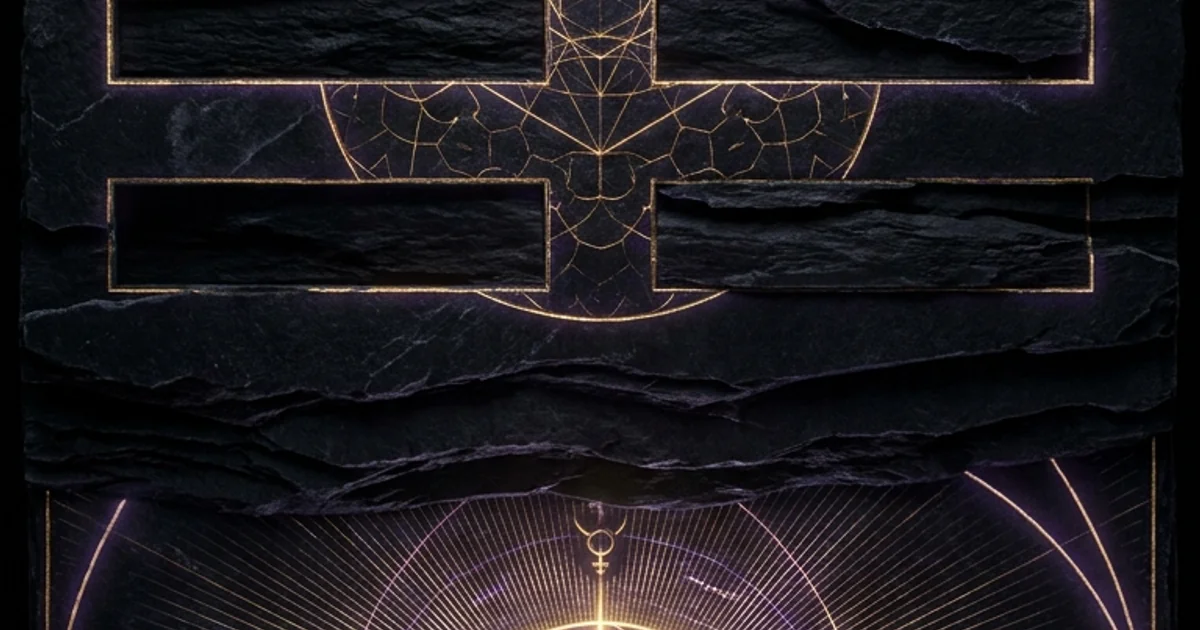
Hexagram 36 Darkening of the Light (Míng Yí): I Ching
Archetypal Thesis & Systemic Paradigm: The Involution of Luminosity
Hexagram 36 (Míng Yí, 明夷), conventionally rendered as Darkening of the Light, designates an ontological and psycho-cosmological crisis: the forced involution of discernment under the pressure of opaque, entropic systemic structures. Within the computational matrix of the I Ching, this archetypal state formalizes the exact mechanics of systemic closure. Rather than demonstrating an absolute eradication of the luminous principle, the hexagram delineates an operational cybernetics of intentional concealment. When lucid awareness confronts an environment governed by unintegrated, predatory, or reactionary forces, outward radiation precipitates immediate systemic neutralization. Survival and long-range continuity demand the suspension of overt manifestation. In the calculus of the Book of Changes, conscious agency survives systemic darkness not through suicidal confrontation, but by withdrawing illumination into the deepest recesses of the interior self, maintaining an uncompromised core while adopting an impenetrable external opacity.
The Entropy of Illumination: Li Subsumed by Kun
The architectural reality of Hexagram 36 is established by the elemental dynamic of earth over fire. In this topological schema, the lower trigram Li (☲, Fire, Solar Disc, Clinging Brightness) is placed beneath the upper trigram Kun (☷, Earth, Dense Mass, Receptive Obscurity). Thermodynamically and symbolically, fire is inherently buoyant; its nature is to ascend, clarify, and illuminate the macroscopic field. Conversely, earth is ponderous, dense, and downward-tending. When earth is positioned above fire, the natural vector of consciousness is structurally inverted. The radiant lucidity of Li is driven underground, suffocated by the sheer inertial mass of Kun.
This spatial juxtaposition denotes an entropic phase-shift. In systemic theory, when an informational agent operating with high negentropy enters an environment characterized by systemic decay, rigid institutional orthodoxy, or blind tyranny, the ambient field cannot assimilate the radiant signal. The surrounding collective perceives the anomalous clarity of Li not as enlightenment, but as an existential threat to its homeostasis. Under such conditions, illuminating the field induces systemic recoil: the light is violently suppressed, wounded, and forced downward into the subterranean layers of matter. The míng yí hexagram maps this exact thermodynamic inversion, codifying the conditions under which intellectual and spiritual luminosity must yield to the oppressive density of its material container.
Catabolic Phases in Dynamic Systems and Consciousness
In dynamic systems, growth does not follow an unbroken linear vector. Biological, cultural, and cognitive architectures undergo periodic catabolic contractions—phases wherein complex, articulated structures break down to conserve the core informational code. Hexagram 36 represents this catabolic necessity within the psycho-spiritual economy. When an organism or an ego confronts an environment that penalizes complexity, the preservation of systemic integrity mandates a strategic lowering of the operational profile.
This corresponds precisely to the mechanics of evolutionary involution. The outward, anabolic expenditure of energy seen in the preceding Hexagram 35 (Jin / Progress) exhausts its ecological niche. Jin represented the sun rising over the earth (Li over Kun), radiating sovereign clarity across the sociopolitical landscape. Hexagram 36 is the mirror inversion of this trajectory: the sun has set beneath the horizon of the terrestrial mass, plunging the system into subjective and objective winter. To resist this descent through persistent extroversion is an error in systemic navigation; it invites the punitive mechanisms of the collective apparatus. Consciousness must transition into an endothermic state, absorbing its heat inward, shielding its nuclear insights within a matrix of silence, and sustaining the integrity of the junzi-archetype through calculated non-disclosure.
The Archetype of the Concealed Adept: Prince Jizi’s Strategic Obscurity
The psychological and historical locus of this hexagram is anchored in the behavior of Prince Jizi (the Count of Chi), a noble counselor during the terminal moral decay of the Shang Dynasty under the tyrant Zhou Xin. When moral admonition failed and direct opposition meant execution, Jizi refused both complicity with the corrupt regime and the vanity of futile martyrdom. Instead, he feigned madness, degrading his outward persona to that of a deranged slave while guarding his inner ethical coherence untouched within his private mind.
This operational posture establishes the concealed adept and holy fool as a primary archetype of cognitive survival. The adept constructs an external mask—a persona deliberately stripped of threatening brilliance—to bypass the surveillance of an oppressive hegemony. The inner clarity of the mind remains diamond-sharp, yet the outward interface presented to the world exhibits the dumb passivity of earth. Through this conscious split between interior reality and exterior performance, the individual prevents the predatory collective from consuming the core seat of consciousness. This strategy differs sharply from hypocrisy or cowardly retreat; it is an act of sovereign psychological warfare against systemic degradation, sustaining the holy flame until the macrocosmic cycle turns toward renewal.
Classical Provenance & Textual Lineage: Historical Trauma and the Zhouyi Canon
To comprehend the hexagram 36 darkening of the light iching meaning, the modern practitioner must examine its origins in the Zhou dynasty’s foundational trauma. The imagery embedded in the Zhouyi is not an abstract metaphysical construct, but the residue of an existential crisis: the transition between the corrupt Shang imperium and the nascent Zhou order, formulated during the imprisonment and persecution of Zhou cultural progenitors.
“Darkening of the Light. In adversity It furthers one to be persevering. One must not be incorrect, One should veil one’s light. The light has sunk into the earth: The image of Darkening of the Light. Thus does the superior man live with the great mass: He veils his light, yet still shines.” — Richard Wilhelm & Cary F. Baynes, The I Ching or Book of Changes (1950)
The Shang-Zhou Transition: King Wen and the Count of Chi at Youli
The historical architecture of Míng Yí is deeply tied to the imprisonment of King Wen at Youli by Zhou Xin, the decadent final sovereign of Shang. King Wen, possessing an elevated moral comprehension and strategic capacity, was confined to a subterranean cell under constant threat of arbitrary liquidation. The prison at Youli represents the literal manifestation of earth pressing down upon fire. Had King Wen openly displayed his strategic genius or his moral superiority, his execution would have been instantaneous.
Instead, Wen applied the hermeneutics of Míng Yí: he submitted externally to the indignity of incarceration, channeled his luminous intelligence inward, and utilized his period of enforced darkness to systematize the hexagram permutations of the Zhouyi itself. Simultaneously, his contemporary, the Count of Chi, lived through the same terror in the royal court, surviving only by smearing himself with filth and acting as an unhinged menial. Hexagram 36 is the distillation of this survival protocol. The text captures the lived terror of an elite cognitive class surrounded by a predatory autocracy, where survival depends entirely on the dialectic between total external obedience and absolute internal independence.
Philological Exegesis of Míng Yí: Pheasant, Brightness, and Injury
The title of the hexagram, Míng Yí (明夷), possesses a rich, multi-layered philological lineage. The character Míng (明) combines the graphs for the sun (日) and the moon (月), signifying absolute visual luminosity, intellectual clarity, and cosmic illumination. However, the graph Yí (夷) is radically polysemic within the archaic oracle bone and bronze inscriptions. In the classical commentary tradition, Yí is understood as “injury,” “wounding,” or “leveling.” Thus, Míng Yí signifies “Wounding of the Bright” or “The Solar Ray Stricken Down.”
Recent epigraphic scholarship, notably advanced by Edward L. Shaughnessy, reveals that archaic usages of Yí frequently referred to a specific avian entity: the mythological solar pheasant, prized for its iridescent, fiery plumage. In this archaic reading, Míng Yí evokes the hunting, striking down, and physical wounding of the solar bird. The radiant creature of the sky is pulled to the dirt, its plumage stained with soil and blood, its wings broken so that it can no longer climb into the heavens. This zoomorphic root deepens the Wilhelm-Baynes rendering: whether interpreted as the solar bird brought low or the eye of discernment wounded by external assault, the structural reality remains consistent. The field of illumination has suffered a catastrophic physical insult from the lower, predatory world.
The Ten Wings and Neo-Confucian Interiority: From External Crisis to Internal Cultivation
The evolution of the Zhouyi from an archaic divinatory handbook to a philosophical manual occurred largely through the appendices known as the Ten Wings (Shi Yi), specifically the Tuanzhuan (Commentary on the Judgment) and the Daxiang (Great Symbolism). Wang Bi, the profound third-century Neo-Daoist commentator, synthesized these texts to strip away mere superstitious omens, reframing Míng Yí as an ontological discipline:
“One must make one’s brightness inwardly luminous while preserving an outward adaptability, yielding to the surrounding perils without abandoning one’s essential integrity. This is the virtue of Prince Jizi.” (Wang Bi, The Classic of Changes, trans. Richard John Lynn).
The Daxiang shifts the emphasis directly to social praxis: “The light has sunk into the earth: The image of Darkening of the Light. Thus does the superior man live with the great mass: He veils his light, yet still shines” (蒞眾用晦而明). Here, the Neo-Confucian lineage identified a paradox of power. The enlightened ruler or sage (junzi) does not dominate the uneducated or corrupted masses through a blinding display of intellect. Such an imposition incites envy, fear, and violent backlash. Instead, the adept practices yong hui (用晦)—the conscious deployment of obscurity. One obscures one’s own brilliance, adopting the common language and humble manners of the collective, while quietly orchestrating ethical coherence beneath the surface of the social matrix.
Structural Mechanics & Symbolic Geometry: Trigram Vectoring and Vectorial Line Dynamics
The internal geometry of Hexagram 36 provides an exact operational blueprint of systemic concealment and gradual emergence. Analyzing its trigram dynamics, nuclear permutations, and line vectors reveals a calculated sequence for surviving and transcending structural oppression.
- Lower Trigram: Li (☲, Fire, Sun, Discernment) — Trapped in the interior/subconscious.
- Upper Trigram: Kun (☷, Earth, Matrix, Inherent Mass) — Imposed upon the exterior/manifest.
- Nuclear Hexagram: Hexagram 40 (Xie ䷧, Deliverance) — Formed by nuclear trigrams Kan (Water) below Zhen (Thunder).
- Human Design Network: Gate 36 (Gate of Crisis / The Darkening of the Light) in the Emotional Solar Plexus Center, mapping the biological confrontation with emotional turbulence and perceptual inadequacy.
- Biomolecular Mapping (Schöenberger): Codon family corresponding to the amino acid Proline, known as a structural disruptor that introduces rigid kinks into peptide chains, halting linear progression.
Trigram Dialectics: Earth (Kun) Suppressing Fire (Li)
The primary dialectic of the hexagram is an irreconcilable topological tension. Li, representing the interior psyche, is pure awareness, critical thinking, and visionary clarity. It corresponds to the heart, the cognitive apparatus, and the flame of the spirit. Kun, occupying the position of external reality, is pure mass, societal consensus, and unreflective tradition. Under normal cosmic configurations, earth resides below, providing a stable foundation for the upward dance of fire.
In Hexagram 36, this relationship is inverted. The massive, unresponsive gravity of Kun rests directly upon the delicate, combustible energy of Li. If fire attempts to burn upward with its typical intensity, it consumes its oxygen and is smothered by the falling earth. Consequently, the fire must adapt to a catalytic, smoldering state: an underground magma chamber rather than an open surface inferno. The mind must recognize that its immediate socio-historical context cannot support open enlightenment; it must internalize its illumination, generating deep subjective heat while presenting a cold, inert crust to external observation.
Nuclear Architecture: Hexagram 40 (Xie) as Latent Resolution
The internal engine of any hexagram is revealed through its nuclear-hexagram, derived from overlapping lines 2-3-4 (nuclear lower) and 3-4-5 (nuclear upper). For Hexagram 36, the nuclear lower trigram is Kan (☵, Water, Danger, the Abyss), and the nuclear upper trigram is Zhen (☳, Thunder, Shock, Movement). When combined, they form Hexagram 40: Xie (Deliverance / Liberation).
Hexagram 36 (Míng Yí):
Line 6: - - (Kun)
Line 5: - - (Kun)   }
Line 4: - - (Kun)   } Nuclear Upper: Zhen (☳) [Lines 3-4-5]
Line 3: --- (Li)    }
Line 2: - - (Li)    } Nuclear Lower: Kan  (☵) [Lines 2-3-4]
Line 1: --- (Li)

Nuclear Hexagram: Hexagram 40 (Xie / Deliverance) [Kan below Zhen]
This structural reality holds profound implications for the practitioner of book of changes divination. It demonstrates that within the very core of Míng Yí’s systemic wounding, the operational software of Deliverance is already running. The peril (Kan) experienced during the darkening phase catalyzes the sudden, decisive release of tension (Zhen). Oppression is not terminal; it is an incubation phase. The pressure within the subterranean core of Hexagram 36 directly builds the kinetic charge that eventually breaks the systemic deadlock in Hexagram 40. Deliverance is not achieved by direct opposition to the darkness, but is naturally generated through the correct internal processing of the crisis.
Line Progression Analysis: From Peripheral Wounding to the Fall of the Tyrant
The six lines of Hexagram 36 articulate a precise topological descent into the underworld of systemic darkness, followed by the inevitable collapse of the oppressive regime:
Six at the Top: Not light, but darkness. First he climbed to heaven, then plunged into the earth.
Six in the Fifth Place: Darkening of the light as with Prince Jizi. Perseverance furthers.
Six in the Fourth Place: He penetrates the left side of the belly. One gets the very heart of the darkening light.
Nine in the Third Place: Darkening of the light in hunting in the south. The great leader is captured.
Six in the Second Place: Darkening of the light injures him in the left thigh. He makes rescue with the horse's power.
Nine at the Beginning: Darkening of the light in flight. He lowers his wings. The superior man on his journey does not eat for three days.
- Nine at the Beginning (Bottom Line): The crisis begins at the periphery. The solar bird, attempting to fly above the rising darkness, is struck in flight and forced to drop its wings. Recognizing the systemic shift, the conscious individual departs immediately. They encounter ridicule, hunger, and ostracism from the collective (“he does not eat for three days”), yet their swift, unhesitating retreat saves their life.
- Six in the Second Place: The wounding moves closer to the biological center: the left thigh is injured. The thigh governs locomotion; the agent’s ability to act independently is structurally impaired. Here, salvation cannot be achieved by individual power alone. One requires an external vehicle—a strong horse—to escape the perimeter of immediate danger. This reflects the reliance on trusted, resilient alliances or protective social structures to bear the weight of the crippled ego.
- Nine in the Third Place: The turning point in the lower trigram. The conscious agent undertakes an intentional counter-maneuver (“hunting in the south”). The south represents the natural home of Fire (Li). By re-anchoring in genuine spiritual lucidity, the seeker strikes at the apex of the dark complex: “The great leader is captured.” However, the text issues a critical warning against premature over-correction: “One must not expect to correct evil too quickly.” Even with the source of darkness unmasked, the systemic rot requires gradual remediation.
- Six in the Fourth Place: The descent into the subterranean citadel. The agent enters “the left side of the belly” of the monster, gaining access to the internal chamber where the dark regime coordinates its operations. This represents total infiltration: the adept perceives the absolute depravity and foundational weakness of the oppressive structure from within. Recognizing its irredeemable nature, one abandons the inner court, stepping through the gate into personal exile before the collapse occurs.
- Six in the Fifth Place: The apex of human conduct under systemic tyranny: the position of Prince Jizi. Stationed in close proximity to the corrupt sovereign (the Sixth Line), escape is physically impossible. The only viable path is the complete adoption of the mask of madness. The light must be veiled to the absolute maximum, while maintaining an unbending, secret internal devotion to righteousness.
- Six at the Top: The dialectical self-destruction of the darkness. The line represents the tyrant Zhou Xin, or systemic entropy pushed to its terminal threshold. “Not light, but darkness. First he climbed to heaven, then plunged into the earth.” Darkness, lacking all self-luminous integrity, survives only by consuming the light. When it has extinguished or driven away every luminous element, it collapses under its own structural void. The oppressive paradigm exhausts its energetic fuel, falling into catastrophic oblivion.
Psychological Dynamics & Operational Praxis: The Alchemical Nigredo and Ego Preservation
Read through the lens of analytical and archetypal psychology, Hexagram 36 maps the confrontation of the ego with the archetypal Shadow, social alienation, and the catabolic phase of psychological transformation.
“The darkening of the light corresponds to that state of psychological depression or crisis wherein the conscious will is paralyzed by the autonomous forces of the unconscious. During such times, any direct attempt to assert the ego’s rational superiority only deepens the neurosis. The individual must endure the dark night of the soul—the alchemical nigredo—withdrawing every external claim to illumination, and cultivating the inner germ of the self in complete silence until the collective psychosis has consumed its own momentum.” — C.G. Jung & Marie-Louise von Franz, Archetypal Processes in the Psyche (Reflecting on CW 11, paras 964–968)
Jungian Nigredo and the Shadow-Contained Ego
In analytical psychology, Míng Yí corresponds directly to the stage of the alchemical-nigredo—the blackening, putrefaction, and mortification of the conscious personality. The alchemist understood that no authentic gold could be synthesized without the primary material first being stripped of its superficial brilliance, sealed within the hermetic vessel, and subjected to sustained, indirect subterranean heat.
When an individual receives Hexagram 36 in deep psychological inquiry, it indicates that the conscious mind (Li) has suffered an inflationary collapse or has been overwhelmed by the shadow-projections of the collective unconscious (Kun). The ego’s customary tools—logic, assertive communication, outward charisma, and rational problem-solving—are entirely ineffective against this structural inundation. To fight the shadow at this juncture is to empower it.
The psychological mandate of Míng Yí is the conscious acceptance of the mortificatio. One allows the outward persona to be reduced to ash, accepting a period of psychological invisibility, ego-reduction, and silence. This containment prevents the ego from projecting its own inner darkness onto the external world, turning the pressure of oppression into a forge for true individuation.
Operational Discretion in Hostile Paradigms: The Art of Strategic Folly
The tactical dimension of Hexagram 36 addresses the preservation of identity within hostile, dogmatic, or totalitarian environments. Societal structures frequently fall into periods of mass psychosis or ideological petrification, during which authentic discernment is branded as heresy or treason. Under such conditions, public displays of intellectual clarity constitute psychological narcissism: an indulgence of the ego’s desire to be recognized, traded at the cost of its destruction.
Míng Yí instructs the conscious agent in the discipline of calculated persona-dissimulation. This is not cynical deceit, but a profound survival strategy:
- Lowering the Perceptual Signature: Ceasing all public attempts to correct, guide, or instruct an environment that has rejected truth.
- External Yielding: Fulfilling superficial bureaucratic, social, and collective obligations without emotional investment or internal surrender.
- Preservation of the Transcendent Function: Guarding the capacity for objective evaluation in private, away from surveillance and collective scrutiny.
- Embracing the Mask of Incompetence: Deliberately cultivating an unremarkable or unthreatening social profile to disarm the paranoia of systemic power.
By adopting the posture of the simpleton, the eccentric, or the conformist, the adept preserves their creative fire intact, allowing the hostile regime to overlook them while it expends its destructive momentum elsewhere.
Divinatory Praxis: Diagnosing Entropic Drift vs. Calling for Strategic Silence
In divinatory consultations, Hexagram 36 is often misread as an omen of unmitigated defeat or external punishment. An advanced hermeneutic, however, understands the hexagram as a precise behavioral prescription. The oracle diagnoses the systemic field as toxic, entropic, and unreceptive to direct intervention.
If a querent inquires about launching an enterprise, exposing a corruption, or forcing an emotional reconciliation, Hexagram 36 issues a clear warning: Halt. Any forward movement, assertive proclamation, or unmasked vulnerability will be met with systemic wounding. The light will be extinguished by the earth.
The divinatory directive mandates a radical shift in orientation. The querent must cease external projection, conserve their material and psychological capital, and cultivate what the Hermeticists called the arcanum: the protected inner garden of gnosis. The question is not “How do I overcome this darkness?” but rather “How do I conduct myself so that this darkness passes over me without detecting the fire I carry?”
Philosophical Synthesis & Macrocosmic Correspondence: Hermetic Polarity and Systemic Resilience
The systemic mechanics of Hexagram 36 reflect macrocosmic rhythms that govern cosmological, historical, and evolutionary cycles. Luminosity and obscurity are not moral absolutes in terminal conflict; they are complementary phases within the engine of universal evolution.
Hexagram 35: Jin (Progress)
- Trigram Geometry: Li (Fire) over Kun (Earth) — The Sun rising unhindered above the horizon.
- Energetic Vector: Extroverted, centrifugal, expansive, radiating systemic coherence.
- Sovereign Persona: The enlightened lord honored with vast herds of horses and royal audiences.
- Psychic Posture: Active integration, external mastery, clarity projected across the social body.
- Operational Directive: Advance boldly; your light meets no fundamental resistance from the field.
Hexagram 36: Míng Yí (Darkening)
- Trigram Geometry: Kun (Earth) over Li (Fire) — The Sun buried deep beneath the subterranean strata.
- Energetic Vector: Introverted, centripetal, contractive, protecting inner integrity.
- Sovereign Persona: Prince Jizi feigning madness; King Wen composing symbols in a prison cell.
- Psychic Posture: Nigredo, deep containment, profound shielding of the individuation axis.
- Operational Directive: Veil your intelligence; comply externally; guard your fire in absolute secrecy.
The Hermetic Rhythm: Polarity and Cyclic Involution
Under the Hermetic Principle of Rhythm, “the measure of the swing to the right is the measure of the swing to the left; rhythm compensates.” Hexagram 36 represents the inevitable counter-swing to the expansive realization of Hexagram 35. No civilizational paradigm, individual consciousness, or biological system can sustain perpetual noon. Constant exterior illumination bleaches the soil of the psyche, depleting its vital reserves and generating unchecked ego-inflation.
Míng Yí is the cosmic midnight. It represents the phase of yin-yang-polarity wherein the active principle (Yang) must descend into the passive, dark matrix (Yin) to undergo purification and rest. During this involutionary period, outward production ceases so that interior depth can be restored. The solar light does not perish when it sinks beneath the earth; it illuminates the antipodes, warming the roots of the world and gathering the geothermal pressure that will fuel the dawn of a new cycle.
Comparative Axis: Hexagram 35 (Progress) versus Hexagram 36 (Darkening)
The systemic relationship between Hexagram 35 and Hexagram 36 is one of direct spatial inversion. In Hexagram 35 (Jin), Fire burns over Earth. The social medium is receptive, porous, and willing to be organized by the central authority of the light. The ruler bestows gifts, and progress is collective, visible, and celebrated.
In Hexagram 36 (Míng Yí), the exact same components are reversed: Earth is piled above Fire. The social medium has turned calcified, paranoid, and suffocating. The surrounding field can no longer tolerate the light because the light exposes its underlying decay. Where Jin called for maximum visibility and leadership, Míng Yí commands complete dissimulation and strategic retreat. The wise practitioner recognizes which half of the cosmic lung is breathing: when the cosmic breath exhales, one rises like Jin; when it inhales, one burrows like Míng Yí. Attempting to live out the archetype of Jin during an epoch governed by Míng Yí is a fatal error that leads directly to destruction.
Macrocosmic Chronobiology and Civilizational Winter
On the civilizational scale, Hexagram 36 defines what traditional cosmologies refer to as a Kali Yuga, an iron age, or a civilizational winter. In these epochs, public institutions rot from within, cultural discernment collapses, and the lowest instincts of the collective seize control of the levers of power.
During such dark ages, authentic esoteric gnosis cannot be broadcast publicly. If cast openly, it is either vulgarized, turned into an instrument of state control, or violently suppressed. The custodians of wisdom throughout history—from the Hermetic brotherhoods of late antiquity to the Daoist lineages during dynastic collapse—have relied on the operational architecture of Míng Yí. They encode their insights into myth, allegorical folklore, architectural geometry, and encrypted alchemical texts. They survive by appearing harmless, irrelevant, or non-existent to the reigning authorities. They understand that their primary task is not to transform the degenerate empire, but to function as a seed bank under permafrost, maintaining the genetic material of truth until the civilizational winter ends.
Frequently Asked Questions
How does Hexagram 36 differ fundamentally from Hexagram 23 (Stripping Away) or Hexagram 47 (Oppression)?
While Hexagrams 23 (Bo), 36 (Míng Yí), and 47 (Kun) all address conditions of severe crisis, their structural mechanics, psychological etiologies, and behavioral remedies are distinct:
- Hexagram 23 (Bo / Stripping Away): The structural configuration shows five Yin lines rising from the base, systematically undermining a single remaining Yang line at the summit (Mountain over Earth). This is endogenous structural rot. The foundation has decayed; the system is collapsing from within due to historical obsolescence. The operational directive is not concealment, but total cessation of activity: one must accept that the old structure cannot be saved and allow it to fall.
- Hexagram 47 (Kun / Oppression / Exhaustion): The configuration is Lake over Water, representing a dried-out reservoir. Here, the crisis is an exhaustion of internal vitality and severe boundary constriction. The agent is trapped within a narrow, arid space where words are useless and energy has run dry. The trial tests whether the inner character can remain cheerful and self-contained despite physical privation.
- Hexagram 36 (Míng Yí / Darkening of the Light): The danger is neither natural structural collapse (23) nor internal energetic exhaustion (47). It is external, predatory hostility directed specifically at the light. The interior fire remains intensely alive, clear, and powerful, but it is covered by the oppressive weight of the earth. The problem is purely communicative and positional: the environment is hostile to consciousness. The strategy is therefore intentional camouflage: feigning the very darkness that threatens you while protecting your flame in silence.
What is the operational directive when receiving Hexagram 36 unchanging in divination?
Receiving Hexagram 36 as a static, unchanging hexagram indicates that the entire field of inquiry is locked into a protracted phase of obscurity. There are no shifting lines to indicate an immediate, easy exit from the condition.
The operational directive is total, unequivocal strategic silence. You must immediately abort any plans for public exposure, aggressive enterprise, ethical confrontation, or self-justification. The unchanging presence of Earth over Fire warns that the systemic environment is utterly unreceptive to your insight, motives, or brilliance. Any overt action will precipitate an immediate, wounding counter-attack from institutional or collective forces.
In this state, adopt the discipline of Prince Jizi:
- Perform your mundane duties with meticulous, mechanical compliance.
- Present an external persona that appears dull, ordinary, and thoroughly unremarkable.
- Do not share your true plans, intellectual projects, or spiritual life with anyone whose loyalty has not been proven under absolute duress.
- Redirect all your creative energy into inward study, structural preparation, and the silent cultivation of the soul. Accept that you are in a civilizational or personal winter; preserve your seed and await the turn of the cycle.
How does the archetype of Prince Jizi inform modern psycho-spiritual individuation?
The archetype of Prince Jizi serves as an essential corrective to the naive spiritualism that demands absolute outward transparency at all times. Modern culture frequently valorizes radical authenticity, demanding that the individual voice their personal truth and display their vulnerability openly in the public sphere.
Prince Jizi demonstrates that under conditions of systemic corruption or collective psychosis, indiscriminate transparency is an act of unconscious complicity with one’s own destruction. When the collective is possessed by ideological fever or institutional paranoia, your “authenticity” simply provides the apparatus with the coordinates it needs to target you.
Jizi’s path introduces the profound psychological distinction between inner fidelity and outer conformity. By willingly smearing himself with ash and playing the fool, Jizi decoupled his true Self from his social persona. He demonstrated that the ego can play any role demanded by physical survival—even the role of a degraded slave—without the underlying core of awareness losing its sovereignty. This is the ultimate test of individuation: maintaining an unwavering dedication to cosmic truth while completely denying the ego its superficial craving for external recognition, validation, or prestige. The light burns brightest when nobody knows it is there.