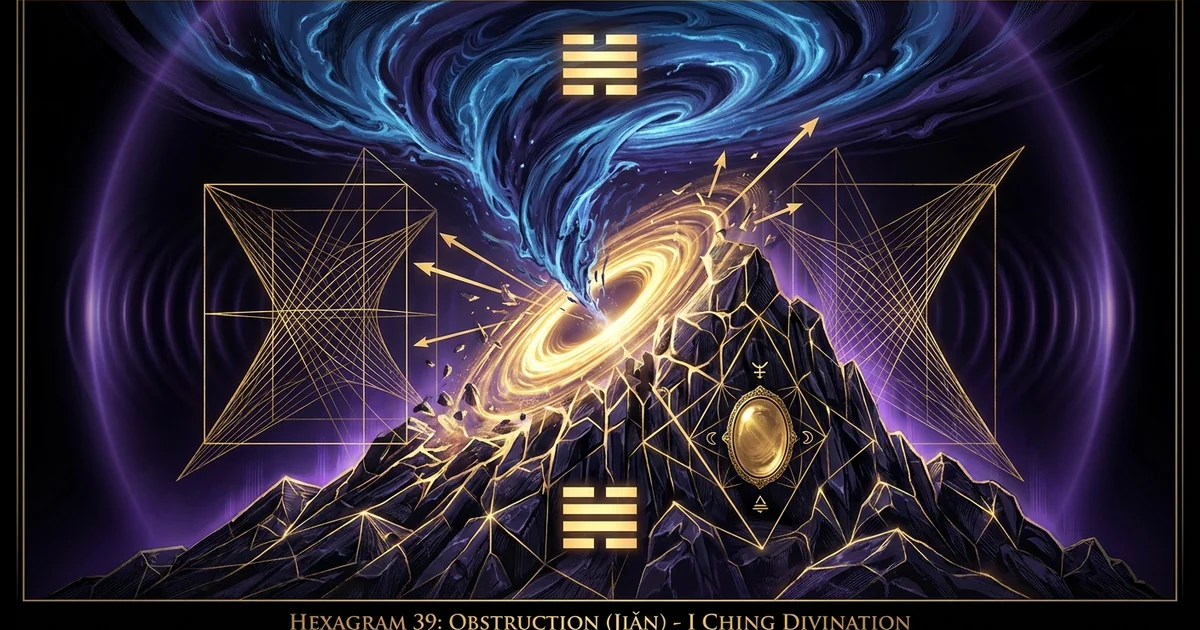
Hexagram 39 Obstruction (Jiǎn): I Ching Divination
Archetypal Thesis & Systemic Paradigm: The Cybernetics of the Threshold
Hexagram 39: Jiǎn (Obstruction)
Structure: Upper Trigram Kǎn (Water/Abyss) over Lower Trigram Gèn (Mountain/Immobility)
Binary Encoding: 001010 | King Wen Sequence: 39 | Nuclear Core: Hexagram 64 (Wei Ji)
Hexagram 39 (蹇, Jiǎn, Obstruction or Halting) constitutes a decisive homeostatic checkpoint within the psycho-cosmological matrix of the I Ching. Rather than serving as an omen of arbitrary ruin or fatalistic paralysis, the hexagram delineates an intentional phase transition within consciousness. In the language of analytical psychology and cybernetics, Jiǎn formalizes the functional confrontation between teleological kinetic momentum and an immutable architectural limit. The systemic agent, accustomed to linear projections of will across an exteriorized landscape, encounters an insurmountable boundary that invalidates existing operational paradigms. The confrontation with the abyss compels the immediate cessation of extroverted assertion, initiating a thermodynamic redistribution of energy from kinetic agency to intensive interiorization. The hexagram operates as an acausal feedback loop, demonstrating that when a system exceeds its ecological or psychic carrying capacity, an equal and opposing structural impedance arises to preserve systemic equilibrium.
“The archetype of the threshold guardian represents that specific structural factor in the unconscious which arrests the conscious ego at the precise moment its kinetic inflation threatens systemic psychic dissociation. Far from being a demonic impediment, this functional inhibition operates as a protective enantiodromia, forcing the libido backward into the core of the personality where genuine transformation must occur.” — C. G. Jung, Synchronicity: An Acausal Connecting Principle (Bollingen Series, 1952); Marie-Louise von Franz, Shadow and Evil in Fairy Tales (1974)
The Dynamic Arrest of Forward Trajectory
The structural phenomenon of Jiǎn is rooted in the sudden, radical invalidation of naive egoic intentionality. In mundane consciousness, progression is conceptualized as an unhindered linear vector extending from desire through intention to manifestation. Within the symbolic grammar of the Book of Changes, this straight trajectory inevitably manifests its own dialectical counter-force. The obstruction denoted by Jiǎn is not merely an external accident; it is the materialization of unconscious resistance, the physical crystallisation of unacknowledged systemic friction. When an individual or an enterprise attempts to navigate an environment without integrating the unconscious dependencies of that environment, the path ahead transforms from an open horizon into an impenetrable barrier. Forward motion under such auspices accelerates systemic entropy. To proceed blindly into the hazard is to court catastrophe, as every mechanical exertion against the obstacle amplifies the mechanical resistance of the barrier itself. The functional instruction encoded within hexagram 39 obstruction iching meaning is unequivocal: the preservation of viability demands the immediate and conscious arrest of all forward trajectory.
Enantiodromia and Psychic Resistance as Evolutionary Feedback
Within Jungian analytical psychology, the encounter with insurmountable obstruction initiates an enantiodromia—the dialectical emergence of an opposing force that restores equilibrium to an overextended psychological system. When the conscious ego pursues a unilateral vector of conquest or expansion, the unconscious withdraws its energetic backing, externalizing this deficit as objective resistance. The physical impedance encountered in the outer world mirrors the psychic schism within the subject. This structural stoppage operates not as a punitive mechanism, but as an evolutionary feedback protocol. The psychic libido, denied its habitual external outlets, cascades back into the self-system, creating high internal psychic pressure. This compression dissolves superficial behavioral patterns and forces the individual to confront foundational misalignments. The impedance of Jiǎn is thus an evolutionary necessity: by terminating the viability of linear expansion, it compels the organism to undergo systemic mutation. The subject does not overcome the obstruction through crude force; rather, the subject is remade by the obstruction until the operational definition of the problem space itself undergoes a structural paradigm shift.
Topological Tension Between Gèn and Kǎn
The phenomenological power of the jiǎn hexagram is derived directly from its topological arrangement: the upper trigram is Kǎn (坎, Water, the Abyssal Chasm), situated directly over the lower trigram Gèn (艮, Mountain, Stillness, the Boundary). This specific configuration of water over mountain generates an acute topological crisis. Lower Gèn represents the absolute immobility of the earth elevated to its highest structural limit—it is the terminus of movement, the boundary stone that enforces pause. Directly above this boundary lies Kǎn, defined by cascading fluid danger, unplumbed abyssal depths, and acute existential peril. If the subject stands atop the mountain of Gèn, any prospective forward step plunges them directly into the torrential chasm of Kǎn. Conversely, if one attempts to retreat, Gèn stands as an unyielding wall behind. This creates an unresolvable topological trap for the linear ego. The outward environment offers neither a secure path forward nor an easy retreat; the boundary below warns that movement has reached its functional limit, while the chasm above signals that external kinetic action will result in catastrophic failure.
Classical Provenance & Textual Lineage: Historical Transmissions of Jiǎn
Received Text (King Wen Sequence):
Hexagram 38: Kuí (Opposition / Divergence)
    │
    ▼ [Crystallization of Divergence into Physical Impasse]
Hexagram 39: Jiǎn (Obstruction / The Limp)
    │
    ▼ [Systemic Release of Accumulated Tension]
Hexagram 40: Xiè (Deliverance / Dissolution)
The historical transmission of Hexagram 39 traces an evolving hermeneutic trajectory from Bronze Age sacrificial and military divination toward sophisticated classical systems of statecraft and interior metaphysics. In the Mawangdui silk manuscripts and the Shanghai Museum bamboo slips, the graph for Jiǎn (蹇) explicitly conveys lameness, limping, or physical halting, establishing that the fundamental biomechanical root of the hexagram is the somatic inability to advance smoothly. In the received King Wen sequence, Jiǎn holds an indispensable macro-structural position: it follows immediately from Hexagram 38: Kuí (Opposition). Where Kuí charts the divergence of wills, the ideological fracture of alliances, and the breakdown of mutual intelligibility, Jiǎn represents the inevitable material consequence of that divergence. When perspectives are fractured and consensus is dismantled, the path forward solidifies into an insurmountable, tangible obstruction. The King Wen architecture dictates that ideological alienation (Kuí) inevitably precipitates systemic paralysis (Jiǎn), which in turn serves as the structural prerequisite for subsequent release in Hexagram 40: Xiè (Deliverance).
The Judgment (Tuan Zhuan): 蹇。西南利,東北不利。利見大人。貞吉。 Jiǎn. The Southwest furthers; the Northeast does not further. It is advantageous to see the Great Man. Perseverance brings good fortune.
The Commentary on the Great Symbolism (Da Xiang Zhuan): 山上有水,蹇。君子以反身修德。 Water on the mountain: the image of Obstruction. Thus the superior person turns his attention to his own person and cultivates his inner virtue (fǎn shēn xiū dé). — Wilhelm, R., & Baynes, C. F. (1950); Wang Bi, trans. Richard John Lynn (1999)
The King Wen Judgment and the Directional Axis (Southwest vs. Northeast)
The classical Judgment for Hexagram 39 introduces a precise spatial and energetic polarity: “The Southwest furthers; the Northeast does not further.” To interpret this injunction purely as historical geography is to miss its structural integration with the Later Heaven (Hou Tian) Bagua arrangement. In King Wen’s directional matrix, the Northeast is the cosmological locus of Gèn (Mountain)—the realm of hard borders, steep rock faces, solitary individuation, and rigid containment. To pursue the Northeast during a phase of Jiǎn is to compound stasis with stasis; it represents retreating into stubborn isolation, solitary hubris, or attempting to scale an impossible cliff through sheer stubbornness.
Conversely, the Southwest is the cosmological seat of Kūn (Earth)—the expansive, level, all-receptive plain characterized by communal alliance, selfless integration, and open spatial cohesion. The instruction to orient toward the Southwest mandates an operational transformation: the subject must abandon the solitary, competitive ascetics of the Northeast in favor of the collaborative, ego-less receptivity of the Southwest. One must seek out allies, integrate broad collective resources, and descend from the isolated peak of stubborn pride down into the shared territory of mutual aid. The further injunction, “It is advantageous to see the Great Man,” reinforces this directional shift: resolution cannot emerge from the subjective, limited consciousness that engineered the crisis. It requires alignment with an objective, higher-order intelligence—the internal or external archetype of the Da Ren (Great Person)—possessing the panoramic systemic clarity required to map a non-linear path through the abyss.
The Duke of Zhou’s Line Texts: Stratification of Impasse
The line texts attributed to the Duke of Zhou stratify the experience of obstruction across six progressive energetic gradations, mapping the shifting calculus between kinetic engagement and strategic preservation:
- Initial Six (Line 1): “Going leads to obstructions; coming meets with praise.” This opening station signals the immediate emergence of resistance. Kinetic continuation (going) deepens systemic entrapment; returning to the base (coming) preserves agency and aligns with natural timing.
- Six in the Second Place (Line 2): “The king’s minister is entangled in obstruction upon obstruction; not through personal fault.” Here, the obstruction is systemic and political rather than self-inflicted. The agent is duty-bound to endure severe friction not for egoic reward, but out of foundational fidelity to a macrocosmic obligation.
- Nine in the Third Place (Line 3): “Going leads to obstructions; hence he comes back.” The third line, at the apex of lower Gèn, directly confronts the chasm of Kǎn. Forward motion is unequivocally catastrophic; true heroic conduct consists in having the structural humility to halt and return to the domestic or internal base of operations.
- Six in the Fourth Place (Line 4): “Going leads to obstructions; coming leads to union.” Isolated advancement fails, but strategic retreat (coming) unites the subject with complementary allies, initiating the collective matrix needed to survive the crisis.
- Nine in the Fifth Place (Line 5): “In the midst of the greatest obstruction, friends arrive.” Operating at the sovereign locus of Kǎn, this line experiences the apex of the chasm. Precisely because the obstruction is held with unyielding rectitude, external and internal allies converge to facilitate systemic survival.
- Six at the Top (Line 6): “Going leads to obstructions; coming leads to great good fortune. It is advantageous to see the Great Man.” The ultimate realization of the hexagram: total disengagement from external kinetic striving produces sublime spiritual crystallization. The sage-observer transvaluates the external impasse into absolute interior completion.
Neo-Confucian and Daoist Hermeneutics: Wang Bi and Cheng Yi
In his epochal Zhouyi Zhu, the third-century Daoist-leaning philosopher Wang Bi established a foundational hermeneutic for Jiǎn: obstruction is not an unfortunate interruption of virtue, but the indispensable condition through which virtue is realized. Wang Bi asserts that when external circumstance denies the manifestation of kinetic agency, the superior person recognizes that heaven has closed off outer paths to force the radical cultivation of the interior axis. This inner recalibration is encapsulated in the classical phrase fǎn shēn xiū dé (反身修德): “turning the attention back into oneself and cultivating virtue.”
Centuries later, the Neo-Confucian scholar Cheng Yi expanded this view in his Yichuan Yizhuan, arguing that worldly difficulties are pedagogical tools deployed by the cosmos. Cheng Yi observed that lesser individuals react to obstruction with bitterness, externalized projection, and frantic, violent attempts to smash through barriers, which only succeeds in deepening their entanglement. The superior person, however, understands the cybernetics of fate: they accept the cessation of outer progress as an invitation to rigorous self-examination. By diagnosing the internal micro-faults that mirror the external structural impasse, the subject eliminates the psychic discordance that invited the obstruction in the first place. Obstruction ceases to be an external enemy; it is recognized as a manifestation of the Dao, an instrument precisely tailored to forge psychological resilience and sovereign character.
Structural Mechanics & Symbolic Geometry: Trigram Vector Dynamics
Hexagram 39 Hexagram Matrix:
Lines 4-6: Upper Trigram Kǎn ☵ (Water / Danger / Downward Vector)
Lines 1-3: Lower Trigram Gèn ☶ (Mountain / Boundary / Static Vector)
Lines 3-5: Upper Nuclear Lí  ☲ (Fire / Luminosity)
Lines 2-4: Lower Nuclear Kǎn ☵ (Water / Abyss)
Nuclear Core (Hexagram 64): Wei Ji (Before Completion)
The energetic anatomy of Hexagram 39 is defined by a severe vector asymmetry between its component trigrams, creating a state of dynamic deadlock. Within the Book of Changes, each trigram possesses an intrinsic directional vector: Kǎn descends downward like water seeking the lowest point, while Gèn remains solidly anchored in foundational stasis. In Jiǎn, the descending, dangerous fluid of upper Kǎn pours down directly upon the immovable, ascended peak of lower Gèn.
Trigrammatic Anatomy: Upper Kǎn (Water/Abyss) Over Lower Gèn (Mountain/Stillness)
Upper Kǎn is composed of an active, luminous Yang line contained between two soft, yielding Yin lines. It is the trigram of the deep trench, the torrential river, and sudden existential crisis. Its kinetic tendency is irrepressible descent: it flows, saturates, dissolves, and challenges whatever it encounters. In Jiǎn, Kǎn is elevated, indicating that perilous conditions dominate the environment.
Lower Gèn consists of a solitary, firm Yang line presiding over two yielding Yin lines. Its intrinsic nature is stillness, cessation, the rigid limit of physical forms. When Gèn occupies the lower position within a hexagram, the ground beneath the subject is fundamentally stable, but it is a stability defined by unyielding immobility—it cannot advance.
When these two energetic configurations are superimposed, their vectors collide. Kǎn pours downward into the subject’s path, creating an active hazard. Gèn, recognizing the abyss, halts. If Gèn were to act foolishly and mobilize forward, it would abandon its natural stability and tumble headlong into the descending torrent of Kǎn. Therefore, the lower trigram’s function is to maintain its structural integrity by standing motionless, bearing the descending weight of the upper abyss without breaking. This is the definition of profound resistance: the conscious choice to remain fixed in the face of an encroaching tempest.
Nuclear Hexagram Interrogation: The Core of Hexagram 64 (Wei Ji)
A structural examination of the interior dynamics of Hexagram 39 requires an interrogation of its nuclear hexagram (hu-ti), derived from the overlapping inner lines:
- Lines 2, 3, and 4 generate lower nuclear Kǎn (Water: ☵)
- Lines 3, 4, and 5 generate upper nuclear Lí (Fire: ☲)
The integration of these two inner trigrams yields Hexagram 64: Wei Ji (Before Completion), the final hexagram of the sixty-four卦 King Wen sequence. This structural presence reveals the deeper purpose of Jiǎn. Beneath the exterior drama of the Mountain arresting the Water, the internal core of Hexagram 39 is driven by the dynamic polarity of Fire and Water in an unsettled state. In Hexagram 64, Fire ascends while Water descends, pulling in opposite directions; the transition across the river is not yet accomplished, and the young fox risks wetting its tail.
The presence of Wei Ji as the nuclear engine of Jiǎn reveals that the obstruction is not a fixed, sterile dead-end. Instead, it is an active phase of pre-completion. The system is trapped in a liminal zone precisely because the foundational elements of insight (Fire/Lí) and survival courage (Water/Kǎn) have not yet attained dynamic equilibrium. The nuclear core demonstrates that Hexagram 39 is the crucible in which the conditions for transition are being forged. The obstruction remains solid until the internal Fire and Water achieve systemic coherence. Once this interior work is realized, the structural grid of Jiǎn can unlock, making transit across the threshold possible.
The Vector Field of Movement and Stillness
The dynamic tension of Jiǎn can be mapped as an energetic vector field where movement and stillness engage in structural dialectic:
$$V_{\text{total}} = \vec{V}{\text{Gèn}} + \vec{V}{\text{Kǎn}} = 0$$
At this topological intersection, the kinetic velocity vector of the system collapses to zero. Crucially, a velocity of zero does not denote an absence of force; rather, it denotes the maximal equilibrium of opposing forces. The pressure exerted by the descending abyss is precisely counterbalanced by the structural refusal of the mountain to advance.
To attempt to force forward movement against this zero-vector field violates the mechanics of systemic equilibrium. Any forward kinetic vector introduced by the conscious will ($\vec{V}_{\text{will}} > 0$) immediately destabilizes this equilibrium, shifting the equation from structural balance to destructive entropy:
$$\vec{V}{\text{entropy}} \propto |\vec{V}{\text{will}}| \times \text{Hazard}_{\text{Kǎn}}$$
The only mathematically sound action under such vector mechanics is the deliberate nullification of extroverted kinetic agency. Energy must be redirected inward, transforming the zero kinetic vector into an expanded scalar potential within the self. The system stops attempting to move through space; instead, it deepens its own mass, grounding itself upon the unshakeable foundation of lower Gèn until the vector dynamics of the outer field dissolve naturally.
Psychological Dynamics & Operational Praxis: Line Progression and Navigational Protocol
Line Architecture of Hexagram 39:
Line 6: Yin (Top)   ── ──  The Sage's Disengagement / Great Good Fortune
Line 5: Yang (Apex) ─────  The Sovereign Standoff / Convergence of Allies
Line 4: Yin         ── ──  The Strategic Pause / Assembling the Coalition
Line 3: Yang        ─────  The Internal Limit / The Wisdom of the Return
Line 2: Yin         ── ──  The Bound Servant / Endurance Without Fault
Line 1: Yin (Base)  ── ──  The Initial Impasse / Preserving Agency
Navigating Hexagram 39 requires an exacting diagnostic literacy of its individual line positions. Within the practice of book of changes divination, drawing Jiǎn indicates that the querent must dismantle linear, goal-directed habits. Each line station offers a navigational rule that counters conventional, egoic instincts.
The Dialectic of Advance and Retreat: Lines 1, 2, and 3
The lower trigram Gèn governs lines 1 through 3, establishing the foundational mechanics of strategic retreat and non-reactive endurance:
- Initial Six (Line 1): Positioned at the very base of the mountain, the subject feels the initial friction of the coming obstruction. The egoic impulse is to accelerate, hoping to clear the threshold before the path closes. The line warns directly against this: “Going leads to obstructions; coming meets with praise.” In this initial station, the subject lacks the institutional weight and momentum to pierce an emergent barrier. The operational instruction is immediate cessation. Pausing here is not cowardice; it is a calculated conservation of resources. One yields to the earliest indicators of structural resistance, sidestepping the trap before it springs.
- Six in the Second Place (Line 2): Situated at the center of the lower trigram, this yielding, correct Yin line is caught in severe friction: “The king’s minister is entangled in obstruction upon obstruction; not through personal fault.” Line 2 has an authentic resonance with the sovereign ruler at Line 5. The obstruction encountered here is neither the result of personal neurosis nor individual miscalculation; it is the structural consequence of transpersonal responsibility. In professional or spiritual contexts, this station demands uncomplaining endurance. The minister does not fight the obstruction with futile aggression, nor do they flee their duty. They hold their position within the teeth of systemic resistance, sustained by the knowledge that their endurance preserves the integrity of the collective structure.
- Nine in the Third Place (Line 3): As the sole Yang line within the lower trigram, Line 3 possesses immense kinetic drive and systemic pride. It stands at the boundary of Gèn, looking directly down into the abyss of Kǎn. The temptation to initiate a heroic, solitary charge across the boundary is acute. The text warns: “Going leads to obstructions; hence he comes back.” Advancing from Line 3 leads to unmitigated systemic ruin. True psychological maturity at this station consists in the capacity to execute a conscious, dignified retreat. The line returns to its familial, internal base—to the interior domain of psychological consolidation. This retreat is an act of sovereign self-mastery that preserves life and structural integrity.
The Sovereign Standoff: Line 5 and the Intervention of Allies
The upper trigram shifts the drama from individual boundary-setting to the management of macrocosmic crises:
- Six in the Fourth Place (Line 4): This station bridges the lower and upper trigrams. It represents the point where personal resources are exhausted: “Going leads to obstructions; coming leads to union.” Unilateral action remains impossible. The fourth line recognizes that its own isolated force cannot cross the abyss. By holding back, it creates a relational space where alliances can form. It signals the abandonment of solo heroics in favor of institutional, distributed, or tribal solidarity.
In the architecture of Human Design, Hexagram 39 corresponds to Gate 39 (The Gate of Provocation / The Obstacle), located in the somatic Root Center. Gate 39 operates as a mechanical pressure transducer, firing the fuel of energetic and emotional provocation across the Channel of Emoting (39–55) toward the Solar Plexus. Biologically tied to the codon for Serine, this gate does not seek comfort; it deliberately provokes the energetic field to assess the integrity of the spirit. When Gate 39 confronts an obstacle, it generates intense somatic pressure that forces an energetic release. It confirms the metaphysical axiom of Jiǎn: obstruction is the pressure vessel through which psychic energy is concentrated until it breaks free from stagnation.
- Nine in the Fifth Place (Line 5): Operating at the commanding height of the abyss, the fifth line represents the apex of structural entrapment: “In the midst of greatest obstruction, friends arrive.” Line 5 is a strong Yang line in a Yang seat, holding the sovereign throne, yet it is fully immersed in the center of the water chasm. This is the condition of the leader, the founder, or the core self confronting a systemic emergency where all standard mechanisms of control have buckled.
The genius of this station is that Line 5 does not attempt to brute-force the chasm alone. It holds its post with radical, central alignment. Because its integrity remains uncorrupted by panic, fear, or reckless action, its predicament becomes a beacon. “Friends arrive”—external allies, archetypal psychic reinforcements, and distributed collective intelligences mobilize to support the sovereign core. Line 5 demonstrates that when the central self maintains its alignment within the center of the storm, the macrocosm inevitably organizes around it to provide the necessary dynamic leverage.
Line 6: The Sage’s Transvaluation from Obstruction to Great Merit
The climax of the hexagram occurs at Six at the Top: “Going leads to obstructions; coming leads to great good fortune. It is advantageous to see the Great Man.” This line has reached the final boundary of the upper trigram Kǎn. The perilous abyss is largely behind it, yet the temptation to launch outward into the world remains perilous. To “go” outward into mundane engagement at this stage is to squander the spiritual distillation achieved through the trial.
Instead, the line executes the final, definitive “coming”—a complete disengagement from external validation and a definitive return to the inner spiritual core. The sage standing at the apex of Jiǎn recognizes that the obstruction was never a mere inconvenience; it was the sacred crucible of individuation. By renouncing the compulsion to act externally, the sage secures “great good fortune” and is capable of seeing the Great Man—that is, embodying the highest archetypal self. The obstruction has accomplished its esoteric work: it has burned away the illusions of the extroverted ego, leaving only the tempered, non-reactive consciousness of the realized master.
Philosophical Synthesis & Macrocosmic Correspondence: Polarity and Rectification
The Dynamic Structural Pair:
Hexagram 39 (Jiǎn - Obstruction)          Hexagram 40 (Xiè - Deliverance)
Upper: Kǎn ☵ (Water)                     Upper: Zhèn ☳ (Thunder)
Lower: Gèn ☶ (Mountain)                  Lower: Kǎn ☵ (Water)
Vector: Containment / Dynamic Deadlock   Vector: Release / Explosive Dispersion
Focus: fǎn shēn xiū dé (Cultivate Self)  Focus: shè chuān (Cross the Great Stream)
The philosophical depth of Hexagram 39 is fully realized through its complementary relationship with its inverted pair, Hexagram 40: Xiè (Deliverance). In the systematic architecture of the I Ching, hexagrams are coupled in enantiomorphic pairs: inverted across a 180-degree rotational axis, they demonstrate the law of inevitable structural succession. Jiǎn and Xiè form one of the clearest demonstrations of this dynamic mechanics.
Hexagram 39: Jiǎn (Obstruction)
- Structural Geometry: Upper Kǎn (Water) over Lower Gèn (Mountain).
- Energetic Vector: Convergent, inward-collapsing, arrest of momentum.
- Strategic Imperative: Halting; turning inward to cultivate virtue (fǎn shēn xiū dé); avoidance of unilateral external motion.
- Psychological State: Intensive compression, threshold confrontation, functional inhibition of the ego.
- Cosmological Timing: The winter freeze, the unyielding wall, systemic crisis demanding consolidation.
Hexagram 40: Xiè (Deliverance)
- Structural Geometry: Upper Zhèn (Thunder) over Lower Kǎn (Water).
- Energetic Vector: Divergent, outward-expanding, explosive liberation.
- Strategic Imperative: Rapid action, forgiveness of errors, swift return to normal operations without lingering.
- Psychological State: Tension release, resolution of complex, catharsis, spontaneous breakthrough.
- Cosmological Timing: The spring thaw, the thunderstorm breaking the drought, systemic circulation restored.
The Inverted Complement: Dialectical Resolution in Hexagram 40 (Xiè, Deliverance)
Hexagram 39 and Hexagram 40 cannot be comprehended in isolation; they are two phases of a singular thermodynamic engine. Jiǎn represents the accumulation of potential energy through progressive spatial and behavioral compression. The mountain blocks the path, the chasm threatens the vanguard, and every avenue of kinetic release is sealed. Under this intense pressure, the system is forced to shed structural inefficiencies, discard extraneous ambitions, and ground its core integrity.
When this interior consolidation is complete, the energetic polarity flips. In Hexagram 40, the trigrams invert: Kǎn (Water) descends to the lower position, and Zhèn (Thunder, Movement) explodes into the upper position. The tension that was concentrated during the stasis of Jiǎn discharges through the catalytic force of Xiè. Thunder breaks over the water; the atmospheric pressure collapses into torrential, cleansing rain; the obstruction dissolves into immediate, kinetic deliverance. Thus, Jiǎn is the indispensable functional prerequisite for Xiè. Without the compression, containment, and ethical purification demanded by Hexagram 39, the explosive liberation of Hexagram 40 would be nothing more than unfocused, chaotic dissipation. The deliverer must first be forged in the silence of the obstruction.
Hermetic Polarity and Daoist Wu Wei: The Principle of Least Action
Hexagram 39 provides an extraordinary point of intersection between Western Hermeticism and classical Daoist physics. In Hermetic cosmology, the Law of Polarity dictates that all manifest phenomena possess dual poles, and that an obstacle is merely the inverted face of an opportunity. The impediment does not exist as an absolute ontological reality; it is an index of friction indicating that an operational methodology has diverged from cosmic rhythm.
This corresponds precisely to the Daoist principle of Wu Wei (無為)—action through non-contrivance, or adherence to the Principle of Least Action. When an individual attempts to cross a mountain that is barred by an abyssal torrent, Wei (contrived, egoic action) insists on building an unviable bridge or fighting the current, guaranteeing exhaustion and collapse. Wu Wei, conversely, recognizes the impassability of the barrier as an authentic expression of the Dao. The practitioner of Wu Wei does not fight the mountain; they embody lower Gèn by resting within their own natural center. They do not challenge the chasm; they respect its depth. By aligning with the natural necessity of the pause, the Daoist adept expends zero kinetic energy while the cosmic environment undergoes its natural, structural phase shift. Non-action in Jiǎn is the highest form of sovereign strategy: it renders the subject immune to the systemic hazards of the chasm.
Macrocosmic Cyclicality: The Liminal Transition Between Stasis and Flow
At the macrocosmic scale, Jiǎn charts the universal rhythm governing the freezing and thawing of systems. In ecological biology, it mirrors the onset of winter: the soil hardens into rock (Gèn), the waters freeze into hazardous ice (Kǎn), and any organism that insists on pursuing summer foraging patterns faces starvation. Survival mandates hibernation, metabolic slowdown, and cellular consolidation. In sociological history, Jiǎn maps the terminal phase of an empire or institutional cycle, where bureaucratic decay, resource depletion, and systemic distrust produce an impasse where no legislation, reform, or administrative intervention can gain traction.
To mistake this structural stasis for ultimate death is to fail to perceive macrocosmic cyclicality. The freezing of the landscape is precisely what allows the underlying soil to rest, regenerate its enzymatic reserves, and prepare for the vernal equinox. The obstruction of Jiǎn is the liminal space between epochs. It is the cosmic pause wherein the old structural paradigm is stabilized and arrested, preventing its unchecked momentum from destroying the evolutionary seeds of the emerging future.
Frequently Asked Questions Regarding Hexagram 39
Deconstructing Fatalism: Does Hexagram 39 Dictate Inevitable Failure?
A common misinterpretation in amateur book of changes divination is reading Hexagram 39 as a deterministic announcement of failure, defeat, or bad luck. This stems from an impoverished, fatalistic view of symbolic divination. Jiǎn does not announce that an enterprise is ontologically doomed; it announces that the current trajectory and operational paradigm are mathematically unviable. The hexagram operates as a diagnostic feedback mechanism, not a punitive sentence.
When Jiǎn appears, it communicates that pushing forward with existing methods will produce catastrophe because the environment is fundamentally misaligned with the intended vector of the ego. The failure belongs exclusively to the naive ambition that assumes the external world will bend to its will. If the subject accepts the counsel of the hexagram, halts all forward kinetic projection, returns to their structural base, and engages in fǎn shēn xiū dé (cultivating virtue through interior inventory), the perceived “failure” transforms into an invaluable phase of strategic consolidation. Obstruction is failure only to those who refuse to stop. For the conscious agent, it is the threshold of evolution.
Deciphering Spatial Directions: The Pragmatic Meaning of Southwest and Northeast
The geographical markers in the Judgment—“The Southwest furthers; the Northeast does not further”—consistently confuse practitioners seeking pragmatic navigational instructions. These markers should not be reduced to literal compass directions, though they can align with geographical movements in mundane queries. Their primary significance is energetic, archetypal, and strategic:
- The Northeast (The Way of Isolation): Governed by the trigram Gèn (Mountain), the Northeast represents the path of solitary effort, stubborn individualism, escalating pride, and trying to force an outcome through willpower. In an operational context, pursuing the Northeast means retreating into defensive posture, cutting off communication, clinging to rigid dogma, and trying to climb an impossible rock face alone. The text states unequivocally: this approach does not further.
- The Southwest (The Way of the Plain): Governed by the trigram Kūn (Earth), the Southwest represents the open plain of receptivity, communal alliance, collaboration, humility, and distributed labor. Pragmatically, orienting toward the Southwest means:
- Ceasing unilateral action and actively seeking alliances, mentors, or collaborative networks.
- Adopting a flexible, humble, and receptive posture that listens to environmental feedback.
- Descending from the isolated, icy peak of theoretical perfection into the pragmatic, grounded realities of collective survival.
Distinguishing Line Dynamics: When to Wait vs. When to Call for Allies
The line mechanics of Hexagram 39 demand a sophisticated capacity to differentiate between distinct operational postures: specifically, knowing when to adopt passive, solitary waiting versus when to actively mobilize collective alliances. This distinction is governed primarily by the line’s position within the lower versus upper trigrams:
- Solitary Stillness and Waiting (Lines 1 and 3): In the lower trigram (Gèn), the subject is dealing with their own immediate boundaries and physical capabilities. Line 1 requires solitary, quiet waiting: the obstruction has just emerged, the subject has no institutional leverage, and any external action will only worsen the situation. The protocol is silent withdrawal. Line 3 similarly demands solitary retreat: the subject stands at the edge of the chasm, and their sole duty is to resist their own heroic hubris, turn around, and return to their internal base. At these lower stations, attempting to organize alliances is premature and counterproductive; the work is purely personal, demanding self-restraint and structural preservation.
- Active Mobilization of Allies (Lines 4 and 5): In the upper trigram (Kǎn), the scale shifts from individual self-restraint to systemic survival within the abyss. Line 4 recognizes that its solitary power is exhausted; it must actively initiate connections, forging networks of mutual aid to withstand the environmental crisis. Line 5 stands at the sovereign center of the hazard: here, passive retreat is no longer possible because the agent holds structural responsibility for the entire system. At Line 5, the subject does not run, nor do they fight alone; they maintain central, unshakeable alignment, transforming their position into an organizational beacon that draws external allies and distributed resources into a unified rescue front. Thus, as the subject moves from the lower to the upper trigram, the strategic mandate transitions from subjective retreat to objective, systemic collaboration.