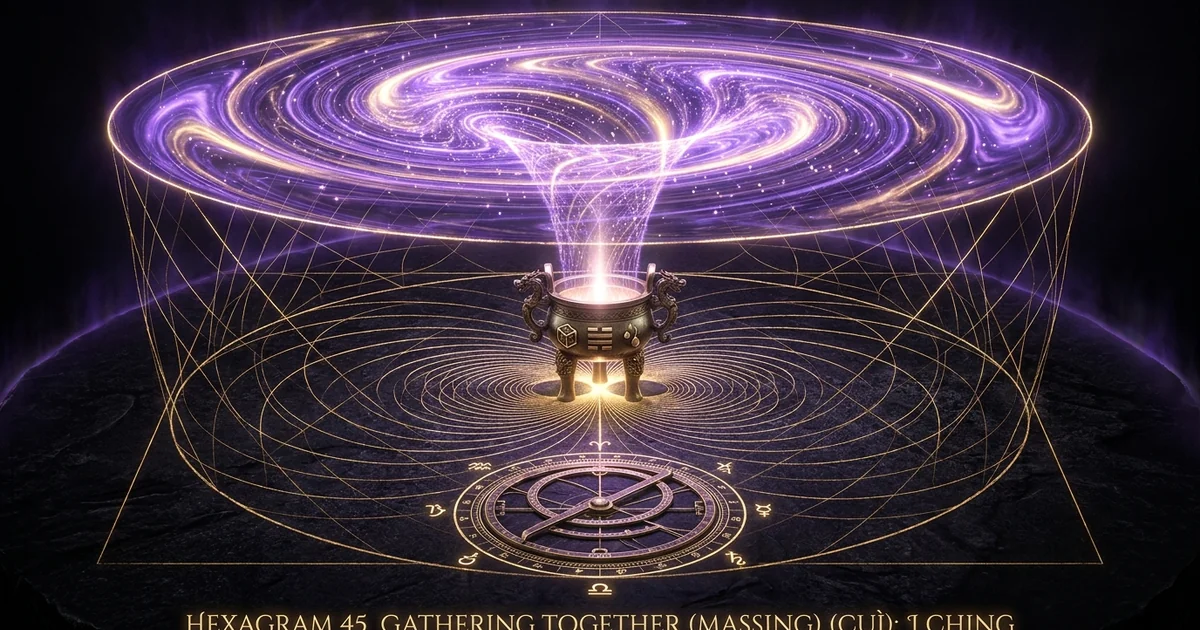
Hexagram 45 Gathering Together (Massing) (Cuì): I Ching
Archetypal Thesis & Systemic Paradigm: The Mechanics of Cohesion
Hexagram 45 (Cuì, 澤地萃) delineates the non-equilibrium thermodynamic and psychodynamic conditions under which disparate entities undergo spontaneous phase-transitions into unified collective structures. Operating through the structural vector of Lake (Duì) perched dynamically over Earth (Kūn), the hexagram models how psychic libido and social coherence require a dedicated vertical axis of sacralization to prevent systemic entropy, transforming raw demographic mass into an integrated, self-regulating macro-organism. Within the taxonomy of the Book of Changes divination, Cuì does not merely signify casual assembly or accidental aggregate; it designates the precise metaphysical coordinates wherein gravity, desire, and mutual utility draw atomic units across an energetic threshold into high-density systemic coherence.
Phase-Transitions in Psycho-Cosmological Fields
The mechanics of cohesion operating within the cuì hexagram can be formulated as an archetypal attractor basin. In both field physics and analytical psychology, unintegrated elements inhabit a high-entropy state characterized by brownian movement, uncoordinated trajectory, and latent friction. The transition from dispersion to aggregation demands an organizing field of sufficient intensity to overcome individual inertia. In the psychological sphere, as investigated in archetypal psychology, this corresponds to the sudden constellation of the collective unconscious, wherein autonomous complexes or disparate socio-cultural groups polarize around a common central archetype. The hexagram 45 gathering together (massing) iching meaning hinges upon this moment of condensation: the raw psychic material ceases to drift across the vast horizontal substrate of the receptive earth and instead collects within a defined basin, creating localized density.
This condensation alters the operational rules of the field. Once an assembly achieves critical mass, its dynamic behavior is no longer reducible to the linear summation of its parts. Instead, non-linear feedback loops emerge. If the phase-transition is unanchored, the resulting aggregation becomes hyper-reactive, manifesting the turbulent and undifferentiated emotionality typical of crowd psychology. The hexagram formalizes this exact threshold: massing induces systemic pressure, which must be metabolized through established structural conduits lest the containment fail, transforming a generative reservoir into a catastrophic flash flood.
The Mandate of the Axis Mundi: Temple and Gathering
To stabilize this non-linear condensation, the Judgment of Cuì establishes an absolute institutional and metaphysical prerequisite: “The King approaches his ancestral temple” (王假有廟). The ancestral temple serves as the primordial axis-mundi, a vertical vector that anchors the horizontal convergence of the masses. In classical Chinese cosmology, the ancestral temple is not merely a physical structure of timber and stone; it is the spiritual nexus where the ancestral lineages (gui-shen) intersect with the contemporary political mandate, submitting the transient passions of the biological collective to transcendent ancestral continuity.
Without this vertical grounding, the collective lacks a stabilizing teleology. When individuals aggregate solely through mutual appetite, anxiety, or geographical proximity, the gathering rapidly falls prey to psychic contagion. The King—representing the ego-consciousness operating in service to the Self—must approach the sacred precinct before attempting to govern the assembled mass. The temple acts as a psychic condenser, transmuting the raw, instinctual libido of the crowd into structured cultural and ethical order. The gathering is thus consecrated: the secular multitude is elevated into a unified body politic, harmonized under cosmic law rather than personal whim or coercive tyranny.
Entropic Dissolution versus Sacred Condensation
The fundamental polarity governing Cuì is the perpetual tension between entropic dissolution and sacred condensation. When social or psychic structures expand without a corresponding intensification of their spiritual core, systemic decoherence accelerates. High-density aggregations, when untethered from moral and transcendental anchors, generate immense friction, manifesting as sectarian violence, ideological fanaticism, or collective shadow projections.
The Book of Changes warns that massing is inherently volatile. The concentration of emotional and physical density produces an energetic surplus that, if left unchanneled, destabilizes existing boundaries. Hence, the gathering must be accompanied by the “great sacrifice” (用大牲吉) and the presence of the “great man” (利見大人). The sacrificial expenditure purges the collective of selfish clinging, while the archetype of sovereign wisdom provides the cognitive architecture necessary to sustain coherence. Through these instruments, Cuì averts the entropic fate of sociological collapse, crystallizing human raw material into enduring civilizational forms.
“The mass crushes out the insight and reflection that are still possible with the individual, and this necessarily brings about a tyrannical—or rather an infantile—state of society, which is characterized by unreason and complete lack of balance. … If the individual is not anchored in God, he can offer no resistance on his own resources to the physical and moral blandishments of the world. For this he needs the evidence of inner, transcendent experience which alone can protect him from otherwise inevitable submersion in the mass.” — C.G. Jung, The Undiscovered Self (Collected Works, Vol. 10, paras. 511–513)
Classical Provenance & Textual Lineage: From Zhou Sacrificial Rites to Neo-Confucian Metaphysics
The historical stratum of Hexagram 45 is deeply intertwined with the early Western Zhou dynasty’s sociopolitical architecture, specifically the sacrificial covenants (méng 盟) and ancestral oblations that forged a feudal confederation out of fractured clan groups. In the bronze inscriptions (jīnwén) and the received text of the Zhouyi, the character Cuì (萃) depicts dense vegetation, signifying a gathering, collection, or thick clustering of herbs, which subsequently evolved into the socio-political concept of congregating or assembling the multitudes.
The King Wen Judgment and the Great Sacrificial Ox
The Judgment attributed to King Wen establishes the classical formula for collective assembly:
萃:亨。王假有廟,利見大人,亨,利貞。用大牲吉,利有攸往。
Gathering: Success. The king approaches his temple. It furthers one to see the great man. This brings success. To persevere is furthering. To bring great sacrificial animals creates good fortune. It furthers one to undertake something.
The explicit prescription of the “great sacrificial ox” (dàshēng 大牲) situates the hexagram squarely within high-state liturgy. In early Zhou ritual protocol, an oblation consisting of a whole bovine animal represented the pinnacle of ceremonial dedication, reserved exclusively for Heaven and the supreme royal ancestors. The sacrifice served a dual purpose: economically, it necessitated the aggregation and liquidation of considerable surplus wealth, signifying communal investment in the metaphysical order; psychologically, the shared sacrificial feast bound the diverse regional lords (zhūhóu) into a sacred covenant sealed by shared consumption and sworn oaths before the spirits.
The phrase lì jiàn dà rén (“It furthers one to see the great man”) emphasizes the functional necessity of central administrative leadership. A gathering devoid of an authentic focal point degenerates into factional intrigue. The “great man” serves as the structural pillar whose personal virtue (dé 德) radiates sufficiently to induce spontaneous alignment throughout the social matrix, rendering external coercion redundant.
“The Commentary on the Decision (Tuan Zhuan) states: ‘Cuì means gathering. Devotion through joyfulness; the firm is central and responded to; hence they gather. The king approaches his ancestral temple: through filial devotion he attains it. It furthers one to see the great man, and brings success: gathering what is correct. Using great sacrificial animals brings good fortune, it furthers one to undertake something: yielding to the movements of Heaven.’ The Great Symbolism (Da Xiang) states: ‘The lake rises above the earth: the image of Gathering Together. Thus the superior man renews his weapons in order to meet the unforeseen.’” — Richard Wilhelm and Cary F. Baynes, The I Ching or Book of Changes (1950)
The Duke of Zhou’s Line Trajectories: The Anatomy of Approach
The Duke of Zhou’s line verses anatomize the subjective and objective mechanics of an individual attempting to locate their place within an emerging collective. Rather than presenting a romanticized view of unity, the six lines detail the anxieties, misalignments, strategic compromises, and ethical hazards intrinsic to mass integration.
The sequence begins at the lowest stratum (Six at the beginning) with systemic disorientation: the pull of the collective generates confusion and emotional oscillation, where cries of alarm alternate with shared laughter. Six in the second line marks the emergence of authentic, uncoerced internal resonance—an attraction so genuine that even modest summer sacrifices (fú 孚) suffice to secure divine approval. By the third line, the individual experiences peripheral exclusion, standing outside the primary center of cohesion, necessitating proactive alignment with the governing powers to escape ignominy.
The upper trigram shifts the dynamic toward administrative execution. Nine in the fourth line occupies the precarious position of the chief minister who commands vast mass allegiances without occupying the formal throne, requiring pristine selflessness to avert suspicion. Nine in the fifth line manifests sovereign majesty, holding the throne with natural authority, though still tasked with cultivating trust among those not yet entirely assimilated. Finally, Six at the top represents the tragic pathology of total alienation: standing at the absolute periphery of an assembled mass, cut off from the vital center, it can only dissolve in tears and lamentation.
Wang Bi and Cheng Yi: Hermeneutics of Resonance and Hierarchical Order
Wang Bi (226–249 CE), the master of the Xuanxue (Neo-Daoist) hermeneutic, fundamentally reconstructed the understanding of Cuì by interpreting massing through the metaphysical doctrine of ganying (感應, mutual resonance and affective response). For Wang Bi, the congregation of entities is not a mechanical aggregation driven by external force, but an ontological inevitability driven by the central Fifth Line. The Nine in the Fifth position, possessing balance and firmness, embodies the ultimate stillness that effortlessly commands motion. Wang Bi argued that things do not gather because they are pushed together; they gather because they find in the sovereign node a resolution to their innate existential lack.
Centuries later, the Song dynasty Neo-Confucian patriarch Cheng Yi (1033–1107 CE) in his I-Chuan redirected the interpretation toward moral and structural governance. Cheng Yi maintained that human assembly is the natural state of the world, yet without rigid ethical standards and structured hierarchy, gathering inevitably descends into chaos. Cheng Yi focused heavily on the Da Xiang admonition: “The superior man renews his weapons in order to meet the unforeseen” (君子以除戎器,戒不虞). Cheng Yi observed that high-density aggregations inherently brew volatility, crime, and rebellion. Therefore, the true sage does not indulge in the sentimental optimism of mass unity; instead, recognizing the innate unpredictability of concentrated human desire, the sage maintains structural defense mechanisms and moral discipline precisely when the assembly reaches its peak joyfulness.
Structural Mechanics & Symbolic Geometry: Trigram Vector Analysis
The internal systemic coherence of Hexagram 45 is a direct consequence of its constituent trigrams and their dynamic spatial vectors. Composed of the upper trigram Duì (☱, Lake/Marsh) positioned directly above the lower trigram Kūn (☷, Earth), the structural geometry immediately communicates the accumulation of a fluid, volatile substance resting upon an expansive, receptive, and structural foundation.
Trigram Polarity: Lake (Duì) over Earth (Kūn)
The primary symbolic reading of the lake over earth dynamic describes water gathering in a depression, forming a reservoir. Kūn is the ultimate receptive field: yielding, dark, capacious, and unconditionally supportive. It represents the broad masses, the territorial soil, and the physiological matrix. Duì, conversely, represents joy, communicative exchange, breachable boundaries, and the sparkling surface of open water.
When the lake rests upon the earth, the moisture enriches the soil, and the soil contains the water, preventing it from dissipating into nothingness. However, this architectural arrangement carries an inherent thermodynamic tension. A lake that swells beyond its banks breaches its containment, transforming agricultural abundance into swampy ruin or catastrophic flooding. The structural vector is therefore one of continuous accumulation requiring precise capacitance. The joyfulness of Duì draws units inward through affinity and mutual delight, while the solidity of Kūn provides the physical space and endurance required to bear the immense weight of the collected volume.
Nuclear Topology: Mountain (Gèn) and Wind (Xùn) as Internal Dynamisms
Beneath the overt interactions of Lake and Earth lies the hidden dynamic architecture of the nuclear trigrams (hùguà 互卦). Lines 2, 3, and 4 form the lower nuclear trigram Gèn (☶, Mountain), while lines 3, 4, and 5 form the upper nuclear trigram Xùn (☴, Wind/Wood). Together, they constitute the underlying nuclear hexagram: Hexagram 53, Jiàn (漸, Gradual Development).
This nuclear configuration reveals the covert operational mechanics required to sustain Cuì:
- The Mountain within (Gèn): Situated at the base of the massing, the interior Mountain provides non-negotiable boundaries, stillness, and structural restraint. It represents the internal ethical stops that prevent the gathering from degenerating into a chaotic stampede. Without the internal firmness of Gèn, the external softness of the gathering collapses under its own gravitational weight.
- The Wind within (Xùn): Operating in the upper registers of the assembly, the interior Wind introduces gentle, subtle penetration and pervasive ideological alignment. Xùn disperses rigid dogmas, distributes resources evenly across the collective, and ensures that the mass remains flexible and responsive to directional leadership.
The presence of nuclear Hexagram 53 indicates that authentic massing cannot be artificially forced in a single abrupt stroke; it must evolve through gradual, methodical phases—like the ceremonial approach of a bride or the flight of wild geese—if the structural integrity of the social or psychic matrix is to remain uncompromised.
The Dyadic Rulership: Structural Tension between Nine in the Fourth and Nine in the Fifth
The operational engine of Hexagram 45 is defined by its two yang lines: Nine in the fourth place and Nine in the fifth place. All other lines are yin, creating an intensely polarized field where four receptive lines gravitate toward two concentrated centers of masculine, organizing potency.
The relationship between these two yang lines generates a classical constitutional tension:
- Nine in the Fourth Line: This is the executive minister, positioned directly atop the lower trigram of the masses (Kūn). Because of its immediate proximity to the earth-masses, the fourth line acts as a magnet for communal loyalty. It is charismatic, operational, and accessible. However, because it occupies a yin position, it lacks intrinsic cosmic legitimacy. If it utilizes this accumulated mass for self-aggrandizement, it commits treason against the whole. It can remain blameless only through radical self-effacement, routing all incoming power directly to the sovereign above.
- Nine in the Fifth Line: This is the authentic sovereign ruler, occupying the central, correct yang position within the upper trigram of Duì. The fifth line holds the divine mandate, embodying the spiritual and structural center of gravity. Yet, precisely because of its exalted position, it is vulnerable to isolation. It relies upon the fourth line to mediate between the high palace and the distant soil.
The stability of Hexagram 45 depends entirely upon the alignment of this dyadic axis: the fourth line must manage logistics without usurping authority, while the fifth line must inspire devotion without succumbing to paranoid autocracy.
Psychological Dynamics & Operational Praxis: Individuation in the Midst of the Collective
In archetypal and depth psychological praxis, Hexagram 45 describes that specific phase of psychological integration where the individual ego confronts the immense, overwhelming power of collective dynamics—both in the outer social arena and in the interior depths of the collective unconscious. The central hazard of this state is psychological inflation, wherein the ego mistakes the boundless energy of the constellated archetype for its own personal power.
Hexagram 45: Gathering Together (Cuì)
- Trigram Composition: Lake (Duì) over Earth (Kūn).
- Structural Vector: Condensation, dynamic aggregation, and resource accumulation within a bounded basin.
- Architectural Mechanics: High institutionalization, formal ancestral covenants, complex logistical and hierarchical frameworks.
- Inherent Vulnerability: Volatility, crowd psychosis, flash-flooding, entropic decay, systemic shadow emergence.
- Core Archetype: The Ancestral Temple; the King marshaling civilizational infrastructure.
Hexagram 8: Holding Together (Bǐ)
- Trigram Composition: Water (Kǎn) over Earth (Kūn).
- Structural Vector: Fluid seepage, organic alignment, natural flowing together toward a center.
- Architectural Mechanics: Informal, spontaneous, primordial relational bonding rooted in mutual necessity.
- Inherent Vulnerability: Hesitation, tardiness, relational ambiguity, missed windows of spontaneous alliance.
- Core Archetype: The Primordial Chieftain; the watering hole in the desert.
Navigating Herd Consciousness and the Mana Personality
When Cuì is constellated in an individual’s psychological field, the ego experiences the intense gravitational pull of herd consciousness. The unconscious compensates for psychological isolation by generating massive surges of collective libido, drawing the individual toward movements, tribes, mass ideologies, or charismatic figures. Within this charged atmosphere, the archetype of the mana personality inevitably arises. The mana personality—whether embodied in an external guru, a political demagogue, or an internal inflated ego-image—claims sovereignty over the gathered libido.
To navigate this danger without succumbing to psychic dissociation, the individual must activate the ritual container of the ancestral temple. In analytical terms, this requires disidentifying from the collective currents and projecting the organizing center onto the Self—the authentic transcendent center of the psyche. The ego must approach this interior temple with absolute humility, recognizing that the accumulated riches, insights, and emotional currents do not belong to the conscious personality, but are transpersonal energies held in trust for the greater psychic ecosystem.
Line-by-Line Divinatory Hermeneutics: The Ascent from Distress to Lamentation
When consulting the cuì hexagram in the Book of Changes divination, the shifting lines trace the exact evolutionary stage of the subject’s relationship to the collective matrix:
- Six at the Beginning (初六): “If you are sincere, but not to the end, there is sometimes gathering, sometimes scattering. If you cry out, then after one grasp of the hand you can laugh again. Do not grieve. Going forward is without blame.”
The subject stands at the threshold of the field. The pull of the mass induces ambivalence and panic. The ego swings wildly between wanting to join and wanting to flee. The text advises that instinctual calls for help will be answered; initial emotional turbulence will resolve into joy if the individual moves forward through the initial social anxiety. - Six in the Second Line (六二): “Letting oneself be drawn brings good fortune and remains blameless. If one is sincere, it furthers one to bring even a small offering.”
Here, the attraction is governed by authentic ganying-resonance. There is no need for manipulative social posturing or elaborate displays of status. The connection to the central organizing power is so pure and grounded that even the simplest, most austere token of commitment (fú 孚) establishes durable alliance. - Six in the Third Line (六三): “Gathering together amid sighs. Nothing that would further. Going is without blame; only slight humiliation.”
The subject feels fundamentally excluded from the inner circle of the assembly. There is profound sadness and isolation while watching others celebrate. The oracle counsels that staying passive in this state yields nothing; one must swallow one’s pride, endure the mild humiliation of being a newcomer or outsider, and proactively seek alignment with those who possess agency. - Nine in the Fourth Line (九四): “Great good fortune. No blame.”
The position of maximum executive impact. The subject holds enormous administrative influence, acting as the primary hub for human and financial capital. This is an inherently dangerous post, fraught with envy and systemic exposure. The oracle gives a cryptic and demanding judgment: only through absolute selflessness and uncompromising structural competence can the leader avoid devastating blunders. - Nine in the Fifth Line (九五): “If in gathering together one has position, this brings no blame. If there are some who are not yet sincerely in the fold, sublime and enduring perseverance is needed. Then remorse disappears.”
The subject occupies the formal throne of power. Prestige and position are undeniable, yet true moral authority (dé) is not yet universal; factions remain suspicious. The sovereign must not resort to authoritarian force to compel obedience; rather, by demonstrating consistent, unwavering integrity over time, systemic trust will organically take root. - Six at the Top (上六): “Lamenting and sighing, floods of tears. No blame.”
The tragic periphery. The individual is stranded at the outermost boundary of the gathering, unable to connect with the joyous center, feeling misunderstood, abandoned, or obsolete amidst collective celebration. The expression of grief is cathartic and correct; recognizing that this particular social or psychological container has reached its structural limit allows the ego to grieve without self-recrimination.
Operational Protocol: Ritual Action and Strategic Alliances
In practical application, encountering Hexagram 45 demands clear diagnostics regarding resource logistics and structural boundaries. The practitioner must discern their precise functional location within the matrix: Are they the attractor node (Nine in the Fifth), the logistical coordinator (Nine in the Fourth), the searching participant (Six in the Second/Third), or the alienated spectator (Six at the Top)?
Operationally, Cuì commands three strategic actions:
- Consolidation of Assets: Disperse no more energy outward; aggregate liquid capital, psychic attention, and operational talent into a centralized reserve.
- Re-consecration of Purpose: Revisit the founding charter, mission statement, or ancestral mythos (the ancestral temple) to ensure the gathering has a teleological justification beyond mere survival.
- Defensive Preparation: In direct obedience to the Da Xiang, inspect and repair structural safeguards (“renewing weapons”). Anticipate the inevitable frictions of human proximity by establishing dispute-resolution protocols and security boundaries long before internal tensions reach boiling point.
Philosophical Synthesis & Macrocosmic Correspondence: Hermetic, Cybernetic, and Genetic Parallels
The systemic principles encoded within Hexagram 45 transcend traditional divination, mirroring fundamental patterns found in non-equilibrium thermodynamics, complex adaptive systems, and biological information networks.
Dissipative Structures and Complex Adaptive Systems
Viewed through the lens of Ilya Prigogine’s Nobel Prize-winning formulation of dissipative structures, Hexagram 45 represents the sudden self-organization of open systems operating far from thermodynamic equilibrium. In classical physics, closed systems relentlessly degrade toward maximal entropy, chaos, and inert uniformity. However, open systems can reverse this trend locally by exchanging energy and matter with their environment.
A lake resting upon the earth is a quintessential dissipative system. It maintains its structural boundary and internal complexity only through the continuous throughput of meteorological cycles—evaporation, atmospheric drift, condensation, and subterranean drainage. Cuì models precisely how a collective organism maintains an island of low internal entropy (civilization, cultural coherence, systemic order) by exporting entropy into its peripheral environment. The “sacrifice of the great ox” is the energetic expenditure required to sustain this far-from-equilibrium state. If the throughput stops, the lake evaporates or stagnates; if the influx exceeds capacitance, the system shatters.
Human Design Gate 45: The Gatherer in the Throat Center
In the synthesis of Human Design, which incorporates the hexagram architecture of the Book of Changes into a biological matrix, Gate 45 occupies a uniquely dominant role. Designated as the Gate 45 Gatherer, it is positioned directly within the throat-center—the center of physical manifestation, voice, and administrative action.
- Center: Throat Center (Metamorphosis, Expression, Manifestation).
- Circuit: Tribal Ego Circuit (Material Survival, Resource Allocation, Communal Preservation).
- Channel: Channel 21–45, The Channel of Money (A Line of Transmission between the Heart/Ego and the Throat).
- Biological Correspondence: Thyroid / Parathyroid glands (hormonal regulation of metabolic rate and mineral homeostases).
- Archetypal Voice: “I Have” or “I Have Not.”
- Genetic Mapping: Codon group for amino acid synthesis (specifically associated with the termination/control codons and Valine/Isoleucine codon groups).
Gate 45 functions as the singular communal voice of the tribal-circuit. While Gate 21 (The Hunter/Biting Through) acts as the operational manager, controlling the field and gathering the actual resources, Gate 45 sits on the throne as the King or Queen of the material realm. Its archetypal phrase is unapologetically possessive: “I have” or “I do not have.” Gate 45 determines who belongs to the tribe, how resources are partitioned, and what portion of the communal wealth must be held in the common storehouse to ensure survival through economic winters. It represents the Throat expressing material authority on behalf of the gathered clan.
Codon Architecture: The Genetic Mapping of Collective Assembly
At the molecular scale, the structural logic of Cuì maps directly to the mechanisms of cellular aggregation and transcription termination. Just as social masses require clear operational protocols to coalesce into institutions without chaotic proliferation, genetic translation requires rigorous regulatory codons to determine where complex peptide chains assemble and terminate. The association of Hexagram 45 with the biochemical translation apparatus underscores its archetypal function: it is the master switch that aggregates individual amino acids into durable biological polymers, transforming simple molecular debris into living, self-maintaining physiological form.
Hermetically, this mirrors the classical alchemical operation of Coagula. Following the expansive, dissolving phase of Solve—wherein structures are broken down into their primordial, undifferentiated prima materia—the Coagula operation demands the dynamic condensation of this purified fluid into fixed, immortal form. The Lake over Earth is the alchemical vessel par excellence: the spirit (Duì, volatile, gaseous water) condensed and safely contained upon the fixed salt of the earth (Kūn), achieving an indissoluble physical crystallite of divine order.
Frequently Asked Questions
Hermeneutic Disambiguation: Hexagram 45 vs. Hexagram 8
A persistent challenge in classical Book of Changes divination is distinguishing Hexagram 45 (Cuì, Gathering Together) from Hexagram 8 (Bǐ, Holding Together). While both hexagrams deal with communal alignment, their underlying mechanics, evolutionary strata, and systemic dangers are fundamentally distinct.
Hexagram 8 features Water (Kǎn) over Earth (Kūn). Water flows naturally across the surface of the earth, seeping into every crevice without resistance. Bǐ therefore describes an organic, primordial, and unforced alignment, characterized by psychological intimacy, kinship bonds, and the instinctive gathering around a watering hole. Its dynamic is immediate and pre-institutional.
Hexagram 45, conversely, features Lake (Duì) over Earth (Kūn). A lake is an artificial or natural basin that holds standing water, demanding distinct geological banks and dikes. Cuì therefore represents formal, institutional, civilizational massing. It deals with large-scale sociopolitical systems, complex resource logistics, religious covenants, and defensive fortifications. While the primary hazard of Hexagram 8 is tardiness or lack of organic devotion, the primary hazard of Hexagram 45 is crowd hysteria, administrative overextension, and the violent breach of containment.
The Meaning of the Sacrificial Ox in Modern Contexts
In antiquity, the sacrifice of an ox (dàshēng) was a massive economic expenditure that depleted the clan’s draft power and immediate wealth to honor the ancestors. In contemporary operational contexts—whether personal, corporate, or spiritual—this symbol must not be interpreted as an encouragement toward superstitious asceticism or literal bloodletting.
The great sacrificial ox represents the willing, conscious surrender of accumulated systemic surplus to secure transcendent integrity. When a corporation or creative project experiences rapid massing (explosive scaling of users, capital, or attention), the leadership is tempted to hoard this windfall for egoic expansion. The oracle warns that this path guarantees catastrophic corruption. The “sacrifice” represents dedicating significant capital, time, and emotional prestige to non-utilitarian, core foundational principles: establishing employee well-being, funding independent structural audits, investing in high-integrity research, or giving back to the civilizational commons that made the massing possible. It is the ritual payment made to the transpersonal matrix to keep the collective honest.
Interpreting the Top Line: Tears and Sighs (Six at the Top)
Six at the top of Hexagram 45 frequently alarms practitioners due to its intensely mournful imagery: “Lamenting and sighing, floods of tears. No blame.” To interpret this correctly, one must analyze its structural placement within the symbolic geometry of Duì (Lake).
Six at the top occupies the absolute apex of the Lake trigram. It represents the very crest of the wave, the uppermost spray that has flown out of the reservoir entirely. In this position, the individual is utterly disconnected from the central life-giving nourishment of Nine in the Fifth and the solid earth of Kūn. They find themselves at an extravagant banquet where they cannot eat, or trapped in an ecstatic crowd with which they share zero psychological affinity.
The judgment “no blame” (wújiù 无咎) is profoundly compassionate. It informs the querent that their melancholy is not a personal failure, a neurotic pathology, or a moral flaw. Rather, it is the mathematically inevitable consequence of their structural position. They have reached the absolute terminus of this particular collective paradigm. The tears are therapeutic: they acknowledge that the individual must look away from the gathered mass and seek their own private, uncrowded path toward individuation.