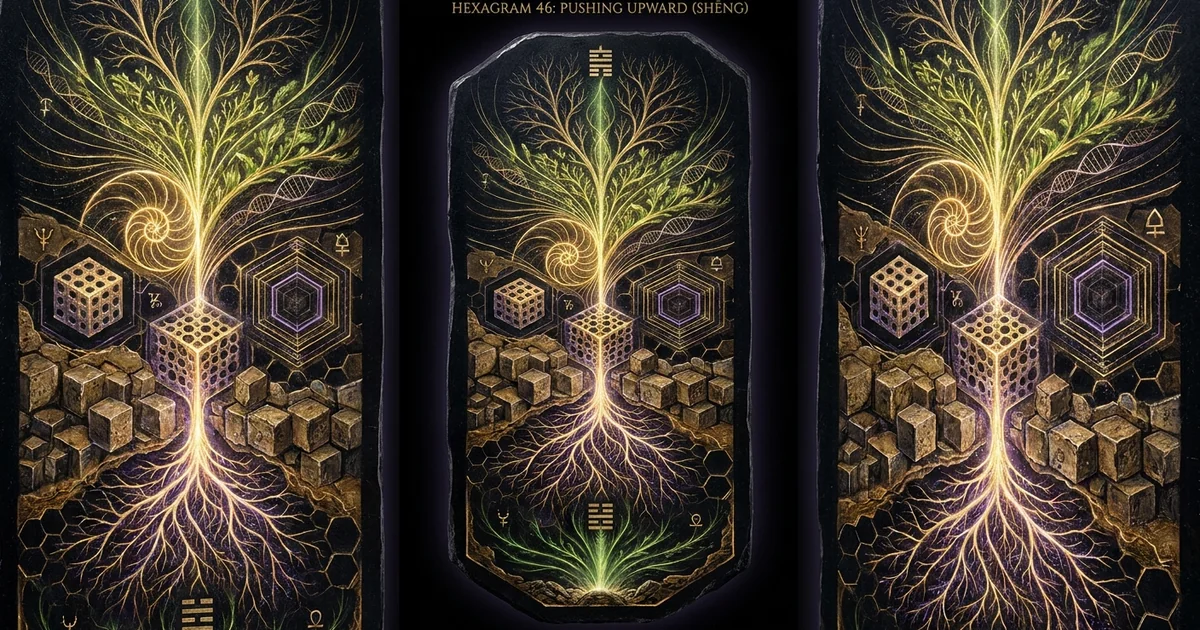
Hexagram 46 Pushing Upward (Shēng): I Ching Divination
Archetypal Thesis & Systemic Paradigm: The Mechanics of Organic Ascent
Hexagram 46 (Shēng / 升) formalizes the thermodynamic and psychological principle of organic negentropy: the inexorable, subterranean conversion of low-potential psychic energy into structured macrocosmic manifestation. In the architecture of the Zhouyi, Shēng embodies an evolutionary vector wherein ascending force circumvents systemic resistance not through kinetic rupture, but through micro-incremental alignment with receptive maternal matrix dynamics. Where revolutionary or disruptive archetypes smash against systemic constraints, the shēng hexagram delineates an evolutionary trajectory defined by botanical inevitability. It is the bio-energetic movement of a seed germinating within absolute darkness, cleaving soil particles through turgor pressure rather than violent displacement, transmuting mineral opacity into vertical architecture.
Hexagram 46: Pushing Upward (Shēng)
        ☷ Kūn (Earth)
        ☴ Xùn (Wind / Wood)
Subterranean Dynamics of Xùn beneath Kūn
The structural geometry of Hexagram 46 situates the lower trigram, trigram-xun (Wind/Wood, ☴), directly beneath the upper trigram, trigram-kun (Earth, Receptivity, ☷). This spatial configuration establishes an energetic dialectic between penetrative persistence and yielding capacity. Xùn represents the root system: flexible, directional, humble, yet possessing the cellular machinery to exploit the faintest fissures within the earth. Kūn signifies the dense, nourishing substrate—a mass of high inertia, unconditional receptivity, and heavy downward gravitational pull. Rather than suffocating the nascent vegetative impulse of Xùn, Kūn acts as the primary medium of transmission, offering structural guidance and biochemical sustenance to the ascending vector.
Within this subterranean ecology, the hexagram 46 pushing upward iching meaning diverges sharply from simplistic notions of vertical mobility or raw ambition. The upward push does not occur in an atmospheric vacuum; it occurs within the high-friction, unyielding reality of the material domain. The ascendancy of wood beneath earth is silent and imperceptible to superficial observational frameworks. It is an underground process that refuses to announce its teleology until its shoot has breached the surface interface. Thus, the archetype governs the initial, invisible phases of structural consolidation—the phase of biological development wherein a system builds its somatic infrastructure long before it yields foliage or fruit.
Negentropy and Incremental Accumulation in Systemic Evolution
From the perspective of open-system cybernetics, Hexagram 46 illustrates the process of thermodynamic negentropy—the importation and systematic organization of free energy within an open systemic structure to counteract systemic degradation. Whereas entropy drives complex structures toward dispersion and undifferentiated equilibrium, Shēng consolidates energy into increasingly coherent, complex geometries. This dynamic operates on an economy of micro-increments. Just as the cambium layer of an oak tree expands by imperceptible micrometers through daily mitotic divisions, so too does the psychic or operational matrix of Shēng advance through microscopic, persistent iterations.
This dynamic of compounding self-organization stands in marked contrast to the solar mechanics observed in /iching/hexagram-35-jin-progress-meaning (Jìn / Progress). In Hexagram 35, the Fire trigram (Lí) rises directly above Earth (Kūn), illuminating the landscape in an overt, dramatic display of royal recognition, rapid advancement, and expansive daytime visibility. Jìn is the triumphant march of a feudatory lord rewarded with herds of horses under the midday sun. In stark opposition, Shēng is the clandestine accumulation of mass within the shadow of the soil. It is evolutionary rather than revolutionary, vegetative rather than solar, metabolic rather than charismatic. The progress of Hexagram 46 relies on the relentless accumulation of small, nearly imperceptible actions that preserve energetic equilibrium during structural phase shifts.
The Anti-Catastrophic Architecture of Shēng
The systemic brilliance of Hexagram 46 lies in its anti-catastrophic mechanics. Catastrophic systems theory demonstrates that when energetic tension builds against a rigid boundary without sufficient pathways for gradual dissipation or integration, the resultant release manifests as a catastrophic bifurcation—a violent snap, fracture, or systemic collapse. Shēng circumvents this structural crisis through systemic softness (róu / 柔). Because the internal vector (Xùn) is inherently adaptable and yields to every unyielding stone it encounters in the dark, it never generates the direct counter-pressure that triggers defensive resistance from the systemic environment (Kūn).
Carl Gustav Jung, writing in Synchronicity: An Acausal Connecting Principle (1952), together with Marie-Louise von Franz in On Divination and Synchronicity (1980), demonstrated that archetypal configurations like Hexagram 46 delineate states where psychic and physical domains synchronize along evolutionary vectors without mechanistic causal propulsion. Individuation is rarely a series of egoic victories; it is more often an unconscious, botanical accumulation of archetypal mass. The ego does not conquer the unconscious; rather, the underlying psychoid matrix permits the ego to push upward into higher fields of awareness, provided the ego surrenders its demand for immediate, disruptive gratification and harmonizes with the latent energetic field.
Psychologically, this dynamic necessitates the total dismantling of willful ego assertion. The ego usually approaches advancement through conquest, dynamic competition, and acute friction with external boundaries. Shēng demands an ontological shift toward synchronistic yielding. It suggests that macrocosmic elevation is not extracted from the world through brute force, but is granted by the environment when the subject’s internal vitality precisely complements the environmental matrix. Ascent within Hexagram 46 is not an act of aggressive colonization; it is an act of vegetative integration, where the climbing entity becomes an indispensable organ of the very ecosystem it ascends.
Classical Provenance & Textual Lineage: From the Zhouyi to the Ten Wings
The textual apparatus of the Zhouyi frames Hexagram 46 as an auspicious omen of high developmental continuity, yet its classical judgments anchor this fortune to strict structural conditions: moral rectitude, deliberate orientation toward south-directed clarity, and reverence for institutional hierarchies.
Judgment (Guà Cí): 升:元亨,用見大人,勿恤,南征吉。 Shēng: Supreme success. One must see the great person. Have no fear. Departure toward the south brings good fortune.
Commentary on the Great Image (Dà Xiàng): 地中生木,升;君子以順德,積小以高大。 Wood growing within the earth: the image of Pushing Upward. Thus the noble person, yielding in virtue, accumulates the small in order to achieve the high and great. — Wang Bi (trans. Richard John Lynn, 1994); Richard Wilhelm and Cary F. Baynes (1950).
The King Wen Sequence: Relational Inversion with Hexagram 45 (Cuì)
Within the structural framework of the king-wen-sequence, Hexagram 46 forms an inseparable, inverse pair with /iching/hexagram-45-cui-gathering-meaning (Cuì / Gathering Together). Hexagram 45 positions Lake (Duì) over Earth (Kūn), presenting an energetic topography of water accumulating in a low-lying reservoir on the earth’s surface—a sociopolitical archetype of collective assembly, ritual condensation, and mass centralization around an ancestral shrine. When the spatial framework of Hexagram 45 is inverted via axial rotation, it transforms directly into Hexagram 46: Earth over Wind/Wood.
Hexagram 45 (Cuì)                   Hexagram 46 (Shēng)
Lake (Duì)    ☱                     Earth (Kūn)   ☷
Earth (Kūn)   ☷   ====[ Inversion ]===>  Wind (Xùn)    ☴
This structural pairing reveals an immutable systemic law: collective social-ritual mass (Cuì) must find its compensatory balance in subterranean vertical growth (Shēng). Hexagram 45 concentrates energy, resources, and human populations into an integrated center; Hexagram 46 extracts that gathered energetic potential and directs it along an evolutionary, vertical trajectory. Cuì is horizontal consolidation; Shēng is vertical deployment. Without the horizontal accumulation of Cuì, the upward thrust of Shēng lacks the material reserves to sustain its climb; conversely, without the ascending, organizing momentum of Shēng, the gathered waters of Cuì stagnate into systemic corruption, swamp-like decay, and political factionalism.
The Dà Xiàng Commentary: Moral Accumulation via Small Deeds
The Dà Xiàng (Commentary on the Great Image) grounds the cosmological mechanics of Hexagram 46 within a rigorous ethical ontology: “Thus the noble person, yielding in virtue, accumulates the small in order to achieve the high and great” (jūn zǐ yǐ shùn dé, jī xiǎo yǐ gāo dà). The linguistic key lies in the phrase shùn dé (順德)—virtue characterized by yielding compliance and natural resonance—and jī xiǎo (積小)—the relentless, disciplined accumulation of the infinitesimally small.
This instruction directly rejects the heroic or messianic paradigm of history and psychological development. In classical Chinese thought, true virtue (Dé) is not a dramatic, episodic eruption of valor, but an iterative accumulation resembling the steady deposition of sedimentary strata. The Ten Wings continuously warn against the hubris of the premature leap. To attempt greatness without the exhaustive accumulation of small, unseen ethical disciplines is to invite the systemic collapse delineated in hexagrams of structural fault, such as Hexagram 28 (Dà Guò / Preponderance of the Great). The noble person achieves colossal height precisely because each incremental layer of growth is thoroughly settled, rooted, and integrated into the foundational reality before the next layer is deposited.
The Southern Vector in King Wen’s Spatial Geometry
The Judgment’s specific geopolitical and directional injunction—“Departure toward the south brings good fortune” (nán zhēng jí / 南征吉)—encodes spatial paradigms derived from Early and Later Heaven cosmologies. In the King Wen (Later Heaven) spatial arrangement, the South is governed by the trigram Lí (☲, Fire, Sun, Illumination, Consciousness). The North is governed by the trigram Kǎn (☵, Water, Abyss, Darkness, Peril).
Later Heaven (King Wen) Spatial Dynamic:
         [ South: Lí (Fire, Consciousness, Illumination) ]
                                ▲
                                │
                        Ascending Vector (Shēng)
                                │
         [ North: Kǎn (Water, Abyss, Latent Potentiality) ]
When the text directs the querent toward the South, it signals an emergence from the subterranean, unmanifest realm of the northern abyss into the explicit, clear illumination of the solar meridian. The germinal impulse that consolidated its structure in subterranean coldness must not remain perpetually hidden; it must have the courage to step onto the public stage of manifest consequence. Moving south signifies aligning one’s internal vegetative development with the sovereign light of objective consciousness. It indicates that the subterranean accumulation has progressed to the threshold where public appearance (yòng jiàn dà rén / “beneficial to see the great person”) is no longer a premature risk, but a necessary systemic evolution.
Structural Mechanics & Symbolic Geometry: Trigram Vectors and Nuclear States
To fully comprehend the structural mechanics of Hexagram 46 in book of changes divination, one must dissect its component trigrams, its nuclear core, and the evolutionary continuum traced across its six constituent lines (yáo).
Hexagram 46 (Shēng / Pushing Upward):
Line 6: ──  ──  Yin  [Summit of Blind Ambition]
Line 5: ──  ──  Yin  [Sovereign Calibration of Step-by-Step Ascent]
Line 4: ──  ──  Yin  [Sacrificial Consecration at Mount Qi]
Line 3: ──────  Yang [Ascent into the Unopposed Empty City]
Line 2: ──────  Yang [Inner Sincerity / The Small Summer Sacrifice]
Line 1: ──  ──  Yin  [Root-Level Concordance / Great Good Fortune]
Vector Analysis: Earth Over Wind (Kūn over Xùn)
The spatial arrangement of earth over wind presents a paradoxical energetic dynamic. In classical physics, heavier, denser matter occupies the lower space, while lighter, gaseous, or dynamic elements rise to the top. Hexagram 46 upends this static equilibrium by placing the heavy, inert Earth trigram above, and the dynamic, penetrative Wind/Wood trigram below.
This inversion creates a field of sustained evolutionary tension. If the upper trigram were Mountain (Gèn), the lower force would be blocked, resulting in Hexagram 53 (Jiàn / Gradual Progress). If the upper trigram were Heaven (Qián), the lower force would be crushed or engaged in hyper-friction, producing Hexagram 9 (Xiǎo Chù / Small Taming). But because the upper trigram is Kūn—the archetype of pure yielding openness—the earth does not present a rigid ceiling. Instead, it yields to the micro-penetrations of Xùn, making room for the root network to interlace its porous mass. The vector dynamic is not one of kinetic collision, but of fluid interpenetration. The wood expands effortlessly upward because the earth knows only how to accommodate, nurture, and embrace.
Nuclear Topology: The Latent Marrying Maiden (Hexagram 54)
Deep within the somatic core of every hexagram lies its nuclear-hexagram (hù guà / 互卦), formed by lines 2-3-4 (the lower nuclear trigram) and lines 3-4-5 (the upper nuclear trigram). For Hexagram 46, this internal core reveals a critical, often overlooked systemic tension:
- Lower Nuclear Trigram (Lines 2, 3, 4): ☱ Duì (Lake, The Joyous, The Youngest Daughter)
- Upper Nuclear Trigram (Lines 3, 4, 5): ☳ Zhèn (Thunder, The Arousing, The Eldest Son)
This combination produces Nuclear Hexagram 54: /iching/hexagram-54-gui-mei-marrying-maiden (Guī Mèi / The Marrying Maiden).
Nuclear Topology of Hexagram 46:
Lines 3, 4, 5: ☳ Zhèn (Thunder)  ┐
                                  ├─ Nuclear Hexagram 54: Guī Mèi (The Marrying Maiden)
Lines 2, 3, 4: ☱ Duì (Lake)       ┘
The presence of Guī Mèi inside Shēng introduces a serious diagnostic caveat. Hexagram 54 models a situation of high systemic vulnerability: an individual operating in a secondary, subordinate, or structurally compromised position who is governed by intense desire and emotional impulse, yet lacks official institutional authority. It warns that within the steady, noble ascent of Hexagram 46 lies a latent, volatile trap: the risk of inappropriate desire, premature initiative, or the temptation to bypass established cultural channels out of impatient ambition.
This nuclear geometry exposes the structural knife-edge upon which Shēng operates. While the outer face of Hexagram 46 is modest, yielding, and grounded (Xùn under Kūn), its inner heart harbors the fiery, impulsive desire for rapid elevation (Zhèn over Duì). If this internal impulse breaches the calm exterior and takes direct control of the personality, the steady ascent of Shēng collapses into the systemic entropic ruin of Guī Mèi—where actions bring only misfortune and nothing that furthers. The vegetative discipline of the root must rigorously constrain the impetuous demands of the nuclear maiden.
The Six Line Stratifications: Biomechanical Trajectory of the Ascent
The transition of the six lines traces the biomechanical trajectory of growth, mapping a complete developmental arc from subterranean anchorage to ultimate teleological exhaustion.
Initial Six: The Root Induction of Concordance
Text: 允升,大吉。 “Ascent that meets with confidence brings great good fortune.” The climb begins at the deepest subterranean level. The bottom yin line is yielding and receptive, perfectly placed at the base of the wood trigram. It does not initiate force; it responds to the systemic call of the upper levels. Because its ascent is welcomed by the environment (yǔn / 允 implies mutual trust, permission, and concord), its progress is wholly natural. There is zero structural resistance.
Nine at the Second: Subterranean Sincerity Over Formalism
Text: 孚乃利用禴,無咎。 “If one is sincere, it is furthered to make even a small offering. No blame.” This dynamic yang line resides in the central place of the lower trigram. It possesses abundant internal energy, yet it faces the massive resistance of the soil above. It does not force its way through extravagant displays or premature demands for social status. It relies instead on the yuè (禴)—a meager, modest summer sacrifice made of simple greens rather than lavish oxen. In the subterranean phase, inner authenticity and energetic sincerity (fú / 孚) matter far more than outer ceremonial displays.
Nine at the Third: Ascent into the Unopposed Void
Text: 升虛邑。 “Pushing upward into an empty city.” Here, the ascending yang force reaches the threshold of the lower trigram, preparing to enter the upper realm. It meets with an astonishing lack of opposition: the city gates are wide open, the streets empty. All conventional barriers dissolve. This represents a critical psychic and strategic trial: when systemic friction drops to zero, the ego risks falling into profound disorientation or self-aggrandizing hubris.
Six at the Fourth: Institutional Consecration
Text: 王用亨于岐山,吉,無咎。 “The king offers him sacrifice on Mount Qi. Good fortune. No blame.” Crossing the liminal threshold into the upper Earth trigram, the individual reaches the base of institutional power. Mount Qi was the historical, spiritual homeland of the Zhou dynasty. Here, the ascending entity is formally acknowledged, sanctified, and integrated into the overarching civilizational matrix. Personal ascent is consecrated as collective duty; the individual becomes an institutional pillar.
Six at the Fifth: Sovereign Step-by-Step Discipline
Text: 貞吉,升階。 “Perseverance brings good fortune. One ascends the steps.” Occupying the sovereign seat of the hexagram, this yielding line achieves maximum social and psychological elevation. Yet it avoids manic flight or imperial grandiosity. It ascends “the steps” (shēng jiē / 升階)—a measured, architectonic progression that takes one tread at a time. The position is stable precisely because it refuses to skip developmental grades.
Six at the Top: The Pathology of Blind Ambition
Text: 冥升,利于不息之貞。 “Ascending in darkness. It is furthuring to be relentlessly persevering in what is right.” The uppermost line represents the tragic exhaustion of the archetype. The climber reaches the peak of the mountain at midnight, yet the climbing instinct fails to disengage. It continues to push upward blindly, compulsively, into the cold void (míng shēng / 冥升). The only corrective is to redirect this blind energetic engine away from external expansion and toward an unrelenting moral perseverance (bù xī zhī zhēn), reversing outward ambition into inner preservation.
Psychological Dynamics & Operational Praxis: The Cybernetics of Divination
When Hexagram 46 emerges within the field of book of changes divination, it establishes an immediate cybernetic feedback loop between the inquirer’s ego-complex and the slow, inexorable movements of the collective unconscious. Divination here functions not as an oracle of external fate, but as a diagnostic readout of the querent’s energetic momentum within a complex social or psychological matrix.
Line 3: Nine at the Third
- Archetype: Ascent into the Unopposed Vacuum (Shēng Xū Yì).
- Kinetic Condition: Complete collapse of systemic resistance; barriers dissolve into open space.
- Psychological Risk: Paralyzing doubt, paranoia regarding hidden traps, or manic inflation.
- Operational Mandate: Move boldly into the clearance without projecting phantom enemies; occupy the structural vacuum through natural presence.
Line 6: Six at the Top
- Archetype: Ascent in the Void of Darkness (Míng Shēng).
- Kinetic Condition: Total dissipation of structural support; vertical trajectory pursued past functional limits.
- Psychological Risk: Workaholism, systemic burnout, climbing puer inflation, terminal blind ambition.
- Operational Mandate: Forceful cessation of outward climbing; ground the lingering momentum into radical inner rectitude.
Deconstructing the Void: Line 3 and the ‘Empty City’
The image of ascending into an “empty city” (xū yì / 虛邑) in Nine at the Third represents one of the most enigmatic psychological thresholds in the Zhouyi. Most human endeavors are calibrated entirely by the resistance they encounter. The ego defines its borders, its strength, and its value through friction with obstacles, critics, competitors, and systemic inertia. When an individual has spent years struggling against systemic constraints, their entire neural and behavioral architecture is wired for siege warfare.
When Nine at the Third manifests, that environmental friction drops instantaneously to zero. The walls are abandoned; the defenders have vanished; the promotion, the creative breakthrough, or the operational terrain is entirely uncontested. This sudden absence of resistance triggers a profound psychological crisis:
- Paranoid Projection: The individual suspects an ambush, assuming that an unopposed advance must be a trap set by hostile forces.
- Impostor Paralysis: Without an external adversary to define the ego’s capability, the individual experiences sudden vertigo, feeling utterly unworthy to occupy the spacious void.
- Manic Delusion: The ego mistakenly attributes the lack of resistance to its own transcendent omnipotence, sowing the seeds of its ultimate ruin.
The operational imperative of Line 3 is to advance without hesitation, yet without fanfare. One must occupy the empty city with the natural simplicity of water filling a basin. The absence of opposition is not a trick; it is an objective systemic vacuum created by historical cycles. The querent must step forward smoothly, refusing to project phantom enemies onto a landscape that has already yielded.
Line 6 and the Pathology of Dark Ambition
At the opposite developmental pole stands Six at the Top, which formalizes the terminal degeneration of the climbing archetype: “Ascending in the dark” (míng shēng / 冥升). This line models the psychology of uncontained, compulsive striving—the archetype of the climbing puer aeternus or the corporate titan who has lost the capacity to pause, savor, or integrate his conquests.
Pathology of Line 6 (Míng Shēng):
[ Compulsive Ascent ] ──> [ Loss of Horizon/Light ] ──> [ Dissipation in Void ]
                                ▲
                                │
               (Must Be Arrested and Inverted)
                                │
[ Relentless Inner Rectitude ] ─┴─ [ Grounding of Striving Drive ]
In the state of míng shēng, the act of climbing has become decoupled from its original teleology. The seed did not stop growing when it broke the surface of the soil, nor when it matured into a towering trunk; it seeks to climb past the upper canopy, upward into the vacuum of space where neither air nor water can sustain it. This is the realm of pathological workaholism, manic ego-inflation, and blind metabolic burn. The individual climbs in the dark because their internal illumination (the Southern vector of Lí) has been extinguished by the blind, mechanical momentum of the climbing engine.
The classical commentary notes that this dark ascent can only be salvaged if one applies this unceasing drive not to external advancement, but to relentless moral perseverance (bù xī zhī zhēn / 不息之貞). The querent must deliberately collapse their external trajectory, executing an energetic about-face. The vast energy previously squandered on blind socio-economic elevation must be redirected down into structural introspection, character consolidation, and radical grounding.
Consultative Methodology: Synchronistic Feedback and Ego-Surrender
In consultative practice, the appearance of Hexagram 46 demands a rigorous audit of the querent’s operational velocity. Modern subjects, conditioned by hyper-kinetic capitalism, routinely misinterpret Shēng as an unconditional green light for aggressive self-promotion, immediate expansion, and rapid scaling. This constitutes an egregious diagnostic error.
When Hexagram 46 is cast, the practitioner must orient the querent toward the cybernetic law of vegetative timing:
- Subterranean Consolidation Over Display: If lines 1 or 2 are active, the querent must suppress all premature marketing, public declarations, or political displays. The work must remain hidden in the soil.
- Identification of the Receptive Matrix: The querent must locate their personal “upper Earth” (Kūn)—the social institution, mentor, or collective environment that is genuinely receptive to their gifts. Pushing upward against an unyielding stone (such as a rigid, hostile bureaucracy or an incompatible partner) wastes structural energy and violates the fundamental premise of Xùn beneath Kūn.
- Structural Humility: The client must replace kinetic force with vegetative infiltration. Wherever an obstacle arises, they must circumvent it with the patient, non-violent adaptability of a creeping vine, trusting that incremental growth will eventually split the stone without a direct kinetic strike.
Philosophical Synthesis & Macrocosmic Correspondence: Hermetic Biology and Genetic Codes
Hexagram 46 operates as a macrocosmic fractal template, projecting its signature of quiet, negentropic verticality across alchemy, esoteric human anatomy, and the fundamental mechanics of molecular biology.
- Hexagram 46: 升 (Shēng / Pushing Upward)
- Trigram Composition: Earth (☷ Kūn) over Wind/Wood (☴ Xùn)
- Human Design Coordinate: Gate 46: The Gate of “Determination of the Self” / “Serendipity”
- BodyGraph Center: G-Center (Vessel of Love, Identity, and Direction)
- Qabalistic Pathway: Netzach (Victory / Vegetative Nature) to Yesod (Foundation / Vital Matrix)
- Genetic Codon Assignment: Codon Triplet translating to Glycine (The Smallest, Most Flexible Amino Acid)
The Alchemical Vegetative Soul: Solve et Coagula in the Soil
Within Western Hermetic philosophy, the cosmos is vitalized by three distinct levels of psychic architecture: the Mineral Soul, the Vegetative Soul (Anima Vegetativa), and the Rational Soul. Hexagram 46 is the preeminent Eastern representation of the Anima Vegetativa operating in its purest alchemical phase: coagulatio within the vessel of the Earth.
Alchemical Cycle of Shēng:
Subterranean Putrefaction (Nigredo) ──> Vegetative Germination ──> Solidification (Coagulatio)
             ▲                                                            │
             └────────────────────────────────────────────────────────────┘
Alchemy is governed by the axiomatic formula Solve et Coagula—dissolve and coagulate. Most seekers fixate upon solutio—the ecstatic, spiritual volatilization of fixed material forms into divine, ethereal light. Yet true alchemical transmutation is impossible without its symmetrical inverse: the fixation of the volatile, the embodiment of the divine spirit within dense, physical reality. This is precisely the drama of Hexagram 46.
The spirit (Xùn / Wind) does not escape into the stratosphere; it descends into the dark, putrefying, moisture-rich matrix of the earth (Kūn) and there begins the slow, arduous work of coagulatio. It draws raw, disordered minerals from the dark soil, using them to synthesize living cells, tissues, and cellular rings. It proves that the highest spiritual achievements are not attained through ecstatic escape from the body, but through the somatic incarnation of psychic vitality within mundane temporal structures.
Human Design Gate 46: The G-Center and Serendipity of the Flesh
In the cybernetic mapping of the Human Design System, Hexagram 46 corresponds to Gate 46, positioned within the G-Center—the internal compass that governs love, identity, and directional geometry. Designated as the gate of “Pushing Upward” and the “Determination of the Self,” Gate 46 is classically defined as the archetype of “Serendipity: Good Fortune That Results from Being in the Right Place at the Right Time.”
G-Center Architecture: The Vessel of Love
Gate 46: "Determination of the Self / Pushing Upward"
         (Somatic Integration / Love of the Body as a Living Temple)
                         ▲
                         │  Channel 29-46: Discovery
                         ▼
Gate 29: "The Abysmal / Saying Yes" (Sacral Center)
The profound esoteric insight of Gate 46 lies in its anchoring within the physical form. In Human Design lore, Gate 46 represents the Love of the Body as a sacred temple. Its vertical ascent is achieved not through strategic mental maneuvering, but through absolute, somatic surrender to the lived physical experience. The “serendipity” attributed to Gate 46 is neither coincidental nor magical; it is the natural consequence of moving through the world with zero mental resistance, allowing the organic intelligence of the vehicle to navigate the material plane.
When aligned with the Sacral Center via Gate 29 (Hexagram 29, The Abysmal / Kǎn, “Saying Yes”), Gate 46 forms the Channel of Discovery: “A Design of Succeeding Where Others Fail.” This channel reveals the bio-energetic truth of Hexagram 46: success is achieved through sustained commitment to a process without mental expectation of immediate reward. The person who embodies Gate 46 throws themselves fully into the cycle of physical experience, trusting that through total presence, the evolutionary vector will carry them effortlessly into the high places of manifest destiny.
Genetic Codon Mapping: Ribosomal Assembly and Translation Mechanics
At the molecular level, the 64 hexagrams mirror the 64 permutations of the genetic code (the four nitrogenous bases—Adenine, Cytosine, Guanine, and Uracil—arranged in triplet combinations). In this biological mapping, Hexagram 46 corresponds with striking precision to the mechanical dynamics of ribosomal protein synthesis: the step-by-step translation of messenger RNA (mRNA) into polypeptide chains.
Ribosomal Translation Dynamic of Hexagram 46:
[ mRNA Transcript: Directional Guidance ]
          │
          ▼
[ Ribosomal Subunit: Molecular Chassis ] ===> Transpeptidation Step by Step
          ▲                                    (No Skipping Codons / *Shēng Jiē*)
          │
[ Nascent Peptide Chain: Ascending Protein Architecture ]
During ribosomal translation, the molecular machinery does not produce an entire protein in a single, kinetic event. It moves along the mRNA transcript strictly in a unidirectional, frame-by-frame vector, precisely like the “ascending the steps” (shēng jiē) described in Line 5:
- Iterative Transfer: A transfer RNA (tRNA) molecule matching a specific codon binds to the ribosomal site, bringing with it a single amino acid.
- Peptide Bond Synthesis: The peptide chain is transferred to the new amino acid via a condensation reaction, extending the chain by a single molecular link.
- Translocation: The ribosome shifts exactly three nucleotides forward along the mRNA strip.
If the ribosome attempts to skip a single base or leap ahead by two codons instead of one, the entire reading frame undergoes a catastrophic frameshift mutation, yielding a nonsense protein that is rapidly targeted for enzymatic destruction. Hexagram 46 is the biological embodiment of this cellular discipline: true evolutionary translation occurs one codon, one peptide bond, one step at a time. The organism climbs into high biological complexity solely because it respects the absolute sanctity of the reading frame.
Frequently Asked Questions: Advanced Hexagram 46 Interpretations
Directional Symbolism: Decoupling the Geopolitical from the Energetic ‘South’
A common source of confusion in classical consulting involves the instruction: “Departure toward the south brings good fortune” (nán zhēng jí). Novice practitioners routinely interpret this literally, advising clients to pack their belongings, migrate to southern territories, or relocate their business operations along a physical southern axis.
While historical Zhou rulers did mount military and trade expeditions southward toward the Yangtze River basin, the deeper esoteric lineage of the Zhouyi treats direction as a psychic coordinate:
Directional Correspondence Matrix:
North (Kǎn / Water) ──> West (Duì / Metal) ──> East (Zhèn / Wood) ──> South (Lí / Fire)
   [ The Dark Abyss ]       [ Sunset/Harvest ]      [ Germination ]       [ Solar Meridian ]
   [ Latent Potential]      [ Material Gain ]       [ Nascent Action ]    [ Maximum Clarity ]
To journey toward the South is to turn one’s back on the cold, fearful inertia of the North (Kǎn), stepping boldly into the realm of Lí (Fire, Consciousness, Noon, Direct Visibility). It is an injunction to bring a hidden, subterranean project out of its private development phase and expose it to the solar test of the public forum. The South demands transparent communication, formal agreements, institutional accountability, and unyielding visibility. It advises the querent: Do not fear being seen; the time for subterranean secrecy has passed.
Diagnostic Divergence: Hexagram 46 (Shēng) vs. Hexagram 35 (Jìn) and Hexagram 53 (Jiàn)
The Book of Changes features three distinct archetypes of advancement and elevation: Hexagram 35 (Jìn / Progress), Hexagram 46 (Shēng / Pushing Upward), and Hexagram 53 (Jiàn / Development/Gradual Progress). Differentiating these three vectors is essential for accurate diagnostic and consultative precision.
The Triad of Upward Vectors:
┌─────────────────┬───────────────────────┬────────────────────────┬──────────────────────┐
│ Attribute       │ Hexagram 35: Jìn      │ Hexagram 46: Shēng     │ Hexagram 53: Jiàn    │
├─────────────────┼───────────────────────┼────────────────────────┼──────────────────────┤
│ Trigrams        │ Fire over Earth (☲/☷) │ Earth over Wind (☷/☴)  │ Wind over Mtn (☴/☶)  │
│ Primary Image   │ Sun rising over field │ Seed rooting in soil   │ Wild geese on crags  │
│ Kinetic Quality │ Solar, rapid, radiant │ Subterranean, organic  │ Ritual, institutional│
│ Driving Force   │ Royal patronage/fame  │ Metabolic negentropy   │ Ceremonial propriety │
│ Typical Shadow  │ Narcissistic hubris   │ Blind climbing (Line 6)│ Stifling conformism  │
└─────────────────┴───────────────────────┴────────────────────────┴──────────────────────┘
- Hexagram 35 (Jìn): The nature of the climb is horizontal and solar. It operates within an open, fully illuminated landscape. The feudal prince is recognized by the sovereign and bestowed with gifts. It represents rapid public promotion, overt charisma, and immediate outward success.
- Hexagram 46 (Shēng): The nature of the climb is strictly vertical, botanical, and subterranean. It operates through high friction and opacity. There is no royal fanfare, no radiant dawn. It is the arduous, quiet work of cellular division, root expansion, and silent, microscopic persistence.
- Hexagram 53 (Jiàn): The nature of the climb is ritual, sociological, and procedural. Illustrated by the flight of wild geese moving progressively across streams, crags, and plateaus, it models the ancient, slow ceremonial steps of the traditional marriage rites. It relies on meticulous adherence to traditional protocol, institutional decorum, and collective patience.
Mitigating Line 6: Reversing Blind Ascent Through Deliberate Inertia
When consulting Hexagram 46, obtaining a moving Sixth Line presents a direct systemic warning: the querent has crossed the threshold where persistent striving transitions from an evolutionary virtue into an engine of self-destruction. The energy of Shēng has curdled into míng shēng—the blind, nocturnal ascent of an ego that cannot stop climbing even when the atmosphere has grown so thin it can no longer support life.
To remediate this condition, the practitioner must counsel the immediate implementation of deliberate, ritualized inertia. The client must systematically dismantle their operational expansion:
- Imposition of Artificial Constraints: The querent must explicitly refuse new projects, promotions, or scaling initiatives, even if those opportunities appear highly lucrative or culturally prestigious.
- Transmutation from Space to Depth: The kinetic upward vector must be forced 180 degrees downward. The client must replace external climbing with internal descent: psychological shadow integration, somatic healing, physical rest, and contemplative grounding.
- The Discipline of Constant Halting: The individual must cultivate the spirit of Hexagram 52 (Gèn / Keeping Still, Mountain), recognizing that without the resting pause of Gèn, the endless climbing of Shēng precipitates catastrophic failure. True mastery consists not in pushing upward forever, but in knowing precisely when the summit has been crossed—and possessing the inner stillness to cease.