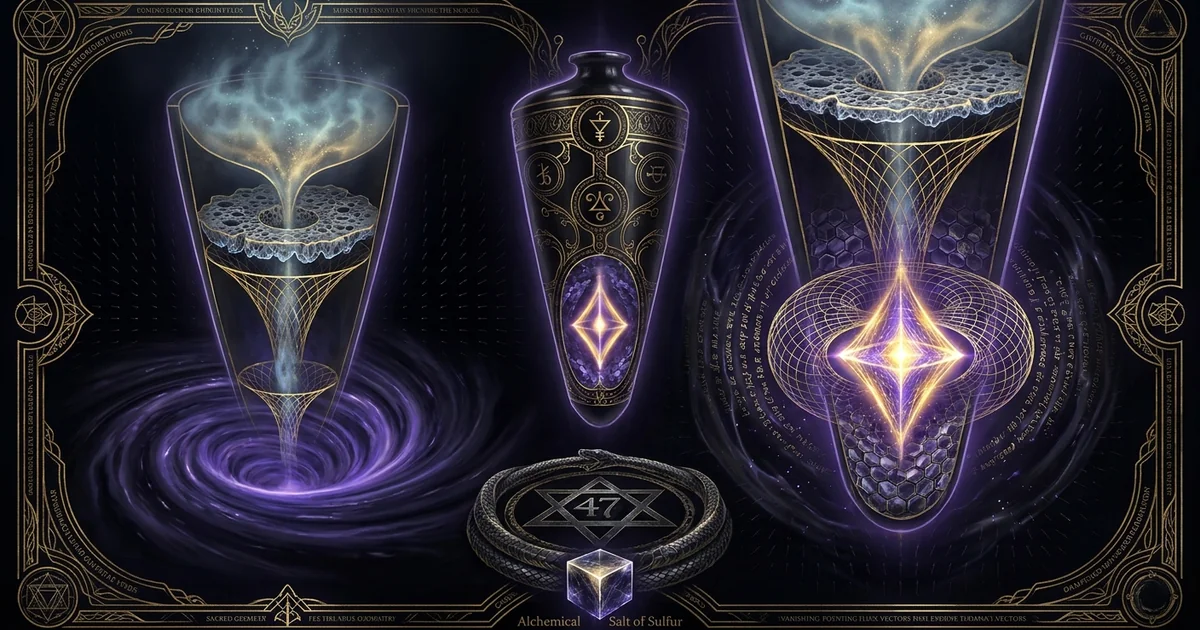
Hexagram 47 Oppression (Exhaustion) (Kùn): I Ching
Archetypal Thesis & Systemic Paradigm: Kùn as the Alchemical Crucible of Inversion
The Mechanics of Depletion: Thermodynamic Entropy in Closed Psychic Systems
Hexagram 47 (Kùn / 困) represents an ontological state-space where systemic energy ceases to circulate into the outer environment, precipitating a total collapse of externalized agency. In the architecture of the I Ching, this condition is designated as Oppression or Exhaustion. Far from denoting a mere circumstantial lack of material capital or physical vigor, the kùn hexagram models a closed thermodynamic psychic circuit. In classical systems theory, when an open system is violently or structurally sequestered from its external energy gradients, entropy rises monotonically within the local boundary until the existing structural parameters undergo either catastrophic systemic failure or a fundamental phase transition. In human consciousness, this manifests when persona-driven adaptations exhaust their operational utility. The ego finds its transactional conduits with the world severed, and its customary methods of projection, manipulation, and mastery are rendered completely inert.
The structural geometry of Kùn—wherein the waters of the lake have drained into the subterranean abyss below—illustrates an ecological dry bed. The psychic libido that formerly nourished the upper social and cognitive strata dries up entirely. The individual encounters an absolute limit where external action can no longer replenish the operational balance sheet. This systemic drying out is not an arbitrary accident of fate; it is an archetypal containment protocol engineered by the transpersonal Self to arrest the dissipative dispersion of psychic energy.
The Epistemic Silence: Why Words Cease to Function as Valid Currency
The canonical Judgment of Hexagram 47 carries a stark epistemological injunction: “When one has something to say, it is not believed.” In the domain of divinatory hermeneutics and cognitive cybernetics, this diagnostic statement signals a breakdown in the communicative channel between the interior subject and the external collective. Under the structural parameters of Kùn, discursive rationalization, self-justification, rhetorical defense, and dialectical persuasion lose all transactional validity. When the energetic baseline of a system collapses below a critical threshold, any attempt by the ego to explain, defend, or assert its innocence merely expends precious, non-renewable metabolic and psychic reserves. The social apparatus ceases to decode the agent’s intent accurately, systematically inverting speech into evidence of guilt, weakness, or delusion.
Defensive articulation during periods of severe structural containment accelerates entropic dissipation. Language functions as an exteriorizing mechanism; it attempts to project interior meaning into an objective field to solicit consensus or secure external relief. In the state of Exhaustion, the objective field has become totally non-conductive. The voice cannot bridge the structural chasm because the surrounding medium is unresponsive. To insist on being understood during the transit of Hexagram 47 is to hemorrhage remaining vitality into an energetic vacuum. Therefore, epistemic silence is an operational necessity: speech must be radically suspended so that the communicative energy turns inward to confront the primary architecture of the psychic crisis.
Enantiodromia and the Inevitable Turning of Constrained Forces
The foundational dynamic governing Hexagram 47 is the Heraclitean and Jungian principle of enantiodromia—the regulatory emergence of an opposing force when a primary psychic dynamic reaches its structural extreme. When limitation reaches its saturation point, the system can no longer proceed along its established evolutionary vector. Within the king-wen-sequence, Kùn directly follows Hexagram 46 (Pushing Upward / Shēng), which describes uninterrupted, linear vertical growth. Hexagram 47 introduces the hard thermodynamic ceiling to this vertical expansion. It arrests unmitigated upward acceleration and compresses the inflated vertical axis back into dense, unyielding matter.
“Energy necessarily creates a slope, a gradient… The principle of enantiodromia acts as a regulatory mechanism: when an extreme is reached, the psychic energy inevitably reverts to its opposite. In situations of profound limitation where all external exits are barred, the libido is thrown back upon itself, forcing a radical introversion of consciousness that strips the ego of its illusions.” — Carl Gustav Jung, Collected Works of C.G. Jung, Vol. 11: Psychology and Religion: West and East (1950)
When compression reaches its maximum density within the crucible of Kùn, the psycho-spiritual apparatus undergoes an involuntary phase shift. Because all peripheral exits are sealed by the architecture of the hexagram, the trapped libido ceases to seek horizontal dispersion and descends into the vertical core of the psyche. This turning point marks the transition from neurotic exhaustion to autonomous spiritual resilience. Deprived of the support of external circumstances, the subject is forced to discover an interior ground that does not depend on worldly validation, favorable conditions, or relational reciprocity. The systemic oppression operates as a structural catalyst, compelling the soul to forge an imperishable center of gravity.
Classical Provenance & Textual Lineage: Historical Transmission of Kùn
King Wen at Youli: The Lived Archetype of Sovereign Confinement
The historical lineage of Hexagram 47 is tied to the formative trauma of early Zhou Dynasty consciousness: the imprisonment of King Wen at Youli by Zhou Xin, the decadent and despotic final ruler of the Shang Dynasty. This episode forms the existential core of the book of changes divination tradition. Wen was stripped of his territorial agency, confined to a subterranean dungeon, and subjected to the psychological terror of arbitrary execution—a state of confinement mirrored in the text of Kùn. It was precisely within this squalor, entirely divorced from temporal sovereignty and military recourse, that King Wen is traditionally held to have meditated upon the sixty-four hexagrammatic archetypes, refining their sequences and authoring the foundational Judgments (Tuan).
The historical reality of the Youli imprisonment confirms that Hexagram 47 is not an abstract philosophical construct, but an empirical map forged inside political isolation. King Wen could not appeal to Shang justice, nor could he deploy rhetorical skill to secure his release; any overt display of defiance or self-justifying intelligence would have triggered immediate execution. Sovereign survival required complete interiorization: the preservation of the sacred mandate (Ming) deep within the silent sanctuary of the individual will, wholly obscured from the gaze of the oppressor. Hexagram 47 therefore canonizes the lived realization that outer confinement can coexist with absolute interior freedom, establishing a paradigm where temporal defeat serves as the chrysalis for profound civilizational vision.
The Commentary on the Tuan (Tuan Zhuan) and the Transmutation of Fate
The Ten Wings (Shi Yi), specifically the Commentary on the Judgment (Tuan Zhuan), elevate Kùn from a catalog of suffering into a manual of sovereign endurance. The canonical commentary states that in exhaustion, the “Superior Person” stakes their life on fulfilling their inner mandate. The term Ming (命), often translated as fate or destiny, signifies the foundational blueprint of transpersonal purpose assigned by Heaven. In mundane conditions of ease and prosperity, the ego conflates Ming with temporal success, social prestige, and biological comfort. Under the crush of Kùn, these superficial accretions are stripped away, forcing the subject to choose between biological survival through self-betrayal, or the unyielding preservation of their cosmological integrity.
“Oppression. The firm is obstructed and suppressed. Joyous and dangerous. To be oppressed and not lose one’s purpose—is this not the Great Man? ‘Words are not believed,’ for to value speech brings exhaustion. To stake one’s life on fulfilling one’s mandate: this is the essence of the noble spirit.” — Richard Wilhelm and Cary F. Baynes, The I Ching or Book of Changes (1950); cross-referenced with Richard John Lynn, The Classic of Changes as Interpreted by Wang Bi (1994)
The Tuan Zhuan highlights the internal psychological posture necessary to navigate this state: “Joyous and dangerous” (yān ér xiǎn). The lower trigram embodies danger and internal depth, while the upper trigram represents joy and outer receptivity. Rather than permitting the darkness of the subterranean abyss to poison the interior attitude with resentment or despair, the noble individual sustains an inner, serene joy (Duì), meeting objective danger (Kǎn) without psychic collapse. This combination prevents the consciousness from degrading into bitter cynicism. By staking their life on the celestial mandate rather than temporal expediency, the practitioner transmutes personal misfortune into an objective spiritual initiation.
Wang Bi’s Neo-Daoist Exegesis: Non-Being as the Core of Containment
In his third-century commentary on the Yijing, the Neo-Daoist philosopher Wang Bi (226–249 CE) deconstructed the deterministic, omen-based readings of the Han dynasty exegetes, offering a radical psychological and metaphysical reappraisal of Kùn. Wang Bi focused on the structural dynamics of the lines, asserting that oppression arises when an entity attempts to impose its will upon a reality that does not permit movement. He argued that the suffering described in Hexagram 47 is largely self-generated: it is the friction caused by the ego’s refusal to accept that non-action (wu wei) is the appropriate systemic response to structural closure.
Wang Bi observed that the lines of Kùn depict individuals who struggle against their circumstances, only to tighten the bonds of their imprisonment. When Wang Bi interprets the line statements—such as being trapped beneath bare trees or leaning against thistles—he identifies these images as metaphors for the psychic error of seeking salvation through outward grasping when the Dao requires radical stillness. According to Wang Bi’s metaphysics of Fundamental Non-Being (benwu), the state of exhaustion is the ultimate crucible because it strips away all phenomenal illusions of self-sufficiency. Only when the individual realizes that their assertive agency is totally void of independent power can they align with the primordial ground of the Dao, discovering the inexhaustible power residing at the heart of absolute stillness.
Structural Mechanics & Symbolic Geometry: Trigram Hydraulic Dynamics
Hydraulic Inversion: Lake (Duì) Drained into the Subterranean Abyss (Kǎn)
The structural architecture of Hexagram 47 presents an ecological and thermodynamic anomaly through its component trigrams: the upper trigram is trigram-dui (☱, the Lake, the Youngest Daughter, characterized by joy and open metal), situated directly above trigram-kan (☵, the Water/Abyss, the Middle Son, characterized by danger and downward motion). Under standard terrestrial physics and elemental mechanics, this arrangement represents a catastrophic hydraulic inversion. Water naturally flows downward; when an abyssal chasm opens directly beneath a porous lake bed, the reservoir empties into the subterranean depths, leaving the surface exposed, cracked, and barren.
Hexagram 47: Kùn (Oppression / Exhaustion)
===========================================
Line 6: - -  (Yin)    Upper Trigram: Duì (Lake / Joyous)
Line 5: ---  (Yang)   [The lake bed dries up as waters drain downward]
Line 4: ---  (Yang)
-------------------------------------------
Line 3: - -  (Yin)    Lower Trigram: Kǎn (Abyss / Water)
Line 2: ---  (Yang)   [The waters sink into inaccessible depths]
Line 1: - -  (Yin)
===========================================
This hydraulic failure models the desiccation of the conscious persona. The lake bed—representing the expressive, relational, communicative, and joyous aspects of the human interface—is deprived of its sustaining medium. The life-giving water has not ceased to exist, but it has descended into the murky, inaccessible subterranean caverns of the unconscious (Kǎn). The subject experiences this dynamic as acute spiritual drought, emotional despondency, and energetic depletion. The environmental context no longer provides an external reservoir of life; what was once a shimmering, communicative surface becomes an arid wasteland where the ego’s survival mechanisms grind to an absolute halt.
Nuclear Core Dynamics: The Underlying Friction of Sun (Wind) and Li (Fire)
Beneath the primary trigrams of Lake and Water lies the latent energetic architecture governed by the nuclear-hexagram. The nuclear hexagram of Kùn is derived from lines 2, 3, 4 (which form the lower nuclear trigram Li, ☲, Fire) and lines 3, 4, 5 (which form the upper nuclear trigram Sun, ☴, Wind/Wood). Together, they constitute Hexagram 37 (Jia Ren / 家人, The Family / The Clan). The presence of Jia Ren inside the core of Kùn provides a crucial hermeneutic key to the mystery of Oppression:
- Primary Outer Trigram: Duì (Lake, ☱)
- Primary Inner Trigram: Kǎn (Water, ☵)
- Nuclear Lower Trigram: Li (Fire, ☲ - lines 2, 3, 4)
- Nuclear Upper Trigram: Sun (Wind/Wood, ☴ - lines 3, 4, 5)
- Nuclear Hexagram Result: Hexagram 37 (Jia Ren / The Family)
This interior configuration reveals that at the structural heart of cosmic and personal exhaustion lies the urgent requirement for domestic structural integrity, precise psychological boundaries, and inner order. Wind above Fire generates intensive warmth and radiant illumination, but it operates entirely within the domestic sanctuary—the inner sanctum of the psyche. The nuclear core demonstrates that Hexagram 47 is not an invitation to public reform or external enterprise; rather, it demands the severe consolidation of one’s psychic household. The chaotic projections, unruly internal complexes, and scattered attachments of the ego must be brought under the sovereign authority of the interior center, purifying the spiritual sanctuary before any outward movement can be successfully attempted.
Line Vector Progression: From the Bare Tree to the Severance of Entangled Vines
The six lines of Hexagram 47 trace the systemic phenomenological progression of oppression through distinct somatic and psychological stages, systematically moving from helpless inertia to final release:
- Initial Yin (Line 1): One sits oppressed under a bare tree and strays into a gloomy valley. For three years one sees nothing. The entry into Kùn is characterized by somatized paralysis and perceptual atrophy. The “bare tree” provides no shade, comfort, or fruit; the “gloomy valley” indicates a collapse into the lowest, most regressive strata of the unconscious. The temporal marker “three years” signifies a full structural cycle of developmental arrest wherein the ego is denied all perceptual clarity.
- Nine in the Second Place (Line 2): One is oppressed while at meat and drink. The man with the scarlet knee-bands comes. It is advantageous to offer sacrifice. To set forth brings misfortune. No blame. Here, oppression manifests paradoxically within material abundance (“meat and drink”). Despite biological sustenance, the spirit suffocates. The “scarlet knee-bands” represent an emissary of institutional power or duty that restricts autonomy. Salvation cannot be attained through ambitious projects (“to set forth brings misfortune”), but only through sacred sacrifice—the conscious renunciation of personal prerogatives to preserve internal alignment.
- Six in the Third Place (Line 3): A man permits himself to be oppressed by stone, and holds on to briers and thorns. He enters his house and does not see his wife. Misfortune. This line demarcates the nadir of subjective folly. The individual leans on solid stone (rigid dogmas or defensive constructs that offer no yield) and grasps at thorny brambles (toxic attachments and self-destructive habits that tear the flesh). Returning to the intimate interior of the psyche (“enters his house”), he finds the feminine anima principle missing (“does not see his wife”). Psychic sterility and relational desolation reach absolute totality.
- Nine in the Fourth Place (Line 4): He comes very quietly, oppressed in a golden carriage. There will be humiliation, but the end is reached. Confinement here takes the form of social privilege, material entrapment, or intellectual pride (“the golden carriage”). The individual is burdened by the very mechanisms of worldly status. While liberation is obstructed by the slow, cumbersome apparatus of past commitments, this line initiates the turning point; the systemic impasse begins to disintegrate through patient, quiet endurance.
- Nine in the Fifth Place (Line 5): His nose and feet are cut off. Oppression at the hands of the man with the purple knee-bands. Joy comes softly. It is advantageous to offer sacrifices and libations. This line invokes the archaic mutilations of the Shang and Zhou legal codes: amputation of the nose (cutting off intuitive breath and discernment) and feet (severing the capacity for worldly progress). The individual is caught between tyrannical social expectations above and the paralysis of agency below. Yet, precisely at this threshold of radical ego-dismemberment, “joy comes softly” (xú xú). Through religious surrender and devotional sacrifice, the transpersonal self begins to shine through the fragmented persona.
- Top Yin (Line 6): He is oppressed by creepers and vines. He moves uncertainly and says, ‘Movement brings remorse.’ If one feels repentance for this and sets forth, good fortune. The final line reveals that the oppression has reached its structural expiration date. The bonds holding the querent are no longer unyielding stone or tyrannical monarchs, but tenuous “creepers and vines”—the lingering, phantom habits of past suffering, trauma projections, and cognitive inertia. The belief that one cannot move is now an illusion. By recognizing that the boundary conditions of Kùn have run their course, the subject dissolves self-imposed paralysis, steps beyond the boundary of the hexagram, and initiates liberation.
Psychological Dynamics & Operational Praxis: Archetypal Containment and the Nigredo
The Nigredo of Analytical Psychology: Calcination of Ego Complexes
Hexagram 47 corresponds precisely to the Hermetic and Jungian stage of the nigredo—the blackening, mortification (mortificatio), and putrefaction (putrefactio) of the psychic substrate. In the Western alchemical opus, the base matter must be sealed within the hermetic vessel and subjected to unyielding, calcifying heat until all volatile, illusory elements are burned away. Within analytical psychology, the hexagram 47 oppression (exhaustion) iching meaning diagnoses the indispensable phase wherein the ego-complex is forcibly broken down. The persona—the masks constructed to elicit collective approval and maintain psychological homeostasis—undergoes calcination.
During this process, the psychological projections that previously sustained the individual are systematically recalled. The naive belief that one’s fulfillment, purpose, or identity can be permanently stabilized through interpersonal relationships, professional achievements, or artistic success collapses into ash. The subject experiences an agonizing sense of spiritual dryness (the desiccated lake bed), psychological impotence, and profound desolation. However, from the perspective of individuation, the nigredo of Hexagram 47 is an indispensable initiatory gate. Without the radical dismantling of the persona’s pretenses, consciousness remains trapped in superficial inflation, entirely blind to the deep subterranean waters of the transpersonal Self.
Egoic Reactivity (Neurotic Exhaustion)
- Operational Stance: Desperate external assertion; litigious justification; frantic over-activity to escape psychic voids.
- Verbal Mode: Prolix defense, polemics, complaining, seeking external vindication (“valuing speech”).
- Thermodynamic Outcome: Accelerated entropic dissipation; deeper entanglement in external traps and bureaucratic machinery.
- Psychic State: Resentment, victim consciousness, paranoia, projection of blame onto the objective environment.
- Energetic Vector: Horizontal fragmentation across external surfaces; leakage of remaining reserves.
Alchemical Containment (Sovereign Endurance)
- Operational Stance: Radical non-resistance; voluntary adoption of stillness; monastic closure of systemic boundaries.
- Verbal Mode: Strict epistemic silence; non-defensive neutrality; preservation of cognitive bandwidth.
- Thermodynamic Outcome: Inversion of entropy; internal condensation of libido; stabilization of the core self.
- Psychic State: Equanimous presence, alignment with the mandate (Ming), sovereign solitude, patient waiting.
- Energetic Vector: Vertical descent into the transpersonal ground; preparation for the emergence of the living Well.
Navigating the Tribunal: Diagnostic Interpretations in Divinatory Practice
In professional divinatory consultations utilizing the book of changes divination, the appearance of Hexagram 47 functions as an unmistakable systemic red flag. When an individual receives Kùn, the oracle diagnoses an environment that is currently non-viable for ambitious undertakings, legal disputes, commercial expansion, or relational confrontation. The fundamental field conditions are actively hostile to assertive movement. Any attempt to clear one’s name through litigation, public statements, or aggressive intervention will inevitably backfire: discursive justifications will be heard by others as admissions of culpability, and strategic advances will march directly into well-prepared ambushes.
The diagnostic imperative of Hexagram 47 commands an immediate cessation of hostilities and a tactical withdrawal into interior space. If the querent is involved in professional negotiations, the counsel is to refrain from pushing terms; if locked in relational discord, the instruction is to cease argument immediately. The tribunal before which the querent stands is not objective, nor can it be swayed by logic or emotional appeals. The environment itself is suffering from an energetic deficit, and it seeks to siphon the querent’s remaining reserves to fuel its own survival. The only effective strategy is structural non-engagement: starving the external conflict of psychological fuel by completely withdrawing identity from the contested arena.
The Praxis of Silence: Active Non-Resistance in High-Entropy Situations
The operational praxis demanded by Hexagram 47 is not passive fatalism, but the rigorous implementation of active non-resistance (wu wei). When systemic entropy is high and communicative lines are down, maintaining internal composure requires intense spiritual discipline. The practitioner must voluntarily enter the monastic sanctuary of the mind, consciously refusing the temptation to react to external provocations, slights, or economic hardships.
This containment protocol preserves the sacred flame of the mind (Li, the lower nuclear trigram) from being extinguished by the flooding dark waters of panic (Kǎn). It redirects cognitive and metabolic bandwidth away from futile external defenses and channels it into the cultivation of unshakeable interior sovereignty. The individual recognizes that their current trials are a temporal necessity—an initiatory drying out of the false self. By resting in total stillness within the empty lake bed, the individual conserves the vital spark, patiently awaiting the macrocosmic turning of the seasons that will inevitably transform systemic oppression into systemic renewal.
Philosophical Synthesis & Macrocosmic Correspondence: Multi-System Coordinates
Human Design Gate 47: The Gate of Realizing and the Pressure of the Ajna
Within the mechanics of Human Design—which synthesizes the sixty-four hexagrams of the I Ching with the chakra system, Kabbalistic Tree of Life, and quantum genetics—Hexagram 47 manifests as gate-47-realizing, situated within the Ajna Center. This gate is the biological and cognitive repository for processing mental pressure from the Head Center via the 64-47 Channel of Abstraction. Gate 47 carries the specific evolutionary role of transmuting past chaos, ancestral memory, and confusing life experiences into coherent, singular realizations.
The fundamental dilemma of Gate 47 mirrors the classical I Ching Judgment: the mental pressure to make sense of the past is relentless, but attempting to resolve this mental pressure through immediate physical action invariably leads to exhaustion and suffering. Gate 47 operates under the illusion that the mind can solve its own existential dilemmas by strategizing its way out of structural limitation. When individuals with an active Gate 47 attempt to force their mental insights onto temporal circumstances before the natural epiphany emerges, they experience deep psychological oppression. The operational law of Gate 47 requires surrender: the mind must remain a watchful, non-reactive witness to the internal stream of memories and mental images, recognizing that the flash of realization cannot be commanded through sheer will, but occurs spontaneously when mental resistance dissolves entirely.
- I Ching Coordinates: Hexagram 47 (Duì over Kǎn, ䷮, Oppression / Exhaustion)
- Human Design Gate: Gate 47 (The Gate of Realizing / Channel of Abstraction 64-47)
- Biological / Genetic Codon: Ring of Alchemy (Codon Sequence: Serine / AGT, AGC)
- Astrological Dignity: Saturn in Scorpio (Calcination of Mars through fixed water) / Saturn in Capricorn (Exile/Decapitation of the solar persona)
- Hermetic Qabalah: Path 27 (Peh / The Tower) bridging Hod (Splendor/Intellect) to Netzach (Victory/Emotion), purified by the stern oversight of Binah (Saturn/Form)
- Alchemical Phase: Nigredo (Mortificatio, Calcinatio, Putrefactio)
Biochemical and Codon Homology: Genetic Codon Rings and Adaptive Stress Responses
In the biochemical mapping of the genetic code to the sixty-four hexagrammatic permutations, Hexagram 47 occupies a critical position within the Ring of Alchemy, corresponding to the codon family coding for the amino acid Serine. Serine plays an indispensable role in the catalytic triad of serine proteases and the phosphorylation signaling cascades that regulate metabolic shutdown, cellular stress responses, and adaptive survival under conditions of systemic nutrient deprivation.
When a biological cell experiences critical starvation or anoxia—the physiological equivalent of Kùn—it does not accelerate metabolic activity; doing so would trigger immediate apoptosis or necrotic lysis. Instead, it activates highly conserved stress-response pathways that arrest cell division, downregulate transcription, and trigger autophagy: the systematic degradation and recycling of non-essential cellular components to sustain the core metabolic machinery. Hexagram 47 mirrors this exact cellular defense mechanism on the psycho-spiritual plane. The psychic organism, faced with environmental toxicity and resource starvation, initiates an interior spiritual autophagy. It breaks down superficial egoic attachments, cognitive biases, and persona vanity, feeding upon its own non-essential structures in order to preserve the sacred, indestructible germ of consciousness.
Astrological and Qabalistic Geometries: Saturnine Calcination on the Path of Peh
In the structural geometry of the Western Hermetic Qabalah, the archetype of Kùn expresses the cold, binding, and transmutational power of Saturn operating through the sephirah Binah (Understanding), cast downward across the lower astral architectures of the Tree of Life. Saturn represents the inescapable boundary of physical space-time, the principle of calcination, and the stern taskmaster that demands structural integrity under crushing gravitational weight. The presence of Kùn corresponds to the experience of the lower astral ego being pinned to the altar of material reality, forced to pay every debt owed to the objective cosmos.
This dynamic intersects with the Path of Peh (The Tower, Mars) connecting Netzach (Desire) and Hod (Intellect). Under the Saturnian influence of Kùn, the false towers of intellectual rationalization and emotional indulgence are struck down. The vibrant, expansive solar forces are eclipsed by the dark night of the soul. The astrological signature evokes Saturn traversing the murky, emotional depths of Scorpio or executing its stern judgments from Capricorn. The superficial, mutable currents of life are frozen, stripping the initiate of all comforting illusions. The planetary forces converge to create an alchemical athanor—a furnace in which the raw, unrefined material of the psyche is subjected to prolonged, agonizing containment until all volatile egoic dross is eliminated, leaving only the immutable gold of transpersonal realization.
Frequently Asked Questions on Hexagram 47 (Oppression / Exhaustion)
Distinguishing Kùn (47) from Kǎn (29) and Jiǎn (39)
Within the diagnostic framework of the I Ching, practitioners frequently conflate Hexagram 47 (Kùn) with two other prominent hexagrams of difficulty: Hexagram 29 (The Abysmal / Kǎn) and Hexagram 39 (Obstruction / Jiǎn). A rigorous comparative analysis reveals distinct systemic dynamics:
- Hexagram 29 (The Abysmal / Kǎn) is composed of the double trigram of Water. It represents pure, unmitigated kinetic danger, the presence of repeated structural chasms, and the necessity of navigating treacherous rapids. In Kǎn, water is abundant—dangerously so. The challenge is one of fluidity, courage, and maintaining an uncorrupted heart while navigating through terrifying currents. Agency is not extinguished; it is challenged to match the relentless movement of water.
- Hexagram 39 (Obstruction / Jiǎn) features Water above Mountain. Here, the traveler encounters an impassable barrier: a steep mountain with an abyss directly behind. Jiǎn does not indicate an internal draining of resources, but an objective obstacle blocking the path of advancement. The operational directive of Hexagram 39 is strategic retreat: to turn back, seek allies in the southwest, and consolidate one’s forces. Movement is halted from the outside, but the internal reserves remain intact.
- Hexagram 47 (Oppression / Kùn), in total contrast, represents neither dynamic water nor an external obstacle. It is the absolute drying up of the water bed itself. The lake above has leaked into the subterranean depths below. The danger in Kùn is entirely structural and metabolic: the subject is physically confined, politically marginalized, and energetically desiccated. One cannot navigate (as in 29) because there is no water; one cannot strategically retreat (as in 39) because the prison door is locked from the outside. The crisis of Kùn is total, demanding an internal transformation rather than a tactical maneuver.
Handling Active Moving Lines in Divinatory Praxis
When interpreting Hexagram 47 within a clinical or personal divination, the presence of changing lines alters the diagnostic prescription, pinpointing the querent’s exact location along the continuum of containment:
- If Line 1 is moving, the querent is trapped in the depressive inertia of victimhood and somatic despair. They are clinging to an unyielding past (“gloomy valley”). The primary clinical counsel is to prevent the individual from making hasty structural changes while their perceptual field remains completely darkened.
- If Line 2 is moving, the oppression is occurring within the very theater of external success, wealth, or professional duty. The querent must recognize that material compensation cannot alleviate spiritual imprisonment; only devotional sacrifice and inner realignment can maintain structural balance.
- If Line 3 is moving, the querent is actively compounding their suffering through foolish resistance, leaning on rigid dogmatic assumptions (“stones”) and clutching onto toxic dependencies (“thorns”). They must immediately cease all self-injurious behavior and accept complete solitude.
- If Line 4 is moving, the querent is slowly emerging from social and intellectual traps (“golden carriage”). The suffering is nearing its end, provided they advance with extreme humility and quietness.
- If Line 5 is moving, the querent is undergoing the ultimate ego-dismemberment at the hands of collective pressures. They must maintain unwavering faith; the suffering has reached its transpersonal apex, and release is imminent (“joy comes softly”).
- If Line 6 is moving, the oppression has ceased to be an objective reality and exists solely as a subjective psychological haunting (“creepers and vines”). The querent must immediately shatter their self-imposed confinement, reject the lingering paralysis of past trauma, and step boldly forward into liberation.
The Paradox of Auspiciousness Hidden Within the Judgment
A superficial reading of Hexagram 47 fixates on the grim imagery of desiccation, imprisonment, and epistemic silence. Yet, the canonical Judgment opens with a stunning declaration: “Oppression. Success. Perseverance. The great man brings about good fortune. No blame.” The attribution of Success (Hēng, 亨) and Good Fortune (Jí, 吉) to a hexagram delineating absolute exhaustion appears fundamentally paradoxical to the uninitiated mind.
This paradox dissolves when viewed through the lens of initiatory mechanics. The I Ching does not evaluate circumstances based on superficial comfort, hedonistic ease, or temporal victory. In the cosmological grammar of the Changes, authentic success is the crystallization of sovereign character through the crucible of temporal limitation. Hexagram 47 is an elite spiritual filter: it systematically separates the opportunist from the authentic sovereign. The ordinary individual, when stripped of material security and collective applause, collapses into bitterness, deceit, and existential panic. The “Great Man” (dà rén), however, uses the complete desiccation of external resources to contact the subterranean, inexhaustible wellspring of the transpersonal spirit. The auspiciousness of Kùn is absolute precisely because it cannot be faked: it is the supreme fortune of a soul that has passed through the alchemical fire of total deprivation and emerged indomitable, self-contained, and whole. In the sequence of the hexagrams, this total desiccation of the Lake is the mandatory structural precondition that clears the ground for the miraculous discovery of the inexhaustible source directly following it: the unfathomable depths of the subterranean waters in Hexagram 48, The Well (Jǐng).