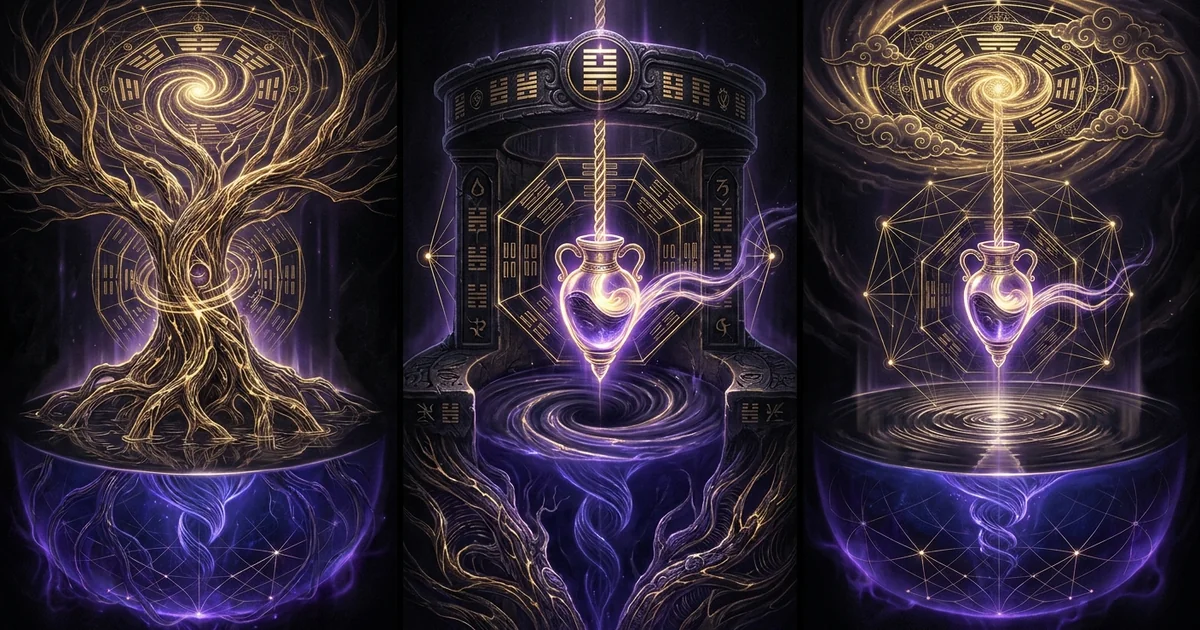
Hexagram 48 The Well (Jǐng): I Ching Divination - Guide
Archetypal Thesis & Systemic Paradigm: The Invariant Subsurface Reservoir
The Transpersonal Wellspring: Invariance Amidst Geopolitical Mutation
Hexagram 48 (井, Jǐng) establishes a fundamental psycho-cosmological coordinate within the architecture of the I Ching: the ontological constancy of the primordial source. In the traditional sequence of the King Wen arrangement, Jǐng follows Hexagram 47 (困, Kùn / Oppression or Exhaustion). Where Kùn marks the constriction of physical energy, the draining of surface reservoirs, and the structural exhaustion of the ego amidst adversity, Hexagram 48 exposes the inexhaustible, invariant stratum that underlies all phenomenal depletion. The judgment opens with an axiomatic political and metaphysical formulation: “The town may be changed, but the well cannot be changed. It neither decreases nor increases. They come and go and draw from the well.” This insight marks a demarcation between transient socio-political formations and the immutable ground of being. Dynasties collapse, urban settlements migrate across geographical terrains, and systems of ideological organization decay into obsolescence, yet the subterranean hydrological layer remains tethered to its intrinsic depth, indifferently sustaining whatever collective consciousness chooses to sink a shaft into its domain.
Viewed through archetypal psychology, Jǐng models the structural relationship between the conscious personality and the collective-unconscious. The superficial layers of identity—civil infrastructure, conscious adaptations, civic boundaries, and cultural defense systems—are subject to temporal shifts and historical contingency. When the querent inquires through book of changes divination regarding institutional, relational, or personal rupture, the appearance of the jǐng hexagram strips away peripheral distractions to demand an evaluation of baseline connectivity. The Well does not wander; its water neither multiplies when celebrated nor diminishes through collective exploitation. It reflects the pure transpersonal reservoir of psychic energy (libido in the Jungian sense), which remains fundamentally untouched by conscious neurosis.
Yet, proximity to the resource does not guarantee its extraction. The classical text swiftly moves from the metaphysical immutability of the aquifer to an operational caveat: if one fails to lower the rope completely, or if the jug breaks before reaching the surface, structural disaster ensues. The availability of transpersonal wisdom is absolute, but access is severely conditioned by the mechanical viability of the intermediary apparatus.
“A more or less superficial layer of the unconscious is undoubtedly personal. I call it the personal unconscious. But this personal layer rests upon a deeper layer, which does not derive from personal experience and is not a personal acquisition but is inborn. This deeper layer I call the collective unconscious. I have chosen the term ‘collective’ because this part of the unconscious is not of an individual nature but is universal; it has contents and modes of behaviour that are more or less the same everywhere and in all individuals. It is, in other words, identical in all men and thus constitutes a common psychic substrate of a suprapersonal nature which is present in every one of us.”
The Hydrodynamics of K’an and Sun: Depth Mediated by Penetrative Receptivity
The internal engineering of Hexagram 48 is defined by its component trigrams: the upper trigram is K’an (☵, Water / The Abysmal), and the lower trigram is Sun (☴, Wind / Wood / Gentle Penetration). This configuration—water over wind or water drawn upward by wood—embodies the mechanics of extraction. In the elemental taxonomy of ancient China, wood does not merely float; as the wooden bucket descending into the dark subterranean hollow, Sun penetrates downward into the domain of K’an, captures the fluid essence, and ascends to the conscious sphere. Alternatively, Sun represents the subterranean root system of vegetation, which gently and imperceptibly enters the soil to draw the invisible moisture of the deep earth upward into the trunk, branches, and leaves.
To understand the mechanics of Jǐng is to comprehend the dynamic equilibrium between these two vectorial forces. K’an embodies raw archetypal depth, the perilous nocturnal underworld of the unintegrated psyche, and the instinctual baseline of existence. Left to itself, as manifested in Hexagram 29, K’an is the bottomless abyss, threatening to drown the unmoored ego in undifferentiated affect. Sun, conversely, represents the gradual, flexible, and deliberate vector of conscious intentionality. It is the capacity for non-violent penetration, sustained discipline, and systematic descent. In Jǐng, the abyss of K’an is tamed, contextualized, and harvested through the instrumentality of Sun. The dangerous current of the deep becomes potable domestic water.
       HEXAGRAM 48: JǏNG (THE WELL)

       Line 6: -- --  (Yin)   [Trigram K'an: Water / The Abysmal]
       Line 5: -----  (Yang)
       Line 4: -- --  (Yin)
       -----------------------------------------------------------
       Line 3: -----  (Yang)  [Trigram Sun: Wind / Gentle Wood]
       Line 2: -----  (Yang)
       Line 1: -- --  (Yin)
This structural convergence asserts that spiritual and psychological nourishment is never a passive event. One does not simply stumble into archetypal integration. The wild waters of the deep must be retrieved by means of a functional container, drawn upward against gravity by a sustained, rhythmic labor. The hexagram 48 the well iching meaning hinges upon this technological synthesis: the abyssal mystery (K’an) remains impotent and potentially destructive to human settlement unless mediated by the crafted, penetrative architecture of conscious technique (Sun). If the vessel lacks structural fortitude, the contact with raw subterranean power results not in life-giving sustenance, but in an abrupt psychic inflation followed by catastrophic collapse.
Classical Provenance & Textual Lineage: From Jingtian Infrastructure to Neo-Confucian Metaphysics
The Western Zhou Jingtian (Well-Field) System as Sociopolitical Template
The glyph for Jǐng (井) presents an unambiguous pictographic representation of the jǐngtián (井田) or “well-field” system, an ancient socio-economic model of agrarian distribution attributed to the Western Zhou dynasty (c. 1046–771 BCE). In this administrative framework, a square parcel of arable land was divided into nine equal subsections in the shape of the Chinese character 井. Eight peripheral plots were distributed to eight independent farming households for private cultivation, while the central ninth plot, containing the communal water well, was designated as the common land (gōngtián). The eight families were legally and structurally bound to cooperate in cultivating the central plot—its yield designated for municipal reserves, taxation, and communal upkeep—before directing their energies toward their individual holdings.
+-------------------+-------------------+-------------------+
|                   |                   |                   |
|   Private Field   |   Private Field   |   Private Field   |
|         1         |         2         |         3         |
|                   |                   |                   |
+-------------------+-------------------+-------------------+
|                   |                   |                   |
|   Private Field   |   Communal Well   |   Private Field   |
|         8         |     & Field 9     |         4         |
|                   |                   |                   |
+-------------------+-------------------+-------------------+
|                   |                   |                   |
|   Private Field   |   Private Field   |   Private Field   |
|         7         |         6         |         5         |
|                   |                   |                   |
+-------------------+-------------------+-------------------+
This arrangement established the well as the geographic, economic, and moral nexus of the community. Survival was explicitly tied to the collective maintenance of this central core. If the central well silted up, if its masonry decayed, or if the distribution conduits were fractured by neglect, the communal integrity of the eight surrounding units evaporated. Thus, the physical well evolved directly into an ethical and cosmological template. It embodied the indispensable common wealth—both tangible and metaphysical—that no private individual owned, yet upon which every individual relied. The agrarian reality informed the philosophical treatises of the Warring States period, most notably in Mencius (Mengzi), where the jingtian-system was retroactively elevated to an idealized archetype of benevolent governance (rénzhèng) and shared responsibility.
“THE JUDGMENT: THE WELL. The town may be changed, but the well cannot be changed. It neither decreases nor increases. They come and go and draw from the well. If one has almost attained the water and has not yet quite reached the water with the rope, or if he breaks the jug, that brings misfortune.”
“THE IMAGE: Water over wood: the image of THE WELL. Thus the superior man encourages the people at their work, and exhorts them to help one another.”
Commentarial Evolution: Wang Bi’s Non-Being (Wu) vs. Cheng Yi’s Cultivation Ethics
The textual lineage of the jǐng hexagram demonstrates a rich dialectical evolution across Chinese intellectual history, oscillating between radical ontology and rigorous interior cultivation. In the third century CE, the profound Xuanxue (Neo-Daoist) philosopher Wang Bi (226–249 CE) radically shifted the interpretation of Jǐng away from bureaucratic agrarianism toward the metaphysics of Non-Being (wú). For Wang Bi, the statement that the well “neither decreases nor increases” provides definitive proof that the Well serves as a symbol for the Dao itself. In his commentary, Wang Bi observes that that which possesses concrete physical form (yǒu) is inherently subject to consumption, exhaustion, and spatial limitation.
Because the Well provides endlessly to an entire population without depleting its intrinsic reserve, it operates by virtue of the bottomless void within it. The water is drawn, yet the ground of water is never exhausted; the capacity of the well to nourish is entirely dependent upon its emptiness. Wang Bi warns that human interference—premature manipulation, artificial meddling, or possessive grasping—disrupts this natural mechanics of spontaneous self-replenishment. To draw successfully from the well is to align with the non-intentional operation of the cosmos (zìrán), allowing the unmanifest ground to inform conscious life without attempting to domesticate or exhaust the subterranean origin.
A millennium later, during the Northern Song dynasty, Cheng Yi (1033–1107 CE) recalibrated the commentary toward Neo-Confucian moral realism and psycho-spiritual cultivation. In the Yichuan Yizhuan, Cheng Yi redirected the primary lens toward human responsibility and self-cultivation. While accepting the invariant reality of the subterranean water, Cheng Yi asserted that water left underground cannot alleviate thirst. The ethical imperative resides wholly within the cultivation of the intermediate channel: the construction of the shaft, the preservation of the masonry, and the deliberate training of the person who lowers the vessel.
For Cheng Yi, the muddy well of Line 1 and the cracked trough of Line 2 represent the degeneration of human character through unexamined desires and moral torpor. The Well is human nature (xìng) in its pristine, uncorrupted purity; however, without the persistent labor of self-rectification (xiūshēn), this nature becomes choked with the silt of petty attachments. While Wang Bi elevated Jǐng to an emblem of Daoist emptiness, Cheng Yi transformed it into an austere manual for the unending work required to clear the psychological conduits of the self.
Structural Mechanics & Symbolic Geometry: Trigram Vectoring and Line Stratification
Vector Analysis: Water over Wind as Controlled Elevation of Subterranean Power
The inner systemic anatomy of Hexagram 48 is governed by its dynamic vectors and the alchemical tensions between its constituent elements. The upper trigram, K’an, carries an intrinsically downward vector; as water, its natural physical tendency is to descend, pool, seek low ground, and infiltrate the deepest fissures of the earth. The lower trigram, Sun, carries an upward, outward, and penetrative vector; as wind, it moves through all porous spaces, and as wood, it draws sap upward toward the celestial light against the drag of terrestrial gravity.
       TRIGRAM VECTORS & NUCLEAR ARCHITECTURE

       Trigram: K'an (Water)    [Vector: Descending / Downward]
       Lines 4, 5, 6            [Archetype: Instinctual Abyss, Affect]

       Nuclear Trigram: Li      [Lines 3, 4, 5: Fire / Consciousness]
       Nuclear Trigram: Tui     [Lines 2, 3, 4: Lake / Communal Joy]

       Trigram: Sun (Wood/Wind) [Vector: Ascending / Upward]
       Lines 1, 2, 3            [Archetype: Method, Containment, Tool]
When K’an is placed over Sun, an intentional thermodynamic and kinetic circuit is established. The natural downward pressure of the water meets the ascending, penetrative power of the wood. Rather than an uncontrolled flood or stagnant dampness, the intersection creates a closed pump mechanism.
This circuit becomes more pronounced when analyzing the nuclear trigrams (hùguà) embedded within the core of Hexagram 48. The lower nuclear trigram (lines 2, 3, 4) is Tui (☱, Lake / Joy / The Mouth), which governs open expression, communal sharing, and fluid interface. The upper nuclear trigram (lines 3, 4, 5) is Li (☲, Fire / Clarity / Consciousness). Taken together, the internal dynamic reveals Hexagram 38 (睽, Kuí / Opposition or Polarized Tension), which operates as the engine beneath the surface.
Within the hidden heart of the Well, Lake lies beneath Fire: an alchemical crucible where raw liquid depth is transformed through internal illumination (Li) into joyous communal sustenance (Tui). The water extracted by the outer trigrams is not meant to be hoarded or held in isolation. It undergoes an internal heating, a refinement of understanding, which renders the subterranean instinct fit for cultural communion and conscious deployment.
The Line Progression: From Silted Detritus to Uncapped Transpersonal Flow
The six lines of Hexagram 48 model a structural progression. The developmental vector does not merely describe circumstances; it blueprints the physical and psychological excavation, rehabilitation, and ultimate dispersal of transpersonal water.
Initial Line (Yin, 6 at the beginning): Silted Mud and Psychic Atrophy
“One does not drink the mud of the well. No animals come to an old well.” The sequence initiates at the absolute base of the shaft. Here, the water is mixed with decomposing detritus and mineral sediment. In psychological terms, this indicates an ego trapped in the swamp of archaic fixations, unconscious trauma, or discarded habits. The well has fallen out of active use through chronic neglect. There is neither clarity nor nutrition; attempting to draw nourishment from this state produces illness. It is a condition of total psychic stagnation, bypassed by the instinctive intelligence of the animal kingdom.
Second Line (Yang, 9 in the second place): The Broken Trough and Misdirected Aim
“At the wellhole one shoots fishes. The jug is broken and leaks.” The water has cleared sufficiently to support rudimentary life forms (small fish), but the infrastructure of extraction is completely degraded. The actor possesses kinetic energy (as a strong Yang line), but expends it trivializing his capacity—shooting small fish in a subterranean hole rather than retrieving water for the populace. The vessel utilized is cracked, bleeding its contents back into the void before reaching the surface. This represents the pathology of misdirected talent: dynamic intelligence spent on neurotically small targets while the primary instrument of conscious containment leaks libido relentlessly.
Third Line (Yang, 9 in the third place): The Cleared Spring Bypassed
“The well is cleaned, but no one drinks from it. This is the sorrow of my heart, for one might draw from it. If the king were clear-minded, good fortune might be enjoyed in common.” The infrastructure has been purged of mud, the spring flows clean, yet collective awareness has not yet recognized its availability. This is the tragic juncture of the unrecognized prophet, the unactualized insight, or the neurotic pattern wherein the individual has performed the inner labor of purification, yet remains disconnected from actual integration with the social matrix. The potential for supreme nourishment exists, but it awaits conscious royal authorization—the integration of the sovereign conscious will—before it can be distributed.
Fourth Line (Yin, 6 in the fourth place): The Tiled Shaft and Interior Fortification
“The well is being lined. No blame.” The trajectory halts active extraction in favor of structural repair. The shaft is lined with protective brick or stone (chén) to prevent future collapse and filter out encroaching earth. This line embodies the therapeutic retreat, the necessity of establishing firm containment structures. The individual ceases the demand to produce or deliver external nourishment, turning entirely to internal structural consolidation. In archetypal psychology, this corresponds to archetypal containment—the construction of a resilient ego boundary capable of bearing the pressure of the subterranean waters without buckling.
Fifth Line (Yang, 9 in the fifth place): The Cold, Limpid Spring
“In the well there is a cool, clear spring from which one drinks.” The apex of individual cultivation is achieved. The line occupies the central and correct sovereign position of the upper trigram K’an. The water is neither muddy, nor hidden, nor inaccessible; it is crystalline, cold, and profoundly potable. The individual has tapped the genuine ego-self-axis, establishing an uninterrupted conduit between individual consciousness and the transpersonal source. The self has become a living fountainhead. Yet, as a Yang line in the fifth position, this state is not yet the systemic culmination; it represents access, but not yet absolute universalization.
Top Line (Yin, 6 at the top): The Uncovered Nexus of Universal Bounty
“One draws from the well without hindrance. It is dependable. Supreme good fortune.” The transformation is absolute. The well is left uncovered; no lid, gate, or proprietary lock restricts access to its waters. It has become a permanent, trans-egoic resource for the entire collective. The individual who reaches this stage has transcended personal proprietorship over their wisdom or life-force. They are no longer an owner, but a transparent conduit for the archetype. Sincerity and dependability (fú) characterize the station: because it is entirely open and makes no exclusive claims, it cannot be depleted or destroyed.
Psychological Dynamics & Operational Praxis: Container Integrity and the Avoidance of Failure
The Ruptured Vessel Syndrome: Neurotic Encroachment and Ego Collapse
The core psychological danger articulated in the Judgment of Hexagram 48 is the failure of the extraction process: “If one has almost attained the water and has not yet quite reached the water with the rope, or if he breaks the jug, that brings misfortune.” This is a precise description of psychological decompensation.
In clinical psychoanalysis and archetypal therapy, the descent into the deep layers of the unconscious is fraught with systemic risk. The “rope” (yin) represents the continuous, unbroken methodology of contemplative discipline, rigorous analysis, and grounded somatic presence that spans the chasm between normal waking consciousness and deep instinctual material. The “jug” or “pitcher” (píng) represents the ego-container, the alchemical vessel (vas hermeticum) forged to hold raw affect, revelatory content, and transformative insights without shattering.
The Broken Vessel (Ego Fracture)
- Psychic Inflation: The ego identifies with the depth of the Well, claiming the transpersonal source as personal genius.
- Premature Ascent: The individual attempts to drag unconscious insights to the surface before the containment apparatus is fully cured.
- Rupture & Leakage: Inability to handle high-voltage archetypal energy leads to affective dissociation, psychosis, or chronic somatic leakage.
- Neurotic Entrenchment: Frustration results in settling for Line 1 “mud” or Line 2 “shooting fish” (trivial, compulsive behaviors).
The Maintained Well (Sustained Extraction)
- Structural Humility: The conscious mind recognizes itself purely as the vessel and conduit, never the creator of the water.
- Measured Technique: Gradual lowering of awareness through patient, disciplined methodology; adequate rope length.
- Elastic Integrity: The ego boundary is strong enough to contain numinous materials without cracking under pressure.
- Communal Utility: Insights are translated into clear, cold, potable nourishment that stabilizes both the self and society.
When the rope is too short, the seeker encounters a profound existential frustration: the conscious intellect perceives that the answers to its existential sterility reside in the depths, yet lacks the cognitive or affective capacity to bridge the remaining distance. This creates cynicism, intellectualization, and the defense of premature closure.
Even more catastrophic is the shattered jug. This occurs when an individual engages in aggressive occult, psychedelic, or contemplative practices designed to force contact with the unconscious without having constructed a sufficiently resilient psychological framework. The raw contents of K’an—the archetypal depths—rush into an unprepared container, resulting in psychological disintegration, panic states, narcissistic inflation, or profound spiritual bypassing. The nourishment is lost, spilled back down into the blackness, and the apparatus of mediation is wrecked.
Contemplative Hermeneutics: Diagnostic Decoding of Divinatory Line Shifts
When Hexagram 48 emerges in an operational divinatory context, it issues an immediate injunction to shift focus from horizontal navigation to vertical structural audit. The querent is almost universally focused on geopolitical, strategic, or interpersonal shifts: whether to change careers, alter the structure of an organization, divorce a partner, or abandon a project. Hexagram 48 cuts through this horizontal anxiety with its opening dictum: the town may be changed, but the well cannot be changed. The changing of outer forms is often a defensive evasion; the core dilemma resides exclusively in how life-force is being drawn from the internal baseline.
The operational diagnostician must read the changing lines not as arbitrary forecasts of luck, but as precise technical evaluations of where the current conduit is failing:
- When Line 1 is active: The diagnostic reading indicates that the querent is drawing from compromised, contaminated sources. In an organizational inquiry, the firm is relying on degraded talent, corrupt methodologies, or stale ideas that no external client respects. In an individual psychological inquiry, the querent is operating from an old grievance or an unresolved complex. Timing mandate: Immediate cessation of intake. A phase of purging, dredging, and somatic quarantine is required before any initiative can succeed.
- When Line 2 is active: Kinetic energy is being expended, but it is leaking into trivialities. The querent is avoiding the true central work through frantic, petty activities (shooting fish in the dark). Resources are actively draining through structural micro-tears in the personal economy or relationship dynamics. Timing mandate: Repair the domestic boundaries; seal leaks before attempting further outreach.
- When Line 3 is active: The capability exists, the inner work is done, but the conduit lacks connection to the dominant power structure or conscious ego intent. The querent is suffering from unrecognized value. Timing mandate: Do not force consumption; focus on bringing the existence of the resource to the awareness of legitimate leadership.
- When Line 4 is active: The timing demands complete withdrawal from active delivery. One must refuse the temptation to teach, produce, or advise. It is a mandatory structural repair phase. Retile the interior walls; rebuild the infrastructure of health, boundaries, and foundational protocols.
- When Line 5 is active: Optimal divine alignment. The resource is pure, cold, and restorative. The querent has authentic depth to offer. Timing mandate: Direct consumption and sharing. The methodology has yielded genuine, unpolluted transpersonal wisdom.
- When Line 6 is active: The transpersonal ideal is realized. The work is no longer personal property. Timing mandate: Absolute transparency, radical generosity, and universal accessibility. The querent must function as an open channel, retaining nothing, confident in the inexhaustibility of the origin.
Philosophical Synthesis & Macrocosmic Correspondence: Cybernetics, Codons, and Gate Dynamics
Biomolecular Parallels: Hexagram 48 within the Genetic Codon Matrix
The structural symmetry of the 64 hexagrams with the universal language of molecular biology was comprehensively formalized by the German physician Martin Schönberger in 1973. By mapping the binary logic of the broken (Yin, 0) and solid (Yang, 1) lines to the purine and pyrimidine base-pair combinations of RNA and DNA, Schönberger and subsequent researchers established that the I Ching is an abstract mathematical mirror of living transcription.
Within the 64-codon matrix of the genetic code, Hexagram 48 (water over wind) operates as an analogue for the cellular translation of deeply stored, invariant epigenetic information into actionable biological reality.
HEXAGRAM 48 BINARY SIGNATURE:
Line 6 (Top):    Yin   (0)
Line 5:          Yang  (1)
Line 4:          Yin   (0)
Line 3:          Yang  (1)
Line 2:          Yang  (1)
Line 1 (Bottom): Yin   (0)

Binary Sequence (bottom-to-top): 0-1-1-0-1-0
Base Pairing Correspondence: Tracing the transcription of nucleic acids
In this biomolecular correspondence, the invariant subsurface reservoir of the Well represents the complete genomic archive locked within the nuclear DNA of the cell—unchanging, passed down through evolutionary epochs, indifferent to the shifting environmental stresses placed upon the individual organism. The apparatus of the well (rope, vessel, winch) corresponds directly to messenger RNA (mRNA), transfer RNA (tRNA), and the ribosome complex. The cellular machinery must descend into the double-helix vault, unwind the strand with precise molecular gentleness (Sun), and extract the genetic transcript without fracturing the chromosome (the broken jug).
If the transcription apparatus fails—if a premature stop codon breaks the chain, or if an environmental toxin creates an erratic transcription fork—the genetic message is misfolded, resulting in cellular pathology. Thus, at the cellular level, Hexagram 48 reflects the high-fidelity extraction of life-sustaining informational code from the immutable genetic deep into the metabolic surface of the cytoplasm.
The Spleen Center and the Fear of Inadequacy: Gate 48 in Human Design Systemics
In the contemporary synthesis of the Human Design System—which maps the 64 I Ching hexagrams directly onto the human energetic body through a synthesis of astrology, the Kabbalistic Tree of Life, and the chakra system—Gate 48 occupies a pivotal position. Located within the splenic-center (the biological hub of lymphatic health, instinctual survival, and primal fear), Gate 48 is structurally named “The Gate of Depth.”
THE SPLENIC-THROAT CIRCUIT (WAVELENGTH)
       +-------------------------+
       |      THROAT CENTER      |  Expression, Manifestation,
       |         Gate 16         |  Experimentation, Mastery
       +-------------------------+
                    ^
                    |  Channel 48-16: The Channel of Wavelength
                    |  (Design of Talent: Depth Seeking Expression)
                    v
       +-------------------------+
       |      SPLEEN CENTER      |  Instinctual Awareness,
       |         Gate 48         |  Primal Memory, Survival Depth
       +-------------------------+</code></pre>
Gate 48 represents the immense, subterranean ocean of intuitive and practical solutions stored within the human organism. However, its position within the Splenic Center binds it inexorably to a core existential anxiety: the primal fear of inadequacy. The shadow frequency of Gate 48 operates as the terrifying conviction that one’s depth is insufficient, that the rope will never reach the water, or that if one attempts to speak or act from their depth, the jug will shatter before anything of substance can be communicated. This manifests neurotically as an endless hoarding of information, perpetual studenthood, and a refusal to step into the world out of an unexamined terror that one does not yet possess the requisite skills to survive.
- Center: Splenic Center (Body Consciousness, Lymphatic System, Primal Survival).
- Circuitry: Collective Understanding (Logic) Circuit; Stream of Taste.
- Channel: Channel 48-16: The Channel of Wavelength (Design of Talent).
- Core Splenic Fear: Fear of Inadequacy (The anxiety of never having enough depth, preparation, or structural competence to meet life).
- Mechanics of Transcendence: Gate 48 contains the pure, cold water of depth, but is completely devoid of an inherent voice. It requires connection to Gate 16 (The Gate of Skills/Enthusiasm) in the Throat Center to bridge the instinctual wellspring to articulate manifest mastery.
Without Gate 16, Gate 48 remains locked in subterranean paralysis: pure genius trapped at the bottom of an unworked shaft. When the channel closes—when Depth (48) connects with Skill and Experimentation (16)—the individual ceases to worry about inadequacy. The well is tiled, the rope is secured, and the subsurface wisdom of the splenic instinct is brought smoothly to the Throat to provide continuous, life-altering sustenance to the collective.
Frequently Asked Questions: Advanced Divinatory and Structural Inquiries
Resolving Divinatory Pathologies: What does a changing Line 1 vs. Line 6 indicate regarding actionable timing?
The structural polarity between Line 1 and Line 6 in Hexagram 48 represents the complete journey of psychic infrastructure from chronic toxicity to radical liberation, and mistaking one for the other in practical divination is fatal to coherent action.
When Line 1 is changing, the situation is completely unusable. The querent is attempting to extract value from a source that is structurally poisoned or calcified. The advice is absolute non-action regarding external ventures: you must not drink the water, you must not offer it to others, and you must not expect foreign investments, alliances, or psychological projects to bear fruit in this condition. The changing Line 1 transforms the lower trigram from Sun (Wood) to Ch’ien (Heaven), turning the entire hexagram into Hexagram 9 (Small Taming). This shift shows that all energy must immediately be dialed back to the micro-level—tending to minute details, restraining the ego, and engaging in deep systemic cleansing.
Conversely, when Line 6 is changing, the infrastructure of delivery is completely perfected, and the divine advice is the exact reverse: total, unreserved distribution. At Line 6, the Well is uncovered, dependable, and sovereign. If a querent receives Line 6 and continues to act with hesitation, caution, or proprietary secrecy, they commit a severe spiritual transgression against the archetypal logic of Jǐng. Line 6 changing transforms the upper trigram from K’an (Water) into Sun (Wind/Wood), producing Hexagram 57 (The Gentle/Penetrative). This indicates that the water has become fully vaporized into the collective atmosphere; the wisdom must be allowed to penetrate the world gently, continuously, and universally without demanding commercial or personal sovereignty over the flow.
Hexagram Contrast: How does Hexagram 48 (The Well) fundamentally diverge from Hexagram 50 (The Cauldron)?
Within the architectural symmetry of the I Ching, Hexagram 48 (The Well) and Hexagram 50 (The Cauldron / Ting) constitute the great dual vessels of cultural and spiritual transformation. Both hexagrams feature the lower trigram Sun (Wood) as their mechanical foundation, indicating that both rely on the gentle, penetrative preparation of material reality. However, their upper trigrams establish a radical divergence in elemental physics, functional purpose, and the temperature of consciousness.
+-----------------------------------+-----------------------------------+
|         HEXAGRAM 48 (JǏNG)        |         HEXAGRAM 50 (TING)        |
+-----------------------------------+-----------------------------------+
| Upper: K'an (Water / Subterranean)| Upper: Li (Fire / Celestial)      |
| Lower: Sun (Wood / Subsurface)    | Lower: Sun (Wood / Subsurface)    |
| Core Dynamic: Deep Extraction     | Core Dynamic: High Transformation |
| Temperature: Cold, Raw, Passive   | Temperature: Boiling, Cooked, Active|
| Vector: Vertical Retrieval (Depth)| Vector: Transmutational Synthesis |
| Nature: Given, Invariant Ground   | Nature: Crafted, Cultural Altar   |
+-----------------------------------+-----------------------------------+
Hexagram 48 is the cold vessel of raw, instinctual sustenance. It taps the subterranean water as it is found in nature; its perfection resides in maintaining absolute purity, coldness, and clarity, entirely untouched by human manufacturing. The Well does not change the nature of water; it merely lifts it uncorrupted from the darkness.
Hexagram 50, by contrast, places the upper trigram Li (Fire) directly over Sun (Wood), creating an intense, alchemical combustion chamber. In the Cauldron, water is no longer drawn cold; raw ingredients are thrown into an ornate bronze vessel and cooked until their individual forms dissolve into a unified, sacred nourishment dedicated to the ancestors and the divine. The Well is primal psychological ground, the uncorrupted nature (xìng) of the human soul. The Cauldron is culture, spiritual evolution, and refined conscious transformation (huà). We visit the Well to remember what cannot be altered; we gather at the Cauldron to consciously refine what can be made sacred.
Structural Invariance: Why can the well never decrease or increase despite communal exploitation?
The foundational paradox of Jǐng—that an entire population comes to draw from it, yet it neither exhausts its reserve nor overflows its borders—is rooted in the Daoist and Xuanxue mechanics of the void (wú). In classical Chinese cosmology, the phenomenal world of named entities (wànwù, the ten thousand things) operates under thermodynamic constraints: whatever is manifested, utilized, or consumed must necessarily decay, diminish, and disperse. A granary decreases as grain is eaten; an army diminishes as soldiers fall; a treasury empties as coin is spent.
The Well, however, is not a storage unit. It is an opening.
Because the Well does not manufacture water, but simply cuts a precise window into the inexhaustible zero-point hydrological cycle of the earth, its capacity is bound exclusively to the capacity of the macrocosmic field. When a bucket of water is removed, hydrostatic pressure forces immediate, effortless replenishment from the surrounding water table; if no water is drawn, the hydrostatic pressure of the surrounding earth halts further inflow, maintaining the surface at its natural level.
To say that the Well “neither decreases nor increases” is to recognize that when an individual or an entire civilization operates in authentic alignment with the collective-unconscious and the Dao, they are no longer running on accumulated personal or mechanical batteries. They are tapping directly into the non-local source code of vitality itself. The personal ego, when acting as a clear channel, cannot suffer from burnout or depletion, because it is not manufacturing the life-force; it is merely maintaining the shaft through which the inexhaustible ground of reality unceasingly emerges.