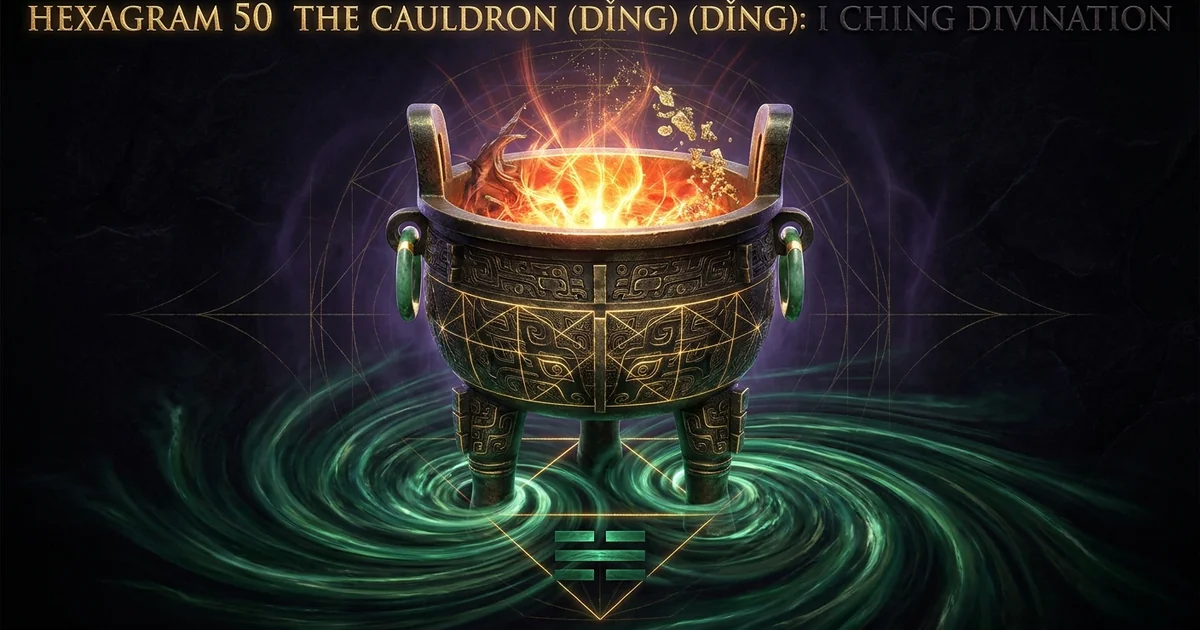
Hexagram 50 The Cauldron (Ding) (Dǐng): I Ching Divination
Archetypal Thesis & Systemic Paradigm: The Vessel of Alchemical Transmutation
Hexagram 50 (Dǐng / The Cauldron) designates the supreme cybernetic archetype of alchemical transmutation, energetic phase shift, and cultural-spiritual consolidation within the sixty-four vector space of the I Ching. Positioned immediately subsequent to Hexagram 49, Gé / Radical Change or Molting, Dǐng represents the architectural stabilization and sacred codification of energies liberated by cataclysmic upheaval. Where Gé enacts the entropic dissolution of outworn political, psychological, and somatic forms, Dǐng constructs the sealed, highly regulated vessel required to transmute that raw biomass into enduring cultural order, noetic clarity, and sovereign consciousness.
Rather than serving as a simplistic prognosticator of domestic fortune, Dǐng operates as a psycho-cosmological coordinate framework modeling the precise thermodynamic, systemic, and ontological boundary conditions under which lower-order psychic material undergoes continuous sublimation into higher-order spiritual intelligence.
       Hexagram 50 (Dǐng)
       ─── ───  Line 6 (Yin): Jade Rings
       ───────  Line 5 (Yang): Golden Rings / Yellow Ears
       ───────  Line 4 (Yang): Cauldron's Belly / Legs Collapsing
       ───────  Line 3 (Yang): Vessel Flanks / Blocked Ears
       ───────  Line 2 (Yang): Crucible Core / Inner Sustenance
       ─── ───  Line 1 (Yin): Overturned Legs / Expelling Stagnation
Thermodynamic Architecture of Fire over Wood
The dynamic mechanics of Hexagram 50 derive from its constitutive trigrammatic architecture: the upper trigram is trigram-li (Fire, Radiance, the Clinging), positioned over the lower trigram trigram-xun (Wood, Wind, the Gentle and Penetrating). This specific arrangement—fire over wood—establishes a continuous, non-divergent thermodynamic loop. In primitive combustion mechanics, wood placed beneath flame provides an uninterrupted, self-regulating supply of caloric energy, while the flame above continuously consumes and metabolizes the fuel, converting dense, cellulose mass into radiant heat, photon emissions, and gaseous dispersion.
Unlike volatile thermodynamic configurations—such as Fire over Water (Hexagram 64), where heat ascends away from the element it seeks to alter—the configuration of Dǐng creates a concentrated heating zone. The wind-wood matrix below penetrates and fans the upper flame, maintaining a constant state of controlled energetic excitation. In systemic terms, this is a negentropic cycle: entropy is deliberately channeled through the apparatus of the vessel to forge structural coherence out of chaotic input. The wood gives up its structural identity to fuel the light of consciousness, formalizing the precise energetic law that higher noetic operations require the sustained consumption and integration of lower instinctual drives.
The Vas Hermeticum and Psycho-Spiritual Sublimation
In the terminology of Western Hermeticism and depth psychology, Dǐng is the functional equivalent of the vas-hermeticum—the strictly sealed crucible of alchemical transformation. Carl Gustav Jung, in his fundamental analyses of alchemical iconography, established that the vas is not a physical object, but an individuation-vessel: a continuous, fortified attitude of consciousness capable of containing the most volatile intrapsychic antinomies without cracking under affective pressure. As an archetypal motif, the hermetic vessel prevents the leakage of volatile unconscious contents into somatic symptoms or impulsive acting-out.
+-------------------------------------------------------------+
|                      THE HERMETIC RETORT                    |
|                                                             |
|       [ Radiance / Illumination ]  <-- Upper Trigram Li    |
|                     ▲                                       |
|                     |  Sublimatio / Coagulatio             |
|                     ▼                                       |
|       [ Volatile Biomass / Instinct ] <-- Lower Trigram Xun |
|                                                             |
+-------------------------------------------------------------+
Hexagram 50 constitutes the systemic blueprint for this psychic crucible. It models the sublimatio and coagulatio phases described in classical Hermeticism, wherein crude psychic elements (prima materia) are subjected to intense internal heat until they vaporize, condense, and crystallize into the incorruptible lapis. The vessel must possess an exceptional tensile strength—a synthesis of structural hardness and receptive ductility—to withstand the affective heat generated when ego-consciousness confronts the Shadow and the archetypal depths of the collective unconscious. If the ego identifies completely with the fire, the container melts; if the ego retreats from the fire, the contents freeze in a state of unredeemed instinctual compulsion. Hexagram 50 balances these polarities through its systemic equilibrium: wood continuously feeds the flame, and the flame hovers steadily over the vessel’s base.
Sovereign Nourishment versus Base Sustenance
Within the architectural sequence of the King Wen arrangement, Dǐng must be rigorously distinguished from Hexagram 27, Yí / Providing Nourishment. While Hexagram 27 models the fundamental bio-mechanical vectors of ingestion, metabolic intake, and individual energetic maintenance—the mouth that chews, swallows, and metabolizes caloric sustenance—Hexagram 50 elevates the concept of nourishment into an ontological, ritual, and civilizational principle. The dǐng is not an everyday domestic pot; it is the monumental, three-legged ritual bronze of state religion, reserved exclusively for sacred sacrifices to Heaven and ancestral spirits, and for banqueting the wise and virtuous ministers whose guidance sustains the empire.
Where Yí asks what the biological organism ingests to sustain somatic life, Dǐng asks what a culture or an integrated individual metabolizes to manifest the mandate-of-heaven (Tianming). Dǐng transubstantiates physical matter into meaning, raw grain and meat into consecrated offerings, and disparate psychological drives into an integrated, moral sovereign self. It is the locus where biological survival ends and the generation of transcendent cultural and spiritual values begins.
“THE CAULDRON. Supreme good fortune. Success… Fire over wood: The image of the Cauldron. Thus the superior man consolidates his fate by making his position correct.” Commentary on the Image: “A wood fire burns, and the water boils in the cauldron; out of this comes food. Here a physical phenomenon is made the symbol of a spiritual happening. Everything that is spiritual needs a vehicle, a physical vessel, in order to manifest in the world of time and space. The wood feeds the fire; the fire cooks the food. The superior man, by harmonizing his outer life with his inner nature, consolidates his destiny and brings his life into harmony with the will of Heaven.”
Classical Provenance & Textual Lineage: From Bronze Age Ritual to Neo-Confucian Metaphysics
The historical development of Hexagram 50 reflects the evolution of Chinese metaphysical thought from Shang-Zhou ritual metallurgy to the sophisticated ontological and ethical systems of the Song Dynasty Neo-Confucian scholars. At every stage of this lineage, the vessel retains its position as the ultimate physical-metaphysical interface connecting terrestrial society with cosmic order.
The Shang-Zhou Bronze Dǐng as Sacral-Political Legitimacy
In Bronze Age China (c. 1600–256 BCE), the dǐng was the paramount material symbol of legitimate political sovereignty and direct cosmological communion. The mythical Nine Tripod Cauldrons (Jiǔ Dǐng), reputedly cast by Yu the Great following the subjugation of the primordial floodwaters, served as the physical palladium of the Chinese realm. Transfer of the Nine Tripods from the Xia to the Shang, and subsequently to the Zhou Dynasty, signified the translatio imperii—the explicit physical transfer of the Mandate of Heaven. To possess the dǐng was to command the energetic axis where Heaven, Earth, and humanity intersect.
       Cosmic / Ancestral Spheres (Heaven: Qian)
                         ▲
                         │  Sacrificial Vapors / Transmutation
                         ▼
        Ritual Bronze Cauldron (Human Realm: Ding)
                         ▲
                         │  Raw Biomass / Instinctual Harvest
                         ▼
          Terrestrial Domain (Earth: Kun)
The physical dǐng was an architectural marvel of high-tin bronze alloy, casting massive weight into three stout legs (embodying structural triadic stability) and a hollow hemispheric belly flanked by two opposing ear-handles (ěr), through which carrying rings or carrying poles were passed. It stood as a permanent architectural mediator: into its bronze belly were placed raw flesh, sacred herbs, and libations; subjected to subterranean flame, these base elements were converted into ascending vaporous aromas designed to feed ancestral spirits, while the boiled, purified essence was distributed to noble dignitaries. The vessel was therefore the technological instrument through which raw material nature was consecrated into civilizational order.
Wang Bi’s Ontological Exegesis of Emptiness and Containment
With the advent of the Neo-Daoist Xuanxue (“Dark Learning”) movement in the Third Century CE, Wang Bi radically re-conceptualized the I Ching, rescuing the text from the mechanistic, omen-obsessed Han Dynasty xiangshu (image and number) scholasticism. In his commentary on Hexagram 50, Wang Bi shifted the analytical focus away from the material bronze object toward the profound structural metaphysics of containment, receptivity, and operational emptiness (wú).
Wang Bi recognized that the transformative agency of the dǐng does not reside in its bronze mass, but in its interior void. The crucible can only cook, transmute, and sublimate because it contains an open, unconditioned space capable of receiving disparate inputs. Drawing upon the core thesis of Chapter 11 of the Daodejing (“Shape clay into a vessel; it is the space within that makes it useful”), Wang Bi demonstrated that the ruler—or the cultivated individual—attains the spiritual potency of the Cauldron precisely by maintaining an unattached, empty center. By remaining vacuous, non-coercive, and radically receptive, the superior individual allows the talents of all beings to enter the crucible, where they are naturally harmonized and cooked without the distortion of subjective egoic will.
“The Ding is an implement by which one cooks and transforms things… What brings about the realization of the Way of the Ding is its handling of the noble and the worthy. To cook and transform raw things into something cooked is to take what is crude and make it into something refined; to turn what is hard into something tender. If the ruler can truly handle the noble and the worthy, he will gather the finest talents of the world into his court and bring them to mature fruition, just as the Ding cooks raw food into an offering worthy of the spirits.”
Cheng Yi and the Neo-Confucian Moral Metallurgy
During the Song Dynasty, the rationalistic Neo-Confucian master Cheng Yi developed this exegesis into a rigorous system of moral metallurgy and psychosomatic discipline in his Yichuan Yizhuan. For Cheng Yi, Hexagram 50 is not an external talisman of political legitimacy, but an urgent internal cultivation rubric (xiūshēn). The human mind-heart (xīn) and physical form (qìzhì zhī xìng) are viewed as a turbid, raw vessel fouled by selfish desires (rènyù) and unregulated affective surges.
Cheng Yi asserts that the individual must subject their somatic and mental substrate to the intense moral heat of Principle (Lǐ). The Cauldron becomes an internal psychological apparatus wherein base passions are boiled away, stubborn habitual patterns are melted down, and the innate, radiant luminous nature of Heaven (Tiānmìng zhī xìng) is restored to pristine functionality. The cultivation of the self requires three continuous operational phases:
- Clearing out old, coagulated residues (Line 1);
- Maintaining a resolute, morally upright interiority capable of bearing caloric stress (Lines 2 and 3);
- Ensuring that outer conduct remains tempered by yielding, benevolent wisdom (Lines 5 and 6).
Cheng Yi’s exegesis transformed the Cauldron into the definitive classical model of psycho-ethical self-rectification.
Structural Mechanics & Symbolic Geometry: Anatomy of the Six Lines and Trigram Dynamics
The architectural coherence of Hexagram 50 is sustained by a direct, line-by-line isomorphism with the physical anatomy of the classical ritual vessel, paired with a dynamic interior tension revealed through its nuclear matrix.
Hexagram Structure:
Line 6: ─── ─── (Yin)  = Jade Rings (Transcendence / Restraint)
Line 5: ─────── (Yang) = Golden Rings / Yellow Ears (Receptive Authority)
Line 4: ─────── (Yang) = Vessel Belly / The Breaking of the Legs (Structural Overload)
Line 3: ─────── (Yang) = Cauldron's Flanks (Blocked Transformation)
Line 2: ─────── (Yang) = Crucible Core (Contained Internal Energy)
Line 1: ─── ─── (Yin)  = The Legs (Overturned to Expel Stagnant Slag)
Trigram Polarity: Li (Radiance/Clarity) over Xun (Penetration/Flexibility)
The macro-cosmological stability of Hexagram 50 rests upon the complementary interaction of its primary trigrams:
- Upper Trigram: Li (☲ - Fire). Li is characterized by internal emptiness embraced by external solid lines; it embodies brightness, lucidity, visual discrimination, and spiritual ascension. In the Cauldron, Li constitutes the active, transformative heat radiating upward and illuminating the sacrificial feast.
- Lower Trigram: Xun (☴ - Wind/Wood). Xun consists of a broken yin line beneath two solid yang lines; it represents yielding penetration, flexibility, sustained pneumatic momentum, and organic wood. Xun enters subtly from below, fanning the flame and providing the dense substance that sustains combustion.
Because Xun acts from beneath with unyielding gentleness, the flame of Li does not consume its fuel in a violent, catastrophic flare-up. Rather, it maintains a precise, homeostatic temperature. In cybernetic systems analysis, this represents a dynamically stable feedback loop: the output of radiant awareness (Li) is continuously calibrated by the gentle, penetrating input of instinctual material (Xun). The dynamic prevents both psychic burnout (hyper-combustion) and melancholic stagnation (cessation of thermal circulation).
Line Progression as Vessel Anatomy: Legs, Belly, Ears, and Rings
The six lines of Hexagram 50 construct a literal somatic and mechanical mapping of the ritual vessel, demonstrating a rigorous progression from the ground to the spiritual heights:
- Initial Yin (Line 1): The cauldron is overturned. A good thing for getting rid of stagnant stuff. One takes a concubine for the sake of her son. No blame. This line represents the legs (zú) of the tripod upturned before the commencement of the sacred rite. Before an alchemical process can unfold, all calcified remnants, toxic sludge, and stagnant detritus of previous operations must be ruthlessly tipped out. It is a purgative, cathode phase.
- Second Yang (Line 2): There is food in the cauldron. My comrades are afflicted, but they cannot harm me. Good fortune. This line enters the lower belly of the vessel. The heat begins to rise; the raw ingredients are safely enclosed. Yang strength in the central, solid position indicates profound internal psychic integrity. External negative influences or projection dynamics cannot disrupt the transformational interiority.
- Third Yang (Line 3): The handle of the cauldron is altered. One is impeded in his way of life. The fat of the pheasant is not eaten. Once rain falls, remorse is spent. Good fortune comes in the end. Occupying the transitional sector of the vessel’s flanks, this line represents heat without immediate utility. The handles are displaced, rendering the vessel unmovable; the rich culinary stew (pheasant fat) cannot yet be ingested or shared. There is a temporary blockage in systemic transmission, requiring the patient integration of moisture (rain/yin balance) before the cooked material can be assimilated.
- Fourth Yang (Line 4): The legs of the cauldron break. The prince’s stew is spilled, and his person is soiled. Misfortune. This represents the catastrophic structural failure of the vessel. The fourth line carries immense systemic weight, poised at the transition between the lower and upper trigrams. When an individual takes on high-voltage spiritual tasks or authoritative responsibilities without possessing the commensurate moral caliber and structural maturity, the legs buckle under the mass. The sacred nourishment crashes to the earth, resulting in personal humiliation and civilizational catastrophe.
- Fifth Yang (Line 5): The cauldron has yellow ears and golden rings. Perseverance furthers. Here the vessel reaches its operational perfection at the level of the carrying handles (ears). Yellow is the median color of the earth, signifying deep balance, moral humility, and centeredness; gold denotes incorruptible structural integrity. The vessel can now be engaged safely; spiritual realization is mediated through balanced, receptive governance.
- Top Yin (Line 6): The cauldron has rings of jade. Great good fortune. Nothing that would not further. The apex of the hexagram transcends rigid metallic hardness. Jade combines indestructible density with a smooth, soft, translucent luster. It represents the highest spiritual attainment: power and wisdom tempered by supreme compassion, flexibility, and detachment. The alchemical work is complete; the vessel has become fully luminous.
Nuclear Hexagram 43 (Guai) and the Expulsion of Impurity
Beneath the outer appearance of Hexagram 50 operates an intensive internal engine revealed through its nuclear trigrams (hùguà). Extracting lines 2-3-4 yields the lower nuclear trigram trigram-qian (☰ - Heaven, Creative Indestructibility), and lines 3-4-5 yield the upper nuclear trigram trigram-dui (☱ - Lake, Joyous Openness). The resulting nuclear-hexagram is Hexagram 43 (Guài / Breakthrough, Resolution).
       Hexagram 50 (Dǐng)             Nuclear Hexagram 43 (Guài)
       Line 6: ─── ───                Line 6: ─── ─── (Dui: Upper Nuclear)
       Line 5: ─────── ──┐            Line 5: ───────
       Line 4: ─────── ──┼── Dui      Line 4: ───────
       Line 3: ─────── ──┼──          Line 3: ─────── (Qian: Lower Nuclear)
       Line 2: ─────── ──┘   Qian     Line 2: ───────
       Line 1: ─── ───                Line 1: ───────
This structural reality exposes the hidden imperative operating within Dǐng: Hexagram 43 consists of five yang lines rising aggressively to decisively expunge a single, corrupt yin line at the zenith. The presence of Guài within the core of the Cauldron indicates that alchemical transmutation is not an indolent or passive process of slow warming. It demands the continuous, resolute expulsion of unintegrated shadow material, moral vacillation, and unconscious sludge. The interior of the Cauldron must be sustained by diamond-hard clarity (Qian) and expressive ethical lucidity (Dui). Transmutation is impossible without the systemic will to excise lower-order corruptions.
Psychological Dynamics & Operational Praxis: The Cauldron as Clinical and Meditative Vessel
In archetypal analysis and clinical psychotherapy, Hexagram 50 manifests as an imperative toward total containment praxis. When this hexagram appears within an analytical consultation, it signals that the querent must immediately halt all external acting-out, cease premature projective activity, and enter a state of deliberate psychical incubation.
The Therapeutic Retort: Transmuting Shadow and Affective Flooding
When an analysand undergoes severe affective flooding—confronting archetypal imagery, acute crisis, or traumatic complexes—the immediate clinical danger is structural disintegration: the ego identification system fractures, inducing psychosis, panic states, or destructive behavioral enactments. Under the archetype of Dǐng, the therapeutic container (temenos) must function as the unbreakable bronze vessel.
The therapist and client must establish a secure holding environment—the analytic individuation-vessel—where negative projections, instinctual rage, and primitive desires are not judged or acted upon, but subjected to steady, non-reactive reflection. This corresponds directly to the alchemical operation of calcinatio: burning away the egotistical claims and personal illusions through conscious suffering, without allowing the emotional heat to rupture the frame of therapy. By sustaining containment, the raw energy bound within neurosis and trauma is detached from somatic paralysis and transmuted into self-reflective insight.
Hexagram 49: Ge (The Molting / Radical Fire)
- Thermodynamic Dynamic: Fire within Water (Combustion / Collision).
- Operational Phase: Dissolution, shattering of outworn forms, active rebellion.
- Systemic Vector: Centrifugal; destroys the container to liberate captive energy.
- Psychological Parallel: Acute crisis, cognitive breakthrough, tearing down obsolete ego-defenses.
Hexagram 50: Ding (The Cauldron / Sacred Vessel)
- Thermodynamic Dynamic: Fire over Wood (Regulated, Sustained Combustion).
- Operational Phase: Sublimation, crystallization of novel values, sacred order.
- Systemic Vector: Centripetal; builds and fortifies the container to concentrate energy.
- Psychological Parallel: Integration, individuation container, long-term stabilization of the Self.
Diagnostic Protocols for Line Transitions in Divination Consultations
Within an operational divination praxis utilizing the yarrow stalks or coin oracle, changing lines in Hexagram 50 reveal precise vulnerabilities or advancements in the querent’s capacity to sustain transformation:
- Line 1 Changing (to Hexagram 14, Da You): Diagnostic of purgative purification. The querent must deliberately overturn their existing mental models, habits, or relationship structures to discard dead psychic waste. Far from being an omen of failure, this inversion is a mandatory prerequisite for systemic abundance (Da You).
- Line 2 Changing (to Hexagram 56, Lu): Diagnostic of inner self-sufficiency amidst outer instability. The inner contents are secure. Even if the surrounding environment is alienated, hostile, or transient (Lu / The Wanderer), the querent possesses sufficient inner spiritual capital to ignore external provocation.
- Line 3 Changing (to Hexagram 64, Wei Ji): Diagnostic of uncalibrated timing and unintegrated heat. The querent possesses authentic psychic insights or artistic materials, but the handles are misaligned: the outer world cannot receive their offerings yet. The prescription is radical patience; prematurely forcing transmission results in bitter frustration. One must wait for the atmospheric cooling (rain) before serving.
- Line 4 Changing (to Hexagram 18, Gu): A catastrophic warning of system collapse through overreach. The querent is taking on spiritual mandates, institutional leadership, or energetic loads that vastly exceed their structural integrity, character maturity, or somatic capacity. The legs of the tripod snap, resulting in corruption, scandal, and systemic breakdown (Gu). The immediate directive is severe ego-deflation and structural repair.
- Line 5 Changing (to Hexagram 44, Gou): Diagnostic of centered, receptive authority. The querent exercises influence not through aggressive dominance, but through the magnetic presence of balanced character (yellow ears). The encounter (Gou) with raw, untamed forces can be mediated safely because the vessel’s handles are pure.
- Line 6 Changing (to Hexagram 32, Heng): The culmination of spiritual attainment. Structural hardness is integrated with jade-like gentleness and compassion. The internal transformation has become an enduring, immutable state of being (Heng / Duration). The querent operates as an enlightened conduit for transpersonal energy.
Active Imagination and Internal Qi Metallurgy (Neidan)
In Daoist Internal Alchemy (neidan-internal-alchemy), Hexagram 50 is the primary technical glyph representing the alignment of the human energetic anatomy for the cultivation of the Golden Elixir (Jindan). The practitioner’s body itself is the dǐng:
          [ Upper Dantian / Niwan (Shen: Spirit) ]
                             ▲
                             │  Alchemical Vapor (Sublimation)
                             │
            [ Middle Dantian / Heart (Qi: Fire / Li) ]
                             ▲
                             │  Thermal Circulation
                             │
      [ Lower Dantian / Mingmen (Jing: Essence / Xun) ]
The lower trigram Xun represents the gentle, rhythmic circulation of the breath (the bellows, tuòyuè) interacting with the primordial sexual essence (Jing) stored in the kidneys and the Lower Dantian (the lower crucible). The upper trigram Li represents the heart-fire, luminous consciousness, and the spirit (Shen) resident within the Middle and Upper Dantians.
Through focused meditative stabilization (Active Imagination and embryological breathing), the practitioner prevents the heart-fire from racing impulsively outward into sensory desires. Instead, the fire is directed downward into the Lower Dantian, warming the waters of the Jing. The Jing is thus boiled, transmuting into refined Qi; this Qi ascends through the Governing Vessel (Du Mai) to the crown, condensing as celestial dew that showers back down the Conception Vessel (Ren Mai) into the Lower Dantian, where it solidifies as the Immortal Embryo. Hexagram 50 is the structural map of this precise internal energetic circuit.
Philosophical Synthesis & Macrocosmic Correspondence: Hermetic, Genetic, and Astrological Parallels
The archetypal architecture formalized by Hexagram 50 extends far beyond ancient Chinese divinatory literature; it represents a fundamental cosmological constant observable across comparative esoteric cartographies and molecular biology.
+-------------------------------------------------------------------------+
|                  CROSS-SYSTEMIC CORRESPONDENCE MATRIX                   |
+-------------------+-----------------------------------------------------+
| Domain            | Systemic Mapping for Hexagram 50                    |
+-------------------+-----------------------------------------------------+
| Human Design      | Gate 50: The Cauldron of Values (Spleen Center)     |
| Western Astrology | Fixed Fire (late Leo) into Mutable Earth (Virgo)    |
| Hermetic Alchemy  | Coagulatio / Calcinatio / The Pelican Retort        |
| Genetics          | Amino Acid Synthesis & Polypeptide Folding Chains   |
| Kabbalah          | Tiphareth mediated by Yesod (Form holding Light)   |
+-------------------+-----------------------------------------------------+
Genetic Codon Mapping and Molecular Transcription
In the research paradigms pioneered by Martin Schönberger and subsequent computational biophysicists examining the structural isomorphism between the 64 hexagrams of the I Ching and the 64 codons of the universal genetic code, Hexagram 50 occupies an integral programmatic position. If the DNA double-helix is understood as a dynamic, linguistic repository of potential human evolution, the Cauldron corresponds precisely to the molecular transcription apparatus: the ribosome.
The ribosome functions as a cellular biological crucible. It is a dense, highly structured macromolecular machine that receives raw, non-differentiated amino acids (the raw biomass of Xun) and, guided by the luminous informational templates of messenger RNA (the radiant instruction set of Li), subjects these components to precise peptide bonding. It cooks raw chemical chaos into folded, tertiary protein structures that determine the biological vitality and functional architecture of the organism. Hexagram 50 is the cipher for this programmatic bio-synthesis, demonstrating that form cannot coalesce without a boundary condition capable of catalyzing molecular transformation.
Astrological Decans and the Fixed Fire of Sublimation
Within comparative astrological hermeneutics, Hexagram 50 aligns with the transition from the fixed fire of Leo Decan III to the critical containment of Virgo Decan I. Leo III embodies the maximum sovereign radiant expression of solar consciousness, the peak of heroic will and creative power. However, without containment, pure solar fire dissipates into barren, entropic arrogance or burns out its substrate.
The Cauldron provides the structural transition where this sovereign solar flame is captured, disciplined, and directed into the meticulous, sacred service of Virgo. It is the fixed fire contained within the earthen crucible. In classical Western astrology, this dynamic invokes the myth of Hephaestus/Vulcan: the subterranean divine smith who works at the forge, using intense volcanic heat enclosed within stone kilns to forge the armor and sacred implements of the gods. The Cauldron resolves the eternal esoteric tension between pure spirit (fire) and physical limitation (earth) by showing that spirit can only achieve historical and cultural permanence when it willingly inhabits and hallows the material vessel.
Human Design Gate 50: The Cauldron of Values and Tribal Guardianship
In the Human Design matrix—a synthesis of the I Ching, Kabbalah, Astrology, and the Hindu-Brahmanic Chakra System—the hexagram corresponds to human-design-gate-50, officially designated as the Gate of Values (The Cauldron), situated within the Spleen Center.
Gate 50 resides at the structural core of the Defense Circuit (Tribal Circuit). The Spleen Center operates on the frequencies of primitive somatic survival, physical health, and instinctual awareness. Here, Gate 50 executes a foundational role: it serves as the psychological and legal cauldron of the tribe, responsible for brewing, maintaining, and defending the historical values, moral boundaries, and custodial rules that protect the community’s offspring. Gate 50 is the source of tribal conscience.
In the operational mechanics of this gate:
- The raw survival instinct of the tribe is cooked into ethical codes, communal laws, and legal safeguards.
- It operates as an energetic filter, scanning incoming behaviors and determining what must be preserved to sustain collective life and what must be excised as toxic or corrupting.
- If Gate 50 is compromised or unintegrated, the values of the tribe degrade; custody breaks down, the “legs break,” and the spiritual nourishment of future generations is spilled upon the earth.
- When functioning with structural integrity, Gate 50 ensures that evolutionary continuity is maintained through the stable guardianship of sacred, transgenerational wisdom.
- Human Design BodyGraph: Gate 50, Spleen Center. Connects via the Channel of Preservation (50-27) to Gate 27 (Nourishment) in the Sacral Center. This biological circuit links instinctual somatic fuel directly to the cauldron of cultural law and spiritual preservation.
- Astrological Coordinates: Approximately 26°00’ Leo to 01°30’ Virgo.
- Alchemical Axiom: Fac totum quod vis, sed custodi vas (“Do what you will, but guard the vessel”).
- Jungian Archetype: The Archetypal Self as the Temenos / The Alchemist executing Sublimatio.
Frequently Asked Questions
How Does Hexagram 50 Differ Mechanically from Hexagram 27 (Nourishment)?
While both hexagrams deal fundamentally with consumption and the distribution of energy, their structural geometry and systemic scope operate on entirely different cosmological levels:
- Hexagram 27 (Yí): Structurally depicts an open mouth: an unbroken line at the base and the summit, containing four receptive, broken lines within. It represents the direct, personal intake of nutrition, the bio-mechanical mechanics of eating, metabolic processes, and the linguistic discipline of speech (what enters and exits the biological mouth). Its domain is individual psychosomatic survival.
- Hexagram 50 (Dǐng): Depicts an objective, technological, and ritual artifact: a tripod vessel designed for communal consecration, sacrifice to the ancestors, and the elevation of society. Dǐng takes the metabolic fuel generated by Yí and subjects it to sacred sublimation. Yí sustains the body; Dǐng transforms culture, sanctifies political power, and transmutes base psychic instincts into spiritual awareness.
What Is the Precise Warning of the Catastrophic Fourth Line?
Line 4 of Hexagram 50—“The legs of the cauldron break. The prince’s stew is spilled, and his person is soiled. Misfortune”—is among the most stark and unequivocal diagnostic warnings in the entire I Ching.
Mechanically, this line occupies an overloaded position at the base of the upper trigram Li. It represents an individual or institution that has pursued advancement, acquired authority, or accepted high spiritual transmission without establishing the necessary somatic, psychological, and moral foundations. The “prince’s stew” represents the highest, most concentrated spiritual or civilizational nourishment. If the vessel’s support apparatus—its ethical discipline, psychological integration, and material stability—is brittle or structurally deficient, the sudden descent of this transpersonal energy causes an immediate mechanical failure. The legs buckle; the sacred contents are desecrated on the ground, and the querent suffers severe psychological collapse, public disgrace, or systemic ruination.
How Does One Operationally Apply the Jade Rings of the Sixth Line in Daily Practice?
The sixth line represents the absolute zenith of the alchemical process, where the golden rings of worldly authority are crowned with rings of pure jade. To operationalize this archetypal state in daily life, one must balance power with absolute softness:
- Soft Strength: Bronze and gold are hard, heavy, and metallic; left to themselves, they become rigid, coercive, and sharp. Jade, while immensely durable, possesses a gentle, cooling, non-aggressive tactile quality. It does not cut or bruise.
- Transcendent Utility: In practical situations, the “jade rings” imply that one must guide others, manage complex institutions, or wield immense psycho-spiritual power without imposing brute force. It is the mastery of governance through complete yielding, non-attachment, and luminous compassion.
- Effortless Containment: The querent achieves their objectives not by fighting resistance, but by embodying an unassailable inner purity and equilibrium that naturally disarms hostility and safely carries the heaviest loads without strain. :::