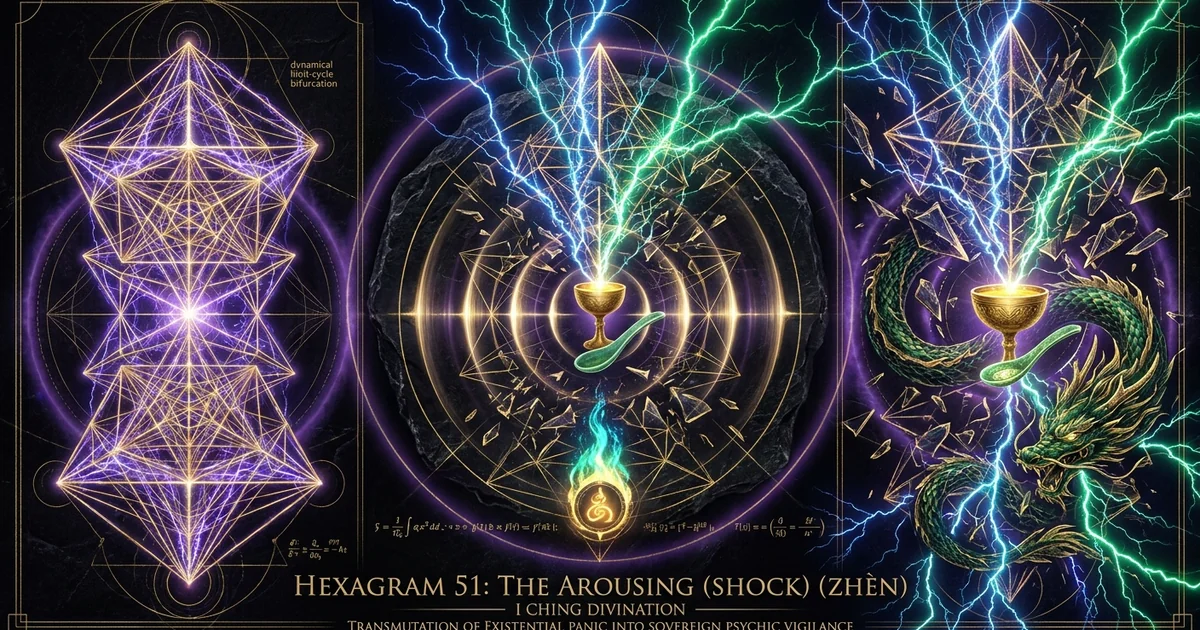
Hexagram 51 The Arousing (Shock) (Zhèn): I Ching Divination
Archetypal Thesis & Systemic Paradigm: The Anatomy of Disruptive Awakening
Hexagram 51 (Zhèn, 震), constituted by the doubling of the primary trigram Zhèn (Thunder over Thunder), represents a non-linear phase transition in psycho-cosmological topology where acute catastrophic disruption shatters calcified homeostatic equilibrium to induce individuation and metaphysical vigilance. Far from serving as a mere prognostic omen of misfortune or an index of external calamity, the zhèn hexagram delineates an archetypal awakening mechanism wherein sudden entropic shock collapses obsolete psychic architecture, catalytically transmuting reflexive terror into sovereign equanimity and ritual order. In the analytical lexicon of the book of changes divination, Zhèn operates as the divine thunderclap: the ontological rupture that tears open the sealed horizon of egoic complacency.
Catastrophic Bifurcation and Non-Linear Dynamics in Psychic Equilibria
From the vantage point of non-linear dynamics and complex systems theory, consciousness remains prone to dynamic sclerosis, wherein self-reinforcing homeostatic feedback loops preserve an outdated baseline at the expense of systemic adaptation. In such states of thermodynamic capture, minor iterative adjustments are insufficient to dislodge the organism from its local energetic minimum. Hexagram 51 models the exact coordinate of a catastrophic bifurcation: a sudden, high-magnitude perturbation that forces an open system across a critical threshold into a far-from-equilibrium state.
[ Baseline Homeostasis ]
                  │
                  ▼  (Systemic Entropic Sclerosis)
       [ Metastable Equilibrium ]
                  │
       ═══════════╪════════════ (Hexagram 51 / Zhèn Disruption)
                  │
        [ Catastrophic Bifurcation ]
         ┌────────┴────────┐
         ▼                 ▼
[ Pathological Collapse ]  [ Dissipative Reorganization ]
(Fixation / Panic)         (Individuation / Equanimity)
The dynamic of doubled Thunder signifies that the perturbation is neither singular nor transient; it arrives in successive wave-trains that destabilize both the external operational field and the internal subjective core. This structural shock instantly dissolves the illusion of unilateral control maintained by the conscious ego. By accelerating the entropy of prevailing cognitive and social matrices, Hexagram 51 does not eliminate structure; rather, it exposes structural vulnerability, driving consciousness across an evolutionary precipice where the only viable alternative to catatonic breakdown is self-organization at a higher tier of systemic complexity.
The Archetype of the Arousing: From Destabilizing Terror to Coherent Metanoia
Within archetypal psychology, the subjective experience of terror (kǒng, 恐) accompanying the onset of the zhèn hexagram is not a pathological defect, but an indispensable somatic index of psychic reorganization. The classical formula posits: “Shock brings terror, then laughing words.” This dialectic illustrates an emotional and cognitive metanoia—a radical repolarization of awareness. The primary dread signals the instantaneous collapse of the persona, the rupture of protective character armors, and the involuntary confrontation with the transpersonal numinosum.
“The encounter with the archetypal numinosum invariably induces what Rudolf Otto termed the mysterium tremendum—a terrifying shock that paralyzes the conscious ego by confronting it with a force manifestly superior to mortal design. Yet it is precisely through this acausal, disruptive impact that the individual is severed from participation mystique and propelled into the crucible of individuation. The shock is the catalyst; the subsequent laughter is the realization that the sovereign Self remains uninjured by the destruction of its provisional forms.” — Carl Gustav Jung, Collected Works, Vol. 9/I: Archetypes and the Collective Unconscious, cross-referencing Marie-Louise von Franz, On Divination and Synchronicity
When the initial thunderclap echoes across a hundred leagues, it generates panic precisely because the secular mind mistakes its operational models for ontological reality. The terror experienced under Zhèn is an affective somatic acknowledgment of the transcendent order reasserting its primacy over human arrogance. When the disruption is properly integrated, the secondary phase emerges: “laughing words” (xiào yán yá yá, 笑言啞啞). This holy laughter is neither cynical dismissal nor manic denial; it represents the somatic release of unbound psychic energy following the recognition that while the vessel may be shaken, the essential core of awareness remains invulnerable.
Cybernetic Feedback Loops: Shock as an Inductive Error-Correction Signal
Within a cybernetic framework, Hexagram 51 functions as an inductive error-correction signal of maximum gain. In standard regulatory mechanisms, negative feedback dampens oscillations to preserve homeostasis; however, when the governing algorithms of the system become corrupted, negative feedback only preserves pathology. Zhèn introduces an explosive burst of positive feedback that violently amplifies the discrepancies between systemic perception and physical actuality.
By treating the shock as an informational operator rather than a moral punishment, the adept decodes the crisis as an epistemic intervention. The sudden intrusion of the unexpected breaks open deterministic behavioral loops, terminating obsolete trajectories and resetting the perceptual sensors. In the broader mechanics of hexagram 51 the arousing (shock) iching meaning, the thunder operates as the cosmic clock-pulse, re-synchronizing mortal praxis with the Tao by sweeping away the noise of accumulated rationalizations and laying bare the raw signal of raw existential truth.
Classical Provenance & Textual Lineage: Transmission of Zhèn through the Canon
The canonical transmission of Hexagram 51 across three millennia reflects a continuous hermeneutic refinement, mapping the movement of cosmic force through liturgical discipline and ethical self-rectification. Recorded in the foundational strata of the Zhouyi, Zhèn crystallizes the moment when the primordial creative impulse bursts through the inertia of the earth, demanding absolute presence and liturgical precision from those charged with maintaining universal balance.
The King Wen Sequence: Contextualizing Hexagram 51 Following Hexagram 50 (The Cauldron)
Within the architecture of the king-wen-sequence, Hexagram 51 occupies a pivotal structural position immediately following Hexagram 50 (The Cauldron, Dǐng). This sequential placement is deeply deliberate and analytically profound. Hexagram 50 establishes the alchemical vessel, the sacred crucible of culture, statecraft, and internal spiritual sublimation; it consolidates the nourishment of the wise and refines raw material into divine nectar. Yet, systemic calcification lurks within sustained refinement: once the vessel is forged and the spiritual nourishment prepared, the system risks stagnation in self-satisfied aestheticism or dogmatic ritualism.
Thus, Hexagram 51 follows Dǐng to test the structural integrity of the vessel. The alchemical vessel that cannot withstand the seismic tremors of Zhèn is revealed to be fragile porcelain rather than forged bronze. The King Wen sequence establishes that spiritual refinement without dynamic resilience is impotent; the vessel must be plunged into the forge of actual disruption. Immediately succeeding Zhèn stands Hexagram 52 (Keeping Still, Gèn), the mountain that halts the oscillation, demonstrating an exquisite rhythmic progression: refinement (50), followed by seismic testing (51), resolved into transcendent stillness (52).
The Judgment and Image: Liturgical Integrity Amidst Seismic Tremors
The classical text of the Judgment (Tuan Zhuan) and the Great Image (Da Xiang) articulates the central spiritual protocol for navigating existential shock. The archetype is not one of hyperactive response, but of unwavering ritual presence at the high altar of the cosmos.
The Judgment: “Shock brings success. Shock comes—oh, oh! Laughing words—ha, ha! The shock terrifies for a hundred miles, And he does not drop the sacrificial spoon and chalice.”
The Great Image: “Thunder repeated: the image of Shock. Thus in fear and trembling The superior person sets their life in order And examines themself.” — Richard Wilhelm and Cary F. Baynes, The I Ching or Book of Changes (1950)
The image of the officiant who “does not drop the sacrificial spoon and chalice” (bù sàng bǐ chāng, 不喪匕鬯) provides the supreme standard of metaphysical composure. In the ancestral temple, the sacrificial spoon was utilized to pour fragrant, herbal libation wine to invoke and commune with the spirits of the ancestors. The seismic tremor of Zhèn strikes terror across an immense perimeter—a hundred leagues—causing the uninitiated populace to flee in absolute disarray. Yet, the sovereign adept remains anchored at the liturgical axis. The nervous system of the adept registers the tremor without losing motor control or ceremonial intent; not a single drop of the sacred libation wine is spilled. This imagery demonstrates that spiritual sovereignty is measured by the capacity to preserve operational coherence and sacred duty under conditions of acute shock.
Exegesis of Wang Bi and Neo-Confucian Commentators on Sacrificial Sovereignty
In his seminal third-century commentary on the Zhouyi, the brilliant Neo-Daoist philosopher Wang Bi unpacked the subtle mechanics of the single yang line operating beneath receptive pairs. Wang Bi observed that Zhèn achieves its dynamic majesty precisely because the firm line takes the primary, initiating position at the base of the trigram, driving upward through structural compliance:
“Zhèn is movement. It begins from below; hence, the single yang line arises beneath the two yin lines. The firm asserts its power over the yielding, initiating action that causes all things to awaken and tremble. The fear it creates is not destructive; it is the arousal that leads to dynamic movement. When the superior man encounters this shock, he turns inward to examine his intentions, knowing that external agitation is but the manifestation of the cosmic mandate demanding rectification.” — Wang Bi, Commentary on the Zhouyi (Trans. Richard John Lynn)
Later Neo-Confucian masters, notably Cheng Yi and Zhu Xi during the Song Dynasty, expanded Wang Bi’s insights into an ethos of personal ethics and systemic vigilance (jìng, 敬). For Cheng Yi, the thunder over thunder represents the continuous self-renewal of heaven. The shock is an ontological demand for self-scrutiny (shēn shěng, 身省). If an individual maintains persistent awareness and internal order during ordinary conditions, the sudden shock will only confirm their alignment; if they are disordered, the shock will scatter them into cognitive ruin. Thus, the sacrificial vessel and the sacred spoon represent the unbroken continuity of the sovereign mind amidst environmental disruption.
Structural Mechanics & Symbolic Geometry: Trigram Doubling and Line Architecture
The structural architecture of Hexagram 51 is a masterclass in dynamic tension, directional vector forces, and symbolic geometry. It is composed of the primary trigram-zhen doubled upon itself, creating a resonant amplification chamber of explosive potentiality within the universal matrix of the bagua.
Thunder over Thunder: Vector Forces of the Lower and Upper Trigrams
The trigram Zhèn (☳) is defined structurally by a single dynamic solid line (Yang) at the bottom, supporting two divided lines (Yin) above. In the spatial mechanics of the bagua, the lowest position represents the subterranean origin of motion, the earth’s interior, or the deep unconscious. When a potent yang force emerges beneath two yin layers, it is structurally compressed. Yin nature is yielding, cold, and downward-tending; yang nature is expansive, hot, and upward-thrusting. The yang line, seeking to ascend, encounters the structural resistance of the overlying yin elements, accumulating kinetic potential until it violently ruptures through the surface. This is the metaphysical signature of thunder, of volcanic discharge, and of vernal sprout emergence.
In Hexagram 51, this explosive dynamic is duplicated: thunder over thunder. The lower trigram represents the internal, subjective, or immediate shockwave, while the upper trigram represents the external, environmental, or systemic replication of the disturbance. The two trigrams resonate at an identical natural frequency, establishing a standing wave of seismic disruption. The lower Zhèn initiates the awakening in the psyche; the upper Zhèn manifests the awakening in the structural domain of circumstance. There is no passive refuge in this hexagram: the lower shock propels the individual outward, while the upper shock demands total operational agility to negotiate the collapsing environment.
Hexagram 51 (Zhèn) Line Matrix:
Line 6: - - (Yin, Upper Trigram)  ── Attenuation / Peripheral Impact
Line 5: - - (Yin, Upper Trigram)  ── Danger of Dissipation / Oscillating Hazard
Line 4: --- (Yang, Upper Trigram) ── Dynamic Impulse Impeded in the Mire
Line 3: - - (Yin, Lower Trigram)  ── Shock Moving Through Senses / Action Required
Line 2: - - (Yin, Lower Trigram)  ── Acute Loss / Ascending the Heights
Line 1: --- (Yang, Lower Trigram) ── Primordial Rupture / Initial Terror to Joy
Nuclear Hexagram Analysis: Hexagram 39 (Obstruction) as the Hidden Core
A mechanical analysis of Hexagram 51 requires an examination of its internal nuclear structure. The nuclear trigrams are extracted from lines 2, 3, 4 (forming the lower nuclear trigram) and lines 3, 4, 5 (forming the upper nuclear trigram).
- Lines 2, 3, 4 of Hexagram 51 consist of: Line 2 (Yin), Line 3 (Yin), Line 4 (Yang). This configuration forms the trigram Gèn (☶, Mountain), the archetype of Keeping Still, Boundary, and Immobility.
- Lines 3, 4, 5 consist of: Line 3 (Yin), Line 4 (Yang), Line 5 (Yin). This configuration forms the trigram Kǎn (☵, Water), the archetype of the Abysmal, Danger, and the Chasm.
The synthesis of nuclear Kǎn (Water) over nuclear Gèn (Mountain) yields Hexagram 39 (Obstruction, Jiǎn). This nuclear dynamic reveals the hidden interior core of Hexagram 51: beneath the deafening roar of thunder and the violent outward movement of doubled Zhèn lies the structural imperative of Jiǎn. Hexagram 39 signifies the presence of an impassable barrier that commands halting, self-examination, and the cultivation of internal virtue rather than reckless forward advance.
Hexagram 51 Line Topology:
Line 6: - - Yin
Line 5: - - Yin  ┐ Upper Nuclear Trigram:
Line 4: --- Yang ┼ Kǎn (☵, Water)
Line 3: - - Yin  ┘ ┬
Line 2: - - Yin  ──┴ Lower Nuclear Trigram: Gèn (☶, Mountain)
Line 1: --- Yang
           ═══════════════════════════════════════════
           Resulting Nuclear Hexagram: Hexagram 39 (Jiǎn, Obstruction)
This structural revelation resolves an apparent paradox in the zhèn hexagram. While the outer trigrams demand awakening and initiate kinetic movement, the nuclear core mandates absolute inner restraint. The shockwave must not be met with uncontrolled kinetic panic; to charge blindly forward in the midst of Zhèn is to plunge directly into the abysmal waters (Kǎn) over the steep precipice (Gèn). The true initiate uses the shock not to sprint blindly, but to pause, recalibrate the inner compass, and achieve the composure modeled by the steady sacrificial spoon.
Line Progression and Vector Transmutations: From Initial Panic to Peripheral Impact
The six lines of Hexagram 51 map an ascending spatial and psychological radius of disruption, moving through distinct operational phases:
- Line 1 (Initial Yang at the Base): The epicenter. Being the only yang line of the lower trigram, this line is the structural root of the shock. The text affirms: “Shock comes—oh, oh! Then follow laughing words—ha, ha! Good fortune.” The direct, unmediated impact is experienced fully; because it is met squarely at the root, the terror exhausts itself rapidly, clearing the perceptual slate and resolving into sovereign joy.
- Line 2 (Yin in the Second Place): The shock threatens material security. The line states: “Shock comes bringing danger. A hundred thousand times you lose your treasures and must climb the nine hills.” Here, the individual experiences sudden secondary dispossession. The strategic mandate is total non-attachment: do not pursue the lost artifacts. Ascend the high ground of transcendental awareness; after seven days, the essential treasures return organically.
- Line 3 (Yin in the Third Place): The shock reaches the transitional threshold between the inner and outer trigrams. “Shock comes and makes one distraught. If shock spurs to action, one remains free of misfortune.” The mind is bewildered by ambient instability. Passivity here induces catatonia; the shock must be translated into active recalibration and ethical movement.
- Line 4 (Yang at the Base of the Upper Trigram): The second thunderclap. However, unlike the clear rupture of Line 1, the dynamic yang impulse of Line 4 is surrounded by yin lines and sinks into structural entanglement: “Shock is mired.” The energy lacks the pure velocity of the primary stroke; the psychic impulse gets trapped in the mud of over-rationalization or environmental resistance.
- Line 5 (Yin in the Fifth Place): The shock oscillates across the ruling axis: “Shock goes and comes along danger. However, there is no loss, only business to attend to.” The disruption surges back and forth; the central ruler does not succumb to panic, but acknowledges the ongoing systemic oscillation, holding the center and attending to the necessary duties without delusion.
- Line 6 (Yin at the Summit): The peripheral boundary of the shockwave: “Shock brings ruin and staring about in terror. To advance brings misfortune. If it has not yet reached us, but only concerns our neighbor, there is no blame.” The disruption has reached catastrophic, disorienting proportions for those who failed to integrate it at the baseline. The sovereign response is profound non-interference and quiet boundary fortification.
Psychological Dynamics & Operational Praxis: Consultative Hermeneutics
In professional consultation, Hexagram 51 operates as a seismic intervention. It confronts both consultant and querent with the immediate reality of psychological disequilibrium, demanding the total abandonment of defensive rationalizations.
Pathological Reaction to Shock
- Somatic Response: Chronic sympathetic activation, tonic immobility (freeze state), sensory fragmentation.
- Cognitive Profile: Neurotic fixation, catastrophic projections, hyper-vigilance devoid of discernment.
- Ego Dynamics: Desperate clutching at collapsing external fixtures; projection of blame onto the objective field.
- Operational Outcome: Systemic bankruptcy, spiritual paralysis, entrapment in the mired sludge of reactive panic.
Initiatory Integration of Zhèn
- Somatic Response: Dynamic nervous system regulation, rapid transition through acute tremor to grounded discharge.
- Cognitive Profile: Metaphysical vigilance (jìng), radical perceptual clarity, holy laughter of liberation.
- Ego Dynamics: Voluntary surrender of obsolete operational models; total alignment with the transpersonal axis.
- Operational Outcome: Preservation of the sacrificial chalice; successful navigation of structural phase transitions.
Autonomic Shock versus Ego Dissolution: Somatic and Archetypal Integration
When Hexagram 51 emerges in a divinatory spread, it signifies that the querent’s autonomic nervous system is likely locked in an acute threat-response circuit. The neurobiology of shock involves immediate subcortical activation: the amygdala overrides cortical deliberation, releasing a cascade of catecholamines that prepare the organism for fight, flight, or tonic immobility. In the somatic experiencing paradigms pioneered by Peter Levine, shock trauma results from kinetic energy that was mobilized by the threat reflex but failed to achieve completion and discharge.
The ancient text of the Zhouyi anticipated this somatic reality with extraordinary clinical precision. The progression from “terror” to “laughing words” encapsulates the natural neurobiological resolution of acute arousal. Laughter, like involuntary neurogenic tremoring, is a physiological discharge mechanism: it vents accumulated sympathetic charge, resets the vagal nerve complex, and restores autonomic flexibility.
The practitioner must ensure that the querent does not short-circuit this sequence by employing intellectualized defenses. The somatic shaking must be permitted to run its course. When the ego allows its provisional control structures to dissolve in the presence of the numinous thunder, it discovers that the deeper substrate of consciousness—the transpersonal Self—remains entirely undisturbed, observing the tremor with quiet, detached amusement.
Consultative Interpretation of Changing Lines in Divinatory Practice
The emergence of moving lines transforms the static geometry of Zhèn into a dynamic blueprint for operational navigation:
- When Line 1 is active: The querent is advised to embrace the initial shock without resistance. It is an immediate, surgical strike against an illusion. The resulting discomfort will be exceptionally brief, yielding breakthrough clarity and liberation. Proceed with confidence; the outcome is highly auspicious.
- When Line 2 is active: The shock will impact resources, status, or cherished positions. The oracle commands: Do not fight for what is falling. Attempting to protect transient assets in the midst of this tremor guarantees injury. Retreat to the inner citadel (“the nine hills”); the loss is temporary, and the fundamental energetic pattern will reconstitute itself once the crisis passes.
- When Line 4 is active: Dynamic energy has stalled in indecision or compromised environments. The querent is attempting to execute a breakthrough, but the vehicle is trapped in psychological sludge (“mired”). Cease aggressive expansion; re-evaluate systemic constraints and wait for the energetic substrate to dry and solidify.
- When Line 6 is active: A warning of acute systemic contagion. The querent is observing the catastrophic collapse of a neighboring system, partner, or ideological framework. Do not intervene heroically; the blast radius is lethal to outside intervention. Fortify boundaries, sustain internal silence, and extract profound lessons from the ruin unfolding across the perimeter.
Operational Hermeneutics: Discerning Personal Exposure vs. Systemic Contagion
A primary interpretive challenge in decoding Hexagram 51 lies in distinguishing between an immediate, personal shock and an ambient, collective contagion. Because Zhèn resonates across a perimeter of “a hundred leagues,” its manifestation is frequently macrocosmic: institutional bankruptcies, ideological shifts, socioeconomic crashes, or family upheavals. The querent often internalizes structural collapses that do not belong to their primary sphere of accountability.
Here, the diviner utilizes the polarity between the inner lower trigram and the outer upper trigram. If the changing lines concentrate in the lower trigram (Lines 1, 2, 3), the disruption is intimate, originating within the querent’s own psychological, somatic, or immediate operational field. The remedy is internal rectification, somatic discharge, and radical self-honesty.
Conversely, if the changing lines cluster in the upper trigram (Lines 4, 5, 6), the shock is predominantly environmental. In this context, the querent is at severe risk of absorbing the ambient anxiety of the collective field. The operational mandate shifts toward liturgical containment: sustaining the center, performing daily rites, holding the sacrificial spoon steady, and refusing to allow external mass hysteria to disrupt internal spiritual sovereignty.
Philosophical Synthesis & Macrocosmic Correspondence: Hermetic Axioms and Genetic Codes
Hexagram 51 serves as an intricate cross-disciplinary node, bridging ancient Afro-Eurasian cosmological mappings with modern structural biology, dynamic astrology, and Western esoteric cartographies.
- I Ching Coordinate: Hexagram 51 (Zhèn, Thunder over Thunder).
- Human Design System: Gate 51 (The Gate of Shock), situated within the Ego/Heart Center; forms the Channel of Initiation (25–51) connecting to the G Center.
- Genetic / Codon Coordinate: Associated with the 51st Gene Key; biochemical codon translating the energetic archetype of Agitation (Shadow) to Initiative (Gift) and Awakening (Siddhi).
- Tarot Archetype: Major Arcana XVI: The Tower (Mars / Peh), representing the sudden lightning strike that shatters man-made edifices of pride to liberate the divine spark.
- Cosmological Vector: East Cardinal Axis, Spring Equinox, Element Wood (Mù), governing the explosive resurgence of the life principle.
Macrocosmic Chronobiology: The Vernal Equinox and Eastern Cardinal Axis
In the structural cosmology of the Later Heaven (King Wen) Bagua, Trigram Zhèn is stationed squarely on the Eastern Cardinal Axis, corresponding precisely to the Vernal Equinox and the dawn of the temporal cycle. In the elemental taxonomy of the Five Phases (wu-xing), Zhèn embodies the purest expression of the Wood Phase (Mù, 木). This is not the flexible, yielding wood of wind and grasses (Trigram Xùn), but the explosive, ascending kinetic power of Hard Wood: the primordial sprout that splits monolithic stone to reach the solar source.
Macrocosmically, Zhèn represents the violent awakening of the Earth following the cold, subterranean dormancy of winter (Trigram Kǎn / North). The dormant creative potency that was preserved and concentrated under the ice is released with volcanic velocity. The thunderclap of the vernal equinox cracks open the seed casing. In biological systems, germination is inherently traumatic: the seed’s protective outer hull must be shattered and torn apart for the embryonic shoot to emerge. Zhèn is this exact moment of developmental rupture—an ontological violence fundamentally necessary for the preservation and evolution of life.
Systemic Symmetry: Human Design Gate 51 (The Gate of Shock) and Genetic Parallels
In modern syntheses such as the Human Design System and the Gene Keys framework, Hexagram 51 is recognized with remarkable diagnostic clarity as Gate 51 (The Gate of Shock). Located within the Heart (Ego) Center, Gate 51 is the lone tribal gate that leaps outward into the individual circuitry through the Channel of Initiation (25–51, The Channel of the Shaman/Priestess), reaching toward the G Center (the seat of the Higher Self and Divine Direction).
Gate 51 represents the mechanical capacity to deliver and absorb shock, utilizing sudden disruption as a competitive or spiritual catapult. In the shadow frequency (Agitation), this dynamic manifests as continuous, anxious hyperactivity—a nervous system chronically jarred by trivialities, lashing out defensively to preempt prospective injury. Transmuted through initiatory trial into the gift frequency (Initiative), it becomes the audacity to step boldly into the unknown, to withstand the shock that breaks everyone else, and to step into the role of the pioneer.
At the ultimate siddhi tier (Awakening), Gate 51 represents the classical lightning-flash of instantaneous enlightenment (satori): the thunderbolt that obliterates the egoic construct in a single stroke, leaving only the pristine awareness of the unconditioned cosmos. Biologically and genetically, this dynamic corresponds to sudden genetic mutations induced by environmental stressors—evolutionary leaps driven by systemic crises that force the organism to rewrite its regulatory code.
The Hermetic Principle of Vibration: Resonating with Cosmic Disruption
The dynamics of Hexagram 51 profoundly articulate the third Hermetic Axiom: The Principle of Vibration—“Nothing rests; everything moves; everything vibrates.” In the Hermetic treatise The Kybalion, mastery of polarity and vibration requires the adept to alter their mental frequency to match the higher spiritual plane, rendering them impervious to the disruptive oscillations of lower circumstances.
When the macrocosmic thunder strikes, the untrained mind attempts to resist the wave through structural rigidity. This resistance is fatal: that which is rigid and unyielding inevitably snaps under the kinetic impact of doubled Zhèn. The Hermetic adept, like the master of Taoist internal alchemy (Neidan), does not resist the shock; instead, they consciously elevate their internal vibration to resonate directly with the source of the lightning. By becoming the thunder, the adept becomes invulnerable to the storm.
The held sacrificial spoon and the undisturbed chalice symbolize this precise Hermetic stabilization: through polar alignment with the eternal, the mortal adept anchors absolute stillness at the very epicenter of absolute vibration.
Frequently Asked Questions: Advanced Divinatory and Hermeneutic Nuances
Differentiating Internal versus External Manifestations of Hexagram 51
A frequent point of confusion in book of changes divination concerns whether Hexagram 51 portends an external crisis (such as the termination of employment, natural catastrophe, or sudden illness) or an internal spiritual or psychological crisis (such as panic attacks, sudden insight, or ego-dissolution).
The answer is derived by examining the relationship between the inner and outer trigrams, as well as the active moving lines. When the lower trigram contains changing lines, the primary locus of the shock is internal: it is a cognitive awakening, an involuntary uprising of repressed unconscious material, or an abrupt somatic symptom that demands immediate recalibration. When the upper trigram moves, the event arrives primarily via the external environmental field.
However, because the macrocosm and microcosm are intrinsically entangled through acausal synchronicity, external shock invariably serves an internal awakening function. Receiving Hexagram 51 confirms that an epistemic intervention has occurred: the boundary between internal psychology and external circumstance has momentarily ruptured, rendering the outer event a precise mirror of the inner necessity for radical change.
The Esoteric Meaning of the Untouched Sacrificial Spoon and Ladle
In classical Chinese ancestral rites, the spoon and chalice (bǐ chāng) were the most sacred liturgical tools, handled exclusively by the chief officiant—the eldest son and legitimate heir of the lineage. The spoon was used to lift and pour the aromatic black-millet wine mingled with herbs, designed to call forth the spirits of the ancestors through scent and presence.
Esoterically, this ritual action represents the unbroken transmission of consciousness: the preservation of the central spiritual thread connecting mortal awareness to the transpersonal realm. For the chalice to drop and the wine to spill means that the shock has severed the lineage—the individual has succumbed to animal instinct, forgotten their spiritual ancestry, and allowed the fire of the altar to be extinguished by ambient panic.
To “not drop the sacrificial spoon and chalice” signifies maintaining the observer consciousness: preserving the sacred axis of internal dignity, focused intent, and conscious communion with the transcendent, regardless of the magnitude of the surrounding seismic disturbance.
Navigating Mutating Line 1 versus Line 6 in Strategic Oracle Interpretation
The strategic divergence between moving Line 1 and moving Line 6 in Hexagram 51 provides one of the most critical polarities in the entire Zhouyi:
- Mutating Line 1 represents direct, foundational immersion. You are at the source of the shock. Do not seek shelter; do not attempt to mitigate the impact. The event is an initiatory blessing disguised as catastrophe. Because you meet it with absolute immediacy, the terror clears quickly and is replaced by joy, relief, and renewed sovereignty. Mutating Line 1 shifts toward Hexagram 16 (Enthusiasm, Yù), demonstrating that integrating this primary thunderclap unlocks tremendous communal harmony and creative vitality.
- Mutating Line 6 represents peripheral contagion and structural exhaustion. Here, the shockwave has reached its outer limit, bringing chaotic disorientation and ruin to those who failed to prepare. The unequivocal instruction is non-involvement: do not attempt to heal, organize, or rectify the system caught in this peripheral blast. The advance brings disaster. You must hold your ground, maintain absolute internal quiet, and observe the boundary. Mutating Line 6 shifts toward Hexagram 21 (Biting Through, Shì Kè), proving that this peripheral collapse requires decisive, surgical separation rather than compassionate entanglement. :::