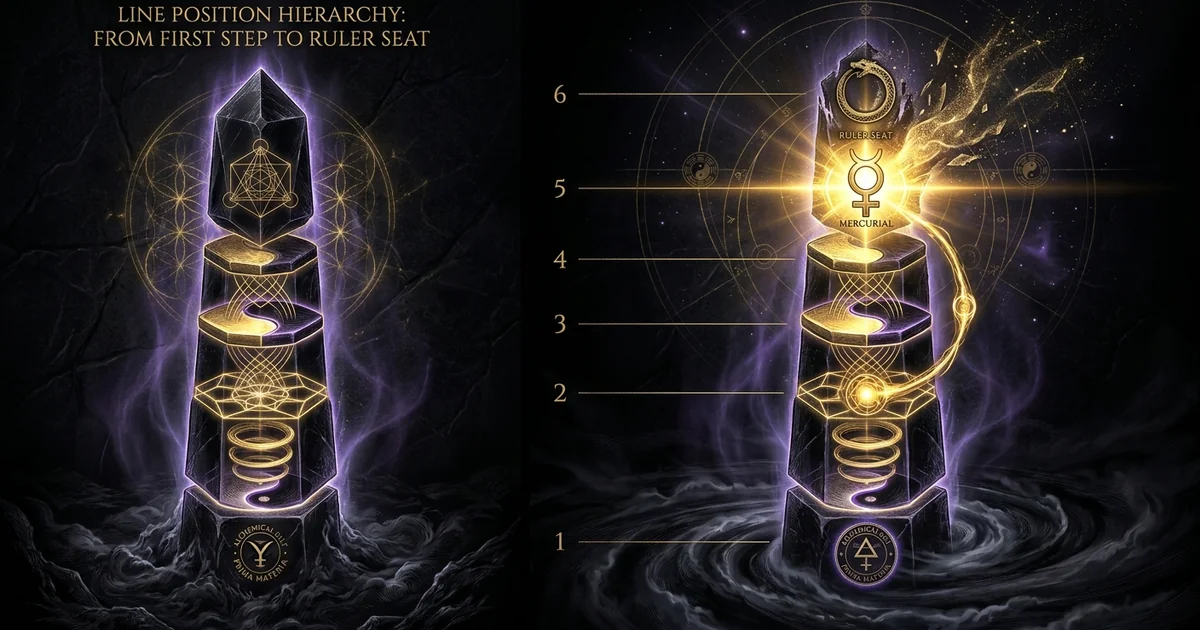
Line Position Hierarchy: From First Step to Ruler Seat
Archetypal Thesis & Systemic Paradigm: The Six-Fold Stratification of Becoming
The architecture of the I Ching hexagram (gua) constitutes an operational, non-linear topological vector space rather than a rudimentary chronological ladder. Within the mechanics of Chinese mantic science, the hexagram is an emergent, six-tiered ontological continuum wherein every level represents a discrete magnitude of systemic agency, systemic drag, and structural vulnerability. Analysts who reduce the spatial hexagram structure to a mere temporal succession—treating the bottom line as the mere “past” and the uppermost line as the mere “future”—strip the system of its cybernetic efficacy. The six positions formulate a dynamic hierarchy of potentiality, manifestation, governance, and entropic decay. In this continuum, energy ascends from unmanifest subterranean latency to sovereign manifestation, only to face phase-transition dissolution at its hyper-extended extremity.
Understanding the iching line positions hierarchy first to sixth requires an appreciation of structural positioning as a deterministic framework. An isolated yin (broken, --) or yang (solid, —) line possesses no intrinsic teleology outside the coordinates of its spatial deployment. A yang line situated at the base of the hexagram behaves as an underground geothermal current: potent, pressurized, yet structurally unequipped for overt geopolitical or macroscopic command. That identical yang line, when elevated to the fifth position, becomes the sovereign axis of the entire systemic field, coordinating peripheral subsystems through centralized authority. The hexagram operates as a phase space whose vertical axis calibrates both structural leverage and operational exposure.
Topological Vectoring of the Hexagrammic Body
The structural topology of the hexagram maps directly to the systemic dynamics of self-organizing networks. In the spatial hexagram structure, the lowest strata represent high-entropy, high-potential inputs, whereas the uppermost strata denote low-entropy, crystallizing outputs that approach structural calcification. As explored in /iching/hexagram-anatomy-mechanics, the hexagram is bifurcated into two trigrammatic engines: the inner (lower) trigram representing subjective, endogenous, and somatic vector forces, and the outer (upper) trigram representing objective, exogenous, and environmental vector forces. The line positions 1, 2, and 3 define the trajectory of internal organization, establishing the root stability, the metabolic cadence, and the boundary friction of the emerging entity.
When the systemic momentum traverses the threshold from the third line to the fourth, it undergoes a qualitative phase transition. The entity crosses the ontological border separating the internal generative matrix from the external administrative domain. Line positions 4, 5, and 6 no longer negotiate internal coherence; they engage systemic friction, macroscopic governance, and trans-systemic dissolution. The vectoring of the hexagram is thus fundamentally asymmetric. The lower positions are characterized by density, direct physical grounding, and reactive operations, while the upper positions are characterized by expansive social coordination, abstract structural management, and the precarious exposure inherent to high systemic altitude.
The Six Steps as a State-Space Progression of Consciousness
When mapped onto the development of consciousness, the iching line positions hierarchy first to sixth delineates the structural conditions of individuation and macroscopic real-world actualization. The progression from Line 1 to Line 6 tracks the systemic life-cycle: raw inception, stable field-level alignment, threshold crisis, executive ministerial execution, sovereign transpersonal integration, and terminal phase exhaustion. Every state-space coordinate carries a non-negotiable tax on agency. At the bottom line, the system enjoys maximal freedom from external observation and social responsibility, yet it suffers from complete political impotence; at the top line, the system transcends the matrix of active governance altogether, yet it risks profound alienation and structural irrelevance if it refuses its own evolutionary demise.
The systemic movement across these six thresholds functions as an iterative algorithm of consciousness. At each successive tier, consciousness confronts a specific class of operational challenge: establishing somatic footing (Line 1), harmonizing with immediate localized environments (Line 2), managing the anxieties of public emergence and structural hubris (Line 3), navigating close proximity to executive power (Line 4), exercising centered systemic dominion (Line 5), and managing the terminal limits of the paradigm itself (Line 6). This progression does not follow a flat, continuous upward slope; it operates as a punctuated equilibrium where the transition across lines requires systemic reconfiguration, sacrifice, and the precise recalibration of identity.
Classical Provenance & Textual Lineage: The Dazhuan and Wang Bi’s Hermeneutics
The architectural formalization of the six line positions received its definitive canonical codification within the Ten Wings (Shi Yi), specifically within the metaphysical and cosmological treatises of the Great Commentary (Xici Zhuan or Dazhuan). The classical authors discerned an absolute isomorphism between cosmological stratification and the political order of the late Zhou dynasty. In the cosmogony of the Dazhuan, Heaven (Tian) operates above as the creative, creative-initiating, and structural pole, while Earth (Di) spreads below as the receptive, spatial, and form-providing matrix. Between these axes operates the human realm (Ren), suspended in a continuous dialectic of adaptation and governance.
The Dazhuan explicitly assigns ontological dignities to mathematical parity. Odd numbers (1, 3, 5) belong to the pure, expansive, creative polarity of Heaven, possessing the energetic qualities of Yang: lightness, initiative, structural hardness, and ascendancy. Even numbers (2, 4, 6) belong to the dense, receptive, contracting polarity of Earth, possessing the qualities of Yin: density, compliance, structural softness, and horizontal spatialization. Through this fundamental binary distribution, the Dazhuan established the structural doctrine of dangwei-proper-place, evaluating the relative systemic equilibrium of any line based on whether its inherent energetic polarity matches the mathematical signature of its vertical seat.
The Great Commentary (Xici Zhuan) on Spatial Dignities
In the systemic grammar of the Xici Zhuan, the spatial disposition of the lines corresponds directly to social stratifications, metaphysical registers, and operational obligations. The Dazhuan observes:
“Heaven is high, the earth is low; thus the creative and the receptive are determined. In correspondence with this difference between low and high, inferior and superior places are established.” (Wilhelm & Baynes, 1950).
This stratification is not an endorsement of rigid feudalism; it is an objective mapping of functional scale. The lowest line represents the common civilian, the foundational soil, or the biological organism in its nascent state. The second line represents the capable local officer, the field magistrate, or the conscious ego anchored in its domestic sphere. The third line signifies the precarious threshold of the minor nobility, the ambitious warrior, or the contested boundary zone.
Ascending into the upper trigram, the fourth line is codified as the high minister, the courtier, or the institutional executive operating in immediate physical and administrative proximity to the head of state. The fifth line represents the sovereign, the sage-emperor, or the divine executive node whose central location guarantees systemic order. The sixth line transcends the court; it is the ancestral temple, the retired elder, the ascetic hermit, or the isolated despot whose altitude has divorced him from the sustaining nourishment of the base. The Dazhuan maintains that movement through these positions tests an individual’s alignment with the Way (Dao). Misalignment between personal moral capacity and the demands of one’s spatial dignity inevitably generates systemic pathology (xiong, misfortune; lin, humiliation).
Wang Bi’s Deconstruction of Han Image-Number (Xiangshu) Scholasticism
During the Han dynasty, the interpretation of the I Ching ossified into the mechanistic, hyper-literal scholasticism of the Xiangshu (Image and Number) tradition. Commentators such as Jing Fang and Zheng Xuan encumbered the lines with intricate systems of mutual interpenetration (huti), seasonal correspondences, and complex astrological correlations. These mechanisms frequently obscured the immediate philosophical and strategic coherence of the core text. In the third century CE, during the Wei-Jin period, the prodigy Wang Bi (226–249 CE) radically dismantled this mechanical apparatus through his Neo-Daoist (Xuanxue) hermeneutic revolution.
Wang Bi discarded the obsession with external omens and rigid calendrical mappings, asserting that the image (xiang) exists solely to convey meaning (yi), and the word (yan) exists solely to illuminate the image. In his Zhouyi Zhu (Commentary on the Zhou Changes), Wang Bi reinterpreted the spatial hexagram structure as a dynamic field of human intentions, contextual relationships, and psychological dispositions. For Wang Bi, the lines were not fixed astrological ciphers; they were fluid, contextual vector nodes. The significance of an energetic polarity in a given position depended entirely on its dynamic resonance (ying-resonance) with other structural players and its contextual proximity (bi-juxtaposition) to the reigning center of gravity within the hexagrammic field.
“Positions have high and low, but the noble does not necessarily mean supreme good fortune, nor does the base necessarily mean base humiliation… Line 5, by occupying the center of the upper trigram, commands the balance of the entire hexagram through its supreme administrative virtue; its virtue matches its position. But when Line 6 reaches the utmost limit of the situation, if it attempts to act as the ruler, it brings catastrophe upon itself. The ultimate position is one of quietude and non-interference; if it seeks to extend its sway beyond its structural bounds, it suffers hyper-extended collapse.” — Wang Bi, General Remarks on the Zhou Changes (Zhouyi Lueli)
The Doctrine of Proper Place (Dangwei) and Line Polarity
Central to classical hermeneutics is the technical principle of dangwei-proper-place (當位). A line is deemed to occupy its proper place when its internal ontological polarity matches the parity of its vertical position:
- Positions 1, 3, and 5 are inherently Yang, requiring solid lines to achieve standard energetic correctness (zheng).
- Positions 2, 4, and 6 are inherently Yin, requiring broken lines to achieve standard energetic correctness (zheng).
When a line satisfies these conditions, it exhibits internal systemic alignment. It possesses the native energetic resources appropriate for the structural tasks demanded by its altitude. For example, a Yin line in the second position demonstrates appropriate modesty, field-level receptivity, and steady domestic competence. A Yang line in the fifth position demonstrates rightful executive power, firmness tempered by central balance, and decisive authority.
However, classical analysis—particularly under the refined lineages of Cheng Yi and Wang Bi—avoids naive moralism regarding dangwei. Proper place is merely one metric of systemic equilibrium; it does not uniformly guarantee good fortune. A Yang line occupying the third position may be structurally “correct” (a Yang line in a Yang seat), yet it is often fraught with grave peril precisely because its inherent hardness reinforces the naturally turbulent, volatile, and exposed characteristics of the third station.
Conversely, an “improper” placement, such as a Yin line in the fifth position, can signify the profound virtue of the humble ruler who exercises governance through receptive delegation, yielding, and ego-subordination. The iching line positions hierarchy first to sixth is therefore never a static moral judgment. It is an algorithmic evaluation of whether a given systemic agent possesses the requisite energetic qualities to navigate the systemic frictions demanded by their altitude.
Structural Mechanics & Symbolic Geometry: Resonances, Dignities, and the Sovereign Axis
The geometric architecture of the hexagram is defined by relational physics. No line functions in isolation. Each tier of the hexagram is enmeshed within a complex lattice of systemic attractors, geometric alignments, and institutional tensions. To understand the operational leverage of any position, the investigator must analyze three distinct structural dynamics: the macro-cosmic tripartite stratification (sancai-three-realms), the formal polar resonances across the trigrams (ying-resonance), and the immediate spatial adjacency dynamics between contiguous lines (bi-juxtaposition).
Position 6: [ - - ] / [ --- ]  |  Heaven Realm  (Transcendence / Exhaustion)
Position 5: [ - - ] / [ --- ]  |  Heaven Realm  (The Sovereign Ruler Seat)
-------------------------------------------------------------------------
Position 4: [ - - ] / [ --- ]  |  Human Realm   (The Ministerial Court)
Position 3: [ - - ] / [ --- ]  |  Human Realm   (Liminal Crisis / Threshold)
-------------------------------------------------------------------------
Position 2: [ - - ] / [ --- ]  |  Earth Realm   (Field Operative / Centered Base)
Position 1: [ - - ] / [ --- ]  |  Earth Realm   (Subterranean Root / Latency)
The Sancai Architecture: Earth (1-2), Humanity (3-4), and Heaven (5-6)
The foundational cosmological blueprint structuring the hexagram is the doctrine of the Three Realms (sancai-three-realms, 三才). The six lines are divided into three equal geometric couplets, each representing a macrocosmic layer of reality:
- Earth Realm (Lines 1 and 2): Represents the somatic base, biological reality, subterranean physical resources, local geography, and instinctive material infrastructure. Here, the system is dense, concrete, and bound by physical constraints.
- Human Realm (Lines 3 and 4): Represents the sociopolitical arena, psychological ego-structures, systemic conflict, and administrative diplomacy. This is the domain of voluntary moral agency, precarious transitions, cultural mechanics, and psychological crises.
- Heaven Realm (Lines 5 and 6): Represents structural law, macro-governance, archetypal principles, spiritual integration, cosmic cycles, and systemic boundary limits. Here, the system deals with ultimate teleology, unified field control, and transpersonal dissolution.
Within each of these couplets, the lower line represents the structural foundation or raw substrate of that realm, while the upper line represents the conscious, active expression of that same realm. Line 1 is the inert earth; Line 2 is the fertile, cultivated field. Line 3 is the struggling, conflicted ego fighting for social ascendancy; Line 4 is the sophisticated, polished minister operating within the institutional network. Line 5 is the active, central sovereign coordinating the cosmos; Line 6 is the transcendent, detached cosmic law signaling the termination of the current structural cycle. Further context on these spatial layers can be found in our analysis of /iching/trigram-elemental-vectors.
Resonance (Ying) and Close Association (Bi): Cross-Line Attractor Dynamics
The dynamic viability of any line position is determined primarily by ying-resonance (應, formal dynamic resonance). The hexagram possesses an intrinsic geometric symmetry linking the lower and upper trigrams. Line positions match precisely with their trans-trigram counterparts across an interval of three steps:
- Line 1 resonates with Line 4 (The foundational root connects to the administrative minister).
- Line 2 resonates with Line 5 (The field operative connects to the sovereign ruler).
- Line 3 resonates with Line 6 (The turbulent boundary threshold connects to the transcendent outlier).
For true resonance (ying) to manifest, these coupled positions must exhibit complementary gua-polarity: one must be Yang (creative, active) and the other Yin (receptive, yielding). If two paired lines share the same polarity (Yang/Yang or Yin/Yin), they experience energetic repulsion or mutual indifference (wu ying, absence of resonance).
When Line 1 is Yang and Line 4 is Yin, the nascent potential at the base finds an institutional patron at the court who can elevate it. Conversely, if Line 2 and Line 5 are in harmonious resonance, the hexagram achieves optimal structural coherence: the ruler possesses an effective executive organ in the field, and the field operative receives authority and direction directly from the sovereign center.
Simultaneously, lines are subject to bi-juxtaposition (比, intimate spatial adjacency). While resonance operates across distance via harmonic resonance, bi operates through direct, contiguous proximity. A line must continuously negotiate its relationship with its immediate neighbors.
Line 4, for example, is structurally determined by its intimate proximity to the sovereign Line 5; it lives in the direct shadow of absolute power. If Line 4 is Yin and Line 5 is Yang, Line 4 exhibits the virtue of devotion and loyal service to the center. If Line 4 is an aggressive Yang line attempting to dominate a weak Yin line at Line 5, catastrophic structural tension and political treason ensue. Adjacency dynamics can neutralize or amplify the distant harmonic pulls of ying.
The Structural Axis: Line 2 Subordinate Stability vs. Line 5 Sovereign Authority
The central operational axis of any hexagram is the structural dialectic between Line 2 and Line 5. These two positions are designated as the “Central” (Zhong, 中) seats. Line 2 occupies the exact center of the lower trigram; Line 5 occupies the exact center of the upper trigram. In the hermeneutics of the I Ching, the attribute of Centrality routinely supersedes even the attribute of Correctness (dangwei). A line that is central rarely commits catastrophic errors because it avoids structural extremes.
Line 5: The Ruler Seat (Central Manifestation)
- Operational Reality: Occupies the supreme position of balanced manifestation (fifth-line-ruler). It unites authority with structural equilibrium.
- Systemic Function: Serves as the central organizing node of the hexagrammic network; issues administrative coherence to all peripheral lines.
- Relational Mechanics: Anchored by ying-resonance with the functional field operative at Line 2; exercises power through measured, centered action.
- Pathology Risk: Complacency or arrogance; vulnerability to court isolation if disconnected from the foundational lines below.
Line 6: The Apex / Top Line Exhaustion (Trans-Systemic Dissolution)
- Operational Reality: Operates beyond the operational threshold of governance; represents terminal altitude and structural boundary depletion (top-line-exhaustion).
- Systemic Function: Catalyzes the phase transition into the succeeding hexagram; forces the liquidation of outmoded systemic patterns.
- Relational Mechanics: Divorced from direct administrative control; maintains tenuous or volatile resonance with the unstable threshold of Line 3.
- Pathology Risk: “The arrogant dragon has cause to repent”; total psychic dissociation, ideological extremism, and entropic collapse.
Line 2 functions as the anchor of empirical implementation. Anchored within the Earth realm and occupying the core of internal development, Line 2 does not govern the system; it stabilizes it. It represents the capable field general, the localized manager, or the integrated psychological ego functioning stably within the realm of manifest reality. Line 2 possesses the unique capacity to hold the base together without demanding ultimate political dominion.
Line 5, by contrast, is the sovereign apex of effective manifestation (fifth-line-ruler). It is the throne, the supreme commander, the integrated Self. It holds the structural mandate (tianming) to align the system’s external activities with its core archetypal purpose. When Line 2 and Line 5 establish dynamic equilibrium, the entire hexagram organizes into an integrated cybernetic feedback loop: Line 5 radiates archetypal order and strategic vision downward, while Line 2 feeds grounded systemic intelligence and empirical stability upward.
Psychological Dynamics & Operational Praxis: The Individuation Arc across Six Positions
When the hexagrammic framework is translated from classical governance into analytical psychology and system dynamics, it provides a rigorous cartography of the individuation process. As Carl Gustav Jung noted in his historic 1950 foreword to the Wilhelm/Baynes translation, the I Ching operates via the principle of synchronicity—meaningful coincidence rooted in the qualitative nature of time and psychic projection.
Viewed through this lens, the iching line positions hierarchy first to sixth is a psychological developmental matrix mapping the emergence of the conscious ego out of the primordial unconscious, its negotiation with the sociopolitical collective, and its eventual integration into and transcendence by the archetypal Self.
Transpersonal / Archetypal:  [Line 6: Detached Sage / Entropic Overreach]
Integration / Sovereignty:   [Line 5: The Individuated Self / Sovereign]
Institutional Complex:       [Line 4: The Courtier / Persona Adaptation]
Ego Boundary Crisis:         [Line 3: The Contested Threshold / Inflation]
Somatic / Instinctive:       [Line 2: The Integrated Ego / Domestic Field]
Primordial Unconscious:      [Line 1: The Latent Seed / Shadow Ground]
Subterranean Grounding: Lines 1 and 2 as Somatic and Shadow Cultivation
Line 1 corresponds psychologically to the primordial unconscious and somatic roots. Here, psychic energy (libido) remains unformed, raw, and embedded in the instinctual ground. At this stage, conscious intervention is premature and often destructive. In Hexagram 1 (Qian), Line 1 famously declares: “Hidden dragon. Do not act.”
The systemic task of Line 1 is the quiet assimilation of nutrients, shadow confrontation, and the enduring of obscurity. The practitioner operating at Line 1 must avoid premature public exposure. To seek recognition or executive influence while positioned in the lowest stratum invites systemic self-sabotage, as the ego has not yet forged an adequate structural vessel (temenos) to withstand external pressures.
Line 2 represents the stage of somatic integration and early ego-consolidation. The raw libido of Line 1 has now organized into an operational, grounded psychic identity. In psychological praxis, Line 2 corresponds to the establishment of healthy emotional boundaries, domestic security, and the cultivation of reliable everyday competence.
Here, the individual discovers their native gifts within their immediate local field. The ego does not yet challenge the collective, nor does it presume to command others; it simply acts with centered authenticity (zhong) within its immediate sphere. This grounded competence at Line 2 forms the essential psychological substrate without which higher transpersonal aspirations inevitably collapse into psychotic inflation.
The Liminal Crisis: Lines 3 and 4 as Ego-Threshold and Social Complex Negotiation
The transit through Line 3 represents the most perilous psychological crisis within the entire hexagrammic arc. Positioned at the apex of the lower trigram, Line 3 is the threshold where the developing ego prepares to leave the safety of its domestic base to conquer the external collective realm. Consequently, Line 3 is structurally dominated by anxiety, friction, systemic hubris, and hyper-vigilance. The Dazhuan emphasizes that Line 3 is perpetually prone to danger and humiliation.
Psychologically, Line 3 marks the danger of the “hero complex” and ego-inflation. Here, the individual is intensely conscious of their rising powers, yet they operate without institutional legitimacy or transpersonal guidance. They are raw ambition confronting systemic inertia. If the ego at Line 3 acts with brash arrogance, it triggers fierce counter-forces from the unconscious and the social environment. The only redemptive discipline for Line 3 is ceaseless structural labor, self-critique, and an absolute refusal to mistake transitional friction for sovereign victory.
Line 4 introduces the psychological confrontation with the collective matrix, the institutional hierarchy, and the demands of the Persona. Having successfully breached the threshold of Line 3, the individual enters the administrative court: the corporate network, the institutional apparatus, the outer sphere of collective expectation. Here, one operates in direct proximity to the sovereign center (Line 5), which can represent either an external organizational authority or the emergent demands of the deep Self.
At Line 4, heroic individualism must yield to strategic diplomacy, political flexibility, and refined persona adaptation. The task here is not to command, but to transmit, interpret, and assist. The ego must remain supple, receptive, and devoid of grandiosity. It walks a razor’s edge: it must wield systemic influence without usurping the sovereign center. Mismanagement of Line 4 results in court paranoia, systemic scapegoating, and catastrophic dismissal.
“The hexagram can be regarded as a visual representation of an archetypal threshold situation. The movement through the line positions tracks the ego’s perilous journey from unconscious latency to conscious exposure. When the practitioner identifies with the fifth position without assimilating the structural humiliations of the third and fourth positions, they succumb to archetypal inflation—the fatal error of mistaking the empirical ego for the sovereign Self.” — Marie-Louise von Franz, On Divination and Synchronicity: The Psychology of Meaningful Chance
Transpersonal Integration: Line 5 Individuated Selfhood and Line 6 Archetypal Transcendence
Line 5 represents the realization of the individuated Self (fifth-line-ruler). In psychological terms, the ego has ceased to operate as an isolated, paranoid agent; it has become an integrated instrument serving the central organizing archetype of the psyche. The sovereign seat does not wield power through violent coercion; it governs through natural authority, psychological balance, and dynamic alignment with the collective unconscious.
The individual at Line 5 has successfully withdrawn their psychological projections. They clearly perceive the structural dynamics of their environment and can allocate energy with precise systemic equilibrium. They occupy the seat of accountability. Because they embody the central axis, their choices project outward across the entire matrix.
Line 6, however, represents the psychological crisis of hyper-extension, terminal altitude, and archetypal transcendence. When the libido reaches the apex of the hexagram, it exhausts the available structural possibilities of that operational paradigm. If the individual clinging to Line 6 refuses to surrender power, they fall into the archetype of the senex, the isolated despot, or the dissociated mystic. Hexagram 1, Line 6 warns: “Arrogant dragon will have cause to repent.”
The only viable psychological adaptation at Line 6 is conscious relinquishment (kenosis). The individual must accept the closure of the cycle, step back from active political governance, and function as the detached, elder sage who prepares the field for the systemic death and rebirth that accompanies the phase shift to the following hexagram.
Philosophical Synthesis & Macrocosmic Correspondence: Cybernetics, Codons, and Universal Order
The universal architectural coherence of the I Ching hexagram transcends historical Chinese philosophy. When examined with structural rigor, the vertical six-position hierarchy reveals profound isomorphisms with Western cybernetics, modern molecular biology, and Hermetic polarity mechanics. The spatial hexagram structure is fundamentally an invariant binary state-space capable of modeling any complex adaptive system undergoing rhythmic, phased evolution.
Molecular Parallels: Six-Line Hierarchies and the Genetic Triplet Stop Codons
In 1973, Martin Schoenberger published The Hidden Key to Life: A Passage to the Secret of the I Ching and the Genetic Code, initiating decades of cross-disciplinary exploration into the mathematical isomorphism between the 64 I Ching hexagrams and the 64 triplet codons of the biological genetic code. In modern biology, messenger RNA is transcribed via sequences composed of four nucleotide bases: Uracil (U), Cytosine ©, Adenine (A), and Guanine (G). These bases organize into triplets ($4^3 = 64$ permutations), precisely mirroring the combinatorial algebra of the hexagram, where two fundamental states (Yin/Yang) across six positions generate $2^6 = 64$ systemic permutations (genetic-codon-hexagram).
The six-line position hierarchy correlates directly to the reading frame mechanics of messenger RNA and peptide chain elongation:
- Lines 1 to 3 (The Lower Trigram): Represents the initiation complex and early folding vectors of the emerging polypeptide chain.
- Lines 4 and 5 (The Upper Trigram Core): Governs structural protein synthesis, active-site enzymatic catalysis, and biological functionality.
- Line 6 (The Upper Boundary / Top Line): Systemically isomorphic with the three universal nonsense / “stop” codons—UAA (Ochre), UAG (Amber), and UGA (Opal).
Just as Line 6 indicates that the structural potential of the hexagram is exhausted and forces the cessation of systemic momentum, the stop codon halts translation, releases the synthesized peptide chain into the cellular void, and closes the reading frame.
This isomorphism reinforces the thesis that the iching line positions hierarchy first to sixth is a core bio-cybernetic archetype. Systemic development requires an initiation threshold, an operational phase, a sovereign structural configuration, and a definitive, non-negotiable termination sequence.
Human Design Line Profiling: The Archetypal Mechanics of Incarnational Role
In the late 20th century, the Human Design System incorporated the structural mechanics of the I Ching hexagram directly into its modern cartography of consciousness. As analyzed in /human-design/profile-lines-archetypes, each of the 64 planetary activations within an individual’s design is filtered through one of the six line positions, generating dynamic “profiles” that govern personal cognitive bias, behavioral strategy, and evolutionary mandate:
- Line 1 (The Investigator): Operates from the primordial need for foundational security. It interrogates the ground, analyzes physical data, and confronts instability through systematic study.
- Line 2 (The Hermit): Operates within natural, unforced domestic genius. It requires solitude in its local field and responds only when called by an external catalyst.
- Line 3 (The Martyr / Experimenter): Operates at the liminal boundary through iterative trial, error, physical mutation, and systemic collision, testing structural weaknesses through direct friction.
- Line 4 (The Opportunist / Networker): Operates across institutional lines through social networks, peer diplomacy, and personal relationships, bridging internal discoveries into the public space.
- Line 5 (The Heretic / General): Operates as the universal projection field of the sovereign savior or executive leader, providing practical solutions to the collective while under extreme scrutiny.
- Line 6 (The Role Model): Operates through a unique tripartite life-cycle—acting as a Line 3 in youth, retreating to “the roof” during mid-life maturity, and descending as an objective, transcendent exemplar in the post-Kironian phase.
This modern system demonstrates the enduring coherence of the classical I Ching spatial hierarchy. Whether applied to ancient geopolitical statecraft or contemporary psychological mechanics, the six positions continuously distribute their operational obligations according to systemic altitude.
Hermetic Polarity and Non-Linear Catastrophe in Line Transitions
The transitions between hexagram line positions do not proceed linearly; they operate according to the Hermetic principle of polarity, detailed in /esoteric-systems/hermetic-principles-polarity. In Hermetic philosophy, “extremes meet; all truths are but half-truths; every paradox may be reconciled.” This axiom finds its mathematical equivalent in René Thom’s Catastrophe Theory, which models how continuous incremental shifts in underlying control variables can trigger sudden, discontinuous breaks in systemic state.
In the I Ching, this non-linear dynamic is most acute at the boundary positions. When a Yang line occupies the sixth position, it does not slowly erode into a mild, slightly less active state. Under the algorithmic mechanics of the oracle, a dynamic (“old”) Yang line—possessing the numerical value of 9—reaches its maximum energetic amplitude and immediately undergoes an enantiodromic collapse into its direct opposite: a receptive Yin line (with a value of 8).
At Line 6, the system hits an entropic wall. It cannot expand further without disintegrating. The phenomenon of top-line-exhaustion demonstrates that within any systemic hierarchy, maximum evolutionary achievement is simultaneously the inception of systemic liquidation. The apex is the precipice.
Frequently Asked Questions: Resolving Hierarchical and Operative Anomalies
Governing Rulers vs. Constituent Rulers
Within classical I Ching hermeneutics, a persistent point of confusion lies in the structural distinction between a hexagram’s Constituent Ruler (Cheng Gua Zhi Zhu) and its Governing Ruler (Zhu Gua Zhi Zhu). The analyst must rigorously distinguish between structural office and energetic prominence.
The Constituent Ruler is virtually always the fifth line. Regardless of which hexagram is examined, Line 5 possesses the inherent dignity of the sovereign throne. It holds the operational mandate of executive command simply by virtue of occupying the central, noble seat of the upper trigram. It represents the structural office of supreme management.
The Governing Ruler, by contrast, is determined by the specific energetic distribution of a unique hexagram. It is the line that defines the core meaning, historical imperative, and energetic movement of that specific gua.
Frequently, the Governing Ruler is the sole representative of an energetic polarity within a hexagram. In Hexagram 24 (Fu, Return), five receptive Yin lines press down upon a single Yang line at the base:
Here, Line 1 is the absolute Governing Ruler of the entire hexagram. Despite occupying the lowest social and physical altitude—the base—Line 1 commands the structural teleology of Fu because it is the sole active seed of returning consciousness around which the five Yin lines organize. In such instances, the practitioner must synthesize the tension between the nominal administrative authority of Line 5 and the actual structural momentum centered upon the Governing Ruler below.
Deciphering Multi-Line Dynamic Conflict in Divination Praxis
When consulting the I Ching as a cybernetic feedback system, the practitioner frequently encounters readings where multiple lines mutate simultaneously. Interpretative paralysis often occurs when contradictory positions change at once—specifically when both Line 1 (latency, subterranean retreat) and Line 6 (extreme exhaustion, trans-systemic departure) mutate in a single hexagram.
To resolve this operational paradox, the analyst must abandon the impulse to read the lines as simultaneous moral instructions for a single ego-state. Instead, the reading must be interpreted as a macroscopic phase shift across time and systemic scale:
- Differentiate the Spheres: Line 1 always addresses the emergent, nascent root of the situation (the internal motive, the immediate biological ground, the unformed potential), while Line 6 addresses the decaying, institutional, or transpersonal macro-context.
- Recognize the Trajectory: The mutating Line 1 demonstrates that a new, subterranean vector has been activated at the base of the psyche or organization, demanding silence and careful cultivation. Simultaneously, the mutating Line 6 demonstrates that the external, collective macro-structure has arrived at terminal exhaustion and must be abandoned.
- Synthesize through the Resulting Hexagram (Zhi Gua): The mutational vectors do not cancel each other out; they document an enantiodromia in progress. The simultaneous dissolution of the highest altitude (Line 6) and the germination of the lowest base (Line 1) represents an evolutionary reset. The old paradigm is dying at the canopy, while a new paradigm is simultaneously germinating at the root.
The Paradoxical Wisdom of Top Line Exhaustion
Modern commentators frequently misread top-line-exhaustion as an exclusively negative, catastrophic omen. Han dynasty texts and medieval European translations often compounded this error by interpreting lines such as “Dragon flying too high will have cause to repent” as mere threats of punishment for ambitious hubris.
In deep hermeneutic practice, the sixth position contains a profound, indispensable wisdom. While it is true that active worldly ambition executed at Line 6 is disastrous—because the operational mandate for political governance belongs exclusively to Line 5—Line 6 is the only position that is truly liberated from the machinery of the social complex. Line 6 represents the Sage emeritus, the Bodhisattva, the retired sovereign, the court advisor who refuses a salary, or the elder who has transcended the games of prestige and power.
When an individual’s awareness aligns with Line 6, their optimal strategy is intentional, graceful detachment. They must consciously abandon the pretense of administrative command. The systemic mandate of the top line is not to govern the existing structure, but to observe it, distill its ultimate philosophical essence, and midwife the structural collapse that enables the succeeding cyclical return. Line 6 accepts its own termination, knowing that only through the exhaustion of the upper canopy can light once again reach the subterranean soil of Line 1.