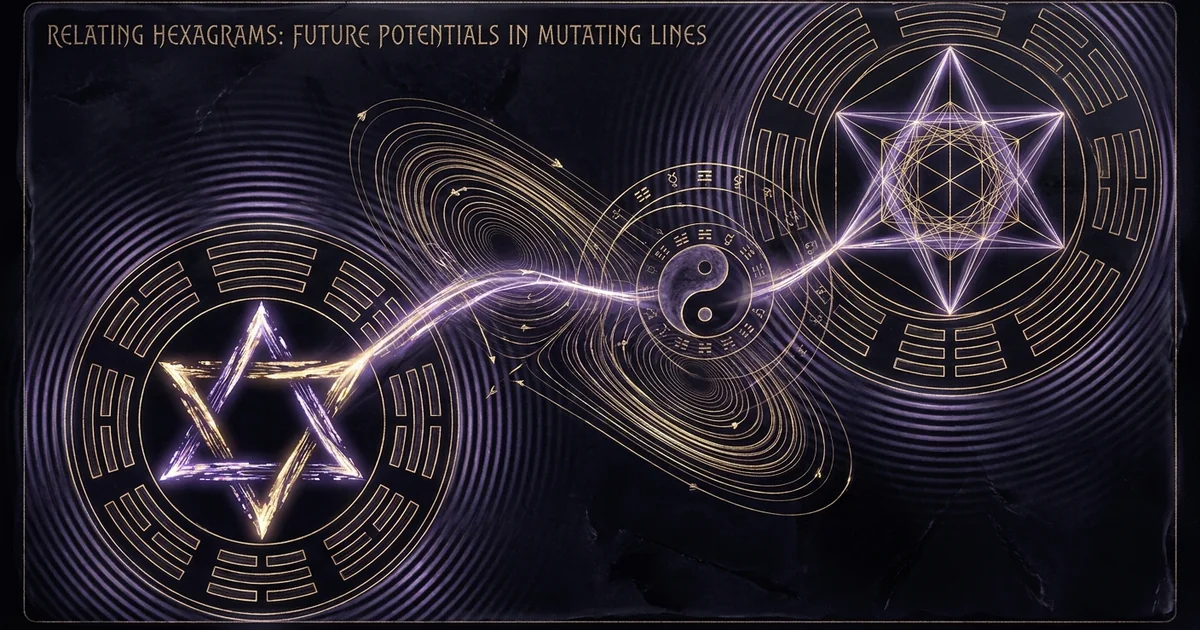
Relating Hexagrams: Future Potentials in Mutating Lines
Archetypal Thesis & Systemic Paradigm: The Dynamic Phase-Space of Zhi Gua
State Transitions in Archetypal Topography
The architecture of the Zhouyi (The Book of Changes) functions not as an index of foreordained events, but as a discrete, six-bit dynamic binary matrix modeling the phase-space of human and cosmic consciousness. Within this cybernetic topology, the primary hexagram (ben-gua 本卦) designates the initial parameters of the system—the immediate energetic disposition and psychic posture of the inquiring subject within their phenomenal field. The relating hexagram (zhi-gua 之卦), conversely, does not formulate an unalterable destination; rather, it delineates the asymptotic boundary conditions, an emergent attractor landscape toward which the current system tends under the influence of structural instability.
This operational shift between coordinate spaces is driven entirely by the mutating lines (bian-yao 變爻). Lines designated as “old” or dynamic—Old Yin (represented numerically by 6) and Old Yang (represented numerically by 9)—are far more than mechanical notations. They denote systemic states operating at extreme thermodynamic and psychic tension. When an energetic archetype is amplified to its absolute boundary condition, it induces what Carl Gustav Jung termed an enantiodromia: the structural inevitability whereby a dynamic quality driven to its excess inverts into its functional opposite. In this computational framework, the mutating line acts as a localized perturbation that precipitates a phase transition across the entire hexagrammatic substrate, forcing the primary hexagram to discharge its internal polarity and resolve into the altered structural coherence of the relating hexagram.
+-------------------------------------------------------------------------+
|                  ARCHETYPAL PHASE-SPACE DYNAMICS                        |
|                                                                         |
|   [ Ben Gua: Initial State ]  ---> (Bian Yao Criticality: 6 / 9)       |
|              |                                    |                     |
|              v                                    v                     |
|   [ Latent Internal Tensions ]        [ Enantiodromic Inversion ]       |
|              |                                    |                     |
|              +----------------> [ Zhi Gua: Attractor Landscape ]        |
+-------------------------------------------------------------------------+
The Teleological Vector: From Ben Gua to Zhi Gua
The transition between the primary to relating hexagram operates through a rigorous directional vector. Within the paradigm of non-linear dynamics, the ben-gua establishes the localized coordinate in the subject’s ontological field, while the zhi-gua establishes the teleological vector governing its trajectory. This developmental arc is fundamentally dependent upon the positioning, quantity, and inner relationality of the bian-yao. A single mutating line indicates a targeted, highly localized locus of tension—a precise psychological complex or environmental inflection point wherein systemic equilibrium is compromised. Conversely, a proliferation of mutating lines denotes a global systemic crisis, a chaotic bifurcation point wherein the structural stability of the ben-gua collapses simultaneously across multiple operational levels.
To trace this energetic progression is to decipher the underlying teleonomy of the psychic apparatus. In depth-psychological terms, the ben-gua maps the present configuration of ego-consciousness, constrained by its prevailing defenses, historical adaptations, and explicit phenomenological reality. The zhi-gua, however, represents the compensatory, teleological momentum of the unconscious. It serves as an archetypal attractor basin: a mathematically probable state of future psychic equilibrium that demands realization unless conscious, calculated intervention reorganizes the vector. The structural relation between the two hexagrams establishes the dynamic field within which the subject’s intentionality must operate. To comprehend the zhi-gua is to comprehend not what must happen, but what the current organization of energy is striving to produce.
Overcoming Fatalistic Teleology via Probabilistic Consciousness
The reduction of the zhi-gua to a fatalistic, static prophecy represents an epistemological regression that completely misunderstands the foundational metaphysics of the Zhouyi. Divination, when stripped of vulgar superstitious prescience, functions as an introspective cybernetic feedback mechanism. It permits an observer to map unintegrated psychic forces before they somatize into concrete physical events or unconscious relational patterns. The temporal divination trajectory traced by the mutating lines charts the momentum of the unconscious; it projects the line of least resistance along which psychic libido will flow if ego-consciousness remains passive, unconscious, and structurally unyielding.
“The unconscious seems to be able to examine the possibilities of the future, calculate how they are likely to turn out, and let us know by an intuitive hunch or a dream. Synchronicity in divination is essentially an observation of the qualitative nature of time at a given moment—a measurement of the psychic energy gradient which, like a river flowing toward the ocean, moves toward an inevitable archetypal attractor unless redirected by conscious illumination.” — Marie-Louise von Franz, On Divination and Synchronicity: The Psychology of Meaningful Chance (1980)
By interpreting the relating hexagram zhi gua future outcome within the I Ching as a probabilistic field rather than a rigid fatalistic certainty, the practitioner regains radical agency. The I Ching operates within an open-system ontology. The moment the consulting subject renders conscious the latent vectors encapsulated within the mutating lines, the observer effect is introduced into the psychic field. Consciousness intervenes in the unconscious calculus, altering the system’s entropy and allowing the subject to consciously metabolize the archetypal shift. The zhi-gua then shifts from a looming, unyielding destiny into an integrated psychological coordinate, liberating the individual from the blind compulsion of unconscious repetition.
Classical Provenance & Textual Lineage: Historical Exegesis of the Mutating Line
The Zuo Zhuan and Early Divinatory Protocols
The historical hermeneutics of mutating lines and relating hexagrams reveal an evolution from archaic ritual protocols to highly sophisticated systems of metaphysical psychology. The earliest historical documentation of Zhouyi divinatory praxis is preserved within the Zuo Zhuan (左傳, The Commentary of Zuo), chronicling the Spring and Autumn period (770–476 BCE). In these ancient records, the standard divinatory formula utilized by aristocratic scribes and court astrologers was consistently structured around the syntax: Gua X zhi Gua Y (Hexagram X going to or relating to Hexagram Y). The verb zhi (之) functioned syntactically as both an operational marker of movement and a demonstrative pronoun indicating relational belonging.
In the Zuo Zhuan accounts, court diviners did not view the zhi-gua as an isolated, detached outcome; rather, the relating hexagram provided the macrocosmic and geopolitical horizon within which the primary hexagram unfolded. For instance, in the famous divination regarding the marriage of Duke Li of Chen, the recorded result was Hexagram 20 (Guan, Viewing) mutating via its fourth line to Hexagram 12 (Pi, Standstill). The court diviner analyzed the specific transformation of the fourth line from an active Yang to a passive Yin not as a deterministic prediction of immediate circumstances, but as a long-range systemic realignment of ancestral lineage, indicating that Duke Li’s descendants would ultimately flourish in an entirely different feudal state. The archaic protocol fundamentally situated the changing line as a historical fulcrum: the locus where divine will, ancestral debt, and temporal crisis coalesced to redirect dynastic lineages.
Wang Bi’s Neo-Daoist Revolution: Meaning Beyond the Numbers
During the late Han Dynasty, divinatory interpretation calcified under the oppressive weight of the Xiangshu (象數, Images and Numbers) school. Commentators such as Jiao Yanshou and Jing Fang constructed vast, hyper-elaborate cosmological frameworks linking hexagram changes to fractional calendar cycles, directional compass points, musical pitches, and intricate line-substitution schemes. In this scholastic morass, the living existential and psychological reality of the mutating line was subordinated to sterile, mechanical computation. The foundational texts lost their philosophical potency, devolving into complex manuals for omen-classification.
+--------------------------------------------------------------------------+
|                     HERMENEUTIC PARADIGM SHIFT                           |
|                                                                          |
|   HAN DYNASTY: XIANGSHU (Images & Numbers)                               |
|   [ Rigid Mechanics ] --> [ Static Omens ] --> [ Calendrical Dogmatism ] |
|                                                                          |
|   WEI-JIN ERA: WANG BI / YILI (Meaning & Principle)                      |
|   [ Line Mutation ]   --> [ Dynamic Position ] --> [ Unified Insight ]   |
+--------------------------------------------------------------------------+
In the 3rd century CE, during the Wei-Jin period, the young Neo-Daoist prodigy Wang Bi (c. 245 CE) launched an epistemological revolution that permanently redefined Zhouyi exegesis. In his seminal commentary, Zhouyi Zhu (Commentary on the Book of Changes), and his theoretical treatise, the Zhouyi Lueli (General Remarks on the Zhouyi), Wang Bi dismantled the rigid literalism of the Han Xiangshu tradition in favor of the Yili (義理, Meaning and Principle) school. Wang Bi argued that images exist solely to convey meaning, and words exist solely to clarify images. Once the underlying principle (li 理) is grasped, the rigid numerical configurations must be transcended.
“The image is what brings out the idea; the word is what clarifies the image. Nothing can equal the image in bringing out an idea, and nothing can equal the word in clarifying an image. The words arise from the images, so one may follow the words to observe the images; the images arise from the ideas, so one may follow the images to observe the ideas. The idea is yielded up completely by the image, and the image is made explicit by the word… Therefore, only if one forgets the image can he obtain the idea; only if one forgets the words can he obtain the image. This is like the hare trap: it serves to catch the hare, but once the hare is obtained, the trap is forgotten.” — Wang Bi, Zhouyi Lueli, translated by Richard John Lynn, The Classic of Changes (1994)
For Wang Bi, a mutating line was not an isolated, mechanistic omen; it represented a relational movement within an organic totality. He posited that the structural integrity of a hexagram is typically anchored by a single dominant line—often the ruler of the hexagram—and that any line mutating represents a profound shift in situational dynamics, power balances, and systemic imperatives. Wang Bi restored the psychological and philosophical utility of the zhi gua analysis, framing the mutating line as a dynamic call for self-reflection and alignment with the Dao, rather than an unalterable pronouncement of external fate.
The Mawangdui and Fuyang Bamboo Manuscripts on Line Mutation
Modern archaeological discoveries have dramatically deepened our understanding of the textual evolution of mutating lines. The discovery in 1973 of the Mawangdui silk manuscripts (dated to approximately 168 BCE) and the 1977 unearthing of the heavily fragmented Fuyang bamboo strips (inscribed before 165 BCE) provided direct material evidence of the Zhouyi in transmission long before the Han imperial orthodoxy finalized the received text.
As Edward L. Shaughnessy meticulously documents in I Ching: The Classic of Changes (1996), these early manuscripts demonstrate significant orthographic, syntactic, and structural variances. In the Mawangdui text, the hexagram sequence departs entirely from the canonical King Wen arrangement, organizing the hexagrams according to a systematic matrix of upper and lower trigrams based on structural families. More significantly, the line statements (yaoci 爻辭) in the Mawangdui and Fuyang corpuses often read not as absolute predictive determinations, but as conditional aphorisms: mnemonic behavioral protocols calibrated for specific moments of structural fragility.
The textual lineage confirmed that archaic practitioners utilized the mutating lines as temporal hinges. The bian-yao recorded the precise threshold where human intention intersected with natural cycles. If the action proposed was harmonious with the moment (shi 時, temporal timeliness), the mutational shift toward the zhi-gua unfolded auspiciously; if discordant, it catalyzed systemic ruin.
Structural Mechanics & Symbolic Geometry: Phase Transitions and Vector Computation
Mathematical Parity: Old Yin and Old Yang as Phase Thresholds
The generation of hexagram lines through classical rituals—specifically the traditional 50-stalk yarrow method—reveals a non-uniform mathematical topology that inherently privileges systemic stability over radical mutation. Unlike the simplified modern three-coin method, which yields symmetric probabilities for mutable lines, the yarrow stalk algorithm generates an asymmetrical probability matrix deeply embedded in classical Chinese number theory.
+--------------------------------------------------------------------------+
|                 YARROW STALK PROBABILITY DISTRIBUTION                    |
|                                                                          |
|   Result Value   Archetypal State     Symbolic Line   Probability        |
|   ------------   ----------------     -------------   -----------        |
|   6 (Old Yin)    Mutable Negative      --- x ---      1/16 (6.25%)       |
|   7 (Young Yang) Stable Positive       ---------      5/16 (31.25%)      |
|   8 (Young Yin)  Stable Negative       ---   ---      7/16 (43.75%)      |
|   9 (Old Yang)   Mutable Positive      --- o ---      3/16 (18.75%)      |
+--------------------------------------------------------------------------+
When evaluating the probability matrix:
- 6 (Old Yin) occurs with a probability of $1/16$ ($6.25%$).
- 7 (Young Yang) occurs with a probability of $5/16$ ($31.25%$).
- 8 (Young Yin) occurs with a probability of $7/16$ ($43.75%$).
- 9 (Old Yang) occurs with a probability of $3/16$ ($18.75%$).
This operational asymmetry yields critical philosophical insights into the energetic dynamics of polarity mechanics. A mutating Yin line (6) is mathematically three times rarer than a mutating Yang line (9). Yin, representing condensation, inertia, and form, requires exceptional systemic pressure to achieve critical mass and invert into dynamic Yang. Yang, representing expenditure, radiation, and dynamic tension, exhausts its own structural integrity far more readily, mutating into Yin with three times the frequency.
Furthermore, the cumulative probability of generating a mutating line ($6$ or $9$) is precisely $4/16$ or $25%$, while the probability of generating a stable, resting line ($7$ or $8$) is $12/16$ or $75%$. The mathematical mechanics of the stalks inherently bias the system toward dynamic equilibrium: a system will tend to maintain its established structural coherence, undergoing punctuated, non-linear phase transitions only when specific thresholds of archetypal tension are crossed. Detailed computational analyses of these probability landscapes can be explored in our technical breakdown of the /iching/yarrow-stalk-probability-matrix.
Topological Permutations: Calculating Multi-Line Phase Shifts
When reading hexagram mutations, the complexity of the transition from primary to relating hexagram increases exponentially with each additional bian-yao. A single mutating line yields a simple vector: a direct, unambiguous phase shift pointing toward a clearly defined relating hexagram. However, when multiple lines mutate simultaneously, the system enters a complex dynamic state wherein multiple conflicting archetypal tensions compete for systemic dominance.
To map multi-line mutations, the investigator must analyze the interaction between the individual line transformations and their overarching trigrammatic architecture. The hexagram is composed of two primary trigrams (bagua 八卦): the inner, lower trigram (representing the subjective, psychic, internal domain) and the outer, upper trigram (representing the objective, social, external domain). If mutating lines occur exclusively in the lower trigram, the operational vector remains internal: the subjective perception and psychological architecture are shifting, while the external world remains structurally static. If mutating lines occur solely in the upper trigram, the external framework is dissolving while the internal consciousness remains fixed.
When mutating lines manifest across both trigrams simultaneously, the subject faces a total ontological collapse: an absolute restructuring of both inner meaning and external reality. Readers seeking deeper theoretical ground on this dual-trigram polarity dynamic should consult our treatise on /iching/trigram-polarity-mechanics.
The Nuclear Sub-Structure (Hu Gua) as Latent Mediating Geometry
The transition between the ben-gua and the zhi-gua is not an instantaneous spatial leap across an unmediated void. It is structurally governed and mediated by the internal geometry of the nuclear hexagram (hu-gua 互卦). The hu-gua is derived by extracting the overlapping core lines of the primary hexagram: the lower nuclear trigram is constituted by lines 2, 3, and 4, while the upper nuclear trigram is constituted by lines 3, 4, and 5.
The nuclear hexagram exposes the concealed, internal somatic and psychic tensions that are silently catalyzing the mutation toward the relating hexagram. While the ben-gua represents the presenting symptom or conscious surface narrative, and the zhi-gua represents the dynamic attractor toward which the situation is being pulled, the hu-gua functions as the underlying mechanical engine of the shift. It reveals the invisible psychological complex, the latent thermodynamic pressure that makes the current primary configuration unsustainable.
If the mutating lines are the localized points of rupture, the hu-gua is the latent tectonic plate whose movement forces those ruptures to occur. Without analyzing the mediating nuclear sub-structure, any reading of the transition from primary to relating hexagram remains superficial, blind to the subterranean currents driving archetypal evolution.
Psychological Dynamics & Operational Praxis: Interpreting Temporal Trajectories
The Zhi Gua as the Shadow and Latent Unconscious Potential
From the vantage point of Jungian analytical psychology, the structural relationship between the ben-gua and the zhi-gua mirrors the dynamic equilibrium between the ego and the collective unconscious. When an individual casts a hexagram, the conscious situation—including their deliberate intentions, rationalized motivations, and self-conceptions—is captured by the primary hexagram. It reflects what the ego thinks the situation is, conditioned by its existing cognitive framework.
+--------------------------------------------------------------------------+
|                  PSYCHO-DYNAMICS OF HEXAGRAM EVOLUTION                   |
|                                                                          |
|   Ego Consciousness (Ben Gua)  ========> Fixation / Persona Defense      |
|               |                                       |                  |
|               | (Libidinal Accumulation)              |                  |
|               v                                       v                  |
|   Mutating Lines (Bian Yao)    ========> Dynamic Complex Eruption        |
|               |                                       |                  |
|               v                                       v                  |
|   Teleological Attractor       ========> Shadow Integration / Fate       |
|   (Zhi Gua)                                                              |
+--------------------------------------------------------------------------+
The relating hexagram, conversely, frequently mirrors the unconscious shadow: the unacknowledged, repressed, or latent systemic counter-position. If an individual acts from an inflated, purely rationalistic posture (represented, for example, by Hexagram 1, Qian, The Creative), lines that mutate within that structure are not arbitrary warnings; they represent points of libidinal exhaustion. If Qian mutates at the top line (Old Yang at line 6, “Arrogant dragon will have cause to repent”), the psychic energy has exceeded its functional threshold, shifting inexorably toward Hexagram 43 (Kuai, Breakthrough) or Hexagram 44 (Gou, Coming to Meet). The zhi-gua indicates precisely where the psychic libido will pool if the ego maintains its current defense mechanisms. It provides the psychotherapist and the practitioner with an exact cartography of the compensatory response preparing to emerge from the archetypal unconscious, a process further elaborated in our foundational work on /archetypes/jungian-synchronicity-divination.
Operational Rules for Multi-Line Mutations: The Zhu Xi Protocol
To prevent the diviner from projecting arbitrary subjective fantasies onto complex, multi-line readings, classical hermeneutics developed rigorous, hierarchical protocols. The most comprehensive, theoretically durable operational system was codified during the Song Dynasty by the great Neo-Confucian synthesizer Zhu Xi (1130–1200 CE) in his seminal manual, Yixue Qimeng (易學啟蒙, Introduction to the Study of the I Ching). Zhu Xi established a rigorous six-fold protocol to determine the precise textual locus of authority based upon the absolute number of mutating lines:
- Zero Mutating Lines: The situation is structurally static. The interpretation relies exclusively upon the Judgment (guaci 卦辭) and Image (xiangci 象辭) of the Primary Hexagram (ben-gua).
- One Mutating Line: The mutational vector is intensely focused. The interpretation relies entirely on the specific Line Statement (yaoci 爻辭) of the single changing line in the ben-gua. The zhi-gua provides the relational horizon and background ambiance.
- Two Mutating Lines: Two opposing tensions coexist. One consults both changing line statements in the ben-gua, but privileges the upper changing line as the primary teleological thrust, using the lower changing line as the supporting, contextual condition.
- Three Mutating Lines: The system is at an absolute inflection point between two worlds. The line texts are subordinated. The practitioner must consult the Judgment of the Primary Hexagram (ben-gua) and the Judgment of the Relating Hexagram (zhi-gua), evaluating them as equal dynamic polarities in active transformation, with the ben-gua representing the originating past/present and the zhi-gua representing the emergent future.
- Four Mutating Lines: The mutational energy has crossed the halfway threshold; the system is already structurally dominated by the relating hexagram. One consults the two non-mutating lines in the Relating Hexagram (zhi-gua), with the lower non-changing line serving as the primary interpretive locus.
- Five Mutating Lines: The primary hexagram has virtually dissolved. The interpretation relies exclusively upon the single non-mutating line within the Relating Hexagram (zhi-gua), as this isolated fixed point anchors the entire emerging structural paradigm.
- Six Mutating Lines: Total systemic transvaluation. For Hexagrams 1 and 2, one reads the special structural invocations: “All dragons appear without heads” for Qian, and “Everlasting perseverance furthers” for Kun. For all other 62 hexagrams, the primary hexagram is completely superseded; one reads exclusively the Judgment and Image of the Relating Hexagram (zhi-gua).
Static Fatalistic Prognostication
- Assumes linear, deterministic temporal mechanics.
- Views the zhi-gua as an unalterable future reality carved into temporal marble.
- Renders human consciousness passive, fatalistic, and reactive.
- Disregards the mediating internal geometry of the nuclear hexagrams (hu-gua).
- Treats line mutations as isolated mechanical omens, divorcing the symbol from the subject’s internal psychic reality.
Dynamic Psycho-Cybernetic Analysis
- Assumes non-linear, probabilistic state-space dynamics.
- Views the zhi-gua as an emergent archetypal attractor landscape.
- Elevates human consciousness to an active, participatory cybernetic observer capable of vector alteration.
- Rigorously tracks mediating geometry, nuclear hexagrams, and trigrammatic polarities.
- Operates through analytical psychology, reading line mutations as active complexes undergoing enantiodromic phase shifts.
Active Imagination and the Integration of the Emerging Gua
Because the zhi-gua represents an archetypal attractor rather than a fixed destiny, the primary task of the practitioner is not passive resignation, but conscious assimilation. In the clinical praxis of Jungian depth psychology, this integration is executed through the deliberate deployment of active imagination. Active imagination allows the subject to descend into the archetypal landscape of the reading, personifying and interrogating the figures, forces, and spatial tensions represented by the mutating lines.
If a divination reveals an alarming or destructive relating hexagram—such as Hexagram 23 (Bo, Splitting Apart) or Hexagram 29 (Kan, The Abysmal Water)—the fatalist succumbs to dread, neurotically generating the very conditions that precipitate the disaster. The psychological practitioner, however, recognizes that Kan or Bo represent unintegrated systemic aspects of psychic reality. Kan signifies the terrifying descent into the primordial waters of the unconscious; Bo indicates the necessary collapse of outworn, petrified ego structures. By deliberately entering into the imaginal landscape of the relating hexagram, dialoguing with its archetypal representations, and voluntarily surrendering the outmoded defenses of the ben-gua, the practitioner alchemically sublimates the energetic charge of the bian-yao. The phase shift is metabolized on the internal, psychological plane, averting the necessity for its violent, unconscious externalization as external catastrophe.
Philosophical Synthesis & Macrocosmic Correspondence: Cybernetics, Chronotopes, and Entropic Flow
Non-Locality, Synchronicity, and Modern State-Vector Collapses
The mechanics governing the mutation of a hexagram share profound isomorphisms with fundamental formulations in modern quantum information theory and systemic cybernetics. In quantum mechanics, a wave function exists as a superposition of probabilistic eigenstates until the intervention of a measurement collapses the state vector into an observable reality. Similarly, the 64 hexagrams of the Zhouyi constitute an archetypal matrix of all possible configurations of human experience, existing in an atemporal, virtual state-space.
When the querent initiates the divinatory act—manipulating yarrow stalks or casting coins—they are executing a psychophysical measurement. Through the operation of synchronicity, which Jung defined as an “acausal connecting principle” rooted in qualitative time, the subject’s unconscious state is projected into the physical act of sorting the stalks. The resulting primary hexagram and its mutating lines represent the collapse of the universal archetypal field into a specific, localized state-vector.
+--------------------------------------------------------------------------+
|                  QUANTUM INFORMATION & SYSTEMIC ISOMORPHISM              |
|                                                                          |
|   Archetypal Superposition Matrix (64 Hexagrams in Virtual Potential)     |
|                                   |                                      |
|                                   v [ Synchronistic Measurement Act ]    |
|   Collapsed State-Vector: Ben Gua (6-Bit Dynamic Binary Matrix)          |
|                                   |                                      |
|                                   v [ Bian Yao Bit-Flip Events ]         |
|   Systemic Reorganization: Zhi Gua (Emergent Attractor Basin)            |
+--------------------------------------------------------------------------+
A mutating line is precisely equivalent to a bit-flip event in an open computational system. In informational cybernetics, flipping a single bit within a highly interconnected six-bit network does not merely alter that localized node; it fundamentally reconfigures the relational syntax, systemic entropy, and algorithmic output of the entire architecture. The zhi-gua is the mathematical result of this bit-flip reorganization, modeling how microscopic fluctuations at critical systemic points inevitably drive macroscopic transvaluations across the subject’s entire relational chronotope.
The 64 Codons and Hexagram Mutations as Epigenetic Analogues
The structural isomorphism between the 64 hexagrams of the Zhouyi and the 64 codons of the universal genetic code represents one of the most astonishing metaphysical convergences in esoteric cartography. As detailed in our comprehensive study on /sacred-geometry/binary-code-genetic-codons, both systems utilize a strict quaternary logic organized into triplets. In molecular biology, four nitrogenous bases (Adenine, Cytosine, Guanine, Thymine/Uracil) combine in groups of three to form the 64 triplet codons that dictate the synthesis of all biological proteins. In the Zhouyi, two binary polarities (Yin and Yang) combine in groups of two to form the four xiang (images: Greater/Lesser Yin and Yang), which in turn combine in groups of three to generate the eight trigrams, culminating in the 64 hexagram permutations.
The 6-bit architecture of the Zhouyi maps directly onto the nucleic acid syntax of DNA/RNA transcription. A mutating line (bian-yao) operates as an archetypal analogue to a single-nucleotide mutation or an epigenetic switch. Just as a point mutation in a biological codon can alter the transcription of a peptide chain—either preserving systemic viability via synonymous mutations or profoundly destabilizing the organism via missense or nonsense mutations—a mutating line in a hexagram shifts the systemic output of the archetypal organism from the metabolic state of the ben-gua to the altered phenotypic reality of the zhi-gua. Both systems demonstrate that complex life and complex consciousness are regulated by dynamic, self-correcting binary state machines.
When a line mutates within a hexagram, we witness an archetypal transcription error or epigenetic activation. The hexagram undergoes a structural mutation that changes the instructions governing how consciousness must metabolize its environmental inputs. The zhi-gua is the newly synthesized operational protein of the soul—the adapted psychic phenotype generated to survive the energetic pressures that rendered the primary hexagram unviable.
Hermetic Polarity and the Cyclical Reclamation of Yang and Yin
The ceaseless mutation from primary to relating hexagram operates in profound concordance with the fundamental Hermetic Principles of Polarity and Rhythm. The Kybalion asserts that “everything is dual; everything has poles; everything has its pair of opposites; opposites are identical in nature, but different in degree.” Within the cosmology of the Zhouyi, absolute Yin and absolute Yang do not exist as independent, static substances; they are phases of a single, continuous, circulating cosmic breath (qi 氣).
The mutating lines embody the Hermetic axiom that extremes meet. Old Yang (9) carries within its dynamic, outward-reaching core the seed of receptive Yin; Old Yin (6) contains within its dense, contractive core the expansive spark of emerging Yang. The relating hexagram zhi gua future outcome within the I Ching constitutes the systemic reclamation of this equilibrium.
When a system leans excessively toward the masculine, solar, structuring principle of Yang, it approaches entropic exhaustion. The appearance of a mutating Yang line signals that the solar energy has spent itself; it must undergo a rhythmic inversion, returning to the maternal, lunar, receptive matrix of Yin to regenerate. The zhi-gua is thus revealed as nature’s cosmic and psychic thermostat, perpetually neutralizing ideological, emotional, and systemic excess, guiding the fractured ego away from one-sided ruin and steering it back toward the unified center of the unnamable Dao.
Frequently Asked Questions: Resolving Operational and Interpretive Anomalies
How is a reading interpreted when all six lines are mutating?
When a consultation produces a hexagram in which every single line is mutable (composed entirely of 6s and 9s), the system has reached a catastrophic bifurcation point: total systemic transvaluation. The primary hexagram (ben-gua) has completely exhausted its structural cohesion and is undergoing immediate, radical dissolution across every tier of its architecture.
In classical hermeneutics, if the primary hexagram is Hexagram 1 (Qian, The Creative) mutating entirely into Hexagram 2 (Kun, The Receptive), the standard line texts are entirely bypassed. Instead, the practitioner consults the unique master-line statement attached exclusively to Qian: Yong Jiu (用九, “Using the Nines”), which proclaims: “All dragons appear without heads; great good fortune.” In archetypal psychology, this signifies an unprecedented situation where active, masculine creative energy voluntarily surrenders its hierarchical ego-control (“dragons without heads”), allowing the selfless receptive principle to govern without the interference of localized self-will.
+--------------------------------------------------------------------------+
|                  ALL-MUTATING LINE EXEGESIS PROTOCOL                     |
|                                                                          |
|   Hexagram 1 (All 9s)  ======> Yong Jiu: "All dragons without heads"     |
|   Hexagram 2 (All 6s)  ======> Yong Liu: "Everlasting perseverance"      |
|   All Other 62 Guas    ======> Complete ontological transfer to Zhi Gua; |
|                                Read Judgment & Image of Zhi Gua only.    |
+--------------------------------------------------------------------------+
Conversely, if Hexagram 2 (Kun, The Receptive) mutates in its entirety into Hexagram 1 (Qian), the specialized text Yong Liu (用六, “Using the Sixes”) is consulted: “Everlasting perseverance furthers.” In this instance, absolute passivity, gestation, and receptive absorption have completed their cycle and must immediately crystallize into unyielding, persistent, upright creative action. For all other 62 hexagrams, an all-changing result signifies that the ben-gua represents a reality that has already completely perished; it functions purely as an archaeological memory. The diviner must discard the line statements entirely and focus exclusively upon the Judgment and Image of the relating hexagram (zhi-gua), recognizing that the subject has been fully relocated into an entirely new operational paradigm.
Does the relating hexagram overwrite the primary hexagram completely?
A persistent operational error among modern students is the assumption that the relating hexagram functions as an absolute replacement that obliterates the primary hexagram. In rigorous zhi gua analysis, the primary hexagram remains the essential, enduring ontological ground of the situation, while the relating hexagram functions as an adjectival, contextual horizon that modifies, qualifies, and reorients that ground.
To illustrate: if Hexagram 36 (Ming Yi, Darkening of the Light) mutates into Hexagram 24 (Fu, The Return), the condition of Hexagram 36—wherein one’s consciousness, brilliance, and integrity must be concealed beneath an exterior of simplicity to survive an oppressive environment—does not instantaneously vanish into thin air. The querent remains within the historical and physical constraints of the “Darkening of the Light.”
However, the emergence of Hexagram 24 as the zhi-gua signifies that within that continued darkness, a definitive turning point has occurred. The light is returning from within, signaling the winter solstice of the soul. The relating hexagram contextualizes the suffering of the primary hexagram: it declares that the oppression is no longer terminal, but cyclical. The zhi-gua does not overwrite the ben-gua; it gives it systemic direction, revealing how the persistent reality of the primary hexagram must be navigated in light of the emerging attractor field.
Can a zhi gua represent past influences rather than future developments?
Because archetypal time in the Zhouyi is non-linear, multidimensional, and structural rather than merely chronological, the relating hexagram can, under specific psycho-historical conditions, represent an unassimilated ancestral, infantile, or historical state that is resurfacing as a future compulsion.
In classical Chinese metaphysics, time is structured cyclically and holistically rather than linearly. What appears to the conscious ego as an unexpected “future event” is frequently nothing more than the return of the repressed: an unresolved psychic configuration, an unintegrated ancestral complex, or a historic trauma that was never consciously metabolized. When such material remains unintegrated in the personal or collective unconscious, it behaves as what analytical psychology terms a repetition compulsion.
In this divinatory scenario, the zhi-gua represents a historic archetypal state that the subject is unwittingly re-creating. The vector from ben-gua to zhi-gua acts as a temporal loop: the subject marches “forward” into what they believe to be an emerging future, only to walk directly into the jaws of an unassimilated past. When the relating hexagram is recognized as a historic or ancestral complex rather than a novel developmental frontier, the subject can finally break the cycle. By consciously integrating the historical root exposed by the zhi-gua, the loop is opened into an evolutionary spiral, finally liberating the subject from the unconscious temporal tyranny of the eternal return.