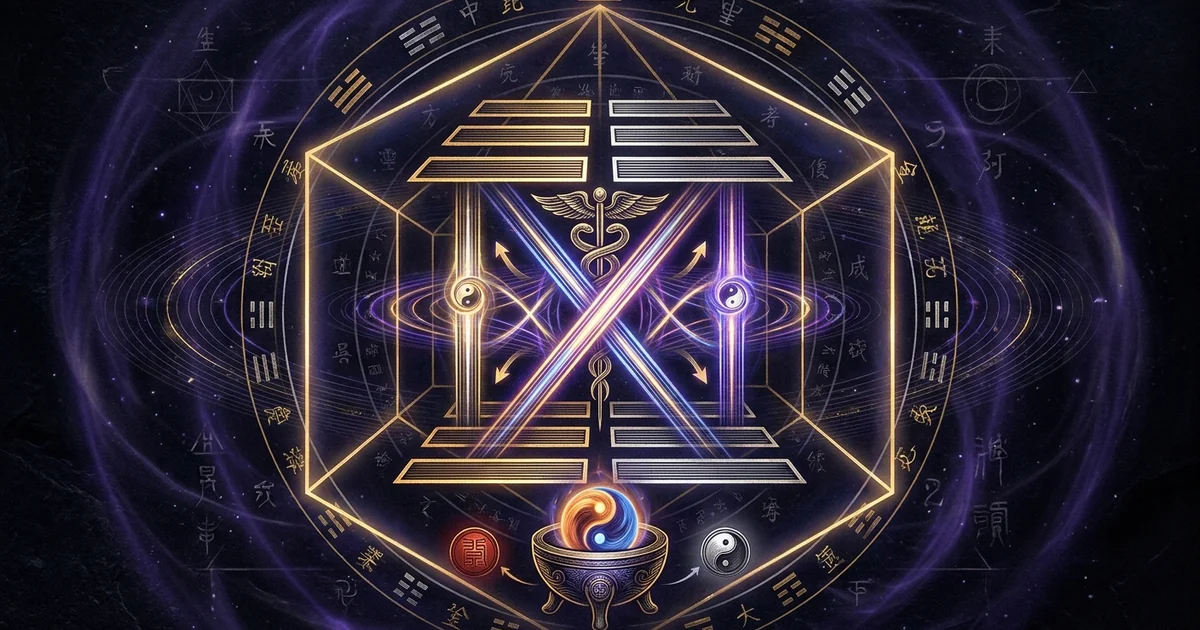
Mutual Resonance of Lines: Corresponding Polar Poles
Archetypal Thesis & Systemic Paradigm: The Dipolar Architecture of Line Resonance
Hexagram Vector Fields and the Dual-Trigram Interface
Within the structural taxonomy of the Yijing, a hexagram is neither an arbitrary tally of binary states nor an inert stack of six mechanical lines. It operates as a complex, stratified vector field generated by the dynamic intersection of two primary energetic envelopes: the inner trigram (Nei Gua, 內卦) and the outer trigram (Wai Gua, 外卦). This dual-trigram interface forms the ontological matrix through which archetypal reality transitions from subjective latency into objective manifestation. The inner trigram occupies the foundational, implicit domain of the psyche, embodying interiority, instinctual teleology, nascent psychological motivations, and the subjective field of consciousness. Conversely, the outer trigram governs the explicit, macroscopic arena of engagement, representing the social ecosystem, the institutional apparatus, systemic friction, and environmental conditions.
The hexagram architecture demands an interpretive shift away from sequential reading toward multidimensional topology. In the study of the /iching/structural-anatomy-of-hexagrams, each individual position (wei, 位) acquires its operational valence not in isolation, but strictly through its systemic placement within the broader vector field. Rather than ascending a simple stair of six discrete rungs, the observer encounters two parallel triadic sub-systems running concurrently. The lower positions—one, two, and three—serve as the micro-structural archetypes for the corresponding upper positions—four, five, and six.
+-------------------------------------------------------------------+
|                  HEXAGRAM POLAR VECTOR FIELD                      |
+-------------------------------------------------------------------+
|  OUTER TRIGRAM (Wai Gua)   Line 6 (Spiritual Culmination / Limit) |
|  Macrocosmic Arena         Line 5 (Sovereign Authority / Center)  |
|  Explicit Manifestation    Line 4 (Executive Threshold / Realize) |
+-------------------------------------------------------------------+
|                         INTERFACE / CHASM                         |
+-------------------------------------------------------------------+
|  INNER TRIGRAM (Nei Gua)   Line 3 (Peripheral Crisis / Volatility)|
|  Microcosmic Locus         Line 2 (Central Intuition / Receptive) |
|  Implicit Potential        Line 1 (Nascent Seed / Latent Impulse) |
+-------------------------------------------------------------------+
This dual-trigram interface establishes a fundamental split across the space separating lines three and four. At this structural boundary, the inner field exhausts its self-contained trajectory and confronts the demands of the external collective. The six lines do not form a monotonic continuum; they establish a bipartite cybernetic network where lower systemic parameters continuously inform and perturb upper systemic parameters, governed by the immutable laws of /sacred-geometry/polar-dipoles-and-vector-equilibria.
Defining Ying (應): Resonance Versus Positional Inertia
The foundational mechanism animating this bipartite field is the principle of mutual resonance (ying, 應). Resonance in the Yijing is the primary criterion for structural equilibrium and communicative capacity across the inner-outer divide. The relational framework known as the resonance of lines iching corresponding positions asserts that lines occupying homologous coordinates within their respective trigrams are bound by an informational entanglement. These paired coordinates are line 1 and line 4, line 2 and line 5, and line 3 and line 6.
LINE 6 (Transcendent Limit) <========> LINE 3 (Threshold Crisis)
                              [3-6 TENSION AXIS]
       LINE 5 (Sovereignty/Center) <========> LINE 2 (Interior Balance)
                              [2-5 ALLIANCE AXIS]
       LINE 4 (Outer Execution)   <========> LINE 1 (Subterranean Seed)
                              [1-4 RESONANCE AXIS]
True resonance (zheng ying, 正應) occurs exclusively through polar complementarity—the systemic pairing of a yielding, receptive broken line (yin, 陰) with a firm, actuating unbroken line (yang, 陽). In this context, yin-yang-polarity functions as a dynamic potential difference, analogous to electrical voltage across a circuit. When line 1 is yang and line 4 is yin (or vice versa), an operational conduit opens between the subterranean seed of the inner trigram and the executive threshold of the outer trigram. This polarity transforms latent positional energy into kinetic communication.
When homologous lines share identical polarities—both yang (gang ying, 剛應) or both yin (rou ying, 柔應)—an energetic impedance occurs. In the classical terminology, this condition constitutes non-resonance (bu ying, 不應) or hostile opposition (di ying, 敵應). Instead of facilitating cross-trigram transmission, the lines exhibit positional inertia. Like polarities repel, forming an energetic barrier where intra-psychic intent fails to find objective traction, locking the system into structural resistance.
The Transduction of Psychic Energy Across Inner and Outer Realms
The psychodynamic implications of dipolar line resonance are immediate. Working within an archetypal model of mind, the inner trigram acts as the personal and collective unconscious matrix, while the outer trigram models the ego-complex situated within the external collective environment. The resonance of lines iching corresponding positions delineates how psychic libido transforms across these experiential registers. When a line in the lower trigram lacks polar correspondence in the upper trigram, its psychic impulse remains trapped in subjective fantasy, unable to find an appropriate collective vehicle for actualization.
Conversely, an outer line that lacks resonance with an inner counterpart operates as a hollow institutional role, an ego-persona stripped of instinctual and archetypal grounding. The presence of true resonance (zheng ying) signals a clear channel for psychic transduction. The instinctual, unformed promptings of the interior life find systemic recognition, functional alignment, and teleological fulfillment within the external world. Through this dipolar lens, divination ceases to be an act of passive fortune-telling and reveals its true nature: a rigorous diagnostic map of structural tension, informational flow, and systemic individuation within human consciousness.
Classical Provenance & Textual Lineage: The Genesis of Ying and Bi in Exegetical Tradition
The Ten Wings and the Formulation of Positional Propriety (Dang Wei)
The canonical codification of line correspondence originates in the foundational commentaries of the Ten Wings (Shi Yi, 十翼), particularly the Tuan Zhuan (彖傳, Commentary on the Decision) and the Xiang Zhuan (象傳, Commentary on the Images). In these early hermeneutic texts, the dynamic interplay of individual lines was organized around rigorous diagnostic criteria: spatial position (wei, 位), central equilibrium (zhong, 中), positional propriety (dang wei, 當位), and mutual resonance (ying, 應).
Positional propriety (dang wei) establishes an intrinsic normative order across the six lines. Classical taxonomy dictates that odd-numbered positions (1, 3, 5) are inherently yang, requiring firm, active lines to achieve formal correctness, while even-numbered positions (2, 4, 6) are inherently yin, demanding yielding, receptive lines. However, the authors of the Tuan Zhuan recognized that mechanical positional correctness alone does not guarantee systemic harmony. A line may be technically correct (dang wei) yet systemically isolated if it lacks a polar counterpart across the trigram divide.
The Tuan Zhuan repeatedly invokes the formula “the firm and the yielding correspond” (gang rou xiang ying, 剛柔相應) as the ultimate justification for an auspicious omen. In Hexagram 11 (Tai, 泰 / Peace), the complete cross-correspondence between the lower yang lines and the upper yin lines generates systemic flourishing, explicitly attributed to the mutual resonance operating across every homologous axis.
Wang Bi’s Yili Revolution: De-literalizing Han Dynasty Xiangshu Hermeneutics
During the Han Dynasty, scholarship degenerated into an excessively rigid, mechanical literalism known as Xiangshu (象數, Image and Number) hermeneutics. Commentators such as Jing Fang and Zheng Xuan burdened the text with elaborate cosmological schemas, including planetary cycles, interlocking trigrams (hu ti), and complex line exchanges (bian gua), reducing the Yijing to an inflexible divinatory almanac.
In the third century CE, during the Three Kingdoms period, the young scholar Wang Bi (226–249 CE) led an intellectual revolution that reshaped classical Chinese philosophy. His Zhouyi Zhu (Commentary on the Book of Changes) discarded these rigid Han mechanics in favor of the Yili (義理, Meaning and Principle) school of structural analysis.
“Lines do not possess fixed fortunes in themselves; they change in accordance with their temporal conditions. Meaning cannot be exhausted by physical images; it must be grasped through systemic relations. Therefore, examine the resonance between the below and the above to discern whether movement meets resistance or response. If the firm finds its yielding counterpart, it acts; if the yielding finds its firm sovereign, it stabilizes. Time and position govern all things, but mutual resonance reveals their dynamic intention.”
Wang Bi asserted that lines represent dynamic operational states rather than concrete material entities. He demonstrated that mutual resonance (ying) is not a magical talisman, but a structural measure of relational integrity. In Wang Bi’s hermeneutic framework, a line can only be understood in relation to its context, defined fundamentally by its timing (shi, 時), its position (wei, 位), and its resonance (ying, 應) with the corresponding pole in the opposite trigram. By framing the hexagram as a web of relational vectors, Wang Bi cleared the path for an ontological understanding of systemic change.
Song Neo-Confucian Systematization: Cheng Yi and the Metaphysics of Principle (Li)
The Song Dynasty Neo-Confucian revival, led by philosophers such as Cheng Yi (1033–1107 CE) in his Yichuan Yizhuan (伊川易傳), elevated the mechanics of resonance from structural hermeneutics to an ontological theory of the cosmos. For Cheng Yi, the entire phenomenal universe is the product of Li (理, metaphysical Principle or Pattern) operating through the medium of Qi (氣, vital energetic matter). In this framework, the resonance between homologous lines serves as the visible manifestation of Li organizing Qi across structural boundaries.
METAPHYSICAL ARCHITECTURE (Cheng Yi):
========================================================================
Upper Trigram (Wai Gua)  --> Qi in Social & Environmental Actualization
Lower Trigram (Nei Gua)  --> Li as Ontological & Moral Ground
Homologous Resonance    --> Unbroken continuity of Principle through Energy
========================================================================
Cheng Yi demonstrated that the inner trigram provides the moral and ontological foundation (the ground of Li), while the outer trigram represents its physical and social actualization (the dispersion of Qi). True resonance (zheng ying) occurs when the internal realization of Principle elicits a direct, uncorrupted response from the external environment. If the inner line possesses integrity but the outer line is non-resonant, Li remains unmanifested, blocked by chaotic Qi. Cheng Yi’s rigorous ethical-ontological systematization established mutual resonance as the definitive diagnostic metric for evaluating moral integrity and cosmological harmony within the Song scholarly tradition.
Structural Mechanics & Symbolic Geometry: The Three Dipolar Axes
Line 1 and 4: Nascent Potential and the Threshold of Realization
The line 1 and 4 resonance governs the critical passage from latent, unconscious potential to the threshold of concrete systemic realization. Position 1, situated at the base of the inner trigram, represents the subterranean seed: unformed initiatives, instinctual impulses, primal motivations, and raw creative capacity. Because it resides at the very beginning of the hexagram’s developmental cycle, line 1 lacks systemic perspective and social agency; it is the child, the pioneer, the unspoken intuition. Position 4, conversely, occupies the lowest tier of the outer trigram, serving as the ministerial gateway, the threshold executive, and the immediate point of entry into the public arena.
[ Line 4: Ministerial Gateway ]  <--- (Systemic Threshold)
       ^
       |  Operational Dynamic: Transduction of Latent Will
       v
[ Line 1: Subterranean Seed   ]  <--- (Raw Psychic Potential)
When line 1 and 4 resonance is active through polar complementarity (yang-1 with yin-4, or yin-1 with yang-4), a functional conduit opens between these two levels. A dynamic yang force in position 1, full of creative momentum, requires the receptive, yielding capacity of a yin line in position 4 to welcome, translate, and integrate that primal impulse into the administrative structures of the outer world.
Without this resonance, a yang line in position 1 faces positional entrapment; its creative power cannot pass beyond the boundary of line 3, stagnating into impotent frustration or blind recklessness. Conversely, when line 4 is yang and line 1 is yin, the outer executive actively reaches down into the instinctual, receptive ground to draw forth nourishment, intuitive wisdom, and latent talent, ensuring that organizational strategy remains anchored in systemic reality.
Line 2 and 5: The Central Sovereign-Ministerial Axis
The line 2 and 5 alliance is the central axis of the entire hexagram. Positions 2 and 5 hold the preeminent status of centrality (zhong, 中) within their respective trigrams; line 2 is the central position of the inner realm, while line 5 is the central position of the outer realm. This shared quality of centrality grants both positions intrinsic moderation, moral equilibrium, and freedom from the destabilizing extremes found at the systemic edges (lines 1, 3, 4, and 6).
Line 1 and 4 (The Threshold Dyad)
- Functional Domain: Subconscious germination to executive implementation.
- Structural Dynamic: Inception meeting systemic reception.
- Energetic Hazard: Entrapment in unmanifested fantasy or blind, unguided projection.
- Archetypal Purpose: Translating raw instinctual potential into structural visibility.
Line 2 and 5 (The Sovereign Axis)
- Functional Domain: Intuitive interior locus meeting legitimate executive governance.
- Structural Dynamic: Dynamic equilibrium through mutual centrality (zhong).
- Energetic Hazard: Autocratic detachment (Line 5) or passive introversion (Line 2).
- Archetypal Purpose: Achieving integrated socio-psychological homeostatic equilibrium.
Line 3 and 6 (The Boundary Dyad)
- Functional Domain: Peripheral crisis meeting terminal transcendent culmination.
- Structural Dynamic: Structural edge conditions and phase-boundary dissolution.
- Energetic Hazard: Hubristic overreach, psychic inflation, or entropic collapse.
- Archetypal Purpose: Enforcing systemic breakdown to initiate self-transcending bifurcation.
When the line 2 and 5 alliance achieves polar resonance—most classically expressed as a yielding yin in position 2 responding to a firm yang in position 5—the hexagram reaches its highest expression of structural balance. Line 2 represents the capable, self-contained minister, the devoted steward of the interior life, or the integrated unconscious self. Line 5 represents the enlightened ruler, the legitimate sovereign, or the conscious ego aligned with transpersonal will.
Their polar correspondence creates an unbroken circuit between legitimate executive authority and deep interior support. The sovereign in position 5 does not degenerate into tyranny because it draws ethical sustenance and intuitive grounding from line 2. Meanwhile, line 2 avoids passive introversion because its quiet labor is recognized, empowered, and elevated by line 5. When this axis is obstructed by identical polarities (bu ying), the system experiences alienation: authority operates without interior legitimacy, and inner talent remains unrecognized in exile.
Line 3 and 6: Dialectical Crisis and Transcendental Culmination
The line 3 and 6 tension forms the volatile outer boundary of the hexagram system. Position 3 represents the apex of the inner trigram, an unstable psychological zone of dialectical crisis. It is the position of transitions, marked by anxiety, ambition, and systemic friction, standing at the precipice where the subjective inner realm directly borders the objective external world. Position 6 occupies the absolute summit of the hexagram, representing exhaustion, obsolescence, hyper-extension, or mystical detachment. It is the domain of the retired elder, the ascetic, or the obsolete ruler who has stepped outside the mechanics of active governance.
[ Line 6: Exhaustion / Detachment ]  <--- (Hyper-extended Summit)
       ^
       |  Operational Dynamic: Radical Phase Transition
       v
[ Line 3: Dialectical Crisis     ]  <--- (Precipice of Transition)
The resonance between lines 3 and 6 is structurally volatile. Because both lines occupy peripheral, non-central (bu zhong) positions, their interaction lacks the natural moderation found in the 2-5 alliance. When line 3 (active and ambitious) attempts to resonate with line 6 (yielding and receptive), the system faces the danger of leapfrogging the stable structures of governance (lines 4 and 5), seeking validation from an ungrounded or detached authority.
When line 3 is yielding and line 6 is firm, an over-extended force at the end of its cycle may place heavy, unsustainable demands upon an insecure transitional boundary. Consequently, the line 3 and 6 tension rarely yields static peace; instead, it generates the friction that sparks systemic breakdown, driving the entire hexagram toward terminal entropy and compelling a structural mutation into a new hexagram configuration.
Psychological Dynamics & Operational Praxis: Archetypal Feedback Loops
Jungian Transference and Anima/Animus Projections in Line Dyads
Viewed through modern psycho-cosmology and analytical psychology, the hexagram’s dipolar resonance maps the dynamic architecture of individuation. Carl Gustav Jung recognized that the ancient Chinese symbolic mind operated through an acausal principle fundamentally distinct from Western linear mechanics. In the context of line correspondence, the lower trigram functions as the subjective interiority of the psyche—the realm of shadow, complexes, and the unintegrated anima or animus—while the upper trigram represents the conscious ego-personality embedded within collective social reality.
INNER TRIGRAM (Unconscious Substrate)  <====[ Ying Resonance ]====>  OUTER TRIGRAM (Ego-Persona / World)
   - Line 1: Primal Instinct / Shadow                                    - Line 4: Social Mask / Persona
   - Line 2: Anima / Soul Ground                                         - Line 5: Ego Ideal / Sovereign
   - Line 3: Ego-Inflation / Crisis                                      - Line 6: Self / Archetypal Shadow
When an individual examines a changing hexagram, the resonance of lines iching corresponding positions delineates the flow of transference and projection. A lack of polar resonance between line 2 and line 5 mirrors a profound dissociative rift: the conscious ego-ideal (line 5) operates in defensive isolation, projecting its repressed, unintegrated shadow or anima onto external targets because it cannot establish an interior dialogue with the intuitive ground (line 2).
Conversely, when true resonance (zheng ying) is activated across this axis, the ego enters into an open, dialectical alliance with the archetypal Self. Polar resonance operationalizes the psychic circuit, enabling the integration of unconscious contents into conscious awareness without triggering neurosis or inflation.
“Synchronicity, as formalized through acausal connecting principles, reveals that the interior psychic state and the exterior physical configuration are non-local reflections of a unitary reality, the unus mundus. In the structural mechanics of the hexagram, this phenomenon is codified through the resonance of paired lines: an archetypal dipole where interior psychic tension finds an exact, reciprocal coordinate within the objective systemic field. Divination is therefore a cybernetic diagnostic tool that renders the unconscious field mathematically intelligible.”
Diagnostic Protocols for Zheng Ying (Proper Polarity) vs. Bu Ying (Static Inertia)
In practical analysis, diagnosing line resonance requires a strict structural methodology. The practitioner must evaluate not merely whether a line changes, but whether its structural environment supports or resists the movement of psychic energy.
RESONANCE DIAGNOSTIC MATRIX
+-------------------+--------------------+-----------------------------+
| Structural State  | Polar Dynamic      | Phenomenological Expression |
+-------------------+--------------------+-----------------------------+
| Zheng Ying (正應) | Yang + Yin Dipole  | Fluid transmission, mutual  |
|                   | Complementary      | reception, integrated will  |
+-------------------+--------------------+-----------------------------+
| Bu Ying (不應)    | Yang + Yang        | Positional inertia, mutual  |
|                   | Yin + Yin          | repulsion, psychic stasis   |
+-------------------+--------------------+-----------------------------+
| Dang Wei (當位)   | Correct Position   | Formal systemic integrity   |
|                   | (e.g. Yang in 1)   | and internal self-reliance  |
+-------------------+--------------------+-----------------------------+
| Bu Dang (不當位)  | Incorrect Position | Positional stress, friction |
|                   | (e.g. Yin in 1)    | with immediate environment  |
+-------------------+--------------------+-----------------------------+- Evaluation of Zheng Ying (True Resonance): If the line under analysis possesses an opposite polarity in its homologous counterpart across the trigram divide, an energetic channel is confirmed. If this line undergoes transformation through /iching/mechanics-of-changing-lines, its psychic energy travels along this channel, finding constructive engagement in the opposite trigram.
- Evaluation of Bu Ying (Static Inertia): If the homologous line shares the same polarity, the channel is blocked. The individual cannot rely on external assistance or intuitive confirmation from the corresponding domain. A firm yang line in position 2, confronted by an unyielding yang line in position 5, cannot look to authority for validation; it must rely strictly on its own central integrity (zhong) and immediate horizontal relationships to navigate systemic friction.
- Integration of Dang Wei (Positional Propriety): A line may be non-resonant (bu ying) yet retain high systemic efficacy if it is correctly positioned (dang wei), such as a firm yang line in position 1. While cut off from external executive patronage in position 4, its internal alignment provides self-sufficiency. Conversely, a line that is both non-resonant (bu ying) and incorrectly positioned (bu dang wei) exhibits acute systemic vulnerability.
The Interplay of Proximity (Bi) and Long-Range Resonance (Ying)
Line movement within a hexagram is simultaneously governed by two competing gravitational forces: vertical, long-range mutual resonance (ying, 應) operating across the trigram chasm, and horizontal, immediate spatial adjacency (bi, 比) operating between contiguous lines. This dual dynamic creates complex strategic dilemmas within the hexagram architecture.
[Line 5] <======== (Macro-Resonance: Ying) ========> [Line 2]
   ^
   |  (Micro-Adjacency: Bi)
   v
[Line 4]
Adjacency (bi) denotes the close, intimate relationship between neighboring lines: line 1 and 2, line 2 and 3, line 3 and 4, line 4 and 5, and line 5 and 6. While resonance (ying) represents formal systemic duty, archetypal alignment, and teleological destiny, adjacency represents tactical proximity, local peer pressure, and psychological intimacy. A line frequently finds itself caught in an acute systemic tension where its long-range resonance demands one mode of action, while an adjacent line exerts immediate magnetic attraction.
Consider line 4: its structural duty often demands long-range resonance with line 1, serving as an impartial minister who welcomes foundational talent into the outer court. Yet line 4 is also physically adjacent to line 5, the reigning sovereign. If line 4 forms an exclusive, sycophantic bond (bi) with line 5, it compromises its structural duty to line 1, severing the feedforward pathway of the hexagram.
Similarly, line 2 often balances its sovereign duty to line 5 against its close emotional ties with line 1 or line 3. Navigating the delicate friction between the structural demands of ying and the immediate pressures of bi forms the core discipline of Yijing line analysis.
Philosophical Synthesis & Macrocosmic Correspondence: Cybernetics, Hermeticism, and Genetic Codons
The Hermetic Axiom of Polarity and the Dipolar Law of Form
The structural mechanics governing the mutual resonance of lines provide an empirical Asian formulation of the fundamental Hermetic axiom: the Principle of Polarity. As articulated in Western esoteric traditions, this principle asserts that all manifested phenomena possess dual poles, opposites that are identical in nature but distinct in degree. In the Yijing, form cannot exist without dipolar tension.
A single line possesses no autonomous meaning; its functional reality emerges entirely from its orientation within the binary field of the hexagram. The Hermetic law states that generation requires the rhythmic interchange between active and receptive forces. In the language of the Zhouyi, this truth is encoded as the absolute mandate that manifestation occurs only when yang firm actuation discharges into yin receptive capacity across a systemic boundary.
The two trigrams, Nei and Wai, embody the Hermetic axiom “As above, so below; as within, so without.” The lower trigram is the “within,” the upper trigram is the “without.” The three resonant dipolar axes (1-4, 2-5, 3-6) act as the operational conduits through which the Hermetic Law of Form realizes itself, demonstrating that systemic equilibrium demands continuous, polar energetic exchange between internal subjective reality and external objective circumstances.
Cybernetic Feedback Loops: Feedforward (1-4), Homeostatic Regulation (2-5), and Entropy (3-6)
When examined through /divination/cybernetics-and-symbolic-computation, the hexagram reveals itself as a state-space cybernetic engine. Rather than a static oracle, it operates as an algorithmic model of a self-correcting dynamic system. The three resonant dyads function as universal cybernetic feedback operators, maintaining coherence while allowing for evolutionary adaptation.
CYBERNETIC STATE-SPACE DYNAMICS
+--------------------------------------------------------------+
| [Lines 3 & 6] Entropy, Dissolution, Systemic Bifurcation     |
|       ^                                                      |
|       |                                                      |
| [Lines 2 & 5] Homeostatic Feedback, Self-Regulation, Balance |
|       ^                                                      |
|       |                                                      |
| [Lines 1 & 4] Feedforward Signal Propagation, Sensor-Actuator|
+--------------------------------------------------------------+
Lines 1 and 4 govern feedforward signal propagation. Line 1 acts as a system sensor, detecting low-amplitude input signals from the ambient environment or subconscious baseline. Line 4 acts as the actuator, translating that sensory input into an operational output that enters the macroscopic systemic environment.
Lines 2 and 5 form the homeostatic regulatory core. Position 2 operates as a comparator, evaluating internal system stability against normative set-points. Position 5 serves as the centralized controller, deploying corrective energetic adjustments to preserve operational equilibrium. This axis prevents catastrophic divergence by maintaining homeostatic negative feedback.
Lines 3 and 6 govern systemic entropy, phase boundaries, and bifurcation dynamics. As an open system experiences increasing stress, line 3 registers positive feedback cascades, pushing internal parameters to critical instability. Line 6 represents the edge of the operational envelope: the dissipative threshold where the system either dissolves into chaos or undergoes a self-transcending bifurcation. The line 3 and 6 tension models the exact mechanics of thermodynamic dissipation, dictating when an obsolete systemic structure must collapse to clear the field for a new developmental cycle.
In modern digital signal processing and computational coding theory, a 6-bit register operates using linear block codes for forward error detection. When mapping a hexagram $H = (b_1, b_2, b_3, b_4, b_5, b_6)$ where $b_k \in {0, 1}$, the dipolar pairs $(b_1, b_4)$, $(b_2, b_5)$, and $(b_3, b_6)$ can be modeled as three cyclic parity checks: $$P_k = b_k \oplus b_{k+3} \quad \text{for } k \in {1, 2, 3}$$ Where $\oplus$ denotes the XOR operator (addition modulo 2). If $P_k = 1$, the dyad demonstrates perfect polar resonance (one firm, one yielding), satisfying the condition of maximal mutual information exchange. If $P_k = 0$, parity fails ($0 \oplus 0 = 0$ or $1 \oplus 1 = 0$), signaling systemic informational redundancy or complete impedance (bu ying). The hexagram’s structural stability can be rigorously formalized as the Hamming distance between the inner and outer trigrams.
Isomorphisms in the Genetic Matrix: Hexagram Symmetries and Nucleotide Base Pairing
The mathematical elegance of line resonance finds a compelling biological parallel in the structural architecture of the universal genetic code. The sixty-four hexagrams of the Yijing form an exact combinatorial isomorphism with the sixty-four mRNA codons that govern biological life. A codon consists of a dynamic triplet of four possible nucleotide bases: Adenine (A), Uracil (U), Guanine (G), and Cytosine ©. In classical molecular biology, these bases are categorized into two structural families: purines (A, G) and pyrimidines (U, C), mirroring the binary archetypes of yang and yin.
NUCLEOTIDE BASE PAIRING            YIJING DIPOLAR MAPPING
========================================================================
Purine (Yang: Adenine/Guanine)  <--->  Pyrimidine (Yin: Uracil/Cytosine)
Complementary Hydrogen Bonding  <--->  Zheng Ying (Polar Resonance)
DNA Double-Helix Doublet        <--->  Inner / Outer Trigram Architecture
========================================================================
Just as the stability of the DNA double helix relies entirely on the strict, complementary base pairing of purines with pyrimidines across double hydrogen bonds (A-U) and triple hydrogen bonds (G-C), the integrity of a hexagram relies on the complementary coupling of firm and yielding lines across the trigram divide. If two purines or two pyrimidines attempt to pair, structural deformation occurs, resulting in transcriptional errors.
This mirrors the structural impedance of bu ying, where identical polarities in positions 1-4, 2-5, or 3-6 disrupt systemic communication. This structural isomorphism between nucleotide base pairing and hexagram line resonance suggests that both frameworks express an underlying natural law: self-organizing informational systems achieve programmatic stability through dipolar, complementary balance.
Frequently Asked Questions
Diagnostic Resolution of Identical Line Polarities
When corresponding lines across the trigram divide share identical polarities—both yang (gang ying) or both yin (rou ying)—the relationship enters a state of non-resonance (bu ying) or structural opposition (di ying). Far from creating a static void, this condition generates active systemic resistance. In classical mechanics, like magnetic poles repel; similarly, two yang lines in positions 2 and 5 produce a clash of wills, ideological conflict, and autocratic competition. Neither position will yield to the other, creating an operational stalemate where executive authority (line 5) and internal autonomy (line 2) work at cross-purposes.
When two yin lines share a resonant axis, the systemic hazard shifts toward passive inertia, mutual evasion, and structural weakness. In this scenario, neither position possesses the generative impetus to initiate action or provide direction.
POLAR OPPOSITION / IMPEDANCE:
[Yang in 5: Autocratic Will] <--- (Repulsion / Friction) ---> [Yang in 2: Unyielding Autonomy]
[Yin in 5: Indecisive Void]  <--- (Passivity / Stagnation) ---> [Yin in 2: Inert Withdrawal]
To resolve this impasse, the system must rely on external stabilization. The practitioner looks to see if either line can forge an adjacent alliance (bi) with a complementary neighbor, or if a dynamic transformation (a changing line) will break the stalemate by altering the polarity of one pole, thereby restoring balance to the axis.
Inter-Line Hierarchy Between Resonance (Ying) and Adjacency (Bi)
When a line is subjected to competing demands between long-range resonance (ying) and immediate spatial adjacency (bi), the interpretive priority is determined by the line’s position within the overall hexagram context. Resonance represents strategic, teleological macro-alignment—the historical purpose, moral mandate, and long-term evolutionary vector of the situation. Adjacency, by contrast, governs tactical, immediate micro-alignment—the interpersonal politics, physical proximity, and short-term environmental pressures acting upon the line.
As a general rule in classical hermeneutics, when an operational crisis emerges, adjacency (bi) produces immediate friction, while resonance (ying) determines the final systemic resolution. If a yielding line 4 is drawn toward an intimate adjacent alliance (bi) with a sovereign yang line 5, it may enjoy short-term influence and safety within the court.
However, if this attachment causes line 4 to ignore its resonant duty (ying) to champion the nascent yang talent rising in line 1, the systemic flow of the hexagram is compromised. When the hexagram undergoes transformation, the unresolved tension at the 1-4 threshold inevitably destabilizes line 4. Adjacency dominates tactical maneuvering, but resonance dictates strategic destiny.
Dynamic Line Transformations and Resonant Phase Shifts
When one partner in a resonance dyad transforms—shifting from yin to yang, or yang to yin through the activation of an old, moving line—the dynamic field changes instantly. This transformation triggers a systemic phase shift across the hexagram’s vector field.
PHASE SHIFT INDUCED BY LINE TRANSFORMATION:
========================================================================
INITIAL STATE:       Line 2 (Yin) <==== (Zheng Ying: Flow) ====> Line 5 (Yang)
TRANSFORMATION:      Line 2 undergoes mutation (Old Yin ---> Young Yang)
RESULTANT STATE:     Line 2 (Yang) <--- (Bu Ying: Friction) ---> Line 5 (Yang)
SYSTEMIC EFFECT:     Homeostatic collapse; inner autonomy challenges sovereign.
========================================================================
If lines 2 and 5 initially enjoy complementary resonance (a yielding line 2 aligned with a firm line 5), the system operates in homeostatic balance. However, if line 2 changes from yin into yang, it suddenly claims firm, autonomous agency. The line 2 and 5 alliance breaks down into competitive opposition (gang ying).
The psychological locus shifts from cooperative service to a direct challenge of sovereign authority. Conversely, if an initial state of non-resonance (bu ying) is disrupted by a mutation that introduces polar complementarity, systemic gridlock dissolves, opening channels for communication, creative discharge, and evolutionary transition. Evaluating the shift between the initial hexagram (ben gua) and the resulting hexagram (zhi gua) provides a rigorous map of these systemic transformations.