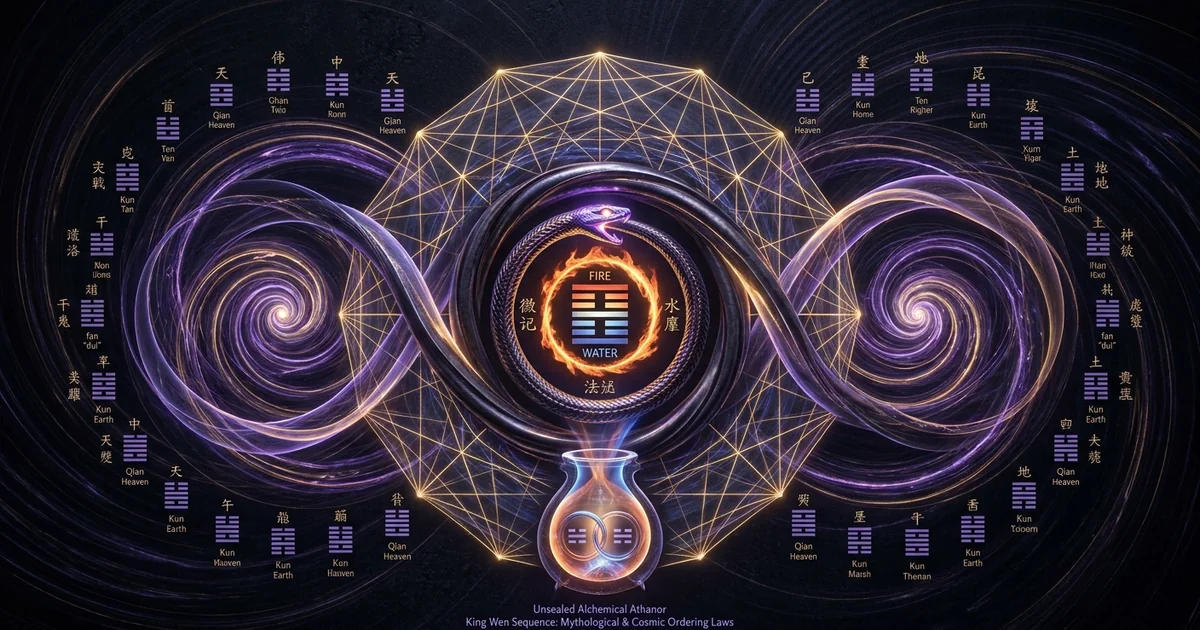
King Wen Sequence: Mythological & Cosmic Ordering Laws
The King Wen Sequence represents one of the most sophisticated psycho-cosmological coordinate frameworks developed in the ancient world. Rather than presenting an arbitrary compilation of mantic omens or a naive, mnemonic ledger of agrarian archetypes, the sixty-four hexagrams of the I Ching are arranged according to a deterministic architecture that maps the mechanics of transformation within manifest time.
Where alternative arrangements prioritize static, mathematical symmetry, the King Wen tradition formalizes an empirical topology of change, friction, and non-equilibrium thermodynamics. By interrogating its mathematical operators, archaeological transmission, psycho-spiritual mechanics, and systemic physics, this monograph decodes the cosmological laws that govern the traditional order of the canonical Book of Changes.
[ Fu Xi (Xiantian) ]                 [ King Wen (Houtian) ]
+-------------------------+         +----------------------------+
|  Static Binary Parity   |         |  Dynamic Temporal Friction |
|  Primordial Potential   |         |  Manifest Non-Equilibrium  |
|  Pure Vector Symmetry   |         |  Dissipative Topology      |
+-------------------------+         +----------------------------+
            |                                     |
            v                                     v
+-------------------------+         +----------------------------+
|  Mathematical Invariance|         |  32 Transformative Dyads   |
|   (Unbroken Idealism)   |         |   (Rotational & Polar)     |
+-------------------------+         +----------------------------+
Archetypal Thesis & Systemic Paradigm: The King Wen Topology of Non-Linear Evolution
The Dialectical Departure from Fu Xi Binary Symmetry
The structural divergence between the primordial Fu Xi arrangement and the traditional King Wen sequence constitutes the foundational dialectic of Chinese psycho-cosmology. The Fu Xi sequence—systematized during the Song Dynasty by Shao Yong and later identified by Gottfried Wilhelm Leibniz as an anticipation of modern base-2 binary arithmetic—organizes the sixty-four hexagrams into absolute mathematical parity. Ascending linearly from pure Yin (000000, Hexagram 2, Kun) to pure Yang (111111, Hexagram 1, Qian), the Fu Xi matrix represents the unmanifest, primordial realm: the Xiantian (Early Heaven).
In this primordial state-space, symmetry is absolute, conservation laws are static, and temporal friction is entirely absent. Each hexagram exists as an idealized, immutable coordinate within a balanced, hyper-dimensional hypercube. The spatial geometry of the Early Heaven Bagua maps complementary polarities directly opposite one another across a central axis, creating an unyielding energetic cancellation where the net cosmological charge remains zero.
Manifest reality, however, does not inhabit the zero-entropy perfection of the Xiantian. Human consciousness, material incarnation, and historical phenomena unfold within the Houtian (Later Heaven)—a cosmic condition characterized by systemic asymmetry, historical contingency, and directional time. The King Wen sequence abandons the binary scalar progression of Fu Xi to model this manifest condition.
Instead of arranging hexagrams by arithmetic value, the King Wen order maps a non-linear phase space wherein energetic states collide, overturn, decay, and recombine. The transition from Fu Xi to King Wen represents the cosmological phase shift from vacuum potential to thermodynamic manifestation, charting how consciousness navigates a universe where symmetry is broken to permit evolution, motion, and structural individuation.
Fu Xi Sequence (Xiantian / Early Heaven)
- Mathematical Topology: Strict binary scalar ordering ($0$ to $63$ in base-2 notation); unyielding directional symmetry across all axes.
- Ontological Realm: The unmanifest, archetypal blueprint; cosmic potential before the introduction of temporal friction and material density.
- Symmetry State: Static equilibrium; complete parity conservation where diametric opposites cancel energetic vector forces to achieve zero entropy.
- Temporal Dynamic: Timeless, cyclical eternity; simultaneous presence of all possibilities without historical consequence or decay.
- Trigram Foundation: Derived from the Early Heaven Bagua, balancing polar extremes directly opposite one another (e.g., Heaven opposes Earth, Fire opposes Water).
King Wen Sequence (Houtian / Later Heaven)
- Mathematical Topology: Dual-operator group transformations utilizing rotational inversion ($180^\circ$ flip) and selective bitwise polarity negation.
- Ontological Realm: The manifest, phenomenological cosmos; temporal unfolding, historical contingency, and existential individuation.
- Symmetry State: Broken symmetry and non-equilibrium thermodynamics; dissipative structures sustained through continual flux.
- Temporal Dynamic: Irreversible temporal arrow; dialectical, non-linear phase shifts characterized by catastrophe, regeneration, and open feedback.
- Trigram Foundation: Derived from the Later Heaven Bagua, mapping seasonal succession, spatial migration, and the energetic turbulence of the Later Heaven Bagua Arrangements.
Asymmetric Conservation Laws in Manifest Reality (Houtian)
The structural mechanics governing the King Wen sequence dictate that manifest reality operates not as a closed, equilibrium-seeking system, but as an open, dissipative structure. In modern non-equilibrium thermodynamics, physical order emerges far from equilibrium through the continual dissipation of energy. The King Wen sequence mirrors this law: its ordering principle purposefully avoids the premature rest states characteristic of the Fu Xi sequence.
By prioritizing the energetic vector of the Later Heaven Bagua, the traditional sequence internalizes the chaotic, asymmetric flow of natural seasons, biological metabolism, and psychic development.
In the Houtian realm, the ideal balance between masculine and feminine, light and shadow, expansion and contraction, is displaced by an unending process of compensation. The king wen sequence 64 hexagrams order meaning lies directly within this structural turbulence. Rather than descending systematically from pure light to pure darkness, the sequence forces radical dislocations: the creative summit of Qian (Hexagram 1) and receptive depth of Kun (Hexagram 2) are immediately thrust into the primordial crisis of Zhun (Hexagram 3, Difficulty at the Beginning) and the cognitive opacity of Meng (Hexagram 4, Youthful Folly).
These initial dialectical jumps prove that the sequence operates under asymmetric conservation laws: structural tension is deliberately conserved and transferred from one pair to the next, preventing the systemic entropy from decaying into thermal static equilibrium.
Hexagram Pairs as Dynamic State Engines
The core structural architecture of the King Wen sequence rests upon an immutable, non-negotiable rule: the sixty-four hexagrams are coupled into exactly thirty-two distinct pairs. These dyads operate as self-contained state engines that drive the sequence forward. In classical hermeneutics, the relationship between the primary hexagram and its immediately following partner is never accidental; it is an organic, functional metamorphosis.
+--------------------------------------------------------------+
|                     The 32 Hexagram Dyads                    |
+--------------------------------------------------------------+
|                                                              |
|   28 Rotational Pairs (Fan Gua)                              |
|   [ Inversion: Line i <---> Line (7 - i) ]                   |
|   (Examples: Zhun 3 <---> Meng 4, Xu 5 <---> Song 6)         |
|                                                              |
|   4 Polarity Pairs (Dui Gua / Xiao Gua)                      |
|   [ Axial Singularities: Invariant under 180° Rotation ]     |
|   [ Transformation achieved via Bitwise NOT: Yin <---> Yang] |
|   (Pairs: 1-2, 27-28, 29-30, 61-62)                          |
+--------------------------------------------------------------+
Within these thirty-two dyads, twenty-eight pairs achieve transformation through the process of Fan Gua—rotational inversion. The second hexagram is generated by rotating the spatial orientation of the first hexagram by 180 degrees, transposing line 1 into line 6, line 2 into line 5, and line 3 into line 4. The remaining four pairs, consisting of eight hexagrams whose internal line configurations are strictly symmetrical and thus invariant under 180-degree rotation, achieve transformation through Dui Gua—complete polarity inversion, where every Yin line is replaced by a Yang line, and vice versa.
By coupling every archetypal state to its dynamic inverse or polar shadow, the King Wen sequence ensures that no cosmological condition can exist in isolation. Every state carries an implicit vector pointing directly toward its systemic counterpart. This operational mechanic establishes that reality cannot be understood through static, isolated moments, but only through the catalytic tension between an initial condition and its compensatory transformation. This structural polarity formalizes the psychic law of cyclical enantiodromia.
Classical Provenance & Textual Lineage: Historical Genesis from Youli to the Ten Wings
The Captivity of King Wen and the Mythos of Youli
The traditional order of the I Ching finds its mythopoetic and historical origin in the eleventh century BCE, tied to the geopolitical crisis that marked the decline of the Shang Dynasty and the ascent of the Zhou. According to classical historiography, King Wen (Ji Chang), the civil founder of the Zhou Dynasty, was incarcerated by the tyrannical Shang monarch King Zhou at the fortress-prison of Youli. Confined to a subterranean cell under immediate threat of execution, King Wen undertook the systematic reconfiguration of the ancient divination trigrams.
Prior to this imprisonment, proto-hexagrammic divinatory practices—such as the Shang dynasty’s Lianshan and Guicang systems—operated primarily as ritualistic and agricultural-astronomical matrices used by imperial shamans for bone and shell pyromancy. The mythos of Youli marks the precise epochal boundary where the oracle was transformed from an external, talismanic forecasting tool into a psychological coordinate system and an interior handbook of ethical survival.
Under the immediate pressure of systemic terror, King Wen decoupled the hexagrams from naive circular symmetry, rearranging them to model the complex, adversarial realities of political intrigue, patience, decline, and moral perseverance. Imprisonment acted as the crucible that exposed the limitations of static, unmanifest idealism; survival demanded a sequence that modeled sudden reversals of fortune, periods of forced retreat, hidden accumulation of inner virtue, and the strategic mastery of historical time.
The Mawangdui Silk Texts and Structural Lineage Stratigraphy
The historical contingency of the King Wen sequence is further illuminated by modern archaeological discoveries, most notably the 1973 excavation of the Han-era tombs at Mawangdui in Hunan Province. The Mawangdui silk manuscripts, transcribed around 168 BCE, revealed a radically different organization of the sixty-four hexagrams than the canonical received text attributed to King Wen.
King Wen Canonical Sequence:
[ Structural Narrative Topology ]
Dyadic Pairs --> Fan Gua (Rotation) & Dui Gua (Polarity)
Organized by macrocosmic, historical, and dialectical phase shifts.
Mawangdui Silk Manuscript Sequence:
[ Taxonomic Trigram-Family Matrix ]
Grouped by Upper Trigram Families (8 sets of 8 hexagrams):
Qian, Gen, Kan, Zhen, Kun, Dui, Li, Xun
Categorized by rigid morphological taxonomy.
In his seminal translation and analysis, Edward L. Shaughnessy demonstrated that the Mawangdui text arranged the hexagrams according to a systematic, taxonomic methodology based on the primary trigram families:
$$\text{Qian} \rightarrow \text{Gen} \rightarrow \text{Kan} \rightarrow \text{Zhen} \rightarrow \text{Kun} \rightarrow \text{Dui} \rightarrow \text{Li} \rightarrow \text{Xun}$$
The upper trigrams dictated eight categorical families, beneath which the lower trigrams cycled in a stable, predictable sequence. This comparative lineage stratigraphy established that the King Wen sequence was not an absolute, uncontested taxonomy of antiquity, but a deliberately curated philosophical masterwork.
Where the scribes of Mawangdui embraced a neat, morphological catalog that prioritized indexing ease and bureaucratic utility, the redactors of the canonical King Wen tradition rejected taxonomic simplicity. They chose instead to preserve an asymmetrical, narrative-dialectical topology that mirrored the structural transformations of human history and cosmological genesis.
The Xu Gua Zhuan as a Cosmological Causality Engine
The definitive teleological justification for the King Wen sequence within the classical canon is articulated in the Xu Gua Zhuan (The Order of the Hexagrams), historically designated as the Ninth Wing of the Confucian Ten Wings commentary. The Xu Gua Zhuan functions as a cosmological causality engine, systematically contextualizing why each hexagram must inevitably generate the specific conditions that manifest in its immediate successor.
Rather than treating the transitions between hexagrams as discrete, isolated shifts, the commentary approaches the sixty-four states as an unbroken, causal sequence of evolutionary necessity. It demonstrates that the conclusion of any given archetypal phase concentrates environmental and psychological pressures until the container ruptures, precipitating the emergence of the next evolutionary coordinate.
Translated by Richard Wilhelm and Cary F. Baynes, Bollingen Series XIX (1950):
“After heaven and earth have come into existence, individual things are produced. That which fills the space between heaven and earth is the mass of individual things. Because of this, Qian and Kun are followed by Zhun. Zhun means filling up; Zhun means the beginning of things. When things are first produced, they are necessarily wrapped up in youth; therefore Zhun is followed by Meng. Meng means youthfulness; it is the condition of not yet being enlightened. When things are youthful, one cannot refrain from nourishing them; therefore Meng is followed by Xu. Xu means the way to eat and drink…”
As demonstrated in the Wilhelm/Baynes translation, the Xu Gua Zhuan frames the opening triad not as three separate symbols, but as the initial phase transitions of cosmogenesis. Qian (pure, unmediated dynamic tension) and Kun (pure, unmediated receptive capacity) interact to engender physical reality. The immediate consequence of this union is not peaceful harmony, but Zhun—chaotic, painful, primeval germination.
The Xu Gua Zhuan demonstrates that every hexagram within the traditional order of the I Ching is linked to its neighbors through deterministic, metabolic necessity. Growth demands nourishment, nourishment generates social aggregation, social aggregation produces friction, and friction necessitates regulation. The sequence operates as an early formulation of systemic causality.
Structural Mechanics & Symbolic Geometry: Inversion, Opposition, and Nuclear Vectors
The Boolean Operators of Inversion (Fan Gua) and Polarity Reversal (Dui Gua)
Under formal mathematical analysis, the King Wen sequence reveals a sophisticated group-theoretic structure operating over a finite Boolean vector space. As established by Andreas Schöter in his research on the Boolean vector space models of the I Ching, a hexagram $h$ can be rigorously formalized as a six-dimensional binary vector:
$$h = [b_1, b_2, b_3, b_4, b_5, b_6]^T \in {0, 1}^6$$
where $0$ represents a broken Yin line and $1$ represents an unbroken Yang line, indexed from the bottom line ($b_1$) to the top line ($b_6$).
Within this formal space, the King Wen sequence deploys two primary deterministic operators to generate its 32 dyadic pairings: the Rotational Inversion Operator ($R$) and the Bitwise Polarity Inversion Operator ($N$).
The Rotational Inversion Operator, known traditionally as Fan Gua (overturned hexagram), executes a 180-degree physical rotation of the hexagram, mapping the lowest line to the highest, the second to the fifth, and the third to the fourth:
$$R(h) = R\left([b_1, b_2, b_3, b_4, b_5, b_6]^T\right) = [b_6, b_5, b_4, b_3, b_2, b_1]^T$$
This spatial transformation governs exactly 56 of the 64 hexagrams, resulting in 28 rotationally inverted pairs (such as Hexagram 3, Zhun $[1, 0, 0, 0, 1, 0]$, transforming into Hexagram 4, Meng $[0, 1, 0, 0, 0, 1]$).
Hexagram 3 (Zhun)                 Hexagram 4 (Meng)
Line 6: --  -- (0)  <--\   /-->  Line 6: ------ (1)
Line 5: ------ (1)  <---\ /--->  Line 5: --  -- (0)
Line 4: --  -- (0)  <----\X/----> Line 4: --  -- (0)
Line 3: --  -- (0)  <----/X\----> Line 3: --  -- (0)
Line 2: --  -- (0)  <---/ \--->  Line 2: ------ (1)
Line 1: ------ (1)  <--/   \-->  Line 1: --  -- (0)
         [ Rotational Inversion Operator: R(h) ]
The second operator, the Bitwise Polarity Inversion Operator, designated as Dui Gua or Xiao Gua (opposing or complementary hexagram), executes an entry-wise logical NOT operation over the vector components:
$$N(h) = N\left([b_1, b_2, b_3, b_4, b_5, b_6]^T\right) = [1 - b_1, 1 - b_2, 1 - b_3, 1 - b_4, 1 - b_5, 1 - b_6]^T$$
This operator is activated selectively when the application of the rotational operator produces no geometric transformation.
The Eight Invariant Singularities and Axial Hinges
The operational necessity of the Bitwise Polarity Inversion Operator stems from the existence of eight specific hexagrams within the 64-element set that possess strict vertical bilateral symmetry. In these configurations, the vector is an invariant palindrome:
$$b_i = b_{7-i} \quad \forall i \in {1, 2, 3, 4, 5, 6}$$
Consequently, for these eight specific states, applying the Rotational Operator yields an identity transformation:
$$R(h) = h$$
If the King Wen sequence relied exclusively upon Fan Gua (rotational inversion), the system would experience systemic breakdown at these eight coordinates, unable to generate a complementary partner through spatial rotation.
Let the set of all sixty-four hexagrams be defined as $H = {0, 1}^6$. The subset of invariant singularities $S \subset H$ contains those elements for which the rotational operator $R$ functions as an identity mapping:
$$S = {h \in H \mid R(h) = h}$$
Explicit evaluation identifies exactly $2^3 = 8$ invariant palindromic hexagrams within the space:
- Hexagram 1 (Qian, The Creative): $[1, 1, 1, 1, 1, 1]^T$
- Hexagram 2 (Kun, The Receptive): $[0, 0, 0, 0, 0, 0]^T$
- Hexagram 27 (Yi, Nourishment): $[1, 0, 0, 0, 0, 1]^T$
- Hexagram 28 (Da Guo, Preponderance of the Great): $[0, 1, 1, 1, 1, 0]^T$
- Hexagram 29 (Kan, The Abysmal Water): $[0, 1, 0, 0, 1, 0]^T$
- Hexagram 30 (Li, The Clinging Fire): $[1, 0, 1, 1, 0, 1]^T$
- Hexagram 61 (Zhong Fu, Inner Truth): $[1, 1, 0, 0, 1, 1]^T$
- Hexagram 62 (Xiao Guo, Preponderance of the Small): $[0, 0, 1, 1, 0, 0]^T$
Because $R(h) = h$ for all $h \in S$, the system enforces the deterministic application of the bitwise NOT operator $N(h)$ to resolve these singularities into four complementary polar dyads: $$\text{Pair } 1: {1, 2} \implies N(\text{Qian}) = \text{Kun}$$ $$\text{Pair } 14: {27, 28} \implies N(\text{Yi}) = \text{Da Guo}$$ $$\text{Pair } 15: {29, 30} \implies N(\text{Kan}) = \text{Li}$$ $$\text{Pair } 31: {61, 62} \implies N(\text{Zhong Fu}) = \text{Xiao Guo}$$
These eight invariant singularities function as the structural pillars and axial hinges of the King Wen sequence. Rather than being scattered at random throughout the text, they are deployed at critical macrocosmic junctures: Hexagrams 1 and 2 establish the absolute boundary conditions of the cosmos; Hexagrams 27, 28, 29, and 30 terminate the Upper Canon with intense elemental thresholds; and Hexagrams 61 and 62 set up the final, irreversible phase transitions of the Lower Canon.
Nuclear Hexagrams (Hu Gua) as Underlying Vector Trajectories
Beyond the visible surface pairing of Fan Gua and Dui Gua, the King Wen sequence possesses an interior topological vector space governed by the overlapping nuclear hexagrams (Hu Gua). The nuclear hexagram of any given primary hexagram is generated by isolating its core four lines—lines 2, 3, 4, and 5—and extrapolating them into two new overlapping trigrams. The lower nuclear trigram is formed by lines 2, 3, and 4, while the upper nuclear trigram is formed by lines 3, 4, and 5:
$$h_{\text{nuclear}} = [b_2, b_3, b_4, b_3, b_4, b_5]^T$$
Primary Hexagram (h)               Extracted Nuclear Trigrams             Nuclear Hexagram (Hu Gua)
Line 6: [b6]                                                               Line 6: [b5]
Line 5: [b5]  -------------\       Upper Nuclear: Lines 3-4-5  ----------> Line 5: [b4]
Line 4: [b4]  ---------\    \--->  (Forms Upper Trigram)                   Line 4: [b3]
Line 3: [b3]  -----\    \--------> Lower Nuclear: Lines 2-3-4  ----------> Line 3: [b4]
Line 2: [b2]  ---\  \------------> (Forms Lower Trigram)                   Line 2: [b3]
Line 1: [b1]      \                                                        Line 1: [b2]
Mathematical analysis demonstrates that while there are sixty-four primary hexagrams, there exist only sixteen possible nuclear hexagrams in total. These sixteen intermediate vectors function as the hidden, deep-tissue topological pathways connecting the primary surface hexagrams. When the nuclear vectors of consecutive King Wen pairs are mapped across the thirty-two dyads, an underlying structural continuity is revealed.
Hexagrams that appear radically divergent on the surface often share identical or mutually complementary nuclear cores, proving that the King Wen sequence is not an aggregate of detached symbols, but a continuous manifold. The nuclear structures demonstrate that interior developmental trajectories are already operating within any given outward circumstance, providing the thermodynamic and psychological impulse that forces the outward situation to evolve into its successor.
Psychological Dynamics & Operational Praxis: Individuation and the Temporal Dialectic
The Diptych Division: The Upper Canon (Cosmogenesis) and Lower Canon (Anthropogenesis)
The canonical structure of the King Wen sequence is formally bifurcated into a diptych of unequal length: the Upper Canon (Shang Jing), comprising Hexagrams 1 through 30, and the Lower Canon (Xia Jing), comprising Hexagrams 31 through 64. This quantitative asymmetry (30 hexagrams versus 34 hexagrams) reflects a profound qualitative divergence in ontological focus.
+--------------------------------------------------------------+
|               The King Wen Cosmological Diptych              |
+--------------------------------------------------------------+
|                                                              |
|   Upper Canon: Hexagrams 1 to 30 (Cosmogenesis)             |
|   * Foundation: Hexagram 1 (Qian) & Hexagram 2 (Kun)        |
|     [Absolute Archetypal Principles: Heaven & Earth]         |
|   * Domain: Macrocosmic law, physics, elemental evolution.   |
|   * Terminal Hinge: Hexagram 29 (Kan) & Hexagram 30 (Li)    |
|     [Dynamic Cosmic Catalysts: Water & Fire]                 |
|                                                              |
|   Lower Canon: Hexagrams 31 to 64 (Anthropogenesis)          |
|   * Foundation: Hexagram 31 (Xian) & Hexagram 32 (Heng)      |
|     [Interpersonal Union: Mutual Attraction & Duration]      |
|   * Domain: Social psychology, political ethics, individuation|
|   * Terminal Hinge: Hexagram 63 (Ji Ji) & Hexagram 64 (Wei Ji)|
|     [The Open Evolutionary Loop: Completion & Incompletion]  |
+--------------------------------------------------------------+
The Upper Canon charts cosmogenesis and the establishment of natural, macrocosmic order. It begins with Qian and Kun—the unmediated cosmic parents, representing pure consciousness and pure energetic space. From this primordial matrix, the Upper Canon traces the condensation of energy into matter, the emergence of systemic difficulties, the accumulation of resources, and the structural friction between elemental forces.
Crucially, the Upper Canon concludes with the dyad of Hexagram 29 (Kan, The Abysmal Water) and Hexagram 30 (Li, The Clinging Fire). Water and Fire represent the two primordial thermodynamic engines of the cosmos: the abysmal gravitational sink and the luminous radiational source. They are the transformative solvents through which nature purges and reorganizes form.
Conversely, the Lower Canon charts anthropogenesis, psychic maturation, and social evolution. It consciously breaks from cosmic abstraction by opening with Hexagram 31 (Xian, Influence/Mutual Attraction) and Hexagram 32 (Heng, Duration/Constancy). The foundation of the human realm is not cosmic omnipotence, but relational coupling: courtship, mutual receptivity, social bonding, and the psychological endurance required to sustain ethical contracts across time.
From this relational matrix, the Lower Canon charts the development of the ego, the confrontation with societal institutions, the shadow of political oppression (as seen in Hexagram 36, Ming Yi), and the eventual transcendent integration of the self. The diptych movement of the King Wen sequence thus traces the complete cycle of evolution: descending from primordial cosmic law into the social reality of the human sphere, and ascending toward individuation and psychological integration.
Enantiodromia and the Tension of Hexagrammic Dyads
In classical Jungian depth psychology, Carl Gustav Jung adopted the Heraclitean term enantiodromia to designate the psychological law whereby every archetypal state inevitably produces its own compensatory opposite. The King Wen sequence functions as the formal cartographic blueprint of enantiodromia. Because the thirty-two dyads are bound through rotational inversion or bitwise polarity reversal, each hexagram carries an active psychic vector pointing toward its partner.
Primary Psychological State (Hexagram A)
      |
      | [ Unconscious Inflation / Accumulation of Extremes ]
      v
Systemic Tipping Point
      |
      | [ Enantiodromic Reversal: Fan Gua or Dui Gua ]
      v
Compensatory Counter-State (Hexagram B)
When an individual or a socio-political collective experiences an archetypal phase represented by any given hexagram, psychological inflation is held in check by the structural presence of its pairing. For example, Hexagram 11 (Tai, Peace/Harmony) is bound to Hexagram 12 (Pi, Standstill/Stagnation). The traditional order dictates that peace does not last indefinitely; the very relaxation of internal vigilance inherent in peace produces the systemic complacency that allows stagnation to crystallize.
The sequence warns the psyche that an archetypal state cannot be understood in isolation. To experience Tai is to already harbor the unconscious seeds of Pi. By structuring the sequence through continuous enantiodromic dyads, the King Wen arrangement models the natural homeostatic feedback mechanisms through which the unconscious compensates for ego-directed extremes.
Consultative Methodology: Reading Paired Vectors in Synchronistic Inquiry
The structural topology of the King Wen sequence imposes specific operational parameters upon the praxis of I Ching consultation. When an inquirer receives a specific hexagram through a synchronized casting mechanism (such as the yarrow stalk manipulation or the coin oracle), classical hermeneutics dictates that the obtained coordinate must not be interpreted as an isolated, static pronouncement. Instead, the adept evaluates the acquired hexagram as a dynamic vector located within a continuous transformational field.
From On Divination and Synchronicity: The Psychology of Meaningful Chance, Inner City Books (1980):
“Number, when looked at qualitatively, is not an invented measuring device of the conscious mind, but an archetypal reality of the collective unconscious… In divination systems such as the I Ching, numbers and their sequence represent qualitative moments in time. The sequence does not measure quantitative duration from the past to the future; rather, it maps the qualitative pattern of the Tao at a specific, synchronistic cross-section of reality. Each hexagram in the King Wen order represents a unique, non-causal phase within a continuous, self-regulating psychological cycle.”
In consultative methodology, an acquired hexagram must be read in direct dialectical relationship to its King Wen partner. If a consultation yields Hexagram 43 (Kuai, Breakthrough/Resolution), the practitioner must actively diagnose the energetic presence of Hexagram 44 (Gou, Coming to Meet/Temptation).
The decisive, upward Yang purge of corrupt elements modeled in Kuai generates an immediate, unconscious vulnerability to subtle infiltration from below, which is precisely the mechanic modeled in Gou. By reading an acquired hexagram through the lens of its paired counterpart, the practitioner discerns not only the present configuration of the manifest field, but also the structural shadow and inevitable compensatory counter-stroke embedded within the moment.
Philosophical Synthesis & Macrocosmic Correspondence: Cybernetics, Chronobiology, and Open Thermodynamics
Prigogine Dissipative Systems and the Resolution at Hexagram 64 (Wei Ji)
The philosophical apex of the King Wen sequence lies in its structural termination. A naive, closed mythological system would seek symmetrical closure: an orderly return to the absolute balance of Qian and Kun, or a celebration of total, unshakeable perfection. The King Wen sequence systematically rejects this static resolution. The final pair of the canonical sequence consists of Hexagram 63 (Ji Ji, After Completion) and Hexagram 64 (Wei Ji, Before Completion).
Hexagram 63 (Ji Ji) is the single hexagram within the entire sixty-four where every single line resides in its mathematically optimal position: every Yang line occupies an odd-numbered place (lines 1, 3, 5), and every Yin line occupies an even-numbered place (lines 2, 4, 6). It is the absolute summit of local structural order.
Yet, within the logic of non-equilibrium thermodynamics—as articulated in Ilya Prigogine’s Nobel Prize-winning work on dissipative structures—absolute thermodynamic equilibrium is functionally equivalent to heat death. An organism, society, or psychological system that achieves total equilibrium possesses no kinetic potential, can perform no work, and cannot process new systemic information.
The King Wen sequence averts thermodynamic heat death by subordinating Ji Ji to Hexagram 64, Wei Ji (Before Completion). In Wei Ji, every single line is inverted out of its proper place: Yang lines occupy even stations, and Yin lines occupy odd stations. Fire (Li) burns above, while Water (Kan) sinks below; their vectors pull entirely away from one another, generating maximum systemic instability and creative tension.
By ending with Wei Ji rather than Ji Ji, the King Wen sequence declares that manifest reality is an open dissipative system. The sequence does not terminate in a static, crystalline tomb; it leaves the evolutionary loop permanently unsealed, establishing an open-ended feedback system that guarantees the continuous cyclical renewal of cosmic and psychological manifestation.
The Genetic Codon Correspondence: Dynamic Transcription vs. Static Storage
During the late twentieth century, structural parallels were recognized between the sixty-four hexagrams of the I Ching and the sixty-four triplet codons of the universal genetic code (composed of combinations of the four nucleotide bases: Adenine, Cytosine, Guanine, and Uracil). While the mathematical isomorphism between four bases arranged in triplets ($4^3 = 64$) and two polar line states arranged in six-line arrays ($2^6 = 64$) is precise, the structural distinction between the Fu Xi and King Wen sequences provides deep operational insight into the nature of biological information processing.
The binary symmetry of the Fu Xi sequence corresponds to the static, spatial architecture of DNA storage: the double-helix library of unexpressed genetic data, balanced, stable, and preserved across generational time. The King Wen sequence, by contrast, models transcriptomic phase dynamics: the temporal, non-linear unfolding of gene expression, enzymatic regulation, and metabolic response.
Within the cellular environment, genetic information is never accessed in a static, arithmetic progression from codon 0 to codon 63. Rather, biological systems respond to environmental stresses, developmental hormones, and thermodynamic fluxes through non-linear cascades, feedback loops, and compensatory shifts that directly reflect the Fan Gua and Dui Gua operations of the King Wen topology. The traditional order models the functional metabolic kinetics of living matter, mapping the translation of static genetic potential into the open thermodynamic reality of an embodied organism.
Spatial Mapping through the Luoshu Magic Square and the Houtian Cycle
The structural coherence of the King Wen sequence becomes fully visible when its hexagram pairs are mapped across the spatial geometry of the Luoshu Magic Square and the Later Heaven Bagua. As documented by Larry Schoenholtz in New Directions in the I Ching: The Yellow River Map and the Luoshu, the Luoshu square is a 3x3 mathematical matrix where the integers 1 through 9 are arranged such that every row, column, and primary diagonal sums to the constant value of 15:
+---+---+---+
| 4 | 9 | 2 |
+---+---+---+
| 3 | 5 | 7 |
+---+---+---+
| 8 | 1 | 6 |
+---+---+---+
When the constituent trigrams of the King Wen hexagrams are traced along the spatial coordinate paths of the Luoshu, they abandon the simple, linear rotations characteristic of the Early Heaven Bagua. Instead, the sequence traces a complex, non-planar, toroidal trajectory that loops through the central five-hub and ricochets between the cardinal and intercardinal nodes.
+--------------------------------------------------------------+
|            The Later Heaven / Luoshu Spatial Cycle           |
+--------------------------------------------------------------+
|                                                              |
|                     South: 9 (Li / Fire)                     |
|                              ^                               |
|                              |                               |
|    Southeast: 4 (Xun)        |        Southwest: 2 (Kun)     |
|              \               |               ^               |
|               \              |              /                |
|                v             |             /                 |
|    East: 3 (Zhen) <--- Center: 5 ---> West: 7 (Dui)          |
|                ^             |             \                 |
|                 \            |              \                |
|                  \           v               v               |
|    Northeast: 8 (Gen)        |        Northwest: 6 (Qian)    |
|                              |                               |
|                              v                               |
|                     North: 1 (Kan / Water)                   |
|                                                              |
+--------------------------------------------------------------+
This complex vector pattern matches the chronobiological oscillations observed in natural ecosystems. The Later Heaven Bagua maps the diurnal arc of the sun, the succession of terrestrial seasons, and the distribution of elemental energies:
$$\text{Zhen (Spring/East)} \rightarrow \text{Li (Summer/South)} \rightarrow \text{Dui (Autumn/West)} \rightarrow \text{Kan (Winter/North)}$$
By anchoring its hexagrammatic transformations to this seasonal and spatial cycle, the King Wen sequence functions as a predictive model for chronobiological adaptation. It maps how dynamic energy condenses into physical manifestation, exhausts its structural integrity through temporal dissipation, and resets its energetic potential within the shifting matrix of space and time.
Frequently Asked Questions on the King Wen Sequence
Why Divination Employs the King Wen Sequence Rather than the Binary Fu Xi Sequence
Divinatory praxis historically abandoned the mathematically pristine Fu Xi sequence because pure binary symmetry models unmanifest, timeless potential (Xiantian) rather than the turbulent reality of incarnate experience (Houtian). When an individual seeks mantic or psychological counsel, they are rarely operating within an unblemished, frictionless vector space.
They are entangled in historical crises, biographical dilemmas, and the emotional friction of human relationship. The Fu Xi sequence provides an idealized, cosmic blueprint of zero entropy, but it lacks the qualitative coordinate structure required to diagnose non-linear temporal dynamics.
The King Wen sequence provides a viable diagnostic architecture for divination precisely because it models broken symmetry, structural tension, and asymmetric transformation. By routing hexagrams through rotational inversion (Fan Gua) and polarity reversal (Dui Gua), the King Wen sequence reflects the way systemic crises actually resolve in manifest time: through catalytic tipping points, periods of retreat, sudden realignments of perspective, and compensatory unconscious reversals. Divination utilizes the King Wen order because its topology corresponds directly to the experiential, dissipative conditions of human consciousness navigating historical change.
The Function of the Eight Non-Inverting Invariant Hexagrams
The eight invariant hexagrams—Hexagram 1 (Qian), Hexagram 2 (Kun), Hexagram 27 (Yi), Hexagram 28 (Da Guo), Hexagram 29 (Kan), Hexagram 30 (Li), Hexagram 61 (Zhong Fu), and Hexagram 62 (Xiao Guo)—function as the axial load-bearing pillars of the sequence. If every hexagram in the I Ching were capable of undergoing rotational inversion (Fan Gua), the system would exhibit a uniform, monotonous topological surface.
These eight configurations, possessing perfect bilateral symmetry ($b_i = b_{7-i}$), act as systemic breaks. Because a 180-degree rotation yields an identical vector, they cannot be inverted spatially.
To maintain the fundamental dyadic pairing that structures the sequence, these eight configurations force the activation of an entirely different transformation operator: complete bitwise polarity inversion (Dui Gua). This sudden operational shift disrupts the sequence’s rotational mechanics, injecting intense systemic friction into the progression.
The eight invariant singularities anchor the sequence at crucial structural intervals: establishing its cosmic origins (1 and 2), sealing the Upper Canon through the elemental crucible of Water and Fire (27, 28, 29, and 30), and stabilizing the terminal phase shifts of the Lower Canon (61 and 62). They act as stabilizers that prevent the cyclical sequence from decaying into uniform, rotational drift.
Why the Canonical Order Terminates with ‘Not Yet Across’ (Hexagram 64)
The termination of the King Wen sequence with Hexagram 64 (Wei Ji, Not Yet Across/Before Completion) rather than Hexagram 63 (Ji Ji, After Completion) represents one of the most profound cosmological insights of classical Taoist and Confucian philosophy. In Hexagram 63, all lines reside in their correct structural stations; the hexagram represents total systemic stabilization, mathematical perfection, and absolute energetic balance.
However, in both natural philosophy and cybernetics, absolute stability is equivalent to total systemic inertia—the cessation of evolution, the loss of adaptive capacity, and terminal thermodynamic entropy.
Hexagram 63 (Ji Ji)                 Hexagram 64 (Wei Ji)
Line 6: --  -- (Yin in 6: Correct)   Line 6: ------ (Yang in 6: Incorrect)
Line 5: ------ (Yang in 5: Correct)  Line 5: --  -- (Yin in 5: Incorrect)
Line 4: --  -- (Yin in 4: Correct)   Line 4: ------ (Yang in 4: Incorrect)
Line 3: ------ (Yang in 3: Correct)  Line 3: --  -- (Yin in 3: Incorrect)
Line 2: --  -- (Yin in 2: Correct)   Line 2: ------ (Yang in 2: Incorrect)
Line 1: ------ (Yang in 1: Correct)  Line 1: --  -- (Yin in 1: Incorrect)
      [ Static Equilibrium ]             [ Dynamic Disequilibrium ]
       (Thermodynamic Death)               (Open-Loop Rebirth)
By placing Hexagram 64 after Hexagram 63, the King Wen sequence establishes that terminal completion is fundamentally an illusion. In Wei Ji, all lines are displaced from their home positions, and the trigrams Fire and Water diverge along opposing vectors, generating systemic friction once again.
Ending with “Not Yet Across” leaves the universe permanently open, dynamic, and pregnant with future development. It ensures that the closure of any developmental cycle instantly catalyzes the commencement of the next, resetting the cosmic and psychological engine to preserve the continuous, unceasing evolution of consciousness throughout manifest time.