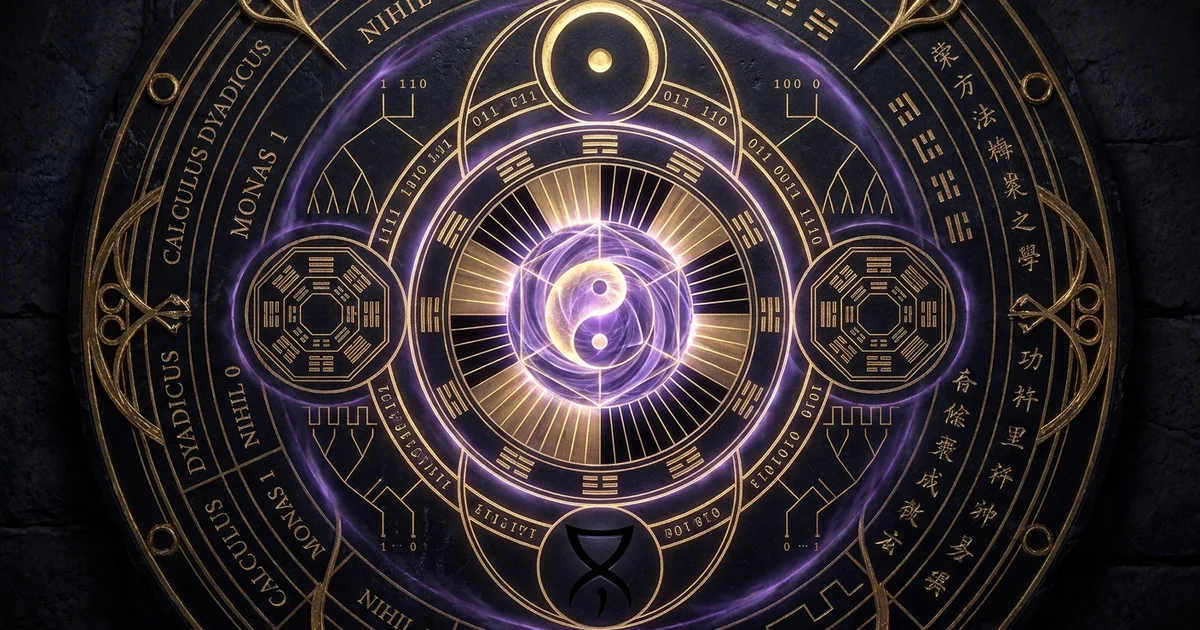
Gottfried Wilhelm Leibniz and the I Ching Binary Code
Archetypal Thesis & Systemic Paradigm: The Dyadic Characteristica Universalis
Creation Ex Nihilo as Combinatorial Ontology: 0 and 1 as Void and Monad
Gottfried Wilhelm Leibniz’s formulation of dyadic arithmetic did not emerge merely as an instrumental tool for mechanical calculation. It arose as a rigorous, metaphysical proof of theological cosmogeny: the continuous creation of the universe out of nothingness (creatio ex nihilo). Within Leibniz’s mathematical ontology, the integer 1 represents the absolute, unconditioned reality of the divine monad—the pure, active potency of God—while 0 designates the void, the privative inertia of unformed matter, non-being, or primeval chaos. In his 1697 essay, De Creatione Ex Nihilo, Leibniz struck a commemorative medallion bearing the motto Omnibus ex nihilo ducendis sufficit unum (“To produce all things from nothing, one is sufficient”), asserting that all conceivable mathematical, physical, and qualitative structures could be synthesized purely through the interplay of unity and zero.
This theological-mathematical system directly mirrored, yet ontologically inverted, the polar dynamics of ancient Chinese thought. Where classical Daoist cosmogony posited the emergence of the manifold world through the undifferentiated origin of taiji generating yin and yang, Leibniz interpreted the broken (yin) and unbroken (yang) lines of the I Ching (Yijing) through the lens of early modern European rationalism. To Leibniz, the unbroken line was the graphic sign of 1 (light, presence, divine intellect), and the broken line was the graphic sign of 0 (shadow, negation, receptive matter). Dyadic arithmetic became the ultimate ontological bridge: an analytical mechanism proving that the physical manifold is computed dynamically through an invariant philosophical dyad.
000000_2 = 0_10 (The Receptive / Kun)
111111_2 = 63_10 (The Creative / Qian)
The mathematical elegance of this formulation demonstrated that complexity is not an irreducible primitive of nature. Rather, complex forms are higher-order composites emerging from an algorithmic recurrence of elementary binary operations.
                  [ 1 ] Divine Unity (Yang / Actuality)
                    ↕  Binary Operation (Ex Nihilo)
                  [ 0 ] The Void (Yin / Potentiality)
                    ↓
 [ 000000 ... 111111 ] Algorithmic Manifold (64 Discrete States)
The isomorphism uniting Leibnizian binary arithmetic with the sixty-four hexagrams relies upon an exact mapping between positional base-2 notation and the structural hierarchy of yao (lines) read from base to apex:
$$\text{Hexagram Integer } N = \sum_{k=0}^{5} b_k \cdot 2^k \quad \text{where } b_k \in {0, 1}$$
In this structural mapping, the initial line (chu yao, bottom) represents the least significant bit ($2^0$), while the terminal line (shang yao, top) constitutes the most significant bit ($2^5$).
- A broken line ($–$, Yin) corresponds to the dyadic zero ($0$).
- An unbroken line ($-$, Yang) corresponds to the dyadic unit ($1$).
Thus, the hexagram Kun (Earth, six broken lines) maps directly to: $$b = 000000_2 = 0 \times 2^5 + 0 \times 2^4 + 0 \times 2^3 + 0 \times 2^2 + 0 \times 2^1 + 0 \times 2^0 = 0_{10}$$
Conversely, Qian (Heaven, six unbroken lines) maps to: $$b = 111111_2 = 1 \times 2^5 + 1 \times 2^4 + 1 \times 2^3 + 1 \times 2^2 + 1 \times 2^1 + 1 \times 2^0 = 63_{10}$$
Under this systemic transposition, the sixty-four hexagrams construct a complete, closed integer interval $[0, 63]$, proving that Shao Yong’s combinatorial sequence is identical to a natural descending binary place-value registry.
The Universal Characteristica: Transcending Linguistic Ambiguity Through Binary Polarity
Central to Leibniz’s lifelong intellectual program was the formulation of a characteristica universalis—an idealized, formal conceptual language capable of expressing all human knowledge through universal symbolic glyphs. Leibniz envisioned an intellectual landscape where philosophical, theological, and scientific disagreements would no longer provoke discursive disputes. Instead of arguing, thinkers would take pens in hand, sit at an abacus or calculating desk, and say to one another: Calculemus (“Let us calculate”).
Leibniz recognized that natural languages are inherently compromised by cultural subjectivity, semantic drift, and syntactical opacity. The binary character of the Yijing revealed to him that an ancient culture had already realized an operational proto-characteristica. The system of linear figures (gua) did not function as phonetic placeholders or subjective metaphors; they functioned as ideographic, structural calculators of universal state conditions. The binary arithmetic of broken and unbroken lines represented an ideography shorn of rhetorical ornament, operating through pure structural morphology.
By assigning fundamental polar values to logical primitives, complex assertions could be computed using basic algebraic mechanisms. In this respect, the leibniz binary system iching correspondence is not an accidental historical footnote, but the direct philosophical ancestor of symbolic logic, Boolean algebra, and formal machine code. Leibniz perceived in the linear permutations of Fuxi (Fu Xi) an uncorrupted surviving fragment of an ancient, primordial scientific language that unified logic, metaphysics, and cosmology into an integrated mathematical matrix.
The Psycho-Cosmological State-Space: The I Ching as Discrete Dynamic Calculus
When stripped of superstitious accretion, the Yijing functions as an advanced, discrete state-space representation of consciousness and cosmic process. A dynamic continuous reality is parsed into a quantified, finite matrix of sixty-four experiential vectors. Classical Western ontology, descending from Parmenides and Aristotle, frequently stalled on the problem of change, privileging static being over dynamic becoming. In contrast, the binary architecture of the Yijing handles continuous flux by discretizing temporal transformations into distinct operational cycles.
Each hexagram represents a discrete systemic configuration—an attractor state within a multidimensional phase portrait of psycho-cosmological evolution. The system does not merely catalog static archetypes; through the mechanism of moving or “changing” lines (lines operating at peak energetic limits of 6 or 9), it models vectors of imminent transition. A moving line flips its dyadic value from $0 \to 1$ or from $1 \to 0$, executing a parity inversion that shifts the base hexagram (ben gua) into a resultant hexagram (zhi gua).
The hexagram array constitutes a self-regulating cybernetic feedback matrix. It models the thermodynamic and psychic equilibrium of a given temporal moment, identifying where a system exhibits systemic excess (entropy) or structural concentration (syntropy). Through this lens, divinatory inquiry ceases to be an appeal to arbitrary fate; it becomes an epistemic operation within an archetypal calculus. The inquirer projects the psychological contents of an intractable life situation into a formal, discrete topological framework, allowing unconscious patterns to register against mathematical laws of polarity and structural transformation.
Classical Provenance & Textual Lineage: The Bouvet-Leibniz Epistolary Network
The Figurist Mission in Beijing: Joachim Bouvet’s Esoteric Hermeneutics
The cross-civilizational transmission that bridged early modern European mathematics and Song Dynasty Neo-Confucian cosmology was forged through the intellectual correspondence between Leibniz and Father Joachim Bouvet, a French Jesuit missionary stationed in Beijing at the court of the Kangxi Emperor. Bouvet was a prominent proponent of Jesuit Figurism, an esoteric theological methodology asserting that the historical foundations of Chinese civilization concealed reflections of Judeo-Christian revelation and ancient Hermetic wisdom.
[ Joachim Bouvet (Beijing) ]
        │  Transmission of Shao Yong's Xiantian Matrix (Nov 4, 1701)
        ▼
[ Gottfried Wilhelm Leibniz (Hanover) ]
        │  Mathematical Formalization / Explication (1703)
        ▼
[ Académie Royale des Sciences (Paris) ]
The Figurists hypothesized that the legendary Chinese culture-hero Fuxi was not a mythological pagan sovereign, but a transmission node of the prisca theologia—contemporary with, or identical to, Hermes Trismegistus, Enoch, or Zoroaster. Bouvet believed that the original, uncorrupted texts of the I Ching were esoteric repositories of antediluvian science, mathematical physics, and prophetic revelation, obscured across millennia by later commentators who lacked the necessary hermeneutic keys.
When Bouvet examined Leibniz’s initial descriptions of binary arithmetic—which Leibniz had shared with Jesuit interlocutors as a tool for Christian evangelization through mathematical reason—the missionary experienced an intellectual breakthrough. Bouvet recognized that the sixty-four hexagram configurations ascribed to Fuxi were an explicit physical manifestation of the dyadic calculus Leibniz claimed to have discovered.
“Fuxi, the most ancient sovereign of China, the author of the linear figures of the Yijing, had composed this work as an accurate, complete, and profound system of natural philosophy and metaphysical science… When your Excellency communicated to me your new arithmetic composed solely of the characters 0 and 1, I immediately realized that this was the very key needed to decipher the enigmatic figures of Fuxi, which consist nothing more than of full lines and divided lines, combined two by two, three by three, and six by six, from which arise the 64 figures that comprise the Book of Changes.” — Father Joachim Bouvet, archival dispatch from Beijing to Hanover.
Reception of the Fuxi Diagram: Translating Shao Yong’s Song Dynasty Matrix
On November 4, 1701, Bouvet dispatched a letter from Beijing containing two woodblock prints of the hexagram arrangements to Leibniz in Hanover. Leibniz did not receive this parcel until April 1, 1703. The primary artifact included in this dispatch was the Xiantian Tu (Diagram of Earlier Heaven), a structural configuration of the sixty-four hexagrams composed of an outer concentric circle enclosing an inner square.
       [ Inner Square Matrix ] ─── Orthogonal Relational Space
                 ▲
                 │
       [ Outer Circular Horizon ] ── Cyclical Phenomenological Time
Crucially, this arrangement was not an ancient artifact from the reign of Fuxi (traditionally dated to the 3rd millennium BCE), but the deliberate mathematical creation of Shao Yong (1011–1077 CE), an eminent philosopher of the Northern Song Dynasty. Shao Yong’s landmark treatise, the Huangji Jingshi (Book of Supreme World Ordering Principles), reconstituted the traditional, mantic King Wen sequence of the I Ching into an entirely abstract, rigorous combinatorial order known as the xiantian-earlier-heaven arrangement.
While the King Wen sequence reflects situational phenomenological pairings and historical shifts, Shao Yong’s Xiantian sequence is generated through an invariant mathematical rule of progressive binary bifurcation. When Leibniz unfurled Bouvet’s parcel, he did not find a mystical divination manual, but a familiar mathematical landscape: an ancient, non-Western tradition had organized the sixty-four hexagrams according to place-value binary progression centuries before European mathematicians considered the computational utility of base-2 arithmetic.
From Ars Combinatoria to the Berlin Academy: Historical Trajectory of the 1703 Memoir
The receipt of the Xiantian Tu dramatically altered Leibniz’s publication strategy. As early as 1666, in his youthful Dissertatio de Arte Combinatoria, Leibniz had posited that all complex concepts are generated by combinations of simpler ones, proposing an alphabet of human thoughts. In 1679, he had fully drafted the mechanics of binary calculation in an unpublished manuscript titled De Progressione Dyadica. For more than twenty years, however, Leibniz had withheld these findings from formal academic presentation, fearing that the binary system would be dismissed as a useless mathematical novelty lacking practical application.
The confirmation of the shao yong hexagrams provided Leibniz with the historical validation he needed. He immediately completed his landmark paper, Explication de l’Arithmétique Binaire, qui se sert des seuls caractères 0 et 1, avec des remarques sur son utilité, et sur ce qu’elle donne le sens des anciennes figures Chinoises de Fohy, and submitted it to the Académie Royale des Sciences in Paris, where it was published in the Mémoires of 1703.
In this seminal paper, Leibniz claimed that the ancient Chinese had possessed the true foundations of the universal science, but had lost its functional key across successive dynasties. By demonstrating that the linear figures of Fuxi were identical to the integers 0 through 63 written in binary notation, Leibniz accomplished a double victory: he legitimized his mathematical invention through historical precedent, while providing Jesuit missionaries with an intellectual tool intended to convert the Chinese literati by validating their foundational philosophical texts.
Structural Mechanics & Symbolic Geometry: Mathematical Topology of the Xiantian Matrix
The Power-of-Two Progression: From Taiji to the 64 Hexagram Horizon
The structural generation of the sixty-four hexagrams in the Xiantian system proceeds through an invariant algorithmic process: a recursive, binary tree-branching model descending from the undifferentiated unity of taiji down to the complex combinatorial manifold. This progression follows a strict geometric power series of base 2:
$$2^0 \longrightarrow 2^1 \longrightarrow 2^2 \longrightarrow 2^3 \longrightarrow 2^6$$
This recursive bifurcation proceeds with algorithmic precision:
- Level 0 ($2^0 = 1$): Taiji, the ground of being, undifferentiated wholeness.
- Level 1 ($2^1 = 2$): Liangyi, the division of unity into primal polarities: Yin ($0$) and Yang ($1$).
- Level 2 ($2^2 = 4$): Sixiang, the four images produced by superimposing another binary line: Greater Yin ($00$), Lesser Yang ($01$), Lesser Yin ($10$), and Greater Yang ($11$).
- Level 3 ($2^3 = 8$): bagua, the eight trigrams generated by adding a third binary position, yielding combinations from Earth (Kun, $000$) to Heaven (Qian, $111$).
- Level 6 ($2^6 = 64$): The hexagram matrix, where two trigrams merge to establish a six-bit byte capable of addressing sixty-four unique systemic permutations.
Each step in this generative sequence represents a simple doubling operation, revealing that the Xiantian matrix is not a poetic assemblage of nature symbols, but a natural arithmetic tree diagram.
Circular and Square Topologies: Shao Yong’s Spatialization of Chronological and Structural Time
Shao Yong laid out his Xiantian diagrams in two complementary topological configurations: an outer circular sequence and an inner square matrix. These forms map time, space, and transformation into coherent coordinate geometries.
The outer circle represents temporal succession—the diurnal, seasonal, and cosmic cycles of expansion (yang) and contraction (yin). Beginning at the northern nadir with Hexagram 24 (Fu, Returning, $000001_2$), Yang energy steadily accumulates upward along the eastern perimeter, sequentially flipping lines from bottom to top until it reaches the southern zenith at Hexagram 1 (Qian, Heaven, $111111_2$).
From this point of maximum expansion, Yin energy enters along the western perimeter, beginning with Hexagram 44 (Gou, Encounter, $111110_2$), flipping lines back to zero until the cycle resolves at Hexagram 2 (Kun, Earth, $000000_2$). The circular topology maps an eternal sine wave of cyclic emergence, saturation, decay, and regeneration.
       South (Zenith)
     Hexagram 1 (Qian)
       [ 111111 ]
           ▲
           │  (Yang Accumulates)
East ──────┼────── West
(Returning)│  (Yin Accumulates)
           ▼
     Hexagram 2 (Kun)
       [ 000000 ]
       North (Nadir)
The inner square matrix translates this temporal cycle into an orthogonal coordinate space of structural relationships. Arranged in an eight-by-eight grid, the sixty-four hexagrams are indexed by their component lower and upper trigrams, functioning like a modern Cartesian plane.
The vertical axis registers structural stability, while the horizontal axis charts active transformational resonance. By placing the cyclical circular system alongside the structural square grid, Shao Yong’s system demonstrates that time (the circle) and space (the square) are mathematically complementary projections of a single underlying binary code.
Lower Trigram (X-Axis: 000 to 111) ──┐
                                     ├──> Intersect at Coordinate (X, Y)
Upper Trigram (Y-Axis: 000 to 111) ──┘    Yielding Hexagram b_5...b_0
Symmetry, Parity, and Bit-Inversion: The Vector Calculus of Gua Transitions
The dynamic movement within the Yijing is governed by precise geometric and arithmetic operations across the six-line vector. When casting the oracle via traditional yarrow stalk or coin methods, individual lines yield four possible numerical values:
- 7: Young Yang (stable unbroken line, $1$)
- 8: Young Yin (stable broken line, $0$)
- 9: Old Yang (changing unbroken line, $1 \to 0$)
- 6: Old Yin (changing broken line, $0 \to 1$)
Stable lines (7 and 8) maintain their structural identity during an inquiry, whereas changing lines (9 and 6) undergo dynamic parity shifts. A changing line is an operational bit-flip. If a reading yields Hexagram 11 (Tai, Peace, consisting of lower trigram Heaven $111$ and upper trigram Earth $000$, or $000111_2$) with a changing line at the base position ($2^0$), that line inverts:
$$000111_2 \xrightarrow{\text{bit-flip at } 2^0} 000110_2$$
This single parity inversion transforms the original vector into Hexagram 26 (Da Chu, Great Accumulation).
Tai (Hexagram 11)        Da Chu (Hexagram 26)
  Line 6: -- (0)            Line 6: -- (0)
  Line 5: -- (0)            Line 5: -- (0)
  Line 4: -- (0)    ───►    Line 4: -- (0)
  Line 3: ── (1)            Line 3: ── (1)
  Line 2: ── (1)            Line 2: ── (1)
  Line 1: ── (9) [Flip]     Line 1: -- (0)
  State: 000111_2           State: 000110_2
In the mathematical topology of the Yijing, this transition is an adjacent shift on a six-dimensional hypercube. The sixty-four hexagrams occupy the sixty-four vertices of a $6$-cube (hypercube), where each line permutation represents a unit vector step along one of six dimensional axes.
The changing line identifies the specific coordinate axis along which the system undergoes structural transformation, modeling systemic tipping points, homeostatic corrections, and the psychological dynamic that Carl Jung termed enantiodromia—the inevitable emergence of an opposing force when any systemic polarity reaches its extreme limit.
Comparative Epistemology: Western Dyadic Monadology vs. Daoist Polar Cosmogeny
God and the Void vs. Continuous Oscillation: Ontological Discrepancies
While Leibniz and the Song Dynasty cosmologists converged on the formal structure of the binary progression, their metaphysical presuppositions differed significantly. Leibniz interpreted binary arithmetic through Christian theology and classical Western metaphysics: the absolute primacy of the Monad (God as 1) creating the cosmos out of absolute Nothingness (Void as 0). In Leibniz’s theology, 1 represents active intelligence, perfection, and light, while 0 represents deprivation, imperfection, passive limitation, and sin.
Leibnizian Dyadics (Western Rationalism)
- 1 (Monad): Absolute, active Divine Intellect; transcendent source of reality.
- 0 (Void): Privation, unformed matter, absence, original sin, nullity.
- Creation Model: Creatio ex nihilo; linear descent of power from divine will into the void.
- Temporal Logic: Teleological, progressive, asymptotic convergence toward ultimate divine harmony.
- Operative Goal: Mechanical automation of human reason via an infallible calculus ratiocinator.
Song Neo-Confucianism (Eastern Polarism)
- Yang (Unbroken): Expansive, dynamic, luminous, penetrating, heaven (Qian).
- Yin (Broken): Receptive, condensing, dark, structural, earth (Kun).
- Creation Model: Spontaneous, uncreated self-generation (Ziran); perpetual bifurcation of Taiji.
- Temporal Logic: Cyclical, recursive, homeostatic oscillation; eternal returns of cosmic breath.
- Operative Goal: Harmonization of human social and psychological action within macrocosmic flow.
Within Song Neo-Confucianism, Yin (the broken line) is not a privative lack of being. It is not “nothingness” in the European scholastic sense. Yin is an equally vital, generative, real metaphysical agency: the ground of structural cohesion, physical condensation, and spatial receptivity. Yin and Yang do not engage in a teleological struggle where the light of 1 conquers the darkness of 0; they are structurally interdependent. Yang initiates change, but Yin actualizes and sustains it.
Leibniz’s model remains hierarchical and theological, anchored by an uncaused First Cause; the Daoist model remains immanent and ecological, anchored by the self-so (ziran) interplay of equal, polar dynamics.
Linear Progressivism vs. Recursive Cycles: Temporal Architectures
The divergent interpretations of 0 and 1 yield fundamentally different architectures of time. Leibniz’s metaphysics, developed in his Monadology, is linked to a linear, progressive, and teleological framework. Every substance or monad develops according to an internal program implanted by God at the creation, progressively actualizing its potential toward greater clarity, sophistication, and harmony:
[ Creation Ex Nihilo ] ──(Teleological Progress)──> [ Pre-Established Harmony ]
History advances linearly along a vector toward eschatological and rational perfection.
The Xiantian cosmology of Shao Yong, by contrast, operates along recursive, cyclical time. The continuous shifting of the hexagram lines does not aim for an apocalyptic endpoint or ultimate mechanical resolution. Instead, the universe functions through eternal breathing: Yuan (origin), Heng (growth), Li (harvest), and Zhen (constancy). Every state of extreme activation (Yang) inevitably collapses into its opposite (Yin), only to regenerate once more:
┌─── [ Yang Maximum: Qian ] ───┐
▼                              ▼
[ Yin Growth: Gou ]      [ Yang Growth: Fu ]
▲                              ▲
└─── [ Yin Maximum: Kun ] ─────┘
Progress within this paradigm is not a linear escape from historical cycles, but the cultivation of timely action (shi zhong) within them. Divinatory inquiry does not predict a predetermined, linear fate; it determines where a person or collective sits within the natural seasonal phase of an overarching cycle.
Computational Reductionism vs. Archetypal Synchronicity
Leibniz understood binary notation as the bedrock of mechanization. By stripping thought down to the interaction of 0 and 1, he laid the conceptual foundation for mechanical computers like his “Stepped Reckoner” (Staffelwalze). His goal was algorithmic determinism: reducing discursive ambiguity to automated calculation. Leibniz’s binary vision was ultimately reductionist in design, striving to resolve the manifold complexities of the physical world into an axiomatic logical syntax.
The traditional Yijing, conversely, deploys binary combinatorial rules in service of an archetypal, synchronistic epistemology. The sixty-four hexagram configurations are not intended to reduce the universe to an automated machine; they serve as qualitative coordinates of human consciousness and natural law.
Where Leibniz sought an external, objective calculating machine to resolve philosophical conflict, the classical commentators utilized the hexagram matrix as an internal, self-reflexive mirror. The system does not automate reasoning; it stimulates synthetic, non-linear cognition by juxtaposing subjective intent against objective archetypal situations.
Psychological Dynamics & Operational Praxis: The Cybernetics of Divinatory Inquiry
Jungian Synchronicity and Number as Archetype of Order
In the twentieth century, the structural intersection of mathematics, psychological dynamics, and the I Ching was substantially revived through the intellectual collaboration between Carl Gustav Jung and Marie-Louise von Franz. Jung recognized that the Yijing operates on an epistemic principle fundamentally different from Western linear causality, a phenomenon he formally termed synchronicity—an acausal connecting principle linking internal psychic states with external, objective events through shared qualitative meaning.
“Number, a purely mental construct, possesses an enigmatic character: it can organize material phenomena while simultaneously emerging from the deepest strata of the unconscious. In this sense, number is not an invention of conscious thought, but an archetype of order that has become conscious… The binary division of the Yijing does not merely compute quantities; it reveals the rhythmic, qualitative time-geometry of the collective unconscious.” — Marie-Louise von Franz, Number and Time: Reflections Leading toward a Mirror Between Matter and Psychology (1974).
In this analytical framework, number is not an arbitrary quantitative measurement invented by humans to tally objects. Instead, it is the most primitive, irreducible archetype of order within the objective psyche.
When an individual casts the yarrow stalks or coins, the random mechanical fall of the instruments appears casual from the standpoint of physical mechanics, but meaningful from the standpoint of synchronicity. The resulting numerical sum ($6, 7, 8,$ or $9$) acts as an uncorrupted psychophysical seismograph. It selects a precise hexagram address from the sixty-four-element state-space that mirrors the real psychological condition of the inquirer’s unconscious.
Subjective Psychic Tension (Unconscious)
                 │
                 ▼  Synchronistic Event (Acausal Fall of Stalks/Coins)
Binary Hexagram Address (Matrix Coordinate: e.g., 010110_2)
                 │
                 ▼  Archetypal Projection & Hermeneutic Dialogue
Integrated Conscious Realization (Resolution of Tension)
The Hexagram as an Attractor State in Non-Linear Consciousness
Within modern archetypal psychology, human consciousness is understood as a dynamic, non-linear system navigating complex psychological landscapes. When confronted with moral, cognitive, or relational crises, conscious ego-structures often enter fixed, dysfunctional loops.
The hexagram functions as an archetypal attractor state. It introduces a structured, alternative vector space that disrupts neurotic loops, reframing personal crises within archetypal human narratives.
The inquirer does not encounter passive fortune-telling; they participate in an interactive cybernetic feedback loop:
[ Psychological State ] ───(Query)───► [ Hexagram Matrix ]
          ▲                                    │
          │                                    ▼
[ Conscious Realization ] ◄──(Feedback)─── [ Bit Transitions ]
Because each hexagram pairs two fundamental three-line trigrams—representing natural forces such as Water (Kan, danger/depth), Fire (Li, clarity/clinging), Lake (Dui, joy/expression), and Mountain (Gen, stilling/boundary)—the hexagram maps the tension between opposing forces within the human psyche.
The individual’s conscious ego identifies with one component of the hexagram, while their repressed unconscious shadow resonates with the opposing trigram. Through this structural tension, the hexagram coordinates unconscious dynamics, making hidden psychological resistances accessible to conscious reflection.
Decoding Dynamic Polarity: The Method of Line Transmutation and Shadow Integration
The operational heart of the Yijing lies in the transmutation of lines. The reading of a hexagram does not stop at a static binary configuration. The inclusion of changing lines ($6$ and $9$) exposes the impending psychological movement within the inquirer’s unconscious. A changing line is an explicit point of psychic instability, marking an unconscious content that has reached its saturation point and is actively tipping into its opposite:
$$\text{Line State: } 9 \text{ (Old Yang)} \xrightarrow{\text{Enantiodromia}} 0 \text{ (New Yin)}$$
$$\text{Line State: } 6 \text{ (Old Yin)} \xrightarrow{\text{Enantiodromia}} 1 \text{ (New Yang)}$$
This transformational process models the psychological integration of the shadow. For example, if an individual receives Hexagram 36 (Ming Yi, Darkening of the Light) with an active changing line at the second position, the reading shifts toward Hexagram 11 (Tai, Peace).
The psychological operation demands that the inquirer confront the immediate, painful reality of wounded consciousness (Ming Yi) without projecting the injury outward onto scapegoats. The bit-flip indicates that accepting this vulnerability is the precise psychic mechanism required to attain genuine systemic equilibrium (Tai).
The mathematical parity shift mirrors psychological enantiodromia. By consciously engaging with the changing line, the individual participates in the transformation of their own psyche, using the hexagram matrix as a reflective map for psychological integration.
Philosophical Synthesis & Macrocosmic Correspondence: Computation, Genetic Codons, and Universal Law
The 64-Element Universal Code: Hexagrams and the Molecular Triplet Codon Isomorphism
The structural isomorphism uniting Leibnizian binary arithmetic with the sixty-four hexagrams found an unexpected scientific parallel in the mid-twentieth-century decipherment of the biological genetic code. Molecular biologists discovered that all terrestrial organic life encodes its inherited structural instructions using a sequence of sixty-four triplet codons constructed from four nucleic acid bases.
The structural logic that governs the generation of the sixty-four hexagrams from four fundamental bigrams (Sixiang) is mathematically isomorphic to the generative logic of the universal genetic code from four nucleic acid bases.
In molecular biology, mRNA is assembled from four nitrogenous bases:
- Adenine (A)
- Cytosine ©
- Guanine (G)
- Uracil (U) / Thymine (T) in DNA
These four bases are read in non-overlapping triplets called codons: $$\text{Total Codon Configurations} = 4^3 = 64$$
In the combinatorial mechanics of the Yijing:
- The four bigrams (Sixiang) are generated by $2^2 = 4$ combinations of Yin and Yang.
- Hexagrams are assembled by combining these into a six-line matrix, or by grouping three two-line or two three-line relationships: $$\text{Total Hexagram Configurations} = 2^6 = 64$$
Through chemical and structural correspondence:
- Thymine / Uracil (U/T): Greater Yin (Taiyin, $00$)
- Cytosine ©: Lesser Yang (Shaoyang, $01$)
- Adenine (A): Lesser Yin (Shaoyin, $10$)
- Guanine (G): Greater Yang (Taiyang, $11$)
Every biological amino acid codon directly maps to a corresponding six-bit hexagram address within the binary hypercube.
This biological mapping—detailed extensively in scholarship on the genetic-codon-isomorphism—suggests that the sixty-four-element matrix is not an arbitrary cultural preference of ancient China or early modern Europe.
Instead, $2^6 = 64$ appears to be a systemic constant: an optimal combinatorial configuration for encoding information across complex open systems. Whether storing biological instructions for protein synthesis or mapping archetypal dynamics of human consciousness, nature and mind converge on an identical discrete binary architecture.
[ Nucleic Base Triplet: 4^3 Codons ] ──(64 Elements)── [ Hexagram Permutations: 2^6 Gua ]
                      ▲                                              ▲
                      │                                              │
                      └─────────────► [ Universal Code ] ◄───────────┘
                                   Optimal Discrete Matrix
Turing, von Neumann, and the Lineage of Modern Digital Architecture
The conceptual lineage connecting Leibniz’s engagement with the Yijing directly shaped the emergence of modern computational architecture. When Leibniz synthesized dyadics in his 1703 memoir, he provided the conceptual foundation that George Boole transformed in his 1854 work, An Investigation of the Laws of Thought, mapping propositional logic directly to binary variables ($1 = \text{True}$, $0 = \text{False}$).
In 1937, Claude Shannon demonstrated in his master’s thesis that Boole’s binary logic could physically control electrical relays and switches. This established the foundational architecture for all digital circuit design, electronic signal processing, and telecommunications networks:
Leibniz (1703: Dyadics & I Ching)
  │
  ▼
George Boole (1854: Boolean Algebra)
  │
  ▼
Claude Shannon (1937: Switching Circuit Theory)
  │
  ▼
Alan Turing (1936: Universal Turing Machine)
  │
  ▼
John von Neumann (1945: Stored-Program Architecture)
  │
  ▼
Modern Computational Matrix
Alan Turing’s conception of the Universal Turing Machine—which reads, writes, and erases binary marks upon an infinite paper tape according to a transition table—operationalized Leibniz’s dream of the calculus ratiocinator.
Shortly thereafter, John von Neumann consolidated this lineage by formulating the stored-program architecture that powers contemporary microprocessors. Modern digital computers execute billions of cycles per second using low- and high-voltage registers: an ongoing technological realization of the dialectic between broken and unbroken lines.
The Holographic Paradigm: As Above, So Below in Discrete Cosmologies
The convergence of Leibnizian dyadics, Song Dynasty Neo-Confucianism, molecular genetics, and modern computer science illuminates the ancient Hermetic axiom: Quod est superius est sicut quod est inferius (“That which is above is like that which is below”). Within this holographic paradigm, every localized system contains a structural reflection of the total cosmic architecture.
In Leibniz’s Monadology, every monad functions as a perpetual, living mirror of the entire universe, perceiving reality from its own distinct systemic perspective.
Similarly, in Shao Yong’s cosmological mathematics, every individual line of a hexagram contains within itself the latent potential of the entire sixty-four hexagram matrix. The part reflects the whole through self-similar fractal recurrence:
[ Individual Line (Yao: 0/1) ]
       │
       ▼ (Self-Similarity across scales)
[ Trigram (Bagua: 3-bit) ]
       │
       ▼
[ Hexagram (Gua: 6-bit) ]
       │
       ▼
[ Macrocosmic Manifold (64-State Phase Space) ]
The sixty-four hexagram matrix acts as a discrete conceptual holographic model of reality. At the microscopic scale, it aligns with the combinatorial codes of molecular biology; at the psychological scale, it maps the archetypal architecture of the unconscious; and at the macroscopic scale, it mirrors the digital logic of computational systems.
Through this synthesis, the dialogue between Leibniz and Joachim Bouvet across the Eurasian landmass reveals a fundamental truth: human consciousness across cultures and epochs arrives independently at the same binary characteristica—a foundational calculus through which the cosmos computes, sustains, and understands itself.
Frequently Asked Questions
Did Leibniz invent binary arithmetic independently of the I Ching?
Yes. Historical and archival evidence verifies that Leibniz developed the mechanics of dyadic arithmetic well before he encountered the linear figures of the I Ching. Leibniz drafted his foundational treatise on the binary system, De Progressione Dyadica, in 1679—twenty-two years before Father Joachim Bouvet mailed the Xiantian hexagram woodblock diagrams from Beijing in November 1701. Leibniz had also designed the mechanical principles for a binary calculator utilizing moving marbles falling through slots into open or closed tracks as early as 1679.
The historical importance of Bouvet’s communication did not lie in teaching Leibniz the binary system, but in providing him with external, ancient confirmation. Leibniz had withheld his dyadic discoveries from academic circulation, fearing they would be dismissed as a mathematical curiosity lacking practical utility. The receipt of the Xiantian Tu provided historical validation, proving that an advanced, long-lived civilization had utilized an isomorphic mathematical notation at the foundation of its classical philosophy and statecraft.
Why is Shao Yong’s sequence different from the traditional King Wen sequence?
The structural divergence between the King Wen sequence and Shao Yong’s Xiantian sequence stems from fundamentally different organizing principles: situational phenomenology versus pure combinatorial mathematics.
The King Wen sequence, which dates to the Western Zhou period, is arranged according to historical, moral, and phenomenological transitions. It groups hexagrams into thirty-two relational pairs, primarily governed by inverted perspective (turning a hexagram upside down) or systemic parity-shift (inverting all lines when a hexagram is symmetrical, such as Qian and Kun). The sequence models the contextual, non-linear unfolding of human dynasties, existential dilemmas, and psychological states.
King Wen Sequence ───► Qualitative, historical, experiential pairings
Shao Yong Sequence ──► Quantitative, axiomatic, binary base-2 progression
Shao Yong’s Xiantian sequence, formulated in the eleventh century, disregards these historical pairings in favor of an abstract, axiomatic mathematical progression. By consistently placing Yin ($0$) before Yang ($1$) at every level of recursive bifurcation, Shao Yong generated an arrangement that tracks the natural progression of numbers from $000000_2$ to $111111_2$.
Shao Yong’s sequence reflects Xiantian (“Earlier Heaven”)—the unmanifest, eternal geometric order of the cosmos prior to its temporal, asymmetric manifestation in Houtian (“Later Heaven”), which the King Wen sequence models.
How do changing lines represent mathematical and psychological state transformations?
Mathematically, a changing line functions as a parity inversion or dynamic bit-flip operation within a six-dimensional vector space. Each hexagram occupies a distinct vertex on a $6$-cube (hypercube) containing sixty-four possible states.
A static line preserves the coordinate value along its dimensional axis ($0$ remains $0$, $1$ remains $1$). A changing line ($6$ or $9$) forces a parity inversion:
- Old Yang ($9$) flips from $1$ to $0$.
- Old Yin ($6$) flips from $0$ to $1$.
This transition maps an operational trajectory from the base hexagram (ben gua) along a specific dimensional edge to an adjacent resultant hexagram (zhi gua).
Base Vertex (Current State) ──[Bit-Flip / Axis Traversal]──► Adjacent Vertex (Attractor State)
Psychologically, as analyzed by Carl Jung and Marie-Louise von Franz, changing lines locate areas of high emotional tension where an unconscious complex has reached maximum saturation. Under the psychological principle of enantiodromia, any archetypal dynamic pushed to its energetic extreme inevitably evokes its opposite.
The changing line indicates an impending transformation within the inquirer’s psyche: a conscious attitude that has become unsustainable, or an unintegrated shadow element demanding recognition. By charting both the present state and the target attractor state, the changing line transforms the I Ching from a static diagnostic tool into a dynamic map of psychological integration.