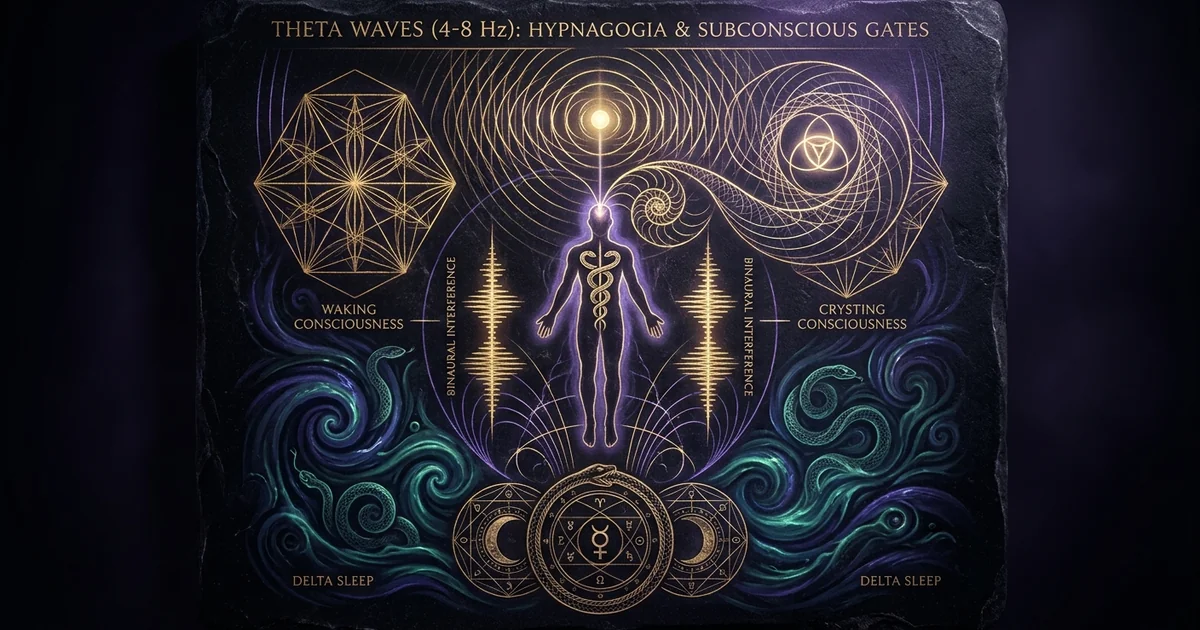
Theta Waves (4-8 Hz): Hypnagogia & Subconscious Gates
Protocol Overview & Neurophysiological Thesis: The Gateway of Hypnagogia
Neuroanatomy of the Twilight State: Thalamocortical Desynchronization
The transition from vigilant wakefulness to sleep is governed by an electrophysiological threshold known as the hypnagogic state, or sleep onset period (SOP). Neurobiologically, this twilight state represents the progressive collapse of high-frequency, low-amplitude beta rhythms (13–30 Hz) and resting posterior alpha rhythms (8–12 Hz) into sustained, medium-amplitude theta oscillations (4.0–8.0 Hz). This oscillatory shift is driven by the dynamic desynchronization of the thalamocortical loop. As ascending cholinergic and monoaminergic inputs from the mesencephalic reticular formation and locus coeruleus decline, the thalamic reticular nucleus (TRN) alters its firing mode from tonic single-spike transmission to burst-firing hyperpolarization.
This hyperpolarization attenuates the relay of exteroceptive sensory data to primary cortical reception areas. During this initial de-afferentation, sensory association cortices do not immediately fall silent; instead, they become decoupled from primary sensory inputs and frontal executive monitoring. This anatomical divergence creates the neurophysiological precondition for hypnagogia: the generation of spontaneous, cross-modal hallucinatory micro-imagery, auditory fragments, and somatosensory illusions. Within this specific window, localized slow-wave activity appears across cortical regions while islands of fast, waking-like oscillations persist. This establishes a hybrid state of consciousness that is neither fully vigilant wakefulness nor the total behavioral quiescence of slow-wave sleep.
“Hypnagogic imagery appears within an oscillatory window distinctly decoupled from both the unified alpha background of relaxed wakefulness and the generalized slow-wave synchrony of early Stage 2 non-rapid eye movement (NREM) sleep. Localized frontomedial theta (fmθ) activity, peaking at 5.0–6.5 Hz over the anterior cingulate cortex, represents an electrophysiological index of sustained internal attention and dream-like imagery synthesis during the sleep onset period. This localized power spectral density diverges sharply from the diffuse, generalized theta distributions characteristic of tonic REM sleep or descending sleep-spindle microstates, demonstrating that hypnagogic imagery is supported by an active, awake-like cortical processing loop operating concurrently with subcortical sensory isolation.” — Cantero, J. L., Atienza, M., & Stickgold, R. (2003). Hypnagogic imagery and EEG theta activity: Distinct neural signatures of dreaming at sleep onset. Cerebral Cortex, 13(10), 1084-1093.
Transient Hypofrontality and Attenuated Cognitive Filtering
The neurofunctional hallmark of the theta-dominated twilight state is transient hypofrontality. During normative waking states, the dorsolateral prefrontal cortex (dlPFC) acts as the central executive hub of the brain, exerting continuous top-down cognitive suppression, error monitoring, and logical contextualization via inhibitory gamma-aminobutyric acid (GABA)-ergic projections to downstream affective and sensory structures. As frontomedial theta (fmθ) oscillations entrain broad swaths of the medial frontal cortex, metabolic rate and blood-oxygen-level-dependent (BOLD) signals within the dlPFC decrease precipitously.
With the dlPFC taken partially offline, the brain’s critical filtering apparatus attenuates. The default mode network (DMN)—anchored by the posterior cingulate cortex, precuneus, and medial prefrontal cortex—undergoes marked topological reconfiguration. It escapes executive suppression, permitting unconstrained self-referential processing, semantic free-association, and the emergence of subconscious narrative structures. In this state of attenuated cognitive filtering, sensory and emotional memory networks that are normally repressed by prefrontal surveillance are granted direct access to conscious awareness. This mechanism forms the neurobiological foundation for using theta brainwaves for hypnagogia and subconscious programming. The individual maintains sufficient metacognitive lucidity to perceive and direct internal imagery without triggering the hyper-rational inhibitory gating that typifies the waking state.
Hippocampal-Neocortical Dialogue and the Subconscious Portal
At the core of the subconscious gate lies the disruption and recalibration of the hippocampal-neocortical dialogue. In the active waking state, the hippocampus receives dense multimodal sensory streams routed through the entorhinal cortex, organizing this information through high-frequency gamma rhythms nested within theta cycles. During the onset of theta-band hypnagogia, the direction of this information flow reverses. Driven by intrinsic hippocampal rhythmic slow activity (RSA)—a rhythm generated primarily by pacemaking GABAergic and cholinergic neurons within the medial septum and the vertical limb of the diagonal band of Broca—the hippocampus begins to broadcast internally generated episodic fragments upstream to the neocortex.
       [ Medial Septum / Diagonal Band ]
                     │  (GABAergic / Cholinergic Pacemaking)
                     ▼
         [ Hippocampal Formation ]
          (Rhythmic Slow Activity: RSA)
                     │
          Episodic Memory Replay
          (Theta Phase-Precession)
                     │
                     ▼
      [ Association Neocortex (Unfiltered) ]
                     │
          Dynamic Memory Reconsolidation
                     │
                     ▼
      [ Limbic Integration (Amygdala/ACC) ]
This reversed dialogue facilitates the spontaneous retrieval and replay of unprocessed limbic memory processing networks. The episodic traces held within CA3 and CA1 pyramidal cells fire in coordinated bursts phase-locked to specific components of the 4.0–8.0 Hz cycle. Unencumbered by top-down dlPFC inhibition, these memory representations enter neocortical sensory association zones, manifesting subjectively as vivid, emotionally charged hypnagogic phenomena.
Because the neurochemical environment of the theta twilight state maintains intermediate levels of acetylcholine alongside declining norepinephrine and serotonin, the underlying neuroplasticity remains remarkably high. Synaptic long-term potentiation (LTP) can be readily induced during hippocampal theta peaks. This makes the stabilized theta window a profound transpersonal and therapeutic portal: an operating state wherein old, maladaptive affective schemas can be targeted, destabilized, and overwritten via targeted subconscious memory reconsolidation.
Biophysical Mechanisms & Brainwave Dynamics: Frequency Following & Limbic Entrainment
The Frequency Following Response (FFR) in the Superior Olivary Complex
Exogenous acoustic induction of hypnagogic theta rests upon the biophysical phenomenon of the frequency-following response (FFR). When an individual is exposed to rhythmic, sub-cortical auditory stimuli matching endogenous neuroelectric rhythms, the central auditory pathway transduces these physical vibrations into electrophysiological waveforms that propagate to the cortex. This transduction begins at the cochlear hair cells, which convert fluid displacement of the basilar membrane into action potentials along the auditory nerve (cranial nerve VIII).
These neural impulses ascend directly into the superior olivary complex (SOC), the primary pontine relay station responsible for processing binaural auditory cues and interaural time differences (ITD). The medial superior olive (MSO) contains specialized bipolar neurons that act as coincidence detectors, measuring timing disparities between acoustic signals arriving at each ear with sub-millisecond precision. When dichotic stimuli of slightly differing frequencies are introduced, the MSO phase-locks its action potentials to the mathematical differential of the two acoustic inputs. This endogenous phase-locked firing generates a secondary, central electrophysiological wave that ascends via the lateral lemniscus to the inferior colliculus, project through the medial geniculate body of the thalamus, and ultimately drive wide-scale thalamocortical resonance.
Acoustic Beat Differential Physics: Carrier Waves vs. Modulating Offsets
The generation of binaural beats relies on precise physical parameters. A binaural beat is not an acoustic artifact produced in the air; it is a neurological percept constructed entirely within the brainstem when two discrete, continuous-tone sine waves of differing frequencies ($f_1$ and $f_2$) are presented dichotically (one to each ear) via stereophonic transducers. The perceived beat frequency ($f_b$) is governed by the absolute difference:
$$f_b = |f_1 - f_2|$$
For the central nervous system to synthesize this phantom beat and activate the superior olivary complex’s phase-locking apparatus, the acoustic carrier frequency ($f_c = \frac{f_1 + f_2}{2}$) must fall within a strict biophysical envelope:
- Carrier frequencies exceeding 1000 Hz fail to generate coherent binaural perception because the membrane physics of human inner hair cells cannot maintain phase-locking at higher velocities.
- The carrier frequency provides optimal entrainment amplitude when positioned between 150 Hz and 250 Hz, where human interaural phase discrimination displays maximum sensitivity.
To safely entrain the central nervous system to the hypnagogic locus of 5.5 Hz theta, an optimized acoustic configuration pairs a primary carrier tone ($f_1$) of 200.0 Hz in the left ear with a secondary tone ($f_2$) of 205.5 Hz in the right ear. The resulting 5.5 Hz envelope acts as an exogenous pacing clock.
As detailed in the foundational mechanics of the /sound-cymatics/frequency-following-response-neurophysics literature, continuous exposure to this phase-locked signal promotes widespread interhemispheric synchronization. As the corpus callosum transfers the phase-locked pontine oscillations across the left and right cerebral hemispheres, bilateral cortical field potentials slowly abandon high-variance desynchronized firing and align their macroscopic electric fields to the 5.5 Hz attractor.
Comparative Neural Dynamics: Delta (0.5–4 Hz) vs. Theta (4–8 Hz) vs. Alpha (8–12 Hz)
To understand the mechanics of the hypnagogic threshold, one must contrast the neurodynamic and phenomenological architecture of the theta band against its neighboring electroencephalographic domains: delta and alpha.
Frequency Spectrum Dynamics & Conscious State Architectures:

0.5 Hz ──────── 4.0 Hz ────────────── 8.0 Hz ──────────── 12.0 Hz
  [    DELTA    ]      [    THETA     ]      [    ALPHA     ]
   Slow-Wave SWS        Hypnagogic Gate       Resting Vigilance
   Loss of Agency       Lucid Subconscious    Top-Down Gating
   Cellular Repair      Active Synaptic LTP   Cortical Idling
Alpha activity (8.0–12.0 Hz), particularly posterior occipital alpha, reflects a state of wakeful sensory rest and cortical idling. Under alpha predominance, the top-down cognitive gating enforced by the frontal-parietal network remains functional. The individual experiences internal calm, but the barrier between the conscious executive self and the unconscious memory bank remains fortified; spontaneous non-linear imagery is suppressed.
At the lower end of the continuum sits slow-wave delta activity (0.5–4.0 Hz), characterized by global, high-amplitude cortical slow oscillations synchronized with generalized thalamic bursting. In delta, conscious access, metacognitive agency, and internal symbolic processing cease entirely, ceding ground to non-rapid eye movement (NREM) Stage 3/4 restorative unconsciousness. Delta dynamics, while essential for growth hormone release and glymphatic clearance (as explored in /meditation/delta-waves-deep-sleep-regeneration), extinguish the subjective observer.
Theta oscillations (4.0–8.0 Hz) occupy the functional sweet spot between these two regimes. Unlike alpha, which maintains waking cognitive structures, theta attenuates the prefrontal matrix enough to expose the subconscious landscape. Unlike delta, which extinguishes the conscious observer, theta allows metacognitive monitoring to coexist alongside subcortical, oneiric projections.
Theta-band synchronization supports long-term potentiation within hippocampal pathways. This provides an electrophysiological platform where the practitioner can consciously observe, deconstruct, and deliberately re-encode deep-seated neuroaffective patterns.
Neurophenomenological Landscapes: Shamanic Trance and Gateway Focus States
Auditory Driving in Cross-Cultural Shamanic Rhythms (4–7 Hz Drumming)
Long before the development of electroencephalography, archaic spiritual traditions developed somatic and acoustic methodologies to reach the hypnagogic twilight state. Foremost among these is the cross-cultural technology of shamanic trance, typically induced via percussive auditory driving. Anthropological and ethnomusicological investigations consistently document that the dominant percussive cadence utilized in classic Siberian, Mongolian, and Indigenous American journeying rituals settles precisely between 4.0 and 7.0 beats per second (240 to 420 beats per minute).
This percussive pacing functions as a form of rhythmic auditory stimulation (RAS). The sharp, acoustic transient spikes of a membranophone drum produce high-energy acoustic wavefronts rich in low-frequency harmonics. These rhythmic transients trigger widespread somatosensory and auditory evoked potentials that bypass the superior olivary complex phase-differential loop, driving the ascending reticular activating system (ARAS) through direct temporal acoustic entrainment.
The neurophysiological outcome is functionally identical to modern synthetic protocols: the practitioner’s waking beta profile collapses, transient hypofrontality sets in, and the central nervous system drops into a sustained 4–7 Hz waking trance. In this state, practitioners report leaving mundane somatic coordinates, navigating complex symbolic internal realities, and communicating with what their frameworks define as archetypal autonomous intelligences.
Shamanic Auditory Driving (Organic RAS)
- Primary Frequency: 4.0–7.0 Hz rhythmic transients (monaural acoustic percussive strikes).
- Neurochemical Profile: Elevated endorphins, systemic dopamine release, modulated adrenocortical arousal.
- Transduction Mechanism: Direct mechanoreceptor and cochlear pacing driving the ascending reticular activating system (ARAS).
- Somatosensory Correlate: Visceral, full-body kinetic entrainment; sustained motor loop engagement or dynamic cataleptic collapse.
- Intentional Objective: Mythopoetic external navigation, spirit-world journeying, archetypal psychopomp transactions.
Precision Hemi-Sync (Engineered Binaural FFR)
- Primary Frequency: 5.5 Hz differential envelope via pure sinusoidal carriers (150–250 Hz).
- Neurochemical Profile: Decreased cortisol, elevated acetylcholine, upregulated central serotonin and endogenous GABA.
- Transduction Mechanism: Medial superior olive coincidence detection driving trans-callosal phase-locking.
- Somatosensory Correlate: Complete physical de-afferentation; motor catatonia (“Mind Awake/Body Asleep”), sensory sensory decoupling.
- Intentional Objective: Systematic subconscious reprogramming, transpersonal ego-deconstruction, nonlocal consciousness exploration.
The Monroe Gateway Archive: Focus 10 (‘Mind Awake/Body Asleep’)
In contemporary transpersonal psychology and esoteric neurophysics, the institutional codification of the stabilized theta twilight state reached its zenith within the Monroe Institute of Applied Sciences. Founded by Robert A. Monroe, the Institute developed the “Gateway Experience,” an acoustic entrainment curriculum designed to induce altered states of consciousness through precise binaural beat technology termed Hemi-Sync (Hemispheric Synchronization).
Central to the Gateway paradigm is “Focus 10,” a somatic state operationalized as “Mind Awake/Body Asleep.” Focus 10 is characterized by profound physical de-afferentation: the motor nervous system crosses the threshold of temporary sleep paralysis (somatic atonality), while the internal observing self retains sharp, linear metacognitive awareness.
Neurobiologically, Focus 10 maps directly to the stabilization of a high-amplitude frontomedial theta rhythm accompanied by the near-complete suppression of somatic electromyographic (EMG) output. In this state, the sensory motor cortex decouples from peripheral afferents, mimicking the physiological conditions of sleep while the prefrontal-cingulate axis remains alert.
The archival research detailed in the /consciousness/monroe-gateway-experience-analysis dossier confirms that Focus 10 serves as the primary stepping stone to higher experiential vectors (Focus 12, Focus 15, and Focus 21). It operates as an ontological vacuum chamber where transpersonal consciousness decouples from neuromuscular coordinates, permitting targeted out-of-body operations and veridical anomalous perception.
Ego-Dissolution, Hypnagogic Phantasia, and Spontaneous Archetypal Influx
As the brain lingers within the stabilized 4–8 Hz theta corridor without lapsing into slow-wave delta amnesia, the neurophenomenological landscape shifts from linguistic, linear cognition into hypnagogic phantasia. This state is characterized by spontaneous, highly dense, visual and kinetic sensory imagery. These images do not present as standard intentional daydreams or fantasy, but arrive unbidden, carrying the phenomenological signature of objective externality.
This influx of archetypal imagery directly reflects the disinhibition of the human limbic system. As top-down dlPFC error-checking dissolves, the right hemisphere and deep limbic structures—specifically the amygdala-hippocampal complex—begin to broadcast information using symbolic, non-linear syntax. Carl Jung conceptualized this phenomenon as the direct emergence of archetypal contents from the objective psyche.
Neurobiologically, it reflects the associative sensory cortices attempting to construct coherent narrative frameworks out of raw, non-linear neurochemical discharges and unintegrated somatic memories. The practitioner becomes a waking observer of their own internal mythopoetic processing, granting them a conscious interface with emotional schemas, shadow material, and symbolic imagery that remain otherwise inaccessible during the hyper-structured waking state.
Step-by-Step Experiential Protocol: Inducing and Stabilizing Controlled Hypnagogia
Chronological Phase Architecture:
[ 00:00 - 15:00 ]  Phase I:   Somatic De-afferentation & Vagal Tone Induction
[ 15:00 - 35:00 ]  Phase II:  Acoustic Entrainment Sweep & Hypnagogic Stabilization
[ 35:00 - 50:00 ]  Phase III: Semantic Inoculation & Limbic Reconsolidation
Phase I: Somatosensory De-afferentation & Vagal Tone Induction (0-15 Min)
The primary obstacle to reaching hypnagogic theta is autonomic hyper-arousal. Subconscious gate access cannot occur under sympathetic branch dominance; sustained muscular tension and elevated heart-rate variability (HRV) low-frequency power maintain high-frequency beta firing across the sensorimotor cortex. Therefore, the protocol begins with somatosensory de-afferentation and conscious vagal tone upregulation.
- Environmental Preparation: Darken the chamber completely (0 lux photic input) or apply an opaque sensory-deprivation eye mask. Ensure ambient temperature is stabilized between 20°C and 22°C to prevent thermoregulatory distress during somatic drops.
- Posture: Recline the physical vessel in a zero-gravity ergonomic position or supine Savasana, with limbs uncrossed and spine axially aligned. Neutralize all kinetic load on the musculoskeletal system.
- Resonant Breathing Mechanics: Initiate parasympathetic autonomic down-regulation via 0.1 Hz resonant respiration. Inhale through the nasal cavity for a count of 4.0 seconds, hold the intrapulmonary volume for 7.0 seconds, and execute a slow, smooth, unforced oral exhalation across an 8.0-second trajectory (the classic 4-7-8 ratio).
- Physiological Transduction: This elongated exhalation phase stimulates the pulmonary stretch receptors, driving baroreceptor-mediated vagal nerve activation. This down-regulates sinoatrial node pacing, dampens systemic cortisol release, and signals the nucleus tractus solitarius (NTS) to attenuate mesencephalic reticular firing, laying the physiological groundwork for thalamocortical slowing.
Phase II: Acoustic Entrainment Sweep & Hypnagogic Stabilization (15-35 Min)
Once somatic stillness and vagal dominance are achieved (typically within 12 to 15 minutes), the acoustic entrainment sweep begins through open-back dynamic or planar-magnetic stereophonic headphones.
- Transducer Integrity: Open-back, circumaural headphones with flat frequency response curves (20 Hz – 20 kHz); avoid high-compression wireless protocols that distort micro-timing differences.
- Carrier Configuration: Pure sinusoidal carrier ($f_1$) fixed at 216.0 Hz in the left channel; secondary tone ($f_2$) initiated at 226.0 Hz in the right channel, delivering an initial 10.0 Hz alpha differential.
- The Entrainment Sweep: Over an unhurried 10-minute descent (minutes 15 to 25), glide the right channel’s frequency continuously downward from 226.0 Hz to 221.5 Hz. This drives the perceived binaural differential from 10.0 Hz down to precisely 5.5 Hz.
- The Conscious Sentinel Mechanism: To prevent the brain from dropping into non-REM delta unconsciousness, employ the “Forearm Sentinel” protocol: place the dominant forearm vertically, resting on the elbow. If the practitioner lapses into stage-3 sleep, somatic tonus drops, the arm collapses, and the somatic shock restores waking theta lucidity without triggering sympathetic panic.
As the binaural beat hits the 5.5 Hz mark, the practitioner crosses the hypnagogic threshold. Proprioceptive awareness will loosen; sensations of physical floating, body enlargement, or light rotational spinning may occur. These somatic illusions mark the functional de-afferentation of the parietal lobe.
At this stage, visual hypnagogia will begin to emerge: geometric phosphenes, flashes of face-like structures, or linguistic echoes. The practitioner must maintain the posture of the detached witness—observing these perceptual phenomena without fixating on them, as dynamic fixation reactivates prefrontal tracking and forces an immediate beta rebound.
Phase III: Semantic Inoculation & Limbic Memory Reconsolidation (35-50 Min)
Between minutes 35 and 50, the brain rests in a stable, frontomedial theta-dominant state. With prefrontal critical monitoring suppressed and hippocampal long-term potentiation elevated, the limbic system is receptive to direct semantic inoculation and memory reconsolidation.
[ Phase III Semantic Inoculation Loop ]
 ┌────────────────────────────────────────┐
 ▼                                        │

[ Sensory Anchor Activation ]                 │
│ (Breath retention or physical mudra)   │
▼                                        │
[ Somatosensory Memory Retrieval ]            │  5.5 Hz Theta Field
│ (Access target maladaptive schema)     │ (dlPFC Disinhibited)
▼                                        │
[ Symbolic Inoculation ]                      │
│ (Deploy non-linear archetypal symbol)  │
▼                                        │
[ Affective Neurochemical Resolution ]────────┘
(Parasympathetic integration)
- Activation of the Sensory Anchor: Introduce a pre-determined sensory trigger—such as a specific subtle hand mudra (e.g., thumb touching index fingertip) or a discrete somatic breath hold. This anchors the current state of neuroplastic receptivity to a reproducible physical cue.
- Retrieval of the Target Engram: Deliberately summon the emotional charge or somatosensory signature of the behavior, trauma, or belief architecture you wish to reprogram. Because the dlPFC is dampened, this memory can be retrieved without triggering defensive cognitive rationalizations.
- Symbolic Replacement (Inoculation): Do not use complex, syntactically dense language, as linguistic decoding requires waking left-hemispheric processing. Instead, project a potent symbolic or archetypal resolution. If addressing a fear schema, project the felt-sense and visual symbol of systemic invulnerability.
- Neurochemical Consolidation: Allow the new symbolic representation to saturate the retrieved memory trace. The coexistence of the old emotional engram with the new archetypal resolution within a 5.5 Hz theta field destabilizes the underlying synaptic proteins. This drives the reconsolidation of the memory trace in a lower-arousal, integrated state, systematically neutralizing its long-term autonomic reactivity.
Operational Safety, Contraindications & Biofield Grounding
Epileptogenic Sensitivity and Acoustic Driving Contraindications
While acoustic brainwave entrainment is non-invasive, it directly modulates large-scale neuroelectric field potentials. As a consequence, it carries physiological risks that require careful management. The primary clinical risk is the induction of paroxysmal electroencephalographic activity in individuals with a genetic predisposition to epilepsy, seizure disorders, or unexplained episodic syncope.
The application of external rhythmic sensory driving—whether acoustic via binaural/monaural beat matrices or photic via Ganzfeld stroboscopic stimulation—carries inherent neurological risks. The entrainment of high-amplitude cortical theta waves (4.0–8.0 Hz) lowers seizure thresholds in susceptible populations.
- Absolute Contraindications: Active or historical diagnoses of idiopathic or generalized epilepsy, cortical lesions, unmedicated bipolar I disorder, borderline personality organization with dissociative tendencies, or active schizophrenia spectrum conditions.
- Acoustic Exclusions: Individuals fitted with cardiac pacemakers should avoid uncalibrated vibroacoustic equipment.
- Methodological Rule: Never apply binaural entrainment while operating machinery, navigating vehicular transport, or when sustained sensorimotor vigilance is required.
Rhythmic auditory stimulation at frequencies within the theta and alpha bands can inadvertently align with the resonant frequencies of subcortical epileptogenic foci. This can catalyze paroxysmal spike-and-wave discharges, producing absence seizures or secondary generalized tonic-clonic convulsions. Individuals with a history of brain injury, stroke, or active neuroinflammatory conditions must clear clinical electroencephalographic screening before utilizing acoustic driving protocols.
Psychological Dissociation, Depersonalization, and Ego-Fragment Vulnerabilities
Beyond the physical central nervous system, deep immersion in hypnagogic theta fundamentally alters psychological equilibrium. The hypnagogic corridor relies on the deliberate deconstruction of the waking ego’s defensive armor. For psychologically integrated practitioners, this creates an empowering transpersonal portal. For individuals with brittle ego structures, latent trauma, or high baseline dissociative traits, prolonged exposure to theta-induced transient hypofrontality can yield destabilizing consequences.
The primary psychological risk is the onset of depersonalization-derealization symptoms. If the prefrontal executive network is repeatedly decoupled from sensory integration without adequate somatic anchoring, the practitioner can experience lingering perceptual distortions, feelings of estrangement from their physical body, and existential dread.
Additionally, because theta states disinhibit the limbic archive, repressed traumatic memories may breach conscious awareness before the practitioner possesses the somatic resilience to process them. This can spark autonomic abreactions, panic spikes, or acute psychological crises.
Somatic Grounding and Biofield Integration Protocols
To avoid chronic dissociation and ensure that insights harvested within the twilight state are safely integrated into the physical organism, the practitioner must conclude every theta entrainment session with a systematic grounding sequence.
       [ Biofield Grounding & Re-Afferentation ]

[ Isometric Somatosensory Re-Afferentation ]
 (Tensing distal extremities, bilateral kinesthesis)
                      │
                      ▼
[ Trigeminal Sensory Shock ]
 (Ice-water immersion, cold-water facial splash)
                      │
                      ▼
[ Direct Galvanic Earthing ]
 (Barefoot terrestrial contact: free-electron sink)
                      │
                      ▼
[ Post-Session Complex Carbohydrate Ingestion ]
 (Shifts metabolism to dense somatic digestion)
- Isometric Somatosensory Re-Afferentation: Prior to opening the eyes, perform deliberate, high-tension isometric contractions of the distal extremities. Clench the toes and feet for five seconds, then release; clench the fists and contract the forearm musculature, then release. This abruptly reactivates the primary motor cortex (M1) and primary somatosensory cortex (S1), re-establishing clear neuromuscular boundaries.
- Trigeminal Sensory Shock: Upon rising, splash ice-cold water ($<10^\circ\text{C}$) directly onto the face. This activates the ophthalmic and maxillary divisions of the trigeminal nerve, inducing the mammalian diving reflex in reverse: instantly triggering sympathetic alertness, constricting peripheral vessels, and breaking the lingering theta trance.
- Direct Galvanic Earthing: Stand barefoot directly upon conductive earth (soil, grass, or stone) for a minimum of five minutes. From a biophysical standpoint, direct cutaneous contact with the planetary surface acts as an electrical sink, providing access to ambient free electrons and realigning the body with ambient geophysical baselines. This principle is explored further in /physics-electromagnetism/schumann-resonance-geomagnetic-entrainment.
- Nutritional Anchoring: Ingest a small quantity of dense, complex food (such as root vegetables or mineralized water with unrefined sea salt). This shifts energetic and metabolic resources directly into the enteric nervous system and digestive tract, anchoring the biofield back into dense somatic reality.
Phenomenological Correlates & Empirical Verification: Laboratory and Archival Data
Quantitative EEG Topography of Frontomedial Theta Emergence
Laboratory mapping using high-density quantitative electroencephalography (qEEG) provides an empirical foundation for tracking the emergence of the hypnagogic state. Under normal waking conditions, a spectral analysis of a healthy adult displays strong, desynchronized beta power (15–25 Hz) concentrated across the frontal leads ($F_3, F_4, F_z$), accompanied by an organized posterior alpha peak (10 Hz) localized over the parietal and occipital electrodes ($P_z, O_1, O_2$).
As the practitioner enters guided hypnagogia, this topographical map transforms. The posterior alpha rhythm slowly disperses, undergoing forward migration. Simultaneously, a sharp, narrow-band power spectral density spike appears across the frontomedial leads ($F_z, F_{c_z}, C_z$), locking into the 5.0–6.5 Hz range. This is the electrophysiological signature of frontomedial theta (fmθ).
      Normative Wakefulness (Beta/Alpha)               Hypnagogic Gateway (fmθ Burst)
                 [ Frontal ]                                    [ Frontal ]
               F3    Fz    F4                                 F3   (Fz)   F4
               Beta Dominance                                   HIGH fmθ
             (Executive Gating)                               (Disinhibition)

                 [ Central ]                                    [ Central ]
               C3    Cz    C4                                 C3   (Cz)   C4
                                                                Synchrony
                [ Occipital ]                                  [ Occipital ]
               O1    Oz    O2                                 O1    Oz    O2
               Alpha Idling                                   Alpha Dispersed
             (Sensory Shielding)                             (Sensory Deprived)
Loreta (Low-Resolution Brain Electromagnetic Tomography) source-localization studies demonstrate that this sustained fmθ peak originates within the anterior cingulate cortex (ACC) and the ventromedial prefrontal structures. The ACC acts as the computational nexus balancing attentional allocation between internal emotional inputs and external cues.
The appearance of localized, high-amplitude fmθ without concurrent delta slow-waves confirms that the practitioner has successfully navigated into the hypnagogic window. They have decoupled from the external world without lapsing into sleep amnesia.
The Menninger Foundation Studies: Voluntary Control of Limbic States
The empirical validation of voluntary, conscious theta-state cultivation was pioneered during the late 1960s and early 1970s at the Menninger Foundation by Elmer and Alyce Green. Utilizing early neurofeedback instrumentation, the Greens investigated the physiological states of advanced meditators, yogic adepts, and ordinary subjects trained in autogenic biofeedback.
Their findings challenged the neuroscientific orthodoxy of the era, which maintained that theta-band oscillations were an involuntary transitional state that could not be consciously sustained without dropping into sleep. The Greens demonstrated that experienced meditators could deliberately suppress alpha and sustain unbroken theta amplitudes for 20 to 45 minutes while remaining fully awake.
The subjective phenomenological correlates recorded in the Menninger laboratory matched traditional accounts of the hypnagogic corridor: subjects reported spontaneous noetic breakthroughs, the vivid replay of long-buried childhood memories, out-of-body sensations, and states of profound transpersonal integration. The Greens’ research proved that the limbic system, long considered an involuntary autonomic processor, could be brought under voluntary conscious awareness through sustained electroencephalographic slowing.
“The Gateway Process uses the Hemi-Sync technique to achieve a state of consciousness termed Focus 10 (‘Mind Awake/Body Asleep’). In this state, the electrical activity of both brain hemispheres exhibits high amplitude, phase-locked coherence in the theta (4–7 Hz) frequency band. This condition induces an extreme attenuation of sensory motor gating, effectively decoupling somatic proprioception from external space-time coordinates. The resultant interhemispheric synchronization allows the human consciousness to function as an energetic transducer, capable of accessing non-local information matrices unavailable to normal waking consciousness. The state is stabilized through the acoustic entrainment of the thalamocortical pathway, circumventing the standard amnesic collapse into slow-wave sleep.” — McDonnell, W. C. (1983). Analysis and Assessment of Gateway Process. US Army Intelligence and Security Command, Fort Meade, MD. CIA-RDP96-00788R001700210016-5.
Declassified Gateway Dossiers: Veridical Anomalous Cognition at 4-7 Hz
The intersection of theta-band hypnagogia and transpersonal human capacities was rigorously investigated by the United States intelligence community. During the Cold War, the Central Intelligence Agency (CIA), the Defense Intelligence Agency (DIA), and US Army INSCOM sponsored classified operational programs—including Project STARGATE and the Gateway Assessment—to explore anomalous cognition and remote viewing.
The declassified assessment authored by Lt. Col. Wayne M. McDonnell confirmed that the targeted sweet spot for operational remote viewing and out-of-body information harvesting was the 4.0–7.0 Hz theta band. The intelligence dossiers noted that when an operative successfully stabilized Focus 10 via binaural Hemi-Sync protocols, the brain’s baseline electromagnetic output shifted away from localized, high-entropy beta toward an integrated, coherent wave.
This coherent state—achieved precisely at the theta boundary—minimized the internal “noise-to-signal” ratio of the central nervous system. By quieting somatic neuromuscular feedback and dlPFC logical processing, the operative could perceive, decode, and sketch distant, non-local physical targets with high statistical accuracy. These archival dossiers remain compelling declassified documentation that the stabilized hypnagogic state functions as a valid cognitive gate for accessing non-local, transpersonal information.
Frequently Asked Questions: Scientific and Methodological Troubleshooting
Differentiating Conscious Hypnagogia from Pathological Slow-Wave Incursion
A foundational challenge encountered by practitioners during prolonged theta entrainment is distinguishing between the healthy, intentional hypnagogic twilight state and pathological slow-wave intrusions, such as excessive daytime sleepiness (EDS) or early-stage narcoleptic sleep-onset REM episodes (SOREMs).
Conscious hypnagogia is characterized by a localized frontomedial theta (fmθ) burst pattern that leaves the practitioner’s metacognitive agency intact. The observer retains the ability to intentionally direct the mind, terminate the session at will, and remember the internal landscape upon returning to waking coordinates.
Conversely, pathological slow-wave incursion involves a rapid, uncontrolled drop directly from beta into diffuse slow-wave delta activity (0.5–3.0 Hz) or fragmented micro-sleeps. This is accompanied by sudden amnesia, heavy cognitive confusion upon waking, and a complete absence of metacognitive tracking.
If a practitioner regularly collapses into unconscious amnesia within seconds of initiating a theta protocol, this indicates chronic adenosine accumulation driven by systemic sleep debt, rather than genuine transpersonal entrainment. In such cases, the brain’s homeostatic sleep drive will override any acoustic attempt to sustain lucid hypnagogia. The foundational remedy is simple: resolve the underlying sleep debt with natural, restorative sleep before attempting deliberate hypnagogic entrainment.
Overcoming the ‘Click-Out’ Phenomenon: Preventing Premature Delta Sleep
A universal hurdle within the Monroe Gateway paradigm and related entrainment methodologies is the phenomenon colloquially designated as “clicking out.” Clicking out occurs when the practitioner is consciously following an internal visualization or entrainment track, only to experience an instantaneous lapse in consciousness—re-emerging thirty to forty minutes later with no memory of the intervening time, yet feeling surprisingly refreshed.
[ Navigating the 'Click-Out' Threshold ]
            [ Initial 5.5 Hz Theta Gate ]
                         │
        ┌────────────────┴────────────────┐
        ▼                                 ▼

[ Metacognitive Focus ]           [ Executive Fade ]
Forearm Sentinel Engaged          Passive Sensorimotor Slip
│                                 │
▼                                 ▼
[ Sustained Lucid Hypnagogia ]       [ Delta Incursion: 'Click-Out' ]
Stage 3/4 Sleep Amnesia
│
▼
[ Technical Remedy ]
Adjust Beat to 6.2–6.5 Hz
Layer 40 Hz Gamma Beacon
Clicking out is the direct result of the central nervous system failing to stabilize at the theta-delta boundary: the brain drops below the 4.0 Hz mark, slipping into Stage 3/4 non-REM slow-wave sleep. Because the dlPFC has powered down completely, long-term memory formation is blocked. To overcome this limitation:
- Adjust the Differential Frequency: Raise the binaural offset slightly. If clicking out occurs at 5.5 Hz, raise the differential frequency to 6.2 Hz or 6.5 Hz. This small elevation maintains sufficient thalamocortical activation to preserve waking lucidity.
- Incorporate a High-Frequency Gamma Beacon: Blend a low-amplitude 40 Hz gamma binaural beat alongside the primary theta carrier. Gamma waves cross-modulate with theta oscillations through phase-amplitude coupling, keeping the executive prefrontal cortex conscious and alert even as the rest of the brain rests in deep theta hypnagogia.
- Utilize the Forearm Sentinel: Re-engage the physical forearm sentinel described in Section 4. The physical feedback of the falling arm acts as a somatic safety switch, intercepting the delta plunge before it can wipe working memory.
Calibration of Custom Carrier Waves for Acoustic Entrainment Resistance
A common issue during continuous, multi-week entrainment training is acoustic habituation. Over time, the superior olivary complex and primary auditory cortex can adapt to a static carrier frequency, dampening the amplitude of the frequency-following response through neural plasticity. If an acoustic protocol that initially produced profound hypnagogic visions begins to yield only mild relaxation, the system has likely habituated to the carrier wave.
To break through this resistance, the carrier wave matrix must be recalibrated while leaving the 5.5 Hz differential offset intact.
- The Harmonic Ladder Strategy: If the baseline carrier was set to 200.0 Hz (yielding channels of 200.0 Hz and 205.5 Hz), shift the carrier upward along the harmonic overtone series. Migrate to a 300.0 Hz carrier (300.0 Hz left / 305.5 Hz right) or a 432.0 Hz carrier (432.0 Hz left / 437.5 Hz right).
- Incorporate Pink Noise Masking: Add an underlying layer of continuous pink noise ($1/f$ spectral energy distribution) beneath the pure sinusoidal tones. Pink noise mimics the endogenous thermodynamic noise of the brainstem, helping to mask distracting ambient room sounds. This prevents auditory habituation and strengthens the acoustic driving effect of the binaural carrier waves.
- Rotate Acoustic Modalities: Cycle between pure sinusoidal binaural beats, isochronic pulses (periodic monaural amplitude modulation), and percussive shamanic acoustic tracks. Rotating these modalities on a bi-weekly cadence prevents the central nervous system from settling into acoustic tolerance, ensuring consistent and reproducible access to the hypnagogic gate.