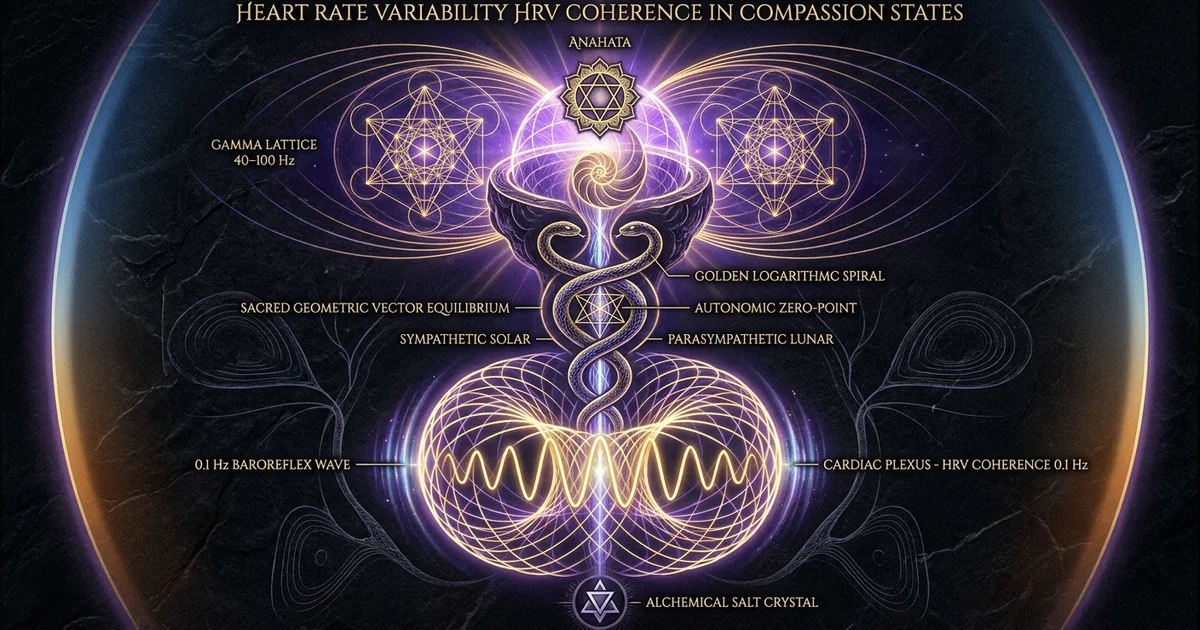
Heart Rate Variability HRV Coherence in Compassion States
Protocol Overview & Neurophysiological Thesis
Cardioneurobiology of the Compassionate State
The volitional generation of sustained, non-referential compassion induces a fundamental reorganization of human autonomic architecture. In ordinary waking consciousness characterized by discursive mentation and variable emotional reactivity, continuous electrocardiographic (ECG) recordings display irregular, stochastic fluctuations in cardiac inter-beat intervals (IBIs). This erratic pattern reflects non-linear, uncoordinated competition between the sympathetic and parasympathetic branches of the autonomic nervous system.
When an operative shifts into an authentic state of objectless compassion—characterized in contemplative lineages as universal benevolence devoid of selective attachment—this stochastic heart rhythm undergoes an immediate phase transition. The inter-beat interval series transmutes into a high-amplitude, periodic, narrow-band sinusoidal wave centered symmetrically within the Low Frequency (LF) spectrum between 0.04 Hz and 0.15 Hz, specifically locking onto the 0.1 Hz cardiovascular resonant peak.
This state, termed psychophysiological coherence, is not a state of inert autonomic quiescence or mere parasympathetic exhaustion. Conventional relaxation typically manifests as a high-frequency (HF) parasympathetic predominance driven by respiratory sinus arrhythmia (RSA) above 0.20 Hz, which simply decelerates overall heart rate while leaving higher-order baroreflex pathways largely uncoupled. In contrast, heart rate variability HRV coherence HeartMath compassion meditation engages an active, high-energy resonance across the neurovisceral axis.
The heart’s intrinsic nervous system, containing an estimated 40,000 sensory neurites capable of sophisticated information processing independent of central cranial commands, establishes a stabilized feedback loop with the brainstem. Concurrently, the mechanical displacement of blood through the aortic arch and carotid sinuses generates pulsatile pressure waves that maximally stimulate stretch-sensitive mechanoreceptors.
                          ┌────────────────────────┐
                          │   Aortic Arch Stretch   │
                          │   & Carotid Sinuses    │
                          └───────────┬────────────┘
                                      │
                         Pulsatile Baroreceptive
                                Afference
                                      │
                                      ▼
                          ┌────────────────────────┐
                          │ Nucleus Tractus         │
                          │ Solitarius (NTS)       │
                          └───────────┬────────────┘
                                      │
                         Ascending Neuromodulatory
                                Projections
                                      │
                                      ▼
                          ┌────────────────────────┐
                          │ Locus Coeruleus,       │
                          │ Thalamus & vmPFC       │
                          └────────────────────────┘
This afferent baroreceptor discharge ascends via unmyelinated and myelinated vagal pathways to the nucleus tractus solitarius (NTS). From this medullary relay, the coherent signal cascades into the parabrachial nucleus, the locus coeruleus, the amygdaloid complex, and the intralaminar nuclei of the thalamus, globally reorganizing cortical processing and emotional homeostasis.
The 0.1 Hz Cardiovascular Resonant Peak
The hemodynamic resonance of the human cardiovascular system occurs at approximately 0.1 Hz, equivalent to a biological cycle of ten seconds. This periodicity is determined by the physical latency of the arterial baroreflex loop: the time required for a blood pressure fluctuation to register at the arterial baroreceptors, travel via the glossopharyngeal and vagus nerves to the brainstem, alter central autonomic output, adjust peripheral vascular tone via sympathetic vasomotor nerves, and alter stroke volume and vascular resistance.
When cardiorespiratory synchronization occurs at 0.1 Hz—accessible through deliberate respiratory pacing at exactly six breaths per minute—the delay in the feedback loop aligns constructively with the natural mechanical rhythm of the heart. The resulting constructive interference amplifies baroreflex gain to its theoretical maximum, transforming systemic blood pressure oscillations, vascular diameter changes, and cardiac output into an integrated, harmonic oscillator.
McCraty, R., Atkinson, M., Tomasino, D., & Bradley, R. T. (2009). The Coherent Heart: Heart-Brain Interactions, Psychophysiological Coherence, and the Emergence of System-Wide Order. HeartMath Research Center. Demonstrates that deliberate sustained induction of core positive affects—such as appreciation and compassion—precipitates a statistically significant shift in the autonomic spectrum, collapsing wide-band spectral dispersion into a single high-amplitude peak near 0.1 Hz, dramatically altering the low-frequency to high-frequency (LF/HF) ratio and entraining systemic physiological oscillators.
Lutz, A., Greischar, L. L., Rawlings, N. B., Ricard, M., & Davidson, R. J. (2004). Long-term meditators self-induce high-amplitude gamma synchrony during mental practice. Proceedings of the National Academy of Sciences (PNAS), 101(46), 16369–16373. Documents that non-referential compassion meditation elicits pronounced, sustained, high-amplitude Gamma-band phase synchrony (30–100 Hz, with high power around 40 Hz) across distributed fronto-parieto-temporal networks, displaying precise phase-locking directly linked to training duration and visceral integration.
At this 0.1 Hz nexus, the sympathetic and parasympathetic branches of the autonomic nervous system stop operating in reciprocal antagonism. Instead, they shift into sympathetic parasympathetic coherence: an in-phase oscillatory harmony where both divisions discharge rhythmically at the identical resonant frequency. Sympathetic efferent bursts are restricted to the acceleration phase of the cardiac cycle, while parasympathetic vagal decelerations fire cleanly during the falling phase.
This alignment eliminates the wasteful, high-entropy physiological friction that characterizes stress-induced emotional states. Autonomic energy efficiency reaches optimal capacity, providing an exceptionally stable physiological foundation for higher contemplative cognition and profound changes in subjective awareness.
Vagal Afference and Thalamocortical Synchronization
The heart acts as the primary mechanical and bioelectromagnetic pacemaker of the human organism. While scientific consensus historically viewed the heart strictly as a responsive pump regulated downstream by central command, modern neurocardiology demonstrates that roughly 85% to 90% of the fibers within the vagus nerve are afferent (ascending), continuously conveying visceral status from the heart and viscera back up into the central nervous system.
The heart’s bioelectromagnetic field is roughly 5,000 times stronger in magnetic amplitude than the cranial field generated by the brain, forming an omnidirectional torus that permeates every cell of the body and radiates several feet outward into peri-personal space. To contextualize the spatial architecture of this biological emitter, review the bioelectromagnetic torus heart field documentation.
                    ┌─────────────────────────────────┐
                    │ Cardiac Bioelectromagnetic Field│
                    │   (~5,000x cranial amplitude)   │
                    └────────────────┬────────────────┘
                                     │
                        Sustained Afferent Discharge
                                     │
                                     ▼
                    ┌─────────────────────────────────┐
                    │  Intralaminar Thalamic Nuclei   │
                    │   (Gating / Attentional Focus)  │
                    └────────────────┬────────────────┘
                                     │
                         Diffusely Modulated Drive
                                     │
                                     ▼
                    ┌─────────────────────────────────┐
                    │  Neocortical Pyramidal Layers   │
                    │   (Phase-Synchronized Gamma)    │
                    └─────────────────────────────────┘
During the generation of a sinusoidal heart rhythm, this continuous, highly ordered afferent baroreceptor discharge structurally alters the gating mechanisms of the thalamus. The intralaminar nuclei of the thalamus, which regulate attentional distribution and project diffusely across neocortical pyramidal layers, synchronize their firing thresholds to the rhythmic afferent pressure volleys arriving from the coherent cardiovascular complex.
This ascending cardiac entrainment suppresses the erratic, desynchronized beta wave activity (15–30 Hz) typically driven by sympathetic threat assessment and discursive ego-defense mechanisms. As thalamocortical gating stabilizes, the brain transitions into coherent neural regimes characterized by synchronized frontomedial theta oscillations (4–8 Hz) interwoven with robust bursts of phase-locked Gamma synchrony (30–100 Hz), precisely as observed in elite contemplative practitioners.
Biophysical Mechanisms & Brainwave Dynamics
The Baroreflex Closed-Loop and Mayer Waves
To trace the biophysical generation of physiological coherence, one must map the interaction between respiratory dynamics and intrinsic blood pressure oscillations known as Mayer waves. Under undisturbed conditions, continuous vascular smooth-muscle tone oscillates spontaneously at approximately 0.1 Hz due to sympathetic vasomotion. These Mayer waves reflect the latency of the feedback loop operating between peripheral vascular resistance, systemic arterial pressure, and sympathetic efferent outflow from the rostral ventrolateral medulla.
When a subject breathes at variable, uncalibrated resting rates (typically 12 to 20 breaths per minute, or 0.20 to 0.33 Hz), respiratory sinus arrhythmia (RSA) operates out of phase with these Mayer waves. The two oscillatory systems collide asynchronously, generating complex, low-amplitude, and fragmented heart rate variability spectra.
Paced Respiration (0.1 Hz) ───┐
                              ▼
           Constructive Interference (Phase Coupling)
                              ▲
Mayer Waves (0.1 Hz) ─────────┘
                              │
                              ▼
            Hemodynamic Systemic Resonance (0.1 Hz)
                              │
                              ▼
             Maximal Baroreflex Dynamic Range
However, when respiration is deliberately modulated to 6 breaths per minute (0.1 Hz), the oscillatory cycle of respiratory sinus arrhythmia matches the precise period of the Mayer wave loop. During inhalation, cardiac acceleration precisely reinforces the sympathetic-driven pressure wave; during exhalation, vagal slowing precisely reinforces the baroreflex-mediated pressure decrease.
This cardiorespiratory synchronization triggers systemic hemodynamic resonance. The arterial baroreflex system achieves its maximum possible dynamic range: arterial stretch triggers massive, synchronized bursts of baroreceptor firing, driving cardiac inter-beat intervals to oscillate across peak-to-trough spans exceeding 100 to 200 milliseconds, even in mature adults. This represents the physiological pinnacle of autonomic flexibility and self-regulatory reserve.
Cardiorespiratory Phase-Locking Mechanisms
Cardiorespiratory phase-locking constitutes a non-linear dynamic state wherein the phase angle between the respiratory cycle and the cardiac cycle becomes invariant over extended periods. This phenomenon is distinct from standard respiratory sinus arrhythmia, which merely describes the modulation of heart rate by breath. In phase-locking, the exact timing of R-wave emergence relative to the onset of the inspiratory or expiratory phase locks into an integer ratio (e.g., 4:1 or 5:1 heartbeats per respiratory cycle).
This phase-locking is coordinated by mechanical stretch receptors in the lungs (Hering-Breuer reflex), intrinsic stretch-activated ion channels in the sinoatrial node, and central respiratory pattern generators within the pre-Bötzinger complex. As the phase relationship stabilizes, cardiac filling pressures (preload) normalize, myocardial contractility coordinates cleanly with systemic vascular compliance, and cardiovascular work efficiency reaches an energetic maximum. Myocardial oxygen consumption per unit of cardiac output decreases significantly.
In this state of physiological resonance, the heart ceases to act as an uncoupled hydraulic pump; it becomes an electro-mechanical resonator driving the central nervous system into structural coherence, establishing the exact physiological medium required to sustain profound compassion states without neuro-affective fatigue.
Afferent Vagal Transmission and EEG Entrainment (Alpha to Gamma)
The ascending neurological signals generated by a coherent 0.1 Hz cardiac rhythm propagate through designated ascending tracts to systematically modulate cortical electroencephalographic (EEG) activity. Unmyelinated C-fibers and finely myelinated A-delta fibers carry afferent mechanoreceptive data from the atria and ventricles through the inferior (nodose) ganglion of the vagus nerve directly into the medullary nucleus tractus solitarius (NTS). From the NTS, adrenergic and noradrenergic ascending pathways project directly into the locus coeruleus, the main noradrenergic control nucleus of the human brain.
Under chaotic, high-stress conditions, erratic afferent inputs induce burst-firing patterns in the locus coeruleus, releasing widespread norepinephrine across the neocortex and triggering hyper-vigilant, fragmented beta rhythms. Under the influence of a steady 0.1 Hz sinusoidal heart rhythm, the locus coeruleus shifts its firing profile from erratic burst patterns into steady, low-frequency tonic firing. This dramatic attenuation of hyper-adrenergic noise frees the central thalamocortical network to organize into large-scale, harmonic brainwave regimes.
First, global cortical Alpha synchrony (8–12 Hz) amplifies, reflecting an internally focused state of sensory gating and parasympathetic ease. As the contemplative operative transitions from cognitive breath regulation to the generation of non-referential compassion, this Alpha base acts as a carrier wave for high-amplitude Gamma oscillations (30–100 Hz, with a focal concentration around 40 Hz).
These Gamma bursts are predominantly localized over the anterior insular cortex, the frontopolar cortex, and the anterior cingulate cortex (ACC). The anterior insula contains the primary cortical representation of internal visceral states, housing specialized spindle-shaped Von Economo neurons that facilitate rapid interoceptive awareness and empathetic resonance. Coherent afferent cardiac pacing directly entrains the insular cortex, transforming raw interoceptive visceral data into non-referential, affective compassion. For an in-depth analysis of these fast-wave dynamics, consult Gamma brainwaves in compassion neurobiology.
Comparative Autonomic Dynamics: Incoherence vs. Sinusoidal Synchronization
Phase Space Trajectories of Emotional Incoherence
Emotional states dominated by cognitive friction, interpersonal hostility, or deep-seated anxiety express an underlying physiology defined by deterministic chaos and autonomic dyssynchrony. When an operative undergoes stress, the balance between sympathetic vasomotor activation and parasympathetic cardiac deceleration decouples. Non-linear phase-space reconstruction plots of inter-beat intervals (Poincaré plots, plotting $RR_n$ against $RR_{n+1}$) in an incoherent state yield wide, asymmetrical, irregularly scattered point clouds.
       RR(n+1)                               RR(n+1)
          ▲                                     ▲
          │      *   *                          │          *
          │   *    *   *   *                    │        *
          │ *   *   *    *                      │      *
          │   *   *   *   *                     │    *
          │      *   *                          │  *
          └────────────────► RR(n)              └────────────────► RR(n)
          INCOHERENT STRESS                     COHERENT COMPASSION
        (Dispersed Point Cloud)               (Collapsed Toroidal Ellipse)
In these states of autonomic incoherence, the sympathetic nervous system continuously overrides natural baroreflex mechanics via surges of epinephrine and norepinephrine. The intrinsic feedback delay of the baroreceptor loop is interrupted. This autonomic fragmentation disrupts neural inputs to the prefrontal cortex, precipitating “cortical inhibition.” In this compromised state, the executive networks of the brain are functionally hijacked by hyperactive limbic survival reflexes. The subject becomes biologically incapable of maintaining perspective, empathy, or emotional equilibrium.
Spectral Power Redistribution in Coherence States
Fast Fourier Transform (FFT) analysis of heart rate variability provides empirical proof of this profound physiological restructuring. In normal waking stress or diffuse distraction, power spectral density (PSD) is broadly and chaotically dispersed across three standard clinical frequency domains:
- Very Low Frequency (VLF: 0.0033–0.04 Hz)
- Low Frequency (LF: 0.04–0.15 Hz)
- High Frequency (HF: 0.15–0.40 Hz)
During an incoherent state, spectral energy fractures unpredictably across these domains, with low overall amplitude and an elevated, irregular LF/HF ratio indicating sympathetic hyperactivity or uncoordinated autonomic co-activation.
Incoherent Stress State
- Spectral Profile: Fragmented spectral distribution across VLF, LF, and HF domains; lack of dominant resonant frequencies.
- Baroreflex Dynamics: Impaired baroreceptor sensitivity; blunted reflex responsiveness; uncoupled Mayer wave and RSA activity.
- Autonomic Balance: Sympathetic predominance; hyper-adrenergic burst firing; continuous competitive co-activation.
- Central Neurobiology: Amygdalar hyper-reactivity; down-regulated ventromedial prefrontal cortex (vmPFC); cortical inhibition.
- Subjective Phenomenology: Cognitive fragmentation; threat-vigilance; defensive contraction; somatic irritability and anxiety.
Coherent Compassion State
- Spectral Profile: >85% of total power concentrated into a single, razor-sharp sinusoidal spike centered at ~0.1 Hz.
- Baroreflex Dynamics: Maximum baroreflex sensitivity; constructive phase-locking between RSA and Mayer vascular oscillations.
- Autonomic Balance: Sympathetic parasympathetic coherence; concurrent rhythmic activation; optimal energetic efficiency.
- Central Neurobiology: vmPFC activation; insular entrainment; fronto-parietal Gamma-band (40 Hz) phase synchrony.
- Subjective Phenomenology: Oceanic non-referential benevolence; expansive interoceptive warmth; profound presence; affective stillness.
When an operative activates heart rate variability HRV coherence HeartMath compassion meditation, the spectral topography reorganizes entirely. Upwards of 85% to 90% of total spectral power collapses out of the surrounding noise and concentrates into an extraordinary, singular, ultra-narrow spike centered precisely between 0.09 Hz and 0.11 Hz.
The coherence ratio, mathematically defined as:
$$\text{Coherence Ratio} = \frac{\text{Peak Power}}{(\text{Total Power} - \text{Peak Power})}$$
increases exponentially by several orders of magnitude. The autonomic nervous system sheds thousands of degrees of internal regulatory freedom, consolidating systemic physiological work into an elegant, coherent macroscopic order.
The Neurovisceral Axis: Amygdala vs. Ventromedial Prefrontal Regulation
This shift from spectral dispersion to a narrow-band 0.1 Hz resonance fundamentally restructures communication along the neurovisceral axis. Under incoherent conditions, disrupted baroreceptor input prevents the medullary nucleus tractus solitarius (NTS) from exerting inhibitory control over the central nucleus of the amygdala. Consequently, the amygdala maintains a hyper-reactive state, continuously interpreting ambiguous somatic cues as imminent existential threats and reinforcing high-frequency defensive vigilance.
       INCOHERENT AFFERENCE                  COHERENT RESONANCE (0.1 Hz)
                │                                         │
                ▼                                         ▼
   Erratic Mechanoreception                  Organized Baroreceptor Volleys
                │                                         │
                ▼                                         ▼
    NTS Disinhibition of Amygdala              NTS Inhibitory Signal to Amygdala
                │                                         │
                ▼                                         ▼
   Hyper-Adrenergic Vigilance                 vmPFC Top-Down Emotional Release
Conversely, the massive, highly organized afferent baroreceptor volleys generated during coherent compassion provide a potent inhibitory signal to the amygdala via ascending NTS-to-amygdalar tracts. As amygdalar firing subsides, the ventromedial prefrontal cortex (vmPFC) is released from subcortical inhibition.
The vmPFC establishes robust, top-down regulatory control over lower emotional circuits, actively modulating affective responses and reinforcing compassionate intentionality. Through sustained practice, this functional shift drives lasting structural neuroplasticity, strengthening white-matter connectivity along the uncinate fasciculus and cementing an enduring baseline of autonomic resilience and universal compassion.
Step-by-Step Experiential Protocol: Heart-Directed Compassion Bio-Entrainment
- Target Posture: Upright, spine-lengthened seated position (siddhasana, padmasana, or firm ergonomic chair) with the pelvis tilted forward at roughly 10 degrees to unload the diaphragm; shoulders relaxed, chest subtly open.
- Respiration Cadence: Exactly 0.1 Hz frequency. Use 5.0 seconds inhalation to 5.0 seconds exhalation (balanced), or 4.5 seconds inhalation to 5.5 seconds exhalation (to gently emphasize parasympathetic vagal outflow).
- Diaphragmatic Trajectory: Smooth abdominal expansion without intercostal gasping or apical shoulder elevation. Completely silent, frictionless air passage across the glottis.
- Primary Somatosensory Anchor: Central anatomical mediastinum, directly behind the mid-sternum.
- Affective Carrier: Progression from personal appreciation/gratitude imagery to unconditioned, non-referential loving-kindness (Mahākaruṇā).
- Session Duration: 20 to 45 minutes daily. Optimal biofeedback confirmation requires photoplethysmography (PPG) or a 1-lead ECG chest strap calibrated to measure 0.1 Hz coherence parameters.
Phase 1: Somatosensory Heart Focus and Sub-diaphragmatic Breathing
The practice commences by systematically withdrawing somatic attention from outer environmental stimuli and anchoring it directly within the physical center of the chest. The operative closes their eyes and shifts conscious awareness to the pericardial mediastinum, resting attention on the physical heartbeat itself.
Simultaneously, the breathing pattern shifts out of the upper thoracic cage down into the lower sub-diaphragmatic space. The practitioner must breathe through the nostrils with zero auditory friction. During inhalation, the diaphragm descends smoothly, expanding the abdomen circumferentially like an expanding ring, allowing the base of the lungs to oxygenate without elevating the clavicles or tightening the scalene muscles.
   Inhale (Diaphragmatic Descent) ───► Abdominal Circumferential Expansion
                 │
                 ▼
         Mediastinal Focus ──────────► Somatosensory Cortical Priming
                 │
                 ▼
   Exhale (Visceral Decompression) ──► Parasympathetic Vagal Engagement
During exhalation, the abdominal wall gently and passively recedes toward the lumbar spine. Somatosensory anchoring upon the anatomical heart initiates an intentional afferent priming: the somatosensory cortex dedicates heightened processing bandwidth to incoming cardiac sensations, opening the neural pathways required for cardiorespiratory synchronization.
Phase 2: Rhythmic Pacing and Cardiorespiratory Synchronization (0.1 Hz)
Once sub-diaphragmatic respiration is stable, the practitioner introduces an exact 0.1 Hz pacing cadence. The target rhythm is precisely six full breath cycles per minute: a deliberate, continuous 5.0-second inhalation followed immediately by a smooth, unforced 5.0-second exhalation. Alternatively, operatives exhibiting baseline sympathetic elevation may utilize a 4.5-second inhalation coupled with a 5.5-second exhalation, subtly extending the expiratory phase to optimize acetylcholine release via the cardiac branch of the vagus nerve.
The practitioner must eliminate any breath-holding or intra-thoracic pressure locks between phases (avoiding the Valsalva maneuver, which artificially skews baroreflex readings). The respiration should resemble a pristine sine wave:
      5.0s Inhalation                  5.0s Exhalation
   ┌────────────────────┐          ┌────────────────────┐
  ╱                      ╲        ╱                      ╲
 ╱                        ╲      ╱                        ╲
╱                          ╲____╱                          ╲____
0s                         5.0s 5.0s                       10.0s
Within 60 to 90 seconds of initiating this exact cadence, the mechanics of respiratory sinus arrhythmia lock into phase with the inherent 0.1 Hz Mayer oscillations of the vasculature. Real-time PPG monitoring will reveal cardiac inter-beat intervals smoothing out from jagged, chaotic lines into a uniform, high-amplitude sinusoidal heart rhythm. At this stage, the operative has achieved pure mechanical cardiorespiratory synchronization.
Phase 3: Generation of Non-Referential Compassion and Afferent Integration
Mechanical respiration alone can induce a basic form of resonant pacing, but it lacks the cognitive and affective drivers required to trigger global thalamocortical Gamma synchronization. In Phase 3, the practitioner shifts the internal cognitive state from mechanical pacing to affective activation.
The operative begins by generating an authentic feeling of unconditional appreciation, profound benevolence, or deep tenderness. Initially, this affect may be primed using a concrete referent: a cherished loved one, an awe-inspiring natural environment, or a compassionate mentor figure.
However, once the warm somatosensory sensations of this affect anchor within the chest, the operative systematically drops the conceptual referent, the image, and the discursive story. The feeling is generalized into an unconditioned, objectless radiation of pure compassion directed outward in all directions simultaneously:
[ Phase 2: Mechanical 0.1 Hz Resonance ]
                   │
                   ▼
[ Concrete Affective Trigger (Loved One / Mentor) ]
                   │
                   ▼
[ De-referencing: Dissolving Image & Narrative ]
                   │
                   ▼
[ Pure Radiating Non-Referential Compassion (Mahākaruṇā) ]
                   │
                   ▼
[ Integration: High-Amplitude Gamma Phase Synchrony ]
In the vocabulary of Buddhist contemplative science, this is dmigs med snying rje—compassion without focus or reference point. By freeing the emotional feeling from conditional mental imagery, the practitioner prevents cognitive fatigue and limbic fading.
The continuous feeling of non-referential warmth stabilizes the 0.1 Hz sinusoidal peak, driving the coherence score to its absolute ceiling. Afferent vagal cascades now flood the thalamus without narrative interference, locking the anterior insula and frontomedial cortices into sustained Gamma-band phase synchrony (30–100 Hz), bridging biological visceral mechanics and transcendental contemplative states.
Operational Safety, Contraindications & Biofield Grounding
- Autonomic & Cardiovascular Vulnerabilities: Operatives diagnosed with primary autonomic neuropathy, orthostatic hypotension, Postural Orthostatic Tachycardia Syndrome (POTS), severe cardiac arrhythmias (e.g., ventricular tachycardia, atrial fibrillation), or an active history of recurrent vasovagal syncope must approach 0.1 Hz resonant pacing with clinical caution. Forceful manipulation of the baroreceptor loop can provoke precipitous blood pressure drops, reflex bradycardia, or presyncope.
- Hypocapnia Protocols: Do not increase respiratory minute volume during 0.1 Hz breathing. Over-breathing (hyperventilation via excessive tidal volumes) flushes carbon dioxide from the blood, inducing arterial hypocapnia, cerebral vasoconstriction, acute dizziness, carpopedal spasms, and dissociative disorientation.
- Trauma & Somatic Abreaction: Sustained interoceptive focusing on the mediastinum often releases suppressed traumatic memory complexes and sudden autonomic discharges (such as involuntary tremors, crying, or spontaneous hyper-arousal). If an autonomic storm or severe panic surfaces, discontinue resonant pacing immediately and execute the Somatosensory Grounding Maneuvers outlined below.
Autonomic Dysregulation and Vasovagal Vulnerabilities
While the induction of a 0.1 Hz coherence state supports long-term autonomic resilience, its acute application places significant demands on baroreflex mechanics. In healthy individuals, the arterial baroreflex system smoothly dampens the blood pressure oscillations induced by 0.1 Hz breathing. However, in individuals suffering from dysautonomia, chronic fatigue syndrome with autonomic involvement, or POTS, the compensatory vasoconstrictor mechanisms often exhibit a delayed or exaggerated response.
Such operatives may experience a transient failure of peripheral vascular resistance, leading to rapid blood pooling in the splanchnic and lower-extremity vascular beds. This manifests as sudden presyncopal lightheadedness, perceptual greying, and nausea. Practitioners with these clinical profiles must avoid seated or standing coherence training; they should execute the protocol in a semi-recumbent or supine posture, gradually training baroreflex gain over several months before attempting fully upright seated meditation. For adjacent energetic perspectives on autonomic dysregulation, see polyvagal theory and kundalini awakening.
Hyperventilation-Induced Hypocapnia Risks
A common technical error made by novices attempting 0.1 Hz respiration is confusing deep breathing with hyperventilation. Respiration at six breaths per minute lengthens the duration of each breath to ten seconds, prompting untrained practitioners to double or triple their normal resting tidal volume.
This dramatic increase in minute ventilation ($V_E = \text{Tidal Volume} \times \text{Respiratory Frequency}$) flushes arterial carbon dioxide, driving arterial partial pressure of carbon dioxide ($PaCO_2$) below the normal physiological threshold of 35 mmHg into hypocapnic territory:
$$\uparrow V_E \implies \downarrow PaCO_2 \ (< 35\text{ mmHg}) \implies \uparrow\text{pH (Systemic Alkalosis)} \implies \text{Cerebral Vasoconstriction}$$
Hypocapnia triggers immediate respiratory alkalosis, increasing blood pH and inducing acute cerebral vasoconstriction. Blood flow to the neocortex can drop by up to 30% to 40%, generating sensations of lightheadedness, peripheral paresthesia (tingling in the fingers and lips), and ungrounded cognitive dissociation. Practitioners mistakenly confuse these hypocapnic symptoms with mystical transcendent states.
Coherence training demands normal, light tidal breathing. The volume of each breath must remain modest (roughly 500 to 600 mL), allowing the practitioner to breathe slowly without hyperventilating, maintaining clean normocapnic equilibrium ($PaCO_2 \approx 40\text{ mmHg}$) throughout the protocol.
Somatic Abreactions and Grounding Methodologies
The somatic region of the physical mediastinum serves as a primary neurovisceral storage site for unprocessed affective trauma, psychological defenses, and chronic somatic bracing. When an operative systematically dissolves these protective holding patterns by coupling 0.1 Hz mechanical breathing with unconditional loving-kindness, suppressed emotional complexes often discharge rapidly into conscious awareness.
This phenomenon can trigger spontaneous autonomic abreactions: localized muscular fasciculations, intense heat sensations traversing the spinal neuro-axis, sudden weeping, or rapid surges of sympathetic panic.
When an operative experiences an overwhelming somatic abreaction, they must not attempt to push through the experience using abstract contemplative focus. Instead, they should immediately execute active Somatosensory Grounding Countermeasures:
[ Unmanaged Emotional Abreaction / Autonomic Storm ]
                         │
                         ▼
        [ Discontinue Affective Compassion ]
                         │
                         ▼
   [ Open Eyes: Fixate on Three Distal Physical Objects ]
                         │
                         ▼
   [ Shift Respiration: Natural 1:1 Tidal Rhythm ]
                         │
                         ▼
   [ Bilateral Somatosensory Grounding (Feet to Floor) ]
                         │
                         ▼
        [ Re-Establish Autonomic Homeostasis ]
- Visual Grounding: Immediately open the eyes and anchor the visual field on three stable, distant physical objects in the room to re-engage the dorsal visual stream and activate fronto-parietal orienting networks.
- Respiratory Reset: Abandon the 0.1 Hz paced breathing and return to an effortless, natural 1:1 tidal rhythm, breathing gently through the nose without conscious counting.
- Tactile Re-anchoring: Firmly press the bare feet into the floor, flex the quadriceps, and place the palms flat upon the knees, concentrating on tactile, weight-bearing sensations.
- Somatic Recalibration: Engage in gentle bilateral sensory self-touch (such as stroking the upper arms or firmly pressing the palms together) to activate peripheral proprioceptive fibers, down-regulate limbic arousal, and ground the nervous system back into baseline reality.
Phenomenological Correlates & Empirical Neuroimaging
Insular Cortex, Anterior Cingulate, and Somatotopic Mapping
Functional neuroimaging (fMRI) and high-density magnetoencephalography (MEG) during high-coherence compassion meditation illuminate a profound shift in brain architecture. Classical interoceptive processing relies on the primary sensory representation of the body within the dorsal posterior and mid-insula. In contrast, the sustained induction of a 0.1 Hz sinusoidal heart rhythm directs neural activation forward into the right anterior insular cortex (AIC) and the dorsal anterior cingulate cortex (dACC)—key functional nodes of the central salience network.
The right anterior insular cortex integrates ascending cardiac afference with active emotional evaluation. Electrocardiographic-EEG co-registration demonstrates that during coherent compassion, the Heartbeat-Evoked Potential (HEP)—the specific cortical electrical waveform elicited roughly 200 to 450 milliseconds following the cardiac R-peak—amplifies significantly across the insular and prefrontal cortices:
Cardiac R-Peak (0 ms)
       │
       ▼  (Afferent vagal conduction delay)
   200–450 ms
       │
       ▼
Amplified Heartbeat-Evoked Potential (HEP)
       │
       ▼
Right Anterior Insula (AIC) & Dorsal Anterior Cingulate (dACC)
       │
       ▼
Somatotopic Re-mapping: "Egocentric Boundary Dissolution"
This amplified HEP signal indicates that the brain is dedicating heightened computational resources to each incoming coherent cardiac pulse. This neural remapping alters interoceptive somatic processing: the standard, localized boundaries of the physical body dissolve, replaced phenomenologically by a sense of spacious, warm, uncontracted oceanic awareness that contemplatives identify as boundless loving-kindness.
High-Amplitude Gamma Bursts in Expert Contemplatives
One of the most remarkable neurophysiological discoveries of modern contemplative neuroscience is the observation of sustained, high-amplitude Gamma-band phase synchrony (30–100 Hz, with strong power concentrated at 40 Hz) in long-term meditation practitioners engaged in non-referential compassion. Electroencephalographic data published by Lutz, Davidson, and colleagues showed that advanced Tibetan Buddhist monks self-induce self-sustained, high-amplitude Gamma synchrony during objectless compassion (dmigs med snying rje) that is orders of magnitude greater than any seen in non-meditating controls.
       0.1 Hz Resonant Afferent Vagal Surge
                         │
                         ▼
        Ascending Cholinergic / GABAergic Drive
                         │
                         ▼
          Fast-Spiking Cortical Interneurons
                         │
                         ▼
   Global Fronto-Parietal Gamma Synchrony (40 Hz)
                         │
                         ▼
 Phenomenological Boundlessness & Compassionate Clarity
Crucially, this Gamma synchrony does not emerge as an isolated cortical event; it locks into phase with the 0.1 Hz cardiovascular resonance cycle. The rhythmic afferent vagal surges arriving at the medullary core modulate the firing thresholds of fast-spiking, parvalbumin-positive GABAergic cortical interneurons.
These local interneurons generate the rhythmic, high-frequency inhibitory pulses required to synchronize firing across millions of distributed pyramidal neurons. The subjective phenomenology of this state is extraordinary clarity, intense non-conceptual presence, and an absence of perceived separation between the observer and the external environment.
Monroe Institute Gateway Analysis & Indo-Tibetan Mahāyāna Texts:
- The Monroe Institute Gateway Intermediate Report (1983): Documents that sustained physiological resonance (Focus 10/Focus 12 states) establishes an integrated mind-body bioelectromagnetic coherence pattern, demonstrating that systemic cardiorespiratory phase-locking acts as an indispensable prerequisite for non-local cognitive expansion and altered perceptual functioning. Review internal mechanics at the Monroe Gateway Experience mechanics.
- The Jewel Ornament of Liberation (Dam chos yid bzhin nor bu) by Gampopa (12th Century CE): Details the progressive generation of dmigs med snying rje (unconditioned, non-referential compassion), noting that true compassion must transcend cognitive conceptualizations (spros pa) to become a spontaneous bodily radiant force (rang rtsal), emerging directly from the internal heart center (tsitta) and stabilizing the dynamic movement of internal subtle prāṇic winds (rlung).
Bioelectromagnetic Cardiac Radiation and Field Interactions
The human heart produces the most powerful rhythmic electromagnetic field in the biological body. Measured via Superconducting Quantum Interference Device (SQUID) magnetometers, the heart’s magnetic field is roughly 5,000 times larger in amplitude than the neurological field generated by the cranial brain. This field radiates omnidirectionally outward from the chest cavity, extending between three to six feet beyond the skin into the surrounding environment.
                  .-'""'-.
                .'   ||   '.
               /     ||     \
              ;      ||      ;
              :      ()      :  <--- Toroidal Heart Field (3–6 ft)
              ;      ||      ;
               \     ||     /
                '.   ||   .'
                  '-....-'
During states of emotional incoherence, this field exhibits a noisy, erratic, and unstable wave architecture. However, during heart rate variability HRV coherence HeartMath compassion meditation, the electromagnetic emissions adopt a clean, harmonic spectrum. The harmonic series produced by the resonant 0.1 Hz cardiac pacing ripples through the toroidal field structure.
In clinical and laboratory settings, this coherent field can be registered by the physiological monitoring equipment of another human sitting nearby. When two operatives sit in close proximity within a shared electromagnetic environment, the coherent cardiac rhythm of one practitioner can induce measurable Heartbeat-Evoked Potential (HEP) synchronization in the EEG readings of the other. This provides an empirical biophysical basis for inter-individual physiological entrainment, explaining why highly stabilized contemplative practitioners can anchor and calm the nervous systems of entire rooms simply by sustaining internal heart coherence.
Frequently Asked Questions
Distinguishing Resonance Biofeedback from Coherence Meditation
A critical conceptual and operational distinction must be drawn between conventional Heart Rate Variability (HRV) biofeedback and heart rate variability HRV coherence HeartMath compassion meditation. Standard HRV biofeedback is fundamentally a mechanical, bottom-up physiological training protocol: the user monitors a pacing display and breathes at roughly six breaths per minute to mechanically maximize their respiratory sinus arrhythmia (RSA) and baroreflex amplitude.
While this mechanical pacing successfully amplifies total HRV power and shifts the autonomic spectrum, it does not intentionally engage higher-order fronto-cortical or insular networks. The practitioner can remain emotionally detached, bored, or mentally preoccupied with analytical thoughts while successfully producing a 0.1 Hz respiratory rhythm.
┌─────────────────────────────────┐       ┌─────────────────────────────────┐
│     Standard HRV Biofeedback    │       │     Compassion Coherence        │
├─────────────────────────────────┤       ├─────────────────────────────────┤
│ • Purely mechanical cadence     │       │ • Resonant cadence (0.1 Hz)     │
│ • Bottom-up autonomic driving   │  vs.  │ • Afferent + Top-down vmPFC     │
│ • Minimal limbic reorganization │       │ • Insular & ACC engagement      │
│ • Alpha baseline maintenance    │       │ • Fronto-Parietal Gamma (40 Hz) │
└─────────────────────────────────┘       └─────────────────────────────────┘
In contrast, compassion coherence meditation systematically marries mechanical bottom-up respiratory entrainment with intentional, top-down affective generation. By actively sustaining non-referential loving-kindness, the operative activates the ventromedial prefrontal cortex, the anterior cingulate, and the anterior insular cortex simultaneously with the 0.1 Hz baroreflex peak.
This dual-vector integration—coupling an afferent visceral surge with intentional neocortical affective firing—triggers the high-amplitude Gamma synchrony documented by Lutz et al., restructuring the neurovisceral axis in ways that mechanical breathing alone cannot achieve. For complementary acoustic methods that assist in stabilizing these neural states, see binaural beats and acoustic physics.
Adjusting Individual Resonance Frequency (IRF) Deviations
While 0.1 Hz (6.0 breaths per minute) serves as the standard clinical baseline for the human cardiovascular resonant peak, the exact individual resonance frequency (IRF) varies based on anatomical and physiological differences. The baroreflex feedback loop is governed by physical conduit dimensions: the physical length of the arterial tree, total blood volume, vascular compliance, and body height.
Taller individuals, possessing longer arterial pathways from the left ventricle through the systemic circulation, have longer pressure-wave transit latencies. As a result, their system resonates at a lower frequency, often between 0.075 Hz and 0.09 Hz (roughly 4.5 to 5.5 breaths per minute). Conversely, shorter individuals or those with stiffer vascular walls may possess an IRF closer to 0.105 Hz to 0.115 Hz (6.3 to 7.0 breaths per minute).
   Taller Stature / Greater Vascular Compliance ──► 0.075–0.09 Hz (4.5–5.5 bpm)
   Standard Human Anatomical Average           ──► 0.10 Hz      (6.0 bpm)
   Shorter Stature / Elevated Vascular Tone    ──► 0.105–0.115 Hz (6.3–7.0 bpm)
To determine one’s exact Individual Resonance Frequency (IRF), an operative must utilize continuous ECG or high-precision PPG monitoring while methodically testing different respiratory paces. The practitioner breathes for two minutes at each of the following paces: 6.5, 6.0, 5.5, 5.0, and 4.5 breaths per minute.
By analyzing the resulting power spectral density, the operative identifies the exact breathing cadence that produces the highest absolute peak in Low Frequency power, the greatest peak-to-trough heart rate oscillations, and the cleanest phase-locking with respiration. This personalized frequency represents the operative’s true IRF and should serve as the primary pacing baseline during all subsequent compassion entrainment protocols.
Navigating Emotional Numbness and Autonomic Resistance
When initiating this protocol, practitioners frequently encounter internal resistance: somatic numbness, an inability to generate authentic compassion, or paradoxical bursts of sympathetic anxiety and tachycardia. This state of autonomic guarding occurs when the nervous system perceives the somatic heart space as vulnerable or associate emotional openness with past psychological injury. When an operative attempts to force positive affect onto a nervous system braced for defense, the autonomic branches clash, generating erratic heart rhythms and affective exhaustion.
If this occurs, the practitioner must drop all affective efforts to generate compassion and return to foundational physiology:
[ Autonomic Resistance / Emotional Numbness Detected ]
                           │
                           ▼
          [ Release Emotional / Affective Intent ]
                           │
                           ▼
  [ Shift to Parasympathetic Cadence: 4s Inhale / 6s Exhale ]
                           │
                           ▼
   [ Neutral Somatosensory Focus: Airflow at the Nostrils ]
                           │
                           ▼
   [ Autonomic Baseline Calibrated (5–10 Minutes) ]
                           │
                           ▼
   [ Re-introduce Mild Gratitude / Ambient Benevolence ]
- Shift the respiratory pacing to an extended exhalation pattern: a 4.0-second inhalation followed by a 6.0-second exhalation. This extends the expiratory phase, maximizing acetylcholine release onto the sinoatrial node via the vagus nerve and dampening sympathetic hyper-arousal.
- Shift the attentional anchor from the mediastinum to the neutral sensation of cool air passing across the upper lip and nostrils.
- Remain in this purely parasympathetic resting state for 5 to 10 minutes until systemic autonomic guarding recedes.
- Only when baseline inter-beat intervals display stable, uniform periodicity should the operative gently reintroduce affective compassion, beginning with mild appreciation for physical safety before expanding into universal, unconditioned benevolence. Through patience and precise neurovisceral calibration, the nervous system safely realigns into enduring cardiorespiratory and compassionate coherence.