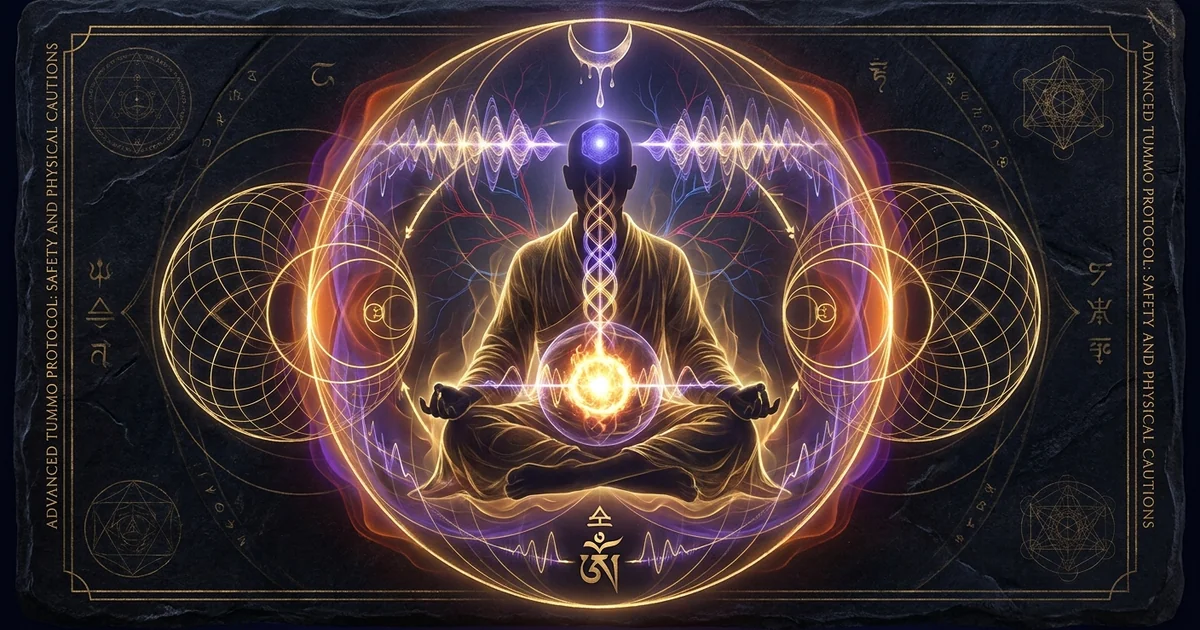
Advanced Tummo Protocol: Safety and Physical Cautions
Protocol Overview & Neurophysiological Thesis: Autonomic Hyperarousal and the Energetic Axis
The Six Yogas Lineage Architecture: Differentiating Gentle vs. Forceful Tummo
Within the traditional Kagyu and Gelug lineages of Vajrayana Buddhism, inner heat yoga (gtum-mo, hereafter Tummo) constitutes the root foundation of the Six Dharmas of Naropa (na-ro’i chos-drug). Far from operating as a generalized somatic relaxation technique, classical tantric physiology frames Tummo as an internal energetic combustive engine designed to dissolve dualistic karmic winds (las-kyi rlung) into the central channel (avadhuti, or rtsa dbu-ma). Crucially, the classical architecture delineates two distinct technical modalities: gentle Tummo ('jam-rlung) and forceful Tummo (drag-rlung). Gentle Tummo prioritizes continuous, rhythmic diaphragmatic cycling coupled with open awareness and soft somatic visualization; it acts as a mild homeostatic stabilizer that calms autonomic reactivity without imposing significant mechanical strain on the cardiopulmonary apparatus.
Forceful Tummo, by contrast, deploys an uncompromising somatic compression mechanism known as the vase retention (bum-pa-can). This method deliberately escalates intra-abdominal and intrathoracic pressures through simultaneous pelvic floor contraction and downward diaphragmatic locking, intentionally forcing subtle energetic currents into the lower terminus of the central channel beneath the navel. While gentle Tummo can be engaged with relative physical latitude, forceful Tummo fundamentally alters autonomic balance, exerting profound mechanical and electrochemical demands upon the cardiovascular system. Without formal progression through foundational preliminaries (sngon-'gro), practitioners attempting forceful Tummo routinely induce severe autonomic de-synchronization. The clinical imperative requires recognizing that forceful Tummo is not merely an intense variation of gentle practice, but an ontologically distinct neuro-somatic intervention that manipulates biological survival reflexes to alter conscious baseline states.
“If the yogin engages in the forceful vase retention without having thoroughly purified the secondary lateral channels (roma and kyangma) through gentle breathing and preliminary somatic postures (trul-khor), the vital wind (srog-rlung) will inevitably deviate from the central path (avadhuti). It will violently enter the life-bearing channel (srog-rtsa) at the heart, causing unendurable thoracic pain, mental agitation, delirium, and irreversible destruction of physical equilibrium. Therefore, the compression must never exceed the capacity of the vessel, and forceful application must be halted the instant subtle tremor or cranial pressure manifests.” — Je Tsongkhapa, The Six Yogas of Naropa: Tsongkhapa’s Commentary Entitled A Book of Three Inspirations (c. 1400 / 2005, trans. Glenn H. Mullin)
Targeted Neurobiological Correlates: Sympathetic Surge Decoupled from Distress
The central paradox of advanced Tummo lies in its unique neurobiological profile: it triggers acute, high-magnitude activation of the sympathetic branch of the autonomic nervous system while completely decoupling that surge from psychological distress, panic, or autonomic collapse. Classical meditative literature historically categorizes contemplative practices under parasympathetic dominance—marked by vagal nerve stimulation, reduced heart rate, decreased metabolic activity, and global suppression of ergotropic functions. However, rigorous clinical research demonstrates that forceful Tummo operates through sympathetic hyperarousal. Practitioners generate pronounced surges in plasma catecholamines (norepinephrine and epinephrine), substantial elevations in cardiac output, and marked shifts in autonomic balance, all while maintaining absolute mental quiescence and focused meta-awareness.
This decoupling of sympathetic activation from cognitive threat appraisals requires structural re-weighting within the central autonomic network (CAN). During standard panic states or survival encounters, sympathetic outflow from the rostral ventrolateral medulla (RVLM) is driven by amygdalar threat detection, which paralyzes prefrontal executive function. In advanced Tummo, functional neuroimaging and electroencephalographic data reveal sustained recruitment of the anterior cingulate cortex (ACC) and dorsolateral prefrontal cortex (dlPFC). This robust top-down inhibitory control permits practitioners to harness profound ergotropic excitation, driving non-shivering thermogenesis and peripheral vasodilation without triggering defensive behavioral programs or subjective anxiety. The somatic body enters an acute state of physiological stress while the cognitive architecture sustains deep serenity. Practitioners seeking further insight into the energetic stabilization of this state should explore the mechanics of kundalini awakening syndrome clinical overview to comprehend how bio-somatic systems integrate such extreme neurochemical loads.
Supervised Monastic Transmission vs. Unregulated Somatic Practice
The translation of esoteric contemplative technologies into secular Western wellness environments has stripped Tummo of its protective pedagogical safeguards. Traditional supervised monastic transmission does not serve an exclusively theological or ceremonial function; it operates as an exhaustive, multi-year clinical triage and diagnostic framework. Within traditional Tibetan monastic colleges (shedras and drupdras), a practitioner is never granted instruction in forceful vase retention (bum-pa-can) until years of preliminary ethical, psychological, and physiological stabilizing practices have been successfully completed. Monastic preceptors continually evaluate the student for subtle indicators of autonomic liability, vascular fragility, psychological imbalance, and energetic volatility, halting or recalibrating breath ratios at the first clinical sign of nervous system strain.
Unregulated somatic adaptation, commonly proliferated through digital seminars and commercialized breathwork workshops, divorces the mechanical breath hold from its vital physiological and diagnostic prerequisites. Stripped of individualized calibration, novice practitioners execute high-pressure breath retentions that exceed their vascular and neural capacities. This unregulated experimentation drives a high incidence of adverse somatic events, spanning from vascular cephalalgia and sustained cardiac palpitations to acute episodes of psychiatric destabilization. Modern somatic culture routinely conflates brute force with spiritual efficacy, ignoring the structural reality that advanced Tummo is an advanced energetic intervention capable of inducing neurovascular damage if practiced outside rigorous pedagogical frameworks. Mastering this balance requires an understanding of advanced tummo safety contraindications lung disorder precautions to prevent structural injury.
Biophysical Mechanisms & Brainwave Dynamics: Thermogenesis, Hemodynamics, and Neural Entrainment
Frequency Dynamics: Frontal-Parietal Beta (15–30 Hz) and High Gamma (40–80 Hz) Coherence
The neurophysiological signature of forceful Tummo departs sharply from the low-frequency alpha (8–12 Hz) and theta (4–7 Hz) patterns observed in mindfulness, Vipassana, or standard somatic relaxation modalities. Quantitative electroencephalography (qEEG) conducted on advanced practitioners during forceful vase retention reveals an explosive recruitment of high-frequency oscillatory dynamics, specifically across the beta (15–30 Hz) and broad gamma (40–80 Hz) bands. These high-frequency bursts demonstrate pronounced phase-locking and coherence across the frontal-parietal axis, reflecting maximum executive vigilance, somatic attention integration, and the stabilization of complex internal multi-sensory mental objects.
“During the forceful vase retention breath (bum-pa-can), advanced meditators demonstrated significant elevations in core body temperature, reaching clinical hyperthermic ranges up to 38.3°C, documented via continuous rectal thermistors and calibrated infrared radiometry. This sustained somatic heating was functionally linked to bursts of high-frequency frontal-parietal beta and gamma (40–80 Hz) power. The findings establish that the core temperature rise is driven by two interdependent components: somatic isometric intrathoracic compression and sustained, high-resolution neurocognitive visualization of internal flame constructs, proving voluntary central command over metabolic set points.” — Kozhevnikov, M., Elliott, J., Shephard, J., & Dhond, R. (2013). Neurocognitive and Somatic Components of Temperature Increases during g-Tum-mo Meditation: Legend and Reality. PLOS ONE, 8(3), e58244.
These synchronized gamma oscillations represent large-scale neural assemblies firing in unified phase, coordinating information transfer across distant cortical and subcortical nodes. As the meditator compresses the breath within the lower abdomen, the somatosensory cortex undergoes intense dynamic restructuring, mapping the generated visceral pressure directly onto the visualization of the micro-flame at the navel chakra. This electrophysiological landscape confirms that the brain during advanced Tummo is not drifting into trance, hypnagogia, or metabolic slowdown; it is operating in an optimized, hyper-aroused state of neural entrainment. For a detailed neurophysiological deconstruction of these hyper-aroused rhythmic regimes, review the analysis on gamma-wave synchrony hyper-arousal states and its implications for human consciousness.
Autonomic Shunting: Brown Adipose Tissue (BAT) and Uncoupling Protein-1 (UCP1) Activation
The biological production of true somatic heat during advanced Tummo relies on non-shivering thermogenesis, mediated primarily through brown adipose tissue (BAT). Unlike white adipose tissue, which serves primarily as an energy storage depot, brown adipocytes contain dense concentrations of iron-rich mitochondria expressing uncoupling protein-1 (UCP1), also known as thermogenin. Located within the inner mitochondrial membrane, UCP1 disrupts the electrochemical proton gradient generated during oxidative phosphorylation. Instead of channeling this proton motive force into the synthesis of adenosine triphosphate (ATP) via ATP synthase, UCP1 short-circuits the gradient, releasing the metabolic energy directly as dissipated thermal energy:
$$\Delta G_{\text{oxidation}} \longrightarrow \text{Thermal Dissipation (Heat)} \quad [\text{via UCP1 Proton Shunting}]$$
During the forceful vase retention, the localized sympathetic surge stimulates postganglionic sympathetic fibers that innervate depots of brown adipose tissue, situated predominantly in the interscapular, supraclavicular, and paravertebral regions. The release of norepinephrine binds to beta-3 adrenergic receptors on brown adipocytes, initiating an intracellular signaling cascade through cyclic adenosine monophosphate (cAMP) and protein kinase A (PKA). This enzymatic cascade activates hormone-sensitive lipase, liberating free fatty acids that concurrently fuel mitochondrial beta-oxidation and allosterically activate UCP1. Consequently, Tummo adepts tap directly into a biochemical heating system that bypasses mechanical muscular shivering, driving clean, sustained internal thermal release that radiates outward from the bodily core.
Valsalva Hemodynamics: Mean Arterial Pressure, Baroreceptor Resetting, and Cerebral Perfusion
The mechanical cornerstone of forceful Tummo—the vase retention (bum-pa-can)—operates hemodynamically as an elongated, precisely graded Valsalva maneuver. Upon executing full diaphragmatic inhalation, downward visceral compression, and upward pelvic floor elevation, intra-abdominal pressure ($P_{\text{abd}}$) and intrathoracic pressure ($P_{\text{thor}}$) spike significantly. This sustained mechanical pressurization exerts immediate downstream effects on the human cardiovascular system:
- Phase I (Compression Onset): The immediate rise in intrathoracic pressure squeezes blood out of the pulmonary circulation and thoracic aorta, causing a transient spike in mean arterial pressure (MAP) accompanied by a baroreceptor-mediated drop in heart rate.
- Phase II (Sustained Retention): Elevated intrathoracic pressure compresses the superior and inferior vena cava, drastically impeding venous return to the right atrium. Consequently, ventricular end-diastolic volume drops, stroke volume diminishes, and mean arterial pressure plummets, inducing reflex tachycardia and systemic peripheral vasoconstriction.
- Phase III (Release / Depressurization): The sudden release of the locks causes intrathoracic pressure to normalize instantly. Blood rapidly pools into the newly uncompressed pulmonary vascular bed, momentarily dropping systemic arterial pressure further.
- Phase IV (Hemodynamic Overshoot): Venous return surges into the heart, producing an elevated cardiac output against a still-constricted peripheral vascular bed. This induces a sharp transient surge in mean arterial pressure, firing the carotid and aortic baroreceptors to trigger secondary profound bradycardia.
+-----------------------------------------------------------------------------------+
|               VALSALVA HEMODYNAMIC PHASES IN VASE BREATH RETENTION                |
+-----------------------------------------------------------------------------------+
| Phase I   | Thoracic squeeze -> Transient MAP elevation -> Brief vagal bradycardia|
| Phase II  | Vena cava compression -> Decreased venous return -> Reflex tachycardia|
| Phase III | Decompression -> Blood pooling in pulmonary bed -> Momentary MAP drop |
| Phase IV  | Venous surge -> High cardiac output + vasoconstriction -> MAP overshoot|
+-----------------------------------------------------------------------------------+
Advanced adepts survive this intense hemodynamic stress through conscious baroreceptor resetting. Under normal conditions, sustained arterial hypoxia combined with hypercapnia during a breath hold triggers intense peripheral vasoconstriction and agonizing respiratory panic. Tummo practitioners, through gradual training, desensitize their arterial baroreceptors and carotid body chemoreceptors to elevated arterial carbon dioxide tension ($P_{\text{a}}\text{CO}2$) and falling arterial oxygen tension ($P{\text{a}}\text{O}_2$). Cerebral perfusion is maintained through intrinsic metabolic autoregulation, keeping cerebral blood flow stable despite substantial fluctuations in systemic mean arterial pressure. To understand the biophysical basis of these fluid-dynamic shifts, see the structural breakdown of biofield electrodynamics and human energy systems.
Step-by-Step Experiential Protocol: Phased Retention, Pacing, and Visualization Architecture
+-----------------------------------------------------------------------------+
|                     SEVEN-POINT VAIROCHANA POSTURE                          |
+-----------------------------------------------------------------------------+
| 1. Legs cross-locked in full vajra posture (padmasana)                      |
| 2. Spine erect, aligned like a stack of golden coins                        |
| 3. Hands resting below navel in dhyana mudra, thumbs lightly touching       |
| 4. Shoulders broadened, suspended like the wings of a vulture               |
| 5. Chin tucked slightly toward throat, gentle cervical extension            |
| 6. Tongue tipped against upper hard palate behind anterior teeth            |
| 7. Gaze cast downward along the bridge of the nose, eyelids half-open       |
+-----------------------------------------------------------------------------+
Phase I: The Ninefold Cleansing Breaths (rlung-ro dgu-sbrug) and Postural Alignment
The execution of advanced Tummo requires establishing absolute biomechanical and postural symmetry via the Seven-Point Vairochana Posture (rnam-snang chos-bdun). The practitioner sits upon a firm, slightly elevated meditation cushion with the lower extremities locked in the full vajra posture (padmasana), which establishes an unyielding mechanical base that stabilizes the pelvic bowl and allows the perineum to compress smoothly against the cushion. The spine is elevated and straightened, stacked like a column of coins; the shoulders are drawn slightly back and expanded laterally; the chin is lightly tucked to lengthen the cervical spine and engage a mild preliminary throat lock; the tongue rests lightly against the hard palate directly behind the front teeth; and the gaze remains unfocused, cast downward along the bridge of the nose at an angle of roughly forty-five degrees.
With the physical frame immobilized, the practitioner initiates the Ninefold Cleansing Breaths (rlung-ro dgu-sbrug) to clear residual metabolic waste and vent stagnant wind (rlung-ro) from the subtle channels. Using the right ring finger, the practitioner closes the right nostril, inhaling slowly and deeply through the left nostril (associated with the lunar, cooling channel kyangma). The practitioner visualizes white, cooling wisdom prana descending into the base of the channel, then releases the right nostril, occludes the left, and forcefully exhales through the right nostril, mentally ejecting attachment and hot inflammatory winds as dark smoke. This procedure is repeated for three cycles, followed by three reciprocal cycles starting through the right nostril (associated with the solar, heating channel roma) to expel anger and subtle agitation.
Finally, three cycles are executed simultaneously through both nostrils without digital occlusion, drawing pristine prana down both peripheral channels to flush ignorance and mental torpor from the central channel (avadhuti). The respiratory pattern throughout Phase I must remain smooth, silent, and progressive, transitioning the nervous system from erratic baseline reactivity into baseline vagal coherence. For an expanded physiological treatment of alternating and pressurized respiration, see the clinical analysis on pranayama breathwork neurobiology autonomic regulation.
Phase II: Forceful Vase Breath (bum-pa-can) Mechanics and Pelvic Lock (Mula Bandha)
Once the subtle pathways are stabilized, the practitioner shifts directly into the mechanical execution of the forceful vase breath (bum-pa-can). The breath intake must be initiated entirely through the diaphragm: the practitioner executes a deep, non-turbulent inhalation through both nostrils, filling roughly seventy to eighty percent of total lung capacity. Simultaneously, the practitioner visualizes the inhaled prana descending down the right and left channels, flanking the spine. As the breath reaches its apex, the practitioner swallows lightly and compresses the diaphragm downward into the abdominal cavity, packing the subtle wind down below the navel like a weighted piston.
- Mechanical Posture: Full Vajra Posture (Padmasana); pelvic floor firmly engaged; cervical spine elongated; chin locked in mild jalandhara bandha.
- Respiration Ratio Configuration: 4:16:8 (Inhalation: 4 seconds | Full Isometric Retention: 16 seconds | Controlled Venting Exhalation: 8 seconds). Advanced practitioners may calibrate this up to a maximum retention threshold of 45–60 seconds, provided no intracranial vascular pulse is felt.
- Intra-Abdominal Mechanics: Diaphragm pushed down flat; transversus abdominis drawn inward; perineum and pubococcygeus pulled sharply upward (mula bandha). The abdominal region forms the shape of a pressurized ceramic vase (bum-pa).
- Somatic Anchor Points: Primary concentration fixed at the intersection of the central channel and the navel center, four finger-widths below the anatomical navel, resting anterior to the lumbar spine.
Simultaneously, the pelvic floor musculature—specifically the levator ani, pubococcygeus, and external anal sphincter—contracts upward in a firm pelvic lock (mula bandha), elevating the perineal floor. This simultaneous downward push of the diaphragm and upward lift of the pelvic floor creates an enclosed, pressurized chamber within the lower abdomen, directly between the navel and the four-finger-width boundary beneath it. This mechanical configuration is the anatomical “vase.”
The practitioner must ensure that the lower abdominal wall remains firm and compact, stabilizing this somatic pressure without allowing high-pressure venous backflow to force its way upward into the thoracic cage, neck, or cranium. If the breath is held via a closed glottis alone while the abdominal muscles relax, the protocol fails completely: arterial pressure rushes into the delicate cerebral microvasculature, immediately raising intracranial pressure and predisposing the practitioner to vascular headache, autonomic decompensation, or syncope.
Phase III: Internal Fire Generation (Ah-she Visualization) and Controlled Dissolution
Mechanical compression alone is insufficient to trigger the targeted thermogenic cascade; it must be coupled with high-resolution neurocognitive visualization. Deep within the pressurized lower abdominal vase, at the junction where the three central subtle channels converge (four finger-widths below the navel, directly in front of the spine), the practitioner visualizes the syllable Ah-she (or short-A). This syllable is not visualized as an abstract letter, but as a microscopic, hair-thin needle of incandescent, blinding red-orange fire, standing roughly half an inch tall. The visualization must be sustained with maximum sensory vividness, accompanied by an imagined sound like a rushing wind or the crackle of dry kindling catching flame.
+-----------------------------------------------------------------------------+
|                          AH-SHE THERMOGENIC ASCENT                          |
+-----------------------------------------------------------------------------+
| Stage 4: Crown Expansion (Ushnisha) -> Drops melt, nectar cascades downward |
| Stage 3: Heart Center (Anahata)     -> Thoracic heating, radiant combustion |
| Stage 2: Navel Channel Expansion    -> Heat fills lower visceral abdominal cavity|
| Stage 1: Ah-she Micro-Flame Ignition-> Hair-thin needle of incandescent flame|
+-----------------------------------------------------------------------------+
With each heartbeat during the retention, the internal pressure generated by the vase hold feeds the Ah-she flame. The fire flares intensely, growing from a hair-thin ember into a roaring thread of liquid thermal luminescence. The heat ascends up the hollow central channel (avadhuti), which is visualized as an upright, translucent reed of radiant light, blue on the outside and vermilion inside. The fire sweeps upward through the navel chakra, ascends the thoracic spine through the heart chakra, and climbs up the throat to the crown of the head (ushnisha).
At the crown, the intense heat strikes the inverted white seed syllable HAM, which liquefies under the thermal assault. This melted white bodhicitta—visualized as cool, blissful energetic nectar—cascades down through the central channel, coating its inner walls and cooling the somatic system while preserving the deep core thermodynamic furnace established below.
When the breath retention limit is reached, the release must be executed with extreme vigilance:
- First, the pelvic lock is gently released.
- Second, the abdominal compression is gradually slackened.
- Third, the breath is exhaled slowly, smoothly, and silently through the nose over an eight-second count, releasing the air without a sudden gasp, explosive cough, or glottal snap.
- Any abrupt decompression of the intrathoracic space instantly destabilizes mean arterial pressure, inducing dangerous baroreceptor rebounds, cardiac arrhythmias, or sudden arterial collapse.
Operational Safety, Contraindications & Biofield Grounding: rLung Pathology and Somatic Hazards
Etiology and Symptomatology of Life-Wind Pathology (srog rlung)
In the taxonomy of traditional Tibetan medicine (gSo-ba Rig-pa), the vital energies are governed by the primary humor known as rlung (prana or subtle wind). The most dangerous and catastrophic manifestation of energetic imbalance resulting from improper yogic practice is the destabilization of the life-bearing wind, clinically diagnosed as srog-rlung (life-wind pathology). The srog-dzin rlung (life-sustaining wind), which ordinarily resides in the crown of the head and traverses the central channel to coordinate sensory processing, emotional resilience, and executive cognitive function, becomes displaced when forceful intra-abdominal pressure is misapplied. If a practitioner exerts excessive pressure during the vase hold, or releases the mechanical locks prematurely while the prana is unstable, this subtle wind is violently diverted out of the central channel and forced laterally into the life-sustaining cardiovascular channel (srog-rtsa).
Forceful Tummo (bum-pa-can) practice is strictly contraindicated for individuals with:
- Pre-existing structural heart disease, cardiac arrhythmias, or history of myocardial infarction;
- Essential hypertension (resting BP > 130/80 mmHg) or clinical intracranial hypertension;
- Cerebral aneurysms, arteriovenous malformations, or high risk of vascular dissection;
- Retinal detachment vulnerability, glaucoma, or severe intraocular hypertension;
- Active pregnancy (risk of premature uterine contractions from elevated intra-abdominal pressure);
- History of bipolar disorder, schizophrenia, severe dissociation, or unmanaged psychosis.
PRACTICE MUST BE HALTED IMMEDIATELY UPON THE EMERGENCE OF:
- Piercing or throbbing pain localized at the center of the thoracic cavity (cardiac center);
- Auditory tinnitus marked by high-pitched, unremitting ringing or roaring acoustic anomalies;
- Paroxysmal night terrors, sudden panic upon falling asleep, or persistent early-morning insomnia;
- Cranial distension, persistent frontal/occipital headaches, or optical aura and scotoma;
- Involuntary muscular fasciculations, muscle tremors, or spontaneous peripheral spasms.
The resulting pathology is multifaceted and severely debilitating. The practitioner experiences persistent, heavy tightness across the chest, often described as an iron band tightening around the pericardium, accompanied by idiopathic cardiac palpitations, ectopic beats, and stabbing thoracic pains that mirror unstable angina without ischemic ECG changes. As the deviated wind climbs into the cervical and cranial regions, high-pitched neuro-sensory tinnitus, unremitting occipital migraines, blurred vision, and dizziness take hold.
Psychologically, srog-rlung precipitates extreme emotional lability, uncontrollable weeping or rage, unprovoked panic attacks, chronic insomnia, and intense sensory hypersensitivity. In advanced stages, the practitioner experiences severe dissociation, depersonalization, and full psychiatric decompensation. This syndrome demonstrates remarkable clinical overlap with modern Western presentations of nervous system dysregulation, such as severe autonomic dysautonomia, complex regional pain syndrome, or profound somatic nervous breakdowns.
Somatic Contraindications: Hypertension, Aneurysm, Glaucoma, and Cardiac Arrhythmias
The biomechanics of forceful vase retention generate immediate and non-negotiable physical contraindications. Because the sustained Valsalva maneuver elevates intra-abdominal pressures beyond 100 mmHg and produces dramatic transient spikes in systemic blood pressure during the Phase IV overshoot, individuals with borderline or established hypertension are at extreme risk of cerebrovascular accidents (strokes) or acute aortic wall dissection. Practitioners harboring undiagnosed cerebral saccular (berry) aneurysms or microvascular malformations can easily trigger fatal subarachnoid hemorrhages under the sheer mechanical pressure exerted within the cranial circulation.
Similarly, the sustained venous backpressure generated by intrathoracic compression dramatically impedes ophthalmic venous drainage via the superior ophthalmic vein. This creates immediate, steep elevations in intraocular pressure (IOP). Consequently, advanced Tummo is strictly contraindicated for anyone diagnosed with primary open-angle or closed-angle glaucoma, as well as individuals presenting with high myopia, lattice degeneration, or prior history of retinal detachment, where sudden fluctuations in ocular pressure risk catastrophic vitreous traction and irreversible visual field loss.
Finally, the violent autonomic shifts—swinging from intense sympathetic excitation to profound, baroreceptor-mediated parasympathetic rebounds—place dangerous demands on the cardiac electrical conduction system. Individuals with underlying cardiac channelopathies, long QT syndrome, Wolff-Parkinson-White syndrome, or history of atrial fibrillation risk provoking lethal ventricular arrhythmias or sudden cardiac arrest during the rapid decompression phase of the vase breath. Applying advanced tummo safety contraindications lung disorder precautions protects both the physical vascular tree and subtle biofield from structural collapse.
Somatic Grounding Interventions: Nutmeg, Sesame Oil Massage, and Channel Vented Resets
When subtle winds deviate into the cardiac or cranial channels, or early indicators of srog-rlung appear, all retention practices must cease immediately. Continued application of forceful breathwork will only drive the pathological winds deeper into the vital channels (rtsa), cementing the dysfunction. The classical clinical compendiums of Tibetan medicine, including the rGyud-bZhi (The Four Tantras), outline an immediate, non-invasive therapeutic triad designed to pacify the erratic, light, and mobile qualities of the wind humor through heavy, warm, oily, and stabilizing somatic interventions.
+-----------------------------------------------------------------------------+
|                     TRIPHASIC rLUNG PACIFICATION PROTOCOL                   |
+-----------------------------------------------------------------------------+
| 1. Dietetics: Warm clarified butter, aged mutton/bone broth, heavy roots    |
| 2. Pharmacognosy: Oral Myristica fragrans (nutmeg) combined with warm milk  |
| 3. External: Hor-me (warmed sesame oil massage) at Baihui and Sternum (CV17)|
+-----------------------------------------------------------------------------+
The first line of intervention is dietetic restructuring: the practitioner must immediately abandon cold, raw, astringent, and stimulating foods (such as raw leafy greens, coffee, black tea, and refined stimulants). The diet is shifted toward warm, unctuous, grounding fare: clarified butter (ghee), bone broths, aged mutton broth, stewed root vegetables, warm full-fat milk, and dense whole grains.
Pharmacognostically, the primary botanical medicine used is Myristica fragrans (nutmeg, known in Tibetan as dza-ti). Nutmeg possesses a warm, heavy, unctuous profile that directly targets the life-sustaining wind in the heart. Half a gram of freshly ground nutmeg powder, taken in warm whole milk or steeped with a teaspoon of ghee prior to sleep, acts as a potent natural neuro-sedative, calming cardiac flutter and restoring the protective lipid envelope of the nervous system.
Externally, the patient must be treated with localized herbal thermotherapy and oil application (hor-me). Warm, unrefined sesame oil is massaged continuously into specific energetic convergence points:
- The apex of the cranium (tsuk-tsuk, corresponding to the acupuncture point GV-20 or Baihui);
- The center of the sternum (snying-kha, corresponding to CV-17, the center of the heart chakra);
- The palms of the hands and soles of the feet (kidney-1 / yongquan);
- The first, sixth, and seventh cervical and thoracic vertebrae (the points of entry for life-wind into the spinal cord).
The application of warm, heavy sesame oil acts transdermally to soothe peripheral nerve endings, pull ascending energetic winds downward toward the earth, and re-anchor the biofield to physical reality. To understand how mechanical touch and lipid administration interact with the subtle energetic anatomy, practitioners can review the biophysical frameworks outlined in the study of biofield electrodynamics and human energy systems.
Gradual Acclimation Dynamics vs. Acute Shock: Cold Exposure Integration
Gradual Acclimation to Cold: Mitigating Hypothermic Shock and Vasoconstrictive Spasm
A primary source of clinical injury among modern practitioners is the premature attempt to test their Tummo prowess through extreme cold immersion or sub-zero ambient exposure before internal thermogenesis has stabilized. The human body’s native physiological response to cold shock is rapid, violent, and mediated by the cold shock response: cutaneous cold receptors instantly trigger uncontrolled gasping, hyperventilation, massive sympathetic peripheral vasoconstriction, and acute spikes in mean arterial pressure. If an untrained meditator enters sub-zero conditions without the non-shivering thermogenic engine running, the body cannot mount sufficient metabolic compensation. The result is rapid cooling of core visceral organs, profound shivering, metabolic exhaustion, systemic hypothermia, peripheral frostbite, and ischemic tissue damage.
Forceful Tantric Tummo (Bum-pa-can)
- Primary Respiratory Engine: Deep diaphragmatic inhalation with isometric pelvic floor upward pull; extended breath retention (kumbhaka) holding air inside.
- Hemodynamic Dynamics: Sustained Valsalva maneuver; intentional elevation of intra-abdominal and intrathoracic pressures; arterial baroreceptor resetting.
- Neuro-Electric Profile: High-amplitude frontal-parietal beta (15–30 Hz) and gamma (40–80 Hz) synchrony; deep top-down executive vigilance.
- Metabolic Substrate: Non-shivering thermogenesis via brown adipose tissue (BAT) and mitochondrial UCP1 uncoupling, ignited by Ah-she focus.
- Pathology Risk Profile: High risk of subtle life-wind pathology (srog-rlung), thoracic channel strain, and intracranial barotrauma if misdirected.
- Teleological Purpose: Dissolution of dualistic consciousness, entering non-dual luminous awareness through central channel energetic convergence.
Modern Hyperventilation Methods (e.g., Wim Hof)
- Primary Respiratory Engine: Rapid, forceful cyclic hyperventilation (30–40 breaths) followed by unforced exhalation and prolonged empty retention.
- Hemodynamic Dynamics: Profound respiratory alkalosis ($P_{\text{a}}\text{CO}_2$ washout); severe systemic vasoconstriction; drop in cerebral arterial perfusion.
- Neuro-Electric Profile: Widespread slow-wave alpha and theta dominance; intermittent hypoxia-induced delta slowing; peripheral paresthesias.
- Metabolic Substrate: Acute adrenomedullary catecholamine dump; temporary systemic anti-inflammatory response driven by extreme metabolic alkalosis.
- Pathology Risk Profile: Risk of shallow water blackout, hypocalcemic tetany, carpopedal spasms, and vasovagal syncope during empty holds.
- Teleological Purpose: Stress-resilience training, conscious immune-modulation, cold tolerance, and general somatic well-being.
Safe integration demands a protocol of gradual acclimation to cold over several months. Practitioners must never expose naked skin to sub-zero Himalayan altitudes or cold plunge tubs in the initial phases of training. The body’s vascular tree requires step-by-step reconditioning: beginning with cool air exposures in unheated rooms (15°C to 18°C), progressing to cold water face immersions to trigger the mammalian dive reflex, and transitioning to brief, temperate showers that steadily decrease in temperature over weeks. This methodical progression allows the peripheral vasculature to build structural resistance against spastic occlusion, stimulates the gradual recruitment and beigeing of subcutaneous white adipocytes into metabolically active brown adipose tissue, and conditions the baroreceptors to manage cold stress without triggering panic.
Comparative Autonomic Mechanics: Tummo vs. Wim Hof Method vs. Cold Plunge Immersion
The popularization of commercial cold-exposure methodologies—most prominently the Wim Hof Method—has caused widespread clinical and scientific confusion, leading many to treat these modalities as interchangeable with classical Tummo. As detailed in the comparative analysis above, their underlying biophysical, neurochemical, and energetic architectures are fundamentally distinct, and in many respects entirely opposite.
The Wim Hof Method relies primarily on cyclic hyperventilation, a deliberate hyper-respiratory state that drives dramatic respiratory alkalosis by purging carbon dioxide from the blood:
$$\text{Hyperventilation} \longrightarrow P_{\text{a}}\text{CO}_2 \downarrow \ \longrightarrow [\text{H}^+] \downarrow \ \longrightarrow \text{Blood pH} \uparrow \ (\text{Alkalosis})$$
This fall in $P_{\text{a}}\text{CO}_2$ drives systemic vasoconstriction—most dangerously in the cerebral vasculature, reducing cerebral blood flow by up to thirty to forty percent. The ensuing prolonged exhalation retention occurs in a state of hypocapnic hypoxia. While this produces a transient adrenaline dump and temporary anti-inflammatory effects through cortisol and beta-endorphin release, it does not engage the isometric, intra-abdominal compression mechanics of the vase hold, nor does it selectively stimulate brown adipose tissue through meditative visualization.
Passive cold plunging, conversely, constitutes an entirely exogenous cold challenge: the subject submerges in cold water, relying on baseline shivering or voluntary relaxation to endure the thermal shock.
Tummo alone combines sustained isometric vase retention (bum-pa-can), intense sympathetic activation without distress, high-frequency gamma neural coherence, and active central visualization of internal fire (Ah-she). Tummo generates endogenous heat that actively moves outward from the visceral core to warm the body, whereas hyperventilation protocols focus on managing peripheral shock through temporary biochemical alkalosis. Failing to appreciate these mechanistic differences exposes practitioners to severe hazards: utilizing hyperventilation techniques while attempting to execute the high-pressure locks of Tummo will rapidly trigger hypocapnic-induced tetany, carpopedal spasms, and syncope.
Subtle Channel Energetics: Avoiding Freezing of the Peripheral Channels
From the perspective of tantric physiology, exposing an unignited energetic body to cold temperatures induces a condition known as “freezing of the peripheral channels” (tsa-kar kheng-pa). The human subtle body comprises seventy-two thousand secondary channels that radiate outward from the central, right, and left energetic conduits. These subtle channels carry the secondary winds that govern peripheral sensory awareness, cellular micro-circulation, and the preservation of the bio-energetic aura. When an individual exposes their physical form to severe cold without having gathered the winds into the central channel via proper vase retention, the cold penetrates these open secondary pathways.
The subtle channels react to intense cold identically to the physical vascular tree: they undergo violent contraction and spasm. This energetic freezing traps stagnant, cold wind (grang-rlung) deep within the neuromuscular framework. Clinically, this manifests as chronic myofascial stiffness, severe arthritic-like joint inflammation, persistent lumbar coldness, diminished vitality, and an ongoing inability to generate metabolic heat even in warm environments. The ancient manuals warn explicitly:
“He who seeks the glory of the dry sheet test before his navel flame has consumed the inner fuel is a fool who invites the frost-demon into his marrow.”
Cold exposure must never serve as the mechanism to force heat generation; it must remain an objective diagnostic measure deployed only after the internal fire has demonstrably ignited within sheltered conditions.
Phenomenological Correlates & Veridical Evidence: Empirical Thermogenesis and Laboratory Anomalies
Peripheral Temperature Paradox: Finger and Toe Elevation vs. Core Somatic Retention
The definitive physiological signature distinguishing advanced Tummo adepts from individuals exposed to standard cold shock is the “Peripheral Temperature Paradox.” Under normal physiological parameters, the human body exposed to freezing temperatures or profound sympathetic activation undergoes intense peripheral vasoconstriction. Sympathetic outflow causes cutaneous arteriole smooth muscle to contract violently, shunting warm blood away from the exposed extremities (fingers, toes, ears) back into the vital thoracic core to protect essential organs:
$$\text{Sympathetic Surge} \longrightarrow \alpha_1\text{-Adrenergic Vasoconstriction} \longrightarrow \text{Peripheral Blood Flow} \downarrow \ \longrightarrow \text{Extremities Cool}$$
Tummo masters, however, fundamentally alter this survival reflex.
In early laboratory investigations conducted by Benson et al. (1982) in the Himalayan foothills of Dharamsala, advanced meditators exposed to ambient temperatures near freezing exhibited dramatic elevations in peripheral cutaneous temperature. Calibrated thermistors placed on the fingers and toes recorded sustained temperature increases of up to 8.3°C, climbing from near-freezing baseline readings up to a steady 33°C to 35°C, while core rectal temperatures remained stable.
This counter-intuitive hemodynamic shift represents a conscious override of classical autonomic mechanics. While the practitioner maintains an intense sympathetic surge—generating internal non-shivering thermogenesis via brown adipose tissue—the central nervous system simultaneously inhibits alpha-1 adrenergic vasoconstriction at the digital arteriovenous anastomoses. The result is massive, regulated peripheral vasodilation that radiates visceral heat out through the extremities without collapsing core temperature. The adept’s body transforms into an open thermodynamic radiator, capable of melting snow or drying wet textiles applied directly to the dermis.
Wet Sheet Drying Trials: Evaporative Dynamics and Caloric Calculations
The definitive operational test of advanced Tummo in the Tibetan monastic traditions is the physical ritual known as skya-rengs or the “wet sheet test,” conducted before dawn on freezing winter mornings at Himalayan elevations above 4,000 meters. Adept candidates are stripped naked and draped with large sheets submerged in ice-cold mountain streams (approaching 0°C). Under standard thermodynamic calculations, an unacclimated individual exposed to this scenario would rapidly succumb to cold-induced incapacitation, hypothermia, and potential death within forty-five minutes, as the damp fabric acts as a high-efficiency conductive and evaporative heat sink, draining metabolic reserves from the body.
To dry an ice-soaked canvas sheet under freezing ambient conditions requires an astonishing expenditure of thermal energy. The latent heat of vaporization of water is approximately $2.26 \times 10^6 \ \text{J/kg}$ (2260 kJ per liter of water evaporated). For a practitioner to dry three successive ice-drenched sheets over a three-to-four-hour period—the canonical requirement for lineage certification—the human body must generate continuous heat output that significantly exceeds baseline human metabolic rates:
$$\text{Baseline Human Resting Output} \approx 80\text{–}100\text{ W} \quad \ll \quad \text{Evaporative Demand} \approx 400\text{–}600\text{ W}$$
This thermodynamic reality confirms that Tummo does not merely represent a psychological re-framing of cold perception or simple conscious cessation of muscular shivering. It represents an acute somatic adaptation capable of sustaining dramatically elevated metabolic rates through non-shivering brown adipose combustion, dynamic tissue mobilization, and central channel activation.
Veridical Correlates: Subjective Dissolution of Body Schema in Radiant Heat
The interior phenomenological landscape experienced by the adept during successful Tummo generation is distinct from mundane sensations of physical warmth or feverish hyperthermia. As the vase retention stabilizes and the Ah-she fire climbs the central channel, the subjective perception of the solid, dense, anatomical body begins to dissolve. The meditator loses the ordinary proprioceptive and tactile sensory boundaries that demarcate self from non-self. The physical form is no longer perceived as flesh, bone, and viscera, but as a completely translucent, hollow vessel composed entirely of radiant, incandescent space.
Somatic sensations shift from localized heat into an all-encompassing, luminous thermal presence. Adepts report spontaneous internal visions of shimmering golden-red geometries, roaring filaments of non-physical fire, and an oceanic flood of blissful somatic currents (bde-dro). The mind experiences an unshakeable stability, characterized by high-frequency executive vigilance that witnesses the surging energetic fire without grasping or aversion. The distinction between the internal practitioner, the visualization of the flame, and the external freezing environment collapses into a unified field of non-dual luminous awareness. This phenomenology verifies the tantric assertion that internal heat is ultimately an energetic by-product; the primary objective of Tummo remains the dissolution of ordinary dualistic perception into primordial consciousness.
Frequently Asked Questions: Clinical Precautions, Monastic Pedagogy, and Energetic Integration
Differential Diagnosis: Srog rLung vs. Panic Attacks or Autonomic Storms
Differentiating between modern psychiatric conditions (such as idiopathic panic attacks or autonomic storms) and meditation-induced subtle wind pathology (srog-rlung) requires precise clinical observation. While both presentations share superficial markers of sympathetic hyperactivity—tachycardia, tachypnea, diaphoresis, and acute feelings of impending doom—their underlying etiology, course, and somatic focal points differ sharply.
Panic attacks present with general, non-localized autonomic arousal: systemic epinephrine release, hyperventilation-induced respiratory alkalosis, dizziness, peripheral numbness, and subjective terror detached from physical meditation locks. They resolve within thirty to sixty minutes as catecholamines metabolize.
Life-wind pathology (srog-rlung), conversely, is causally linked to breath retention mechanics. Its symptoms do not resolve after thirty minutes; they establish a chronic, persistent baseline of somatic dysfunction.
+-----------------------------------------------------------------------------+
|                      DIAGNOSTIC CRITERIA COMPARISON                         |
+-----------------------------------------------------------------------------+
| Symptom Profile       | Srog rLung Pathology    | Idiopathic Panic Attack   |
|-----------------------|-------------------------|---------------------------|
| Onset Trigger         | Pressurized breathwork  | Cognitive/emotional stress|
| Duration              | Chronic / Weeks-months  | Acute / 30-60 minutes     |
| Thoracic Sensation    | Direct "iron heart" pain| Diffuse chest tightness   |
| Tibetan Pulse Profile | Floating, empty, rapid  | Rapid, full, bounding    |
| Response to Ghee/Oils | Rapidly soothed         | Negligible effect         |
+-----------------------------------------------------------------------------+
Tibetan clinical pulse diagnosis reveals that srog-rlung generates an empty, floating, erratic pulse waveform, described as “feeling like a bird alighting on water.” Furthermore, srog-rlung patients report distinct sensations of a physical wind or energetic fluid moving upward along the vertebral column and becoming stuck in the throat or behind the center of the sternum. Ordinary anti-anxiety medications (such as selective serotonin reuptake inhibitors) often fail to resolve this condition, whereas classical grounding dietetics, warm oil therapy (hor-me), and immediate cessation of breath retentions rapidly stabilize the system.
Requirements for Supervised Monastic Transmission vs. Secular Self-Initiation
The uncompromising insistence on supervised monastic transmission within traditional Vajrayana lineages is not an exercise in dogmatic gatekeeping; it is an irreplaceable structural safeguard. A qualified lineage master (lama) serves as a seasoned contemplative clinician. Having traversed the physical and energetic transformations of the practice themselves, the teacher diagnoses subtle somatic deviations before they manifest as somatic damage. They observe the candidate’s eyes, postural micro-adjustments, breathing cadence, vocal quality, and psychological stability on a daily basis.
When self-taught practitioners attempt to reconstruct advanced Tummo through books, podcasts, or unregulated seminars, they inevitably bring unconscious somatic tension into the breath locks. Without direct diagnostic feedback, novice practitioners mistake dangerous intracranial vascular pressure for spiritual energy, misapply the pelvic floor lock (mula bandha) to trigger urinary retention or hemorrhoidal inflammation, and exacerbate latent psychiatric vulnerabilities.
Secular self-initiation strips the practice of its foundational ethical commitments, psychological context, and restorative grounding protocols. Vajrayana manuals uniformly warn that attempting to force the subtle winds into the central channel without the empowerment, transmission, and ongoing clinical oversight of a master is like a child attempting to steer an imperial chariot: an accident is guaranteed. Proper adherence to advanced tummo safety contraindications lung disorder precautions remains non-negotiable.
Safe Recovery Protocols for Premature Thermogenic Drop or Vasovagal Syncope
If an adept encounters an abrupt somatic collapse—manifesting as a premature thermogenic drop (where body temperature plunges rapidly after unmonitored cold exposure) or vasovagal syncope (triggered by sudden baroreceptor rebound following glottal decompression)—immediate recovery protocols must be enacted.
In the event of acute syncope, the practitioner must be placed immediately in the supine position with lower extremities elevated at a thirty-degree angle. This position counteracts venous pooling in the splanchnic and lower limb vascular beds, rapidly restoring venous return and cerebral perfusion. The airway must be inspected to ensure unrestricted respiration, and any tight clothing or meditation belts (sgom-thag) must be removed immediately.
+-----------------------------------------------------------------------------+
|                        EMERGENCY SYNCOPE INTERVENTION                       |
+-----------------------------------------------------------------------------+
| 1. Immediate Supine Positioning -> Elevate legs 30 degrees to restore flow  |
| 2. Thermal Re-warming           -> Passive insulation; NO direct hot showers|
| 3. Channel Vented Resets        -> Slow diaphragmatic exhalations with "HA"  |
| 4. Caloric Restoration          -> Warm broth with salt and clarified butter|
+-----------------------------------------------------------------------------+
If the practitioner exhibits a premature thermogenic drop accompanied by profound muscular shivering and cyanotic extremities:
- The individual must not be plunged into a hot bath or shower; rapid cutaneous warming causes massive peripheral vasodilation that pulls core blood to the surface, triggering an “afterdrop” that cools visceral organs further and can induce fatal ventricular fibrillation.
- Rewarming must be entirely passive and central: wrap the trunk in dry wool blankets, place warm heat packs exclusively over the groin, axillae, and neck, and administer warm, salted liquids containing simple carbohydrates and clarified butter.
- Once consciousness and gross physical equilibrium are restored, the practitioner must perform “Channel Vented Resets”: unpressurized, extended diaphragmatic exhalations accompanied by the sub-vocalized sound “HA,” consciously visualizing hot, trapped, and discordant winds venting cleanly through the pores of the skin out into the earth.
All vase retentions, cold exposures, and forceful visualization exercises must remain suspended for a minimum of forty-eight hours, allowing the autonomic nervous system to re-establish baseline homeostatic stability. Masterful execution of advanced Tummo requires treating the human biological vessel with uncompromising clinical precision, ensuring that the ascent toward transcendent realization never outpaces the physiological capacity to sustain life.