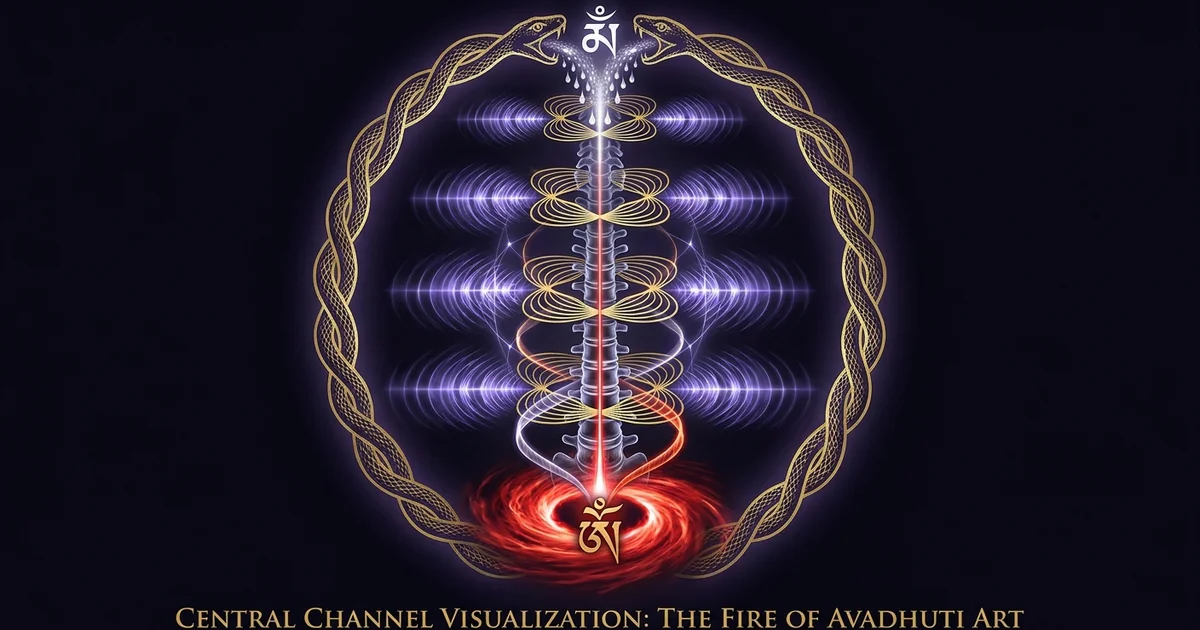
Central Channel Visualization: The Fire of Avadhuti Art
Protocol Overview & Neurophysiological Thesis
The esoteric Tibetan Vajrayāna practice of Avadhūti visualization—specifically the ignition of Caṇḍālī (tummo) within the central channel (dbu ma, classical Sanskrit: suṣumnā)—constitutes an advanced neuro-visceral biofeedback technology. Far from representing an arbitrary mythopoetic schema, the central channel visualization avadhuti sushumna tummo flame matrix functions as an introspective mapping of the human Central Autonomic Network (CAN), the anterior cingulate cortex (ACC), and the interoceptive insular cortex. By systematically organizing interoceptive attention, respiratory mechanics, and localized somatic imagery, the practitioner induces an intentional, highly coordinated shift in cortical state, neuroendocrine secretion, and metabolic throughput.
                               ▲ [Crown Wheel / Mahāsukha / HAM]
                               │
            (Lalanā / Iḍā)    │    (Rasanā / Piṅgalā)
           [Vagal / Cool]     │    [Sympathetic / Solar]
                  \            │            /
                   \           │           /
                    ▼          │          ▼
                     ●---------●---------●  [Throat Wheel / Sambhoga]
                               │
                               │
                     ●---------●---------●  [Heart Wheel / Dharma]
                               │
                               │
                     ●---------●---------●  [Navel Wheel / Nirmāṇa]
                    /          │          \
                   /           │           \
                  ▲            │            ▲
                               │
                               ▲ [Ignition: Half-Letter A / Caṇḍālī]
The Topography of the Tri-Channel Matrix and the Four Wheels
Within the canonical anatomical models preserved in the Anuttarayogatantra traditions, the subtle body (sūkṣmaśarīra) is organized around a primary triadic conduit system intersected by nodal vortices designated as the four chakra wheels rtsa. The central channel, the avadhūti, ascends vertically along the anterior plane of the vertebral column, extending from a point situated four finger-widths beneath the umbilicus up to the sagittal suture of the cranium, terminating anatomically at the fontanelle before curving forward into the inter-eyebrow space (ājñā). Parallel to this central conduit run the lateral channels: the white, feminine, lunar channel (lalanā, Tibetan: rkyang ma) on the left, carrying the descending, cooling currents of calm (prāṇa), and the red, masculine, solar channel (rasanā, Tibetan: ro ma) on the right, conducting the ascending, thermogenic currents of active metabolic consumption.
These lateral conduits do not run strictly parallel without interruption; rather, they loop around and constrict the central channel at specific embryonic loci, creating functional structural blockades termed channel knots (rtsa-mdud). The primary intersections constitute the four chakra wheels rtsa: the navel wheel of emanation (nirmāṇacakra, possessing sixty-four radiating petals or channel branches), the heart wheel of phenomena (dharmacakra, possessing eight petals), the throat wheel of enjoyment (sambhogacakra, possessing sixteen petals), and the crown wheel of great bliss (mahāsukhacakra, possessing thirty-two petals). In ordinary neurovisceral operation, somatic and cognitive activity is mediated exclusively through the dualistic lateral conduits, maintaining the nervous system in an oscillatory state between sympathetic arousal and parasympathetic conservation. The central channel remains collapsed and dormant, its luminal space occluded by the tensional constriction of the vascular and myofascial sheaths mirrored in the autonomic tone.
Neurological Correlates of the Non-Dual Conduit: Suṣumnā as the Central Axis
From the standpoint of functional neurobiology, the tri-channel architecture maps precisely onto the bilateral lateralization of the human nervous system and the homeostatic mechanics governed by the sympathetic and parasympathetic trunks. The lateral channels (lalanā and rasanā) mirror the alternating functional dominance of the left and right cerebral hemispheres, which correlates closely with the ultradian nasal cycle governed by the hypothalamus. Sympathetic tone dominates the right-sided solar channel (rasanā), mediating catabolic breakdown, ergotropic readiness, and outward attentional focus. Parasympathetic tone correlates with the left-sided lunar channel (lalanā), mediating anabolic recovery, trophotropic preservation, and internally diverted cognitive processing.
+-----------------------------------------------------------------------------+
|                     ASYMMETRIC LATERAL DUALITY (BASELINE)                   |
|                                                                             |
|   Lalanā (Left Channel / Lunar)           Rasanā (Right Channel / Solar)    |
|   - Parasympathetic Dominance             - Sympathetic Dominance           |
|   - Anabolic / Troptotropic               - Catabolic / Ergotropic          |
|   - Left Nasal Patency                    - Right Nasal Patency             |
|   - Internalizing / Passive               - Action-Oriented / Arousal       |
+-----------------------------------------------------------------------------+
                                       │
                         Kumbhaka & Spatial Dissolution
                                       ▼
+-----------------------------------------------------------------------------+
|                       NON-DUAL CENTRAL AXIS (AVADHŪTI)                      |
|                                                                             |
|   - Bilateral Autonomic Co-Activation (Sympathetic + Parasympathetic Lock)  |
|   - Cephalo-Spinal Midline Synchronization (ACC / Insula / Prefrontal)      |
|   - Interhemispheric Gamma-Band Phase-Locking (40–80 Hz)                    |
|   - Collapse of Lateralized Cognitive Dualisms                              |
+-----------------------------------------------------------------------------+
The intentional internalization of vital winds (prāṇa, rlung) into the avadhūti represents the neurodynamic cessation of this alternating hemispheric asymmetry. When the winds are forced out of the lateral conduits via targeted somatic manipulation, the autonomic nervous system enters a state of simultaneous sympathetic-parasympathetic co-activation. The visual geometry of the suṣumnā—perceived introspectively as an unbending, perfectly translucent luminous axis along the sagittal midline—corresponds to the cephalo-spinal alignment of the neuroaxis, recruiting the dorsal column-medial lemniscal pathways, the periaqueductal gray (PAG), and the midline frontoparietal networks. This structural centralization effectively arrests the asymmetric cortical oscillations that generate the subject-object divide, inducing a state of sustained, non-dual hemispheric coherence across the cerebral mantle.
The Thermogenic and Hemodynamic Objectives of Tummo Flame Internalization
The functional deployment of the central channel visualization avadhuti sushumna tummo flame targets two distinct physiological endpoints: the voluntary activation of non-shivering thermogenesis and the elevation of systemic hemodynamic volume through microvascular recruitment. Classical texts classify this inner fire (caṇḍālī, gtum-mo) not as a passive state of mental relaxation, but as a dynamic combustion protocol that converts biochemical and bioelectric potentials into raw thermal energy. This somatic thermogenesis is not an arbitrary side-effect; it is the thermodynamic prerequisite for dissolving subtle cognitive obscurations and liberating internal neurochemical substrates.
Mechanistically, the practice aims to elevate the practitioner’s somatic heat through localized vasoconstriction and deep-core thermoregulatory resets. This thermal generation initiates a continuous ascending bioelectric vector that uncoils the autonomic knots constricting the mesenteric, cardiac, and cervical plexuses. This thermodynamic shift alters blood plasma viscosity, stimulates the synthesis of heat-shock proteins, and upregulates mitochondrial ATP synthesis across target tissues. Through the deliberate maintenance of the visualization of an intense, hair-thin flame ascending the central axis, cognitive processing is stripped of peripheral sensory distractors and anchored directly into the autonomic substrate, establishing a unified somatic-cognitive continuum.
“The central channel, the Avadhūti, must be visualized as possessing four definitive structural characteristics: it is utterly straight like the trunk of a plantain tree; it is intensely translucent red like liquid lac or pure ruby; it is exceedingly radiant like an oil lamp burning in an enclosed vessel; and it is completely hollow like a reed of bamboo, extending from the base of the secret place up to the crown of the head. Within its very center, at the level of the navel, burns the half-letter A (shad), no thicker than a fraction of a horse hair, searingly hot, vibrating with the energetic hum of living fire.” — The Life and Teaching of Naropa, translated and edited by Herbert V. Guenther (1963), Oxford University Press, collated with the commentary of Yang-jen-ga-way-lo-drö (Lati Rinpoche & Hopkins, 1979).
Biophysical Mechanisms & Brainwave Dynamics
Coherence Mapping: From Beta Desynchronization to Gamma (40-80 Hz) Synchrony
The neurodynamic profile of advanced avadhūti visualization is characterized by a rapid evacuation of low-amplitude, desynchronized Beta activity (13–30 Hz)—the typical electrical signature of discursive, narrative-driven mentation—and the emergence of self-sustained, high-amplitude Gamma oscillations (40–80 Hz). Electroencephalographic (EEG) recordings of long-term contemplative practitioners engaging in tantric visualization demonstrate that this Gamma burst is not an epiphenomenon of muscular tension, but a highly coordinated, large-scale neural synchrony spanning distal cortical regions (Lutz et al., 2004). This Gamma phase-locking indicates widespread functional integration across the frontoparietal networks, the insular cortex, and the thalamocortical loops.
Standard Dualistic Baseline (Beta Desynchronization: 13–30 Hz):
Left Hemi:  /\_/\__/\_/\___/\_/\__/\_ (Desynchronized narrative loop)
Right Hemi: __/\_/\__/\_/\___/\_/\__/ (Asymmetric emotional / somatic tracking)

Avadhūti Coherence Transition (High-Amplitude Gamma: 40–80 Hz):
Left Hemi:  /\/\/\/\/\/\/\/\/\/\/\/\/ (High-amplitude, phase-locked Gamma)
Midline:    ||||||||||||||||||||||||| (Phase-Locked Frontoparietal Axis)
Right Hemi: /\/\/\/\/\/\/\/\/\/\/\/\/ (High-amplitude, phase-locked Gamma)
During the active phase of channel ignition, the visualization of the needle-thin vertical lumen serves as an attentional constraint that suppresses the Default Mode Network (DMN), specifically reducing metabolic activity within the posterior cingulate cortex (PCC) and the precuneus. Concurrently, the Task-Positive Network (TPN) and the Salience Network (SN) undergo acute synchronization. As the visualization intensifies, these Gamma oscillations synchronize with lower carrier frequencies, establishing cross-frequency phase-amplitude coupling between Alpha-Theta pacemakers (4–10 Hz) and ultra-fast Gamma bursts. This neurodynamic state facilitates the non-referential awareness described in Mahāmudrā epiphenomenology, characterized by hyper-lucidity without cognitive fragmentation. Practitioners investigating the intersection of this state with acoustic entrainment often examine protocols such as the /consciousness/monroe-gateway-gamma-synchronization protocols to model these cross-cortical phase couplings.
Thermogenesis, Sympathetic Upregulation, and Interscapular Brown Adipose Activation
The somatic reality of tummo practice manifests most visibly in the deliberate elevation of cutaneous and core temperatures. Laboratory evaluations of Tibetan practitioners have recorded localized peripheral temperature increases of up to 8.3°C in the distal extremities, accompanied by systemic metabolic elevations exceeding normal baseline limits by 15% to 60% (Benson et al., 1982). This thermogenic surge relies on the targeted mobilization of brown adipose tissue (BAT) concentrated in the interscapular, perirenal, and supra-clavicular spaces, alongside severe beta-adrenergic receptor activation.
Somatic Vessel Breath + Navel Flame Visualization
                      │
                      ▼
Sympathoadrenal Surge via Thoracic Spinal Segments (T1–T5)
                      │
                      ▼
   Norepinephrine Release at Adipose Terminals
                      │
                      ▼
Beta-3 Adrenergic Receptors Activated on Brown Adipocytes
                      │
                      ▼
  Intracellular Lipolysis & Free Fatty Acid Mobilization
                      │
                      ▼
Uncoupling Protein-1 (UCP-1) Activation in Inner Mitochondrial Membrane
                      │
                      ▼
Proton Gradient Dissipated as Pure Metabolic Heat (Non-Shivering Thermogenesis)
The bioelectric and somatic sequence begins with the somatic visualization of the half letter a seed syllable at the navel wheel, which coordinates directly with the sympathetic preganglionic neurons residing within the intermediolateral cell columns of the thoracolumbar spinal cord. This focal point triggers a massive, localized surge of norepinephrine into deep somatic tissue. Brown adipocytes respond via their $\beta_3$-adrenergic receptors, initiating a cascade of cyclic adenosine monophosphate (cAMP) production, intracellular lipolysis, and the subsequent activation of uncoupling protein-1 (UCP-1 / thermogenin) located within the inner mitochondrial membrane.
Instead of routing the transmembrane electrochemical proton gradient through ATP synthase to generate biochemical energy, UCP-1 short-circuits this gradient, releasing proton motive force directly as pure metabolic heat. This mechanism, outlined in detailed somatic studies such as /meditation/tummo-inner-fire-kumbhaka-physiology, demonstrates how mental somatic focus directly influences mitochondrial-level uncoupling.
Phase-Locked Resonance: Vessel Breathing, Kumbhaka, and Vagal Braking
The physiological engine driving this bioelectric and metabolic transformation is the “Vessel Breath” (bum-pa-can, classical Sanskrit: kumbhaka). This breathwork protocol requires the intentional coordination of the pelvic floor, the lower abdominal wall, and the diaphragm to create a sealed, pressurized somatic cylinder within the abdominothoracic cavity. By contracting the perineal musculature (mūla bandha) and compressing the lower abdomen, the practitioner forces the descending apāna-vāyu (thur-sel rlung) upward. Concurrently, by drawing down the thoracic diaphragm and swallowing a partial volume of inspired air, the descending prāṇa-vāyu (srog-'dzin rlung) is driven down, locking the two opposing biofluid vectors together at the navel wheel.
       [ Upper Vector: Prāṇa-Vāyu ] ───┐
                                       ├──► [ Pressurized Abdominal "Vase" ]
       [ Lower Vector: Apāna-Vāyu ] ───┘           (Kumbhaka Retention)
                                                           │
                                                           ▼
       [ High-Amplitude Vagal Afferent Spike via Solitary Tract (NTS) ]
                                                           │
                                                           ▼
       [ Frontoparietal Synchrony & Cortical Phase-Locking (40–80 Hz) ]
This mechanical compression generates marked elevations in intra-abdominal and intrathoracic pressures, which in turn stimulate the baroreceptor complexes located within the carotid sinus and the aortic arch. This persistent baroreflex activation sends rapid afferent signaling through the glossopharyngeal and vagus nerves directly into the nucleus of the solitary tract (NTS).
Rather than inducing typical parasympathetic bradycardia, the practitioner executes a conscious somatic override: the sympathetic drive elicited by hypoxia and intense muscular contraction is paired with high vagal afferent tone, establishing a state of autonomic co-activation. This high-amplitude vagal signaling acts as an oscillatory brake, preventing the neurocardiac axis from descending into unorganized tachycardia and instead driving resonant, phase-locked coupling across the autonomic nervous system.
“Our findings demonstrate that g-Tum-mo practice comprises two distinct neurocognitive and physiological components: a somatic ‘Forceful Breath’ technique characterized by the vase retention (kumbhaka) that elevates core body temperature up to fever levels through sympathetic and muscle metabolic upregulation, accompanied by distinct shifts in Beta- and Alpha-band power; and a sustained contemplative ‘Gentle Breath’ technique dominated by the pure visual internalization of the Avadhūti. This latter phase maintains elevated temperatures through focused imagery alone, eliciting prolonged, high-amplitude cortical Gamma synchronization (40–80 Hz) across the frontoparietal axes, proving that sustained mental representation of channel geometry directly modulates autonomic homeostatic set-points.” — Kozhevnikov, M., Elliott, J., Shephard, J., & Dhargye, K. (2013). PLoS ONE, 8(3), e58298.
Anatomical Architecture: Channels, Syllables, and Energetic Drops
The Four Chakra Wheels (rtsa-’khor): Nodal Geometry of Navel, Heart, Throat, and Crown
The subtle architecture of the tantric body operates as an electro-hydrodynamic manifold composed of the central channel (avadhūti) and the four chakra wheels rtsa that intersect it at specific bio-anatomical junctions. These wheels act as geometric routing hubs that coordinate the flow of subtle winds (rlung) and red and white subtle drops (bindu, thigle) throughout the organism.
Chakra Wheel     Tibetan Name    Petals / Branches    Morphological Architecture
--------------------------------------------------------------------------------
Crown Wheel      Mahāsukha       32 descending        Inverted umbrella; white drop nexus
Throat Wheel     Sambhoga        16 ascending         Funnel/upward goblet; vocal-thyroid hub
Heart Wheel      Dharma          8 descending         Radial wheel; indestructible thigle core
Navel Wheel      Nirmāṇa         64 ascending         Triangular cone; Caṇḍālī combustion site
The navel wheel (nirmāṇacakra) serves as the somatic crucible for the entire practice. Anatomically correlated with the celiac and mesenteric plexuses, its sixty-four channels flare upward like an inverted cone, providing the structural boundary required to generate internal thermogenesis.
Ascending the central axis, the practitioner encounters the heart wheel (dharmacakra), an eight-petaled hub oriented downward, directly correlated with the cardiac plexus and the intrinsic cardiac nervous system. It is within the center of this wheel that the “indestructible drop” (mi shigs pa’i thigle) resides—the subtle informational locus encapsulating the clear light mind.
Further upward lies the throat wheel (sambhogacakra), with sixteen channels radiating upward like a chalice, corresponding to the pharyngeal-laryngeal plexuses, the thyroid axis, and vocal-linguistic cognition.
Finally, the crown wheel (mahāsukhacakra) contains thirty-two channels radiating downward like the spokes of an open umbrella, situated beneath the sagitto-coronal cranial suture and neuroanatomically mapped to the third ventricle, the hypothalamus, and the pineal-pituitary axis. The primary tantric impediment to unified awareness consists of the tight, myofascial, and energetic channel knots (rtsa-mdud) formed by the bilateral channels wrapping around the avadhūti at these four locations. The untying of these knots requires an internal pressure gradient, forcing the winds to enter the central channel and sever the energetic constrictions from within.
The Micro-Ignition: Mechanics of the Half-Letter A Seed Syllable
At the focal center of the navel wheel, within the luminal interior of the avadhūti, sits the primary catalyst of the practice: the half letter a seed syllable (a-shad, ཨ). Morphologically, this syllable is visualized not as a flat calligraphic character, but as a three-dimensional vertical stroke resembling a fine, luminous needle. It is described as being half a finger-width in height, no thicker than the fiber of a lotus stem or a fraction of a horse hair, radiant red-orange like a glowing ember, pulsating with microscopic, high-frequency kinetic vibration, and emitting intense, concentrated thermal radiation.
       Crown: Inverted White HAM (Cooling, Quiescent Potential)
                        [ ཧཾ ]
                           │
                           │   (Avadhūti Central Conduit)
                           │
                           ▲   Ascending Needle of Fire
                           │
        Navel: Half-Letter A (shad) [ ཨ ] (Combustion Nexus)
The technical mechanics of the micro-ignition require sustained, point-focus interoceptive concentration (ekāgratā). The practitioner fixes conscious attention entirely upon this microscopic coordinate while executing the pressurized Vessel Breath. Through the mechanical compression of kumbhaka, intra-abdominal heat and bioelectric charge are routed directly into the base of the avadhūti.
This concentrated somatic pressure ignites the dormant half-letter A. The syllable begins as a smoldering spark, transitions into a hair-thin micro-flame, and rapidly evolves into a self-sustaining energetic filament. This micro-ignition is not a symbolic mental projection; it is a bioelectric focusing event that directs somatic innervation and microvascular perfusion to the exact somatic coordinate, initiating an ascending cascade of metabolic thermogenesis.
Thermodynamic Dissolution: White Ham Liquefaction and Red Drop Ascendance
As the half letter a seed syllable combusts within the navel wheel, the intense, localized thermal energy generates an energetic convection current that ascends vertically through the hollow lumen of the avadhūti. The flame climbs through the heart wheel, untying the eight-petaled knot and exposing the cardiac core to intense thermal stimulation. It continues upward through the throat wheel, expanding in radiance until it reaches the crown wheel of great bliss.
::: diagram [Somatic Fluid Dynamics of Central Channel Ignition]
<div class="diagram-flow flex flex-col items-center gap-3 my-4 w-full">
<div class="diagram-row flex flex-wrap items-center justify-center gap-3">
<div class="diagram-node px-4 py-2 rounded-xl bg-elevated border border-gold/30 text-primary font-mono shadow-md transition-all">Navel Wheel: Half-Letter A Ignition</div>
</div>
</div>
│
▼
<div class="diagram-flow flex flex-col items-center gap-3 my-4 w-full">
<div class="diagram-row flex flex-wrap items-center justify-center gap-3">
<div class="diagram-node px-4 py-2 rounded-xl bg-elevated border border-gold/30 text-primary font-mono shadow-md transition-all">Ascending Tummo Flame via Avadhūti</div>
</div>
</div>
│
▼
<div class="diagram-flow flex flex-col items-center gap-3 my-4 w-full">
<div class="diagram-row flex flex-wrap items-center justify-center gap-3">
<div class="diagram-node px-4 py-2 rounded-xl bg-elevated border border-gold/30 text-primary font-mono shadow-md transition-all">Unraveling Heart & Throat Knots</div>
</div>
</div>
│
▼
<div class="diagram-flow flex flex-col items-center gap-3 my-4 w-full">
<div class="diagram-row flex flex-wrap items-center justify-center gap-3">
<div class="diagram-node px-4 py-2 rounded-xl bg-elevated border border-gold/30 text-primary font-mono shadow-md transition-all">Crown Wheel: White HAM Melting</div>
</div>
</div>
│
▼
<div class="diagram-flow flex flex-col items-center gap-3 my-4 w-full">
<div class="diagram-row flex flex-wrap items-center justify-center gap-3">
<div class="diagram-node px-4 py-2 rounded-xl bg-elevated border border-gold/30 text-primary font-mono shadow-md transition-all">Descending Nectar / Thigle Dissolution</div>
</div>
</div>
│
▼
<div class="diagram-flow flex flex-col items-center gap-3 my-4 w-full">
<div class="diagram-row flex flex-wrap items-center justify-center gap-3">
<div class="diagram-node px-4 py-2 rounded-xl bg-elevated border border-gold/30 text-primary font-mono shadow-md transition-all">Heart Wheel: Clear Light Convergence</div>
</div>
</div>
:::
At the summit of the crown wheel resides the subtle white seed syllable—the inverted HAM (ཧཾ)—representing the condensed white bindu (thigle), the concentrated somatic-neurochemical essence of anabolic, trophotropic cooling potential. Under the influence of the ascending heat from the caṇḍālī flame, the syllable HAM undergoes a thermodynamic state transition: it liquefies.
From the inverted letter, an ecstatic, cooling fluid—often characterized as subtle energetic ambrosia (amṛta)—begins to distill and descend through the core of the central channel. As this liquid nectar cascades downward, it saturates the throat, heart, and navel wheels, progressively quenching the intense heat of the ascending flame. The physiological correlates of this phase involve widespread parasympathetic rebound, intense parasympathetic-sympathetic coherence, and the systemic release of endogenous neurochemical cascades. The meeting and fusion of the descending white thigle and the ascending red thigle within the indestructible drop at the heart center induces the phenomenological collapse of ordinary dualistic cognition, giving rise to the profound subjective emergence of the Four Joys (ānanda) and the pristine manifestation of the Mother Clear Light.
Step-by-Step Experiential Protocol: Igniting the Avadhūti Fire
[Phase I: Seven-Point Alignment & Ninefold Expulsion]
                   │
                   ▼
[Phase II: Abdominal Pressurization & Kumbhaka Locking]
                   │
                   ▼
[Phase III: Micro-Ignition of Navel Half-Letter A]
                   │
                   ▼
[Phase IV: Vertical Propagation along Avadhūti Axis]
                   │
                   ▼
[Phase V: Crown Liquefaction & Descent of White HAM]
                   │
                   ▼
[Phase VI: Indestructible Drop Fusion at Heart Center]
                   │
                   ▼
[Phase VII: Dissolution into Non-Dual Clear Light]
Phase I: Channel Clarification, Expulsion of Dead Air, and Postural Geometry
The execution of the protocol begins with the rigorous physical establishment of the Seven-Point Posture of Vairochana. The legs are bound in the full vajra posture (vajrāsana), which serves to anatomically compress the femoral arteries, redirecting peripheral arterial blood volume directly into the iliac and abdominal viscera. The spine is held as straight as a stack of golden coins, slightly expanding the intervertebral spaces and reducing spinal cord torsion. The shoulders are retracted like the wings of an eagle, broadening the thoracic cage and facilitating full diaphragmatic excursions.
The hands are placed in the meditative equanimity gesture (dhyāna mudrā) four finger-widths beneath the umbilicus, resting directly over the location of the subtle navel wheel. The chin is tucked slightly toward the throat (jālandhara bandha orientation), straightening the cervical spine, while the gaze is directed naturally along the bridge of the nose into open space.
Following structural stabilization, the practitioner executes the preliminary nine-fold expulsion of stale air (rlung ro dgu bsal). Closing the left nostril with the right ring finger, the practitioner inhales deeply through the right solar channel (rasanā), visualizing pure white, radiant energy clearing the channel. The breath is then forcefully expelled through the left lunar channel (lalanā), visualizing the purging of all obstacles connected to attachment and parasympathetic torpor in the form of grayish-white smoke.
This process is repeated in reverse: inhaling through the left and expelling through the right, systematically purging anger, aversion, and sympathetic overactivation in the form of dark-red smoke.
Finally, the practitioner inhales deeply through both nostrils simultaneously, directing the vital currents down through both lateral channels to their junction at the lower abdomen, before expelling the air through the central conduit, visualizing the elimination of foundational ignorance and cognitive obscurations as black soot. This sequence balances the ultradian nasal cycle and levels mucosal resistance across both nasal passages.
Phase II: The Vessel Breath (Bum-pa-can) and Syllable Enkindling
With the channels clarified, the practitioner initiates the core somatic engine: the forceful Vessel Breath (bum-pa-can). The inhalation is drawn smoothly, deeply, and rapidly through both nostrils, passing directly down the lateral channels like air driven into a bellows. The volume of air is swallowed smoothly down the esophagus while simultaneously contracting the thoracic diaphragm downward. Concurrently, the lower pelvic floor is vigorously contracted: the anal sphincter is pulled upward, the perineum is locked (mūla bandha), and the lower rectus abdominis and transversus abdominis muscles are drawn firmly backward against the lumbar spine.
                              Diaphragmatic Descent
                                      │
                                      ▼
                        [ Upper Thoraco-Vascular Seal ]
                                      │
                                      ▼
             [ Intraperitoneal High-Pressure Vault (The "Vessel") ]
                                      ▲
                                      │
                        [ Lower Pelvic-Perineal Seal ]
                                      ▲
                                      │
                           Mūla Bandha Retraction
This dual-vector compression forms the “vase” or “vessel”—a sealed, pressurized somatic vault within the intraperitoneal and retroperitoneal spaces. The breath is retained smoothly without strain, maintaining an internal pressure equilibrium. During this period of retention, the practitioner fixes the visual mind onto the half letter a seed syllable situated inside the avadhūti at the navel wheel.
The seed syllable is visualized as an ultra-fine, searingly hot needle of fire. With every second of retention, the natural somatic pressure generated by kumbhaka fans the fire of the syllable. The syllable vibrates rapidly, producing a high-frequency bioelectric hum, its heat compounding exponentially until it shifts from a dull red ember to a blindingly incandescent, razor-sharp flame that fills the lower bowl of the central channel.
Phase III: Vertical Propagation, Drop Liquefaction, and Non-Dual Rest
Once the half-letter A is enkindled, the practitioner initiates the phase of vertical propagation. As the retention reaches its designated temporal threshold (initially 30 to 45 seconds, advancing to 60 to 90 seconds in seasoned adepts), the flame shoots upward within the hollow, translucent lumen of the avadhūti. It shoots like a thin lance of liquid fire, piercing directly through the heart wheel and illuminating the thoracic cavity with red-gold brilliance. The practitioner mentally maintains the diameter of the flame at no more than the thickness of a thread, preventing the heat from dispersing laterally into the systemic musculature.
The flame pierces through the throat wheel and strikes the crown wheel, directly targeting the inverted white syllable HAM. The intense heat engulfs the syllable, causing the white drop (thigle) to melt. As the retention is released with a soft, slow exhalation that avoids explosive decompression, the melted nectar cascades down the interior of the central channel.
The practitioner experiences a wave of cooling neuro-somatic release, described in classical texts as supreme bliss (paramānanda). The ascending red heat and the descending white coolness meet and dissolve into one another at the heart wheel (dharmacakra). Discursive thought collapses; the default networks fall silent. The practitioner rests in the clear light of awareness, free from cognitive elaboration, sustaining the visualization of the empty, luminous central axis.
- Postural Alignment: Lock limbs into the Seven-Point Posture of Vairochana. Ensure spinal erection is rigid yet free from peripheral muscular hyper-tonicity.
- Channel Visualization: Before breathing, construct the mental matrix of the three channels: avadhūti (translucent ruby, 1 cm diameter, along midline), lalanā (lunar white, left), and rasanā (solar red, right), intersecting at the navel, heart, throat, and crown.
- Inhalation & Swallowing: Inhale smoothly through both nostrils for 4–6 seconds, drawing subtle wind down the lateral channels to four finger-widths below the navel. Swallow saliva smoothly to seal the upper airway, simultaneously depressing the diaphragm.
- Vessel Retention (Kumbhaka): Lock the pelvic floor upward (mūla bandha) and contract lower abdominal wall backward. Hold for 30–60 seconds. Direct internal abdominal pressure into the half letter a seed syllable (0.5 mm wide, 1 cm high, burning with intense heat).
- Flame Propagation: Drive the searing needle-flame up the interior of the avadhūti, untying the heart and throat channel knots.
- Crown Contact & Melt: Impact the inverted white HAM at the crown. Retain until the white bindu liquefies.
- Exhalation & Dissolution: Exhale smoothly through both nostrils without collapsing abdominal tone. Track the descending cool nectar as it coalesces with the ascending fire at the heart wheel. Rest in pristine, non-dual luminosity for 2–5 minutes.
Systemic Channel Dynamics: Comparative Subtle Body Models
Vajrayāna Avadhūti vs. Classical Hindu Suṣumnā Nāḍī
While the Tibetan Vajrayāna avadhūti and the classical Hindu Haṭha Yogic suṣumnā nāḍī share an identical anatomical substrate along the cerebrospinal axis, their operational dynamics and epistemological architectures diverge substantially. The classical Haṭha model, as detailed in the Haṭhapradīpikā and Śiva Saṃhitā, conceptualizes the subtle energy dynamic as the uncoiling of a dormant, serpentine goddess—kuṇḍalinī śakti—resting coiled three and a half times around the svādhiṣṭhāna or mūlādhāra chakra at the base of the spine. The primary catalyst is upward ascension: the serpent awakens through intense prāṇāyāma (such as bhastrikā and mūla bandha), pierces through the six primary chakras (ṣaṭcakranirūpaṇa), and ascends to the crown (sahasrāra) to achieve static, transcendental union with śiva.
+-----------------------------------------------------------------------+
   |             CLASSICAL HINDU HAṬHA (KUṆḌALINĪ) MODEL                   |
   |                                                                       |
   |   Crown (Sahasrāra) ── Unmoving Transcendental Union (Śiva)           |
   |           ▲                                                           |
   |           │   Linear, Unidirectional Ascent                           |
   |           │   (Piercing of Six Chakras / Granthis)                    |
   |           │                                                           |
   |   Base (Mūlādhāra) ── Dynamic Serpentine Force Awoken (Kuṇḍalinī)     |
   +-----------------------------------------------------------------------+
±----------------------------------------------------------------------+
|               TIBETAN VAJRAYĀNA (AVADHŪTI / TUMMO) MODEL              |
|                                                                       |
|   Crown (Mahāsukha) ── White Ham / Anabolic Liquefaction (Amṛta)       |
|           │   ▲                                                       |
|           │   │   Bidirectional Thermodynamic Feedback Circuit        |
|           ▼   │                                                       |
|   Navel (Nirmāṇa)   ── Red Half-Letter A / Caṇḍālī Thermogenesis      |
|           │   ▲                                                       |
|           └───┴── Indestructible Drop Clear Light Convergence (Heart) |
±----------------------------------------------------------------------+
In direct contrast, the Tibetan Vajrayāna protocol of the avadhūti is fundamentally a bidirectional thermodynamic feedback circuit. The focus is not an ascending serpentine power piercing localized centers, but rather the simultaneous ignition of the red thermogenic drop (caṇḍālī/tummo) at the navel and the subsequent liquefaction and descent of the white cooling drop (thigle) from the crown.
The ultimate operational resolution does not occur at the crown fontanelle, but collapses back into the heart wheel (dharmacakra), where the white and red subtle drops fuse into the indestructible drop (mi shigs pa’i thigle). This architectural divergence alters the neurophysiological outcome: whereas classical Kuṇḍalinī ascent often triggers unpredictable central nervous system excitation and erratic motor discharges (kriyās), the avadhūti protocol enforces strict hemodynamic containment and thermoregulatory stability through the balancing polarity of descending cooling drops.
Tibetan Vajrayāna Avadhūti
- Channel Path Geometry: Linear, translucent vertical lumen extending from four finger-widths beneath the navel straight to the crown fontanelle, curving forward into the brow center (ājñā).
- Primary Catalyst Syllables: The vertical, needle-thin red half-letter A (shad) at the navel wheel and the inverted white HAM at the crown.
- Thermodynamic Direction: Explicitly bidirectional: ascending metabolic heat (tummo) forces the descending liquefaction of cooling neurochemical drops (thigle).
- Autonomic Expression: High-amplitude thermogenesis coupled with strict somatic and hemodynamic stillness; simultaneous sympatho-vagal co-activation without involuntary motor activity (kriyās).
- Epistemological Aim: The dissolution of the conceptual winds into the indestructible drop at the heart center, precipitating the ground Clear Light of non-dual consciousness (’od gsal).
Classical Haṭha Suṣumnā
- Channel Path Geometry: Unbroken spinal canal conduit ascending directly from the basal pelvic floor (kanda/mūlādhāra) through the spinal cord into the cerebral cortex.
- Primary Catalyst Syllables: The Bīja syllables of the five elements along the central column, crowned by the unuttered sound OṂ at the brow and crown.
- Thermodynamic Direction: Primarily unidirectional: the ascending piercing vector of the feminine fire (kuṇḍalinī-śakti) rising to unite with the static masculine consciousness (śiva).
- Autonomic Expression: Explosive sympathetic excitation often triggering somatic spasms, hyperventilation, and spontaneous involuntary motor discharges (kriyās).
- Epistemological Aim: The transcendence of lower energetic domains, culminating in the absorption of individual identity into cosmic consciousness (sahaja samādhi) at the sahasrāra.
Mechanistic Divergences in Microcosmic Orbit Taoist Circulation
The Taoist internal alchemical tradition (Neidan) approaches subtle energetic circulation through the dynamic of the Microcosmic Orbit (Xiao Zhou Tian), presenting a structural divergence from the strict linear verticality of the avadhūti. In the Taoist framework, energy is not restricted to a central cephalo-spinal channel; rather, it is circulated continuously through two primary regulatory channels: the Governing Vessel (Du Mai), which ascends the posterior midline of the spinal column from the perineum (Huiyin) over the skull to the upper palate, and the Conception Vessel (Ren Mai), which descends along the anterior midline of the thorax and abdomen back down to the perineum.
Taoist Microcosmic Orbit (Cyclic Continuous Loop):
        ▲ [Du Mai: Posterior Spinal Ascending Vector]
        │                                           │
  (Perineum: Huiyin)                       (Palate-Tongue Seal: Magpie Bridge)
        │                                           │
        ▼ [Ren Mai: Anterior Thoracic Descending Vector]

Vajrayāna Avadhūti Matrix (Strict Sagittal Centerline Axialization):
        ▲ [Crown: White HAM / Descending Amṛta]
        │
        │ (Unbroken, Non-Dispersive Translucent Core Luminal Axis)
        │
        ▼ [Navel: Half-Letter A / Ascending Caṇḍālī Flame]
The Microcosmic Orbit relies on a continuous loop of circulation, using the tongue against the hard palate as a physical switch (the “Magpie Bridge”) to link the two vessels. Energetic currents are perpetually moved, refined (Jing into Qi, Qi into Shen), and stored within the lower cinnabar field (Dantian).
In contrast, the central channel visualization avadhuti sushumna tummo flame protocol deliberately avoids peripheral or anterior-posterior circulation. The tantric adept does not circle energy through the outer visceral perimeter; energy is compressed into the unbending central axis. By forcing the winds out of both anterior and posterior currents and dissolving them inside the sagittal centerline, the practitioner prevents the subtle winds from sustaining discursive spatial models. This operational difference directly affects biofield dynamics, a topic explored deeply in the analysis of /physics-electromagnetism/biofield-electrodynamics-human-system.
Ascending Energy Vectors: Kundalinī Piercing vs. Downward Flowing Thigle
The phenomenological trajectory of these systems produces distinct physiological shifts. In systems relying exclusively on ascending energetic vectors, such as the classical piercing of the knots (granthis) by Kuṇḍalinī, the practitioner frequently experiences severe sympathetic hyper-arousal, accompanied by tactile paresthesias, abrupt cardiac acceleration, and sensations of uncontrolled electric current discharging through peripheral nerves. Because the ascending force is not systematically counterbalanced by an integrated, descending cooling mechanism, the nervous system can struggle to downregulate, leading to intense neurovisceral exhaustion.
The avadhūti model avoids this uncalibrated sympathetic run-away by engineering the downward flowing white thigle as an integral component of the protocol. The moment the inner fire ignites and climbs, it triggers the descending cascade of neuroendocrine and parasympathetic substrates represented by the liquefaction of the syllable HAM. The descent of this cooling nectar dampens excessive sympathetic outflow, counteracting the hyperthermic drive before pathological tissue heating can occur. This dual-action thermodynamic mechanism produces intense somatic heat accompanied by hemodynamic stability, calm affective tone, and non-distracted cognitive absorption.
Operational Safety, Contraindications & Biofield Grounding
IMPROPER PRACTICE TRAJECTORY
               (Failure of Lower Vessel Breath & Pelvic Lock)
                                   │
                                   ▼
        [ Upward Herniation of Uncontained Wind: Srog-Rlung ]
                                   │
                                   ▼
+----------------------------------------------------------------------+
|                     PATHOLOGICAL MANIFESTATIONS                      |
|                                                                      |
|  - Cardiac Plexus Stagnation: Severe Arrhythmias, Tachycardia        |
|  - Intracranial Hypertension: Ocular Migraines, Retinal Shearing     |
|  - Cortical Destabilization: Dissociative Psychosis, Paranoia        |
|  - Vagal Shock & Autonomic Collapse                                  |
+----------------------------------------------------------------------+
                                   │
                                   ▼
                    MANDATORY GROUNDING INTERVENTION
       [ Release Retentions ── Earth Visceral Grounding ── Sole Gaze ]
Rlung Disorders (Prāṇa Imbalance): Etiology, Cardiac Compression, and Cognitive Agitation
In the context of Tibetan traditional medicine (gSo-ba Rig-pa) and transpersonal neuropsychiatry, the most severe adverse outcome resulting from improper avadhūti practice is the emergence of a structural rlung disorder—specifically the upward displacement of “life-supporting wind” (srog-’dzin rlung) into the cardiac and cerebral compartments. This pathology emerges when an adept attempts the forceful Vessel Breath without adequately establishing the lower pelvic floor seal (mūla bandha), or attempts to drive the subtle wind up the central axis through mental strain rather than somatic relaxation.
When the upward-moving vital wind becomes unanchored, it herniates out of the central channel and enters the lateral channels, directly invading the heart wheel (dharmacakra). Because the heart wheel is the primary interoceptive nexus of cardiac autonomic control, this invasion presents clinically as severe functional pathology: intractable cardiac arrhythmias, resting sinus tachycardia, debilitating precordial constriction, and sudden-onset panic attacks that do not respond to standard anxiolytics.
If the displaced wind continues to ascend into the cranial vault, it produces profound neurocognitive instability, manifesting as auditory tinnitus, insomnia, derealization, extreme emotional volatility, and psychotic-like breaks termed rlung-induced cognitive fragmentation.
The energetic and somatic practices described in this monograph involve extreme physiological shifts, intense intrathoracic and intracranial pressurization, and significant autonomic nervous system modulation. The execution of the forceful Vessel Breath (bum-pa-can) combined with tummo visualization is strictly contraindicated for individuals presenting with:
- Severe cardiovascular pathology, including ischemic heart disease, cardiac arrhythmias, aneurysms, or unmanaged systemic hypertension.
- Cerebrovascular risk factors, history of stroke, transient ischemic attacks, or intracranial vascular malformations.
- Glaucoma or elevated intraocular pressure, due to dramatic spikes in central venous pressure during kumbhaka.
- Active psychotic disorders, bipolar spectrum illness, or severe trauma-related dissociative conditions.
Mandatory Termination Criteria: Practitioners must immediately abort the practice if they experience sharp ocular pain, visual migraines, throbbing unilateral cranial pressure, irregular cardiac rhythms, or unmanageable dissociative anxiety. Continuing the practice through these symptoms can lead to cerebrovascular injury, vagal collapse, or long-term neurocognitive dysregulation.
Absolute Physiological Contraindications: Cardiovascular, Hypertensive, and Cerebrovascular Risks
From a strict neurovisceral standpoint, the execution of the forceful kumbhaka represents an extended, high-effort Valsalva maneuver. During the prolonged pressurized retention phase, intrathoracic pressure spikes significantly, causing an initial transient surge in arterial blood pressure, followed by compression of the superior and inferior vena cava. This venous compression leads to a dramatic drop in cardiac preload, a reduction in stroke volume, and an acute drop in mean arterial pressure, which triggers a compensatory sympathetic reflex.
       Prolonged Pressurized Kumbhaka Retention (Phase II / III)
                                 │
                                 ▼
   Severe Elevation of Intrathoracic Pressure (> 40–60 mmHg)
                                 │
                                 ▼
      Compression of Superior & Inferior Vena Cava
                                 │
                                 ▼
         Abrupt Fall in Venous Return & Stroke Volume
                                 │
                                 ▼
Sudden Release Phase: Massive Arterial Flow Rebound & Cranial Surge
When the breath retention is suddenly terminated, venous blood rushes back into the cardiac chambers, precipitating an immediate rebound surge in cardiac output and systemic blood pressure. For individuals with undiagnosed cerebral micro-aneurysms, structural vascular weaknesses, or atherosclerotic plaques, this instantaneous pressure differential carries a significant risk of vascular dissection or intracranial hemorrhage.
Furthermore, the mechanical transmission of intra-abdominal pressure into the cerebrospinal fluid (CSF) compartments elevates intracranial pressure (ICP), which directly increases intraocular pressure via the optic nerve sheath. Therefore, this practice requires strict screening and absolute adherence to gradual somatic conditioning.
Grounding Somatics: Resolving Upper-Channel Stagnation to the Earth Matrix
If a practitioner detects symptoms of upper-channel stagnation—characterized by sensations of fullness in the cranial vault, facial flushing, ocular migraines, mental agitation, or acute insomnia—they must immediately suspend all vessel retention and fire visualization. A targeted physiological and somatic grounding sequence must be deployed to draw the trapped bioelectric potential back down through the somatic core to the earth matrix.
[ Upper-Channel Stagnation Detected (Cranial Fullness, Agitation) ]
                               │
                               ▼
        [ Cessation of Kumbhaka & Forceful Breath Retentions ]
                               │
                               ▼
            [ Descending Gaze Shift: Inter-Eyebrow to Soles ]
                               │
                               ▼
           [ Downward Visualization: Deep Blue HŪṂ at Soles ]
                               │
                               ▼
  [ Somatic Ingestion: Warm Heavy Nutrients & Foot Pressure Massage ]
                               │
                               ▼
           [ Resolution of Trapped Winds to Earth Matrix ]
The corrective grounding protocol requires four immediate steps:
- Gaze and Spatial Recalibration: The adept drops the internal gaze entirely away from the upper chakra wheels, directing the mental focus down through the legs and into the centers of the soles of the feet (yongquan point, Kidney 1).
- Downward Somatic Visualization: Inside the soles of the feet, the practitioner visualizes dark, heavy, deep-blue syllables HŪṂ (ཧཱུྃ), which function as energetic sinks, drawing the buoyant, agitated winds downward out of the thoracic and cranial cavities.
- Somatic Recalibration via Pressure and Heat: Firm, manual pressure must be applied to the soles of the feet, the calves, and the base of the spine, paired with the application of warm sesame oil to the vertex of the skull and the feet, soothing the irritated myelin sheaths and calming peripheral cutaneous receptors.
- Nutritional Stabilization: The practitioner must consume warm, dense, grounding nutrients (such as bone broths, ghee, or complex fats) to activate digestive parasympathetic pathways, halting the ascending sympathetic-adrenergic vector and anchoring the system back within baseline visceral homeostasis.
Phenomenological Correlates & Veridical Evidence
The Dissolution Phases: Mirages, Smoke, Fireflies, and the Splendor of Clear Light
The subjective phenomenological landscape experienced during deep avadhūti absorption is neither random nor hallucinatory; it follows an invariant, cross-culturally validated sequence of internal structural dissolution signs (phyi sa-bon dang nang gi rtags). As the vital winds are systematically evacuated from the seventy-two thousand peripheral channels and forced into the central channel, the practitioner experiences the sequential dissolution of the physical elements, accompanied by specific internal visual phosphenes:
Dissolution Phase    Elemental Substrate    Subjective Internal Phosphene
---------------------------------------------------------------------------
1. Earth Dissolves   Prthvī into Apas       Shimmering mirage, watery optical distortions
2. Water Dissolves   Apas into Tejas        Wisps of drifting smoke or steam
3. Fire Dissolves    Tejas into Vāyu        Sparks or glowing fireflies in the darkness
4. Wind Dissolves    Vāyu into Vijnāna      Steadily burning oil-lamp flame, unaffected by wind
---------------------------------------------------------------------------
5. White Appearance  Aggregated Thoughts    Pristine, empty white radiance (like autumn moonlight)
6. Red Increase      Desire Dissolution     Vibrant, empty red-copper illumination (like sunset)
7. Black Attainment  Ignorance Dissolution  Total, pitch-black darkness; swoon/unconscious border
8. Clear Light       Fundamental Mind       Non-dual luminosity (*’od gsal*); non-referential clarity
As the winds dissolve entirely within the indestructible drop at the center of the heart wheel, the adept transitions through the final three subtle stages of dissolution:
- The White Appearance (snang ba), emerging from the downward descent of the white drop from the crown, flooding the cognitive field with an empty, brilliant white radiance resembling a clear sky saturated with autumn moonlight.
- The Red Increase (mched pa), emerging from the upward surge of the red drop from the navel, transforming the field into an empty, copper-red twilight brilliance.
- The Black Near-Attainment (nyer thob), occurring when these two drops converge and seal the heart wheel; the visual field drops into profound, empty blackness, during which ordinary conceptual consciousness suspends entirely.
Finally, emerging from this brief void comes the Ground Clear Light (gzhi’i 'od gsal)—the ultimate fruition of the avadhūti practice. This is not the perception of an external light source, but the direct, non-dual realization of fundamental, unconditioned consciousness itself, operating free from sensory mediation.
Laboratory Thermometry: Empirical Verification of Peripheral and Core Temperature Spikes
The physiological reality of tummo was brought into the sphere of Western clinical investigation through the landmark studies conducted by Herbert Benson and his research team from Harvard Medical School in the early 1980s. Working under field conditions in upper Dharamsala, India, Benson recorded unprecedented alterations in human thermoregulation among Himalayan adepts executing avadhūti visualizations.
“In laboratory trials conducted under sub-zero conditions (-15°C) in the Himalayan foothills, Tibetan yogins practicing g-Tum-mo were shown to voluntarily increase the temperature of their peripheral extremities (fingers and toes) by as much as 8.3°C above baseline, with no changes in ambient environmental warmth. Furthermore, the subjects exhibited the capacity to dry cold, soaking wet sheets wrapped around their bare bodies within minutes, evaporating moisture through intense cutaneous hyperthermia that would cause profound hypothermia in unconditioned subjects. These data provide empirical verification of voluntary control over the human autonomic nervous system, demonstrating selective recruitment of sympathetic non-shivering thermogenesis and profound changes in peripheral vascular tone.” — Benson, H., Lehmann, J. W., Malhotra, M. S., Goldman, R. F., Hopkins, J., & Epstein, M. D. (1982). Nature, 298(5872), 402-404.
These thermometric elevations were later replicated and extended under controlled laboratory conditions by Kozhevnikov et al. (2013). Using continuous rectal thermistors, calibrated cutaneous probes, and high-density EEG, the researchers demonstrated that core body temperature could be elevated directly into the moderate clinical fever range (reaching 38.3°C / 101°F). The investigators confirmed that these elevations were not the result of simple physical exertion or sustained muscular shivering, but were correlated directly with the combination of the forceful Vessel Breath and the steady internal visualization of the fiery central axis.
Subjective Ecstasy vs. Objective Brainwave Synchronization: The Endogenous Opiate Axis
A consistent phenomenological hallmark of tummo fire visualization is the emergence of intense, somatic joy and blissful absorption (ānanda, bde-ba). While classical texts attribute this ecstasy to the downpour of the melted white drop (thigle) through the central conduit, modern neurobiology recognizes in this state the mass activation of the endogenous opiate and endocannabinoid systems, coupled with sustained cortical synchronization.
Dissolution of Knots & Intense Thigle Visualization
                        │
                        ▼
   Massive Endogenous $\beta$-Endorphin / $\mu$-Opioid Surge
                        │
                        ▼
     Striatal & Accumbens Dopaminergic Signaling Lock
                        │
                        ▼
Fronto-Insular Phase-Locked Gamma Resonance (40–80 Hz)
                        │
                        ▼
    Phenomenological Ecstasy Coincident with Non-Dual Clarity
The profound subjective bliss is driven by a massive, central release of $\beta$-endorphins and enkephalins within the periaqueductal gray, the hypothalamus, and the striatum, triggered by the intense visceral pressures of kumbhaka and the focused mental imagery of flame ignition. Concurrently, the endocannabinoid anandamide ($N$-arachidonoylethanolamine) spikes, crossing the blood-brain barrier to bind to presynaptic $\text{CB}_1$ receptors, dampening stress-response feedback loops and producing sensations of timelessness and unity.
Crucially, this neurochemical cascade does not induce cognitive torpor or sedation. Because it is bound to fronto-insular Gamma synchronization (40–80 Hz), the practitioner remains alert. The subject experiences this state as self-luminous bliss that acts as the vehicle for non-referential insight, demonstrating the integration of high-amplitude brainwave dynamics and profound affective state modulation.
Frequently Asked Questions
Diagnostic Indicators of Wind Entering the Avadhūti
Distinguishing between genuine prāṇic entry into the avadhūti and simple psychosomatic imagination is a primary diagnostic concern within contemplative science. Authentic internalization of vital winds produces three objective somatic markers:
- Cessation of Asymmetric Nasal Airflow: The alternating ultradian nasal cycle ceases entirely. Airflow through both the left and right nostrils becomes identical in volume, velocity, and temperature, indicating that the lateral channels (lalanā and rasanā) have yielded their flow to the midline.
- Involuntary Respiratory Quiescence: Respiration becomes imperceptible. The autonomic requirement for frequent pulmonary ventilation drops significantly, allowing the adept to remain comfortable with minimal, shallow diaphragmatic engagement.
- Abdominal Incurvature: The lower abdominal wall beneath the navel naturally flattens and draws inward toward the lumbar spine without voluntary muscular contraction. The practitioner feels a stable, solid somatic core within the central axis, accompanied by a feeling of lightness and an intrinsic cessation of spontaneous mental narrative.
       [ Stage 1: Asymmetrical Nasal Airflow Ceases Entirely ]
                                 │
                                 ▼
       [ Stage 2: Involuntary Drop in Pulmonary Demand / Quiescence ]
                                 │
                                 ▼
       [ Stage 3: Spontaneous Inward Incurvature of Lower Abdomen ]
                                 │
                                 ▼
       [ Confirmed Diagnostic Entry of Prāṇa into the Avadhūti ]
Navigating Pressure and Heat at the Crown Fontanelle
When practicing the vertical propagation of the tummo flame, adepts occasionally encounter uncomfortable pressure, sharp heat, or throbbing sensations concentrated at the skull vertex or the sagittal suture. This presentation indicates that the ascending energetic vector has reached the crown wheel (mahāsukhacakra) without triggering the reciprocal liquefaction and descent of the white cooling drop (bindu), creating localized vascular and energetic congestion.
[ Localized Cranial Congestion / Vertex Throbbing Detected ]
                              │
                              ▼
  [ Cease Ascending Flame Visualization; Drop Focus to Heart ]
                              │
                              ▼
[ Visualize Throat/Crown Transformed into Cool, Pale Blue Syllable OṂ ]
                              │
                              ▼
  [ Release Abdominal Pressurization; Lengthen Smooth Exhalations ]
                              │
                              ▼
[ Cooling Downward Fluid Vector Re-Established; Equilibrium Restored ]
To resolve this imbalance:
- Immediately release all forceful kumbhaka retentions, transitioning to the Gentle Breath (’jam rlung).
- Cease visual tracking of the ascending flame. Redirect visualization away from the crown, resting attention in the center of the heart wheel or dropping it down to the navel.
- Internally visualize the crown wheel and throat wheel suffused with a cool, moon-like, pale-blue light, picturing the syllable OṂ emitting refreshing, cooling rays that absorb excess thermal energy.
- Lengthen the duration of the exhalation phase, allowing the trapped heat to dissipate smoothly out through the crown fontanelle into open space, re-establishing balance between the ascending fire and the descending nectar.
Integration of Acoustic Brainwave Entrainment with Somatic Visualization
The integration of precision acoustic brainwave entrainment can support the stabilization of the rapid Gamma synchronization (40–80 Hz) required for avadhūti visualization. However, this pairing must be executed with careful parameter control to prevent autonomic over-stimulation.
The most effective acoustic architecture uses binaural beat frequencies set precisely to a 40 Hz Gamma differential, layered over a stable carrier frequency within the low-to-mid Alpha band (e.g., a 200 Hz carrier in the left ear and a 240 Hz carrier in the right ear). Practitioners can examine the mathematical mechanics of these auditory setups through /sound-cymatics/binaural-carrier-frequency-mechanics.
The 40 Hz auditory beat elicits an electrophysiological Frequency Following Response (FFR) within the superior olivary complex and the inferior colliculi, promoting frontoparietal synchronization that helps stabilize the mental imagery of the needle-thin half-letter A.
Isochronic pulses should generally be avoided during tummo practice: their abrupt, high-contrast amplitude modulations introduce sensory startle reflexes that disrupt subtle diaphragmatic engagement during the Vessel Breath. Auditory entrainment must remain an unobtrusive background framework, reinforcing neural coherence while the practitioner’s focused somatic interoception drives the neurovisceral mechanics of the inner fire.