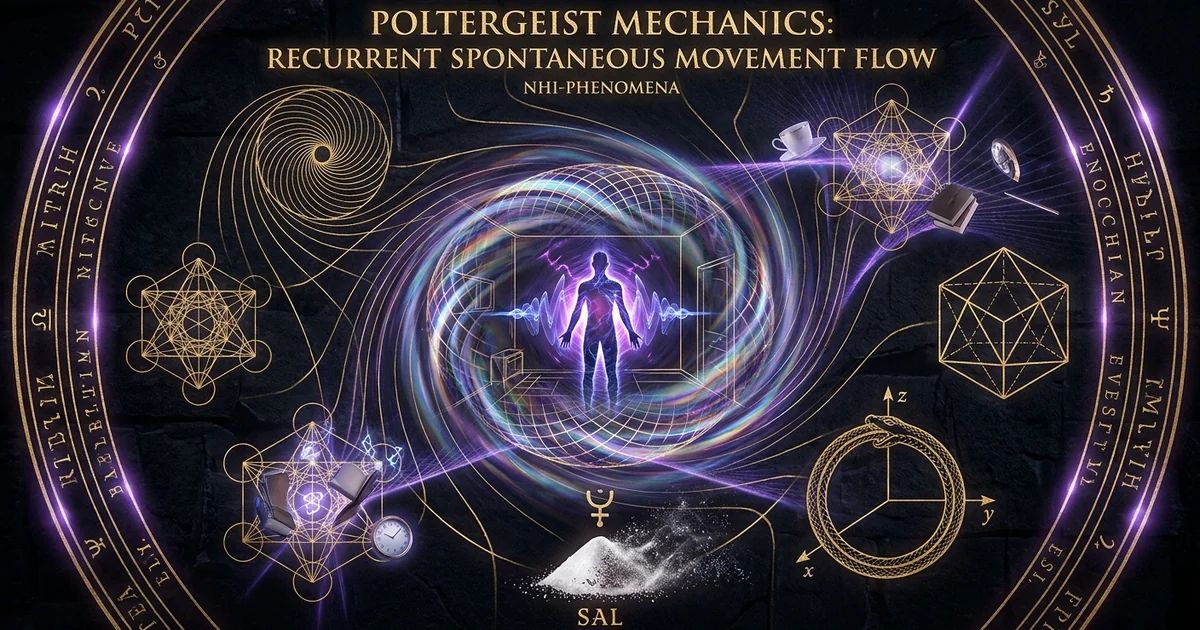
Poltergeist Mechanics: Recurrent Spontaneous Movement Flow
Metaphysical Thesis & Epistemological Opening: The Trans-Physical Nature of Recurrent Spontaneous Movement
The classical paradigm of physical dynamics rests upon the postulate of macroscopic local realism: objects change their state of rest or uniform motion only when acted upon by identifiable, externally mediated forces whose vector propagation obeys conservation of energy, linear momentum, and local thermodynamic entropy. Within the enclosed habitats of anomalous macro-kinetic events, however, this classical framework collapses. The phenomenon historically termed the poltergeist—classified in modern parapsychological anomalistics as Recurrent Spontaneous Psychokinesis (RSPK)—demonstrates a categorical rupture in normative kinematics. Rather than exhibiting the parabolic trajectories governed by Newtonian gravity and initial kinetic impulse, macroscopic bodies subjected to these displacements trace complex, non-ballistic paths characterized by sustained levitation, aberrant right-angle vector shifts, and anomalous low-velocity impacts that fail to transfer destructive kinetic shock into recipient surfaces.
This mechanical breakdown cannot be comprehensively parsed through conventional models of classical mechanics or clinical psychopathology alone. The Cartesian bifurcation that neatly separates interior psychodynamic disturbance from exterior, objective physical metrics is fundamentally invalidated by recurrent spontaneous movement. When solid-state furniture, sealed liquid containers, and heavy structural members displace without physical contact, mechanical stress, or measurable ambient draft, we are witnessing an intersection where interior psychic tension acts directly upon the fundamental metric of spacetime. To categorize these dynamics strictly as domestic neuroses or fraudulent fabrications is an epistemological evasion; conversely, to assign them wholesale to archaic, anthropomorphized discarnate entities is to substitute ontological inquiry with superstitious closure.
Instead, rigorous metaphysical anomalistics demands that poltergeist mechanics rspk recurrent spontaneous psychokinesis uap interactions be recognized as a single continuum of high-strangeness macroscopic disruptions. The spatial architecture of an domestic RSPK outbreak exhibits structural isomorphisms with close-encounter physical trace signatures documented in anomalous aerospace phenomena: localized gravitational decoupling, steep magnetic field gradients, anomalous isotopic shifts, and temporal dilations. The physical vacuum within these operational zones undergoes an informational phase shift, rendering the surrounding domestic envelope a laboratory for non-standard metric engineering.
The Rupture of Classical Kinematics in High-Strangeness Enclosures
The observation of telekinetic object displacement within confined domestic sites systematically dismantles standard ballistic equations. In normative mechanics, an unguided projectile accelerated by an instantaneous force follows a trajectory determinable by Newtonian vector calculation, with air resistance and gravitational acceleration dictating an invariant parabolic curve toward ground impact. During verified RSPK cascades, researchers consistently document trajectories that William G. Roll termed “abnormal flight profiles.” Heavy ceramic, glass, and metallic items lift off surfaces without sudden mechanical acceleration, travel through air at velocities far below what would be required to maintain lift, navigate around architectural obstructions such as door frames and hallway corners, and set down with imperceptible acoustic deceleration or, conversely, impact violently without fracturing.
These non-parabolic, highly structured flight paths indicate that the energy vector is not imparted as a single ballistic impulse at the origin point. Rather, the moving object appears entrained within a localized traveling metric distortion—a moving potential well. When an object descends slowly as if suspended in high-viscosity fluid, or accelerates horizontally across a room without rotational tumbling, classical drag and inertia are locally suspended or counterbalanced. The field geometry suggests an active manipulation of localized gravitational and inertial mass properties, directly implicating transient spacetime metric perturbations that envelope the displaced mass within an engineered bubble of altered vacuum permittivity.
The spatial behavior of telekinetic object displacement also challenges standard inverse-square attenuation models. While field effects classically dissipate according to the square of the distance from their source, extensive telemetry of RSPK spatial matrices reveals highly localized “hot zones” or discrete geometric nodal lines throughout an afflicted architecture. Objects are repeatedly drawn into specific trajectory channels, suggesting that the local environment develops a standing-wave matrix of kinetic susceptibility. Within these nodal envelopes, physical objects cease to act as independent classical particles; they become passive informational tokens modulated by a coherent, non-local force.
Epistemological Blindspots of Reductionist Parapsychological Materialism
For more than a century, post-Enlightenment materialism has struggled to assimilate RSPK into its mechanistic ontology. The dominant reductionist impulse oscillates between two unviable extremes: complete delegitimization via the assumption of unseen mechanical fraud, or an oversimplified somatic-conversion model that treats macro-kinetic displacement as an unexplained, direct electro-chemical discharge from an epileptic or hysterically repressed adolescent. While the involvement of a focal human agent is statistically indisputable across historical case registries, treating the human organism as an ordinary physical generator capable of projecting thousands of joules of targeted mechanical energy through empty air via known biological mechanisms violates every law of metabolic and thermodynamic conservation.
The standard biological body cannot generate the electromagnetic or acoustic fields required to lift a fifty-kilogram oak cabinet across a room without undergoing catastrophic cellular and thermal destruction. Reductionist parapsychology, in its desperate quest for scientific legitimacy, attempted to sanitize the phenomenon by stripping it of its inherent high-strangeness. Investigators frequently excised reported observations of spontaneous apports, localized temperature plummets, inexplicable phantom knocks displaying autonomous intelligent cadence, and geometric light anomalies from case reports simply because these vectors resisted conversion into clean, linear laboratory psychokinesis models.
By forcing poltergeist mechanics into an impoverished mechanistic framework, reductionist science blindfolds itself to the fundamental nature of the phenomena. Macro-PK cannot be understood as a physical limb elongated through invisible energetic wires; it operates as an informational restructuring of the vacuum state. The failure of reductionist parapsychology lies precisely in its refusal to adopt an ontology capable of synthesizing the conscious observer, the non-physical information field, and the materialization of kinetic force within a non-dual cosmological architecture.
The Continuum Between RSPK and UAP Boundary Disruption
A critical epistemological development in the study of anomalous mechanics occurred when Jacques Vallée demonstrated that the phenomenology of the poltergeist overlaps almost completely with physical close encounters involving unidentified aerospace phenomena (UAP). In both operational domains, human percipients are confronted with an intelligence or mechanism that destabilizes consensus reality parameters. Both phenomena exhibit identical electromagnetic telemetry: broadband radio-frequency interference, sudden draining of direct-current electrochemical cells (batteries), localized static charges on non-conductive surfaces, and severe perturbations of the local geomagnetic field.
Furthermore, both poltergeist outbreaks and close-proximity UAP events frequently induce acute physiological effects in human percipients, including transient paralysis, temporal distortion, localized thermal burns, and persistent neurological symptoms reminiscent of cranial nerve trauma. When physical objects are displaced or hovered in both domains, they demonstrate identical aerodynamic absurdities: instantaneous acceleration without sonic shockwaves, zero observable reactionary exhaust, and sharp vector turns that would subject classical structures to catastrophic g-force shear. The boundary dividing a domestic poltergeist infestation from an anomalous interdimensional craft encounter is an arbitrary taxonomic fiction established by historical compartmentalization.
RSPK manifestations must be theorized as a microscopic or localized iteration of the identical boundary-collapse mechanism governing UAP-human interfaces. In both scenarios, the informational substrate underlying physical spacetime becomes plastic. Human consciousness—specifically its dissociated, repressed, or transpersonal strata—interacts directly with an interdimensional control matrix, opening an ontological aperture through which physical conservation laws are temporarily suspended, allowing non-human or trans-physical dynamics to colonize physical space.
“The poltergeist is not an unruly spirit dwelling in plaster and timber, nor is it an ordinary mechanical impulse originating within the muscles of an unhappy adolescent. It behaves as an informational feedback system that challenges the thermodynamic inevitability of entropy, establishing local negentropic coherence by drawing upon the fundamental information matrix that underpins physical geometry.”
— Jacques Vallée, The Invisible College (1975), juxtaposed with William G. Roll’s spatial-attenuation models in The Poltergeist (1976).
Primary Codices & Historical Transmission: From Daemonological Seizures to Physical Anomalistics
The documentation of recurrent spontaneous movement long predates modern psychical laboratories. Ancient, medieval, and early modern texts preserve a dense historical record of macroscopic anomalous displacements, though the epistemic lenses through which these observations were filtered shifted radically across cultural eras. In late antiquity, such events were categorized through the technical operations of theurgy and pneumatic manipulation; in the medieval epoch, they were filtered through inquisitorial demonology; and in the late nineteenth century, they underwent reclassification as subjects for physical anomalies research under the auspices of the early Society for Psychical Research (SPR).
Across these chronological transitions, the physical morphology of the phenomenon remains remarkably stable. Chroniclers separated by millennia and continents consistently describe identical mechanical signatures: stones flung along non-linear vectors that drop gently to the earth, rhythmic percussion against domestic boundaries that tracks human speech, the unscrewing of sealed architectural fastenings, and the spontaneous transport of domestic implements through solid partitions. Tracing this codical transmission illuminates how human cultures have continually re-encoded an invariant trans-physical dynamic into the reigning ontological nomenclature of their time.
Telestic Rites and Pneumatic Disturbances in Late Antiquity
In the Neoplatonic theurgy developed by late antique philosophers such as Iamblichus and Proclus, anomalous kinetic disruptions were recognized as intrinsic hazards of manipulating the pneuma (πνεῦμα)—the subtle, pneumatic vehicle linking the unmanifest soul to the sensible cosmos. In De Mysteriis Aegyptiorum (On the Mysteries of the Egyptians, Chaldeans, and Assyrians), Iamblichus directly addressed the uncontrolled stirring of inanimate matter during poorly executed telestic rites. For the late Neoplatonist, physical matter was bound to the divine orders through sympathetic chains (seirai). When an operator attempted to draw down celestial or daemonic powers without possessing rigorous interior purification, the descending current could destabilize the ambient physical environment.
Under these conditions of spiritual and somatic misalignment, the pneuma of the officiant and the ambient atmospheric air became violently agitated. Inanimate statues (agalmata) were recorded as shifting their positions, hovering, or vibrating upon their plinths, while stones and ceremonial vessels were displaced across the theurgic enclosure. Iamblichus was careful to differentiate between true epiphanies of pure noetic gods—which induced absolute stillness, luminosity, and profound equilibrium—and the turbulent incursions of lower, material daemons or unsettled pneumatic currents. These lower entities, lacking autonomous noetic intelligence, operated within the dense, reactive layers of sublunary nature, producing cacophonous sounds, erratic fires, and violent mechanical movements that closely anticipate the modern poltergeist.
The late antique theurgists recognized what modern parapsychologists would rediscover centuries later: that spontaneous macroscopic disturbances are intrinsically tied to human energetic receptivity. The unruly displacement of physical reality was seen as an involuntary exteriorization of pneumatic force, occurring when an individual’s subtle vehicle became cracked or porous, allowing disordered intermediate intelligences to leverage the physical body as an anchor to disrupt terrestrial matter.
“For if the presence of the gods imparts balance, health, and quietude of both soul and body, the approach of the disorderly daemons casts the body into erratic convulsion, agitates the air with violent murmurs, and shakes the very foundations of the material precinct, displacing inanimate things with an uncontrolled kinetic fury that possesses neither order nor purpose.”
— Iamblichus, De Mysteriis Aegyptiorum, Book II, Section 7 (c. 300 CE).
The Shift from Demonic Obsession to the Focal Psychodynamic Agent
As classical theurgy was systematically dismantled by the rise of institutional Christianity, the philosophical taxonomy of pneumatic field effects was replaced by an absolute moral dualism. The scholastic and inquisitorial manuals of the late medieval and early modern periods—most notoriously Heinrich Kramer’s Malleus Maleficarum (1486) and later demonological treatises by Jean Bodin and Nicholas Rémy—categorized all instances of telekinetic object displacement, invisible rapping, and domestic levitation under the uniform rubric of obsessio (demonic harassment) or possessio (internal demonic occupation).
Within this inquisitorial paradigm, the physical anomalies were interpreted as the malicious operations of fallen angels functioning under divine permission to punish sin or test the faith of the elect. The human subject at the center of these occurrences was no longer understood as an unwitting somatic resonator or pneumatic catalyst, but as either a willing witch bound by a pact with the infernal hierarchy, or an innocent, tormented victim whose bodily orifices and physical environment were co-opted by discarnate evil. This theological framework forced field observers to ignore the profound correlation between the emotional, psychological, and physiological states of the central individual and the spatial mechanics of the displacements.
Despite this dogmatic distortion, the primary empirical field notes embedded within inquisitorial and clerical records provide invaluable data. Clergymen conducting exorcisms routinely cataloged instances of furniture moving without human intervention, stones flying through interior chambers without breaking window glass, and heavy iron chains undulating like serpents. By establishing a punitive interpretive paradigm, early modern demonology inadvertently preserved an exhaustive historical corpus of macro-kinetic events, documenting a recurring mechanical signature that consistently evaded mechanical explanations.
Twentieth-Century Field Telemetry: The SPR and Psychical Enquiries
The late nineteenth-century foundation of the Society for Psychical Research (SPR) in London marked the decisive rupture between demonological superstition and systematic physical anomalistics. Pioneers such as Frederic W. H. Myers, Frank Podmore, and Sir William Barrett approached domestic disturbances with the newly forged tools of physical empiricism, deploying photographic plates, precise room measurements, spatial distribution mappings, and rigorous witness cross-examination. Podmore’s landmark analyses systematically revealed a constant variable across hundreds of historically disparate incidents: the physical disruptions clustered almost exclusively around a single human focal point, predominantly an adolescent undergoing acute emotional repression, domestic abuse, or endocrine transition.
This realization birthed the living human agent hypothesis. Rather than hunting for discarnate devils, psychical researchers began tracking the physical dynamics of the living epicenters. By the mid-twentieth century, this approach culminated in the quantitative field investigations of William G. Roll, who formally coined the term Recurrent Spontaneous Psychokinesis (RSPK). Roll moved parapsychology away from anecdotal case studies and into mathematical physics. He plotted the precise geometric coordinates of displaced objects relative to the focal agent, calculating the physical energies required for each trajectory and establishing spatial decay curves that demonstrated how the probability of an object being moved decayed inversely with its distance from the human catalyst.
Roll’s laboratory and domestic field telemetry demonstrated that RSPK was not a chaotic, ambient spectral intrusion, but a structured field effect governed by definite physical parameters. The living human agent was formally isolated as the operational nexus—a biological system whose subconscious neuro-affective stress served as the primary power supply for macroscopic metric deformation. The focus of inquiry shifted irreversibly from external theological agents to the interface between human neuro-energetics and the physics of the local environment.
Ontological Architecture & Cosmological Models: The Interdimensional Control Matrix
The resolution of the poltergeist enigma requires moving beyond the false dichotomy of the living human agent versus the external discarnate entity. To presume that macro-kinetic displacements must originate exclusively within the biological skull of a traumatized human, or conversely, emanate entirely from an autonomous disembodied spirit, is to remain trapped within a naive Cartesian dualism. Reality does not bifurcate into hermetically sealed compartments of “subjective mind” and “objective physical mechanism.” Instead, the human organism functions as a resonant node within an expansive, multidimensional cosmological matrix.
Within this broader ontological framework, the living focal agent does not mechanically generate the anomalous metric field out of raw biological calories. Rather, the agent’s subconscious architecture functions as a bio-informational waveguide—a localized crack in the consensus reality envelope that permits trans-dimensional forces, autonomous intelligences, or latent field dynamics to colonize physical space. The poltergeist outbreak represents an interdimensional interface where human psychodynamics are harnessed, mimicked, or amplified by an external informational control system.
Vallée’s Informational Thermostat and Reality Deception Mechanisms
In The Invisible College, Jacques Vallée formulated the groundbreaking hypothesis that anomalous phenomena—encompassing both UAP encounters and poltergeist outbreaks—operate as a non-human cybernetic control system. Rather than representing literal visitations from extraterrestrial civilizations or discarnate human ghosts, these events function as an environmental thermostat designed to regulate human cultural evolution, perceptual boundaries, and ontological concepts. The mechanism underlying this control system is fundamentally informational and linguistic, manipulating physical physical metrics to destabilize prevailing epistemological paradigms.
A hallmark of this control system is its deployment of high-strangeness and intentional absurdity. Telekinetic manifestations rarely exhibit functional, utilitarian logic; instead, they present an unsettling blend of the terrifying and the ridiculous. Enclosed spaces will witness the slow levitation of heavy armoires alongside the inexplicable displacement of chicken eggs, the spontaneous turning inside-out of sealed clothing, or the precise arrangement of kitchen utensils into esoteric geometric arrays. This theatrical absurdity is not an accidental byproduct; it is a calculated mechanical countermeasure against human scientific reductionism.
The phenomenon acts deliberately to prevent consensus science from capturing it within a simplistic materialist schema. Every time physical telemetry is deployed to isolate the mechanism, the phenomenon alters its signature, operating through blindspots, producing fraudulent-looking mimicry, or shifting from kinematic displacements to spontaneous combustion or acoustic phantoms. Vallée’s informational thermostat utilizes absurdity as a reality deception mechanism, forcing human consciousness to confront the radical contingency of its physical laws while preventing the phenomenon itself from being fully domesticized by mechanistic science.
Living Human Agent (RSPK Epicenter)
- Causal Vector: Severe subconscious psychodynamic compression; localized bio-field voltage.
- Energy Profile: Inverse spatial decay tied to physical coordinates of the human catalyst.
- Consciousness Interface: Direct psychokinetic transduction of repressed rage, trauma, or limbic distress.
- Physical Trajectory: Highly concentrated domestic hot zones; non-ballistic parabolic bypass.
- Containment Protocols: Psychological integration, environmental relocation, limbic stabilization.
Autonomous NHI / Daemonic Incursion
- Causal Vector: Intentional interdimensional boundary incursion; parasitic informational intrusion.
- Energy Profile: Non-decaying macroscopic disruptions; spontaneous localized metric collapse.
- Consciousness Interface: Sophisticated mimicry of host psychodynamics; adversarial reality deception.
- Physical Trajectory: Coordinated multi-locus displacements, apports, and non-Euclidean geometries.
- Containment Protocols: Theurgic banishing, reality boundary restoration, informational decoupling.
The Focal Catalyst vs Autonomous NHI Continuum
The rigid historical division between agent-driven psychokinesis and autonomous entity manifestation breaks down when subjected to deep field analysis. The most accurate model is that of a complex, continuous ecosystem. At one terminus of this spectrum lies pure, unadulterated RSPK: a closed psychokinetic loop where an individual’s suppressed limbic stress triggers localized vacuum fluctuations without the participation of external non-human entities. At the opposing terminus lies fully autonomous Non-Human Intelligence (NHI)—an interdimensional intervention wherein an external consciousness executes macroscopic operations with minimal human somatic resonance.
However, the overwhelming majority of documented anomalous events occur within the intermediate zone of this continuum. In this operational theater, an individual experiencing profound neuro-affective tension—often an adolescent, a severely traumatized adult, or an uninitiated occult practitioner—acts as an energetic catalyst. The protracted psychological compression generates an intense bio-informational signature that acts like an open channel in the fabric of local spacetime. Autonomous, opportunistic intelligences—designated in esoteric traditions as sublunary daemons, elemental sprites, or archontic parasites—are attracted to this open conduit.
Once attached, these entities latch onto the agent’s subconscious matrix, utilizing the living human’s nervous system as a ground wire through which to pull and manipulate physical matter. The entity feeds upon the emotional terror, confusion, and polarization generated by its kinematic acrobatics, effectively establishing an autonomous feedback loop. The living agent provides the bio-physical anchor into the material plane, while the autonomous NHI directs the high-strangeness theatricality of the manifestation. To argue whether a poltergeist is “just the human mind” or “an actual spirit” is to fundamentally misunderstand the collaborative, predatory ecology of interdimensional contact.
Sefirotic Transmutation: The Rupture Between Yesod and Malkhut
This trans-physical dynamic is mapped with extraordinary precision within the cosmology of the Hermetic Kabbalah. In the architecture of the Tree of Life, the physical cosmos is embodied in the lowest sphere, Malkhut (the Kingdom), which represents the terminal crystallizing point of matter, governed by rigid spatial boundaries, sensory inertia, and immutable conservation laws. Immediately superior to Malkhut is the sphere of Yesod (the Foundation), the astral-formative realm of subtle energetic matrices, automatic unconscious processing, reproductive force, and the collective subconscious information reservoir.
Normatively, the descending currents of divine emanation cascade smoothly from the divine source (Pleroma), traversing the intermediate spiritual sefirot, passing through the formative filters of Yesod, and crystallizing peacefully into the physical realm of Malkhut. In healthy metaphysical equilibrium, the boundary between Yesod and Malkhut is guarded by strict informational thresholds. The mental representations, repressed archetypes, and dynamic image-forms of Yesod are prevented from directly precipitating into physical density without the intermediary of mechanical human labor.
[ PLEROMA / DIVINE SOURCE ]
               |
               v
     [ SEFIROTIC MATRIX ]
               |
               v
       [ YESOD (Foundation) ]
     (Astral Matrix / Unconscious)
               |
        === THRESHOLD ===  <-- Pathological Rupture / Bio-Informational Collapse
               |
      [ MALKHUT (Kingdom) ]
     (Physical Density / Matter)
In the poltergeist outbreak, this foundational boundary undergoes a catastrophic rupture. The suppressive psychological structures within the human subject fail, causing the astral-formative currents of Yesod to breach the ontological threshold and spill directly into Malkhut. The dynamic, non-local, and highly plastic rules of the astral realm displace the rigid structural integrity of the physical world. Inanimate objects, which should remain bound by the inertia of Malkhut, are suddenly animated by the chaotic, dream-like fluidity of Yesod. Physical matter is transmutated into a symbolic medium; the domestic environment becomes an externalized cinema of the unconscious mind, manipulated by both human psychological distress and the lower denizens that populate the Yesodic plane.
Phenomenological Mechanics & Interdimensional Interaction: Electromagnetic and Spacetime Metric Disruptions
To understand the actual mechanics of telekinetic object displacement, one must abandon the naive presumption that poltergeists operate by applying macroscopic mechanical forces equivalent to physical limbs. If an unseen force were merely “pushing” a heavy object through the air, the physical consequences of that push would remain visible within the local atmosphere: air molecules would be violently compressed, generating localized acoustic shocks, observable air currents, and turbulence capable of extinguishing open flames or disturbing nearby lightweight tapestries. Yet field research consistently notes that even during the violent transit of multi-kilogram objects, the surrounding air remains completely still, candles flicker without disruption, and dust motes drift peacefully through the operational field.
This lack of kinetic back-reaction reveals that the target object is not being propelled through static space. Instead, the object is enveloped within a localized metric perturbation—a transient distortion of the vacuum state that alters the gravitational, inertial, and electromagnetic constants within a bounded spatial domain. The physical phenomena documented during poltergeist activity are the macro-scale thermodynamic and electrodynamic consequences of localized spacetime engineering.
Telekinetic Object Displacement: Non-Ballistic Flight and Thermal Anomalies
The kinematic signatures of objects displaced during RSPK events present a direct challenge to standard Newtonian dynamics. Multiple field investigators, beginning with William G. Roll and extended through modern anomalous physical researchers, have cataloged trajectories displaying the “slow-fall” effect. Solid objects—such as stones, heavy flatirons, or delicate glassware—have been observed detaching from elevated ledges and floating toward the ground at a fraction of standard gravitational acceleration ($g = 9.8 \text{ m/s}^2$). Furthermore, upon reaching the floor, these items frequently come to rest without bouncing, rolling, or shattering, as though their inertial mass had been drained during transit.
Complementing this slow-fall dynamic is the frequent observation of thermal anomalies. Displaced objects are routinely recovered exhibiting significant thermal shifts: stones, coins, and household utensils frequently arrive at their terminal impact points radiating acute heat, occasionally reaching temperatures sufficient to cause second-degree burns on the hands of witnesses, while nearby surfaces show no signs of conductive thermal transfer. In other distinct cases, objects arrive coated in condensation or exhibit temperatures plummeting below the local ambient dew point.
These thermal shifts reveal the thermodynamic cost of localized vacuum metric manipulation. According to the foundational theories of psychokinesis formalized by Helmut Schmidt, the production of macroscopic anomalous kinetic motion requires a rapid, highly localized extraction of entropy from the surrounding physical environment. The field absorbs or discards thermal energy from the kinetic object’s internal crystalline lattice to balance the local energy equations of the vacuum state. The object is not merely thrown; its atomic and thermodynamic relationships with the ambient space are fundamentally altered throughout the duration of the flight.
Electromagnetic Interference in Domestic Enclosures
The occurrence of recurrent spontaneous movement is universally accompanied by severe, non-linear electromagnetic interference home disruptions. In domestic enclosures undergoing active anomalous sieges, modern electronic infrastructure undergoes systematic degradation. Direct-current cells (such as standard alkaline or lithium-ion batteries) experience accelerated, catastrophic voltage drops, losing full charge within minutes without corresponding heat dissipation. Alternating-current household wiring systems experience severe voltage fluctuations, with circuit breakers tripping across isolated circuits that carry zero excessive amperage load.
Simultaneously, magnetometers deployed within these anomalous zones record localized magnetic field gradients swinging from several hundred nanoteslas to pulses exceeding multiple milligauss. These magnetic pulses do not originate from centralized domestic appliances or standard high-voltage lines; they manifest as discrete, localized spatial fields that move through interior walls, hover over specific furniture items, and closely track the physical movements of the living human agent. Radio-frequency (RF) spectrum analyzers capture broadband electromagnetic bursts, predominantly clustered within the very high frequency (VHF) and ultra-high frequency (UHF) spectrums, occurring micro-seconds prior to physical kinetic displacements.
This electromagnetic interference home telemetry confirms that macroscopic movement is preceded by a profound electrical polarization of the environment. The domestic space acts as a macroscopic capacitor that is slowly charged by the bio-informational tension of the focal human subject. When this stored charge reaches a critical threshold, it discharges not as lightning or electrical arcing, but through an informational transduction that couples the local electromagnetic field to the gravitational vacuum potential, resulting in physical displacement.
Spacetime Metric Engineering and Micro-Wormhole Topologies
In his groundbreaking technical report for the United States Air Force Research Laboratory, Teleportation Physics Study (2004), physicist Eric W. Davis systematically evaluated the mechanisms underlying both anomalous psychokinetic teleportation and macroscopic object displacement. Davis concluded that macroscopic psychokinetic events—including the spontaneous apportation of objects through solid physical barriers—cannot be accounted for by classical mechanical models or standard electrodynamics. Instead, Davis situated these anomalies within the theoretical framework of general-relativistic metric engineering and quantum vacuum polarization.
Davis noted that the physical passage of an object through a solid partition (such as a locked door or exterior brick wall) without structural fracture, alongside the instantaneous appearance of stones or fluids within sealed rooms, implies the generation of transient, micro-scale traversable wormhole topologies, or Einstein-Rosen bridges. Drawing upon advanced vacuum polarization models, Davis observed that if a conscious agency or unknown field mechanism can alter the zero-point energy density of the local vacuum—inducing a localized negative energy state—it becomes mathematically possible to modify the local metric tensor:
$$G_{\mu\nu} = \frac{8\pi G}{c^4} T_{\mu\nu}$$
By locally modifying the stress-energy tensor $T_{\mu\nu}$, the phenomenon locally adjusts the gravitational and spatial curvature parameters. Under such an engineered metric, an object does not physically shatter its way through a wall; the space separating the inside and outside of the enclosure is topologically folded. The object enters a micro-wormhole throat at the source point and emerges at the destination node without traversing the intervening Euclidean distance. Poltergeist apports, slow-motion hoverings, and high-velocity wall-penetrations are the macro-scale physical signatures of an intelligence or bio-field mechanism executing real-time spacetime metric engineering.
Initiatic Synthesis & Philosophical Implications: Psychokinesis, Human Sovereignty, and Reality Architecture
The confrontation with poltergeist mechanics exposes the radical vulnerability of consensus human reality. For centuries, human societies have shielded themselves behind the comforting illusion that the material universe is an immutable, objective machine governed by static physical constants indifferent to human consciousness. The sudden eruption of macroscopic psychokinesis within the safe confines of the home shatters this collective defensive construct. It demonstrates that physical space is not an absolute, unyielding foundation, but a delicate, highly regulated informational consensus susceptible to disruption by both interior psychodynamic pressures and non-human intelligences.
This realization carries profound metaphysical and initiatic implications. When the boundaries separating interior mental states from exterior kinetic forces dissolve, human consciousness is forced to reckon with its latent causal power. However, this power, when accessed unconsciously through somatic repression and unprocessed psychological trauma, manifests not as illuminated spiritual liberation, but as a destructive, chaotic terror that imperils the sovereign integrity of both the human subject and the witness collective.
The Danger of Egregoric Feedback and Ontological Enmeshment
The primary danger confronting witnesses, victims, and parapsychological investigators during an anomalous kinetic outbreak is the phenomenon of egregoric feedback. An egregore is a non-physical, autonomous informational entity generated and sustained by the focused mental, emotional, and ritual energies of a collective human group. When a poltergeist manifestation begins, it invariably induces acute existential terror, paranoia, and obsessive analytical fixation within the domestic enclosure.
This pervasive collective terror acts as an exceptionally potent energetic nutrient. The witnesses begin to project elaborate narrative frameworks onto the phenomenon, interpreting every ambient sound, dropped utensil, or draft as intentional hostility directed by demonic entities, restless spirits, or ancestral curses. This externalizing fear establishes a parasitic feedback loop. The living agent’s bio-informational leakage feeds the emerging egregoric structure; the egregore, gaining autonomous coherence, utilizes this stolen energetic voltage to produce increasingly violent and coordinated macroscopic displacements; these heightened displacements induce even greater panic in the human witnesses, endlessly fueling the cycle.
Investigators who enter these environments with sensationalist or ungrounded spiritual mindsets inevitably become integrated into this feedback matrix. They undergo cognitive contagion, reporting poltergeist outbreaks following them back to their own residences—a well-documented anomalous transfer known as the “hitchhiker effect.” This contagion occurs because the observer has allowed their own perceptual architecture to resonate with the operational frequency of the control matrix. True metaphysical defense requires breaking this informational loop through ruthless psychological neutrality, refusal to feed the spectacle, and the restoration of firm perceptual boundaries.
Treating macroscopic spontaneous psychokinesis as an external religious theater or literal demonic invasion validates the precise deception matrix deployed by the phenomenon. Anthropomorphizing anomalous metric perturbations establishes an open cognitive conduit through which opportunistic egregoric parasites anchor themselves into the investigator’s personal psychic ecology. Without absolute detachment, empirical neutrality, and integrated shadow psychology, field engagement with macro-PK phenomena induces severe psychodynamic fragmentation and somatic field entanglement.
Archontic Mimicry and the Reclamation of Conscious Causality
From the perspective of Gnostic cosmology, the phenomenon of recurrent spontaneous movement illuminates the nature of the Heimarmene—the web of tyrannical fate and cosmic limitation maintained by the Archons under the dominion of the blind demiurge. Within the Gnostic codices (such as those preserved in the Nag Hammadi library), the physical cosmos is not an organic divine creation, but a flawed, restrictive imitation designed to ensnare the divine spark of the Pleroma within the illusions of material density, linear time, and thermodynamic decay.
The Archontic structures rule through mimicry (antimimon pneuma). When their operational envelope is stressed by high-voltage human consciousness, they respond by staging grotesque, deceptive spectacles that parody spiritual power. The poltergeist is the ultimate archontic caricature: it mimics true theurgic mastery of physical matter, substituting divine alignment with a chaotic, degrading circus of flying crockery and slamming doors. Its ultimate objective is to divert human awareness away from internal spiritual awakening and trap it within externalized terror, keeping the soul subordinated to the physical sensory parameters of the material prison.
Reclaiming conscious causality demands seeing through this archontic mimicry. The poltergeist demonstrates that the physical laws of the Demiurge are not immutable; they are flexible boundary conditions that can be bent, warped, and broken. The task of the awakened consciousness is not to succumb to the spectacle of macro-PK, but to recognize that if repressed, disordered psychological trauma can unconsciously tear the fabric of spacetime, then focused, sovereign, and illuminated will can consciously reorganize that same reality field toward harmonic divine integration. The phenomenon is an inverted mirror showing humanity the unrealized, trans-physical reach of its own divine potential.
The Participatory Reality Framework: Beyond Material Inertia
The ultimate synthesis emerging from the study of poltergeist mechanics, anomalous aerospace encounters, and interdimensional phenomena is the validation of John Archibald Wheeler’s “participatory universe” elevated to its highest metaphysical octave. We do not inhabit a sterile, spectator universe where independent observers gaze out at pre-existing, static matter across a vacuum of absolute separation. We inhabit an entangled, self-referential informational matrix where the conscious observer, the vacuum substrate, and the physical token exist in continuous, bi-directional co-creation.
The poltergeist is a violent, uncontrolled proof of this participatory reality. It reveals that matter is not dead, immutable substance; it is frozen information, stabilized by the collective unconscious consensus of human observers and interdimensional regulators. When an individual’s internal psychic tension rises to a level where it overcomes the localized consensus threshold, the material world around them softens, reverting to an indeterminate, plastic state where thought, emotion, and kinetic displacement bleed into one another.
To master this reality architecture requires transcending both naive materialism and ungrounded occultism. The investigator and the initiate must walk the razor’s edge of empirical metaphysics, recognizing that poltergeist mechanics rspk recurrent spontaneous psychokinesis uap dynamics are the visible fault-lines of an interdimensional control system that regulates the boundary between human potential and material constraint. By confronting these kinematic fractures with scientific rigor, psychological transparency, and sovereign metaphysical consciousness, humanity begins to decipher the fundamental mechanics of the cosmic architecture itself.
Frequently Asked Questions: Resolving the Anomalous Kinematic Paradox
Is RSPK Exclusively Induced by Adolescent Focal Agents?
No. While the classical literature of twentieth-century parapsychology—dominated by the pioneering surveys of William G. Roll and the Society for Psychical Research—heavily emphasized the statistical prevalence of adolescent focal agents, this demographic concentration is an incomplete epidemiological picture. Puberty represents a biological period characterized by rapid endocrine transitions, profound neurological rewiring, and severe psychological repression, particularly within restrictive domestic or institutional enclosures. This internal pressure makes adolescents exceptionally efficient conduits for bio-informational vacuum displacement.
However, verified historical and modern registries demonstrate that adult human agents can and do act as active RSPK epicenters. The necessary variable is not chronological age, but the presence of severe, unintegrated psychological tension operating within a somatic structure capable of quantum coherent bio-field amplification. Adults suffering from severe post-traumatic stress, dissociative disorders, unexpressed narcissistic or borderline rage, or sudden neurological episodes (such as temporal lobe lability) frequently trigger macroscopic movement cascades. Furthermore, intentional esoteric practitioners utilizing advanced theurgic, tantric, or hermetic trance techniques can involuntarily induce identical field collapses when latent subconscious shadows are stirred without adequate energetic integration.
+-----------------------------------------------------------------------------+
|                      RSPK AGENT DEMOGRAPHIC MATRIX                          |
+--------------------------+--------------------------------------------------+
| Demographic Category     | Primary Bio-Informational Activation Mechanism   |
+--------------------------+--------------------------------------------------+
| Pubescent Adolescent     | Acute limbic repression, rapid endocrine shifts. |
| Traumatized Adult        | Dissociative trauma states, suppressed rage.     |
| Neurological Focal Point | Temporal lobe lability, bio-electric spikes.     |
| Occult Practitioner     | Unaligned theurgic operations, shadow eruption.  |
+--------------------------+--------------------------------------------------+
What Causes Severe Electromagnetic Interference During Poltergeist Episodes?
The pervasive electromagnetic interference home signatures recorded during poltergeist activity—encompassing sudden battery drainage, circuit-breaker trips, RF emissions, and magnetic field pulses—are secondary macroscopic byproducts of a deeper vacuum metric disruption. According to theoretical models developed by Harold Puthoff and Eric W. Davis, altering the spatial curvature or gravitational potential of a local space requires modifying the local vacuum permittivity $\varepsilon_0$ and permeability $\mu_0$.
Because the speed of light in a vacuum is dictated by:
$$c = \frac{1}{\sqrt{\varepsilon_0 \mu_0}}$$
any intentional or spontaneous perturbation of the vacuum state induces immediate, severe distortions in ambient electromagnetic fields. Household electrical circuits act as vast, unshielded antennae that absorb these induced electromotive forces, resulting in blown fuses, flickering lights, and disrupted electronics. Direct-current batteries do not experience ordinary resistive discharge through an external load; their electrochemical equilibrium is disrupted at the quantum level by the fluctuating vacuum permittivity, causing instantaneous depletion of accessible potential energy. The electromagnetic chaos is the thermodynamic exhaust of spacetime metric manipulation.
How Do Anomalous Aerodynamics Differentiate Macro-PK from Hoaxes?
The structural difference between a mechanically propelled object (whether thrown by a human hand, propelled by a concealed spring, or pulled by transparent nylon monofilament) and an authentic telekinetic object displacement is absolute when analyzed through kinematic and aerodynamic telemetry. A manually hurled or mechanically launched object is governed by classical ballistic mechanics: it accelerates instantaneously at the release point, follows a predictable parabolic arc dictated by gravitational acceleration, undergoes aerodynamic tumbling or spin based on its surface friction, and impacts target surfaces with violent kinetic energy transfer that shatters brittle materials (such as glass or porcelain).
The Greek term pneuma (πνεῦμα), deriving from the root pneo (to blow or breathe), designates far more than atmospheric air or breath in late Platonic and Hermetic philosophy. Within theurgic physics, it denotes the dynamic, non-physical carrier-wave through which divine or daemonic nous (mind) imprints formative geometric matrices upon hyle (prime matter). In the context of modern physical anomalistics, pneuma can be conceptualized as the non-local informational field that orchestrates the vacuum polarization underlying macroscopic psychokinesis.
Conversely, objects displaced via genuine macro-PK consistently exhibit non-parabolic, levitational, and non-inertial motions. These objects:
- Frequently lift off resting surfaces with an initial slow, creeping acceleration rather than a sharp ballistic impulse.
- Maintain sustained horizontal trajectories without dropping at $9.8 \text{ m/s}^2$, often navigating tight corners and changing vectors at sharp angles without rolling or tumbling.
- Decelerate immediately prior to impact, landing with abnormal softness, or, in high-velocity cases, striking surfaces with anomalous percussion while leaving the fragile object structurally intact.
- Exhibit localized thermal shifts (radiating intense heat or severe cold) that are physically impossible to simulate via simple mechanical hoaxes.