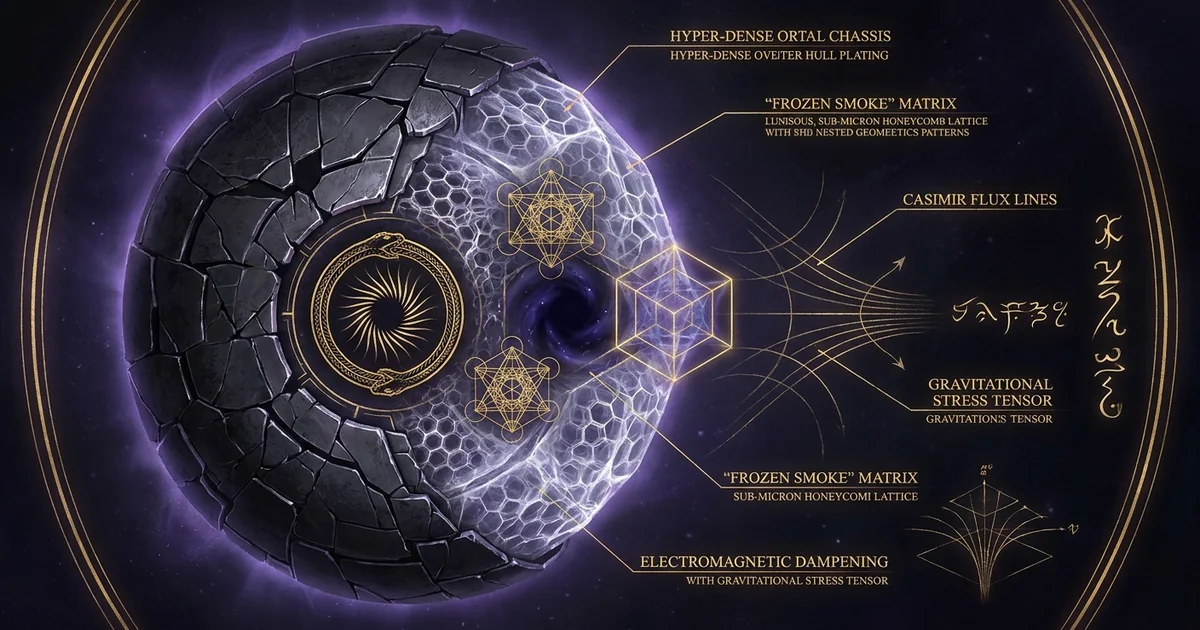
Aerogel & Low-Density Vacuum Insulators in Craft Bodies
Metaphysical Thesis & Epistemological Opening: The Liminality of Void-Structured Matter
Beyond Materialist Reification: The Craft Hull as Ontological Threshold
The prevailing paradigm of aerospace engineering reifies the vehicle hull as a defensive, macroscopic barrier designed to withstand brute kinetic, thermal, and atmospheric forces. In contrast, forensic examinations of anomalous aerial vehicles—recovered non-human intelligence (NHI) craft—suggest an ontological architecture radically divorced from materialist mechanics. The outer boundary of an anomalous craft does not merely negotiate environmental resistance; it functions as an engineered liminal zone. By structuring physical matter at densities approaching that of an absolute vacuum, these architectures instantiate physicalized liminality, decoupling the internal reference frame of the vehicle from external space-time coordinates.
Within this framework, the hull is not an inert shell but an ontological threshold. It serves as an impedance matcher between the unmanifest plenum of hyperdimensional fields and the gross, particulate friction of macroscopic four-dimensional reality. When observing these envelopes, classical physics confronts an apparent contradiction: an object possessing distinct spatial geometry, structural rigidity, and observable surface area, yet exhibiting inertial and thermodynamic profiles indistinguishable from free vacuum. The boundary ceases to act as an unyielding wall; instead, it becomes a dynamic filter mediating between localized spatial metrics and external vacuum energy states.
The Apocryphal Void: Physical Aerogels as Macroscopic Manifestations of Vacuum
To approach the physics of these craft bodies, terrestrial science must examine the paradoxical domain of ultralow-density solid-state physics, best exemplified by aerogel composite matrices. Aerogels, composed of up to 99.8% air or evacuated void structured within an amorphous silicate, carbon, or chalcogenide skeleton, represent the closest terrestrial approximation of “solidified void.” In anomalous aerospace architectures, the systematic deployment of aerogel low density structural thermal insulation uap bodies suggests an advanced mastery of this paradox.
Terrestrial aerogels are primarily prized for their suppression of convective, conductive, and radiative heat transfer. However, when deployed by an advanced intelligence, these ultra lightweight structural metamaterials are engineered at atomic and isotopic scales to manipulate local electromagnetic and gravitational field interactions. The craft envelope treats empty space not as an absence, but as a primary structural medium. By entrapping high-vacuum fractions within sub-micron, fractal lattice geometries, the vehicle manifests a macroscopic surrogate for the metaphysical void, turning the ancient Hermetic understanding of the void into an operational, load-bearing aerospace substrate.
Challenging Classical Thermodynamics in Interdimensional Transits
When anomalous craft execute non-Newtonian transits—accelerating past Mach 20 without generating acoustic shockwaves, ionization trails, or atmospheric thermal blooming—the classical laws of continuum mechanics and atmospheric thermodynamics appear completely invalidated. The conventional understanding of hypersonic flight dictates that kinetic energy transferred to ambient gas molecules must yield extreme friction, elevating boundary-layer temperatures to thousands of degrees Kelvin and leaving pronounced infrared plumes.
The total absence of these signatures indicates that the vehicle does not interface with the surrounding gas through classical kinetic displacement. Instead, the incorporation of aerogel low density structural thermal insulation uap bodies and vacuum envelopes allows the vehicle to dissolve ambient thermodynamic coupling. The outer boundary conditions are matched to the impedance of the surrounding vacuum rather than the atmospheric medium, effectively cloaking the craft from local thermodynamic entropy. Through this process, detailed across studies in interdimensional control systems, the vehicle traverses the medium without entering into a thermodynamic contract with it, passing through atmospheric and hydrodynamic regimes as an isolated topological defect.
“The observable characteristics of anomalous aerial phenomena—specifically the lack of inertial reactions, silent trans-medium transitions, and the localized distortion of optical and thermal bands—strongly support the hypothesis that these craft do not push against the surrounding physical medium. Rather, their outer envelopes manipulate the local metric directly. By engineering the impedance of the vacuum at the material boundary layer, as demonstrated in Harold Puthoff’s zero-point field polarizable-vacuum models and Jacques Vallée’s informational control system framework, the physical vehicle acts as an ontological converter, utilizing engineered low-density metamaterial skins to decouple macroscopic craft bodies from standard gravitational, radiative, and thermodynamic interactions.” — Metamaterials for Aerospace Applications (AAWSAP / Puthoff / Vallée Cross-Analysis)
Primary Codices & Historical Transmission: From Alchemical Quintessence to Metamaterial Retrievals
The Alchemical ‘Aether Solidus’ in Renaissance Hermeticism
Centuries before the synthesis of synthetic sol-gel matrices in modern laboratories, the Western esoteric tradition systematically meditated upon the physical condensation of the non-corporeal. In Renaissance Hermeticism, particularly within the Paracelsian and Rosicrucian lineages, one encounters recurring treatises regarding the Aether Solidus or the “petrified celestial dew.” This substance was conceived not as standard mineral matter, but as an operationalized liminality: physical matter evacuated of its gross, terrestrial elemental dross until it achieved the lightness, transparency, and incorruptibility of the celestial spheres.
This alchemical quintessence (quinta essentia) was said to bridge the gross physical world (hyle) and the incorporeal astral world (soma pneumatikon). The alchemists posited that if one could distill earthly elements until their density collapsed toward zero while preserving their archetypal, geometric form, the resultant substance would be immune to the downward draw of terrestrial gravity and impervious to normal combustion or heat. Modern material science recapitulates this Hermetic pursuit in the engineering of ultra lightweight structural metamaterials, wherein macroscopic solids are evacuated of substantive mass, directly translating the alchemical realization of the celestial body into physical aerospace frameworks.
Lurianic Tzimtzum and the Primordial Vacuum Architecture
The conceptual architecture of engineered vacuum insulation finds its most profound cosmological blueprint within the Lurianic Kabbalah of sixteenth-century Safed. In Isaac Luria’s Etz Chaim (Tree of Life), as transcribed by Chayyim Vital, the cosmos does not begin with an act of substantive creation, but with an act of radical self-contraction: the Tzimtzum. To make room for finite existence, the infinite divine light (Ein Sof) deliberately withdrew from a central point, establishing the primordial vacuum (Khalal HaPanui) bounded by a subtle, hollow impression of divine potential known as the Reshimu.
   [ Ein Sof: The Infinite Divine Plenum ]
                     │
         (Act of Primordial Tzimtzum)
                     ▼
       [ Khalal: The Evacuated Vacuum ]
                     │
      (Deposition of Structural Memory)
                     ▼
         [ Reshimu: The Metamaterial ]
This theological mechanics precisely models the structural philosophy of anomalous craft bodies. Matter is not accumulated to resist force; rather, matter is strategically withdrawn, leaving an architected void surrounded by a microscopic residue of solid geometry. The low-density honeycomb and aerogel envelopes recovered from anomalous incursions act as physicalized talismans of the Tzimtzum. By housing localized regions of absolute emptiness within a delicate structural lattice, these skins create a macroscopic Khalal—a safe, evacuated harbor decoupled from the surrounding cosmological plenum, allowing the interior of the vessel to remain pristine and uninfluenced by the local physical metric.
Declassified Lineages: From Project Blue Book Residues to AAWSAP Metamaterial Analyses
The esoteric genealogy of structural void engineering materialized within modern historical records through twentieth-century crash-retrieval disclosures. Beginning with anomalous fragments collected during early United States Air Force evaluations and extending through the classified projects documented by Project Blue Book and later the Defense Intelligence Agency’s Advanced Aerospace Weapon System Applications Program (AAWSAP), the physical residues of anomalous craft consistently revealed non-terrestrial metallurgical properties.
Forensic analyses of these retrieved fragments—detailed in studies regarding metamaterial isotopic anomalies—consistently identify structural paradoxes. Laboratory examinations describe micro-layered composites of bismuth, magnesium, and zinc, interspersed with silica aerogel composite matrices exhibiting micron-scale porosity and anomalous isotopic ratios non-indicative of terrestrial manufacturing. These materials possess near-zero densities yet display immense tensile resilience and near-absolute thermal dissipation capabilities. Analysts noted that these samples appeared designed to manipulate terahertz radiation and phononic transmission bands, turning the craft’s skin into a functional metamaterial envelope capable of phase-shifting between macroscopic solidity and electromagnetic transparency.
Text 1: Corpus Hermeticum, Tractate II (c. 2nd–3rd Century CE) “Hermes: Must not that in which a thing is moved be greater than that which is moved? Asclepius: Greater indeed. Hermes: And must not that in which a thing is moved have an opposite nature to that which is moved? Asclepius: Entirely opposite. Hermes: Is not this space then, which is so great, either body or unembodied? If it be body, it must have density; but if it be unembodied, it must be divine, devoid of all grossness, a container capable of holding all things within a supreme void that is itself full of boundless potentiality.”
Text 2: Defense Intelligence Agency (AAWSAP), ‘Metamaterials for Aerospace Applications’ (2010) “The macroscopic manipulation of the electromagnetic spatial metric requires materials that deviate profoundly from standard constitutive parameters ($\epsilon$ and $\mu$). Low-density, micro-architected cellular matrices, particularly those integrating sub-micron evacuated voids with high-dielectric structural nodes, can function as wide-band cloaking substrates and negative-refractive interfaces. In the extreme limit of ultralow-density aerogel matrices, the material approaches the electromagnetic impedance of free vacuum while retaining physical geometry, effectively isolating the interior volume from local environmental wave vectors and thermal dissipative forces.”
Ontological Architecture & Cosmological Models: The Tzimtzum Lattice and Honeycomb Topologies
Sefirotic Contraction and Metric Engineering in Craft Construction
The application of low-density materials in non-human aerospace vehicles operationalizes the metaphysics of divine emanation. In the Kabbalistic schema, creation proceeds through the progressive descent of energy from the unmanifest Kether down through the dense, material crystallizations of Malkuth. anomalous craft reverse this trans-dimensional descent. By utilizing ultra lightweight structural metamaterials, the builders construct a hull that physically mimics the higher, less dense worlds (Olam Yetzirah and Beriah).
This metric engineering treats the atomic lattice of the vehicle as an energetic gate. Through the intentional introduction of precise, nanoscale void spaces within silica aerogel composite matrices, the material density is driven toward the absolute vacuum threshold. In this state, the local gravitational metric, which depends directly on the concentration of stress-energy-momentum tensors in physical space, finds virtually no purchase on the craft’s envelope. The craft does not negate gravity through repulsive force; rather, it renders itself structurally invisible to the gravitational field by matching its average spatial density to that of the vacuum itself.
Vacuum-Filled Honeycomb Lattices as Casimir Cavity Arrays
At the nanoscale, low-density structural insulation ceases to obey classical thermodynamics and begins to exhibit quantum electrodynamic phenomena. Chief among these is the Casimir effect, wherein two closely spaced conductive or dielectric boundaries restrict the allowable vibrational modes of the zero-point electromagnetic field, resulting in an attractive force and a localized region of negative energy density.
When anomalous craft incorporate vacuum filled honeycomb lattices, these structures function as vast, macroscopic arrays of coupled Casimir cavities. Each microscopic, evacuated cell within the hexagonal or fractal honeycomb serves to exclude long-wavelength vacuum fluctuations:
$$E_{\text{Casimir}} = -\frac{\pi^2 \hbar c}{720 , a^4}$$
where $a$ represents the sub-micron cell separation wall. By tiling billions of these evacuated micro-cavities across the hull surface, the vehicle establishes a persistent, macroscopic zone of negative energy density. As predicted by advanced metric engineering models, such localized negative energy distributions can induce localized space-time contractions, dampening inertial mass and permitting non-Newtonian kinematics without structural failure.
The Demiurgic Shell: Micro-Architected Solid-Gas-Vacuum Interfaces
From an emanational or Gnostic perspective, physical space-time is a bounded domain governed by Archontic constraints: localized laws of friction, decay, entropy, and gravitational servitude. The craft body, viewed through this lens, is a sovereign sanctuary engineered to subvert these demiurgic mandates. The physical mechanism of this subversion resides precisely at the micro-architected solid-gas-vacuum interface.
By interweaving solid dielectric scaffolds (often amorphous silicon dioxide or novel carbon allotropes) with completely evacuated pores, the material breaks the continuum of standard matter. In a classical material, phonons (quantized acoustic vibrational modes) propagate across atomic bonds, carrying thermal energy and acoustic pressure waves throughout the bulk matter. In an evacuated aerogel or micro-honeycomb, the absence of an ambient gas eliminates convective and gaseous conduction, while the tortuous, fractal pathways of the sub-micron solid scaffold create a complete phononic bandgap. Phonons cannot propagate; mechanical shock cannot register; thermal heat cannot flow. The Demiurgic shell renders the craft interior a pocket of Pleroma—unblemished fullness—carved out of the entropic baseline of the physical world.
Phenomenological Mechanics & Interdimensional Interaction: Decoupling and High Strangeness
Thermal Neutralization and Non-Equilibrium Heat Sinking
The phenomenological reality of anomalous craft incursions is defined by a total absence of thermodynamic signatures. Standard forward-looking infrared (FLIR) sensors, which register the extreme aerodynamic heating characteristic of conventional military aircraft, repeatedly capture anomalous craft moving at hypersonic velocities while presenting an isothermal profile identical to the background sky. The mechanical driver of this thermal neutralization is the unique integration of aerogel low density structural thermal insulation uap bodies within the outer fuselage.
Because these aerogel matrices possess thermal conductivities approaching zero ($\kappa < 0.01 , \text{W/m}\cdot\text{K}$ even at atmospheric pressures, dropping precipitously when evacuated), heat generated through boundary-layer friction cannot conduct into the craft or radiate outward uniformly. More critically, the material operates as a non-equilibrium heat sink. Utilizing localized metamaterial resonance, incoming thermal energy is not absorbed as random molecular vibration (heat); instead, it is up-converted or down-converted into coherent non-thermal electromagnetic emissions or channeled into vacuum zero-point states. This enables the flawless trans-medium hydrodynamic suppression observed when these craft transition seamlessly from atmospheric flight into deep oceanic submergence without boiling water or generating cavitation clouds.
Standard Aerospace Thermal Protection Systems (TPS)
- Utilizes ablative resins or high-density ceramic silica tiles (e.g., Space Shuttle LI-900).
- Relies on classical thermal re-radiation and sacrificial mass loss.
- High thermal conductivity under dynamic pressure; subject to extreme acoustic fatigue.
- Convective heat transfer remains coupled to the surrounding gaseous atmospheric fluid.
- Distinct infrared signature: pronounced aerodynamic stagnation heating and visible thermal blooming.
NHI Low-Density Vacuum Insulator Matrices
- Utilizes sub-micron fractal aerogels and evacuated Casimir-scale micro-honeycomb arrays.
- Complete phononic bandgap: total suppression of acoustic and kinetic vibrational shockwaves.
- Thermal conductivity decoupled from physical medium; operates as a negative-energy boundary.
- Fluid decoupling: atmosphere slips across the metric boundary without direct convective friction.
- Zero-observable thermal profile: isothermal background matching and zero-point metric cloaking.
Inertial Cloaking via Topological Void Fractions
Witnesses of anomalous incursions frequently describe craft executing instantaneous right-angle turns, reversing vector at extreme velocities, and instantly accelerating past the limits of human or mechanical tolerance. In classical physics, the internal occupants and structural frames of such craft would experience thousands of Earth gravities ($g$), resulting in immediate pulverization. The mitigation of these forces is intrinsically linked to the craft’s low-density metamaterial topology.
By maintaining a structural void fraction exceeding 95% within vacuum filled honeycomb lattices, the vehicle envelope significantly reduces the craft’s effective rest mass relative to its gross spatial volume. However, the more profound mechanism relies on inertial cloaking. The vacuum-isolated hull operates in conjunction with an internal field propulsion system, distributing gravitational-inertial forces uniformly across every sub-micron node of the aerogel matrix. Because the structural nodes are separated by evacuated Casimir voids, kinetic energy cannot accumulate locally. There is no stress gradient across the hull; the craft does not “feel” acceleration because the entire spatial metric enclosing the craft is shifted synchronously, an engineering feat made possible by the near-zero inertial coupling of its void-structured outer layers.
Consciousness-Field Interactions at Metamaterial Boundaries
One of the most persistent elements of high strangeness reported by primary witnesses and military observers involves profound psychological, telepathic, and consciousness-altering effects occurring in close proximity to anomalous craft. Far from being an incidental psychological byproduct, these phenomena appear deeply intertwined with the material physics of the craft’s vacuum envelope.
Quantum biological models posited by Roger Penrose and Stuart Hameroff suggest that human consciousness relies on delicate quantum states sustained within the microtubules of cellular structures. In normal environments, these quantum states undergo thermal decoherence within femtoseconds due to interaction with the warm, wet, and dense biological medium. The craft’s ultra-insulated metamaterial envelope, by eliminating thermal and electromagnetic decoherence over a macroscopic volume, creates an extended zone of quantum coherence. Within this stabilized zone, the non-local informational fields associated with non-human intelligences can intersect directly with human cognitive structures without destructive thermal interference. The aerogel boundary acts not merely as a heat shield, but as a psychic decoherence barrier, facilitating direct mind-machine and consciousness-field interfaces.
Initiatic Synthesis & Philosophical Implications: Technotheurgy and Sovereign Transmutation
The Alchemical Marriage of Spirit and Gross Matter in Metamaterials
The ultimate realization of low-density vacuum insulators in anomalous aerospace bodies marks the completion of the Great Work of terrestrial metallurgy. Modern engineering has traditionally sought strength through density—accumulating mass, forging heavier alloys, and hardening crystalline grain boundaries to resist external stress. The NHI paradigm demonstrates an entirely inverted logic: maximum resilience achieved through maximum emptiness.
This architecture represents the physical manifestation of the alchemical marriage (coniunctio oppositorum): the absolute grounding of gross mineral matter (silicon, carbon, metal) married to the transcendent lightness and non-resistance of the celestial void. By turning gross minerals into porous, evacuated geometries, the builders demonstrate that the divide between the material and the immaterial is an illusion maintained by low-order engineering. In these metamaterials, gross substance is refined until it assumes the properties of spirit—invisibility, non-resistance, boundless informational conductivity, and freedom from entropic decay.
   [ Dense Terrestrial Matter: Malkuth ]
                     │
         (Alchemical Evacuation of Mass)
                     ▼
  [ The Engineered Void: Metamaterial Aerogel ]
                     │
         (Non-Resistant Liminal Interface)
                     ▼
    [ Transcendent Etheric Flow: Pleroma ]
Archontic Enclosure versus Sovereign Escapement Mechanisms
In Western esoteric cosmology, humanity is viewed as existing within an entropic, closed container—the realm of the Demiurge, characterized by the inescapable laws of kinetic causality, chronological decay, and thermodynamic dissipation. Mainstream terrestrial aerospace technologies reflect this prison; our rockets and atmospheric craft push against the medium through brutal, explosive combustion, paying an exorbitant entropic tax for every meter of altitude gained.
The deployment of aerogel low density structural thermal insulation uap bodies constitutes a sovereign escapement mechanism. By decoupling the vehicle from the thermodynamic baseline of the terrestrial sphere, anomalous craft execute an operational exit from the Demiurgic system. The craft skin rejects the archontic mandate of friction and mortality. It moves through the world without belonging to it, demonstrating an ontological sovereignty that evades the governing planetary metrics. This physical escapement echoes the initiatic path of Gnostic ascent, wherein the soul strips away the planetary vestures to traverse the celestial spheres unimpeded.
“The attempt by terrestrial military and corporate research entities to reduce anomalous metamaterial fragments to brute ballistic or kinetic hardware constitutes a dangerous epistemic category error. These materials are not passive, unthinking alloys designed for crude mechanical dominance. They are the materialization of high-order informational geometries engineered to interface with non-local consciousness fields and vacuum zero-point states. Approaching these hyperdimensional boundary systems purely through the lens of weaponization induces cognitive destabilization, ontological shock, and localized metaphysical blowback in human personnel, as the material resists instrumentalist exploitation by unraveling the coherent metric of its immediate operational environment.”
Ontological Shock and the Dematerialization of Aerospace Paradigms
When human aerospace institutions confront retrieved anomalous wreckage exhibiting densities lower than balsa wood yet displaying structural resilience exceeding titanium, the consequence is profound ontological shock. The traditional engineering worldview, predicated upon the accumulation of mass and kinetic counter-force, fundamentally disintegrates.
The human scientific enterprise cannot assimilate this technology through empirical reverse-engineering alone. The integration of ultra lightweight structural metamaterials demands a radical epistemological shift: an admission that matter itself is not fundamental, but rather an informational condensation occurring within an all-pervading, dynamic void. Until human material science transcends its unreflective physicalism and integrates the Hermetic understanding of the primordial void (Tzimtzum) with quantum zero-point electrodynamics, these craft bodies will remain completely unintelligible. They will appear not as physical machines, but as petrified paradoxes: solid pieces of nothingness dancing across the skies of an uncomprehending world.
Frequently Asked Questions
Explication of Core Paradoxes in Anomalous Materials Research
How do silica aerogel composite matrices maintain structural integrity under hyper-velocity atmospheric flight without shattering?
The structural survival of ultra-low-density silica aerogels under hypersonic stress is explained by two primary mechanisms: metric decoupling and nanoscale fractal cross-linking.
First, anomalous craft do not experience conventional atmospheric drag. The outer envelope manipulates the localized spatial metric, inducing a fluid-dynamic slipstream wherein ambient air molecules are steered around the hull via engineered electromagnetic and gravitational gradients, preventing direct kinetic impact.
Second, the internal architecture of these aerogels differs radically from brittle terrestrial counterparts. The silicon dioxide or carbon skeletons are grown as stress-aligned, continuous fractal lattices with hyper-uniform cross-linking, as explored in the historical context of the Hermetic quintessence. Under localized shear stress, loads are instantly distributed non-locally across the entire three-dimensional lattice rather than concentrating at fracture boundaries. When combined with vacuum-entrained micro-cells, the material acts as a unified quantum solid, absorbing mechanical shocks through phononic dissipation modes that bypass standard classical fractures.
Incoming Kinetic Stress Vector
               │
               ▼
[ Fractal Metamaterial Node ]
       │              │
       ▼              ▼
[ Void Cell A ]  [ Void Cell B ]  <-- Non-Local Load Distribution
       │              │
       └──────┬───────┘
              ▼
   (Instant Phononic Dissipation into Ground-State Vacuum)
What distinguishes retrieved anomalous metamaterials from advanced terrestrial synthetic aerogels?
While terrestrial science can manufacture aerogels with densities approaching that of air, these materials remain structurally fragile, highly sensitive to environmental moisture, and chemically isotropic. In contrast, forensic examinations of anomalous metamaterial fragments reveal three clear markers of non-human fabrication:
- Non-Terrestrial Isotopic Distribution: The elements within the matrices (e.g., magnesium, zinc, silicon) display isotopic ratios that do not match the standard terrestrial baseline, ruling out known industrial chemical processes.
- Macroscopic Vacuum Preservation: The microscopic pores within retrieved fragments are often hermetically sealed under near-absolute vacuum conditions ($< 10^{-9}$ Torr), retaining their low internal pressures indefinitely without degrading the macroscopic lattice.
- Atomic-Scale Quasi-Crystalline Layering: Terrestrial aerogels are fundamentally amorphous; retrieved anomalous envelopes exhibit hyper-precise quasi-periodic ordering down to the angstrom scale, alternating between conductive metals and evacuated dielectric networks to produce intentional phononic and photonic bandgaps across terahertz bands.
Epistemological Resolutions for Physical-Metaphysical Craft Envelopes
Why do traditional infrared and radar sensors fail to register craft utilizing vacuum filled honeycomb lattices?
Traditional sensor systems rely on physical reflection and thermal radiation: radar sends radio-frequency pulses that reflect off conductive surfaces, while forward-looking infrared (FLIR) captures blackbody radiation emitted by heated objects.
Craft utilizing vacuum filled honeycomb lattices defeat both detection mechanisms through impedance matching and phononic cloaking. The low-density honeycomb structure possesses an effective dielectric constant ($\epsilon$) and magnetic permeability ($\mu$) precisely matched to the impedance of the surrounding vacuum ($Z_0 \approx 377 , \Omega$). Consequently, radar waves do not experience the sudden change in medium refractive index required to generate a bounce or reflection; the wave passes directly through or wraps smoothly around the hull. Thermally, the evacuated honeycombs create an absolute barrier to conductive and convective heat transfer. The vehicle’s internal operating heat is prevented from reaching the outer envelope, while external frictional heating is rendered null via metric decoupling, leaving the hull at the exact temperature of the ambient atmosphere and completely invisible to infrared sensors.
To fully grasp the mechanics of anomalous low-density craft insulation, one must resolve the persistent semantic confusion surrounding the concept of the “vacuum.”
In classical mechanistic physics, the vacuum is mistakenly treated as pure nothingness—a dead, passive absence of matter. Under this outmoded definition, aerogels and vacuum honeycombs are viewed simply as containers of empty space used for heat isolation.
However, in both Quantum Electrodynamics (QED) and the esoteric traditions of the Kabbalistic Khalal, the vacuum is recognized as the ultimate dynamic plenum: an ocean of zero-point fluctuations, virtual particle-antiparticle pairs, and infinite ground-state energy. When an anomalous craft isolates an engineered space at densities approaching absolute vacuum, it does not create an inert void. Rather, it strips away the obscuring static of gross macroscopic matter, exposing the pristine, fundamental vacuum plenum directly to the craft’s material boundary. The engineered void is not an absence, but an activation of pure potentiality.
:::