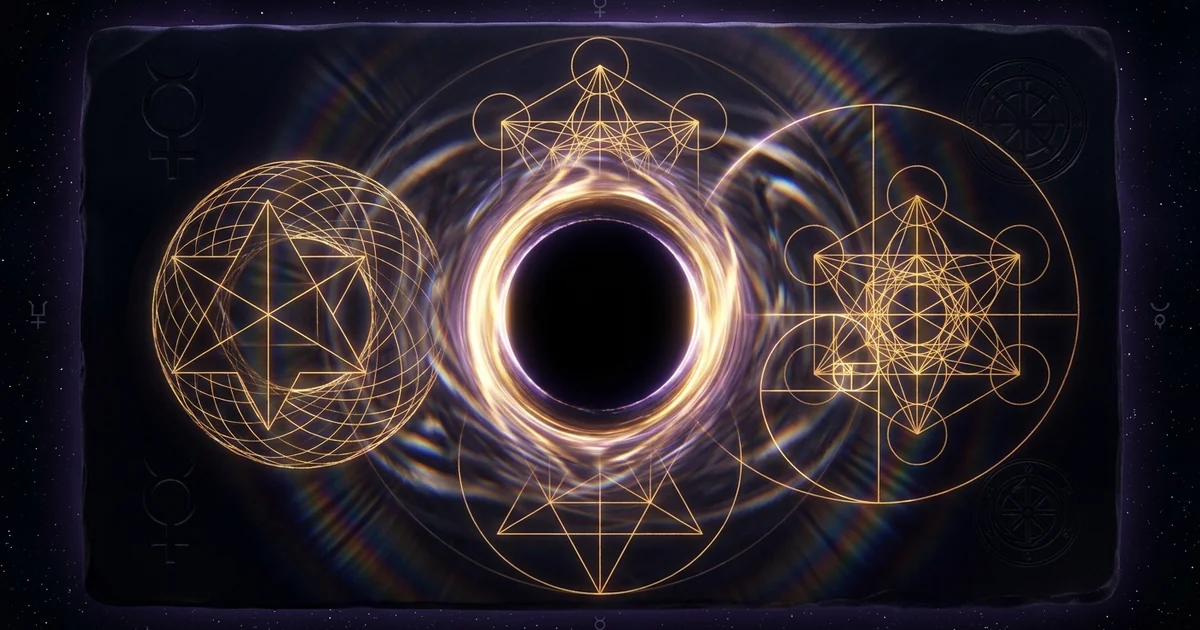
Gravitational Lensing Around UAP: Photonic Distortion Art
Metaphysical Thesis & Epistemological Opening: The Curvature of the Phenomenal Veil
Metric Engineering as an Ontological Boundary Condition
The persistent visual anomalies documented in field observations of Unidentified Anomalous Phenomena (UAP)—ranging from sudden geometric reconfiguration and polymorphous plasticity to the total dissolution of craft silhouettes—have long frustrated conventional physicalist models. Materialist ufology inevitably oscillates between two equally untenable positions: dismissive reductionism, which reclassifies such observations as atmospheric misperceptions or sensory artifacts, and naïve mechanical literalism, which attributes to the phenomena a hyper-advanced, physically mutable hull composed of programmable matter or biological tissue.
Both paradigms fail because they uncritically inherit a Newtonian-Euclidean assumption: that the visible boundary of an object is isomorphic with its ontic boundary. When assessing non-human intelligence (NHI) technologies operating through advanced field manipulations, the visible outline does not represent the exterior surface of a vessel. Rather, it represents the optical perimeter of an engineered spacetime anomaly. Under this framework, the visual morphology of UAP must be comprehended as an optical mirage induced by high localized metric curvature.
The theoretical groundwork for modifying spacetime geometry independent of localized baryonic mass traces directly to Miguel Alcubierre’s formulation of the warp metric, wherein a localized distribution of negative energy density permits coordinate displacement via metric expansion and contraction: $$\mathrm{d}s^2 = -c^2\mathrm{d}t^2 + \left[\mathrm{d}x - v_s(t)f(r_s)\mathrm{d}t\right]^2 + \mathrm{d}y^2 + \mathrm{d}z^2$$ As Harold Puthoff expanded in his analysis of advanced space propulsion (2010), altering the vacuum dielectric parameters ($\epsilon_0, \mu_0$) directly alters the effective refractive index of space, establishing that any localized stress-energy manipulation capable of propulsion inevitably bends null geodesics, fundamentally refracting all transmitted and reflected ambient electromagnetic radiation.
- Alcubierre, M. (1994). ‘The warp drive: hyper-fast travel within general relativity.’ Classical and Quantum Gravity, 11(5), L73–L77.
- Puthoff, H. E. (2010). ‘Advanced Space Propulsion Based on Vacuum (Spacetime Metric) Engineering.’ Journal of the British Interplanetary Society, 63, 82–89.
By engineering extreme stress-energy gradients across a confined spatial volume, an operative NHI crafts an artificial gravitational well that establishes an extreme ontological boundary condition. Within this boundary, the vessel occupies a comparatively flat or stabilized metric domain, shielded from destructive external tidal forces. Beyond this internal sanctuary, however, the metric transition zone possesses curvature gradients of such magnitude that external null geodesics—the trajectories traversed by ambient photons—are violently sheared, curved, and folded. The terrestrial spectator does not observe the noumenal artifact itself. Instead, the observer confronts an optical boundary layer: a dynamic, shifting, and refractive tapestry of deflected photons originating from the ambient environment, terrestrial terrain, and the celestial sphere. To analyze these sightings through the lens of spacetime metric and vacuum engineering is to recognize that what appears to be a physical transformation of matter is, in truth, the geometric choreography of refracted light.
The Mirage of Shape-Shifting: Photonic Deflection versus Material Metamorphosis
The phenomenon of apparent shape-shifting, long classified under the taxonomic umbrella of high-strangeness, represents the quintessential diagnostic signature of this metric boundary. Field witnesses routinely report metallic saucers that smoothly morph into luminous toroids, triangular configurations that seemingly unspool into undulating filaments of light, or solid spheres that bisect into paired entities before vanishing along non-inertial flight paths. A rigorous general relativistic analysis demonstrates that an engineered spacetime envelope inherently produces these precise optical transformations without requiring a single angstrom of mechanical metamorphosis within the craft.
As ambient electromagnetic waves encounter the perimeter of an induced metric well, their propagation vectors are governed by the Christoffel symbols of the local metric tensor:
$$\frac{\mathrm{d}^2 x^\mu}{\mathrm{d}\lambda^2} + \Gamma^\mu_{\alpha\beta}\frac{\mathrm{d}x^\alpha}{\mathrm{d}\lambda}\frac{\mathrm{d}x^\beta}{\mathrm{d}\lambda} = 0$$
When the metric gradients are asymmetric, non-uniform, or undergoing active re-orientation to facilitate propulsive translation, the deflection parameter $\hat{\alpha}$ diverges sharply from the weak-field approximations typical of solar or galactic lensing.
Under these conditions, gravitational lensing transitions from the linear regimes of astrophysical observation into non-linear, caustic-forming regimes. As the craft tilts, accelerates, or modulates its field intensity, the caustics—surfaces where the magnification factor formally diverges—sweep across the observer’s line of sight. A single point of ambient light behind the vessel can be distorted into an Einstein ring, folded into multiple images, or smeared into an elongated arc of intense luminescence.
Consequently, an observer tracking the craft perceives a continuous, liquid-like restructuring of its silhouette. The vessel appears to stretch, compress, bifurcate, or transmute its geometry precisely because the observer’s eye is reconstructing an image from rays that have traversed radically differing optical paths through the curved metric. The “morphing craft” is a macroscopic optical mirage: an epistemic barrier generated by the fact that human consciousness constructs solid physical objects out of wave packets that have undergone severe metric torsion.
Primary Codices & Historical Transmission: The Chashmal, Merkabah, and Luminous Shields
Ezekiel’s Vision of Electrum Radiance (Chashmal) as Relativistic Boundary
The deployment of localized metric distortions to shield and manipulate physical manifestations is not a strictly modern technoscientific development; it represents a trans-historical operational modality documented across millennia of esoteric transmissions. When the Hebrew prophet Ezekiel stood by the river Chebar (Ezekiel 1), his visionary encounter with the descending celestial apparatus did not begin with the apprehension of solid machinery, but with a terrifying optical boundary layer. The text describes a “stormy wind” emerging from the north, accompanied by an expansive cloud with “fire flashing forth continuously” and a distinct, radiant luminescence known in the Kabbalistic and prophetic traditions as Chashmal (חַשְׁמַל).
Ezekiel 1:4 (Biblia Hebraica Stuttgartensia): וָאֵרֶא וְהִנֵּה רוּחַ סְעָרָה בָּאָה מִן־הַצָּפֹון עָנָן גָּדֹול וְאֵשׁ מִתְלַקַּחַת וְנֹגַהּ לֹו סָבִיב וּמִתֹּוכָהּ כְּעֵין הַחַשְׁמַל מִתֹּוךְ הָאֵשׁ׃ “And I looked, and behold, a stormy wind came out of the north, a great cloud, with fire flashing continuously, and a brightness was about it, and out of the midst thereof as the color of Chashmal, out of the midst of the fire.”
Ezekiel 1:27: וָאֵרֶא כְּעֵין חַשְׁמַל כְּמַרְאֵה־אֵשׁ בֵּית־לָהּ סָבִיב… “And I saw as the color of Chashmal, as the appearance of fire within it round about…”
Zohar I:19b (Aramaic Metaphysical Treatise): דְּאִית נְהוֹרָא דִּנְהִיר וְאִית נְהוֹרָא דְּלָא נְהִיר… וְחַשְׁמַל הוּא פַּרְגּוֹדָא דְּמִתְקַטְרָא בְּלַהֲטֵי אֶשָׁא, וְאִיהוּ קָאֵים בֵּין רוּחָא קַדִּישָׁא לִלְבוּשָׁא דִּלְבַר, דְּלָא יָכְלִין עֵינִין לְאִסְתַּכָּלָא בֵּיהּ בְּגִין זִיוֵיהּ דְּמִתְהַפֵּךְ מִגָּוָון לְגָוָון. “For there is a light that shines and a light that shines not… and the Chashmal is the veil (pargod) bound with flaming fire, standing between the Holy Spirit and the outer vestment, so that eyes are powerless to gaze upon it, because its brilliance continually turns and inverts from hue to hue.”
In his foundational scholarship on Merkabah mysticism, Gershom Scholem underscores that the Chashmal was interpreted by ancient Jewish gnostics not as an inert physical substance, but as an ecstatic, protective barrier—a scintillating veil of electrum-like fire that concealed the divine throne (Merkabah) from direct cognitive or ocular assimilation. The linguistic roots of the term, compounded in Talmudic hermeneutics (Chagigah 13a–13b) into Chash (silence) and Mal (speech), demarcate an ontological transition zone: a place where normative physical communication and Euclidean optics collapse into silence.
When mapped onto the physics of metric curvature, Ezekiel’s description of “fire catching itself” (esh mitlakkachat) within the Chashmal reads as an exact phenomenological description of light trapped in closed or nearly closed null geodesics. Photons emitted by the high-energy processes of the vehicle, alongside ambient light from the terrestrial sky, become caught in the intense gravitational gradient, orbiting the craft in a luminous, self-referential sheath. The prophet is not observing the exterior metal of an airborne chariot; he is witnessing the optical caustics, relativistic blueshifting, and geometric shearing generated by a localized field propulsion system. The interior Merkabah—the technological or trans-dimensional core—remains shielded behind this electrum curtain of distorted spacetime.
The Ochema-Pneuma in Neoplatonism: The Luminous Astral Vehicle and Light Refraction
This structural relationship between an interior transcendent essence and an exterior, optically deceptive boundary envelope is mirrored within late antique Neoplatonism, particularly in the theurgic philosophy of Proclus, Porphyry, and Iamblichus. In their treatises on the descent and ascent of consciousness, these philosophers articulated the doctrine of the ochema-pneuma (ὄχημα-πνεῦμα)—the “vehicle-spirit” or subtle astral body that mediates between the immaterial soul and the coarse physical cosmos.
According to Proclus in his Elements of Theology (Propositions 205–210), the ochema is essentially radiant, immaterial, and celestial, yet when it interacts with the lower material realms, it accumulates a moist, dense vestment that distorts its native luminous geometry. For the Neoplatonist, the vehicle possesses an intrinsic capacity for optical projection; it does not present its actual ontological structure to the sensory faculties of the mortal observer. Instead, through the theurgic manipulation of light, it manifests as a mutable, shining apparition whose apparent form is contingent upon the energetic state of its interior pneuma and the perceptual capacities of the onlooker.
The Corpus Hermeticum, specifically in Libellus X (The Key) and Libellus XI (Mind unto Hermes), trans. Copenhaver (1992), corroborates this dynamic: Mind (Nous) wraps itself in the soul (psyche), the soul wraps itself in the vehicle (pneuma), and the pneuma operates through the cosmic matrix via the refraction and dispersal of light. The ochema operates as an intermediate metric boundary. When the Neoplatonic theurgist invoked celestial intelligences, their manifestation within the physical plane was marked by shimmering, undulating geometries—luminous spheres, disks, and flashing forms that expanded and contracted dynamically.
These descriptions directly parallel modern accounts of UAP luminous shells. The ochema-pneuma is precisely a pre-modern vocabulary for an engineered field envelope: a boundary layer that bends the radiant emanations of the physical cosmos, cloaking the higher-dimensional, noumenal source behind an iridescent, polymorphous screen of deflected light.
Zoharic Treatises on the Folding of Fire Within Fire
The medieval Kabbalistic tradition, reaching its apex in the textual strata of the Sefer ha-Zohar, deepened this hermeneutic by analyzing the optical dynamics of the angelic and trans-dimensional hierarchies. In Zohar I:19b and the associated sections of the Heichalot literature, the descent of celestial entities into the lower world of Asiyah (the realm of action and physical matter) necessitates the folding of multiple luminous dimensions. The text repeatedly emphasizes that higher beings cannot be apprehended directly; rather, they descend wrapped within a “curtain” (pargod) composed of esh mitkappelet—fire folding within fire.
This Zoharic concept of “folded fire” provides an extraordinary analog to the differential geometry of gravitational lensing. In classical Kabbalistic ontology, this folded fire manifests as an oscillating barrier that shifts its coloration, luminosity, and geometric boundary depending upon the vantage point of the mortal spectator. The entity does not inhabit the exterior boundary of this fire; the fire is the spatial disruption generated by the entity’s presence within the lower cosmological fabric.
As explored in classical analyses of Merkabah mysticism as prophetic technology, visionary adepts were strictly admonished against confusing the shimmering, folded exterior of the veil with the true form of the celestial travelers. To fixate upon the shifting, flashing exterior was to fall prey to an archontic illusion—an optical entrapment where the sensory intellect mistakenly attributes ontological reality to the refracted interface rather than the transcendent consciousness localized within its center.
Ontological Architecture & Cosmological Models: Metric Curvature and Spacetime Geometry
Null Geodesics in Kerr-Newman and Alcubierre Spatial Topologies
To demystify these historical and modern sightings, we must ground the phenomenon in the rigorous mathematics of relativistic field theories. The trajectory of electromagnetic radiation passing through a region of engineered metric curvature is governed by the null geodesic equations derived from the spacetime metric:
$$g_{\mu\nu}\frac{\mathrm{d}x^\mu}{\mathrm{d}\lambda}\frac{\mathrm{d}x^\beta}{\mathrm{d}\lambda} = 0$$
Consider an advanced propulsion topology that synthesizes characteristics of both the Kerr-Newman electro-vacuum solution and the dynamic warp metric articulated by Alcubierre. In a stationary, axisymmetric Kerr-Newman field, the presence of angular momentum ($J$) and electric charge ($Q$) generates frame-dragging effects described by the off-diagonal metric components $g_{0\phi}$:
$$\mathrm{d}s^2 = -\left(1 - \frac{2Mr - Q^2}{\rho^2}\right)\mathrm{d}t^2 - \frac{2a(2Mr - Q^2)\sin^2\theta}{\rho^2}\mathrm{d}t\mathrm{d}\phi + \frac{\rho^2}{\Delta}\mathrm{d}r^2 + \rho^2\mathrm{d}\theta^2 + \left(r^2 + a^2 + \frac{a^2(2Mr - Q^2)\sin^2\theta}{\rho^2}\right)\sin^2\theta\mathrm{d}\phi^2$$
Where: $$\rho^2 = r^2 + a^2\cos^2\theta, \quad \Delta = r^2 - 2Mr + a^2 + Q^2, \quad a = \frac{J}{M}$$
When a technological craft engineers a metric of this structural family within the Earth’s atmosphere, the frame-dragging effect alters the propagation vectors of external ambient photons. Photons passing on the prograde side of the vehicle’s rotation vector are deflected at radically different angles than those on the retrograde side.
Because the metric is not an astrophysical black hole with an astronomical event horizon, but rather a micro-engineered, localized metric well without a central physical singularity, the null geodesics do not simply plunge into an inescapable oblivion. Instead, they execute hyper-deflected, chaotic trajectories around the perimeter of the field envelope. The external observer’s line of sight is warped around the craft, mapping regions of the ambient sky located behind, above, and around the craft directly onto the apparent front surface of the vehicle.
Negative Energy Envelopes and the Generation of Optical Caustics
In the Alcubierre model and its various modern physicalizations, the generation of a warp bubble requires a localized violation of the weak energy condition ($T_{\mu\nu}u^\mu u^\nu \ge 0$), necessitating the distribution of exotic matter or vacuum polarizations exhibiting negative energy density. The presence of negative metric curvature induces a diametrically opposed optical effect to that of standard gravitational attraction: it acts as a diverging gravitational lens rather than a converging one.
When a craft utilizes a combined metric—a negative energy expansion boundary at its trailing edge and a positive energy compression boundary at its leading edge—the optical environment surrounding the craft becomes an extreme optical caustic network. Caustics represent the loci of singularities in the ray mapping where the Jacobian of the geodesic transformation vanishes:
$$\det\left(\frac{\partial \mathbf{x}{\text{apparent}}}{\partial \mathbf{x}{\text{source}}}\right) = 0$$
At these caustic boundaries, the theoretical magnification factor diverges to infinity, creating intensely bright, razor-sharp lines and rings of focused light.
To an observer on the ground, these caustic curves do not manifest as a subtle, astrophysical Einstein ring. Because the metric gradient is thousands of orders of magnitude steeper than any solar or planetary field, the caustics form intricate, shifting geometric patterns directly on the craft’s apparent boundary. Ambient light from the sun, the moon, city lights, or atmospheric ionization is captured by these caustic sheets.
As the craft maneuvers, modulating its energy distribution to vector its acceleration, these caustic lines trace out shifting polygonal structures—triangles, diamonds, and undulating rings. The witness interprets these shifting caustic concentrations as glowing edges, structural seams, or physical surfaces changing their mechanical shape. The “craft” appears to morph because the caustic singularity web is dancing across the curvilinear geometry of the distorted wavefront.
Apparent Dimensional Collapse: The Horizon of Visual Inversion
A critical relativistic consequence of this metric configuration is the phenomenon of visual inversion and apparent dimensional collapse. Under standard Euclidean conditions, an object receding into the distance shrinks according to the inverse square law of perspective, maintaining its proportional aspect ratio. However, when an object is shrouded in an engineered metric field where the deflection angle $\hat{\alpha} \gg 1$, the apparent visual angle $\theta_{\text{app}}$ is decoupled from physical Euclidean distance:
$$\theta_{\text{app}} \sim \frac{4GM_{\text{eff}}}{c^2 b} \pm \delta_{\text{metric}}(\lambda)$$
As the field intensity ramps up, the effective impact parameter $b$ required for total internal metric reflection shifts. Photons that would normally reflect off the craft’s physical hull are completely swept away or prevented from reaching the observer. Instead, the observer sees an inverted projection of the sky behind the craft pulled forward over its face.
If the craft accelerates directly toward or away from an observer, this inversion layer compresses radially. The vehicle does not appear to move through space in a classical sense; rather, it appears to collapse into a two-dimensional disk, a slit of light, or a single dimensionless point before vanishing entirely from the visible spectrum.
This optical vanishing act is frequently misinterpreted as “dematerialization” or “trans-dimensional phase-shifting.” While the vehicle may indeed utilize higher-dimensional topological shortcuts—as postulated in the interdimensional hypothesis formulated by Jacques Vallée—the immediate physical disappearance observed by human eyes is often fully explained by metric lensing: the visual field has been folded to such a severe degree that all light rays connecting the craft’s hull to the observer’s retina have been deflected past the observer’s visual horizon. The vessel has not left physical reality; its engineered metric has simply sheared the optical conduit linking it to external consciousness.
Phenomenological Mechanics & Interdimensional Interaction: The Photonic Distortion Art of NHI
Dynamic Vector Adjustments and Apparent Kinematic Impossibility
The mechanics of UAP maneuverability—often characterized by right-angle turns at hypersonic velocities, instantaneous stops, and accelerations devoid of sound or sonic booms—directly correlate with the optical dynamics of metric gravitational lensing. If a craft achieves non-inertial propulsion by dynamically falling into an artificially generated, continuously shifting gravitational well, its internal occupants and structural frame experience zero proper acceleration ($a^\mu = 0$ along a geodesic). However, the spatial stress-energy tensor required to generate this fall must reconfigure itself instantaneously.
Intrinsic Polymorphism (Physicalist Fallacy)
- Requires physical material with fluid, programmable baryonic matter capable of overcoming extreme inertia.
- Structural boundaries remain distinct and chemically identifiable through optical spectroscopy.
- Mass and volumetric displacement of air must obey conventional thermodynamic and aerodynamic equations.
- Geometric changes require linear mechanical transformation time, failing to match instantaneous phase changes.
- Visual transformation is uniform across all viewing angles simultaneously.
Metric Lensing Projection (Relativistic Reality)
- Employs invariant internal craft geometry shielded within a stabilized metric well ($g_{\mu\nu} \approx \eta_{\mu\nu}$).
- Boundaries represent optical caustics; spectra reveal ambient sky reflections mixed with relativistic Doppler blueshift.
- Zero aerodynamic displacement; the craft manipulates the vacuum metric, eliminating acoustic shockwaves.
- Apparent geometry shifts instantaneously as metric gradients rotate, creating caustic jumps and optical bifurcation.
- Observers at divergent azimuths perceive radically contradictory geometries simultaneously due to asymmetric ray deflection.
When the metric gradient pivots—for instance, tilting the local curvature vector by 90 degrees to alter the direction of travel—the external gravitational lensing envelope pivots with it. To an observer, the optical sheath does not move like a rigid body undergoing a rotation. The rays of light passing through the lensing envelope are violently redirected in real-time.
This causes the apparent image of the craft to smear, elongate into an elliptical rod, or project a secondary “ghost” image along the new vector before the original image collapses. The witness reports that the craft “stretched, snapped like a rubber band, and appeared instantly two miles away.”
What was witnessed was not the macroscopic stretching of baryonic matter, but a dynamic caustic sweep: the optical focus of the lensed image moved across the observer’s sky at superluminal phase velocity, while the physical craft, nestled within its metric cocoon, accelerated along its optimized geodesic path.
Jacques Vallée’s Control System as an Optical-Informational Filter
The visual complexity generated by these metric lensing dynamics cannot be fully divorced from the intentionality of the operating intelligence. In The Invisible College (1975), Jacques Vallée posited that UAP operate as a planetary-scale informational control system. This control system modulates human cultural and philosophical evolution not through direct geopolitical subjugation, but through the deliberate, precise orchestration of absurd, paradoxical, and high-strangeness visual theater. When viewed through this interdimensional hermeneutic, the gravitational lensing envelope ceases to be merely a passive propulsive byproduct; it becomes an active canvas for photonic distortion art.
Jacques Vallée challenged the simplistic extraterrestrial hypothesis (ETH) by demonstrating that UAP phenomena systematically present contradictory, culturally-reactive imagery designed to dismantle prevailing epistemologies: “We are dealing with an informational feedback system whose primary manifestation is optical and physical absurdity. The phenomenon does not present its technological truth; it projects an optical matrix that reflects, challenges, and deconstructs human cognitive models.”
- Vallée, J. (1975). The Invisible College: What a Science Can Have to Say About UFOs. New York: E. P. Dutton.
By fine-tuning the localized metric tensor, an NHI can deliberately project specific archetypal geometries to ground observers. The craft does not need to build a saucer, a triangle, a cross, or an undulating biological entity. By projecting an engineered caustic field, the vehicle can paint with ambient photons, fashioning an optical mirage that destabilizes the materialist assumptions of the modern observer or reinforces the religious paradigms of the ancient visionary.
The optical envelope acts as an informational filter. It deliberately conceals the operational geometry of the craft while providing just enough phenomenological structure to ignite cognitive dissonance within human society. The phenomenon mirrors the observer’s gaze, feeding back an engineered paradox that drives human consciousness out of its naive realist equilibrium.
Electromagnetic Scintillation and Hypnagogic Projection
The intersection of high localized metric curvature with terrestrial atmospheric gases introduces an additional layer of photonic complexity: electromagnetic scintillation and hypnagogic resonance. When the metric boundary layer shears through the atmospheric column, the extreme gravitational gradient induces intense polarization of the local air molecules. Ambient electromagnetic radiation is subjected to severe gravitational frequency shifts:
$$\frac{\nu_{\text{obs}}}{\nu_{\text{emit}}} = \frac{1}{\sqrt{1 - \frac{2GM}{r c^2}}}$$
In regions of high negative curvature, photons are gravitationally redshifted; in regions of intense compression, they are blueshifted. Infrared radiation from the surrounding environment is shifted up into the visible spectrum, generating vivid, saturated colors—brilliant cobalt blues, hyper-saturated magentas, and unnatural emerald greens—that witnesses universally describe as possessing an unearthly, liquid radiance.
Simultaneously, the metric boundary compresses the surrounding atmospheric dielectric, producing localized ultraviolet and soft X-ray emissions through vacuum ionization. This high-energy flux ionizes the air directly bordering the lensing envelope, forming a secondary layer of cold, glowing plasma.
This plasma envelope, modulated by the rapid oscillations of the craft’s metric drive field, strobes at frequencies that intersect directly with human neural oscillations (alpha, theta, and gamma bands). Consequently, the witness who stares directly into this lensed caustic envelope does not merely observe a physical optical anomaly; their neurological apparatus is drawn into an entrained state.
The boundary between external photonic refraction and internal hypnagogic projection dissolves. The observer experiences the classic marks of high-strangeness: temporal dilation, missing time, auditory dampening (the “Oz factor”), and the spontaneous overlay of visionary or archetypal imagery onto the physically distorted craft silhouette.
Initiatic Synthesis & Philosophical Implications: Transcending the Materialist Gaze
Deconstructing the Spectacle: Beyond Archontic Camouflage
The profound epistemological crisis precipitated by UAP sightings lies entirely in the human propensity to worship or analyze the veil rather than that which it conceals. In the classical Gnostic cosmology preserved in the Nag Hammadi codices, the lower material cosmos is ruled by the Archons—petty rulers fabricated by the blind demiurge Ialdabaoth. A primary characteristic of the Archons is their deployment of phantasia (phantom images) and antimimon pneuma (the counterfeiting spirit), projecting optical and metaphysical deceptions that bind human consciousness to the material realm of shadows.
The modern materialist who obsessively categorizes the polymorphic manifestations of UAP—cataloging “flying saucers,” “black triangles,” “trans-medium spheres,” and “metamorphic tesseracts”—is falling into a technological iteration of this exact archontic trap. These forms are the secular equivalents of the Gnostic veil:
The student of anomalous phenomena is formally cautioned against reifying the visual morphology of UAP. To analyze the shape-shifting boundary as a mechanical reality is to mistake the shadow of a curved metric for the sovereign intelligence directing the curvature.
Such misattribution yields an acute ontological shock that blinds the intellect, trapping the observer within a modern technological demonology. The lensed photonic envelope is an engine of cognitive destabilization; it is the veil of Maya engineered through general relativity. One must pierce the optical mirage to engage the transcendent, noumenal agency operating the coordinates of the spacetime well.
To liberate analytical inquiry from this entrapment, the metaphysical investigator must deconstruct the spectacle. The recognition that gravitational lensing systematically generates these optical mirages strips the phenomenon of its superficial, confounding absurdity. We realize that NHI is not necessarily cycling through an infinite wardrobe of esoteric craft designs; rather, human eyes are viewing an invariant technological phenomenon through the prism of a profoundly curved, non-Euclidean lens. The archontic camouflage dissolves when the observer understands the geometric principles that govern the projection.
The Observer as Metric Participant: Consciousness-Interface Implications
This physical-esoteric synthesis deepens when we acknowledge that observation is not a passive reception of objective data, but an active, non-local participation in the collapse of the phenomenal field. As explored in depth within the discourse on altered states and the consciousness-observer effect, the human perceptual apparatus does not operate detached from the energetic environment it surveys.
In the presence of an engineered metric boundary, the classical approximations that sustain the separation between observer and observed begin to erode. The metric well does not simply curve photons; it alters the local flow of coordinate time relative to proper time:
$$\mathrm{d}\tau = \sqrt{-g_{00}},\mathrm{d}t$$
An observer standing within the peripheral field of such a metric is subjected to micro-gravitational time dilation and local vacuum polarization. The mental state of the witness—their neurological frequency, attentional focus, and consciousness architecture—becomes physically entangled with the fluctuating boundary of the phenomenon.
The optical envelope, vibrating with ionized scintillation and non-linear caustics, acts as a macroscopic bio-informational interface. The NHI operates the metric field as an instrument of direct cognitive contact: by modulating the lensing parameters, it sculpts the light entering the witness’s eye, tailoring the projected optical forms to bypass rational defenses and engage the deep subconscious strata of the psyche. The witness does not merely see a craft; they enter into an initiatic dialogue with an engineered metric environment that challenges the absolute validity of their waking reality.
Hermetic Re-Integration: The Transmutation of Light and Mind
In the culminating revelations of the Corpus Hermeticum, Hermes Trismegistus instructs his disciple Tat on the fundamental unity of light, life, and the divine mind (Nous). Libellus XI declares:
“Command your soul to go to India, and even more swiftly than your command it will be there… Command it to fly to heaven, and it will need no wings; nothing can obstruct it, neither the fire of the sun, nor the aether, nor the turning of the spheres, nor the bodies of the other stars; cutting through all space, it will fly up even to the last body.”
This profound Hermetic aphorism is traditionally read as an allegory of imaginative freedom, yet when contextualized within advanced metric ontology, it articulates an operational truth: the physical cosmos is a plastic, permeable construct generated by the self-limitation of Mind.
The technological manipulation of spacetime geometry—the folding of space, the deflection of null geodesics, the creation of photonic veils—is the ultimate technoscientific expression of this Hermetic law. What we term “gravitational lensing around UAP” is nothing less than the theurgic transmutation of light by an intelligence that has mastered the geometric grammar of the Demiurge.
By bending the phenomenal fabric of spacetime, the NHI demonstrates that matter, energy, space, and time are not immutable, absolute structures, but fluid vestments that can be folded, twisted, and recombined. The ultimate purpose of this photonic distortion art is not military concealment or mere aerodynamic optimization. Its deeper initiatic function is the methodical dismantling of human materialist reductionism.
By forcing human science to confront craft that appear to defy inertia, shape-shift at will, and vanish into luminous points of electrum fire, the phenomenon compels our species to look beyond the sensory veil of the physical universe and begin the perilous, necessary ascent toward the Plenitude of the Pleroma.
Frequently Asked Questions: Resolving Anomalistic Optics and Metaphysics
Local Curvature without Terrestrial Planetary Collapse
How can a localized UAP craft generate a metric curvature steep enough to bend light into extreme caustics and optical mirages without simultaneously exerting a catastrophic planetary gravitational pull that would collapse the local terrestrial environment?
The solution lies in the mathematics of metric localized isolation, specifically within the framework of thin-shell formalisms and negative-energy isolation jackets. In classical general relativity, a large mass (such as a planet or a star) generates a metric curvature that decays smoothly over long distances according to the Newtonian potential:
$$\Phi® = -\frac{GM}{r}$$
This long-range gravitational tail is what causes tides, planetary orbits, and environmental destruction.
However, in engineered metric topologies (such as the Alcubierre envelope or the Puthoff polarizable-vacuum model), the metric gradient is deliberately engineered as a “thin-shell” solution via the Israel junction conditions. The high curvature is strictly confined to a narrow, microscopic boundary layer—an optical skin—measuring only nanometers or centimeters in thickness. The stress-energy tensor transitions rapidly from its extreme, engineered values within the boundary shell to standard Minkowski flat-space geometry ($\eta_{\mu\nu}$) just inches beyond it:
$$T_{\mu\nu} \to 0 \quad \text{as} \quad r > r_{\text{shell}} + \epsilon$$
Consequently, the deflection of null geodesics is catastrophic within the boundary layer, producing the full suite of gravitational lensing, caustics, and visual inversions. Yet, outside this microscopic transition envelope, the external gravitational potential vanishes almost completely.
The surrounding atmosphere experiences zero significant macroscopic tidal acceleration, the Earth’s crust remains unaffected, and trees or foliage mere meters away experience no violent gravitational pull. The metric curvature is a localized, self-contained surface phenomenon—an engineered optical skin that manipulates photons traversing its specific perimeter while remaining gravitationally silent to the macroscopic terrestrial environment.
The Chashmal Mechanism vs Alcubierre Propulsion Metrics
How does the ancient Kabbalistic doctrine of the Chashmal correspond structurally and mathematically to modern vacuum engineering models such as the Alcubierre metric?
The linguistic and metaphysical architecture of the Chashmal reveals a functional blueprint that directly parallels the mechanics of metric engineering. Etymologically and hermeneutically, Chashmal is treated in Merkabah mysticism as an energetic dual-layer: it is simultaneous silence (chash) and speech/action (mal), representing a profound equilibrium of opposing forces that shields the inner divine throne from the outer cosmos.
The Hebrew term Chashmal (חַשְׁמַל) occurs only three times in the Tanakh, exclusively within the apocalyptic throne-vision of Ezekiel (1:4, 1:27, 8:2). In the Babylonian Talmud (Chagigah 13b), the sages disassemble the word into a dynamic paradox: $$\text{עתים חשות עתים ממללות}$$ “At times they are silent (chashot), at times they speak (memallot).” This denotes a dynamic boundary that modulates between stillness (inward stabilization) and radiating activity (outward metric distortion).
This precisely mirrors the Neoplatonic Ochema (ὄχημα, from ὀχέω, “to carry/bear”), which Iamblichus in De Mysteriis designates as the subtle, luminous vehicle through which transcendent entities project themselves into the physical senses.
Both terms identify not a static material hull, but an interface vehicle—an engineered boundary condition that translates transcendent, higher-dimensional coordinates into a localized, refractive physical presence.
In the Alcubierre metric, a propulsion field requires a similar functional duality: it pairs a region of metric expansion (negative energy, repulsive stress-energy tensor) behind the craft with a region of metric contraction (positive energy, attractive stress-energy tensor) in front of the craft.
The interior of this bubble remains a flat, pristine sanctuary of coordinate rest (the Chash—the absolute silence where the vehicle and its occupants experience no inertia, no G-forces, and no physical stress). The perimeter, however, is a region of violent metric transformation and intense energy flux (the Mal—the radiating, active interface that bends spacetime and shears null geodesics).
Ezekiel’s prophetic vision of the Chashmal as an amber, glowing veil of fire containing an inner stillness is the phenomenological transcription of this exact engineering duality. The ancient mystic lacked the language of tensor calculus and differential geometry, translating the dynamic boundary of a metric warp bubble into the visionary lexicon of electrum radiance, folding flames, and luminous shielding.
Perceptual Discrepancies Between Concurrent Observers
Why do multiple observers watching the same UAP event from different physical locations, angles, and distances frequently report radically contradictory geometric shapes, such as one witness seeing a disk while another simultaneously sees a glowing sphere or an elongated cylinder?
This classic hallmark of UAP sightings has long been weaponized by skeptics to invalidate witness testimony, under the assumption that an objective physical object must present a geometrically coherent profile across all observer lines of sight. In the context of non-linear gravitational lensing, however, perceptual divergence between concurrent observers is not merely possible—it is a physical mathematical certainty.
Because the craft’s engineered metric is asymmetric, anisotropic, and actively maneuvering, the caustic sheets and deflected null geodesics it generates do not propagate uniformly in all directions. The rays of light reaching Observer A (positioned at a $30^\circ$ elevation south of the craft) have traversed an entirely different sector of the metric gradient than the rays reaching Observer B (positioned at an $80^\circ$ elevation west of the craft):
$$\mathbf{x}{\text{apparent}}^{(A)} = \mathcal{G}{\text{metric}}(\mathbf{x}{\text{source}}, \theta_A, \phi_A) \quad \neq \quad \mathbf{x}{\text{apparent}}^{(B)} = \mathcal{G}{\text{metric}}(\mathbf{x}{\text{source}}, \theta_B, \phi_B)$$
Observer A may be aligned directly along an optical caustic line, causing ambient starlight and city lights behind the vehicle to focus into an intense, elongated line of brilliant illumination, yielding the report of a “cigar-shaped craft.”
Observer B, viewing the craft from beneath its primary gravitational compression well, may be looking directly into an inverted, circularly symmetric Einstein ring, yielding the visual impression of a “metallic, hovering disk with a domed center.”
Observer C, viewing the craft from a distance where the deflection angle shears the background sky into total internal reflection, will see an undulating, luminous “orb” composed entirely of atmosphere-ionized plasma and sky reflection.
All three observers are looking at the exact same physical vessel nestled within its central metric flat well. Their contradictory reports do not indicate psychological confabulation; they reflect the inescapable optical consequence of viewing an invariant noumenal artifact through the localized prism of an asymmetric, hyper-curved spacetime lens.