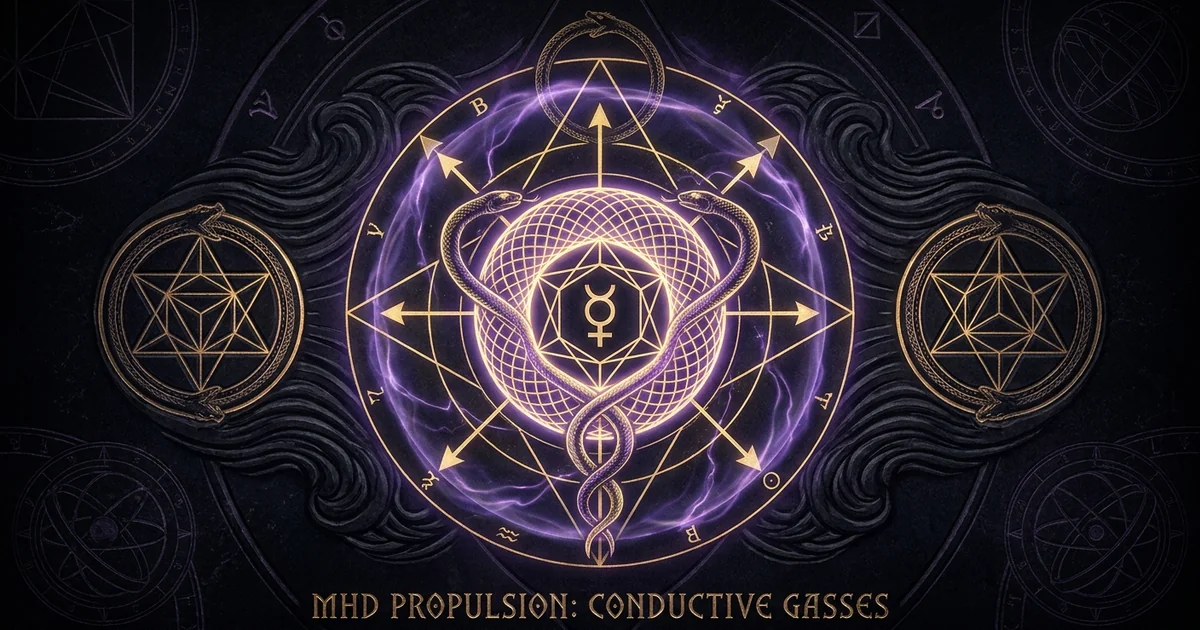
Magnetohydrodynamic MHD Propulsion in Conductive Gasses
Metaphysical Thesis & Epistemological Opening: The Plasma Sheath as Ontological Threshold
Trans-Medium Locomotion and the Demise of Purely Mechanical Aerodynamics
The observable kinetic behaviors of Unidentified Anomalous Phenomena (UAP)—characterized by abrupt, discontinuous accelerations exceeding hundreds of gravities, sharp ninety-degree turns executed at hypersonic velocities without observable turning radii, and silent transitions across air-water interfaces—irrevocably dismantle the mechanical paradigms of classical aerothermodynamics. In classical fluid mechanics, a solid vehicle navigating an atmospheric medium is irrevocably bound to the conservation of momentum and viscous dissipation defined by the Navier-Stokes equations:
$$\rho \left( \frac{\partial \mathbf{u}}{\partial t} + \mathbf{u} \cdot \nabla \mathbf{u} \right) = -\nabla p + \mu \nabla^2 \mathbf{u} + \mathbf{f}$$
Under standard macroscopic parameters, moving a physical body through air at hypersonic velocities inevitably generates compressible shock fronts, discontinuous stagnation pressures, extreme viscous aerodynamic heating, and acoustic detonations known as sonic booms.
The radical absence of these aerodynamic consequences indicates that anomalous craft do not interact with the atmosphere as inert macroscopic bodies colliding with passive gas molecules. Rather, these structures employ advanced boundary layer control via magnetohydrodynamic (MHD) interactions, wherein ambient air is violently ionized into a highly conductive, non-equilibrium plasma envelope.
By applying cross-field electromagnetic geometries—specifically through localized crossed electric ($\mathbf{E}$) and magnetic ($\mathbf{B}$) fields—the craft induces intense Lorentz force gas acceleration ($\mathbf{J} \times \mathbf{B}$) directly upon the ambient fluid. This forces the adjacent gaseous medium to flow smoothly around the hull, accelerating fluid packets synchronously with vehicle displacement. The vehicle does not cleave through the medium; it dynamically polarizes, conditions, and entrains the gas via active field propulsion and dielectric polarization. Classical aerodynamic surfaces (ailerons, rudders, elevons) and thermal expulsion plumes become completely obsolete when the surrounding atmosphere itself is commandeered as the primary reaction mass.
The Ionized Envelope as a Demiurgic Membrane
This luminous fluid interface operates on an ontological level far deeper than a mere propulsion mechanism; it serves as a demiurgic membrane. Within Gnostic cosmology, the demiurge constructs and regulates the material universe via strict archontic constraints—structural boundaries characterized by entropy, friction, inertia, and thermodynamic degradation. Solid mechanical crafts are subservient to this lower physical substrate, caught within the coarse drag of the material medium. Conversely, magnetohydrodynamic boundary layer control represents a deliberate intervention into the local electromagnetic constants of the surrounding vacuum-atmospheric matrix.
By utilizing pulsed microwave, high-voltage radiofrequency (RF), or soft X-ray emissions to seed cold, non-thermal ionization, the craft detaches itself from the ambient fluidic friction of the lower atmospheric plane. The cold plasma sheath functions as an active spatial threshold: within the vehicle’s local frame, standard thermodynamic equilibrium is suspended. The envelope actively decouples internal vehicle geometry from outer environmental stresses.
Through this lens, the plasma sheath is an alchemical furnace (athanor), transmuting inert, unorganized ambient gas into a coherent, highly structured magneto-active fluid that bends to the informational will of the field generator. The transition from solid-on-gas mechanical friction to electromagnetic fluidic integration mirrors the esoteric transfiguration of raw gross matter (prima materia) into spiritualized, compliant pneumatics.
Epistemic Rupture: Jacques Vallée’s Physical Signature Paradox
A persistent paradox confronts physical scientists investigating the anomalous behavior of UAP: the empirical measurements consistently oscillate between physical traces (ground radiation, microwave burns, soil calcination, magnetic anomalies) and non-local, psychophysical phenomena characterized by high-strangeness. Jacques Vallée posited that treating these encounters exclusively as incursions by hardware-based nuts-and-bolts craft hailing from standard three-dimensional planetary origins fails to address the paraphysical nature of the phenomenon. In the framework of the interdimensional hypothesis and the Vallée control system, the physical signatures are precisely calibrated byproducts of an informational control architecture that interfaces with human perceptual and cognitive structures.
“I propose the hypothesis that UFOs are physical manifestations of an intelligence that possesses an advanced knowledge of space, time, and the human mind… We are dealing with a control system that acts on human consciousness by utilizing a physical reality that can mimic our technological expectations while exceeding our underlying paradigm.” — Jacques F. Vallée, The Invisible College: Being What a Curious Man Would Find If He Looked into the UFO Phenomenon (1975)
The realization of magnetohydrodynamic mhd propulsion uap ionized air plasma airflow mechanics does not invalidate Vallée’s control system hypothesis; it corroborates it. The physical manifestation—a localized non-equilibrium plasma envelope engineered via Lorentz body forces—constitutes the precise macroscopic boundary where an informational, higher-dimensional architecture impinges upon physical spacetime.
The localized plasma discharge is the thermodynamic “footprint” of dimensional transduction. When an entity or apparatus shifts its informational coordinate state into the low-entropy substrate of the Earth’s lower atmosphere, it must reconcile its transit with the local dielectric, magnetic, and fluidic properties of the air. The induced magnetohydrodynamic field acceleration is the minimum required physical projection necessary to navigate dense atmospheric layers without tearing the local spacetime manifold. The glowing gas envelope acts as an epistemological screen, presenting an undeniable electromagnetic signature to military sensor networks while simultaneously operating as an active, deceptive mask.
Primary Codices & Historical Transmission: From Ezekiel’s Hashmal to Cold War Aerodynes
Exegesis of Hashmal: Glowing Electrum and Chariot Plasma in the Zohar
The empirical observation of self-luminous, aerodynamically unbound phenomena is not an invention of post-World War II military aviation. In early visionary codices, particularly the prophetic accounts of the Hebrew Bible and their subsequent mystical decodings in the Kabbalistic tradition, identical phenomenological signatures are chronicled with extraordinary structural precision. Central to this lineage is Ezekiel’s prophetic encounter by the River Chebar, wherein the visionary witnesses the descent of the divine vehicle—the Merkabah.
“And I looked, and, behold, a stormy wind came out of the north, a great cloud, with a fire flashing up, so that a brightness was round about it, and out of the midst thereof as the colour of electrum [Hashmal - חַשְׁמַל], out of the midst of the fire.” (Ezekiel 1:4)
Zohar, Parashat Bereshit / Chariot Commentary: “What is Hashmal? Rabbi Judah said: Living creatures speaking fire (Hayot esh memalelot). It is taught that the inner light is concealed within the amber luminescence; it is neither entirely physical fire nor invisible spirit, but the boundary garment wherein the descending glory clothes its operations within the dense wind of the lower world.”
In ancient Hebrew, the term Hashmal (חַשְׁמַל), translated in the Septuagint as elektron (amber or gleaming metal alloy), denotes a radiant, iridescent plasma-like substance. The Sefer Ha-Zohar identifies Hashmal as an angelic, energetic boundary layer that wraps the inner operations of the Merkabah mysticism and chariot ascension.
The Hashmal is an electrified, luminous sheath through which higher trans-dimensional directives interface with the terrestrial winds (Ruach Se’arah). The chariot shifts vectors instantly, without turning its physical geometry—“they turned not when they went; they went every one straight forward” (Ezekiel 1:9)—a mechanical behavior identical to omnidirectional, field-driven Lorentz force gas acceleration where physical rotational maneuvers are rendered irrelevant by dynamic topological field inversions.
Cold War Field Physics: Sakharov, Kantrowitz, and Petit’s Dissident MHD Studies
During the mid-twentieth century, the race for hypersonic superiority drove mainstream aerospace research to mirror these visionary archetypes. Physicists recognized that mechanical turbojets and chemical rocketry faced an absolute thermodynamic barrier: the stagnation enthalpy of hypersonic flight melts standard metals and creates unstable plasma sheaths that blind radar and communications.
Arthur Kantrowitz, at the Avco-Everett Research Laboratory, laid the foundations for hypersonic magnetohydrodynamics by evaluating high-temperature shock tubes and the properties of non-LTE (Local Thermodynamic Equilibrium) gases. Kantrowitz demonstrated that if ambient atmospheric gas could be artificially ionized ahead of an aerodynamic body, the resulting conductivity would allow magnetic fields to decelerate and redirect the fluid dynamically.
Simultaneously in the Soviet Union, Andrei Sakharov pioneered the conceptual framework of using high-power pulsed electromagnetic fields to manipulate hypervelocity gas dynamics, envisioning explosive magnetic flux compression generators to project massive Lorentz forces into fluid boundary layers.
However, it was the French astrophysicist and fluid dynamicist Jean-Pierre Petit who advanced the most comprehensive, scientifically rigorous public models directly analyzing the anomalous aerodyne geometries reminiscent of UAP sightings. Petit demonstrated that shock waves could be entirely eliminated in transonic and supersonic regimes using non-equilibrium magnetohydrodynamic fields:
$$\nabla p = \mathbf{J} \times \mathbf{B}$$
By establishing a radial electric field and an axial magnetic field over discoid or lenticular hulls, the induced Lorentz force accelerates gas around the stagnation zone, matching vehicle velocity to ambient flow and suppressing acoustic wave formation. Petit’s work, while marginalized by the French academic establishment, exposed how non-thermal plasma sheaths generated via surface-embedded multi-frequency RF electrodes cancel hydrodynamic turbulence and wave drag.
The Hermetic Principle of Pneumatic Dominion across Classical and Modern Paradigms
The historical transmission of “pneumatic propulsion” reveals a conceptual continuity linking ancient esoteric theurgy to field-effect engineering. In classical Hermetic and Stoic philosophy, the atmosphere is not empty void, but Pneuma—an active, breath-infused medium operating as the vehicle of cosmic soul (anima mundi). The ancient theurgist, working within the framework of Iamblichus or Proclus, operated upon the subtle body of the world by aligning symbolic vectors (synthemata) to command the flow of pneumatic currents.
In modern electrodynamics, this theurgic dominion is secularized yet structurally identical. The atmosphere is recognized not as an impassive obstacle, but as a sea of dormant ions waiting for electromagnetic re-polarization. By commanding the local conductivity ($\sigma$), permittivity ($\varepsilon$), and permeability ($\mu$) of the atmospheric medium, the craft enforces order onto chaotic gas molecules.
The vehicle commands the aer to open before it and close behind it through synchronized electromagnetic fields. This process transfigures the vehicle from an object suffering passive aerodynamic degradation into an active center of pneumatic dominion, projecting its field geometry outward to transform the thermodynamic state of ambient reality.
Ontological Architecture & Cosmological Models: The Magnetohydrodynamic Interface as Dimensional Transduction
The Pleroma and the Aer: Gnostic Fluidics of Lower Substrate Manifestation
To conceptualize how high-energy field propulsion interacts with physical space, it is necessary to map the transition across ontological strata. In classical Gnostic topology, reality is arranged in a descending hierarchy of emanative densities:
[ PLEROMA ]
       (Infinite Unbounded Energy /
     Pure Non-Local Informational State)
                  |
                  v
         [ KENOMA / HYLE ]
   (Physical Vacuum / Sub-quantum Zero-Point)
                  |
                  v
               [ AER ]
   (Macro-Atmosphere / Dense Molecular Gas)
The physical atmosphere (Aer) represents a highly fragmented, thermodynamically volatile domain governed by entropic friction, acoustic turbulence, and linear temporal decay.
When an anomalous vehicle operates, it executes a dimensional transduction: higher-dimensional order is injected into the chaotic molecular matrix of the lower atmosphere. The craft generates a localized zone of high coherent energy density that repels the disordered kinetic collisions of standard gas molecules.
The non-equilibrium magnetohydrodynamic envelope is the actual phase-boundary between the structured inner field of the craft and the dense entropic exterior of the material world. The craft does not touch the terrestrial Aer; it insulates itself within an engineered energetic halo, enforcing pleromic coherence upon the chaotic, demiurgic fluid medium.
Topological Field Inversion via High-Magnetic Field Atmospheric Drives
Achieving such radical fluidic dominion requires massive field intensities. A high-magnetic field atmospheric drive employs superconducting magnetic topologies capable of generating continuous or ultra-short-pulsed magnetic flux densities exceeding tens of Teslas. Under these extreme conditions, the craft modifies the magnetic Reynolds number ($R_m$) of the atmospheric boundary layer:
$$R_m = \mu_0 \sigma u L$$
Where $\mu_0$ is the vacuum permeability, $\sigma$ is the electrical conductivity of the gas, $u$ is the fluid velocity, and $L$ is the characteristic length scale. Under standard conditions, $R_m \ll 1$, meaning magnetic fields diffuse rapidly through air without exerting significant kinetic force.
However, by radically elevating electrical conductivity through non-equilibrium ionization (such that electron temperature $T_e \gg T_{ion}$), the craft drives the boundary layer into an $R_m \gg 1$ regime, effectively “freezing” the magnetic field lines into the plasma sheath according to Hannes Alfvén’s theorem of flux conservation:
$$\frac{\partial \mathbf{B}}{\partial t} = \nabla \times (\mathbf{u} \times \mathbf{B})$$
Through this magnetic freezing, topological field inversion becomes possible. By rapidly modulating the phase and vector direction of the field coils, the boundary layer plasma is propelled over the hull via the $\mathbf{J} \times \mathbf{B}$ vector cross-product.
The surrounding atmosphere is transformed into an electrodynamic conveyor belt, dynamically evacuated from the vehicle’s leading edge and accelerated into the wake, eliminating stagnation pressure and thermal friction.
Classical Mechanical / Turbine Aerodynamics
- Reaction Mass: Internal propellant or mechanical ingestion of ambient air compressed via turbomachinery.
- Sonic Signature: Generation of discontinuous acoustic shock fronts ($N$-waves); prominent supersonic sonic booms.
- Thermal Profile: Extreme aerothermal viscous stagnation heating; infrared signature scales exponentially with velocity ($\sim v^3$).
- Medium Interaction: Passive mechanical collision with air molecules; vulnerability to boundary layer separation, turbulence, and stall.
- Material Constraint: Rigid structural tolerance governed by mechanical shear stresses and aerodynamic drag coefficients ($C_d$).
Non-Equilibrium MHD Transduction Drives
- Reaction Mass: Volumetric body-force entrainment of ambient atmosphere converted locally into a conductive plasma.
- Sonic Signature: Shockwave annihilation via upstream electromagnetic field deceleration; silent supersonic locomotion.
- Thermal Profile: Non-LTE plasma sheath dampens thermal conduction; vehicle body remains thermally insulated via cold-electron fields.
- Medium Interaction: Active electromagnetic coupling; fluid boundary layer is entrained and directed, preventing turbulence.
- Material Constraint: Hull structure protected by magnetic cushion; mechanical stresses transferred to electromagnetic fields.
Phenomenological Mechanics & Interdimensional Interaction: Boundary Layer Control and Lorentz Force Dynamics
Mathematical Formulations of Lorentz Body Force in Non-Equilibrium Gases
The core physical mechanism enabling frictionless hyper-maneuverability is the volumetric Lorentz body force acting upon the non-equilibrium ionized gas layer. The generalized momentum equation governing this boundary layer incorporates the electromagnetic force density vector:
$$\rho \frac{D\mathbf{u}}{Dt} = -\nabla p + \mu \nabla^2 \mathbf{u} + \mathbf{J} \times \mathbf{B}$$
Where $\mathbf{J}$ is the current density vector through the gas, given by the generalized Ohm’s law for a partially ionized gas:
$$\mathbf{J} = \sigma \left( \mathbf{E} + \mathbf{u} \times \mathbf{B} \right) - \frac{\beta}{B} (\mathbf{J} \times \mathbf{B})$$
Here, $\beta = \omega_e \tau_e$ denotes the Hall parameter, with $\omega_e$ representing electron cyclotron frequency and $\tau_e$ the mean electron-neutral collision time. In low-density or high-magnetic field conditions, the Hall effect induces secondary current vectors perpendicular to both $\mathbf{E}$ and $\mathbf{B}$, generating electrothermal instabilities that degrade simple MHD systems.
To overcome this, advanced field-propulsion configurations deploy synchronized, high-frequency pulsed electric fields intersecting with spatially alternating magnetic fields. This cancels the negative operational impacts of the Hall effect and yields a unidirectional, forward-to-aft Lorentz force:
$$\mathbf{F}{MHD} = \int{V} (\mathbf{J} \times \mathbf{B}) , dV$$
Because this body force acts on every ionized particle within the boundary volume $V$, the gas is accelerated without mechanical displacement or macroscopic shear stresses. The gas molecules flow laminar over the hull, preventing the transition from laminar to turbulent flow.
Shockwave Annihilation via Radial Pressure Gradient Induction
In conventional supersonic flight, a shockwave forms when pressure disturbances cannot propagate upstream against the supersonic flow, culminating in a steep discontinuous jump in pressure, temperature, and density.
A field-driven MHD aerodyne alters this mechanic by projecting an electromagnetic force upstream from the physical hull. By ionizing the gas ahead of the craft via high-power microwave arrays or pulsed laser filaments, an active electromagnetic back-pressure gradient is established:
$$\nabla p_{induced} \approx - (\mathbf{J} \times \mathbf{B})$$
This electromagnetic force acts as a non-material cushion, progressively decelerating and deflecting incoming gas stream-tubes before they collide with the hull. The local Mach number is smoothly lowered in the vehicle’s reference frame:
$$M = \frac{u}{\sqrt{\gamma R T}}$$
By flattening the steep density gradient ($d\rho/dx \to 0$), the acoustic signature collapses completely. The shock front is replaced by a continuous, isentropic deceleration zone.
The vehicle bypasses the acoustic barrier silently, solving one of the most prominent observables recorded across decades of military sensor contacts.
This closed-loop system is inherently trans-medium. When transitioning from the atmosphere into liquid water, the craft adjusts its electromagnetic cross-field configurations. Liquid water, having a much higher density and natural conductivity (particularly saline seawater), requires the modulation of field frequencies to prevent excessive ohmic heating while scaling up the volumetric Lorentz body force:
$$\mathbf{F} \sim \sigma (\mathbf{E} + \mathbf{u} \times \mathbf{B}) \times \mathbf{B}$$
The craft creates a thin vapor/plasma supercavitating sheath via localized dielectric breakdown, accelerating water around the hull using the exact same $\mathbf{J} \times \mathbf{B}$ vector architecture, seamlessly transitioning from hypersonic atmospheric flight to high-speed underwater travel without kinetic impact.
Initiatic Synthesis & Philosophical Implications: Technosophia, Atmospheric Domination, and the Demiurgic Loom
The Weaponization of the Ether vs. Interdimensional Symbiosis
The historical trajectory of human aerospace engineering is an escalating assault upon the material substrate—a brute-force, thermodynamic conquering of the air. Internal combustion engines, jet turbines, and rocket nozzles burn chemical fuels, weaponizing expansive combustion to brute-force a vehicle through space by violently reacting against friction and gravity.
The discovery and reverse-engineering of non-equilibrium magnetohydrodynamic propulsion represents a fundamental branch-point in human technics.
It marks the threshold where crude material displacement yields to field-harmonic coordination, aligning human technology with the foundational laws of plasma cosmology and mythological petroglyphs.
[ THERMODYNAMIC BRUTE-FORCE ]
   Combustion --> Kinetic Thrust --> Material Friction
                    |
                    v (Initiatic Rupture)
                    |
          [ FIELD-HARMONIC COHERENCE ]
   Ionization --> Lorentz Dynamics --> Pneuma Integration
However, the military-industrial complex treats this transition purely as an operational upgrade in kinetic dominance. In attempting to harness high magnetic field atmospheric drives strictly for hypersonic strike craft and sensor-invisible reconnaissance, modern institutions remain trapped within the demiurgic paradigm: they seek to dominate the material loom of reality using its own lowest-level electromagnetic interactions.
Conversely, the Non-Human Intelligence (NHI) configurations utilizing these mechanisms demonstrate a state of interdimensional symbiosis. For such intelligences, the magnetohydrodynamic plasma envelope is not merely a propulsion mechanism, but an active boundary condition—a fluid transductive membrane where localized physical laws are held in suspense, permitting informational architectures to express themselves stably within physical spacetime.
Ontological Shock and Epistemological Hazards of Reverse-Engineering NHI Artifacts
The epistemological hazards associated with reverse-engineering recovered field-propulsion technologies stem from a fundamental mismatch of paradigms. When a reductionist scientific paradigm encounters an artifact whose operational principles depend on non-local coherence, the researchers suffer profound ontological shock.
The apparatus does not consist of separated, modular sub-assemblies (pumps, engines, exhausts, fuel lines); instead, the entire structural matrix of the vehicle acts simultaneously as the power source, the field coil, the waveguide, and the transductive antenna.
CONVENTIONAL AERODYNAMICS            NHI TRANSDUCTION FIELD
    +------------------------------+     +--------------------------+
    |  Engine  -->  Exhaust Plume  |     |   Unified Metamaterial   |
    |  Wings   -->  Mechanical Lift|     | Hull = Coil = Conductor  |
    |  Rudder  -->  Momentum Shift |     |  Boundary = Propulsion   |
    +------------------------------+     +--------------------------+
(Modular / Fragmented) (Holistic / Non-Local)Researchers and military personnel exposed to non-thermal plasma sheaths and ultra-intense localized electromagnetic fields produced by anomalous aerodynes exhibit high rates of neurovascular, psychological, and physiological degradation. The high-gradient microwave frequencies, non-ionizing radiofrequency fields, and continuous multi-Tesla magnetic flux alter human biological dielectric properties. These fields disrupt synaptic transmission, induce temporary or permanent temporal lobe dysregulation, and provoke intense psychophysical hallucinations that align precisely with ancient descriptions of “angelic dread” or demonic disorientation. Prolonged exposure without adequate quantum-informational and biological shielding inevitably fragments human psychological coherence.
These physiological and psychological disruptions demonstrate that the craft’s field interactions are not merely hydro-acoustic, but psycho-physical. Attempting to isolate the physical plasma envelope while ignoring the non-local pilot-craft neuro-informational interface fractures the epistemic foundation of the investigator. The machine demands a complete re-evaluation of the boundary separating mind from matter.
Technosophia: Integrating Hermetic Physics with Modern Electrodynamics
The resolution of this crisis requires the development of Technosophia—an intellectual and operational synthesis that reintegrates Hermetic physics with modern electrodynamics. In this unified ontology:
- Matter is slow, frozen energy;
- Energy is structured, localized information;
- Information is the primary emanative ground of reality.
Magnetohydrodynamics reveals itself as the physical mechanics of this hierarchy. By controlling the information state of the local electromagnetic vacuum (via potential field vectors $\mathbf{A}$ and $\phi$), the energy state is reshaped into intense $\mathbf{E}$ and $\mathbf{B}$ fields. These, in turn, orchestrate the behavior of gross physical matter—the conductive atmospheric gas—via the Lorentz force.
$$\text{Information} \xrightarrow{\quad} (\mathbf{A}, \phi) \xrightarrow{\quad} (\mathbf{E}, \mathbf{B}) \xrightarrow{\quad} (\mathbf{J} \times \mathbf{B}) \xrightarrow{\quad} \text{Pneumatic Dominion}$$
This realization completes the Hermetic circuit: That which is below is like that which is above, and that which is above is like that which is below, to perform the miracles of the one thing. The ancient Merkabah mystic climbing the celestial palaces and the advanced fluid dynamicist mapping Lorentz force shockwave cancellation are observing the identical architecture across different cultural prisms. The ionized gas envelope is the ultimate symbol of this synthesis: a blazing veil of Hashmal, bridging the physical air of the demiurgic world with the non-local light of the pleroma.
Frequently Asked Questions: Ontological, Aerothermodynamic, and Paraphysical Inquiries
Thermodynamic Efficiencies and Non-Equilibrium Plasma Regimes
Question: How can an anomalous craft sustain the colossal power densities required for continuous atmospheric ionization without suffering catastrophic thermal ablation or melting its own structural hull?
Analysis: The solution lies in the exploitation of non-equilibrium (cold) plasma regimes. In classical thermodynamic equilibrium (LTE), the electron temperature ($T_e$) and the ion/neutral gas temperature ($T_h$) are equal ($T_e \approx T_h$), which at ionization levels sufficient for MHD propulsion would translate into gas temperatures of $10,000 \text{ K}$ to $20,000 \text{ K}$—readily destroying any known macroscopic alloy.
         THERMAL EQUILIBRIUM (LTE)               NON-EQUILIBRIUM PLASMA (Non-LTE)
           [ Te ≈ Th ≈ 15,000 K ]                     [ Te >> Th ]
         (Thermal Destruction / Melt)         (Te ≈ 20,000 K  |  Th ≈ 300 K)
                                              (Cold Gas / High Conductivity)
However, by utilizing high-frequency, ultra-short sub-nanosecond electric pulses or pulsed microwave/soft X-ray ionizing beams, the vehicle achieves a non-LTE condition where:
$$T_e \gg T_h$$
The free electrons absorb nearly all the electromagnetic energy, achieving temperatures exceeding $20,000 \text{ K}$ (which provides the necessary electrical conductivity $\sigma$ of tens or hundreds of S/m), while the heavy neutral gas molecules and ions remain near ambient atmospheric temperatures ($T_h \approx 300 \text{ K}$).
Because the heavy atoms carry the kinetic thermal energy that causes physical melting, the hull remains cold. Furthermore, active boundary layer suction driven by the Lorentz force sweeps the energized electrons continuously downstream, converting the electromagnetic input directly into directional kinetic momentum rather than wasted thermal dissipation.
Interdimensional Transit vs. Terrestrial Gas Propulsion
Question: Does the demonstration of magnetohydrodynamic atmospheric propulsion prove that UAP are purely physical, nuts-and-bolts machines originating from technological civilizations within our standard spacetime continuum?
Analysis: It does not. This deduction represents a classical category error. Within Jacques Vallée’s informational control system framework, an interdimensional or trans-dimensional intelligence interfacing with our lower four-dimensional reality must project physical signatures that obey local conservation laws at the point of interface.
The physical appearance of an MHD plasma drive is the exact morphological state required when a higher-dimensional energetic structure intersects a dense fluid medium like the Earth’s atmosphere.
The ancient Greek Pneuma (πνεῦμα), the Sanskrit Prāna (प्राण), and the Hebrew Ruach (רוּחַ) unify three concepts modern materialism has artificially separated: wind/breath, dynamic physical energy, and spiritual consciousness.
In early Hellenic physics, Pneuma was conceived as a subtle material substance, a warm active air that permeated gross matter and imparted form, life, and locomotion to the cosmos.
When modern non-equilibrium aerothermodynamics ionizes the atmospheric gas—imbuing ordinary air with electromagnetic vectors, currents, and Lorentz force locomotion—it returns the fluid medium to the state of Pneuma: spirited, conductive, responsive gas capable of receiving dynamic informational structure.
If an anomalous craft navigated the Earth’s skies without interacting with the air via electromagnetic fields, the atmospheric gases would collide violently with its localized spacetime bubble, generating extreme friction and sonic booms that would destabilize its energetic coherence.
The magnetohydrodynamic mhd propulsion uap ionized air plasma airflow mechanism is the necessary physical transductive interface—the vehicle’s dynamic “handshake” with the lower-dimensional physics of our planetary atmosphere. The physical hardware observable by radar and thermal imaging is the material precipitate of an informational architecture operating from beyond the local spacetime manifold.
Luminescent Color Variations Across the Electromagnetic Spectrum
Question: Why do anomalous aerial craft exhibit distinct luminescent shifts—ranging from soft lavender and neon violet to brilliant orange, emerald green, and blinding white—during their flight maneuvers?
Analysis: The visible chromatic signatures emitted by the vehicle’s surrounding envelope are directly correlated to the specific ionization states and atomic emission spectra of the ambient gas, driven by the instantaneous power output, pulse repetition frequency, and field strength of the MHD drive:
[ SPECTRAL SHIFT SEQUENCE ]
 Low Power / Idle  --->  Moderate Velocity  --->  Extreme Acceleration
 (Lavender / Violet)         (Emerald / Red)              (Blinding White)
N2 Second Positive Atomic Oxygen Total Bremsstrahlung- Lavender to Neon-Violet / Soft Blue: At low power levels or during hovering maneuvers, the cold plasma envelope primarily excites the Second Positive System of molecular nitrogen ($N_2$) and the First Negative System of ionized nitrogen ($N_2^+$), which emit prominently in the ultraviolet and blue-violet regions of the spectrum ($337.1 \text{ nm}$ to $427.8 \text{ nm}$).
- Emerald Green to Fiery Orange-Red: As the craft demands higher Lorentz acceleration to execute sudden maneuvers, the field energy drives dissociation of ambient atmospheric molecules into atomic species ($N$ and $O$). The green emission corresponds to the forbidden auroral transition of atomic oxygen at $557.7 \text{ nm}$, while the intense amber-red luminescence arises from the First Positive System of $N_2$ and atomic oxygen emissions at $630.0 \text{ nm}$—the exact hue of Ezekiel’s Hashmal.
- Blinding Continuum White: Under maximum operational load or extreme localized field inversion, the electron density of the sheath surpasses the critical plasma cutoff frequency:
$$\omega_p = \sqrt{\frac{n_e e^2}{\varepsilon_0 m_e}}$$
At this threshold, the gas transitions into an optically thick, fully ionized plasma where electron-ion Bremsstrahlung (braking radiation) and high-density recombination produce a continuous blackbody spectrum that washes out individual spectral lines, emitting brilliant, blinding white light across the entire visible and near-ultraviolet spectrum. These visual manifestations are the direct chromatic readouts of dynamic magnetohydrodynamic boundary layer control.