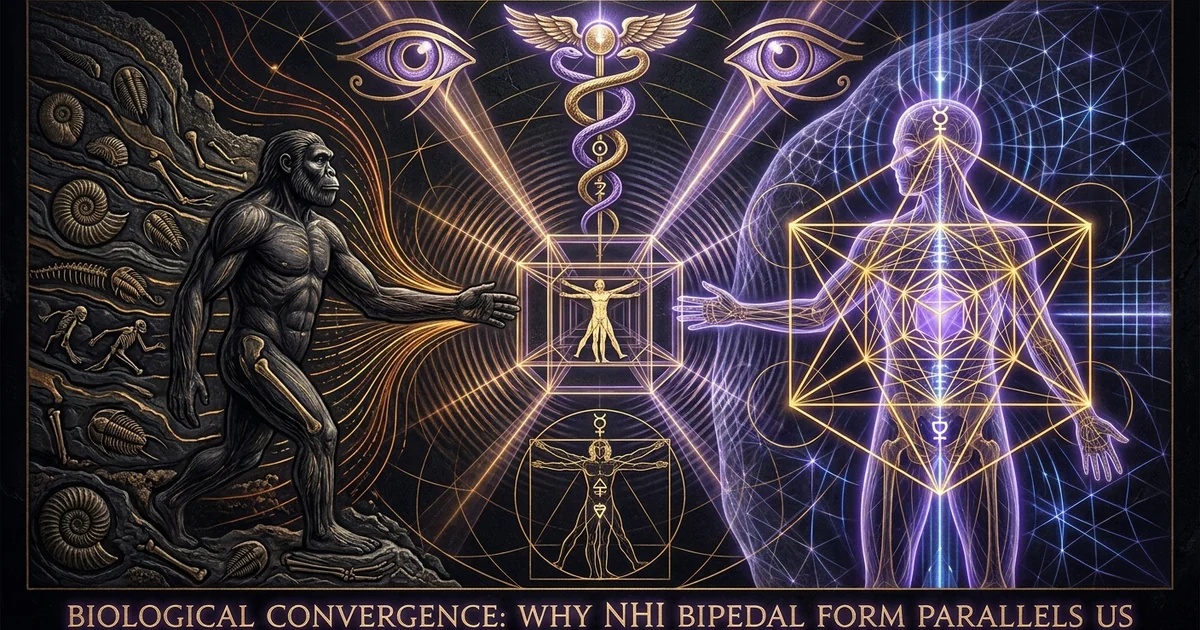
Biological Convergence: Why NHI Bipedal Form Parallels Us
Metaphysical Thesis & Epistemological Opening: The Morphological Invariant
The Anthropomorphic Fallacy vs. Radical Morphological Parity
Standard materialist astrobiology routinely dismisses the recurrent reporting of bipedal humanoid Non-Human Intelligence (NHI) as psychological projection, cognitive pareidolia, or cultural folklore. In this view, encounters documented in anomalistic literature—from twentieth-century close encounters to pre-modern folkloric visitations—simply reflect human observers casting external unknowns into their own anatomical mirror. This dismissive stance, however, fails to confront the statistical anomaly of invariant morphologies reported across historically and geographically isolated cohorts. Observers with zero exposure to Western media, ancient chroniclers recording encounters with luminous aerial entities, and modern technical observers consistently describe an operational morphology displaying bilateral symmetry, an upright bipedal carriage, a distinct cephalic region housing stereoscopic visual apparatus, and articulated manipulation appendages.
[ Universal Biophysical Constraints ]
                  (Gravity, Fluid Mechanics, Optics)
                                  │
                                  ▼
                     [ Morphic Attractor Basin ]
                   (Optimal Toolmaker Morphology)
                                  │
         ┌────────────────────────┴────────────────────────┐
         ▼                                                 ▼
[ Homo Sapiens ]                                  [ Non-Human Intelligence ]
(Terrestrial Branch)                             (Convergent / Interdimensional)
The epistemological refusal to investigate this morphology as an objective phenomenon functions as a psychological defense mechanism. By characterizing morphological parity as a cognitive hallucination, mainstream reductionism evades a profound disruption to its philosophical paradigm: the prospect that the human form is neither an evolutionary accident exclusive to Earth nor the uncontested summit of biological agency. The persistence of the upright bipedal morphology across thousands of global anomalous events requires either an unprecedented, trans-cultural mass psychopathology or the physical and trans-physical reality of convergent evolution humanoid bipedal form nhi simon conway morris frameworks within cosmic morphogenesis.
When stripped of cultural interpretation, the physical descriptions of NHI do not represent arbitrary fantasy. Human imagination, unconstrained by physics, reliably invents hydras, chimeras, amorphous polyps, and radially symmetrical monstrosities, as evidenced by world mythologies and speculative science fiction. Encounters with NHI, conversely, converge upon a conservative and functional anatomical schema: a compact, energy-efficient chassis optimized for locomotion, manipulation, and high-bandwidth environmental sensing. Dismissing this recurrent configuration as mere anthropocentric bias obscures a vital ontological clue regarding the structure of universal evolution.
Morphogenetic Attractors in Universal Evolutionary Landscapes
To comprehend why non-human entities mirror the human physical architecture, evolutionary biology must transcend the mid-twentieth-century dogma of radical contingency. Stephen Jay Gould famously asserted in Wonderful Life that if the tape of life were replayed from the Burgess Shale, the resulting fauna would be utterly unrecognizable, rendering humanity an unrepeatable, contingent accident. This view has been systematically dismantled by evolutionary paleobiologist Simon Conway Morris. In Life’s Solution: Inevitable Humans in a Lonely Universe, Conway Morris demonstrates that evolutionary pathways across cosmic time are channeled into narrow phenotypic corridors by fundamental biophysical constraints. Evolution is not an unconstrained walk across an infinite landscape; it is a rapid, inevitable descent into structural attractor basins.
These morphogenetic attractors are defined by the universal laws of physics and chemistry, as detailed by Charles S. Cockell in The Equations of Life: How Physics Shapes Evolution. Gravity, mechanical stress, thermodynamics, fluid dynamics, and optical wave mechanics govern biological systems on any planetary body capable of supporting complex organic chemistry. Hydrodynamics mandates that fast-swimming pelagic organisms—whether the extinct ichthyosaur, the modern shark, or the mammalian dolphin—converge upon an identical fusiform, streamlined geometry. Terrestrial optics mandates that eyes with crystalline focusing mechanisms evolve independently across multiple phylogenic lineages, including vertebrates, cephalopods, and cnidarians.
“Again and again we see that [evolutionary] convergence is ubiquitous… The number of evolutionary endpoints is very limited. The evolutionary routes are many, but the destinations are few. What is true for the camera eye of the octopus and the vertebrate, or the streamlining of the ichthyosaur and dolphin, is equally true for the evolution of intelligence and the physical machinery required to operate tools.” — Simon Conway Morris, Life’s Solution: Inevitable Humans in a Lonely Universe (Cambridge University Press, 2003, pp. 283–284).
By applying these principles of functional convergence to technological intelligence, the humanoid form emerges as an optimal terrestrial toolmaker morphology. Conway Morris establishes that if an organism is to achieve high-order abstract cognition and manipulate matter at a technological scale, it must fulfill rigorous anatomical prerequisites. It must inhabit a dry-land interface to harness combustion and metallurgy; it must free its anterior appendages from locomotive duties to facilitate micro-manipulation; and it must elevate its primary sensory arrays above the ground plane to expand its visual horizon. The humanoid configuration is not a terrestrial quirk; it is a universal biological solution to the thermodynamic and mechanical challenge of interacting with physical macro-reality.
Challenging Flat Materialism: The Anthropos as Cosmic Archetype
A purely mechanistic interpretation of evolutionary convergence remains incomplete without examining its metaphysical counterpart. If the humanoid bipedal form is a universal attractor, the physical morphology operates as a localized materialization of an antecedent morphic blueprint. This dynamic challenges the metaphysical commitments of flat materialism, which views organic life as an arbitrary, bottom-up assembly of lifeless matter. Integrating Conway Morris’s biological observations with esoteric philosophy reveals that physical evolution behaves as a teleological current drawn toward an archetypal form: the primordial Anthropos.
Within esoteric metaphysics, nature does not accidentally stumble upon the human silhouette through blind mutation; rather, matter is shaped by informational templates inherent to the cosmos. As explored in investigations into /consciousness/morphogenetic-fields-sheldrake-physics, morphic resonance and non-local informational fields provide the organizing substrates through which embryonic and phylogenetic structures navigate. The morphological parity shared between terrestrial humans and NHI points toward a shared resonance with an underlying morphogenetic field that transcends local planetary evolution.
This synthesis resolves the false dichotomy between materialist Darwinism and classical creationism. Evolution is fully operational, yet its channels are carved by cosmic geometry. Whether an intelligence emerges within our local biosphere, evolves upon an exoplanet orbiting a G-type star, or materializes via trans-dimensional phase shifts, its expression within physical spacetime converges toward the humanoid template. The Anthropos is not merely a biological classification for terrestrial primates; it is a primary cosmic archetype, an ontological geometry through which consciousness interacts with three-dimensional matter.
Primary Codices & Historical Transmission: The Archetypal Anthropos
The Hermetic Anthropos and Kabbalistic Adam Kadmon as Primal Templates
Long before empirical biology identified evolutionary convergence, classical Western esoteric lineages maintained that the human physical vessel reflects an archetypal cosmic progenitor. In the Alexandrian Hermetica—specifically Tractate I (Poimandres) and Tractate XI (Mind unto Hermes) of the Corpus Hermeticum—the creation of the universe involves the manifestation of the archetypal Anthropos. This entity is not an earthen biological organism, but a luminous, divine intelligence generated directly from the Mind of God (Nous). The Hermetic codices preserve an explicit metaphysics of morphology: the physical human form is a localized, lower-dimensional reflection of this celestial pattern.
“Now the Mind, the Father of all, being Life and Light, brought forth a Man like to Himself, whom He loved as His own child; for the Man was very fair, bearing the image of his Father… And the Man, having beheld in the water the form of the Beautiful, and having seen the shadow of it upon the earth, loved it, and willed to dwell there; and immediately with the will came the act, and he inhabited the form devoid of reason. And Nature, having received her beloved, embraced him wholly, and they mingled; for they were in love.” — Translated from A.D. Nock & A.-J. Festugière, Corpus Hermeticum, Tome I (Paris: Les Belles Lettres, 1946).
This Hermetic doctrine parallels the Lurianic Kabbalistic exposition of adam-kadmon (Primordial Man), analyzed extensively in Gershom Scholem’s On the Kabbalah and Its Symbolism. In Isaac Luria’s sixteenth-century Safed cosmology, the initial withdrawal of the infinite divine source (Tzimtzum) leaves a void into which the divine light projects in the form of Adam Kadmon. This figure is not a terrestrial hominid, but the primordial metaphysical structure through which the divine emanations (Sefirot) organize into dynamic equilibrium. Luria asserts that every biological human being born into the physical realm reflects the structural proportions, bilateral symmetry, and tripartite energetic divisions of this cosmic architecture.
          [ Ein Sof: The Absolute Infinite ]
                         │
                         ▼
        [ Contraction / Void: The Tzimtzum ]
                         │
                         ▼
      [ Adam Kadmon: The Primordial Archetype ]
        (Kether, Chokmah, Binah, Chesed, etc.)
                         │
                         ▼
 [ Terrestrial Flesh ] ◄───► [ Trans-Dimensional NHI ]
 (Localized Hominid)          (Archetypal Incursion)
Read through this framework, the humanoid morphologies reported across encounters with NHI are manifestations of this same structural blueprint. Entities navigating the cosmic hierarchy—whether descending from the spiritual realms (Pleroma) or traversing parallel dimensions—inevitably reflect the geometry of Adam Kadmon. Further metaphysical context on this bridge between celestial archetypes and physical forms can be found in /esoteric-cosmology/hermetic-anthropos-and-adam-kadmon. The human form is not exclusive property generated on Earth; it is a universal uniform embedded in the informational fabric of the cosmos.
Archontic Mimicry in Nag Hammadi Exegesis
While Hermetic and Kabbalistic texts celebrate the divine origin of the humanoid form, Gnostic codices discovered at Nag Hammadi expose a dark, operational counter-narrative concerning morphological imitation. In The Apocryphon of John (NHC II, 1), the creation of physical man is depicted as a calculated act of morphological mimicry executed by the Archons—the non-human planetary rulers subordinate to the blind demiurge, Yaldabaoth.
According to the Gnostic exegesis, the Archons lacked original creative power. When the luminous image of the heavenly Anthropos reflected downward from the Pleroma into the lower waters of chaos, the Archons were captivated by its proportions. Yaldabaoth commanded his subordinates to craft a material vehicle modeled precisely on this descending image:
“Let us create a man according to the image of God and according to our likeness, that his image may become a light for us.” — The Apocryphon of John (NHC II, 1: 15)
The Archons assembled a psychic and physical frame modeled upon the celestial archetype, seeking to trap the divine spark (pneuma) within an organic interface they could manipulate.
This Gnostic narrative offers a striking perspective on NHI encounters: non-material, archontic intelligences utilize the humanoid geometry as a functional interface. By adopting or engineering vehicles that reflect the Anthropos, non-human entities bridge the ontological gulf between dimensional realities. The morphological parity observed in encounters is not an index of shared planetary ancestry, but a calculated engineering effort. NHI operate through humanoid forms precisely because that geometry is the cosmic blueprint required to harness, mirror, and influence conscious observers.
From Daemonic Encounters to Modern Phenomenological Manifestations
The historical transmission of anomalous encounters shows an unbroken structural continuum. Long before the twentieth-century crystallization of the technological extraterrestrial mythos, historical encounters with non-human intelligences were recorded through the lenses of daemonology, fairy lore, and theurgic evocation. Across these diverse cultural settings, the fundamental structural morphology of the visitor remained invariant: an upright, bipedal agent displaying heightened facial emphasis, intense ocular focus, and articulate digital manipulation.
In Neoplatonic theurgy, as codified by Iamblichus in De Mysteriis, the apparitions of spirits, planetary daemons, and demigods followed strict morphological hierarchies. Entities proximate to the material world manifested in forms closely paralleling the human silhouette, whereas chaotic or lower sub-lunar entities appeared unstable, shifting, and grotesque. During the medieval and early modern periods, encounters with the Good Folk or subterranean fairies—documented by figures such as the Reverend Robert Kirk in his 1691 manuscript The Secret Commonwealth—detailed an elusive, intermediate race. These beings were bipedal, small-statured, possessed piercing gazes, and communicated telepathically, mirroring modern close encounter accounts.
This morphological stability reveals that the modern NHI phenomenon is not a novel artifact of the Space Age. Instead, anomalous intelligences utilize the bipedal humanoid framework as an interactive medium. Whether manifesting as a fourteenth-century sylph, an eighteenth-century daemonic visitant, or a contemporary Grey or Mantid operative, the bipedal template functions as a universal translator, providing a familiar physical interface to prevent catastrophic cognitive collapse in the human observer.
Ontological Architecture & Cosmological Models: Biomechanical Optimization and Morphic Basins
Biophysical Invariants: Stereoscopic Vision, Cephalization, and Manipulative Digits
A forensic examination of the reported NHI physique reveals a cohesive, functional biomechanical system. To interact with high-energy physical environments and create advanced tools, any sentient entity must satisfy strict biophysical imperatives. Terrestrial evolution demonstrates that technological manipulation requires three interdependent anatomical adaptations:
- Cephalization Proximate to Sensory Arrays: High-speed cognitive processing requires short synaptic path lengths. Housing the central neural hub in a cephalic node directly adjacent to primary sensory inputs (eyes, acoustic receptors, equilibrium organs) minimizes signal latency, allowing rapid real-time calculations.
- Stereoscopic Vision and Optics: Precision manufacturing and fine motor manipulation demand binocular depth perception. Eyes positioned forward on a single cephalic plane provide overlapping visual fields essential for calculating micro-distances.
- Opposable Digits and Appendicular Freedom: Bipedal balance liberates the upper limbs from the mechanical burden of body support. This allows the forelimbs to evolve into specialized manipulation instruments featuring opposable thumbs and tactile pads capable of fine motor control.
       [ Upright Bipedal Locomotion ]
                     │
                     ▼ (Liberates Anterior Appendages)
  [ Dexterous Manipulation: Opposable Digits ]
                     │
                     ▼ (Requires Real-Time Depth Calculation)
 [ Binocular Sensory Array: Stereoscopic Gaze ]
                     │
                     ▼ (Minimizes Neural Signal Latency)
   [ Cephalization: Compact Centralized Cranium ]
When close encounter literature is examined through this biomechanical lens, the morphology of typical NHI—such as the classic archetypes documented in anomalistic databases—proves to be hyper-optimized. Their enlarged cranial vaults, forward-facing stereoscopic eyes, narrow torsos, articulated fingers, and bipedal stride are not science-fiction caricatures; they represent an uncompromising suite of anatomical attributes. Any technologically capable agent operating within standard baryonic matter must converge upon this optimal terrestrial toolmaker morphology to manipulate its physical environment.
The Energy Landscape of Morphogenetic Attractor Basins
The evolution of physical form can be modeled as a trajectory across an energetic fitness landscape, an idea originally framed by C.H. Waddington as an “epigenetic landscape.” In this model, developmental and evolutionary pathways roll down branching valleys toward stable equilibrium points, known as attractor basins. The morphology of an organism represents an equilibrium state where physical laws, metabolic costs, and functional necessities reach dynamic stability.
Pure Materialist Convergence (Simon Conway Morris)
- Causality: Purely physical, bottom-up evolutionary optimization driven by universal environmental selection pressures.
- Morphological Origin: Biophysical constants (gravity, mechanics, optics) channel random mutations into predictable, inevitable functional phenotypes.
- Observer Interface: Physical biological lifeforms originating on distant exoplanets through independent, parallel abiogenesis.
- Key Limiting Factor: Assumes encounters represent physical space travel within standard relativistic spacetime constraints.
Informational & Esoteric Convergence (Vallée / Hermetic Anthropos)
- Causality: Top-down morphic projection interacting with an informational control system; physical form acts as a semiotic interface.
- Morphological Origin: The physical chassis is a localized instantiation of an archetypal template (Adam Kadmon / Anthropos) mediated by morphogenetic fields.
- Observer Interface: Multi-dimensional consciousness down-sampling into the human sensory band to calibrate cultural, spiritual, and biological evolution.
- Key Limiting Factor: Operates beyond flat materialism, utilizing high-strangeness mechanics and psycho-physical entanglement.
The humanoid form constitutes a profound attractor basin in the macro-scale universe. An organism that adopts four legs commits its forward limbs to weight-bearing, severely limiting fine tool manipulation. An organism relying on radial symmetry (like an echinoderm) lacks a directional axis, impeding forward locomotion and centralized vision. Conversely, bilateral bipedalism produces an optimal trade-off: efficient forward movement, a minimal ground-contact footprint, elevated panoramic sensing, and two unencumbered manipulation appendages. Evolution across the cosmos falls into this attractor basin because the laws of physics heavily penalize alternative arrangements for technological species.
The Interdimensional Control System as an Ontological Tuning Mechanism
While biophysical convergence accounts for mechanical efficiency, it does not fully explain the anomalous, dream-like quality that characterizes human-NHI encounters. In his 1975 monograph The Invisible College, computer scientist and astrophysicist Jacques Vallée introduced a groundbreaking framework: the anomalous phenomena are not simply visiting extraterrestrial travelers from distant star systems. Instead, they act as an informational control system—a meta-biological regulatory mechanism manipulating human consciousness and cultural evolution across millennia.
       [ Non-Local Source / Interdimensional NHI ]
                            │
                            ▼
      [ Valleean Control System: Semiotic Modulation ]
         (Generates Absurdist / Archetypal Mask)
                            │
                            ▼
     [ Space-Time Intrusion: Localized Down-Sampling ]
                            │
                            ▼
[ Human Perceptual Interface: Upright Humanoid Avatar ]
Within Vallée’s framework, the humanoid form serves an ontological function. The control system modulates its appearance depending on the cultural era, yet retains an underlying, uncanny bipedal template. This presentation functions as a semiotic mask. If the intelligence manifested as an entirely incomprehensible geometry—such as an unresolvable multi-dimensional hyper-shape—human observers would experience catastrophic cognitive shutdown, preventing meaningful interaction. Conversely, if it appeared entirely human, it would blend unnoticed into the background population.
The humanoid bipedal form struck by NHI balances familiar anatomy with profound biological alienness. The subtle variations—disproportionately large crania, elongated digits, absent nostrils, non-vocal mouths, and deep, unblinking eyes—produce an intense cognitive dissonance known in psychodynamics as high-strangeness. This morphological tuning bypasses conscious defenses, implanting transformative informational inputs directly into the human collective unconscious. Further semiotic analysis of this mechanism is explored in /nhi-phenomena/vallee-control-system-semiotics.
Phenomenological Mechanics & Interdimensional Interaction: The Semiotic Mask and Genetic Intersects
Jacques Vallée’s Thermostat: Humanoid Camouflage in High Strangeness Encounters
Vallée models the anomalous control system on a homeostatic feedback loop, like a biological thermostat. When human society drifts into rigid dogma—whether primitive superstition or arrogant scientific materialism—the phenomenon introduces calculated, paradoxical inputs that shake established assumptions, revitalizing cultural and philosophical development.
┌────────────────────────────────────────────────────────┐
│             Human Cultural Consensus Matrix             │
│        (Materialist Realism / Religious Orthodoxy)      │
└───────────────────────────┬────────────────────────────┘
                            │
                            ▼ (Exceeds Tolerance Limits)
┌────────────────────────────────────────────────────────┐
│         Control System Thermostat Intervention         │
│           (Injects Paradox & High Strangeness)         │
└───────────────────────────┬────────────────────────────┘
                            │
                            ▼
┌────────────────────────────────────────────────────────┐
│             Anomalous Humanoid Manifestation           │
│      (Semiotic Mask: Familiar Biped + Alien Details)    │
└───────────────────────────┬────────────────────────────┘
                            │
                            ▼ (Triggers Epistemic Crisis)
┌────────────────────────────────────────────────────────┐
│     Socio-Spiritual Re-Calibration & Paradigm Shift     │
└────────────────────────────────────────────────────────┘
The humanoid silhouette serves as an anchor in this process. During high-strangeness encounters, witnesses consistently describe an unsettling mixture of biological familiarity and physical impossibility. Entities are observed stepping effortlessly through solid walls, levitating without propulsion, or inducing instant paralytic states, all while maintaining an upright bipedal posture. The familiar body plan invites empathetic engagement, while their impossible physics shatters the witness’s mechanistic worldview. The humanoid appearance is not a transparent window into their ultimate native ecology; it is a calibrated avatar engineered for semiotic resonance within human neural architectures.
The Common Genetic Tree: Cryptoterrestrial Divergence vs. Pan-Spermic Morphogenesis
The morphological convergence between Homo sapiens and NHI raises radical hypotheses regarding biological lineage. If we reject pure interdimensional projection and take the physical traces recovered from close encounters seriously, we face three hypotheses regarding our shared genetic framework:
- The Cryptoterrestrial Hypothesis: NHI may not hail from distant stars or alternate dimensions, but represent relics from unrecorded evolutionary branches of our common genetic tree. A divergent hominid branch could have survived an ancient catastrophe, retreating into subterranean or deep oceanic ecosystems and advancing technologically in isolation. This hypothesis is explored further in /ancient-prehistory/antediluvian-hominid-divergence. If so, their shared anatomy—such as the bilateral skeletal structure and five-digit extremities—is phylogenetically conserved rather than purely convergent.
- Universal Panspermia and Shared Genomic Code: In this model, primitive biological code (DNA/RNA) is not unique to Earth, but seeded universally throughout the cosmos via interstellar comets and radiation pressure. Given identical genetic code and universal biophysical constraints, complex life on distant worlds follows familiar evolutionary channels. The humanoid body plan would thus represent the universal, inevitable expression of cosmic genetic programming.
- Directed Trans-Dimensional Seeding: Advanced non-human intelligences may have actively directed terrestrial hominid evolution, introducing specialized genetic changes into primitive primates to produce an anatomy compatible with higher-order consciousness. In this scenario, we do not parallel NHI by coincidence; rather, Homo sapiens is an engineered variant of a cosmic template.
Neural Transduction and the Projection of the Sensory Interface
To understand how an observer perceives an NHI entity, one must look closely at human perceptual neurobiology. The human visual cortex does not operate as a passive camera; it is an active engine of mathematical inference. It translates incoming electromagnetic radiation (photons within the narrow 400–700 nanometer band) into a coherent, three-dimensional spatial simulation. When an entity operating in higher-dimensional space-time interacts with local reality, human sensory apparatus cannot perceive the entity’s complete, unmediated geometry.
Instead, the human nervous system down-samples the high-dimensional informational field into an internally decipherable construct. This process operates as an interactive holographic projection. The non-local informational signature intersects the observer’s visual and neural processing arrays, forcing the brain to decode the trans-dimensional data stream into the most biologically coherent structure available: an upright biped with forward-facing sensory organs. In this light, the humanoid body plan is an interactive translation layer—a sensory interface synthesized at the intersection of non-human informational fields and the human cognitive apparatus.
Initiatic Synthesis & Philosophical Implications: Shattering Anthropocentrism
The Collapse of Biological Exceptionalism: Form Without Exclusivity
The recognition that the humanoid bipedal form is shared across independent cosmic intelligences dismantles human biological exceptionalism. Western philosophy, particularly since the Enlightenment, has anchored human uniqueness to our physical and mental status as the sole conscious toolmakers in the known universe. We presumed that our anatomy was uniquely ours—the contingent result of terrestrial savannah environments, arboreal brachiation, and accidental tool development.
Recognizing our morphological archetype as a universal invariant rather than our exclusive biological property demands a revision of human ontological status within the cosmic hierarchy. The bipedal humanoid framework is not the exclusive property of Earth; it is a universal uniform worn by conscious technological intelligences throughout the cosmos. Humanity is stripped of its morphological exclusivity, yet simultaneously integrated into a grander community of intelligence. We are not isolated anomalies on an obscure speck of dust, but participants in a widespread morphological lineage that spans interstellar and interdimensional space.
[ The Cosmic Choir of Anthropic Forms ]
                                       │
     ┌─────────────────────────────────┼─────────────────────────────────┐
     ▼                                 ▼                                 ▼
[ Terrestrial Branch ]        [ Exoplanetary Branch ]         [ Trans-Dimensional Branch ]
  (Homo Sapiens)              (Convergent Organisms)           (Archontic / Morphic Avatars)
     │                                 │                                 │
     └─────────────────────────────────┼─────────────────────────────────┘
                                       ▼
                     [ Universal Evolutionary Attractor ]
Teleology Without Intelligent Design: Physical Laws as Morphic Templates
This realization allows natural philosophy to recover an authentic teleological perspective without tumbling into the naive traps of fundamentalist intelligent design. Historically, evolutionary materialism discarded all teleology (telos, or purpose-driven direction), declaring the universe a blind, mechanical accident. Conversely, antievolutionary movements posited a simplistic supernatural craftsman who artificially assembled biological structures from the outside.
Evolutionary convergence, joined with esoteric principles of morphogenesis, exposes the shallow assumptions of this debate. Teleology is built directly into the fabric of physical law. The universe does not require external intervention to produce intelligent, upright bipeds; the physical constants themselves—the charge of the electron, the dynamics of gravity, the chemistry of carbon, and the laws of optics—steer evolving matter toward the upright humanoid framework. The Anthropos is written into the fundamental code of nature. Matter is predisposed to stand upright, look out upon the cosmos through stereoscopic eyes, and reach into its surroundings with articulated fingers to manipulate its reality.
Ontological Shock, Epistemic Humility, and Human Sovereignty
Confronting an NHI that shares our fundamental anatomical layout while possessing vastly superior cognitive and technological power triggers acute ontological shock. When humanity encounters an intelligence that looks like an evolved, alternate reflection of itself, it shatters our comforting sense of intellectual supremacy. This rupture can quickly lead to epistemic panic, cognitive vulnerability, or religious surrender.
“When an anomalous intelligence projects an interface mirroring the human silhouette, the observer is vulnerable to deep psychological projection. The human mind instinctively assumes that a humanoid form implies shared emotional grammar, moral frameworks, and psychological structures. This assumption is dangerous. The bipedal mask can disguise intelligences with cognitive architectures utterly alien to human empathy. Preserving human sovereignty demands recognizing the humanoid form as an interface rather than proof of shared values, preventing ideological possession or blind subservience to archontic mimicry.”
Navigating this confrontation requires developing profound epistemic humility while firmly maintaining human intellectual sovereignty. Humanity must reject two equal and opposite errors: arrogant anthropocentrism (which dismisses NHI as impossible illusions) and abject sycophancy (which bows before non-human visitants as divine masters). Morphological parity provides a common grammatical foundation for trans-species engagement. By recognizing the bipedal humanoid form as a universal cosmic architecture rather than our exclusive possession, humanity prepares to stand as an autonomous participant within a wider, multidimensional reality.
Frequently Asked Questions: Ontological, Historical, and Evolutionary Resolutions
Biological Inevitability vs. Extraterrestrial Contingency
Question: Would differing planetary gravity, atmospheric pressure, and biochemical conditions on distant worlds inevitably preclude the evolution of the upright humanoid bipedal form?
Resolution: Variations in planetary environments alter scale, muscle density, respiratory structures, and integumentary layers, yet they rarely overturn the core mechanical principles governing macroscopic toolmakers. As Charles S. Cockell demonstrates in The Equations of Life, the physics of structural support, movement, and lever mechanics apply uniformly across the cosmos.
On a super-Earth with surface gravity approaching 2G, an upright technological organism might evolve a lower center of mass, thicker skeletal architecture, and broader feet, yet it still benefits thermodynamically from bipedal locomotion. Quadrupedal locomotion locks the forelimbs into support, preventing the emergence of delicate, decoupled manipulation digits. Similarly, lower-gravity environments (e.g., 0.5G) relax structural loads, potentially facilitating taller, more slender bipeds—a profile matching recurrent descriptions of certain NHI classes. Unless an environment lacks a terrestrial land-atmosphere interface altogether, the upright bipedal framework remains the most efficient anatomical bridge between complex abstract thought and physical tool craft.
Physical Retrieval Data vs. The Interdimensional Control System
Question: How can reports of recovered physical biological material, cellular tissues, and structural debris be reconciled with Jacques Vallée’s thesis of an interdimensional, non-physical informational control system?
Resolution: This tension stems from a false dichotomy that treats the “physical” and the “interdimensional” as mutually exclusive categories. Under an advanced physics that recognizes matter as condensed information, an interdimensional intelligence can project temporary, localized material forms into our four-dimensional spacetime metric.
The Greek term Anthropos (Ἄνθρωπος), traditionally analyzed in Platonic philosophy (notably in Plato’s Cratylus, 399c), is derived from anathron ha opope—signifying “he who looks upward at what he has seen.” This etymological framing captures the biomechanical and spiritual essence of the morphology: an upright stance that frees the gaze from the earth, orienting the stereoscopic vision toward the cosmos, uniting biological stability with contemplative consciousness.
These physical vehicles—often described as biological drones, bio-mechanical chassis, or engineered constructs—do not require millions of years of conventional planetary evolution. They can be synthesized within our spacetime frame to allow the non-local source to operate locally. When these vehicles suffer catastrophic structural decoherence (crashes), they leave behind tangible baryonic debris, cellular tissues, and metallurgical artifacts. The physical nature of recovered materials does not invalidate the informational control system; rather, it reveals how the control system fabricates temporary physical instruments to execute its operations in the material world.
Hominid Genetic Divergence vs. Morphogenetic Attractor Fields
Question: If genetic analysis of recovered biological materials reveals base pairs and genomic structures closely mirroring terrestrial hominids, does that prove an earthly cryptoterrestrial origin rather than an interdimensional or convergent extraterrestrial intelligence?
Resolution: Genomic similarity alone cannot confirm a simple cryptoterrestrial heritage. While finding hominid-like DNA is consistent with isolated divergence from our own tree of life, it is equally consistent with two alternative frameworks:
- Morphic Field Resonance and Universal DNA: If DNA is the universal molecule for life across our cosmological sector, then organisms evolving in the humanoid attractor basin must utilize comparable genomic sequences to express that anatomy. Morphogenetic fields channel gene expression into parallel patterns, producing genetic convergence alongside morphological parity.
- Trans-Dimensional Biological Harvesting and Hybridization: Anomalistic literature consistently records that non-human intelligences harvest terrestrial genetic materials. An advanced, non-local intelligence designing an avatar to operate within Earth’s biosphere would naturally utilize local organic building blocks, integrating indigenous hominid genomes into its physical constructs.
Therefore, distinguishing between an ancient divergent branch of terrestrial hominids and an advanced interdimensional intelligence adopting a humanoid form cannot rely on genomic sequencing alone. It requires analyzing the isotopic composition of the materials, assessing anomalies within non-coding introns, and evaluating the high-strangeness phenomena that accompany their appearance. The humanoid bipedal form remains a multifaceted cosmic phenomenon: a biological crossroad where evolutionary convergence, archetypal geometry, and trans-dimensional semiotics meet. :::