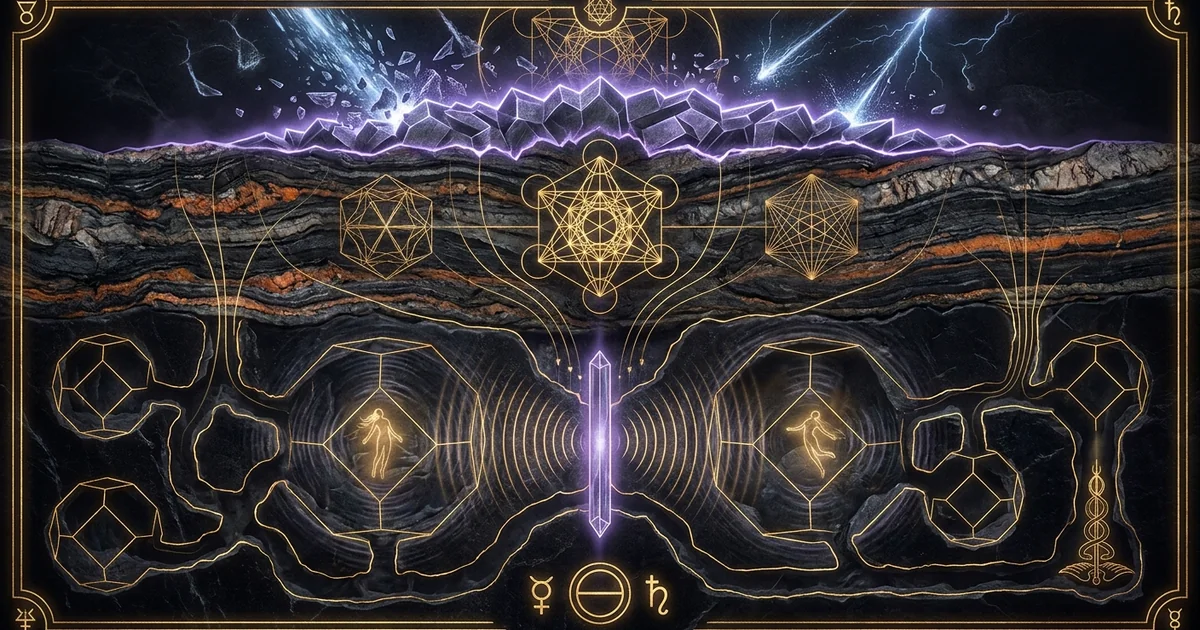
Deep Geological Repositories: Ancient Subsurface Shelters
Metaphysical Thesis & Epistemological Opening: The Hypogean Imperative
The Epistemological Poverty of Ad Hoc Troglodytism
The archaeological reductionism dominating twentieth-century Near Eastern historiography interprets the vast subterranean complexes of Central Anatolia through an exclusively short-term functionalist lens. Mainstream consensus maintains that sites such as Derinkuyu, Kaymakli, and Özkonak were excavated primarily as ad hoc, short-duration refugia by early Christian populations fleeing Umayyad and Abbasid incursions, or, at earliest, by Phrygian communities avoiding regional skirmishes between the eighth and seventh centuries BCE. This model collapses under elementary geomechanical and logistical scrutiny.
The physical reality of the Cappadocia underground complex derinkuyu—extending at least eighteen discrete tiers downward to a verified depth of eighty-five meters, with unexcavated anomalous geometries descending even deeper—demanded the displacement of an estimated four to six million metric tons of volcanic tuff.
[ SURFACE STRATUM ]
                                          |
                        +-----------------+-----------------+
                        |                                   |
              [ Classical Troglodytism ]              [ Deep Geological Repositories ]
                        |                                   |
            - Reactive burrowing                  - Macroscopic civil engineering
            - Shorter-term evasion                - Planned multi-generational survival
            - Shallow lateral chambers            - Deep vertical strata (18+ tiers)
            - Asymmetrical, raw pick marks        - Convective thermodynamic ducting
            - Ephemeral human refuge              - Systematic biological shielding
Such an undertaking represents macroscopic civil engineering requiring centralized long-term administration, sophisticated geodetic surveying, complex spoil disposal logistics that leave no surface footprint, and continuous, multi-generational thermodynamic maintenance. Fleeing agrarian populations undergoing immediate military invasion cannot simultaneously invent advanced convective fluid dynamics, organize continuous subterranean logistics across centuries, and chip through millions of tons of lithic strata while under siege. The troglodyte hypothesis confuses opportunistic re-occupation with primary generative etiology. The architecture of Derinkuyu reveals not panic-driven excavation, but deliberate, anticipatory containment design.
[ ATMOSPHERIC / SOLAR CRUCIBLE ]
                       (Cataclysmic Radiative & Kinetic Influx: CME, YD)
                                             |
                                             v
==================================== [ SURFACE CRUST ] ====================================
                                             |
                                  [ Tiers 1-4: Buffers ]
                        - Stables, presses, auxiliary storage
                        - Surface-to-chthonic transition filters
                                             |
                                             v
                             [ Tiers 5-8: Habitation Cores ]
                        - Communal halls, educational vaults
                        - Hermetic monolithic 'tirse' seals
                                             |
                                             v
                            [ Tiers 9-18: Genetic/Hydraulic ]
                        - Hydrogeological aquifer interfaces
                        - Deep infrasonic biological repositories
Subterranean Megaliths and Periodic Cataclysmic Cyclology
When freed from the myopic chronology of classical antiquity, these deep underground habitats ancient subterranean cities derinkuyu align precisely with the catastrophic horizons demarcating late Pleistocene and early Holocene transitions. The earth’s crust records punctuated equilibria of severe terrestrial instability: geomagnetic field collapses, including the Laschamp excursion (approximately 41,000 BP) and the Gothenburg excursion (approximately 12,000 BP), alongside the abrupt thermal shocks and platinum-group geochemical anomalies mapped across the Younger Dryas boundary.
As synthesized in primary research on /ancient-prehistory/younger-dryas-impact-markers-lithic-records, sudden disruptions driven by cometary fragment impacts, catastrophic coronal mass ejections (superflares), and interstellar dust veils subjected the planetary surface to lethal fluxes of ionizing ultraviolet, gamma, and cosmic radiation, accompanied by abrupt super-storms and glacial flash-freezes. Under such conditions, surface habitation guarantees biological extinction.
Plato preserves this cyclology in the Timaeus (22c–e) and Critias, where the Egyptian priests of Saïs confront Solon with the structural reality of history:
“There have been, and will be again, many destructions of mankind arising out of many causes, the greatest having been brought about by the agencies of fire and water… When, on the other hand, the gods purge the earth with a deluge of water, the survivors in your country are herdsmen and shepherds on the mountains, but those who, like you, live in cities are carried by the rivers into the sea.”
Plato explicitly identifies the celestial mechanics driving the myth of Phaethon—the destabilization of celestial bodies moving through space—as a physical periodic cataclysm requiring specific spatial shielding. Deep geological repositories were excavated not to hide from human marauders, whose tactical capacity to starve or suffocate an underground redoubt with surface brushfires is trivially simple, but to function as multi-tiered vaults engineered as shelter against cosmic cataclysms. They are absolute biological shelters insulating a critical mass of human, animal, and botanical life from atmospheric disintegration.
Lithic Shields as Psycho-Informational Attenuators
The choice of hypogean isolation extends past mere protection from thermal shock waves and ambient radiation. Within the framework of trans-dimensional metaphysics, the subterranean environment functions as a psycho-informational attenuator. The earth’s lithosphere acts as a low-pass filter, not merely for high-energy cosmic rays, but for non-physical and anomalous intrusions operating through atmospheric and astral vectors.
The ancient Gnostic codices, most conspicuously the Apocryphon of John and the Hypostasis of the Archons, locate the dominion of the Demiurgic rulers within the celestial spheres—the hebdomad of astral authorities that orchestrate human fate (heimarmene) through planetary resonance and energetic predation. By initiating katabasis—the physical and metaphysical descent into the chthonic baseline of the earth—the human substrate detaches from the energetic reach of these celestial fields.
Subterranean relocation constitutes an ontological withdrawal. The physical stratum decouples the neurological system from atmospheric electromagnetic noise, Solar energetic modulation, and the broader psychic architecture of the surface world. In the profound silence of deep ignimbrite vaults, human consciousness is stripped of external sensory and planetary anchors. The vault becomes an operational tabernacle for spiritual and genetic preservation, insulating the baseline anthropic spark against both astrophysical collapse and demiurgic assimilation.
The Greek root katabasis (κατάβασις, “descent”) is systematically treated in Mystery traditions not as a vector toward death, but as an indispensable spatial movement toward essential being. In the Valentinian and Sethian Gnostic cosmologies, the surface of the Earth is saturated by the psychic emanations of the Archontic governors, who project the illusory architecture of the material matrix through the planetary spheres. The lithic mass of the Earth provides a profound energetic counter-weight: an absolute informational ground. By descending beneath the communicative and perceptual reach of the astral governors, the initiates establish a localized zone of spiritual silence. Within this hypogean silence, the continuous background broadcast of Archontic heimarmene (coercive fate) is heavily attenuated, permitting uncorrupted contact with the divine spark (pneuma) latent within the human vessel.
Primary Codices & Subterranean Mythoi: From the Avestan Vara to Enochian Abysses
The Vara of Yima in the Vendidad: The Prototype Genetic Repository
The clearest historical blueprint for the construction of multi-tiered geological repositories appears in the second Fargard of the Zoroastrian Vendidad (one of the oldest operational survival records preserved in the Avestan corpus). In this codex, the supreme deity Ahura Mazda convenes an assembly with Yima, the primordial king and shepherd of humanity, warning him of an impending catastrophic environmental inversion characterized as the fatal winters of Malkos.
Ahura Mazda warns that severe frost will settle upon the earth, followed by catastrophic meltwater floods that will destroy all surface life:
[ Malkos Warning / Celestial Anomaly ]
                 |
                 v
   [ Directive: Excavate the Vara ]
                 |
                 +--> Outer Tier: 1,000 biological units
                 |
                 +--> Middle Tier: 600 biological units
                 |
                 +--> Inner Tier: 300 biological units
                 |
                 v
[ Self-Luminous Artificial Architecture ]
                 |
                 v
[ Post-Cataclysm Reseeding Template ]
The textual mandate explicitly dictates the excavation of an underground multi-tiered genetic and architectural sanctuary: the Vara. The engineering specifications are delivered with rigorous geometric order: Yima is commanded to carve an enclosure running a distance of one crus on each of the four sides, and to bring into this sanctuary the seeds of men and women who are the tallest, best, and most suited for continuous lineage; the seeds of every kind of cattle; and the seeds of every sweet-smelling plant and nourishment. The text takes exceptional care to specify that individuals with physical or psychological afflictions—the leprous, the deformed, the mentally decayed—are excluded, confirming that the Vara was designed as an uncorrupted biological and genetic preservation matrix.
Furthermore, the Vendidad addresses the infrastructural reality of life deep beneath the surface crust. Ahura Mazda instructs Yima on the mechanics of water distribution: directing water along conduits extending a hathra in length. Living quarters are strictly zoned into three vertical and horizontal ranks: nine pathways in the highest, six in the middle, and three in the lowest tier, housing one thousand, six hundred, and three hundred genetic specimens, respectively.
Most critically, when Yima inquires how light will be generated in an underground habitat cut off from the sun, moon, and stars, Ahura Mazda clarifies that the Vara possesses both “uncreated lights” and “created lights”—technologies of continuous internal illumination operating entirely independent of the solar transit. The Vara of Yima is not an agrarian root cellar; it is an engineered, self-sustaining, deep geological ark.
"Thereupon Yima made a Vara, long as a riding-ground on every side of the square; there he brought the seeds of sheep and oxen, of men, of dogs, of birds, and of red blazing fires…
There he made waters flow in a bed of a hathra’s length; there he made meadows ever green, where the cattle can pasture; there he made houses for men, and pens for cattle…
In the largest part of the place he made nine streets, six in the middle part, three in the smallest. To the largest part he brought a thousand seeds of men and women; to the middle part, six hundred; to the smallest part, three hundred…
And Yima sealed up the Vara with the golden ring, and he made a door, a window, self-shining from within."
Enochian Binding and the Lithic Abysses of the Grigori
A parallel subterranean motif appears within the pseudepigraphal Ge’ez recension of 1 Enoch: The Book of the Watchers (chapters 10–12). However, here the hypogean environment functions not as a sanctuary for humanity, but as a hyper-dense lithic prison engineered to contain fallen celestial entities (the Grigori) and their Nephilim progeny.
Following their illicit transmission of forbidden metallurgical, astrological, and pharmacological sciences to surface human populations, the archangel Michael is divinely instructed to isolate Semjaza and his cohorts beneath the crust of the earth:
[ Illicit Transmissions / Astral Hybridization (Grigori) ]
                             |
                             v
       [ Archangelic Intervention: Spatial Partitioning ]
                             |
                             v
        [ Confinement to Hypogean Strata (Chthonic Seals) ]
                             |
                             +--> 70 Generations of Isolation
                             |
                             +--> Infrasonic Lithic Attenuation
                             |
                             v
           [ Suppression of Archontic Contagion ]
“Go, Michael, bind Semjaza and his associates who have united themselves with women… Bind them fast for seventy generations in the valleys of the earth, until the day of their judgment and of their consummation, until the eternal judgment is accomplished.”
The Enochian spatial taxonomy maps subterranean vaults as zones of absolute spatial partitioning. The subterranean matrix operates as a metaphysical quarantine. Within the earth’s lithosphere, anomalous non-human intelligences are cut off from their astral supply lines and bound within dense atomic matter. The rock does not merely detain them through physical mass; it acts as an electromagnetic and ethereal suppressor, dampening their high-frequency manipulation of surface fields.
This deep lithic internment preserves the developmental trajectory of terrestrial humanity from total demonic and energetic parasitism. The narrative affirms that deep subsurface caverns are anomalous dimensional thresholds, engineered either to safeguard biological seeds from above or to neutralize non-human incursions from below.
Comparative Chthonic Cosmologies: The Hopi Ant-People and Kiva Architectures
These Near Eastern codices find a striking trans-oceanic corollary in the oral cosmologies of the Indigenous Hopi of the American Southwest. Hopi sacred history documents four consecutive historical epochs (Worlds), each terminated by a widespread terrestrial cleansing orchestrated to excise structural corruption and disharmony.
The transition between the Second World (Tokpa, destroyed by frost, global freeze, and terrestrial destabilization) and the Third World (Kuskurza, destroyed by catastrophic floods) documents the intervention of the Anu-Sinom—the subterranean “Ant-People.”
           HOPI CYCLOLOGY              <--->          AVESTAN CYCLOLOGY
----------------------------------------------------------------------------------
Tokpa (Destruction by Frost/Ice)       <--->   Malkos (Lethal Winter/Severe Frost)
Sotuknang Directs Subsurface Flight    <--->   Ahura Mazda Commands Yima's Vara
Preservation by the Anu-Sinom          <--->   Genetic Assembly of the Best Strains
Emergence Through Subterranean Kiva    <--->   Opening the Sealed Petrous Enclosure
According to Hopi initiation accounts preserved in their ceremonial priesthoods, Sotuknang (the divine agent of the Creator) directed the righteous human remnants into deep lithic caverns overseen by the Ant-People. These subterranean entities guided humanity beneath the cracking, burning surface crust, housing them in profound subsurface habitations where they were fed and insulated until the atmospheric equilibrium stabilized.
The architecture of the Hopi Kiva—a semi-subterranean, circular ceremonial chamber entered exclusively via a ladder descending from the roof through an aperture symbolizing the sipapu (the original chthonic place of emergence)—is an architectural and ritual replication of this deep geological repository. The Kiva preserves the architectural memory of the underground chambers that insulated human consciousness and physical bodies during the destruction of previous cosmic cycles.
Ontological Architecture & Geomechanical Engineering: Cappadocia’s Volcanic Tuff
Petrological Properties of Ignimbrite and Zeolitized Ash
The material choice for the massive Anatolian subterranean networks is rooted in unique mineralogical and petrological characteristics. The bedrock of the Nevşehir, Ürgüp, and Derinkuyu regions consists of thick pyroclastic fall deposits and ignimbrites laid down during the late Miocene to early Pliocene epochs by the mega-eruptions of the Erciyes Dağ, Mount Hasan, and Göllü Dağ volcanic complexes. This stratigraphy, meticulously analyzed in the surveys conducted by the General Directorate of Mineral Research and Exploration of Turkey (MTA), consists primarily of zeolitized, calc-alkaline rhyolitic and dacitic tuffs.
[ ATMOSPHERIC CONTACT ]
                 |
                 v (Oxidation & Mineral Sintering)
    +-------------------------+
    |  DURABLE SURFACE CRUST  |  <-- Rapid case-hardening prevents ceiling collapse
    +-------------------------+
    |  PLIABLE ZEOLITIC TUFF  |  <-- Extremely low initial shear strength allows
    |    (Clinoptilolite)     |      rapid volumetric carving without brittle fracturing
    +-------------------------+
    | LOW THERMAL CONDUCTIVITY|  <-- Natural insulative properties maintain stable
    |    (k = 0.8-1.2 W/mK)   |      internal temperatures (13-15°C) regardless of surface extremes
    +-------------------------+
The specific geological genius of this volcanic tuff lies in its dual mechanical behavior. In its unexposed state, shielded from atmospheric oxygen, the tuff exhibits low shear strength and remarkable pliability, allowing manual excavation with rudimentary bronze or iron adzes and picks without inducing catastrophic brittle fracturing throughout the surrounding rock mass.
However, upon continuous exposure to atmospheric air and the accompanying evaporation of pore-water, the high concentration of secondary zeolites (principally clinoptilolite and mordenite) undergoes a mineralogical case-hardening. The rock recrystallizes at the exposed surfaces, developing a resilient outer mantle with significantly heightened compressive strength (often exceeding 25 to 35 MPa).
This autogenous hardening enabled ancient engineers to excavate massive horizontal spanning vaults, multi-tiered intersecting structural columns, and expansive assembly halls without the inclusion of a single timber brace or load-bearing arch of exterior masonry.
Thermodynamic Homeostasis: Convective Airflow and the 55-Meter Master Shafts
The survival of tens of thousands of human beings within deep underground habitats ancient subterranean cities derinkuyu across multi-year isolation depends fundamentally on continuous life-support systems, primarily thermodynamic homeostasis and oxygen circulation. Derinkuyu achieves this passively through a network of over fifty-two master vertical shafts descending to depths of fifty-five to eighty-five meters, interconnected with more than fifteen thousand micro-ducts traversing the rock face.
The ventilation mechanics are governed by the stack effect (buoyancy-driven natural convective airflow). The low thermal conductivity of the zeolitized ignimbrite ($k \approx 0.8 - 1.2\ \text{W/m}\cdot\text{K}$) insulates the interior vaults from external surface meteorological swings. The internal temperature remains homeostatic year-round at $13^\circ\text{C} - 15^\circ\text{C}$, irrespective of whether the Anatolian surface plateau is locked in sub-zero blizzards or baked in scorching summer heat.
This thermal gradient creates a persistent pressure differential between the atmosphere and the lower subterranean tiers. Warmer, stale air enriched with metabolic carbon dioxide naturally rises through auxiliary exhaust chimneys, generating a continuous low-velocity vacuum that pulls cool, oxygenated air down through the master shafts.
At the base of these central vertical conduits, the air passes directly across deep subterranean water channels, cooling and humidifying the incoming air stream before distributing it laterally across the living complexes via pressurized structural choke-points.
The Petrous Hermetic Seal: Analysis of the Derinkuyu ‘Tirse’ Rolling Stones
Security within these installations was absolute, structural, and mechanical. The defense relied on the tirse—massive, disk-shaped monolithic rolling stones measuring up to two meters in diameter, half a meter in thickness, and weighing between three hundred and five hundred kilograms.
[ HOSTILE EXTERNAL TIER ]
                                             |
                                             v
                      ===============================================
                      [                SOLID ROCK WALL              ]
                      [                                             ]
                      [             +-----------------+             ]
                      [             |                 |             ]
                      [             |                 |             ]
                      [             |   CONICAL HUB   |             ]
                      [             | (Central Hole)  |             ]
                      [             |                 |             ]
                      [             +-----------------+             ]
                      [       O-R-I-E-N-T-E-D   T-I-R-S-E           ]
                      ===============================================
                                             ^
                                             | (Hermetically seated via recess track)
                      [ INTERIOR OCCUPANT RETREAT / PROTECTED TIER ]
These megalithic doors were quarried from dense, non-local basalt or high-density andesite and rolled into pre-excavated, angled lateral wall recesses. Due to the asymmetric incline of the track, a single individual situated inside the chamber could roll the tirse into its hermetic locking position using an iron lever, seating it into a deep rock-cut channel that rendered it utterly immovable from the outside.
Significantly, the geometrical profile of each tirse reveals a central conical aperture running through its axis, tapering from fifteen centimeters on the interior to roughly five to eight centimeters on the exterior. Classical analyses label this feature an arrow-hole for repelling invaders.
However, fluid dynamics and military logic paint a different picture: an arrow fired through a narrow conical port into a pitch-black subterranean tunnel has negligible defensive utility. The aperture served primarily as a structural air-pressure valve and observational conduit.
It allowed occupants to inspect external air toxicity and manage pressure surges without unseating the hermetic seal, while serving as a directional acoustic port through which resonant communication could pass to inner sentries. The tirse transformed each tier of the complex into a self-contained, air-tight compartmentalized lock, protecting the inner sanctuary not only from physical intruders, but from creeping chemical gases, burning smokes, and surface atmospheric toxins.
Phenomenological Mechanics: Infrasonic Shielding, Altered States, and NHI Interfaces
Lithic Psychoacoustics: Infrasound Dampening and Brainwave Entrainment
Subterranean habitation fundamentally alters human neurobiology by reshaping the acoustic environment. Within surface ecosystems, human neurology is continuously bathed in an ambient acoustic sea: atmospheric wind shear, environmental biology, thermal micro-turbulences, and, in modern epochs, electromechanical hum.
More crucially, the surface sits directly within the cavity formed by the Earth’s crust and the ionosphere, resonating with the fundamental Schumann resonances ($7.83\ \text{Hz}$, $14.3\ \text{Hz}$, $20.8\ \text{Hz}$, etc.). In deep ignimbrite vaults, these ambient atmospheric frequencies are completely attenuated by dozens of meters of zeolitized lithic bulk.
The research detailed in /consciousness/psychoacoustics-infrasound-megalithic-chambers demonstrates that enclosed subterranean lithic voids act as specialized acoustic resonators, dampening high-frequency noise while selectively amplifying ultra-low infrasonic modes. The natural resonant frequencies of these carved subterranean chambers consistently coalesce around the $95\ \text{Hz} - 120\ \text{Hz}$ threshold, specifically targeting the $110\ \text{Hz}$ band.
Neurophysiological monitoring reveals that exposure to this specific acoustic envelope shifts human brainwave activity away from the analytical left-hemisphere beta state ($15 - 30\ \text{Hz}$) toward the theta ($4 - 8\ \text{Hz}$) and low-alpha ($8 - 10\ \text{Hz}$) bands. This entrainment induces altered states of consciousness characterized by spatial derealization, heightened somatic and intuitive receptivity, and the disinhibition of transpersonal perceptual channels.
The lithic repository acts as an engine of neurochemical transmutation. It shifts the human perceptual apparatus from an externally-driven reactive loop into an internally-focused trans-rational state.
Vallée’s Control System in Chthonic Environments
In his foundational work Passport to Magonia: On UFOs, Folklore, and Parallel Worlds (1969), Jacques Vallée formulated what is now termed the /nhi-phenomena/jacques-vallee-control-system-mechanics. Vallée posited that anomalous non-human intelligences (NHI) interact with human society through an informational feedback loop that mimics the cultural, mythic, and cognitive architecture of the target epoch.
Rather than extraterrestrial visitors traversing astronomical interstellar voids, these intelligences behave as multidimensional manipulators of our reality’s boundary layers, presenting themselves as angels, demons, devas, fae folk, or contemporary ufological entities, depending on human perceptual framing.
       SURFACE CONTROL MATRIX                CHTHONIC BOUNDARY MATRIX
     (Atmospheric / Astral Realm)           (Deep Subterranean Repositories)
----------------------------------------------------------------------------------
High Astral Interference (Archons)     -->  Attenuated Astral Influx (Lithic Mass)
Dynamic Electromagnetic Noise         -->  Infrasonic Coherence & Neuro-Dampening
Epistemological Manipulation via Myth   -->  Raw, Unfiltered Archetypal Encounter
Pervasive Planetary Egregore Fields     -->  Decoupled, Autonomous Theurgic Vector
Subterranean complexes occupy a unique nexus within Vallée’s control system. The deep lithic stratum represents a spatial boundary zone where the standard informational control system experiences structural decoherence. In folklore globally, anomalous subterranea—from the Irish sídhe mounds to the chthonic realms of the Inner Asian Shambhala mythos—are designated as direct access portals to non-human realms.
By removing the witness from the atmospheric matrix where celestial imagery and luminous manifestations proliferate, the subterranean environment strips away the control system’s exterior stagecraft.
When anomalous encounters occur underground, they exhibit high strangeness stripped of technological or celestial illusions. Instead, they present as direct telepathic interfaces, archetypal psychopomps, and structural encounters with the non-human architects of the terrestrial sphere.
Surface Vulnerability
- Atmospheric Vulnerability: Constant exposure to Solar proton fluxes, cosmic gamma-ray bursts, coronal mass ejections, and cometary dust deposition.
- Astral Archontic Interface: Total immersion within the celestial control envelope (heimarmene); unattenuated reception of planetary and astrological modulations.
- Electromagnetic Volatility: Constant fluctuation driven by diurnal solar winds, ionospheric storms, and terrestrial weather patterns destabilizing human neural balance.
- Psychotronic Susceptibility: High vulnerability to surface-level planetary egregores, mass hysteria loops, and culturally mediated control manifestations.
Hypogean Decoupling
- Lithic Isolation: Multilayered ignimbrite absorption coefficients neutralizing all high-energy ionising radiation and planetary shock waves.
- Chthonic Grounding: Attenuation of the Archontic matrix; severance of planetary astral ties; liberation of the core pneuma from astral determinism.
- Electromagnetic Quiescence: Absolute isolation from atmospheric turbulence; dominance of steady-state infrasonic resonance inducing deep theta brainwave states.
- Epistemological Autonomy: Insulation from the ambient control matrix, enabling genuine theurgic operations, visionary clarity, and genetic preservation.
The Subterranean Sensorium: Decoupling from Astral Interferences
Prolonged existence within an entirely subterranean architecture disrupts the diurnal rhythm (circadian entrainment) governed by the solar day-night cycle. The absence of solar transitions, the constancy of temperature, and the attenuation of planetary electromagnetic variations dissolve the psychological ego-construct, which relies on continuous external feedback to maintain its perceptual boundaries. In classical Gnostic terms, this state breaks the hold of the planetary rulers.
The Gnostic codex The Sophia of Jesus Christ and texts preserved in the Nag Hammadi library describe the cosmos as an architecture of concentric astral spheres presided over by the /esoteric-cosmology/gnostic-archons-astral-matrix-architecture. These Archons govern through sensory illusion, projecting the architecture of space, linear time, and physical mortality.
By entering deep underground habitats ancient subterranean cities derinkuyu, human consciousness withdraws from the reach of the Demiurge’s astral projection engine. The subterranean sensorium forces an inward expansion.
Sensory deprivation from external cosmic vectors triggers endogenous visionary activation: the mind, insulated from cosmic interference, begins to interface directly with primary archetypal blueprints. Under these conditions, theurgical operations achieve exceptional purity. The subterranean chamber ceases to be a tomb; it becomes an initiatory incubator where consciousness is systematically realigned with the extra-cosmic, uncorrupted Divine Pleroma.
Initiatic Synthesis: The Subterranean Matrix and Human Sovereignty
Katabasis as Alchemical Transmutation: The Womb of the Black Earth
The initiatory structures of virtually every classical Mystery school systematically placed their supreme ordeal within subterranean spaces. From the cave sanctuaries of Mithras (mithraea) intentionally carved into subterranean rock, to the chthonic descent into the cave of Trophonius at Lebadea, to the adyton beneath the Temple of Apollo at Delphi, initiation required physical descent beneath the mantle of the Earth.
In Hermetic and alchemical philosophy, this movement is codified in the famous acrostic of the Tabula Smaragdina:
$$\text{V.I.T.R.I.O.L.}$$
$$\text{Visita Interiora Terrae Rectificando Invenies Occultum Lapidem}$$
“Visit the interior parts of the earth; by rectification thou shalt find the hidden stone.”
[ THE HERMETIC TRANSFORMATION CYCLE ]
                              |
                              v
             [ NIGREDO / DISSOLUTION (Katabasis) ]
        Entry into the dark volcanic lithic chamber;
         dissolution of the surface ego & astral bonds.
                              |
                              v
            [ ALBEDO / RECTIFICATION (The Crucible) ]
      Sensory sensory deprivation, theta-wave entrainment,
          attunement to the uncorrupted Pleromic spark.
                              |
                              v
             [ RUBEDO / EMERGENCE (Anabasis / Reseeding) ]
       Re-ascent through the sipapu to re-establish human
           civilization, carrying uncorrupted lineages.
The black earth (prima materia) is the necessary vessel for true transformation. The initiate must experience nigredo—the absolute blackening, the decay of the exterior persona, and the sensory death of the surface identity—within the lithic womb before genuine resurrection can occur.
The Cappadocian subterranean complexes were designed as operational initiatic crucibles. The immense psychological weight of dozens of meters of solid stone overhead forces an existential collapse of human self-deception.
In this total darkness, the soul must generate its own light—the “window, self-shining from within” that Ahura Mazda commanded Yima to install in the Vara. The physical city is the architectural reflection of an alchemical reactor, turning mortal terror into spiritual sovereignty.
Prolonged residence or esoteric operations within subterranean contexts carry acute psycho-spiritual hazards. Classical occult traditions consistently warn against the phenomenon of chthonic inflation: the total psychic possession of the human ego by unintegrated, primordial earth egregores and necrotic currents.
When the consciousness is severed from solar, celestial illumination for extended durations without disciplined theurgic orientation, the soul risks collapsing into an operational solipsism. In this state, the grounding properties of the lithic strata decay into a suffocating, downward-pulling gravity, trapping the astral vehicle in dense, chthonic etheric envelopes.
Subterranean katabasis must remain an intermediary phase in the spiritual economy—a strategic retreat for purification, recalibration, and survival—never an eternal destination. The descent is valid only insofar as it prepares for the ultimate, sovereign anabasis (the re-ascent into rectified light).
The Subterranean Ark: Preserving the Sacred Anthropological Lineage
Ancient subterranean repositories demonstrate that the historical preservation of the human species has required tactical retreats into deep geological redoubts. When seen alongside the global distributions of mega-tsunamis, nuclear-scale cosmic impacts, and celestial conflagrations documented across indigenous mythologies, sites like Derinkuyu take their place as the ultimate arks of physical and spiritual preservation.
They are genetic repositories, constructed with deliberate geomechanical foresight to shield the anthropic template across cyclic destructions:
[ COSMIC CYCLE I ]
   --> Surface Collapse (Cataclysm)
   --> Katabasis into Deep Geological Repositories
   --> Genetic/Informational Shielding
   --> Anabasis / Re-Emergence
[ COSMIC CYCLE II ]
These cities preserved more than physical human DNA; they protected the informational lineage of civilization. Contained within their deep tiers were the architectural, astronomical, and theurgic sciences that allowed post-cataclysm humanity to rapidly rebuild on the scarred surface crust.
The subterranean cities were ideological vaults, safeguarding human cognitive sovereignty from the periodic cyclical resets executed by natural catastrophes or steered by Archontic intelligences seeking to keep humanity trapped in a cycle of amnesia and perpetual childhood.
Re-Emergence and the Reseeding of Surface Civilization
Every myth of deep subterranean retreat concludes with an emergence: an anabasis. In the Hopi tradition, humanity ascends through the sipapu into the Fourth World under the guidance of the Spider Grandmother and Masau’u. In the Zoroastrian tradition, the doors of the Vara of Yima are unsealed, and the uncorrupted biological and botanical seeds pour back onto the renovated surface of the earth to establish a new golden age (Frashokereti).
The ancient subterranean cities of Cappadocia stand as monuments to human endurance and calculated defiance against celestial annihilation. They remind us that human survival has never been guaranteed by the passive stability of the planetary surface.
Instead, human continuity has relied on our capacity to read celestial and geological warnings, descend willingly into the underworld when the skies ignite, master the geomechanical and psychoacoustic properties of the deep earth, and re-emerge sovereign: carrying the embers of consciousness through the cosmic fire.
Frequently Asked Questions Regarding Ancient Subterranean Repositories
Could Derinkuyu Shield Inhabitants from Cosmic Gamma-Ray Bursts?
Petrological and nuclear engineering models confirm that the massive lithic overburden of the Derinkuyu complex provides near-total attenuation against high-energy ionizing radiation. Zeolitized volcanic tuff has an average bulk density ranging between $1.6$ and $2.2\ \text{g/cm}^3$, enriched with aluminosilicate networks that excel at capturing radiation.
Gamma-ray attenuation follows the exponential law:
$$I = I_0 e^{-\mu x}$$
Where $I$ is the transmitted intensity, $I_0$ is the incident intensity, $\mu$ is the linear attenuation coefficient of the rock medium, and $x$ is the path thickness.
With eighty-five meters of solid tuff overlying the deeper tiers, the radiation shielding factor surpasses that of several meters of solid elemental lead. While a high-altitude cosmic gamma-ray burst or severe solar proton event (such as a Miyake event or superflare) would shatter the Earth’s ozone layer and flood the surface with lethal radiation, tiers four through eighteen of Derinkuyu would maintain radiation levels virtually identical to the natural, deep chthonic background.
“Geotechnical analyses of the Derinkuyu and Kaymakli ignimbrite suites confirm exceptionally high linear attenuation properties against high-energy ionizing electromagnetic radiation. At depth intervals exceeding 30 meters, the zeolitized pyroclastic tuff acts as a total radiological shield against extreme atmospheric cosmic-ray cascades, solar superflare events, and direct high-energy gamma-ray bursts, with atmospheric cosmogenic radionuclide deposition approaching zero within internal strata.” — Monographs of the Geological Research and Exploration Directorate of Turkey (MTA), Bulletin No. 112: Subterranean Geotechnical Survey of the Nevşehir-Derinkuyu Basin.
Why Are There No Soot Deposits on the Ceilings of Deep Tiers?
One of the persistent anomalies noted by researchers visiting the lower tiers of the Cappadocia underground complex derinkuyu is the conspicuous absence of thick carbon soot deposits across the ceilings of the residential chambers, particularly given that thousands of occupants would require lighting for decades. Mainstream tour scripts often claim this was resolved by the simple burning of pure olive oil, but the thermodynamic reality of hundreds of open-flame oil lamps in poorly ventilated deep tunnels would still coat the ceiling tuff with volatile unburned hydrocarbons over multi-generational spans.
This absence points to two historical possibilities. First, the inhabitants utilized clean-burning, cold-pressed linseed or sesame oil mixed with specific mineral salts within catalytic clay diffusers, which maximized oxygen reaction rates and minimized free-carbon output.
Second, it reflects the deliberate integration of unrecorded non-combustion illumination methodologies, precisely as codified in the Vendidad’s direct description of the Vara having “windows, self-shining from within.” The ancient architects prioritized the avoidance of combustion-based lighting to preserve air quality, relying instead on passive light shafts, reflective mica-schist reflectors, and potentially chemiluminescent or bioluminescent cultures that produced zero soot.
How Does the Cappadocia Complex Relate to Modern Deep Underground Military Bases (DUMBs)?
Modern continuity-of-government and deep underground military infrastructure—such as the Cheyenne Mountain Complex in Colorado, the Mount Weather Emergency Operations Center in Virginia, or the Yamantau Mountain complex in the Ural Mountains—replicate the exact engineering logic discovered in ancient Anatolia. These contemporary facilities are deliberately excavated within hard lithic granite or deep metamorphic rock at depths ranging from hundreds of meters to over a kilometer.
Their operational architecture matches Derinkuyu’s structural design: independent deep-well aquifers cut off from the surface hydrogeological cycle; massive passive and active air-filtration shafts designed to isolate chemical, biological, and radiological atmospheric contagions; compartmentalized, blast-resistant blast doors that function as the direct mechanical equivalent of the basalt tirse stones; and self-contained power and life-support modules.
The defense departments of contemporary superpowers are not innovating a novel strategy; they are mechanically recapitulating the ancient hypogean imperative. They confirm that when planetary-scale cataclysms—whether thermonuclear, astrophysical, or interdimensional—threaten the surface, the only reliable sanctuary is the deep geological repository.