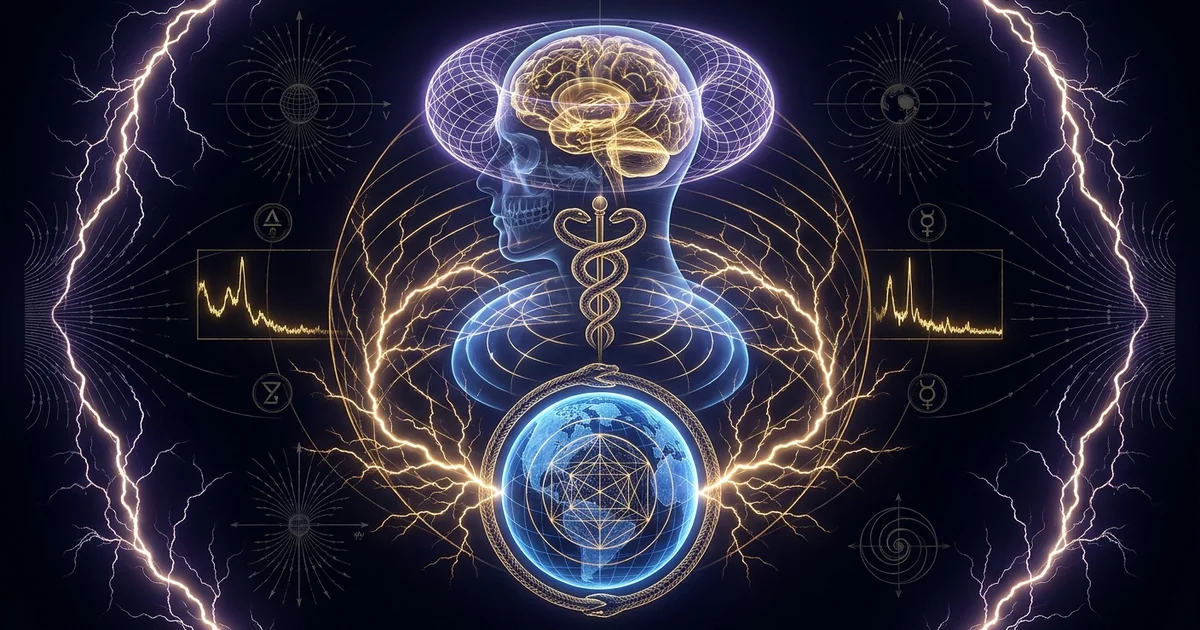
Schumann Resonances: 7.83 Hz Ionospheric Brain Resonance
Executive Summary & Theoretical Thesis: Terrestrial Waveguides and Endogenous Neuro-Oscillators
Electrodynamics of the Concentric Spherical Cavity
The terrestrial environment is bounded by a concentric spherical dielectric waveguide consisting of two conducting spherical shells: the solid and aqueous surface of the Earth below and the conductive plasma of the lower ionospheric D- and E-regions above. This planetary structure functions as an electromagnetic cavity resonator. The terrestrial lithosphere and hydrosphere exhibit electrical conductivities ranging from $\sigma_g \sim 10^{-3} \text{ S/m}$ in dry crust to $\sim 4 \text{ S/m}$ in oceanic seawater, presenting an effective short-circuit boundary to terrestrial electric fields. Conversely, the lower boundary of the ionosphere, situated between 60 km (daytime D-layer) and 90 km (nighttime E-layer) in altitude, displays an anisotropic, complex conductivity tensor dictated by ambient electron densities ($N_e \sim 10^8 - 10^{10} \text{ m}^{-3}$) and electron-neutral collision frequencies ($\nu_{en} \sim 10^6 \text{ s}^{-1}$).
Within this spherical dielectric shell, bounded by radii $R_E \approx 6,371 \text{ km}$ and $R_I \approx 6,431\text{–}6,471 \text{ km}$, electromagnetic radiation at extremely low frequencies (ELF, 3–3000 Hz) propagates with minimal radial attenuation. Because the radial thickness of the dielectric air gap ($d = R_I - R_E \approx 60\text{–}100 \text{ km}$) is three orders of magnitude smaller than the planetary radius and substantially smaller than the free-space wavelength of ELF radiation ($\lambda \approx 38,300 \text{ km}$ at 7.83 Hz), radial electric field lines and azimuthal magnetic field lines dominate. This geometric confinement prevents the propagation of higher-order transverse electric (TE) modes below their cutoff frequencies in the kilohertz regime, leaving transverse magnetic ($TM_{m0}$) modes as the dominant electrodynamic phenomena governing global electromagnetic wave dispersion. For an exhaustive treatment of dielectric boundary conditions across macroscopic media, see the formal derivation in /physics-electromagnetism/maxwell-dielectric-waveguides.
Biophysical Isochronism: Alpha Wave Coincidence and Evolutionary Optimization
The fundamental transverse magnetic eigenmode of this planetary cavity resonates at an empirical baseline of approximately 7.83 Hz, with subsequent harmonic modes occurring at ~14.3, 20.8, 27.3, and 33.8 Hz. This continuous, low-amplitude oscillating electromagnetic field—characterized by electric field components on the order of $100\text{–}300\ \mu\text{V/m}$ and magnetic flux densities on the order of $1\text{–}3\ \text{pT}$—constitutes the pervasive electrodynamic background within which all terrestrial biological systems evolved. A foundational inquiry in modern biophysics concerns the striking congruence between these planetary frequencies and the endogenous neuro-oscillatory regimes of the mammalian central nervous system.
Specifically, the fundamental mode at 7.83 Hz precisely intersects the junction of the human electroencephalographic (EEG) theta band (4–8 Hz) and alpha band (8–12 Hz). This narrow oscillatory regime governs states of relaxed alert consciousness, sensorimotor idling, memory consolidation, and internally directed attentional focus. Evolutionary adaptation over geological epochs did not occur in an electromagnetic vacuum; rather, it proceeded under the continuous imprint of this planetary oscillation. The biological persistence of the alpha rhythm represents a long-term evolutionary entrainment of neural synchrony to the ubiquitous geoelectric background. Through primary sensory and non-sensory biophysical transduction mechanisms, this ambient field acts as an environmental synchronizer (zeitgeber), stabilizing internal neurological phase relationships against thermal noise and intrinsic biological drift.
Under idealized, lossless conditions wherein both the terrestrial surface and the ionosphere are modeled as perfectly conducting concentric spheres ($\sigma \to \infty$), the undamped eigenmode frequencies $f_n$ of the spherical cavity are calculated via the eigenvalues of the radial wave equation: $$f_n = \frac{c}{2\pi R_E} \sqrt{n(n+1)}$$ For the fundamental mode ($n = 1$), this idealized relation yields: $$f_1 = \frac{2.9979 \times 10^8 \text{ m/s}}{2\pi (6.371 \times 10^6 \text{ m})} \sqrt{2} \approx 10.59 \text{ Hz}$$ However, real-world ionospheric boundaries possess finite conductivity profiles and high collisional dampening, which substantially reduce the phase velocity of the propagating wave ($v_{ph} \approx 0.74c$). This complex boundary impedance lowers the fundamental mode by roughly 26%, establishing the empirically measured resonance peak at $f_1 \approx 7.83 \text{ Hz}$.
Historical Lineage & Experimental Precedents: From Telluric Currents to Balser-Wagner Radiometry
Tesla’s Colorado Springs Teleforce Experiments and the 1899 Discoveries
The empirical recognition of terrestrial stationary waves originated with the experimental investigations of Nikola Tesla at his experimental station in Colorado Springs between May 1899 and January 1900. Utilizing an extra-large magnifying transmitter—a high-frequency, air-core resonant transformer capable of developing potentials exceeding $10^7 \text{ Volts}$—Tesla observed periodic stationary potential nodes across the ground during powerful, moving electrical storms over the Rocky Mountains. Tesla realized that the terrestrial globe acted not as an infinite sink for electrical charge, but as a bounded resonant conductor capable of supporting standing waves of electrical energy.
[ Magnifying Transmitter Primary / Secondary ]
                            │
               ┌────────────┴────────────┐
               ▼                         ▼
      [ High-Elevation ]         [ Deep Ground ]
      [ Terminal Node  ]         [ Telluric Point ]
               │                         │
               └────────────┬────────────┘
                            ▼
        [ Earth-Ionosphere Waveguide Excitation ]
By systematically logging the phase, amplitude, and spatial interference patterns of electrical potentials via tuned coherers and sensitive electromechanical indicators, Tesla established that local lightning discharges emitted low-frequency waves that traversed the terrestrial sphere, reflected at the antipodal point, and returned to generate interference nodes. Although Tesla’s interpretive framework was articulated through his idiosyncratic model of non-Hertzian, longitudinal dielectric stress waves, his mathematical calculations regarding the fundamental electrical capacity ($C \approx 710\ \mu\text{F}$) and self-inductance of the Earth anticipated the discovery of planetary-scale standing electromagnetic waves. A detailed historical review of these early earth-conduction experiments is available in /physics-electromagnetism/telluric-currents-planetary-grids.
“For the present it will be sufficient to state that the planet has been found to behave, in many respects, like a conductor of limited dimensions, possessing a definite capacity and self-induction… When the earth is shaken electrically into vibration by a properly designed generator, an electrical wave passes through the globe with a velocity that is practically that of light… At the opposite point of the globe, the wave is reflected and returns to the originating station, where it establishes standing waves possessing nodal and ventral regions.” — Nikola Tesla, Art of Transmitting Electrical Energy Through the Natural Mediums, Granted April 18, 1905.
Winfried Otto Schumann’s Vector Spherical Harmonic Formulations (1952)
The mathematical formalization of the Earth-ionosphere cavity was achieved by German theoretical physicist Winfried Otto Schumann at the Electrophysical Institute of the Technische Hochschule München. In a series of foundational papers published in 1952, Schumann sought to determine the non-radiative eigenmodes of a conducting sphere enclosed by a concentric ionospheric shell, independent of Tesla’s earlier empirical assertions. Applying Maxwellian electrodynamics and vector spherical harmonics, Schumann treated the Earth and the ionosphere as concentric boundary surfaces exhibiting distinct dielectric properties and finite conductivities.
Schumann resolved the radial and angular components of the wave equation within the cavity by employing Legendre polynomials to model the latitudinal distribution and spherical Hankel functions for the radial field distribution. His initial formulation, which assumed infinite conductivity for the terrestrial surface and a simplified, sharp-boundary conductivity for the ionosphere, generated the pure harmonic series centered near 10.6 Hz for $n = 1$. In subsequent collaborations with Herbert L. König, Schumann integrated realistic ionospheric conductivity gradients and finite surface impedances, demonstrating that the collision-dominated ionospheric plasma dampens the phase velocity of the wave, thereby shifting the fundamental resonant mode down to 7.83 Hz.
Empirical Radiometric Isolation by Balser and Wagner (1960)
Although Schumann conceptually deduced the cavity modes, direct physical confirmation was delayed by the technical difficulty of isolating extremely low-amplitude, sub-audible electromagnetic signals from local 50/60 Hz power-grid interference and near-field atmospheric noise. Conclusive laboratory verification was achieved in 1960 by Martin Balser and Charles A. Wagner at the Massachusetts Institute of Technology’s Lincoln Laboratory. Operating a specialized radio receiving station with high-gain, low-noise induction coils and narrow-band spectrum analyzers, Balser and Wagner systematically surveyed the radio spectrum between 50 and 100 cycles per second.
Through extended integration times and autocorrelation analysis of ambient radio noise, Balser and Wagner extracted discrete spectral power peaks at 7.8, 14.1, 20.3, 26.4, and 32.5 Hz. Their measurements confirmed Schumann’s predictions, experimentally demonstrating that the global cavity is continuously driven by impulsive equatorial lightning. This definitively elevated the study of the Earth-ionosphere waveguide from theoretical deduction to observational radio physics.
Mathematical Formalism & Physical Mechanics: Maxwellian Wave Dispersion within Lossy Concentric Spheres
The Vector Helmholtz Equation and Radial Boundary Conditions
The mathematical description of electromagnetic propagation within the Earth-ionosphere waveguide begins with Maxwell’s equations for a source-free, linear, isotropic, and time-harmonic medium ($\mathbf{E}(\mathbf{r}, t) = \mathbf{E}(\mathbf{r}) e^{-i\omega t}$, $\mathbf{H}(\mathbf{r}, t) = \mathbf{H}(\mathbf{r}) e^{-i\omega t}$):
$$\nabla \times \mathbf{E} = i\omega\mu_0 \mathbf{H}$$
$$\nabla \times \mathbf{H} = -i\omega\epsilon_0 \mathbf{E} + \mathbf{J} = (\sigma® - i\omega\epsilon_0) \mathbf{E} = -i\omega\epsilon_{\text{eff}}® \mathbf{E}$$
Here, $\epsilon_{\text{eff}}® = \epsilon_0 \left(1 + i\frac{\sigma®}{\omega\epsilon_0}\right)$ denotes the complex effective permittivity, governed by the radially dependent conductivity profile $\sigma®$. Taking the curl of the curl equations yields the vector Helmholtz equation for the electric field:
$$\nabla^2 \mathbf{E} + k^2® \mathbf{E} = 0$$
where $k® = \omega \sqrt{\mu_0 \epsilon_{\text{eff}}®} = \frac{\omega}{c}\sqrt{1 + i\frac{\sigma®}{\omega\epsilon_0}}$ represents the complex propagation constant.
Due to the spherical symmetry of the cavity, the field is expanded into vector spherical harmonics using spherical coordinates $(r, \theta, \phi)$. Given that the height of the cavity $h = R_I - R_E \ll \lambda$, propagation is dominated by the zero-order transverse magnetic mode ($TM_{m0}$), wherein the magnetic field vector is entirely azimuthal ($H_r = H_\theta = 0, H_\phi \neq 0$) and the electric field has radial and polar components ($E_r \neq 0, E_\theta \neq 0, E_\phi = 0$). Introducing the Debye scalar potential $U(r, \theta)$, the field components are expressed as:
$$E_r = \frac{1}{r} \left( \frac{\partial^2}{\partial r^2} + k^2 \right) (r U)$$
$$E_\theta = \frac{1}{r^2} \frac{\partial^2 (r U)}{\partial r \partial \theta}$$
$$H_\phi = \frac{i\omega\epsilon_{\text{eff}}}{r} \frac{\partial (r U)}{\partial \theta}$$
The radial potential $r U(r, \theta)$ is separable into $R® P_n(\cos\theta)$, where $P_n(\cos\theta)$ represents the Legendre polynomial of degree $n$, satisfying the angular equation:
$$\frac{1}{\sin\theta} \frac{\partial}{\partial \theta} \left( \sin\theta \frac{\partial P_n}{\partial \theta} \right) + n(n+1) P_n = 0$$
The radial function $R®$ satisfies the spherical Bessel differential equation. Applying the boundary conditions of finite surface impedance at $r = R_E$ and $r = R_I$ links the radial eigenvalue $n$ to the allowable complex propagation frequencies.
                  r = R_I  (Ionosphere: D/E Layer)
       ----------------------------------------------------  σ_i (r)
            ↑
            │      Air Dielectric Cavity Gap
            │      h = 60 - 100 km (TM_0 Modes)
            │      Er(r, θ) ,  Hφ(r, θ)
            ↓
       ----------------------------------------------------  σ_g ≈ ∞
                  r = R_E  (Terrestrial Surface)
Ionospheric Finite Conductivity Profiles and Modal Damping Factors
The real ionosphere does not present a discrete, perfectly reflecting conductive mirror; it is an inhomogeneous, anisotropic, collision-dominated plasma. Its conductivity is governed by the Appleton-Hartree equation, where electron density $N_e(z)$ and electron-neutral collision frequency $\nu_e(z)$ change as a function of altitude $z = r - R_E$. In the lower D-region (60–80 km), the parallel conductivity is modeled as:
$$\sigma_{||}(z) = \frac{N_e(z) e^2}{m_e (\nu_e(z) - i\omega)}$$
Because the collision frequency dominates within the lower D-region ($\nu_e \sim 10^6 \text{ s}^{-1} \gg \omega \approx 50 \text{ rad/s}$), the conductivity is primarily real and dissipative: $\sigma(z) \approx \frac{N_e(z) e^2}{m_e \nu_e(z)}$.
The reflection coefficient for an obliquely incident ELF wave within this inhomogeneous profile is determined by the surface impedance $Z_i$ evaluated at the effective ionospheric reflection height $h_1$:
$$Z_i = \sqrt{\frac{\mu_0}{\epsilon_0 + i\frac{\sigma(h_1)}{\omega}}}$$
This non-zero surface impedance introduces an imaginary component into the angular eigenvalue $n$, transforming it into a non-integer complex parameter: $\nu(\omega) = n(\omega) + i \alpha(\omega)$, where $\alpha(\omega)$ is the spatial attenuation factor. The resonance condition requires the round-trip phase change around the circumference of the Earth to equal an integer multiple of $2\pi$:
$$\text{Re}[\nu(\omega)] + \frac{1}{2} = \left( n + \frac{1}{2} \right)$$
This dispersion relation reveals the source of modal damping: the finite conductivity causes a significant decrease in the phase velocity of the wave, $v_{ph} = \frac{\omega}{\text{Re}[k]} = c \frac{\sqrt{n(n+1)}}{\text{Re}[\nu(\omega) + 1/2]}$, shifting the resonant frequency down to 7.83 Hz while simultaneously lowering the Quality Factor ($Q$) of the cavity to roughly:
$$Q = \frac{\text{Re}[\omega]}{2 \text{Im}[\omega]} \approx 4\text{–}6$$
This low $Q$-factor indicates a highly damped cavity resonator, preventing sharp, divergent standing wave oscillations and producing broad, stable spectral resonance peaks.
Global Lightning Discharge Current Vectors as Cavity Exciters
The electrodynamic excitation sustaining the Schumann resonances is driven by global lightning activity. At any given second, approximately 50 to 100 cloud-to-ground lightning discharges occur across the planet, primarily concentrated in three tropical convective chimneys: the Amazon Basin, the Congo Basin, and the Maritime Continent of Southeast Asia. Each cloud-to-ground lightning stroke represents an impulsive vertical electrical current dipole of length $dl \sim 5\text{–}10 \text{ km}$, transferring tens to hundreds of Coulombs of charge via a peak current $I_0 \sim 30\text{–}100 \text{ kA}$.
The source current density $\mathbf{J}_s(\mathbf{r}, t)$ can be modeled as a vertical electric dipole with current moment $P(t) = I(t) dl$. In the frequency domain, the current moment represents a wideband white-noise excitation across the ELF spectrum:
$$P(\omega) = \int_{-\infty}^{\infty} I(t) dl , e^{i\omega t} dt$$
The radial electric field $E_r$ generated by an ensemble of spatially distributed, uncorrelated lightning strokes located at coordinates $(\theta_j, \phi_j)$ is formulated by summing the Green’s function responses of the spherical shell:
$$E_r(r, \theta, \omega) = \frac{i I(\omega) dl}{4\pi \epsilon_0 \omega h R_E^2} \sum_{n=0}^{\infty} \frac{(2n+1) P_n(\cos\theta)}{\frac{\omega^2 - \omega_n^2}{\omega^2} - i \frac{1}{Q_n}}$$
Because these lightning discharges occur continuously, the terrestrial cavity is persistently stimulated by an incoherent stochastic driver. The global waveguide acts as a spatial-temporal filter, selecting and amplifying the cavity eigenmodes while attenuating non-resonant frequencies.
Empirical Evidence & Observational Data: Electrophysiological Entrainment and Circadian Synchronization
Rutger Wever’s Underground Bunker Trials at the Max Planck Institute
The primary experimental validation of biological coupling to the Earth’s electromagnetic field was established through the work of chronobiologist Rutger Wever at the Max Planck Institute for Behavioral Physiology in Erling-Andechs, Germany (1964–1979). Wever constructed two subterranean isolation bunkers to evaluate human circadian rhythmicity in the absence of all external time cues. Crucially, one bunker was unshielded from natural geoelectric and geomagnetic fields, while the second was enclosed within a double-walled Permalloy and steel Faraday shield, reducing ambient ELF electric and magnetic fields by more than 99%.
┌─────────────────────────────────┐       ┌─────────────────────────────────┐
│       UNSHIELDED BUNKER         │       │     FARADAY SHIELDED BUNKER     │
│  Ambient ELF / Schumann Present │       │     ELF / Magnetic Zero-Field   │
├─────────────────────────────────┤       ├─────────────────────────────────┤
│ Circadian Drift: Minimal        │       │ Circadian Drift: Severe         │
│ Period: ~24.5 - 25.0 Hours      │       │ Period: 28.0 - 36.0+ Hours      │
│ Phase-Locking: Intact           │       │ Internal Desynchronization      │
└─────────────────────────────────┘       └─────────────────────────────────┘
Over decades of trials involving hundreds of voluntary subjects, Wever documented that subjects housed within the unshielded bunker maintained relatively stable circadian sleep-wake cycles averaging 24.5 to 25.0 hours. In contrast, subjects isolated inside the hypomagnetic, ELF-shielded bunker showed substantial internal desynchronization. Their autonomous periods expanded to 28, 32, or even 36 hours, accompanied by a dissociation between the sleep-wake rhythm and the core body temperature cycle.
Without access to the terrestrial ELF field, the neurochemical pacemakers within the human suprachiasmatic nucleus (SCN) drifted. To verify causation, Wever installed hidden electrodes within the shielded bunker, introducing low-voltage, high-frequency square and sine wave electric fields. When an artificial 10 Hz field with an amplitude of only 2.5 V/m was energized, the subjects’ internal desynchronosis ceased. Their expanded circadian rhythms contracted, resynchronizing to a stable 24.5-hour cycle. High-frequency fields (e.g., 100 Hz, 10 kHz) and static direct-current (DC) fields failed to produce this corrective effect, establishing that the human neuro-oscillatory architecture is tuned to extremely low-frequency terrestrial fields.
König’s ELF Laboratory Testing: Reaction-Time and EEG Alpha Shifts
Complementing Wever’s chronobiological trials, Herbert L. König (Schumann’s successor at the Technical University of Munich) analyzed the immediate neurophysiological responses of human subjects to artificial ELF fields. König exposed human cohorts to artificial fields resembling the primary Schumann spectrum (7.83–10 Hz) versus localized, non-harmonic environmental signals (such as 3 Hz industrial or meteorological noise).
Using multi-channel EEG telemetry and precision optoelectronic reaction-time timers, König demonstrated that exposure to a weak 10 Hz electric field consistently produced a measurable acceleration in human motor reaction times, accompanied by an increase in the amplitude and phase coherence of the parietal-occipital alpha rhythm. Conversely, exposure to irregular 3 Hz fields induced a deceleration in reaction speed and disrupted alpha synchronization.
König’s empirical data provided early quantitative evidence that human cortical oscillations do not operate in total isolation from environmental electromagnetism; rather, they can be entrained by external electromagnetic flux matching endogenous neuro-electric frequencies.
Ambient Terrestrial Resonance (Unshielded 7.83 Hz Field)
- Core Body Temperature: Rhythmic, stable 24.0–24.8 hour diurnal sinusoidal oscillation.
- Circadian Regularity: Stable neuroendocrine synchronization with consistent sleep-wake architecture.
- EEG Spectral Density: Dominant parietal-occipital alpha coherence (8–12 Hz) with stable phase-locking values.
- Neuro-Affective Baseline: Balanced autonomic tone, regulated cortisol-melatonin inverse transitions, stabilized affect.
Hypomagnetic / Shielded Environment (Zero ELF Background)
- Core Body Temperature: Phase desynchronosis; free-running period drifts to 28–36 hours, decoupling from sleep-wake cycles.
- Circadian Regularity: Severe internal temporal desynchrony, sleep fragmentation, impaired slow-wave delta sleep.
- EEG Spectral Density: Alpha desynchronization, heightened theta-delta intrusion during waking states, loss of global phase coherence.
- Neuro-Affective Baseline: Depressive symptom onset, cognitive slowing, emotional lability, elevated adrenocortical stress markers.
Biophysical Transduction Mechanisms: Pineal Melatonin Pathways and Magnetoreception
The biophysical coupling between pT-to-nT amplitude magnetic fields and mammalian neurochemistry involves two main pathways: radical-pair magnetoreception and quantum ion-cyclotron resonance within cell membranes.
The primary biochemical pathway operates through the pineal gland, which synthesizes the sleep-regulating and neuroprotective indolamine melatonin (N-acetyl-5-methoxytryptamine) from serotonin. Melatonin synthesis is governed by the rate-limiting enzyme serotonin N-acetyltransferase (AANAT). Pulsed ELF magnetic fields modulate the transcription and post-translational enzymatic activity of AANAT by altering intramembrane calcium ($Ca^{2+}$) flux:
$$\frac{d[Ca^{2+}]{\text{in}}}{dt} = k{\text{channel}} \cdot P_o(V, \mathbf{B}{\text{ELF}}) - k{\text{pump}} [Ca^{2+}]_{\text{in}}$$
The open probability $P_o$ of voltage-gated calcium channels (VGCCs) in neural and neuroglial membranes is sensitive to weak, low-frequency electromagnetic fields. ELF fields modulate the electrostatic potential gradient across the plasma membrane, shifting the activation threshold of the channel’s charged S4 voltage-sensor domains. This modulation alters intracellular secondary messenger pathways (such as cyclic AMP and protein kinase A), adjusting the production of melatonin. In environments where the ambient 7.83 Hz field is eliminated, this diurnal melatonin rhythm is blunted, leading to disrupted sleep architecture and degraded neuroplastic recovery.
[ Ambient 7.83 Hz Transverse Magnetic Flux ]
                            │
               ┌────────────┴────────────┐
               ▼                         ▼
   [ Ethmoid Bone / Temporal ]    [ Neuroglial Plasma ]
   [ Biogenic Magnetite (Fe3O4) ] [ Membranes (VGCCs) ]
               │                         │
               ▼                         ▼
     [ Torque / Cytoskeletal ]      [ Calcium-Ion (Ca2+) ]
     [ Mechanotransduction   ]      [ Flux Modulation    ]
               │                         │
               └────────────┬────────────┘
                            ▼
     [ Pineal Gland / AANAT Enzyme Transcription ]
                            │
                            ▼
     [ Diurnal Melatonin / Cortisol Homeostasis ]
                            │
                            ▼
     [ Cortical Alpha-Rhythm (8-12 Hz) Phase-Locking ]
A parallel sensory mechanism relies on biogenic magnetite ($Fe_3O_4$) nanoparticles embedded within the human ethmoid bone, dura mater, and temporal cortex. These sub-micron, single-domain ferrimagnetic crystals couple mechanically to adjacent cell membranes via cytoskeletal microfilaments. When exposed to an external ELF magnetic oscillation, the torque exerted on the magnetic dipole of the crystal:
$$\mathbf{\tau} = \mathbf{m} \times \mathbf{B}_{\text{ELF}}$$
induces nanometer-scale mechanical displacements that open mechanosensitive ion channels. Concurrently, cryptochrome flavoproteins (specifically CRY4) located in the retina and cerebral cortex undergo light-activated electron transfer, forming spin-correlated radical pairs $[FAD^{\bullet-} \dots W^{\bullet+}]$. The recombination dynamics of these radical pairs depend on the local magnetic field vectors, translating weak geoelectric oscillations into cellular signals.
Aerospace Syntheses: Mitigating Neuro-Degenerative Desynchronosis in Deep Space
Zero-Field Syndrome in Microgravity and Extra-Atmospheric Trajectories
During the initial expansion of human spaceflight, aerospace medical teams observed that astronauts and cosmonauts sustained neuro-affective and physiological impairments that could not be fully explained by microgravity or altered atmospheric pressure alone. Dubbed “Zero-Field Syndrome,” these symptoms included persistent sleep architecture breakdown, loss of executive attentional focus, psychomotor slowing, immune dysregulation, and an accelerated drop in bone mineral density.
Telemetry from early Vostok, Voskhod, Mercury, and Gemini missions indicated that once a spacecraft enters low Earth orbit (LEO), it moves through the upper F-region of the ionosphere ($h > 200\text{–}400 \text{ km}$). This places the spacecraft outside the terrestrial dielectric cavity, where ambient Schumann resonances are strongly attenuated by the intervening reflective ionospheric plasma.
Furthermore, as a spacecraft orbits the planet at $\sim 7.8 \text{ km/s}$, it traverses an artificially compressed diurnal cycle ($\sim 90 \text{ minutes}$). This transit cycle introduces high-frequency geomagnetic field fluctuations that override the normal 24-hour geoelectric baseline. Outside the resonant cavity, the biological clock drifts without its regular ELF timekeeper, accelerating neuro-visuo-motor latency decay.
“Long-term isolation of human operators from the natural extremely low frequency electromagnetic field of the Earth induces functional desynchronosis… Characterized by an extinction of the dominant alpha-rhythm indices, an increase in spontaneous cortical dysrhythmia, and an attenuation of diurnal neuroendocrine cycles… The deployment of an artificial, pulse-modulated low-frequency field emitter (7.8 to 9.0 Hz, 0.5 to 1.5 V/m) within the habitable volume reconstitutes the phase-locking properties of central neural networks and stabilizes metabolic homeostasis.” — Soviet Academy of Sciences, Space Biology and Aerospace Medicine Report, Series IV-B, Moscow (1976).
Engineering Artificial Schumann Generators for Orbiters and Stations
To counter this environmental deficit, both the Soviet space program (and subsequently Roscosmos) and NASA developed artificial, solid-state Schumann resonance generators. Early Soviet systems, such as the Pulsar and Rezonans hardware arrays installed aboard the Salyut space stations and later integrated into the Mir orbital complex, used synchronized Helmholtz coil arrays to generate synthetic ELF fields inside the crew compartments.
[ Primary Spacecraft DC Power Bus (28V / 120V) ]
                            │
                            ▼
       [ Precision Quartz / DSP Digital Clock (7.83 Hz) ]
                            │
                            ▼
       [ Current Amplifier / Wave-Shaping Filter ]
                            │
               ┌────────────┴────────────┐
               ▼                         ▼
      [ Orthogonal Helmholtz ]    [ Distributed Radiating ]
      [ Magnetic Coils       ]    [ Dielectric Electrodes ]
               │                         │
               ▼                         ▼
      B_ELF ≈ 1.0 - 5.0 nT        E_ELF ≈ 0.5 - 2.5 V/m
               └────────────┬────────────┘
                            ▼
      [ Cabin Habitable Volume: Unified Synthetic Environment ]
These generators operate by synthesizing a phase-stable, low-distortion 7.83 Hz sine or square wave, amplified through orthogonal tri-axial Helmholtz coils and distributed capacitive antennae. The goal is to generate an electromagnetic environment matching the natural terrestrial baseline: an electric field amplitude of $0.5\text{–}2.5 \text{ V/m}$ and a magnetic flux density of $1\text{–}5 \text{ nT}$.
Following the implementation of these synthetic Schumann fields on orbital platforms, flight medical logs recorded reductions in sleep latency, a rebound in slow-wave sleep duration, and stabilized cardiac autonomic regulation among crew members on long-duration missions.
Long-Duration Interplanetary Flight Protocols: Mars Architectures
Human missions outside low Earth orbit—such as lunar base habitats or Mars transit profiles—face an even harsher electromagnetic environment. Beyond the terrestrial magnetosphere, spacecraft navigate interplanetary space dominated by the solar wind and galactic cosmic radiation, completely separated from the Earth-ionosphere cavity.
Active biological support architectures for deep-space missions integrate artificial electromagnetic ecosystems into the spacecraft hull. A Mars transit habitat requires active superconducting magnetic shielding to deflect high-energy charged particles, coupled with internal field-generating coils to maintain the homeostatic 7.83 Hz signal. Without this synthetic geoelectric background, crews face the risk of progressive neuroplastic decay and disruption of circadian rhythms over multi-year missions.
Metaphysical Implications & Unified Synthesis: Macro-Microcosmic Coherence and Biogeochemical Harmonic Fields
The Resonant Planetary Biosphere: An Integrated Electrodynamic Organism
The physical characteristics of the Earth-ionosphere waveguide challenge the historical separation between abiotic planetary dynamics and biological life. Rather than serving merely as a passive material stage, the planet acts as an integrated, self-regulating electrodynamic engine. Terrestrial solar irradiance drives atmospheric convection; convection powers global lightning networks; lightning excites the resonant cavity; and the resulting standing waves provide an electromagnetic frame that helps coordinate biological rhythms.
Viewed through non-linear acoustics and wave mechanics, the biosphere functions as a macroscopic resonant network. Biological life did not emerge alongside this field; it adapted within it, utilizing the cavity’s standing waves to coordinate metabolic, neurochemical, and physiological systems across diverse taxa.
Esoteric Principles of the Anima Mundi Validated by Electrodynamics
This electrodynamic continuity offers a mechanical framework that parallels several historical esoteric doctrines. The Hermetic aphorism quod est inferius est sicut quod est superius (“that which is below is like that which is above”) finds a tangible analog in the dynamic relationship between the planetary cavity and the mammalian brain.
Macrocosm:  Ionospheric Cavity   ──( 7.83 Hz TM Mode )──►   Planetary Coherence
                     ▲                                             │
                     │                                             ▼
Microcosm:  Human Cortical Field ──( 7.83 Hz Alpha Mode )─►   Neural Phase-Locking
The Platonic concept of the Anima Mundi (World Soul) and the Stoic idea of the planetary Pneuma—long regarded as purely symbolic representations of life-force—describe a similar phenomenon: a pervasive physical medium that coordinates terrestrial life through rhythmic, oscillating energy. Classical traditions conceived the Earth as a living organism bound together by invisible energetic pathways.
Similarly, the telluric current channels that cross the Earth’s crust intersect with ionospheric return paths to form closed loops of electromagnetic energy. The ancient intuition that biological life is bound to an unseen celestial rhythm is systematically described by the dispersion equations of transverse magnetic modes within our planetary dielectric waveguide.
Phase-Locking and Scalar Potentials in Consciousness Studies
The structural parity between the planetary cavity and the brain provides valuable insight into contemporary consciousness research. The central nervous system is fundamentally an open thermodynamic system that exchanges energy, matter, and information with its surrounding environment. The brain does not generate consciousness within an isolated skull; it coordinates subjective and cognitive states through complex oscillatory networks that remain sensitive to background electromagnetic fields.
Cortical information processing relies on phase synchronization across widely distributed neural assemblies. When populations of pyramidal neurons synchronize their dendritic inputs, they generate macroscopic local field potentials observable via electroencephalography. The alignment between these endogenous neural rhythms and the planetary cavity’s fundamental mode suggests that ambient electromagnetic fields help stabilize neural phase relationships against thermal noise.
To quantitatively measure transient phase synchronization between the ambient Earth-ionosphere cavity oscillations and human neural networks, continuous analytic phase time-series are computed via the Hilbert transform. Let $s_{\text{cavity}}(t)$ represent the radial electric field component $E_r(t)$ of the 7.83 Hz Schumann mode, and let $s_{\text{cortex}}(t)$ represent the filtered EEG signal from the parieto-occipital scalp channels: $$Z_c(t) = s_{\text{cavity}}(t) + i \tilde{s}{\text{cavity}}(t) = A_c(t) e^{i\phi{\text{cavity}}(t)}$$ $$Z_e(t) = s_{\text{cortex}}(t) + i \tilde{s}{\text{cortex}}(t) = A_e(t) e^{i\phi{\text{cortex}}(t)}$$ The Phase-Locking Value (PLV) across $N$ discrete sampling points within a temporal window is formulated as: $$\text{PLV} = \frac{1}{N} \left| \sum_{n=1}^{N} \exp\left(i \left[ \phi_{\text{cortex}}(t_n) - \phi_{\text{cavity}}(t_n) \right]\right) \right|$$ Where $\text{PLV} \in [0, 1]$. In hypomagnetic shielded bunkers, the biological $\text{PLV}$ approaches zero (uniform circular distribution), indicative of complete phase desynchronization. In natural environments, non-zero values confirm intermittent, stochastic phase-locking between cortical alpha ensembles and global ionospheric standing waves.
Frequently Asked Questions: Advanced Electrodynamic and Biophysical Inquiries
Diurnal and Seasonal Drift in the Fundamental Eigenmode
What physical mechanisms prevent the fundamental Schumann mode from remaining fixed precisely at 7.83 Hz?
The fundamental Schumann resonance is not a static frequency; it continually fluctuates within an operational envelope between roughly 7.5 Hz and 8.3 Hz. This dynamic variation is governed by two main factors: changes in ionospheric conductivity profiles and the geographical migration of global lightning activity.
       [ Solar Zenith Angle / Terminator ]
                        │
                        ▼
       [ Photoionization of D-Region Plasma ]
                        │
                        ▼
       [ Effective Cavity Height: Day (60 km) vs Night (90 km) ]
                        │
                        ▼
       [ Waveguide Boundary Phase-Velocity Shifts (Δf ≈ ±0.5 Hz) ]
The day-to-day frequency drift is largely driven by the solar terminator. During daylight hours, solar extreme ultraviolet (EUV) and Lyman-alpha radiation ionize nitric oxide molecules in the lower atmosphere, driving the effective conductive boundary of the D-layer down to roughly 60 km. At night, electron-ion recombination raises this boundary toward 90 km. This change alters the physical dimensions of the waveguide, shifting its phase velocity and changing the resonant frequency:
$$\Delta f_1(t) \propto \frac{1}{h(t)}$$
Concurrently, global lightning activity migrates across different continents throughout the day. Convective lightning activity peaks in the late afternoon over three key regions: the Maritime Continent (~08:00 UTC), the Congo Basin (~14:00 UTC), and the Amazon Basin (~20:00 UTC). As the spatial distance between these primary lightning sources and observation points varies relative to day/night ionospheric conditions, the measured modal frequencies and amplitudes experience predictable diurnal cycles.
Debunking the ‘Ascension’ Narrative: Is the Schumann Resonance Accelerating?
Does the fundamental Schumann resonance ever permanently elevate to 12–13 Hz, as claimed by contemporary alternative narratives?
No. Assertions that the fundamental Schumann resonance is accelerating from its baseline of 7.83 Hz up to 12, 13, or 16 Hz confuse temporary changes in spectral amplitude with changes in the underlying eigenmode frequencies.
The fundamental mode of the Earth-ionosphere waveguide is governed by the speed of light in the cavity ($v_{ph} \approx 0.74c$) and the circumference of the Earth ($2\pi R_E \approx 40,075 \text{ km}$):
$$f_1 \approx \frac{v_{ph}}{2\pi R_E} \sqrt{2} \approx 7.83 \text{ Hz}$$
For the fundamental resonance to permanently double to 13 Hz, either the phase velocity of light within the lower atmosphere would have to increase by 60% (violating special relativity), or the physical circumference of the Earth would have to contract from ~40,000 km down to ~24,000 km.
Pop-science claims often misread raw spectrograms from observatories like the Russian Space Observing System in Tomsk. When severe solar coronal mass ejections (CMEs) or intense thunderstorms occur, wideband electromagnetic noise injects energy into higher harmonic modes (such as the second mode at 14.3 Hz or the third at 20.8 Hz). Uncalibrated readings can register these higher-order spikes as shifts in the fundamental baseline. Once the storm passes, the fundamental standing wave relaxes back to its physical baseline of 7.83 Hz.
Shielding versus Ambient Exposure in Modern Dense RF/Microwave Urban Environments
How does modern anthropogenic electromagnetic noise alter the biological interface with the Schumann spectrum?
Urban electromagnetic noise does not extinguish the global Schumann resonance. Rather, it introduces high-amplitude local interference that masks the weaker planetary signal at the biological level. Natural Schumann resonances reach terrestrial ground stations with field strengths on the order of microvolts per meter ($\sim 10^{-4} \text{ V/m}$) and magnetic flux densities measured in picoteslas ($\sim 10^{-12} \text{ T}$).
Modern urban environments are saturated by anthropogenic electromagnetic fields that operate at substantially higher amplitudes:
Anthropogenic Power Grid: 50/60 Hz Fields   ──►   E ~ 10 - 100 V/m     (10^5x higher amplitude)
Natural Schumann Field:   7.83 Hz Resonance ──►   E ~ 0.0001 - 0.0003 V/m (Ambient Baseline)
High-voltage transmission systems, switch-mode power supplies, and digital telecommunications hardware introduce pervasive near-field electromagnetic noise that operates orders of magnitude above the natural geoelectric background. This high-amplitude noise can swamp biological transductive pathways. Although the natural 7.83 Hz resonance continues to propagate through concrete and architectural structures, the high signal-to-noise ratio (SNR) of anthropogenic interference can compromise endogenous phase-locking.
This masking effect can disrupt the delicate temporal cues that the central nervous system uses to stabilize circadian and neural rhythms. The result is an electromagnetic decoupling from the natural geoelectric environment, contributing to sleep fragmentation, autonomic imbalance, and chronic nervous system dysregulation in dense urban populations.
Authored by the Senior Research Fellow in Theoretical Physics, Non-Linear Acoustics, and Archaeoastronomy at Deep Wizards.