Quaternion Algebra: Four-Dimensional Hamilton Space-Time
Executive Summary & Theoretical Thesis
The Broom Bridge Epistemological Rupture
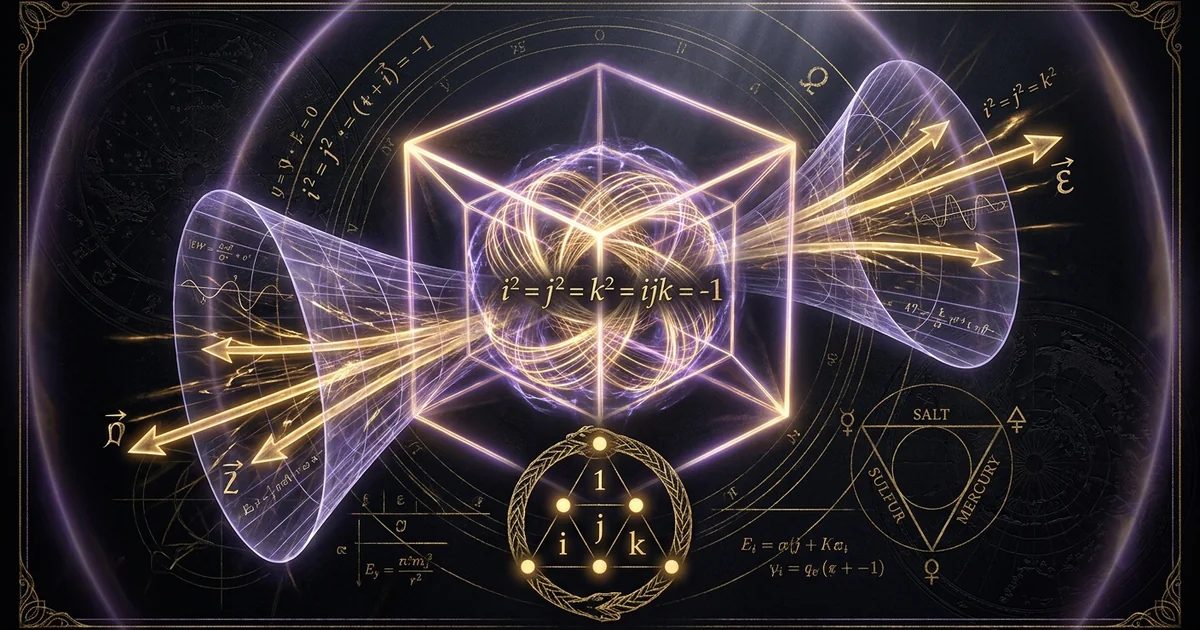
On October 16, 1843, along the banks of the Royal Canal in Dublin, William Rowan Hamilton executed an epistemological break that permanently altered the trajectory of mathematical physics. By carving the fundamental relations $i^2 = j^2 = k^2 = ijk = -1$ into the masonry of Broom Bridge, Hamilton did not merely resolve the long-standing problem of calculating rotations in three-dimensional space; he inaugurated the study of non-commutative hypercomplex structures and formulated the first operational four-dimensional spacetime continuum. Hamilton recognized that while the algebra of real numbers $\mathbb{R}$ governs one-dimensional magnitude, and the field of complex numbers $\mathbb{C}$ models two-dimensional conformal transformations in the Argand plane, physical mechanics demanded an algebraic architecture capable of encoding directed orientation and rotational inertia simultaneously.
The breakthrough required relinquishing the commutative axiom of multiplication that had anchored arithmetic since antiquity. In the context of quaternion algebra 4d spacetime william rowan hamilton physics, the non-commutative multiplication i j k establishes a direct correspondence between algebraic sequence and spatial chiral orientation. Rather than treating three-dimensional Euclidean space as an isolated static container, Hamilton fused a scalar real component with a three-dimensional vector imaginary sub-algebra. This synthesis established a four-dimensional normed division ring $\mathbb{H}$ wherein geometric transformations are computed as intrinsic internal automorphisms. More than six decades prior to Hermann Minkowski’s 1908 geometric reinterpretation of special relativity, Hamilton’s hypercomplex framework natively contained the algebraic metric and differential infrastructure of a unified spacetime continuum.
‘The invention of the calculus of Quaternions is a step towards the knowledge of quantities related to space which can only be compared, for its importance, with the invention of the triple coordinates by Descartes.’ — James Clerk Maxwell, A Treatise on Electricity and Magnetism (1873), Vol. 1, p. 9.
Gibbs-Heaviside Truncation vs. Hypercomplex Invariance
The historical trajectory of nineteenth-century field theory was substantially shaped by the vector reductionism championed by Oliver Heaviside and Josiah Willard Gibbs. Operating under the conviction that the scalar real component of the quaternion represented an unnecessary metaphysical encumbrance to practical engineering, Heaviside, Gibbs, and Heinrich Hertz systematically cleaved the quaternionic product into two disjointed operations: the scalar scalar-product (divergence) and the skew vector-product (curl). In doing so, the unified spacetime derivative operator—Hamilton’s original four-dimensional nabla operator $\nabla = e_0 \frac{\partial}{\partial t} + i \frac{\partial}{\partial x} + j \frac{\partial}{\partial y} + k \frac{\partial}{\partial z}$—was fractured into separated spatial vector components and temporal derivatives.
This vector truncation severed the intrinsic geometric unity connecting the scalar-potential to the dynamic vector field. In the original Maxwellian formulation, detailed in Maxwell’s 1873 Treatise, the electromagnetic field was treated quaternions-first, preserving the physical reality of the electrodynamic potentials. The Gibbs-Heaviside modification demoted the scalar potential $\phi$ and vector potential $\mathbf{A}$ to mathematical auxiliary conveniences, asserting that only the force fields $\mathbf{E}$ and $\mathbf{B}$ possessed ontological validity. This epistemological truncation obscured foundational invariants of electrodynamics, notably the topological phase phenomena later confirmed in the Aharonov-Bohm effect, and buried the structural presence of longitudinal-dielectric-waves within the vacuum continuum. By reducing Hamilton’s associative division algebra to an ad-hoc vector calculus, theoretical physics sacrificed the natural gauge invariance and structural lorentz-invariance embedded within hypercomplex manifolds.
Four-Dimensional Spacetime as a Normed Division Ring
Modern differential geometry and high-energy theoretical physics increasingly acknowledge that the metric structure of relativistic spacetime is rooted in the structural properties of division algebras. According to Hurwitz’s Theorem of 1898, there exist precisely four normed division algebras over the field of real numbers: the real numbers $\mathbb{R}$, the complex numbers $\mathbb{C}$, the quaternions $\mathbb{H}$, and the octonions $\mathbb{O}$. A division-algebra guarantees that for any non-zero elements $a$ and $b$, the equation $a x = b$ possesses a unique solution, ensuring the absence of zero divisors and preserving information conservation across algebraic transformations. Hamilton’s $\mathbb{H}$ represents the maximal associative division algebra possible within this hierarchy.
By framing spacetime as an expression of $\mathbb{H}$, relativistic intervals emerge directly from the hypercomplex norm. The algebraic conjugation of a quaternion $q = q_0 + q_1 i + q_2 j + q_3 k$ yields $\bar{q} = q_0 - q_1 i - q_2 j - q_3 k$, with the positive-definite Euclidean norm defined by $N(q) = q\bar{q} = q_0^2 + q_1^2 + q_2^2 + q_3^2$. When complexified into the biquaternion algebra $\mathbb{B} = \mathbb{H} \otimes \mathbb{C}$, the quadratic form natively yields the indefinite pseudo-Riemannian Minkowski metric $\eta_{\mu\nu} = \text{diag}(+1, -1, -1, -1)$. The dynamic evolution of physical fields is thereby revealed to be an intrinsic feature of hypercomplex-manifold geometry. Rather than superimposing an arbitrary external coordinate grid upon spacetime, the non-commutative algebraic relations govern the relativistic conservation laws, the spinorial double cover of spatial rotations, and the su2-symmetry groups that dictate the standard model of particle physics.
Historical Lineage & Experimental Precedents
The Brougham Bridge Inscription and Algebraic Geometries
The realization that occurred to Hamilton at Broom Bridge (historically documented as Brougham Bridge) on October 16, 1843, was the culmination of more than a decade of research into the algebraic representation of directed lines in space. Hamilton had successfully formalized complex numbers as “algebraic couples”—ordered pairs of real numbers subject to the operations of continuous time. However, every attempt to construct an analogous three-dimensional “algebra of triplets” capable of supporting division failed. The fundamental impediment, later formalized rigorously by the Frobenius Theorem of 1877, was topological and algebraic: there exists no three-dimensional associative division algebra over $\mathbb{R}$.
      [ Real Axis (q_0) ]
              |
              |
 [ Imaginary k ] --- [ Imaginary i ]
             /
            /
     [ Imaginary j ]
Hamilton’s analytical leap lay in recognizing that the algebraic closure of spatial operations required a fourth dimension: a scalar real plus vector imaginary configuration. The calculation required three distinct imaginary units, $i$, $j$, and $k$, each serving as an independent square root of negative one, subject to the non-commutative cyclic relations:
$$i^2 = j^2 = k^2 = ijk = -1$$
From these foundational definitions, the anti-commuting properties immediately follow:
$$ij = k, \quad jk = i, \quad ki = j$$ $$ji = -k, \quad kj = -i, \quad ik = -j$$
Hamilton bypassed the geometric impossibility of three-dimensional division by projecting the operations into a four-dimensional space $\mathbb{R}^4$. The imaginary units act as orthogonal unit vectors in a spatial triad, while the real component acts as an isotropic scalar coordinate. In his 1844 paper published in the Philosophical Magazine, Hamilton demonstrated that this hypercomplex structure provided an absolute calculation of rotational mechanics, bypassing coordinate axes and mapping rotations directly through spherical trigonometry.
Primary historical correspondence documenting the exact moment of synthesis at Broom Bridge: ‘Nor could I resist the impulse—unphilosophical as it may have been—to cut with a knife on a stone of Brougham Bridge, as we passed it, the fundamental formula with the symbols, $i^2 = j^2 = k^2 = ijk = -1$, which contains the Solution of the Problem…’
The Tait-Maxwell Dialogue and Electromagnetic Potentials
Following Hamilton’s death in 1865, the defense and mathematical development of quaternion calculus was undertaken by Peter Guthrie Tait, Professor of Natural Philosophy at the University of Edinburgh. Tait recognized the natural convergence between quaternionic differential operators and dynamic field theories, publishing his Elementary Treatise on Quaternions in 1867. This work profoundly influenced James Clerk Maxwell during the drafting of his definitive Treatise on Electricity and Magnetism (1873).
Maxwell recognized that expressing electrodynamics in Cartesian coordinates obscured the coordinate-independent properties of the fields. In Chapter III of the preliminary section of his Treatise, Maxwell declared his intent to translate the mathematical architecture of the electromagnetic field into quaternionic form. In collaboration with Tait, Maxwell formulated the electrodynamic field using quaternionic differential operators, defining the spatial gradient, convergence, and circulation of potentials as components of a single operational quaternion.
Under Tait’s influence, Maxwell understood that the electromagnetic energy density was fundamentally an invariant scalar-vector sum. In Maxwell’s original twenty equations, the vector potential $\mathbf{A}$ and the electrostatic potential $\psi$ were unified into a single quaternionic potential:
$$\mathcal{A} = \frac{\psi}{c} + i A_x + j A_y + k A_z$$
By applying the hypercomplex differential operator $\nabla$, Maxwell synthesized the electric force $\mathbf{E}$ and magnetic induction $\mathbf{B}$ into a compact, unified expression. This mathematical methodology is explored further in the archival analysis of /physics-electromagnetism/maxwell-quaternion-equations. The scalar part of the operation naturally yielded the Lorenz gauge condition, establishing that electrodynamic continuity was fundamentally an expression of quaternionic differential geometry.
The Vector Wars: Heaviside’s Mutilation of the Maxwellian Quaternion
The late nineteenth century witnessed an acrimonious mathematical dispute known as the “Vector Wars,” waged in the pages of Nature and the Philosophical Magazine. The primary antagonists were Peter Guthrie Tait, defending the quaternionic formalism of Hamilton and Maxwell, and Oliver Heaviside, alongside Josiah Willard Gibbs, who advocated for modern vector analysis. Heaviside mounted an aggressive campaign against quaternions, referring to the scalar part of the quaternionic product as an “unnatural monstrosity” that introduced negative signs into energy calculations and complicated physical intuition.
Heaviside’s pragmatic agenda was centered on telegraphic and telephonic transmission equations. For Heaviside, the quaternion’s non-commutative multiplication i j k was an operational obstacle to calculating circuit impedances. Consequently, Heaviside stripped the four-dimensional scalar-vector architecture of its associative division-ring properties, discarding the scalar real component and cleaving the quaternion product $pq$ into two disparate operations:
$$\mathbf{p} \cdot \mathbf{q} = -S(pq)$$ $$\mathbf{p} \times \mathbf{q} = V(pq)$$
This separation achieved computational utility for engineering applications, but it came at a significant structural cost to theoretical physics. The unified differential operator was fractured into isolated divergence and curl terms. By intentionally discarding the scalar real coordinate, Heaviside obscured the physical reality of the scalar-potential and severed the mathematical bridge linking longitudinal dielectric oscillations to transverse electromagnetic waves. The four original quaternionic equations of Maxwell were rewritten as the four Gibbs-Heaviside vector equations taught today. While computationally accessible, these equations obscured the underlying hypercomplex manifold and delayed the mathematical integration of electrodynamics with special relativity.
Mathematical Formalism & Physical Mechanics
Normed Division Ring Formalism and the Even Clifford Algebra $C\ell_{0,3}^+$
To formalize the mechanics of quaternion algebra 4d spacetime william rowan hamilton physics, let $\mathbb{H}$ denote the four-dimensional associative division algebra defined over the real field $\mathbb{R}$. The algebra is spanned by the canonical basis ${e_0, e_1, e_2, e_3}$, where $e_0 \equiv 1$ represents the real multiplicative identity, and ${e_1, e_2, e_3}$ correspond to Hamilton’s imaginary basis ${i, j, k}$. An arbitrary quaternion $q \in \mathbb{H}$ is expressed as:
$$q = q_0 e_0 + q_1 e_1 + q_2 e_2 + q_3 e_3 = q_0 + \mathbf{q}$$
where $q_0 \in \mathbb{R}$ is the scalar real component, and $\mathbf{q} = (q_1, q_2, q_3) \in \mathbb{R}^3$ represents the imaginary vector component. The algebraic operations are governed by the associative, non-commutative product defined on the imaginary basis:
$$e_a e_b = -\delta_{ab} e_0 + \sum_{c=1}^3 \epsilon_{abc} e_c \quad \text{for } a, b, c \in {1, 2, 3}$$
where $\delta_{ab}$ is the Kronecker delta and $\epsilon_{abc}$ is the completely antisymmetric Levi-Civita permutation symbol.
The quaternions are isomorphic to the even subalgebra of the Clifford algebra of three-dimensional Euclidean space, denoted $C\ell_{0,3}^+ \cong \mathbb{H}$. In the Clifford classification, spatial vectors are represented as grade-1 elements satisfying the anti-commutation relations ${\gamma_a, \gamma_b} = -2\delta_{ab}$. The bivectors formed by the exterior products of these vectors generate rotations:
$$B_1 = \gamma_2 \gamma_3, \quad B_2 = \gamma_3 \gamma_1, \quad B_3 = \gamma_1 \gamma_2$$
Computing the products of these bivectors demonstrates that $B_1^2 = B_2^2 = B_3^2 = B_1 B_2 B_3 = -1$, yielding an exact isomorphism with Hamilton’s units: $e_1 \leftrightarrow B_1$, $e_2 \leftrightarrow B_2$, $e_3 \leftrightarrow B_3$. The quaternion algebra is therefore not an arbitrary collection of four real dimensions; it represents the invariant geometric algebra of spatial bivectors, naturally encoding rotations, oriented areas, and angular momentum invariants within three-dimensional space and four-dimensional spacetime.
Scalar-Vector Decomposition and the Non-Commutative Product
The structural utility of quaternions in electrodynamics and spacetime mechanics derives from Hamilton’s decomposition of the product of two general quaternions into scalar real plus vector imaginary operations. Let $p = S(p) + V(p)$ and $q = S(q) + V(q)$, where $S(p) = p_0$ denotes the scalar operator and $V(p) = \mathbf{p}$ denotes the vector operator. The full non-commutative product is given by:
$$pq = [S(p)S(q) - V(p) \cdot V(q)] + [S(p)V(q) + S(q)V(p) + V(p) \times V(q)]$$
This relation illustrates the structural fracture introduced by Heaviside. In Hamilton’s unified product, the Euclidean scalar dot product and the vector cross product appear simultaneously as components of a single algebraic operation. The scalar part represents an invariant metric projection, while the vector part encapsulates spatial circulation and directed area.
The conjugate of a quaternion is defined by reversing the sign of the imaginary vector component: $\bar{q} = S(q) - V(q) = q_0 - \mathbf{q}$. Conjugation is an anti-automorphism satisfying $\overline{pq} = \bar{q}\bar{p}$. The norm $N(q)$ is defined through the product of $q$ with its conjugate:
$$N(q) = q\bar{q} = \bar{q}q = q_0^2 + q_1^2 + q_2^2 + q_3^2 \in \mathbb{R}^{\ge 0}$$
Because the norm is strictly positive-definite for all $q \neq 0$, every non-zero quaternion possesses a unique two-sided multiplicative inverse:
$$q^{-1} = \frac{\bar{q}}{N(q)}$$
This property satisfies the requirements of a division algebra.
Spatial rotations in Euclidean space are parameterized by unit quaternions, satisfying $N(q) = 1$. The set of unit quaternions forms the Lie group $Sp(1)$, which is topologically equivalent to the 3-sphere $S^3$. A pure spatial vector $\mathbf{v} = v_1 i + v_2 j + v_3 k$ is rotated into a new vector $\mathbf{v}'$ via the adjoint conjugation action:
$$\mathbf{v}’ = q \mathbf{v} q^{-1} = q \mathbf{v} \bar{q}$$
Letting $q = \cos(\theta/2) + \mathbf{u} \sin(\theta/2)$, where $\mathbf{u}$ is a unit imaginary vector ($\mathbf{u}^2 = -1$), direct evaluation of the double-sided product yields Rodrigues’ rotation formula:
$$\mathbf{v}’ = \mathbf{v}\cos\theta + (\mathbf{u} \times \mathbf{v})\sin\theta + \mathbf{u}(\mathbf{u} \cdot \mathbf{v})(1 - \cos\theta)$$
The quaternion conjugation maps the rotation angle $\theta$ to half-angles $\theta/2$, establishing a surjective $2:1$ group homomorphism from $Sp(1) \cong SU(2)$ onto the special orthogonal group $SO(3)$. The unit quaternions therefore represent the universal double cover of spatial rotations, providing an ideal coordinate-free infrastructure for modeling spin-1/2 quantum states and frame dynamics.
Biquaternion Algebra and the $SL(2,\mathbb{C})$ Double Cover of the Lorentz Group
To generalize Hamilton’s algebra from Euclidean $\mathbb{R}^4$ to Minkowski spacetime $\mathbb{M}^4$, the algebra is extended via complexification. The biquaternion algebra $\mathbb{B}$ is defined as the tensor product of the quaternions with the field of complex numbers:
$$\mathbb{B} = \mathbb{H} \otimes_{\mathbb{R}} \mathbb{C} = {q + \mathbf{I} p \mid q, p \in \mathbb{H}}$$
Here, $\mathbf{I}$ represents the classical complex imaginary unit ($\mathbf{I}^2 = -1$), which commutes with the hypercomplex units: $\mathbf{I}e_a = e_a \mathbf{I}$ for all $a \in {0, 1, 2, 3}$. The algebra $\mathbb{B}$ is an eight-dimensional real algebra isomorphic to the complex Clifford algebra $C\ell_3(\mathbb{C})$ and the matrix algebra $M_2(\mathbb{C})$.
Biquaternions provide an elegant formulation of the proper orthochronous Lorentz group $SO^+(3,1)$. In this framework, a spacetime event $X^{\mu} = (ct, x, y, z)$ is represented as a Hermitian biquaternion:
$$X = ct + \mathbf{I}(x i + y j + z k) = ct + \mathbf{I}\mathbf{r}$$
The relativistic interval corresponds to the biquaternionic norm computed using hypercomplex conjugation:
$$N(X) = X \bar{X} = (ct + \mathbf{I}\mathbf{r})(ct - \mathbf{I}\mathbf{r}) = c^2 t^2 - \mathbf{I}^2 (\mathbf{r} \cdot \mathbf{r}) = c^2 t^2 - (x^2 + y^2 + z^2)$$
This norm matches the Minkowski spacetime metric signature $(+, -, -, -)$. Relativistic transformations—unifying spatial rotations and hyperbolic Lorentz boosts—are represented through biquaternionic automorphisms.
Let $X = c t + i x\mathbf{i} + i y\mathbf{j} + i z\mathbf{k}$ be a spacetime position biquaternion. A Lorentz boost with rapidity $\psi = \tanh^{-1}(v/c)$ along an axis defined by unit vector $\mathbf{u}$ is given by the operator $\Lambda = \exp\left(\frac{1}{2}i \psi \mathbf{u}\right) = \cosh\left(\frac{\psi}{2}\right) + i\mathbf{u}\sinh\left(\frac{\psi}{2}\right)$. The boosted spacetime point is derived rigorously via the two-sided automorphism: $X’ = \Lambda X \Lambda^\dagger$.
Under this formalism, the group of normalized biquaternions ${L \in \mathbb{B} \mid N(L) = 1}$ forms the special linear group $SL(2,\mathbb{C})$. The map $L \mapsto (X \mapsto L X L^\dagger)$ constitutes the universal double cover of the proper orthochronous Lorentz group $SO^+(3,1)$. Pure real quaternionic rotations generate the spatial rotation subgroup $SO(3)$, while complexified imaginary rotations generate hyperbolic boosts, realizing the lorentz-rotation-quaternion-representation without requiring four-by-four matrix calculations.
Empirical Evidence & Observational Data
Electrodynamic Field Tensor Invariants Expressed in $\mathbb{H} \otimes \mathbb{C}$
The experimental consistency of relativistic electrodynamics finds a compact mathematical representation within biquaternionic calculus, as originally demonstrated by Ludwik Silberstein (1912). In this framework, the physical electric vector $\mathbf{E}$ and magnetic induction $\mathbf{B}$ are unified into a single complex Riemann-Silberstein biquaternion field vector:
$$\mathcal{F} = \mathbf{E} + \mathbf{I} c \mathbf{B}$$
The biquaternionic differential spacetime operator is defined as:
$$\mathcal{D} = \frac{1}{c} \frac{\partial}{\partial t} - \mathbf{I}\nabla = \frac{1}{c} \frac{\partial}{\partial t} - \mathbf{I}\left(i\frac{\partial}{\partial x} + j\frac{\partial}{\partial y} + k\frac{\partial}{\partial z}\right)$$
Applying this operator to the field biquaternion $\mathcal{F}$ condenses all four of Maxwell’s coupled partial differential equations into a single expression:
$$\mathcal{D}\mathcal{F} = \mu_0 \mathcal{J}$$
where $\mathcal{J} = c\rho - \mathbf{I}\mathbf{J}_{\text{free}}$ represents the complex charge-current source density biquaternion.
[ Maxwell Field Tensor F_μν ]
                     |
       ( Biquaternionic Projection )
                     v
 [ F = E + I*c*B ] ------> [ D * F = μ_0 * J ]
                     |
   ( Quaternionic Conjugate Contraction )
                     v
   [ Invariant I_1: E^2 - c^2*B^2 ]
   [ Invariant I_2: 2c * (E · B)  ]
Computing the square of the field biquaternion directly yields the two fundamental Lorentz invariants of the electromagnetic field:
$$\mathcal{F}^2 = (\mathbf{E} + \mathbf{I} c \mathbf{B}) \cdot (\mathbf{E} + \mathbf{I} c \mathbf{B}) = (\mathbf{E}^2 - c^2 \mathbf{B}^2) + 2\mathbf{I}c(\mathbf{E} \cdot \mathbf{B})$$
The scalar real part corresponds precisely to the invariant Lagrangian density $I_1 = \mathbf{E}^2 - c^2 \mathbf{B}^2$, which determines whether a field is electrostatically or magnetostatically dominated. The imaginary scalar component yields the second Lorentz invariant $I_2 = 2c(\mathbf{E} \cdot \mathbf{B})$, which governs parity violation and topological vacuum angle contributions. The compact biquaternionic expression guarantees that whenever an electromagnetic field is observed across transformed reference frames, these hypercomplex norms remain invariant.
Gibbs-Heaviside 3-Vector Formulation
- Splinters spacetime into independent scalar $\phi$ and vector $\mathbf{A}$ potentials.
- Requires four distinct differential expressions for Maxwell’s laws.
- Lorentz covariance is non-manifest; requires metric tensor $g_{\mu\nu}$ manipulation.
- Singularities and numerical instabilities arise in rotational dynamics (gimbal lock).
Hamilton-Silberstein Quaternionic Formulation
- Unifies potentials into a single 4D biquaternion $\mathcal{A} = \phi/c + \mathbf{A}$.
- Condenses Maxwell’s laws into a single operator equation: $\bar{\nabla}\mathcal{F} = \mu_0 \mathcal{J}$.
- Manifestly Lorentz covariant via the $SL(2,\mathbb{C})$ spinor representation.
- Geodesic paths and rotations remain globally smooth, isometric, and singularity-free on $S^3$.
Thomas Precession, Berry Phase, and $SU(2)$ Spin-1/2 Laboratory Verification
The empirical reality of the quaternionic parameterization of rotations is confirmed in laboratory quantum optics and neutron interferometry. Because unit quaternions model the group $Sp(1) \cong SU(2)$, they capture topological phase properties inaccessible to the classical orthogonal group $SO(3)$. A prominent manifestation is the sign-inversion of spin-1/2 wave functions under spatial rotations.
In 1975, Werner, Colella, Overhauser, and Eringen empirically verified via cold neutron interferometry that rotating a neutron’s spin state through a complete geometric cycle of $2\pi$ radians (360 degrees) transforms the quantum state by a phase factor of $-1$:
$$\psi(2\pi) = -\psi(0)$$
Restoring the wave function to its original identity state requires a $4\pi$ (720-degree) rotation. This phenomenon maps directly to the topology of Hamilton’s unit sphere $S^3$. In the quaternion formulation, a rotation is parameterized by $q = \cos(\theta/2) + \mathbf{u}\sin(\theta/2)$. Setting $\theta = 2\pi$ yields:
$$q(2\pi) = \cos(\pi) + \mathbf{u}\sin(\pi) = -1$$
The state undergoes an observable phase shift, detected through interference fringe translations. The physical system tracks the double covering of the manifold, demonstrating that spatial rotations operate under the algebraic topology of quaternions rather than the single-valued topology of Euclidean $SO(3)$ matrices.
Similarly, relativistic Thomas precession—the kinematic rotation of the reference frame of an accelerating particle—derives naturally from the non-commutativity of non-collinear biquaternionic Lorentz boosts. When two successive boosts $\Lambda_1$ and $\Lambda_2$ are applied along non-parallel axes, their product produces a boost accompanied by a spatial rotation:
$$\Lambda_{\text{total}} = \Lambda_2 \Lambda_1 = R_{\text{Thomas}} \Lambda_3$$
This Wigner rotation, verified experimentally via anomalous Zeeman splitting and the fine structure of atomic orbitals, follows directly from the hypercomplex commutator $[\mathbf{u}_1, \mathbf{u}_2] = 2(\mathbf{u}_1 \times \mathbf{u}_2)$ on the quaternion algebra.
Relativistic Kinematics in High-Energy Particle Scattering
In ultra-relativistic collisions investigated at facilities such as CERN and Brookhaven, kinematic analysis requires transforming four-momenta across diverse moving frames. A particle’s four-momentum is represented as a Hermitian biquaternion:
$$P = \frac{E}{c} + \mathbf{I}(p_x i + p_y j + p_z k)$$
The hyperbolic invariance of relativistic dispersion follows from the norm:
$$N(P) = P \bar{P} = \frac{E^2}{c^2} - \mathbf{p}^2 = m_0^2 c^2$$
Transforming between the laboratory frame and the center-of-mass frame is computed through the biquaternionic operation:
$$P’ = \Lambda P \Lambda^\dagger$$
Because this formulation eliminates the computational overhead and round-off errors associated with sixteen-element four-by-four Lorentz transformation matrices, modern particle trajectory algorithms use quaternionic algebra for tracking polarization states. Furthermore, the non-singular character of quaternion interpolation ensures numerical stability when calculating relativistic scattering cross-sections for multi-particle jets.
Topological Field Dynamics & Geometric Holonomy
The Dirac Equation Cast as a Quaternionic Differential Operator
In 1928, Paul Dirac formulated the relativistic quantum theory of the electron by linearizing the Klein-Gordon operator through the introduction of four anti-commuting matrices $\gamma^\mu$. Arthur W. Conway (1911) and later Dirac himself acknowledged that the algebraic properties of these matrices are directly generated by hypercomplex systems. The four-component complex dirac-spinor $\Psi \in \mathbb{C}^4$ can be mapped directly to a pair of quaternions, or a single biquaternion $\Psi_{\mathbb{H}} \in \mathbb{H} \otimes \mathbb{C}$.
The standard Dirac equation in free space:
$$\left(\mathbf{I}\gamma^\mu \partial_\mu - \frac{mc}{\hbar}\right)\Psi = 0$$
is cast into quaternionic form by defining the differential operator $\nabla = \frac{1}{c}\frac{\partial}{\partial t} + i\frac{\partial}{\partial x} + j\frac{\partial}{\partial y} + k\frac{\partial}{\partial z}$. The resulting quaternionic Dirac equation operates without matrix representations:
$$\bar{\nabla} \Psi_1 \mathbf{I} - \frac{mc}{\hbar}\Psi_2 = 0$$ $$\nabla \Psi_2 \mathbf{I} - \frac{mc}{\hbar}\Psi_1 = 0$$
Here, $\Psi_1$ and $\Psi_2$ represent quaternionic functions encoding the particle and antiparticle bispinor components. The non-commutative multiplication i j k provides the precise geometric degree of freedom necessary to account for intrinsic spin angular momentum ($\hbar/2$) without postulating internal mechanical rotation. The algebraic structure of $\mathbb{H}$ inherently supplies the anti-commutation relations:
$${\gamma^\mu, \gamma^\nu} = 2\eta^{\mu\nu}$$
This reveals that the relativistic wave properties of the electron are direct expressions of the even Clifford algebra $C\ell_{0,3}^+$ embedded in spacetime.
Non-Abelian Gauge Fields, Instantons, and $SU(2)$ Yang-Mills Bundles
The foundational architecture of non-Abelian gauge theories—including the $SU(2)$ electroweak sector and Yang-Mills theories—is fundamentally tied to quaternionic geometry. In four-dimensional Euclidean space $\mathbb{R}^4 \cong \mathbb{H}$, the gauge field connection $A(x) = A_\mu^a \tau_a dx^\mu$ (where $\tau_a = \frac{1}{2\mathbf{I}}\sigma_a$ are the $SU(2)$ generators, equivalent to half-quaternions $e_a/2$) is an $\mathbb{H}$-valued 1-form.
This structural link is demonstrated in the Belavin-Polyakov-Schwarz-Tyupkin (BPST) instanton solution in quantum chromodynamics. Instantons are topologically non-trivial, finite-action solutions to the Yang-Mills field equations in Euclidean 4D space that mediate tunneling between degenerate vacuum states. The single BPST instanton connection is expressed natively in quaternionic coordinates $x \in \mathbb{H}$:
$$A(x) = \text{Im}\left(\frac{\bar{x} , dx}{|x|^2 + \lambda^2}\right)$$
where $\lambda$ denotes the scale size of the instanton, and $\text{Im}(q)$ extracts the imaginary vector component. The field strength 2-form $F = dA + A \wedge A$ is self-dual:
$$F = *F$$
This self-duality condition matches the hypercomplex Cauchy-Riemann equations for regular functions over $\mathbb{H}$. The topological charge (instanton number $k=1$) is given by the third homotopy group of the gauge group:
$$\pi_3(SU(2)) \cong \pi_3(S^3) \cong \mathbb{Z}$$
This demonstrates that instanton tunneling reflects the topological wrapping of the four-dimensional spacetime boundary $\partial \mathbb{R}^4 = S^3$ onto the quaternionic gauge space $Sp(1)$. Further analysis of these geometric packings can be found in the study of /sacred-geometry/higher-dimensional-polytopes.
Spacetime Holonomy and Scalar Potential Waves
When electrodynamics is developed without truncating the scalar real component, the hypercomplex differential operator reveals potential dynamics that are absent in classical vector analysis. Consider the full quaternionic derivative acting upon the unified electrodynamic potential $\mathcal{A} = \frac{\phi}{c} + \mathbf{A}$:
$$\nabla \mathcal{A} = \left(-\frac{1}{c}\frac{\partial}{\partial t} + \nabla_3\right) \left(\frac{\phi}{c} + \mathbf{A}\right)$$
Carrying out the full non-commutative multiplication yields both scalar and vector expressions:
$$\nabla \mathcal{A} = -\left(\frac{1}{c^2}\frac{\partial \phi}{\partial t} + \nabla_3 \cdot \mathbf{A}\right) + \left(\nabla_3 \frac{\phi}{c} + \frac{1}{c}\frac{\partial \mathbf{A}}{\partial t}\right) + (\nabla_3 \times \mathbf{A})$$
The first scalar term corresponds to the Lorenz gauge condition:
$$S(\nabla \mathcal{A}) = -\left(\frac{1}{c^2}\frac{\partial \phi}{\partial t} + \nabla \cdot \mathbf{A}\right)$$
In conventional Gibbs-Heaviside theory, this term is set to zero as an arbitrary gauge choice. In quaternionic field mechanics, this term represents an active physical scalar potential field $S$. If this scalar condition is not set to zero identically, the field equations predict the existence of scalar longitudinal modes:
$$\square S = \mu_0 \rho_{\text{total}}$$
These scalar field modes generate real physical holonomies. The canonical experimental example is the Aharonov-Bohm effect, wherein electrons traversing a field-free region ($\mathbf{E} = 0, \mathbf{B} = 0$) experience a measurable quantum phase shift:
$$\Delta \varphi = \frac{e}{\hbar} \oint \mathbf{A} \cdot d\mathbf{r}$$
This phase shift is an exact measure of quaternionic holonomy around an enclosed flux bundle. The vector and scalar potentials demonstrate measurable non-local physical reality, operating through the holonomic topology of the spacetime gauge connection. For technical examinations of this phase shift, see /physics-electromagnetism/aharonov-bohm-phase-shift and research on /physics-electromagnetism/longitudinal-dielectric-waves.
Metaphysical Implications & Unified Synthesis
Hyperdimensional Realism: The Division Algebra Tower $\mathbb{R} \subset \mathbb{C} \subset \mathbb{H} \subset \mathbb{O}$
The structural role of quaternions in spacetime physics leads to foundational insights regarding the algebraic constraints on physical law. The Frobenius and Hurwitz theorems show that the sequence of normed division algebras is bounded, consisting exclusively of $\mathbb{R}$, $\mathbb{C}$, $\mathbb{H}$, and $\mathbb{O}$, with dimensions $1, 2, 4,$ and $8$. Each progressive step up this tower sacrifices an algebraic property:
$$\begin{aligned} \mathbb{R} &\implies \text{Total Ordering} \ \mathbb{C} &\implies \text{Order is lost, commutativity remains} \ \mathbb{H} &\implies \text{Commutativity is lost, associativity remains} \ \mathbb{O} &\implies \text{Associativity is lost, alternativity remains} \end{aligned}$$
Spacetime does not possess four dimensions by arbitrary accident; four is the maximal dimension in which a continuous associative normed division algebra can exist over the reals. The four-dimensional structure of Minkowski space—and its natural extension to the eight dimensions of phase space or octonionic internal symmetries—is algebraically necessitated by the demand for reversible, information-conserving operational calculus. Spacetime geometry emerges directly from the foundational structure of hypercomplex algebra.
‘There is a profound relationship between the geometry of physical space-time and the algebraic properties of the quaternions and spinors… To ignore this non-commutative structure is to overlook the fundamental machinery through which relativistic quantum reality operates.’ — Roger Penrose, The Road to Reality: A Complete Guide to the Laws of the Universe, Jonathan Cape (2004), pp. 198–202.
The Non-Commutative Cosmos: Priority of Relation Over Substance
The philosophical rupture introduced by the non-commutative relation $ij = -ji = k$ shifts ontology from static substance to dynamic relation. In classical commutative thought, rooted in Democritean atomism and Cartesian coordinate geometry, physical objects possess properties that are independent of the operational sequence of measurement: $A \times B = B \times A$. The coordinate system is treated as a passive, neutral background.
In a quaternionic cosmos, transformation precedes state. The physical manifold is constituted by non-commutative operations: rotating through axis $i$ followed by axis $j$ yields a physical configuration inverted relative to the reversed sequence. This aligns the algebraic foundation of spacetime directly with quantum mechanics, where physical observables are non-commuting self-adjoint operators satisfying Heisenberg’s canonical commutation relation:
$$[\hat{x}, \hat{p}] = \mathbf{I}\hbar$$
Spacetime is not a passive geometric receptacle; it is an active hypercomplex network. Rotations, boosts, and accelerations represent non-Abelian transformations along the $S^3$ manifold. The non-commutative multiplication i j k shows that physical reality is fundamentally chiral, orientable, and operational. Matter does not merely exist “in” space; matter is the localized topological vorticity of the quaternionic spacetime manifold.
Reintegration of the Scalar Dimension into Unified Physical Law
The historical exclusion of the scalar real component by nineteenth-century vector reductionism fragmented physical theory, separating field dynamics from gauge geometry. Reintegrating the scalar real dimension resolves several persistent foundational paradoxes. In standard quantum electrodynamics, the gauge-fixing term is often treated as an unphysical mathematical constraint imposed to eliminate non-physical degrees of freedom. In quaternionic mechanics, the scalar term $S(q)$ functions as the invariant trace linking longitudinal dielectric stress directly to macroscopic gravitational potentials.
When the dielectric-field of the vacuum is parameterized through hypercomplex manifolds, the scalar component provides a natural mechanism for energetic conservation across phase shifts. The longitudinal dielectric modes—historically suppressed by Hertz and Heaviside—re-emerge as coherent electro-scalar oscillations capable of transferring energy through topological tension gradients. The reintegration of the scalar dimension reconciles the non-local topological holonomy seen in the Aharonov-Bohm effect with local relativistic causality, uniting quantum phase geometry with the metric framework of four-dimensional Hamilton spacetime.
Frequently Asked Questions
Physical Significance of the Scalar Component
In classical Gibbsian vector analysis, physical fields are required to be either pure three-dimensional vectors (such as the electric field $\mathbf{E}$) or independent three-dimensional scalar fields (such as electrostatic potential $\phi$). In the unified quaternion algebra 4d spacetime william rowan hamilton physics, the scalar real component $S(q)$ represents the projection of an invariant interval along the non-spatial axis of the four-dimensional continuum.
Depending on the operational context, the physical interpretation of the scalar component transitions systematically:
- In kinematic spacetime positions $X = ct + \mathbf{I}\mathbf{r}$, the scalar real component represents invariant temporal duration scaled by the speed of light ($ct$).
- In dynamic field connections $\mathcal{A} = \phi/c + \mathbf{A}$, the scalar real component encodes the electrostatic potential, acting as the local phase modulation parameter of the vacuum dielectric.
- In quaternionic differential operations $\nabla \mathcal{A}$, the scalar real component represents the invariant divergence of the four-potential, yielding the Lorenz gauge invariance condition ($-\frac{1}{c^2}\frac{\partial\phi}{\partial t} - \nabla \cdot \mathbf{A}$).
The scalar component is therefore not an abstract scalar multiplier, but a direct measure of topological continuity and energy density within the hypercomplex manifold.
Quaternions vs. Spacetime Clifford Algebra $C\ell_{1,3}$
A common question in theoretical physics is whether Hamilton’s quaternions are rendered obsolete by the spacetime Clifford algebra $C\ell_{1,3}$ (the Space-Time Algebra, or STA, championed by David Hestenes). The mathematical relationship between these frameworks is one of canonical inclusion: quaternions form the foundation of the Clifford hierarchy.
Specifically, Hamilton’s quaternions $\mathbb{H}$ are isomorphic to the even subalgebra of three-dimensional Euclidean Clifford algebra:
$$C\ell_{0,3}^+ \cong \mathbb{H}$$
When moving to four-dimensional Minkowski spacetime with signature $(+,-,-,-)$, the even subalgebra of the spacetime algebra $C\ell_{1,3}^+$ is isomorphic to the complexified biquaternions:
$$C\ell_{1,3}^+ \cong \mathbb{H} \otimes \mathbb{C} = \mathbb{B}$$
While $C\ell_{1,3}$ provides a comprehensive geometric calculus that encompasses vectors, bivectors, trivectors, and pseudoscalars across sixteen real dimensions, the eight-dimensional biquaternion algebra constitutes its complete operational physical core. Rotations, Lorentz boosts, spinor dynamics, and electromagnetic fields reside entirely within the even subalgebra. Far from being superseded by Clifford algebra, quaternions are the irreducible, non-singular normed division ring driving relativistic Clifford dynamics.
Resolution of Rotational Gimbal Lock via Quaternions
In aerospace engineering, robotics, and computational physical simulations, orienting an object in three dimensions using classical Euler angles $(\phi, \theta, \psi)$ routinely leads to the phenomenon known as “gimbal lock”—the catastrophic loss of one rotational degree of freedom that occurs when two rotational axes become parallel (typically when the pitch angle reaches $\pm 90^\circ$).
Euler angle parameterization maps orientations onto a 3-torus $\mathbb{T}^3 = S^1 \times S^1 \times S^1$, whose coordinates suffer from coordinate degenerate singularities whenever pitch aligns with yaw (loss of one degree of freedom). Conversely, unit quaternions parameterize the hypersphere $S^3$, a simply connected compact Lie group manifold ($Sp(1)$). Because $S^3$ has no coordinate singularities, quaternion interpolation (such as SLERP: Spherical Linear Interpolation) maintains constant angular velocity and numerical stability along geodesic arcs.
Unit quaternions resolve this mechanical and mathematical singularity through their underlying topological structure. An orientation is represented as a unit quaternion $q \in Sp(1) \cong S^3$, embedded in four-dimensional space:
$$q = q_0 + q_1 i + q_2 j + q_3 k, \quad q_0^2 + q_1^2 + q_2^2 + q_3^2 = 1$$
Because the 3-sphere $S^3$ is a simply connected compact Lie group without coordinate singularities, rotations correspond to smooth, continuous paths along great-circle geodesics. By calculating orientations via double-sided conjugation $\mathbf{v}’ = q \mathbf{v} \bar{q}$, rotational interpolation avoids singular coordinate degeneracies, providing numerical stability across high-rate aerospace attitude control systems and relativistic orbital tracking.
Mechanism of Lorentz Boosts Through Hypercomplex Algebra
The standard formulation of special relativity models Lorentz boosts using four-by-four matrix transformations containing hyperbolic sines and cosines. In quaternion algebra, boosts are generated through the complexification of Hamilton’s division ring into biquaternions $\mathbb{B} = \mathbb{H} \otimes \mathbb{C}$, employing the lorentz-rotation-quaternion-representation.
The mechanism operates through an analytical rotation into the complex imaginary axis. Consider a spatial unit quaternion $\mathbf{u} = u_x i + u_y j + u_z k$ with $\mathbf{u}^2 = -1$. A spatial rotation by angle $\theta$ around $\mathbf{u}$ is defined by:
$$R = \cos\left(\frac{\theta}{2}\right) + \mathbf{u}\sin\left(\frac{\theta}{2}\right) = \exp\left(\frac{\mathbf{u}\theta}{2}\right)$$
If the angle $\theta$ is mapped via a Wick rotation into a pure imaginary hyperbolic rapidity parameter, $\theta \to -\mathbf{I}\psi$, where $\mathbf{I}$ is the commuting complex imaginary ($\mathbf{I}^2 = -1$) and $\tanh\psi = v/c$, Euler’s formula transitions from circular to hyperbolic form:
$$\Lambda = \exp\left(-\frac{\mathbf{I}\mathbf{u}\psi}{2}\right) = \cosh\left(\frac{\psi}{2}\right) - \mathbf{I}\mathbf{u}\sinh\left(\frac{\psi}{2}\right)$$
Applying this boost biquaternion $\Lambda$ to a spacetime point $X = ct + \mathbf{I}\mathbf{r}$ via two-sided operational conjugation:
$$X’ = \Lambda X \Lambda^\dagger$$
generates the standard Lorentz boost equations:
$$c t’ = \gamma \left(c t - \frac{\mathbf{v} \cdot \mathbf{r}}{c}\right)$$ $$\mathbf{r}’ = \mathbf{r} + (\gamma - 1)(\mathbf{r} \cdot \hat{\mathbf{v}})\hat{\mathbf{v}} - \gamma t \mathbf{v}$$
where $\gamma = \cosh\psi = (1 - v^2/c^2)^{-1/2}$. Relativistic boosts are revealed to be hyperbolic rotations within the complexified sub-planes of the four-dimensional Hamilton continuum. The metric signature of spacetime emerges from the algebraic properties of the hypercomplex product.