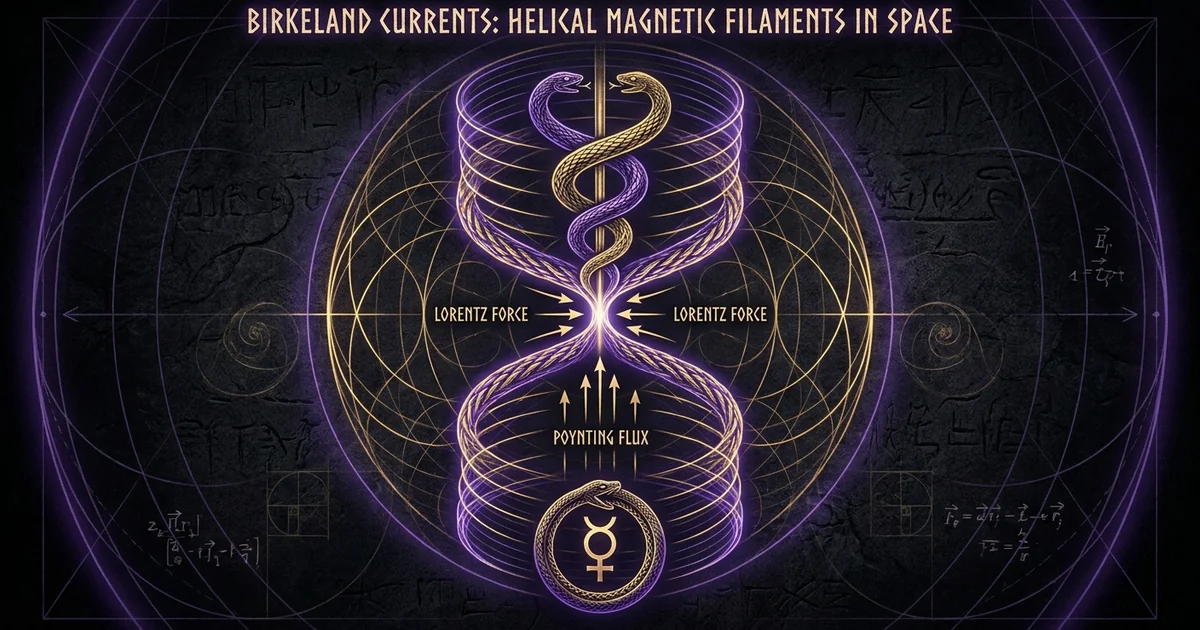
Birkeland Currents: Helical Magnetic Filaments in Space
Executive Summary & Theoretical Thesis: Morphological Supremacy of Electrodynamic Filamentation
The structural organization of the observable universe presents a fundamental contradiction to isotropic gravitational collapse models. Vast networks of luminous matter, spanning from parsec-scale interstellar molecular clouds to multi-megaparsec intergalactic filaments, exhibit pronounced anisotropic, thread-like morphologies that standard cold dark matter ($\Lambda\text{CDM}$) simulations struggle to reproduce without ad hoc parameterizations. The foundational mechanism governing this morphometry resides in the electrodynamics of magnetized plasmas, specifically through the action of self-confining, field-aligned current structures known as Birkeland currents. These helical vector systems channel charges along magnetic field lines, establishing a balance between thermal kinetic expansion and electromagnetic pinch forces. Rather than behaving as passive, perfectly conducting fluids dominated by the gravitational field, cosmic plasmas actively segregate charges, generate macroscopic potential drops, and construct self-organizing circuits across vast spatial dimensions.
“The concept of ‘frozen-in’ magnetic field lines is often applied to regions where its validity conditions are completely violated. In dilute, inhomogeneous cosmic plasmas, electric currents produce significant parallel electric fields ($E_\parallel \neq 0$), decoupling the plasma motion from the magnetic field and rendering classical ideal magnetohydrodynamic approximations fundamentally invalid.”
— Hannes Alfvén, Cosmical Electrodynamics (Oxford: Clarendon Press, 1950).
The Breakdown of Ideal Magnetohydrodynamic Approximations in Dilute Plasmas
For decades, the dominant paradigm in theoretical astrophysics rested on the assumption of ideal magnetohydrodynamics (MHD), which posits an infinite electrical conductivity ($\sigma \to \infty$) throughout astrophysical media. Under this idealization, the electric field in the frame of the plasma vanishes, enforcing the condition:
$$\mathbf{E} + \mathbf{v} \times \mathbf{B} = 0$$
This formulation leads directly to Alfvén’s frozen-in theorem, wherein the magnetic flux through any closed loop moving with the fluid is strictly conserved. While mathematically tractable, this approximation fails catastrophically when applied to low-density, collisionless cosmic environments. In rarefied astrophysical plasmas—such as the terrestrial magnetosphere, the solar wind, and the warm-hot intergalactic medium (WHIM)—the classical Spitzer resistivity, which depends on Coulomb collisions, becomes physically irrelevant.
When collision frequencies drop below the gyrofrequency of the charged species, non-collisional kinetic mechanisms dominate transport. Microscopic plasma instabilities, wave-particle interactions, charge-separation double layers, and anomalous resistivity generate strong, localized electric fields parallel to the background magnetic vector ($E_\parallel = \mathbf{E} \cdot \mathbf{B} / |\mathbf{B}| \neq 0$). Under these conditions, the decoupling of charged particles from the magnetic field lines allows electrons and ions to accelerate in opposite directions along the field vector. This longitudinal particle motion manifests as field-aligned currents that mediate direct energy transfer between disparate cosmic regions, invalidating the frozen-in theorem and transforming the plasma into an active, circuit-driven electrodynamic medium. More details on displacement phenomena are analyzed in /physics-electromagnetism/maxwell-ampere-dielectric-displacement.
Beltrami Vector Fields and Force-Free Helical Configurations ($\nabla \times \mathbf{B} = \alpha \mathbf{B}$)
The spatial architecture of Birkeland currents in space plasma helical magnetic field filaments is dictated by the principle of minimum energy dissipation. In an unconstrained plasma carrying high current densities, the macroscopic Lorentz force density is expressed as:
$$\mathbf{f}_L = \mathbf{J} \times \mathbf{B}$$
A plasma column subjected to perpendicular Lorentz forces will expand or shed its structure unless balanced by an external pressure gradient:
$$\nabla P = \mathbf{J} \times \mathbf{B}$$
However, in cosmic environments where the thermal kinetic pressure is small relative to the magnetic energy density—quantified by a low plasma beta parameter ($\beta = 2\mu_0 P / B^2 \ll 1$)—the plasma dynamically relaxes into a force-free-field state. In this equilibrium configuration, the Lorentz force identically vanishes:
$$\mathbf{J} \times \mathbf{B} = 0$$
This mathematical condition requires that the current density vector $\mathbf{J}$ be everywhere collinear with the local magnetic induction vector $\mathbf{B}$. By invoking the static Maxwell-Ampère law ($\nabla \times \mathbf{B} = \mu_0 \mathbf{J}$), the force-free state takes the form of an eigenvalue equation characteristic of a Beltrami vector field:
$$\nabla \times \mathbf{B} = \alpha(\mathbf{r}) \mathbf{B}$$
Here, $\alpha(\mathbf{r})$ is a scalar function of position that satisfies $\mathbf{B} \cdot \nabla \alpha = 0$, indicating that $\alpha$ remains invariant along any given field line. When $\alpha$ is spatially constant, the state is termed a linear (or Taylor-relaxed) force-free field. The topological solution to this vector differential equation in cylindrical geometry yields a nested series of concentric, helical magnetic surfaces. At the central axis of the current filament, the magnetic field is purely axial (longitudinal). As radial distance from the central axis increases, the field lines shear systematically, acquiring an increasingly dominant azimuthal (transverse) component. This concentric shearing establishes an intrinsic self-confining envelope that prevents the lateral expansion of the current channel.
Cosmic Electric Currents: Challenging Purely Gravitational Morphogenesis
Standard cosmological frameworks operate on the premise that gravitational interaction is the sole architect of large-scale structure. Gravity, being universally attractive, scales with distance according to the inverse-square law:
$$F_G \propto \frac{G m_1 m_2}{r^2}$$
This inverse-square dependency governs isotropic collapse, typically predicting spheroidal or ellipsoidal mass condensations. In sharp contrast, electromagnetic forces acting between parallel currents depend upon the Biot-Savart configuration. When two long, linear Birkeland filaments carry parallel currents $I_1$ and $I_2$, the attractive Lorentz force per unit length $L$ scales inversely with the first power of the spatial separation distance $r$:
$$\frac{F_{EM}}{L} = \frac{\mu_0 I_1 I_2}{2\pi r}$$
Because the electromagnetic interaction decreases as $r^{-1}$ rather than $r^{-2}$, parallel intergalactic current filaments exert an organizing influence across distances where gravitational forces have attenuated below the kinetic noise threshold. Furthermore, the magnitude of the electromagnetic force between individual fundamental charges exceeds their gravitational attraction by a factor of approximately $10^{39}$. Consequently, even a minuscule degree of fractional charge segregation ($n_e - n_i \sim 10^{-18}$) is sufficient to generate electrodynamic forces that entirely overwhelm local gravitational fields. The cellular, braided, and web-like structure of the cosmic web represents the macroscopic manifestation of these electromagnetic filaments drawing matter into linear and cylindrical nodes via magnetic pinching, rather than the consequence of purely isotropic gravitational instability.
Historical Lineage & Experimental Precedents: From the Terrella Apparatus to Satellite Verification
The recognition that helical current conduits bridge planetary and cosmic bodies developed through severe theoretical conflict. For more than half a century, the mainstream geophysical community dismissed the physical reality of space-borne electric currents, asserting that the interplanetary medium was a pristine, charge-neutral vacuum incapable of supporting sustained current paths.
“A current of several hundred thousand amperes, entering the upper atmosphere from space along the magnetic lines of force, passing horizontally through the auroral belt, and then ascending again along the lines of force into cosmic space, will fully account for the magnetic disturbances observed at the Earth’s surface during violent polar storms.”
— Kristian Birkeland, The Norwegian Aurora Polaris Expedition 1902-1903, Vol. 1 (Christiania: H. Aschehoug & Co., 1908).
Kristian Birkeland’s Terrella Experiments (1896–1913): Cathode Rays in a Magnetic Dipole
The foundational lineage of cosmic electrodynamics originated in the laboratory of the Norwegian physicist Kristian Birkeland. Operating from the University of Christiania, Birkeland synthesized observational polar geomagnetism with experimental vacuum physics. He constructed a series of evacuated chambers, culminating in a 1,000-liter apparatus, within which he suspended a “terrella”—a spherical copper globe containing an internal electromagnetic coil capable of producing an adjustable dipole field.
+-------------------------------------------------------------------+
|                     EVACUATED VACUUM CHAMBER                      |
|                                                                   |
|   Cathode Ray Gun ---> [ High-Voltage Relativistic Electrons ]    |
|                                 |                                 |
|                                 v                                 |
|                     ( Terrestrial Dipole B-Field )                |
|                                 |                                 |
|                                 v                                 |
|                      +---------------------+                      |
|                      |  Magnetized Terrella|                      |
|                      |   [Copper Sphere]   |                      |
|                      |                     |                      |
|                      |   * Polar Phosphor  |                      |
|                      |     Auroral Rings   |                      |
|                      +---------------------+                      |
|                                                                   |
|   Empirical Manifestations Observed:                              |
|   1. Twin Polar Auroral Ovals                                     |
|   2. Equatorial Ring Currents                                     |
|   3. Retrograde Diamagnetic Electron Drifts                       |
+-------------------------------------------------------------------+
By subjecting this magnetized sphere to an external stream of cathode rays (electrons) accelerated across potentials exceeding 100 kilovolts, Birkeland directly reproduced the terrestrial auroral ovals. The relativistic beam, deflected by the dipole field, was guided toward the poles along the magnetic lines of force, producing luminous phosphorescent rings upon striking the coated surface of the terrella.
From these laboratory models and the quantitative ground-based data collected during his polar expeditions of 1899–1903, Birkeland posited that the Earth’s aurora borealis is not an isolated upper-atmospheric phenomenon. Instead, he concluded that it is the visual signature of a vast electrical circuit linking the Sun to the terrestrial magnetosphere, driven by kristian birkeland auroral currents streaming through the interplanetary void.
The Sydney Chapman Neutral Sheet Hegemony and the Decades of Academic Resistance
Despite Birkeland’s experimental validation and rigorous vector calculus formulations, his deductions were rejected by mainstream theoretical geophysicists for nearly six decades. The opposition was led primarily by the British mathematician and geophysicist Sydney Chapman. Chapman, working with V.C.A. Ferraro, formulated a mathematical paradigm of geomagnetic disturbances based entirely on the assumption of a dead interplanetary vacuum.
Chapman argued that any current system responsible for polar magnetic variations must be confined strictly within the conductive layers of the Earth’s ionosphere. He engineered mathematical models employing fictitious “equivalent current sheets”—closed, horizontal, two-dimensional ionospheric current patterns that could mathematically account for the ground-based magnetometer perturbations without requiring charges to leave or enter the terrestrial system.
Chapman declared that the hard vacuum of interplanetary space could not sustain electrical potentials or field-aligned charge conduits. Because Chapman’s spherical harmonic models were mathematically clean and adhered to the prevailing belief in a purely gravitational, electrically inert cosmos, his view became rigid scientific dogma. Birkeland’s field-aligned current hypothesis was relegated to scientific obscurity, and the Norwegian pioneer died in 1917 without seeing his primary thesis accepted.
Space-Age In Situ Validation: Satellite TRIAD and the Iijima-Potemra Current Systems
The theoretical impasse was broken by in situ satellite measurements. In 1966, an onboard magnetometer aboard a U.S. Navy navigation satellite detected transverse magnetic disturbances at an altitude of 1,100 kilometers that could not be reconciled with horizontal ionospheric current sheets. However, the final confirmation of Birkeland’s vision occurred with the launch of the TRIAD satellite in 1972.
Equipped with a sensitive three-axis fluxgate magnetometer, TRIAD flew through the low-altitude auroral oval in a circular polar orbit. The magnetometer data systematically recorded sharp, step-like magnetic perturbations exclusively in the east-west component ($\Delta B_y$), corresponding to vertical, field-aligned sheet currents passing through the satellite’s trajectory.
In a pair of seminal papers, Takeshi Iijima and Thomas A. Potemra mapped the global morphology, seasonal variations, and statistical distributions of these field aligned currents iijima potemra. Their comprehensive data demonstrated that millions of amperes of electrical current continuously flow into and out of the high-latitude polar ionosphere along the geomagnetic field lines. The scientific community was forced to formally abandon Chapman’s closed ionospheric model and officially adopt the nomenclature of Birkeland currents to honor the scientist who had predicted their exact geometry seventy years earlier.
Mathematical Formalism & Physical Mechanics: Cylindrical Z-Pinch and Force-Free Equilibria
The generation, propagation, and structural stability of Birkeland currents are governed by non-linear magnetohydrodynamic and kinetic equations. The primary mechanism responsible for their self-confinement is the electromagnetic z-pinch, which concentrates dilute matter into coherent, high-density filaments.
Cylindrical Coordinate Maxwell-Ampère Derivation of Helical Current Systems
Consider a steady-state, axially symmetric plasma column aligned along the $z$-axis of a standard cylindrical coordinate system $(r, \theta, z)$. Under the condition of azimuthal symmetry ($\partial / \partial \theta = 0$) and infinite axial extent ($\partial / \partial z = 0$), the current density vector $\mathbf{J}$ can be decomposed into an axial drift component $J_z®$ and an azimuthal spiral component $J_\theta®$:
$$\mathbf{J}® = J_\theta®\hat{\mathbf{\theta}} + J_z®\hat{\mathbf{z}}$$
Applying the static Maxwell-Ampère law, $\nabla \times \mathbf{B} = \mu_0 \mathbf{J}$, the components of the curl operator in cylindrical coordinates yield:
$$-\frac{\partial B_z}{\partial r} = \mu_0 J_\theta®$$
$$\frac{1}{r}\frac{\partial}{\partial r}(r B_\theta) = \mu_0 J_z®$$
Integration of these differential relations reveals the dual nature of the resulting magnetic induction field $\mathbf{B}® = B_\theta®\hat{\mathbf{\theta}} + B_z®\hat{\mathbf{z}}$. The axial current $J_z®$ generates a toroidal (azimuthal) magnetic field $B_\theta®$:
$$B_\theta® = \frac{\mu_0}{r}\int_0^r J_z(r’) r’ dr’$$
Simultaneously, the azimuthal current $J_\theta®$, representing the helical gyro-motion of the charged species, generates an axial (poloidal) magnetic field $B_z®$:
$$B_z® = B_z(0) - \mu_0 \int_0^r J_\theta(r’) dr’$$
The macroscopic Lorentz force density acting within the filament column is:
$$\mathbf{J} \times \mathbf{B} = (J_\theta B_z - J_z B_\theta)\hat{\mathbf{r}}$$
To prevent mechanical disruption, this radial electromagnetic force must be balanced by the internal kinetic pressure gradient of the plasma, $\nabla P = (dP/dr)\hat{\mathbf{r}}$:
$$\frac{dP}{dr} = J_\theta B_z - J_z B_\theta = -\frac{B_z}{\mu_0}\frac{dB_z}{dr} - \frac{B_\theta}{\mu_0 r}\frac{d}{dr}(r B_\theta)$$
Integrating this relationship radially establishes that the azimuthal magnetic field $B_\theta$ exerts an inward magnetic pinch pressure ($B_\theta^2 / 2\mu_0$), driving the plasma toward the central cylindrical axis, while the axial magnetic field $B_z$ exerts an outward magnetic tension that resists total gravitational or electromagnetic collapse. This dynamic equilibrium creates a structurally stable, self-channeling cosmic transmission line. Further explorations of this dynamic are detailed in /sound-cymatics/acoustic-levitation-vortex-dynamics.
In a constant-$\alpha$ linear force-free equilibrium ($\nabla \times \mathbf{B} = \alpha \mathbf{B}$), the cylindrical components of the magnetic field reduce to the zero-order and first-order Bessel functions of the first kind: $$B_z® = B_0 J_0(\alpha r)$$ $$B_\theta® = B_0 J_1(\alpha r)$$ $$B_r® = 0$$ where $B_0$ denotes the axial magnetic field strength at $r = 0$. The current density components map directly to the field components via $J_z® = (\alpha / \mu_0) B_z®$ and $J_\theta® = (\alpha / \mu_0) B_\theta®$. The first zero of $J_0(\alpha r)$, occurring at $\alpha r \approx 2.4048$, defines the radial boundary where the axial magnetic field reverses direction, forming a self-shielded, diamagnetic outer sheath that isolates the inner current core from external perturbations.
The Bennett Pinch Equilibrium Equation ($I^2 = \frac{2Nk(T_e + T_i)}{\mu_0}$)
The mechanical equilibrium condition governing an axially symmetric current filament was formulated by Willard Harrison Bennett in 1934. Multiplying the radial balance equation by $r^2 dr$ and integrating by parts across the entire cross-section of the plasma cylinder (from $r = 0$ to $r = \infty$), one obtains the classical Bennett relation.
Assuming that the external ambient pressure approaches zero at infinite radius, the integrated kinetic pressure yields the total thermal energy per unit length:
$$\int_0^\infty 2\pi r P® dr = N k (T_e + T_i)$$
where $N$ is the number of electrons (and ions) per unit length along the cylinder:
$$N = \int_0^\infty 2\pi r n® dr$$
and $T_e$ and $T_i$ represent the mean electron and ion temperatures, respectively, with $k$ denoting the Boltzmann constant. The integrated magnetic term reduces to:
$$\frac{\mu_0 I^2}{8\pi}$$
Equating these terms yields the celebrated Bennett pinch condition:
$$I^2 = \frac{8\pi N k (T_e + T_i)}{\mu_0} = \frac{2}{\mu_0} N k (T_e + T_i) \cdot 4\pi$$
Or in standard MKSA form:
$$I^2 = \frac{2}{\mu_0} N k (T_e + T_i) \cdot 4\pi \implies I^2 = \frac{8\pi}{\mu_0} N k (T_e + T_i)$$
When the current $I$ exceeds this critical Bennett threshold, the inward magnetic pinch pressure ($B_\theta^2 / 2\mu_0$) overcomes the internal thermal kinetic pressure of the plasma, initiating a spontaneous radial contraction known as the z-pinch. This process compresses both charged particles and neutral atoms (via neutral-drag polarization) directly into the central filamentary core, producing dense, highly ionized plasma columns out of disperse media.
Biot-Savart Attraction, Parallel Filament Coalescence, and Double Layer Formation
When multiple Birkeland current filaments are generated across a shared region of space, their interactions are governed by the superposition of their fields. Two parallel filaments carrying currents $I_1$ and $I_2$ in the same direction experience a mutual attractive force per unit length:
$$F = \frac{\mu_0 I_1 I_2}{2\pi d}$$
This long-range Biot-Savart attraction causes isolated current filaments to drift toward one another across cosmic distances. However, because each filament possesses a dynamic helical twist ($B_\theta \neq 0$), the interaction does not result in simple planar collision. Instead, the filaments enter into orbital angular momentum around a common center of mass.
As the filaments approach, their transverse magnetic fields reconnect and interweave, forming a braided, multi-strand ropelike structure. This mechanical braiding generates extreme local magnetic shears. Within these shears, the classical condition of quasi-neutrality ($n_e \approx n_i$) breaks down completely, resulting in the formation of electrostatic double layers.
An electrostatic double layer consists of two thin, adjacent space-charge sheaths: one possessing an excess of positive charge, the other an excess of negative charge. This localized charge separation produces a sharp, localized scalar-potential step ($\Delta \Phi$). In cosmic settings, these double layers can sustain potential drops ranging from tens of volts in the terrestrial auroral acceleration zone to billions of volts in galactic and intergalactic jets.
Charged particles traversing these localized electric double layers are accelerated to relativistic velocities without requiring macroscopic magnetic dissipation. This structural kinetic acceleration converts Birkeland currents into natural, large-scale particle accelerators that populate space with high-energy cosmic rays.
Empirical Evidence & Observational Data: Magnetospheric Coupling to Extragalactic Filaments
Empirical validation of Birkeland current phenomena spans from low-altitude terrestrial satellite measurements across fourteen orders of magnitude up to radio polarimetric observations of multi-megaparsec intergalactic current filaments.
========================================================================================
                      SCALE-INVARIANT BIRKELAND CURRENT CONTINUUM
========================================================================================
Scale:         Scale Length:     Typical Current (A):    Dominant Mechanism:
----------------------------------------------------------------------------------------
Laboratory     10^-2 - 10^0 m    10^4 - 10^7             Dense Plasma Focus / Z-Pinch
Magnetosphere  10^3 - 10^5 m     10^6 - 10^7             Region 1/2 Auroral Coupling
Interstellar   10^16 - 10^18 m   10^13 - 10^15           Molecular Cloud Filaments
Galactic       10^20 - 10^21 m   10^18 - 10^19           Galactic Core Jet Collimation
Intergalactic  10^22 - 10^24 m   10^19 - 10^20           Cosmic Web / Synchrotron Voids
========================================================================================
Ionosphere-Magnetosphere Current Systems: Region 1, Region 2, and the Auroral Electrojets
Within the terrestrial space environment, field aligned currents iijima potemra govern the exchange of momentum, mass, and energy between the dynamic solar wind and the low-altitude upper atmosphere. Modern multi-spacecraft missions, including the ESA Cluster and Swarm constellations and the NASA FAST satellite, have resolved the spatial architecture of this electrodynamic engine.
The system is organized into two primary concentric azimuthal rings:
- Region 1 Currents: Located poleward, these field-aligned sheets map directly to the outer boundary layers of the magnetosphere (the low-latitude boundary layer and the plasma sheet boundary layer). Region 1 currents transfer mechanical momentum from the decelerating solar wind plasma directly into the ionosphere, flowing downward on the dawn side and upward on the dusk side.
- Region 2 Currents: Located equatorward, these sheets map to the inner edge of the magnetospheric ring current. Region 2 currents flow in the opposite directional sense to Region 1—upward on the dawn side, downward on the dusk side—acting as an electrodynamic return closure that regulates high-latitude convective electric fields.
Upon reaching the conductive ionospheric E-layer (altitudes of 100 to 120 km), these vertical Birkeland currents close horizontally via cross-field currents: the dissipative Pedersen currents, which flow parallel to the ionospheric electric field and drive substantial Joule heating ($J \cdot E > 0$), and the nondissipative Hall currents, which flow perpendicular to both the electric and magnetic fields ($\mathbf{J}_H \propto \mathbf{E} \times \mathbf{B}$). The intense, focused channels of these Hall currents constitute the auroral electrojets, which frequently exceed $10^6$ Amperes during periods of sustained geomagnetic storms and coronal mass ejection impacts.
Earth Magnetospheric Currents
- Spatial Dimension: $10^3$ to $10^5$ meters (Local high-latitude boundary layers)
- Current Intensity: $10^6$ to $10^7$ Amperes
- Magnetic Field Strength: $3 \times 10^{-5}$ to $6 \times 10^{-5}$ Tesla (0.3 to 0.6 Gauss)
- Radiation Mechanism: Atomic/molecular collision; quantum electronic excitation of oxygen ([O I] 557.7 nm green line, 630.0 nm red line) and molecular nitrogen ($N_2^+$ First Negative bands).
- Plasma Parameters: High collisionality with neutral atmosphere; medium plasma beta ($\beta \sim 10^{-2} - 1$).
Intergalactic Cosmic Filaments
- Spatial Dimension: $10^{22}$ to $10^{24}$ meters (0.5 to 50 Megaparsecs)
- Current Intensity: $10^{18}$ to $10^{20}$ Amperes
- Magnetic Field Strength: $10^{-10}$ to $10^{-9}$ Tesla ($10^{-6}$ to $10^{-5}$ Gauss)
- Radiation Mechanism: Non-thermal synchrotron radiation; relativistic electrons spiraling within helical magnetic sheaths producing polarized continuum radio emission.
- Plasma Parameters: Completely collisionless; low plasma beta ($\beta \ll 1$) dominated by macroscale electrodynamic pinch fields.
Radio Interferometric Polarimetry: Synchrotron Signatures of Intergalactic Magnetic Filaments
Observational proof of the existence of intergalactic current filaments has advanced via ultra-sensitive radio interferometers, such as the Low-Frequency Array (LOFAR), the Giant Metrewave Radio Telescope (GMRT), and the Karl G. Jansky Very Large Array (VLA). These radio arrays detect direct synchrotron emission from cosmic filaments spanning bridge distances between merging galaxy clusters.
Synchrotron emission requires two distinct components: relativistic charged particles (electrons) and an organizing magnetic field. When relativistic electrons spiral along the magnetic lines of force of a cosmic Birkeland filament, they emit linearly polarized broadband radiation. By measuring the polarization angle across multiple frequencies, astronomers compute the Faraday Rotation Measure ($RM$):
$$RM = \frac{e^3}{2\pi m_e^2 c^4} \int_0^d n_e(s) B_\parallel(s) ds$$
where $n_e$ is the electron plasma density, $B_\parallel$ is the line-of-sight magnetic field component, and $ds$ is the path length increment through the filament. Multi-frequency polarimetry reveals systematic reversals and gradient patterns in the $RM$ across transverse profiles of intergalactic filaments.
These transverse gradient shifts cannot be produced by uniform or purely turbulent magnetic fields; they are the exact mathematical signature of a cylindrical, force-free helical magnetic field generated by an axial current filament. Modern radio polarimetric mapping confirms that the magnetic fields along bridge filaments in systems like the Coma cluster and the A399-A401 filament possess organized, coherent helical topologies spanning millions of parsecs, carrying steady currents calculated to be on the order of $10^{18}$ to $10^{19}$ Amperes.
Laboratory Pulsed-Power Plasma Discharges: Scalable Morphological Invariance
One of the central tenets of plasma electrodynamics, first formalized by Hannes Alfvén and Anthony Peratt, is the scale-invariance of plasma phenomena. Unlike gravitational systems, which lack scale-invariance because their microscopic constituents (atoms, nucleons) cannot scale their mass proportionately with system size, magnetized plasma behavior is governed by dimensionless invariants. The fundamental magnetohydrodynamic equations remain mathematically invariant under transformations that preserve the ratios:
$$\Pi_1 = \frac{B^2}{\rho v^2}, \quad \Pi_2 = \frac{v t}{L}, \quad \Pi_3 = \frac{\mu_0 \sigma v L}{1}$$
High-energy-density pulsed-power facilities—such as the Z-Machine at Sandia National Laboratories and Dense Plasma Focus (DPF) installations worldwide—routinely discharge mega-ampere currents across microsecond and nanosecond intervals. These experiments demonstrate the spontaneous filamentation of the plasma column into braided, helical conduits that exhibit structural instabilities identical to those observed in stellar astrophysical jets and active galactic nuclei (AGN).
Specifically, the experimental plasma columns undergo transitions through characteristic magnetohydrodynamic instability modes: the $m = 0$ (sausage) instability, which pinches the plasma into discrete, axially separated nodes resembling stellar beads along an interstellar filament; and the $m = 1$ (kink) instability, which warps the axial current into a persistent macroscopic corkscrew helix. High-speed framing cameras, laser interferometry, and X-ray pinhole imagery confirm that the geometric, kinetic, and non-linear properties of these laboratory pinches scale directly to astrophysical dimensions, confirming the physical mechanism behind birkeland currents space plasma helical magnetic field filaments across terrestrial to cosmological realms.
Universal Synthesis & Non-Linear Vortex Geometries: Macrocosmic Circuitry and Plasma Topology
The electrodynamic architecture of the universe demands a shift away from closed, isolated thermodynamic systems toward an open, circuit-connected framework. In this paradigm, celestial bodies are not isolated islands responding solely to local gravitational potentials, but load elements embedded within continuous, non-linear transmission circuits.
::: diagram [Electrodynamic Energy Cascade of Birkeland Currents]


    Interplanetary Poynting Flux / Solar Wind Kinetic Energy


    │


    ↓


    Magnetopause Shear & Magnetic Reconnection Zones


    │


    ↓


    Field-Aligned Birkeland Currents: Region 1 & Region 2


    │


    ↓


    Auroral Acceleration Region: Electrostatic Double Layers


    │


    ↓


    Ionospheric Load: Pedersen Joule Dissipation & Auroral Photons


::::
Poynting Flux and the Transmission of Cosmic Power Without Dissipative Loss
The mechanism driving energy transfer across light-years of space without thermal dissipation is the electromagnetic Poynting flux. In classical field theory, the directional energy flow per unit area per unit time is defined by the Poynting vector:
$$\mathbf{S} = \frac{1}{\mu_0} (\mathbf{E} \times \mathbf{B})$$
In a force-free Birkeland current column, the vector cross product of the radial electric field $\mathbf{E}r$ (generated by space-charge segregation within the pinched column) and the azimuthal magnetic field $\mathbf{B}\theta$ (generated by the axial current $J_z$) yields an intense, longitudinally directed energy flux:
$$\mathbf{S}z = \frac{1}{\mu_0} (E_r B\theta)\hat{\mathbf{z}}$$
This electromagnetic energy propagates parallel to the filament axis through the outer dielectric-field sheath of the current system. The central, high-density plasma filament serves as the conducting core, while the rarefied, magnetized plasma surrounding it functions as a low-loss waveguide.
Consequently, energy generated at a primary cosmic source—such as the rotational kinetic energy of a spinning galactic nucleus or the magnetic dynamo of a stellar core—does not scatter spherically according to the classical inverse-square law. Instead, it is guided as a focused, directed Poynting flux over astronomical distances, sustaining ionization, heating, and relativistic particle acceleration in distant plasma loads with minimal dissipative loss along the conduit. For broader mechanical analogs, see /sacred-geometry/helical-vortex-field-geometries.
Nonlinear Plasma Turbulence and Cymatic Vortex Filament Analogs
The structural self-organization of field-aligned current filaments demonstrates a deep mathematical isomorphism with classical non-linear fluid dynamics and acoustic vortex behavior. When multi-strand Birkeland currents rotate and wrap around a shared longitudinal axis, the cross-sectional distribution of current density breaks up into discrete, symmetrical azimuthal patterns.
This phenomenon is identical to the formation of Kelvin-Helmholtz shear vortex street instabilities observed in non-neutral fluid dynamics. As demonstrated experimentally by Anthony Peratt, when the ratio of the filament separation to filament diameter matches specific critical numbers, the braided currents form polygonized cross-sections: triangular, square, pentagonal, and hexagonal patterns of luminous plasma columns.
       *     *               * --- *             * --- *
      *       *             /       \           /       \
     *    *    *           *    *    *         *    *    *
      *       *             \       /           \       /
       *     *               * --- *             * --- *
     TRIANGULAR             PENTAGONAL          HEXAGONAL
    CURRENT NODE           CURRENT NODE        CURRENT NODE
These geometrical configurations operate analogously to cymatic-modal-nodes generated by stationary longitudinal-waves in acoustic resonators. In cosmic plasmas, the standing wave-modes are governed by Alfvén wave resonances propagating along the helical field lines. The interference of these modes establishes localized, stable regions of minimum stress, causing matter to precipitate into distinct geometrical nodes.
This behavior provides a physical, electrodynamic explanation for the polygonal structures observed at planetary poles (such as Saturn’s northern hexagonal vortex), the spiral arm bifurcations of disc galaxies, and the regularly spaced knot structures observed along extragalactic astrophysical jets (e.g., in the M87 relativistic plasma beam). Further fluid and wave dynamics are discussed in /physics-electromagnetism/plasma-cosmology-alfven-waves.
Cosmic Electric Circuitry: Reassessing Dark Matter and Galactic Rotation Curves
The standard cosmological model invokes extensive distributions of non-baryonic, collisionless cold dark matter to resolve the galactic rotation curve anomaly. When astronomers measure the orbital velocities of stars and neutral hydrogen ($H\text{ I}$) gas clouds in the outskirts of spiral galaxies, the velocities do not exhibit the Keplerian decline predicted by Newtonian gravity based on the observed distribution of luminous mass ($v \propto r^{-1/2}$):
$$v® = \sqrt{\frac{G M®}{r}}$$
Instead, rotation curves systematically remain flat ($v \approx \text{constant}$) or slightly rise out to the measurable limits of the galactic disc.
Orbital Velocity v(r)
  ^
  |      +----------------------------------------- [ Flat Observed Curve ]
  |     /                                           (Lorentz Pinch + Gravity)
  |    /
  |   /
  |  /
  | /       - - - - - - - - - - - - - - - - - - - - [ Keplerian Falloff ]
  |/                                                (Pure Newtonian Gravity)
  +----------------------------------------------------> Radial Distance (r)
Electrodynamic analysis demonstrates that galaxies are not gravitationally isolated systems; they are disc-shaped homopolar generators embedded in intergalactic current filaments. A spiral galaxy is threaded axially by a colossal cosmic Birkeland current on the order of $I \sim 10^{19}$ Amperes. This current enters the galactic nucleus perpendicular to the galactic plane, flows radially outward along the conducting interstellar plasma disc, and exits via the outer perimeter into large-scale cosmological circuits.
The interaction between this radial current density $J_r$ and the vertical galactic magnetic field $B_z$ produces an azimuthal Lorentz force density:
$$f_\theta = (\mathbf{J} \times \mathbf{B})_\theta = J_r B_z$$
Simultaneously, the axial current produces a sweeping azimuthal magnetic field $B_\theta$, resulting in an inward radial Lorentz pinch force:
$$f_r = (\mathbf{J} \times \mathbf{B})r = -J_z B\theta$$
When this electromagnetic inward acceleration ($a_{EM} = f_r / \rho$) is added directly to the gravitational acceleration ($a_G = -G M®/r^2$) in the radial equation of motion:
$$\frac{v^2®}{r} = \frac{G M®}{r^2} + \frac{J_z® B_\theta®}{\rho®}$$
the electrodynamic term dominates at large galactic radii because the magnetic pinch force scales as $r^{-1}$, whereas gravitational acceleration falls off as $r^{-2}$. Consequently, the orbital velocity $v®$ asymptotically approaches a flat profile:
$$v® \approx \sqrt{\frac{r J_z B_\theta}{\rho}} \approx \text{constant}$$
This completely accounts for the observed rotation velocity profiles of disc galaxies via the Lorentz forces inherent to cosmic circuits, eliminating the theoretical necessity for invisible, non-baryonic dark matter halos.
Frequently Asked Questions: Advanced Theoretical and Observational Inquiries
Circuit Closure in the Hard Vacuum of Interplanetary and Intergalactic Space
A frequent question regarding the physics of Birkeland currents concerns how electrical circuits can close across vast regions of near-total vacuum. Under classical terrestrial conditions, electrical circuits require metallic conductors or dense electrolytic paths; in the dilute void of space, charge carriers appear too scarce to sustain high currents.
In a multi-component, collisionless cosmic plasma, the generalized Ohm’s law takes the form: $$\mathbf{E} + \mathbf{v} \times \mathbf{B} = \frac{1}{n e}\mathbf{J} \times \mathbf{B} - \frac{1}{n e}\nabla \cdot \mathbf{P}_e + \frac{m_e}{n e^2}\left[ \frac{\partial \mathbf{J}}{\partial t} + \nabla \cdot (\mathbf{J}\mathbf{v} + \mathbf{v}\mathbf{J}) \right]$$ Here, the classical collisional resistive term ($\eta \mathbf{J}$) is replaced by the Hall term ($\mathbf{J} \times \mathbf{B} / ne$), the electron pressure tensor gradient ($\nabla \cdot \mathbf{P}_e$), and the electron inertia term proportional to $m_e / n e^2$. Charge conservation ($\nabla \cdot \mathbf{J} = -\partial \rho_q / \partial t = 0$) is maintained dynamically even in ultra-low density environments ($n \sim 10^{-4}\text{ cm}^{-3}$) through the collective drift velocities of collisionless charge carriers and capacitive displacement current dynamics.
In space, the apparent vacuum is not devoid of matter; it is populated by an ionized, fully collisionless plasma. Although particle number densities are low, the spatial cross-sections of these cosmic transmission lines are enormous, spanning thousands of astronomical units to millions of light-years. Because total current is the surface integral of current density across the cross-sectional area:
$$I = \iint_S \mathbf{J} \cdot d\mathbf{S} = \iint_S n e (\mathbf{v}_i - \mathbf{v}_e) \cdot d\mathbf{S}$$
even an exceptionally small current density—such as $J \sim 10^{-12} \text{ A/m}^2$—integrated over a cross-sectional area measuring several light-years across ($S \sim 10^{32} \text{ m}^2$) produces total currents exceeding $10^{20}$ Amperes.
Circuit closure does not require solid boundaries. The circuit closes via low-density return paths that run antiparallel to the main filament core, or through conductive ionospheric, accretion-disc, and interstellar boundary layers where collisions allow cross-field Pedersen conduction. The entire circuit functions as an open, inductively coupled macroscopic system governed by the generalized Ohm’s law.
Distinction Between Birkeland Currents and Neutral Current Sheets
A critical theoretical distinction must be maintained between field-aligned Birkeland currents and neutral current sheets. Both are foundational elements of space plasma physics, but their topological configurations, physical mechanics, and stability regimes are diametrically opposed.
A neutral current sheet, such as the heliospheric current sheet (HCS) or the terrestrial magnetotail plasma sheet, occurs at the boundary between two opposing, anti-parallel magnetic field domains. In this configuration, the current density vector $\mathbf{J}$ is directed perpendicular to the local magnetic field vectors ($\mathbf{J} \perp \mathbf{B}$):
$$\mathbf{J} \times \mathbf{B} = \nabla P \neq 0$$
Neutral current sheets are non-force-free systems characterized by high plasma beta ($\beta \gg 1$) and intense mechanical pressure gradients. They are inherently prone to the tearing mode instability, which drives explosive magnetic reconnection, dissipating magnetic energy into thermal kinetic energy and violently disrupting the current sheet.
In direct contrast, a Birkeland current is a field-aligned configuration where the current density is parallel to the magnetic field vector ($\mathbf{J} \parallel \mathbf{B}$). As derived via the Beltrami relation ($\nabla \times \mathbf{B} = \alpha \mathbf{B}$), the perpendicular Lorentz force vanishes ($\mathbf{J} \times \mathbf{B} = 0$). Birkeland currents are low-beta ($\beta \ll 1$), force-free structures that do not rely on high internal kinetic pressures to balance external magnetic fields.
Because their concentric, sheared helical fields produce mutual self-confinement (the Bennett pinch), Birkeland currents resist explosive tearing mode disruptions, allowing them to remain stable over astronomical timescales and propagate energy across cosmic distances without dynamic decay.
Observational Constraints on Large-Scale Current Densities in the Cosmic Web
Measuring the exact current densities ($J$) operating within the multi-megaparsec filaments of the cosmic web presents severe observational challenges. Spacecraft cannot be dispatched to take direct in situ fluxgate magnetometer readings across deep intergalactic voids. Consequently, astrophysicists utilize indirect, integrative polarimetric and spectroscopic methodologies to constrain these values.
The primary technique relies on Faraday Rotation Measure Synthesis. By analyzing background polarized quasars whose light paths intersect an intervening cosmic filament, researchers measure the differential rotation of the polarization angle:
$$\Delta \chi = \lambda^2 \cdot RM$$
By combining the measured $RM$ with independent measurements of the electron density $n_e$—derived from thermal X-ray bremsstrahlung emission observed by space telescopes or from the dispersion measures ($DM$) of Fast Radio Bursts (FRBs)—the line-of-sight magnetic field $B_\parallel$ is directly determined:
$$\langle B_\parallel \rangle = \frac{\int n_e B_\parallel ds}{\int n_e ds} \propto \frac{RM}{DM}$$
Once the transverse magnetic field profile $B®$ across the filament cylinder is mapped, the axial current density $J_z®$ is derived directly via the differential Maxwell-Ampère relation:
$$J_z® = \frac{1}{\mu_0 r}\frac{\partial}{\partial r}(r B_\theta®)$$
Current observational constraints using the LOFAR telescope and the MeerKAT array indicate that intergalactic magnetic filaments possess field strengths ranging from $0.1$ to $10$ nanoTesla ($10^{-6}$ to $10^{-5}$ Gauss). These fields indicate axial currents of $I \approx 10^{18} - 10^{20}$ Amperes flowing along primary filaments, corresponding to average intergalactic current densities on the order of:
$$J \sim 10^{-18} \text{ to } 10^{-15} \text{ A/m}^2$$
These current densities, while extraordinarily diffuse by terrestrial standards, operate over spatial volumes so immense that their aggregate electromagnetic force governs the large-scale mechanics and filamentary morphology of the cosmic web. :::