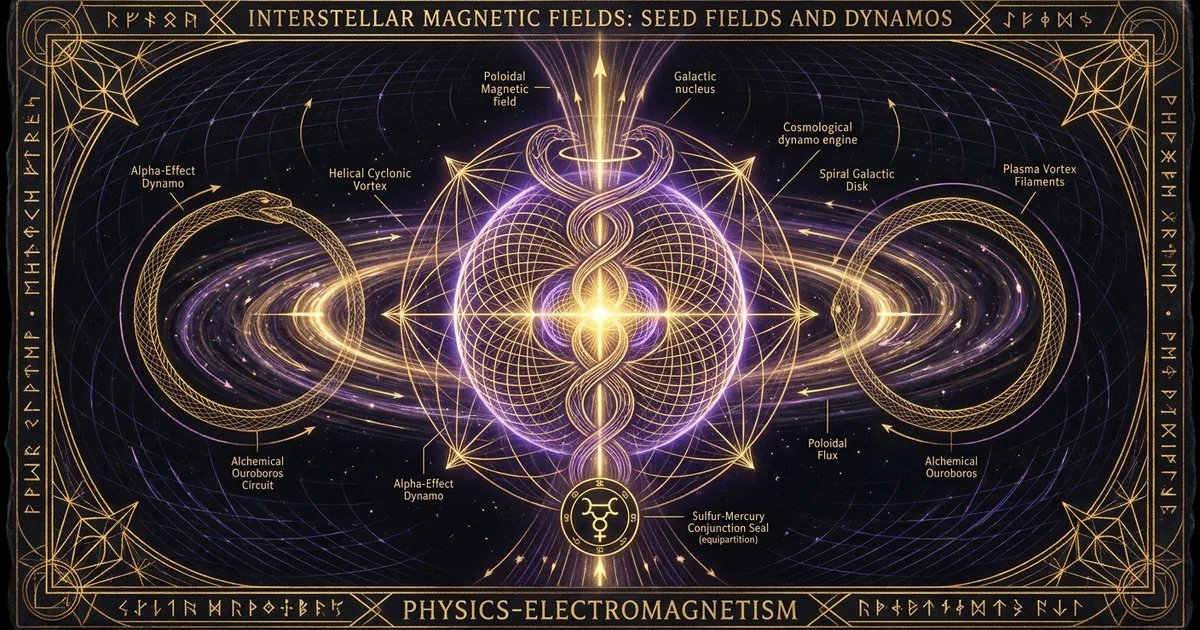
Interstellar Magnetic Fields: Seed Fields and Dynamos
Executive Summary & Theoretical Thesis
The Microgauss Disparity in Virialized Galactic Disks
Observational astrophysics presents a persistent quantitative dilemma: pervasive, dynamically significant magnetic fields possessing total amplitudes between $1\ \mu\text{G}$ and $10\ \mu\text{G}$ are ubiquitously detected in both mature spiral systems and young, high-redshift galactic disks. Polarimetric radio observations and high-frequency continuum surveys demonstrate that these microgauss galactic magnetic fields are ordered on multi-kiloparsec scales, exhibiting coherent axisymmetric or bisymmetric planar spiral morphologies. This observed intensity represents an energy density, $U_B = B^2 / 8\pi$, that is in approximate dynamical equipartition with both the turbulent kinetic energy density of the interstellar medium (ISM), $U_K = \frac{1}{2}\rho v_{\text{turb}}^2$, and the cosmic ray energy density, $U_{CR} \sim 1\ \text{eV},\text{cm}^{-3}$.
This equipartition state poses a severe challenge to early magnetogenesis theories that relied solely on the flux-freezing compression of primordial cosmological magnetic fields. If a galactic disk collapses from an unmagnetized or weakly magnetized protogalactic perturbation, the maximum field amplification achievable via isotropic adiabatic compression follows the geometric relation $B \propto \rho^{2/3}$, where $\rho$ is the baryonic gas mass density. Given an average diffuse intergalactic medium (IGM) density of $\rho_{\text{IGM}} \sim 10^{-29}\ \text{g},\text{cm}^{-3}$ collapsing to a mean interstellar disk density of $\rho_{\text{ISM}} \sim 10^{-24}\ \text{g},\text{cm}^{-3}$, the density contrast factor of $10^5$ to $10^6$ can enhance an initial seed field by at most a factor of $10^3$ to $10^4$.
Upper limits placed on primordial magnetic fields by cosmic microwave background (CMB) anisotropies and big bang nucleosynthesis (BBN) constrain any pre-galactic cosmological seed field to $B_0 \lesssim 10^{-9}\ \text{G}$ on megaparsec scales, and lower limits within extragalactic voids suggest values as small as $B_0 \sim 10^{-16}\ \text{G}$. Simple geometric compression of these baseline bounds yields fields orders of magnitude below the observed microgauss thresholds. Crucially, when applied to realistic battery mechanisms operating within protogalactic clouds where seed fields do not exceed $10^{-21}\ \text{G}$, compression falls short by more than ten orders of magnitude. Consequently, observed field strengths demand active, in-situ amplification factors spanning $10^{10}$ to $10^{15}$ within timescales demonstrably shorter than the turnaround and virialization periods of high-redshift systems.
Seed Field Genesis vs. Turbulent Dynamo Saturation Limits
To bridge the gap between infinitesimal primordial perturbations and mature microgauss equilibria, modern magnetohydrodynamics (MHD) bifurcates the field evolution into two distinct physical regimes: the generation of an initial seed field through microscopic, non-magnetic plasma kinetics, and the subsequent inductive magnification of that seed via turbulent and differential fluid motions. In the absence of an initial background field, the classical induction equation admits the trivial solution $\mathbf{B}(\mathbf{x}, t) = 0$ for all time; magnetic flux cannot emerge spontaneously from a purely ideal fluid governed by Alfvén’s frozen-in theorem. Therefore, seed field genesis requires the non-ideal, non-conservative decoupling of electron and ion dynamics, most notably realized via the biermann battery mechanism or related plasma kinetic instabilities such as the Weibel instability in collisionless shocks.
Once a seed field of order $B_{\text{seed}} \sim 10^{-21}\ \text{G}$ to $10^{-18}\ \text{G}$ is established across sub-kiloparsec scales, it enters a multi-stage dynamo cycle. The first phase consists of a rapid, small-scale turbulent dynamo (the Kazantsev or fluctuation dynamo) driven by isotropic supersonic and subsonic interstellar turbulence. This regime stretches, twists, and folds magnetic flux ropes at the turbulent eddy turnover rate, exponentially magnifying the magnetic energy density with a growth rate $\gamma_{\text{turb}} \sim v_{\text{eddy}} / \ell_{\text{eddy}}$ without requiring macroscopic system rotation. The small-scale dynamo operates on spatial scales bounded from below by the resistive dissipation scale and from above by the integral scale of interstellar turbulence ($\sim 100\ \text{pc}$).
The small-scale dynamo saturates when the local magnetic field reaches equipartition with the turbulent kinetic energy of the smallest driving eddies. However, this process alone produces an isotropic, highly tangled field configuration characterized by vanishing spatial averages over galactic scales ($\langle \mathbf{B} \rangle \approx 0$). The generation of coherent, multi-kiloparsec scale fields requires a second phase: the large-scale mean-field dynamo. Operating over galactic evolutionary timescales, this mechanism couples the non-uniform differential rotation of the disk to cyclonic, stratified turbulence driven by stellar feedback and supernova explosions. The growth rate of the large-scale dynamo is constrained by macroscopic parameters, ultimately saturating when the global Lorentz force, $\mathbf{J} \times \mathbf{B}$, dynamically back-reacts on the turbulent convective cells, altering the kinetic helicity and driving the system into a non-linear steady state.
Paradigmatic Shift in Non-Ideal Cosmic Magnetohydrodynamics
Understanding these transformations requires abandoning the classical view of the interstellar medium as an ideal, single-fluid conductor. The historical presumption that interstellar space could be modeled via infinite conductivity ($\sigma \to \infty$) and vanishing electric fields in the co-moving plasma frame obscured the fundamental mechanisms responsible for magnetogenesis. In an ideal fluid, the topology of magnetic field lines is absolute; magnetic reconnection is strictly prohibited, and the operational field cannot transcend its initial topological configuration. Interstellar space, however, is an open, non-ideal, multi-component plasma composed of thermal electrons, atomic and molecular ions, neutral gas fractions, dust grains, and relativistic cosmic rays.
The correct theoretical paradigm necessitates a non-ideal generalized Ohm’s law that incorporates the electron pressure tensor, electron-ion collisional drag, Hall currents, and radiative acceleration gradients. It is precisely through these non-ideal extensions that the electric field acquires a non-zero curl in regions where thermodynamic surfaces of constant density and constant temperature fail to align. The baroclinic vector field $\nabla n_e \times \nabla T_e$ breaks zero-flux conservation, transforming thermal and mechanical kinetic energy directly into magnetic flux. Furthermore, the interstellar medium exhibits a magnetic Prandtl number ($P_m = \nu / \eta$) far exceeding unity, meaning viscous dissipation occurs at scales much larger than resistive dissipation. Under these physical parameters, turbulent motions persist deep into sub-viscous scales, drastically altering the spectrum of magnetic field fluctuations and enabling non-linear inductive energy transfer.
The operation of turbulent amplification and magnetic reconnection in diffuse astrophysical plasmas depends on the dimensionless Magnetic Reynolds Number ($R_m$) and the Magnetic Prandtl Number ($P_m$): $$R_m = \frac{u L}{\eta}, \quad P_m = \frac{\nu}{\eta} = \frac{R_m}{Re}$$ where $u$ is the characteristic root-mean-square turbulent velocity, $L$ is the outer injection scale of interstellar turbulence ($\approx 100\ \text{pc}$), $\nu$ is the kinematic viscosity, and $\eta = c^2 / (4\pi \sigma)$ is the classical Spitzer magnetic diffusivity. In the warm ionized medium (WIM) of the galactic disk:
- $u \approx 10\ \text{km},\text{s}^{-1}$
- $L \approx 100\ \text{pc} \approx 3.08 \times 10^{20}\ \text{cm}$
- $\eta \approx 10^7\ \text{cm}^2,\text{s}^{-1}$
- $R_m \gtrsim 10^{17} \gg 1$
- $P_m \sim 10^{11} \gg 1$
Because $R_m \gg 1$, magnetic flux is extraordinarily well conserved on macro-scales, yet because $P_m \gg 1$, magnetic energy is driven into sub-viscous scales, establishing the necessary conditions for non-linear kinetic-to-magnetic energy cascading detailed in /physics-electromagnetism/alfven-waves-plasma-astrophysics.
Historical Lineage & Experimental Precedents
Cowling’s Anti-Dynamo Theorem and the Axisymmetric Dilemma
The modern theoretical foundation of astrophysical dynamos was forged against the constraint of Thomas George Cowling’s 1934 anti-dynamo theorem. Cowling mathematically demonstrated that a steady, axisymmetric magnetic field cannot be maintained by a purely axisymmetric fluid velocity field through self-consistent inductive action. In cylindrical coordinates $(r, \phi, z)$, if both the magnetic field $\mathbf{B}$ and the velocity field $\mathbf{u}$ exhibit $\partial / \partial \phi = 0$, the magnetic field lines in the poloidal plane ($r, z$) must contain at least one closed neutral ring where the poloidal component vanishes ($\mathbf{B}_p = 0$). At this neutral line, Ampère’s law dictates that the current density $\mathbf{J} = \frac{c}{4\pi} \nabla \times \mathbf{B}$ is strictly directed along the azimuthal unit vector $\hat{\boldsymbol{\phi}}$:
$$J_\phi = \frac{c}{4\pi} \left( \frac{\partial B_r}{\partial z} - \frac{\partial B_z}{\partial r} \right) \neq 0$$
According to Ohm’s law for an isotropic medium, $\mathbf{J} = \sigma (\mathbf{E} + \frac{1}{c} \mathbf{u} \times \mathbf{B})$. Along this closed neutral line, the inductive term identically vanishes because $\mathbf{B}p = 0$ and the cross product of the purely azimuthal components $(\mathbf{u}\phi \hat{\boldsymbol{\phi}}) \times (B_\phi \hat{\boldsymbol{\phi}})$ equals zero. Consequently, maintenance of the current requires a macroscopic electrostatic or inductive azimuthal electric field:
$$\oint E_\phi , dl = \frac{J_\phi}{\sigma} \neq 0$$
However, by Stokes’ theorem, the line integral of the electric field around this closed loop corresponds to the time rate of change of the magnetic flux threading the loop:
$$\oint \mathbf{E} \cdot d\mathbf{l} = -\frac{1}{c} \frac{d}{dt} \int \mathbf{B} \cdot d\mathbf{S}$$
In a steady state, $\partial \mathbf{B} / \partial t = 0$, meaning the closed line integral of $\mathbf{E}$ must vanish. This direct contradiction establishes that ohmic dissipation must cause the current $J_\phi$ at the neutral line to decay, leading to the collapse of the surrounding poloidal magnetic field.
Cowling’s result dismantled early attempts to explain stellar and galactic fields using simplistic two-dimensional laminar circulation models. It demonstrated that any sustained astrophysical dynamo must fundamentally break axisymmetry. The cosmic dynamo must operate either through non-axisymmetric planar configurations or via three-dimensional, intrinsically asymmetric helical turbulence.
The Biermann Battery: Thermoelectric Plasma Induction (1950)
To establish an inductive dynamo cycle, an initial seed field is mathematically required to avoid the null trivial solution of the induction equation. The breakthrough mechanism for the purely astrophysical, non-primordial generation of such fields was formulated by Ludwig Biermann in 1950. Biermann recognized that in a multi-component plasma composed of electrons and ions, the vast mass disparity ($m_i / m_e \approx 1836$ for protons) causes electrons to experience significantly higher accelerations under hydrodynamic pressure gradients.
In an unmagnetized, ionizing protogalactic cloud undergoing gravitational collapse, shock heating, or stellar radiative ionization, spatial variations in electron density $n_e$ and electron temperature $T_e$ develop independently. The momentum balance for the electron fluid, neglecting the electron inertial mass in the low-frequency limit, reduces to a balance between the macroscopic electric force, the electron partial pressure gradient, and the electron-ion frictional collision term:
$$0 = -e n_e \left( \mathbf{E} + \frac{1}{c} \mathbf{u}_e \times \mathbf{B} \right) - \nabla P_e + \frac{e n_e}{\sigma} \mathbf{J}$$
Assuming an initial state devoid of magnetic field ($\mathbf{B} = 0$) and vanishing macroscopic current ($\mathbf{J} \approx 0$), the microscopic thermoelectric electric field required to maintain quasi-neutrality and halt electron-ion separation is:
$$\mathbf{E}_{\text{Biermann}} = -\frac{\nabla P_e}{e n_e}$$
Applying the Maxwell-Faraday equation, $\frac{\partial \mathbf{B}}{\partial t} = -c \nabla \times \mathbf{E}$, to this non-conservative electric field yields:
$$\frac{\partial \mathbf{B}}{\partial t} = c \nabla \times \left( \frac{\nabla P_e}{e n_e} \right)$$
Invoking the vector identity $\nabla \times (\psi \mathbf{A}) = \psi (\nabla \times \mathbf{A}) + (\nabla \psi) \times \mathbf{A}$ and noting that the curl of any exact gradient identically vanishes ($\nabla \times \nabla P_e = 0$), the expression simplifies to:
$$\frac{\partial \mathbf{B}}{\partial t} = c \left( \nabla \left( \frac{1}{e n_e} \right) \times \nabla P_e \right) = -\frac{c}{e n_e^2} (\nabla n_e \times \nabla P_e)$$
Assuming an ideal gas equation of state for the electron gas, $P_e = n_e k_B T_e$, the spatial gradient of the pressure expands to $\nabla P_e = k_B T_e \nabla n_e + n_e k_B \nabla T_e$. Inserting this into the cross-product relation eliminates the parallel density term ($\nabla n_e \times \nabla n_e = 0$), leaving the canonical Biermann battery induction term:
$$\frac{\partial \mathbf{B}}{\partial t} = \frac{c k_B}{e} \left( \frac{\nabla T_e \times \nabla n_e}{n_e} \right) = \frac{c k_B}{e} (\nabla T_e \times \nabla \ln n_e)$$
Ludwig Biermann formally demonstrated that whenever thermodynamic surfaces of equal temperature (isotherms) fail to coincide with surfaces of equal density (isopycnals), the plasma becomes baroclinic ($\nabla P \times \nabla \rho \neq 0$). Under these conditions, the divergence of the electron pressure tensor generates an un-curled electric field, generating an internal macroscopic rotational electromotive force.
“In rotierenden Sternen oder Gasnebeln müssen elektrische Ausgleichsströme fließen, wenn die Flächen gleichen Drucks und gleicher Dichte nicht zusammenfallen. Diese Ströme erzeugen unvermeidbar ein kosmisches Magnetfeld aus dem reinen hydrodynamischen Nichtgleichgewicht.” — Biermann, L. (1950). ‘Über den Ursprung der Magnetfelder auf Sternen und im interstellaren Raum.’ Zeitschrift für Naturforschung A, 5(2), 65-71.
Operating across oblique shock fronts in the collapsing protogalaxy or along the ionization fronts of the first generation of Population III stars, the Biermann battery produces magnetic field growth rates on the order of:
$$\left| \frac{\partial \mathbf{B}}{\partial t} \right| \sim \frac{c k_B}{e} \frac{|\nabla T_e| |\nabla n_e|}{n_e} \sin \theta \sim 10^{-29}\ \text{G},\text{s}^{-1}$$
Integrated across a characteristic protogalactic dynamical accretion phase of $10^8\ \text{yr} \approx 3 \times 10^{15}\ \text{s}$, this mechanism reliably establishes an initial seed field baseline of $B_{\text{seed}} \sim 10^{-21}$ to $10^{-19}\ \text{G}$. While dynamically negligible on its own, this baroclinically induced flux provides the necessary initial boundary conditions for subsequent turbulent amplification.
The Parker Alpha-Omega Framework and Modern Mean-Field Electrodynamics
The theoretical resolution to Cowling’s dilemma was formulated by Eugene Parker in his foundational 1955 paper, Hydromagnetic Dynamo Models. Parker demonstrated how three-dimensional, cyclonic convective motions could regenerate poloidal magnetic fields from toroidal fields, thereby completing an un-attenuated, self-sustaining inductive feedback loop within rotating astrophysical bodies.
POLOIDAL FIELD (B_p)
                |
                |  Omega-Effect (Differential Rotation: d\Omega/dR)
                v
       TOROIDAL FIELD (B_phi)
                |
                |  Alpha-Effect (Helical Convection: <u' x (curl u')>)
                v
       REGENERATED POLOIDAL FIELD (B_p)
The Parker model, which serves as the archetype for the contemporary mean-field dynamo, operates through the sequential interaction of two macroscopic phenomena:
-
The Omega Effect ($\Omega$-Effect): The interstellar gas disk does not rotate as a solid body; it exhibits non-uniform, differential shear rotation characterized by an angular velocity gradient $\frac{d\Omega}{dR} \neq 0$. An existing large-scale radial or poloidal magnetic field line threading the disk is frozen into the highly conducting plasma. The differential shearing across the radial coordinates drags the field line azimuthally, stretching it around the galactic center and generating a powerful, large-scale toroidal field component ($B_\phi$).
-
The Alpha Effect ($\alpha$-Effect): As buoyant, supernova-heated gas parcels or starburst convective plumes rise perpendicular to the galactic midplane ($+z$ direction), they expand due to the stratified atmospheric density gradient ($\nabla \rho < 0$). In a rotating reference frame, this radial expansion is subjected to the Coriolis force, $\mathbf{F}_C = -2\rho (\mathbf{\Omega} \times \mathbf{u}')$. The expanding fluid parcel is forced to rotate, imparting an intrinsic kinetic helicity:
$$H_K = \langle \mathbf{u}’ \cdot (\nabla \times \mathbf{u}') \rangle \neq 0$$
This cyclonic motion twists the newly formed toroidal magnetic flux tubes into localized, loop-like helical coils oriented in the meridional ($r, z$) plane. Through microscopic magnetic reconnection driven by turbulent diffusion, these individual, twisted poloidal loops coalesce, reconstructing the large-scale poloidal magnetic field with a spatial orientation capable of reinforcing the original field. This dynamic framework is linked to cyclic magnetohydrodynamic processes occurring across disparate astronomical regimes, including geomagnetic excursions explored in /ancient-prehistory/cosmic-cycles-geomagnetic-reversals.
This two-step process breaks the symmetry constraints identified by Cowling. The cyclic feedback transformation:
$$\mathbf{B}p \xrightarrow{\Omega} \mathbf{B}\phi \xrightarrow{\alpha} \mathbf{B}_p$$
establishes an unstable eigenvalue problem for the magnetic field vector. If the dimensionless dynamo number, $D = \frac{\alpha_0 \Omega_0 h^3}{\beta^2}$ (where $h$ is the disk scale height and $\beta$ is turbulent magnetic diffusivity), exceeds a critical threshold $D_{\text{crit}} \sim -10$, the system enters a self-exciting regime. The mean magnetic field undergoes runaway exponential inductive growth until non-linear Lorentz forces modify the underlying velocity field.
Mathematical Formalism & Physical Mechanics
The Extended Induction Equation and Baroclinic Generation Terms
To track the mathematical genesis and amplification of cosmic fields, one begins with Maxwell’s equations coupled to the generalized multi-fluid momentum equation. Maxwell’s relations under the standard non-relativistic MHD approximation—wherein displacement currents $\frac{1}{c} \frac{\partial \mathbf{E}}{\partial t}$ are neglected because characteristic fluid velocities are non-relativistic ($u^2/c^2 \ll 1$) and high-frequency plasma oscillations are averaged out—are given by:
$$\nabla \times \mathbf{E} = -\frac{1}{c} \frac{\partial \mathbf{B}}{\partial t}$$
$$\nabla \times \mathbf{B} = \frac{4\pi}{c} \mathbf{J}$$
$$\nabla \cdot \mathbf{B} = 0$$
The coupling between the plasma velocity field $\mathbf{u}$ and the electrodynamic vectors is determined by the generalized Ohm’s law, derived from the first moment of the Boltzmann transport equation for electrons:
$$\mathbf{E} + \frac{1}{c} (\mathbf{u} \times \mathbf{B}) = \frac{\mathbf{J}}{\sigma} + \frac{1}{e n_e c} (\mathbf{J} \times \mathbf{B}) - \frac{\nabla P_e}{e n_e} + \frac{m_e}{e^2 n_e} \frac{\partial \mathbf{J}}{\partial t}$$
In the diffuse ISM, the Hall term $\frac{1}{e n_e c} (\mathbf{J} \times \mathbf{B})$ and electron inertial terms are negligible across the multi-parsec scales of mean-field dynamos. Substituting the electric field $\mathbf{E}$ from Ohm’s law directly into the Maxwell-Faraday equation yields the extended induction equation:
$$\frac{\partial \mathbf{B}}{\partial t} = \nabla \times (\mathbf{u} \times \mathbf{B}) + \eta \nabla^2 \mathbf{B} + \frac{c k_B}{e} \frac{\nabla T_e \times \nabla n_e}{n_e}$$
Here, $\eta = \frac{c^2}{4\pi \sigma}$ is the Spitzer magnetic diffusivity, and the baroclinic Biermann term serves as an inhomogeneous source term. The scalar-potential configurations that mediate these electrodynamic structures interface with broader theoretical frameworks analyzing gauge-field behaviors, such as those evaluated in /physics-electromagnetism/maxwell-heaviside-scalar-potentials. When the system possesses non-zero initial boundary flux, the baroclinic term becomes negligible compared to the inductive advection term $\nabla \times (\mathbf{u} \times \mathbf{B})$, which drives exponential field growth via fluid stretching.
Mean-Field Electrodynamics: Mathematical Decomposition of Alpha and Omega Effects
In turbulent astrophysical flows, the spatial velocity field $\mathbf{u}$ and magnetic vector field $\mathbf{B}$ fluctuate chaotically across spatial and temporal dimensions. To resolve the evolution of macroscopic structures without tracking every microscopic eddy, mean-field electrodynamics applies a Reynolds decomposition, splitting each variable into an ensemble-averaged mean component and a zero-mean fluctuating turbulent component:
$$\mathbf{u} = \mathbf{U}_0 + \mathbf{u}‘, \quad \langle \mathbf{u}’ \rangle = 0$$
$$\mathbf{B} = \overline{\mathbf{B}} + \mathbf{b}‘, \quad \langle \mathbf{b}’ \rangle = 0$$
Substituting these decomposed fields into the classical induction equation and taking the ensemble average yields the equation governing the large-scale mean magnetic field:
$$\frac{\partial \overline{\mathbf{B}}}{\partial t} = \nabla \times (\mathbf{U}_0 \times \overline{\mathbf{B}} + \boldsymbol{\mathcal{E}}) - \nabla \times (\eta \nabla \times \overline{\mathbf{B}})$$
where the vector field $\boldsymbol{\mathcal{E}} \equiv \langle \mathbf{u}’ \times \mathbf{b}’ \rangle$ is the turbulent electromotive force (EMF). The turbulent EMF represents the statistical correlation between the fluctuating micro-velocity and the micro-magnetic fields. Under conditions of isotropic, quasi-steady, homogeneous turbulence with weak scale separation, $\boldsymbol{\mathcal{E}}$ can be expanded mathematically as a Taylor series in terms of the mean field and its spatial gradients:
$$\mathcal{E}i = \alpha{ij} \overline{B}j + \beta{ijk} \frac{\partial \overline{B}_j}{\partial x_k} + \dots$$
For pseudo-isotropic turbulence lacking mirror symmetry (i.e., possessing non-zero kinetic helicity), the tensors reduce to isotropic scalars: $\alpha_{ij} = \alpha \delta_{ij}$ and $\beta_{ijk} = -\beta \epsilon_{ijk}$. Consequently, the turbulent EMF simplifies to:
$$\boldsymbol{\mathcal{E}} = \alpha \overline{\mathbf{B}} - \beta (\nabla \times \overline{\mathbf{B}})$$
By applying the First-Order Smoothing Approximation (FOSA, or second-order correlation approximation), valid when the magnetic Reynolds number based on the eddy scale is moderate or the turnover time $\tau$ is short, the transport coefficients are rigorously related to the turbulent velocity statistics:
$$\alpha = -\frac{1}{3} \tau_{\text{corr}} \langle \mathbf{u}’ \cdot (\nabla \times \mathbf{u}') \rangle = -\frac{1}{3} \tau_{\text{corr}} H_K$$
$$\beta = \frac{1}{3} \tau_{\text{corr}} \langle \mathbf{u}'^2 \rangle \equiv \eta_t$$
Here, $\tau_{\text{corr}}$ is the turbulent eddy correlation time, $H_K$ is the mean kinetic helicity, and $\beta = \eta_t$ represents the turbulent magnetic diffusivity. Because the turbulent velocity fluctuations in the interstellar medium ($u’ \sim 10\ \text{km},\text{s}^{-1}$, $\ell_{\text{turb}} \sim 100\ \text{pc}$) dwarf microscopic atomic diffusion, $\eta_t \approx \frac{1}{3} u’ \ell_{\text{turb}} \sim 10^{26}\ \text{cm}^2,\text{s}^{-1}$, exceeding the microscopic Spitzer diffusivity $\eta \sim 10^7\ \text{cm}^2,\text{s}^{-1}$ by nineteen orders of magnitude.
Inserting this simplified turbulent EMF back into the ensemble-averaged induction equation generates the fundamental partial differential equation of the $\alpha\Omega$-mean-field-dynamo:
$$\frac{\partial \overline{\mathbf{B}}}{\partial t} = \nabla \times (\mathbf{U}_0 \times \overline{\mathbf{B}}) + \nabla \times (\alpha \overline{\mathbf{B}}) + (\eta + \eta_t) \nabla^2 \overline{\mathbf{B}}$$
In a thin galactic disk characterized by cylindrical coordinates $(R, \phi, z)$, with $\mathbf{U}0 = R \Omega® \hat{\boldsymbol{\phi}}$, the field decomposes into poloidal $\overline{\mathbf{B}}p = \nabla \times (A \hat{\boldsymbol{\phi}})$ and toroidal $\overline{\mathbf{B}}\phi = B\phi \hat{\boldsymbol{\phi}}$ components:
$$\frac{\partial A}{\partial t} = \alpha B_\phi + \eta_t \left( \nabla^2 - \frac{1}{R^2} \right) A$$
$$\frac{\partial B_\phi}{\partial t} = -R \left( \nabla A \times \nabla \Omega \right) \cdot \hat{\boldsymbol{\phi}} + \alpha (\nabla \times \overline{\mathbf{B}}p)\phi + \eta_t \left( \nabla^2 - \frac{1}{R^2} \right) B_\phi$$
In the standard $\alpha\Omega$ limit, the differential shear term $R \frac{d\Omega}{dR} \frac{\partial A}{\partial z}$ dominates the weak induction term $\alpha (\nabla \times \overline{\mathbf{B}}p)\phi$, yielding an exponentially unstable coupled wave equation that generates trailing spiral magnetic topologies matching astronomical observation.
Nonlinear Saturation: Helicity Quenching and Flux-Rope Reconnection
The linear mean-field equations predict unbounded exponential growth of the field, $\overline{\mathbf{B}}(t) \propto e^{\gamma t}$. In physical reality, growth is bounded by non-linear saturation. As the magnetic field approaches dynamical equipartition with the turbulent velocity field:
$$B_{\text{eq}} = \sqrt{4\pi \rho} , u_{\text{turb}} \sim \text{several } \mu\text{G}$$
the dynamic back-reaction of the Lorentz force $\mathbf{J} \times \mathbf{B} = \frac{1}{4\pi} (\nabla \times \mathbf{B}) \times \mathbf{B}$ alters the fluid equations of motion. The Lorentz force exerts a resisting torque against the cyclonic twisting of turbulent convective cells, damping the amplitude of the $\alpha$-effect.
This dynamic suppression is intimately governed by the topological conservation of magnetic helicity. Magnetic helicity, defined as the volume integral of the scalar product of the magnetic vector potential $\mathbf{A}$ and the magnetic field $\mathbf{B}$:
$$H_M = \int_V (\mathbf{A} \cdot \mathbf{B}) , d^3x$$
is an invariant of ideal MHD. In a system characterized by finite, Spitzer-scale resistivity $\eta$, the global rate of helicity dissipation is constrained by the resistive relation:
$$\frac{d H_M}{dt} = -2\eta c \int_V (\mathbf{J} \cdot \mathbf{B}) , d^3x$$
As the large-scale dynamo generates helical large-scale fields possessing a net magnetic helicity $\overline{H}_M$, an equal and opposite sign of small-scale magnetic helicity $h_m = \langle \mathbf{a}’ \cdot \mathbf{b}’ \rangle$ must be produced locally to maintain total helicity conservation:
$$\frac{d \overline{H}_M}{dt} = -\frac{d h_m}{dt}$$
The accumulation of this microscopic helical field produces a magnetic $\alpha$-effect ($\alpha_M$) that acts with the opposite algebraic sign to the kinetic $\alpha$-effect ($\alpha_K$):
$$\alpha = \alpha_K + \alpha_M = -\frac{1}{3}\tau_{\text{corr}} \langle \mathbf{u}’ \cdot (\nabla \times \mathbf{u}‘) \rangle + \frac{1}{3}\tau_{\text{corr}} \frac{\langle \mathbf{b}’ \cdot (\nabla \times \mathbf{b}') \rangle}{4\pi \rho}$$
Because micro-scale resistive dissipation of magnetic helicity scales inversely with the macroscopic magnetic Reynolds number, the system encounters catastrophic quenching in closed systems:
$$\alpha(\overline{B}) = \frac{\alpha_0}{1 + R_m \left( \frac{\overline{B}}{B_{\text{eq}}} \right)^2}$$
If unmitigated, catastrophic quenching would halt large-scale dynamo amplification at unobservably weak field levels: $\overline{B} \sim R_m^{-1/2} B_{\text{eq}} \sim 10^{-8} B_{\text{eq}}$. To avoid this saturation lock, real galactic systems must be topologically open. The excess small-scale magnetic helicity must be dynamically vented from the disk into the circumgalactic halo via vertical advective outflows, such as galactic fountains, starburst super-winds, and localized coronal flux-rope reconnection events.
Empirical Evidence & Observational Data
Faraday Rotation Measure (RM) Syntheses across Extragalactic Lines of Sight
The primary observational tool for mapping interstellar magnetic field vectors in both the Milky Way and external galaxies is the phenomenon of faraday-rotation. When a linearly polarized electromagnetic wave traverses a magnetized, ionized plasma, the dielectric tensor splits the wave into right- and left-circularly polarized modes possessing distinct phase velocities. This birefringence induces a rotation of the polarization angle $\chi$ proportional to the square of the observing wavelength $\lambda$:
$$\chi(\lambda^2) = \chi_0 + \text{RM} , \lambda^2$$
The rotation measure (RM) constitutes the physical path integral along the observer’s line of sight ($ds$), parameterized in practical astronomical units:
$$\text{RM} = \frac{e^3}{2\pi m_e^2 c^4} \int_{\text{source}}^{\text{observer}} n_e(s) B_\parallel(s) , ds \approx 0.812 \int_{\text{source}}^{\text{observer}} \left( \frac{n_e(s)}{\text{cm}^{-3}} \right) \left( \frac{B_\parallel(s)}{\mu\text{G}} \right) \left( \frac{ds}{\text{pc}} \right) , \text{rad},\text{m}^{-2}$$
where $n_e$ is the thermal electron number density, and $B_\parallel = \mathbf{B} \cdot \hat{\mathbf{s}}$ is the magnetic field component parallel to the line of sight.
Linear Polarized Wave ───> [ Magnetized Plasma: n_e, B_|| ] ───> Rotated Polarization
                              Line of Sight (ds)                   \chi = \chi_0 + RM * \lambda^2
By measuring the polarization angle across wide frequency bands using the technique of RM Synthesis—a Fourier-like mathematical inversion developed by Brentjens and de Bruyn that converts continuous polarization spectra $P(\lambda^2)$ into a Faraday dispersion function $F(\phi)$—astrophysicists isolate discrete line-of-sight magnetic environments:
$$F(\phi) = \frac{1}{\pi} \int_{-\infty}^{\infty} P(\lambda^2) e^{-2i\phi\lambda^2} , d(\lambda^2)$$
Through extensive Rotation Measure grids derived from background quasars, pulsars, and diffuse galactic synchrotron backgrounds, systematic reversals of the sign of the RM are observed across the galactic plane. In the Milky Way, these sign changes demonstrate that the ordered field reverses direction between the Sagittarius and Scutum-Crux arms.
In external disk galaxies such as Andromeda (M31), the Whirlpool Galaxy (M51), and the fireworks galaxy (NGC 6946), large-scale sinusoidal variations of RM with azimuthal disk angle verify the existence of coherent, disk-wide Axisymmetric Spiral Structures (ASS) and Bisymmetric Spiral Structures (BSS). The phase alignments of these structures definitively confirm the operation of $\alpha\Omega$-mean-field dynamos, as pure flux-freezing or wrapped primordial fields would possess winding numbers $N_{\text{wind}} \sim \Omega t \gg 10^2$, yielding pitch angles far more tightly wrapped than the observed open pitch angles of $p \approx -10^\circ$ to $-25^\circ$.
Large-scale radio polarimetric surveys utilizing the Effelsberg 100-meter telescope and the Karl G. Jansky Very Large Array (VLA) demonstrate that total magnetic field strengths in normal spiral galaxies range from $5\ \mu\text{G}$ to $15\ \mu\text{G}$, with starburst galaxies reaching $50\ \mu\text{G}$ to $100\ \mu\text{G}$.
“Magnetic fields are ubiquitous in spiral galaxies. The total field strength spans from a few microgauss in flocculent systems to more than 100 microgauss in the nuclear regions of intense starbursts. The regular fields trace spiral patterns with open pitch angles that cannot be explained by differential rotation alone, requiring modern dynamo action.” — Beck, R. (2015). ‘Magnetic fields in spiral galaxies.’ The Astronomy and Astrophysics Review, 24(1), 4.
“Extragalactic magnetic fields are dynamically significant components of galaxies and galaxy clusters, displaying coherence over distances comparable to the system sizes.” — Kronberg, P. P. (1994). ‘Extragalactic magnetic fields.’ Reports on Progress in Physics, 57(4), 325-382.
Interstellar Synchrotron Emission and Polarized Dust Emission
While Faraday rotation isolates the thermal electron density weighted by the parallel field ($n_e B_\parallel$), the perpendicular component of the interstellar field ($B_\perp$) is directly probed through non-thermal relativistic synchrotron radiation and the linear polarization of thermally radiating interstellar dust grains. Ultra-relativistic cosmic ray electrons spiraling along magnetic field lines emit highly beamed, linearly polarized synchrotron radiation. The total non-thermal synchrotron emissivity $\epsilon_{\text{sync}}$ at frequency $\nu$ scales directly with the relativistic electron density $N_{CR}(E) = N_0 E^{-\gamma}$ and the perpendicular magnetic field strength:
$$\epsilon_{\text{sync}}(\nu) \propto N_0 B_\perp^{(\gamma + 1)/2} \nu^{-(\gamma - 1)/2}$$
For a typical interstellar cosmic ray electron energy distribution index of $\gamma \approx 2.6$ to $3.0$, the synchrotron intensity scales as $I_{\text{sync}} \propto B_\perp^{1.8 \text{ to } 2.0}$. Polarimetric mapping reveals fractional polarizations reaching up to $p_{\text{frac}} \sim 20-30%$ across inter-arm regions, closely approaching the theoretical maximum for a completely uniform field:
$$p_{\text{max}} = \frac{\gamma + 1}{\gamma + 7/3} \approx 70-75%$$
The deviation between observed and theoretical maximum polarization fractions provides direct empirical quantification of the ratio between the mean ordered field $\overline{\mathbf{B}}$ and the isotropic turbulent fluctuating field $\mathbf{b}'$:
$$p_{\text{frac}} = p_{\text{max}} \frac{\overline{B}\perp^2}{\overline{B}\perp^2 + \langle b’^2_\perp \rangle}$$
High-frequency sub-millimeter measurements conducted by space-based observatories such as Planck provide independent, extinction-free validation of magnetic geometry. Interstellar non-spherical silicate and carbon dust grains maintain an electric dipole moment and are aligned with their short axes parallel to the local magnetic field vectors through radiative torque alignment (RAT). Consequently, thermal dust emission at frequencies $\nu \gtrsim 353\ \text{GHz}$ is linearly polarized perpendicular to the local plane-of-sky magnetic field vector.
Cross-correlation between polarized synchrotron emission (sensitive to the diffuse halo and disk) and polarized thermal dust emission (sensitive to cold, dense molecular phases) confirms that magnetic field vectors systematically parallel the morphological gas filaments of galactic spiral arms. This parallel alignment holds even across the inter-arm regions where hydrodynamic shear is minimal, proving that large-scale magnetic stresses actively govern the macroscopic gas flow patterns rather than passively tracing fluid streamlines.
Zeeman Splitting Diagnostics in Dense Molecular Cloud Cores
The transition from diffuse interstellar phases to dense, gravitationally bound molecular cloud cores represents the ultimate test of magnetic field strength in controlling star formation. While Faraday rotation and synchrotron metrics provide integrated path measures, the direct, model-independent in-situ measurement of magnetic field amplitudes within cold neutral gas is achieved via the Zeeman effect.
When an interstellar atom or radical molecule with an unpaired electron transitions between electronic, rotational, or hyperfine energy levels within a magnetic field, the degeneracy of its magnetic quantum states $m_F$ is broken. The spectral line splits into three distinct components: a central unshifted $\pi$-component ($\Delta m_F = 0$) polarized parallel to $\mathbf{B}$, and two symmetrically displaced $\sigma$-components ($\Delta m_F = \pm 1$) circularly polarized perpendicular to $\mathbf{B}$. The frequency shift $\Delta \nu_Z$ is directly proportional to the line-of-sight magnetic field amplitude:
$$\Delta \nu_Z = 2 Z B_\parallel$$
where $Z$ is the specific Zeeman splitting factor determined by the Landé $g$-factor of the molecular quantum states. Because thermal Doppler broadening $\Delta \nu_D \propto \sqrt{k_B T / m}$ in cold molecular clouds ($T \sim 10-50\ \text{K}$) significantly exceeds the tiny Zeeman frequency shift ($\Delta \nu_Z \ll \Delta \nu_D$), direct detection requires observing circular polarization spectra via Stokes parameter $V(\nu)$:
$$V(\nu) \equiv I_R(\nu) - I_L(\nu) \approx \frac{dI(\nu)}{d\nu} \Delta \nu_Z = 2 Z B_\parallel \frac{dI(\nu)}{d\nu}$$
Rigorous observational programs employing radio spectral transitions of the neutral hydrogen $\text{H},\text{I}$ $21\ \text{cm}$ line, the hydroxyl radical $\text{OH}$ transitions at $1665\ \text{MHz}$ and $1667\ \text{MHz}$, and the cyanide molecule $\text{CN}$ at $113\ \text{GHz}$ have mapped field strengths across gas densities ranging from $n_{\text{H}} \sim 10^1\ \text{cm}^{-3}$ up to $n_{\text{H}} \sim 10^6\ \text{cm}^{-3}$.
These spectroscopic surveys establish that at low gas densities ($n_{\text{H}} \lesssim 300\ \text{cm}^{-3}$), the magnetic field strength remains approximately constant at diffuse background values ($B \approx 4-6\ \mu\text{G}$). However, above the critical threshold density $n_0 \approx 300\ \text{cm}^{-3}$, where gravitational forces overwhelm diffuse thermal and magnetic pressure, the field scales systematically with gas density according to a clear power law:
$$B \propto n_{\text{H}}^\kappa, \quad \kappa \approx 0.65 \pm 0.05 \approx \frac{2}{3}$$
This $\kappa \approx 2/3$ scaling directly corresponds to the theoretical prediction for the spherical, isotropic, flux-frozen contraction of a self-gravitating gas core. Computing the dimensionless mass-to-magnetic-flux ratio parameter:
$$\lambda = \frac{(M/\Phi)}{(M/\Phi)_{\text{crit}}} = \frac{M / \int \mathbf{B} \cdot d\mathbf{S}}{\left( \frac{1}{2\pi \sqrt{G}} \right)}$$
reveals that cloud envelopes are systematically subcritical ($\lambda < 1$, where magnetic forces permanently halt gravitational collapse), whereas dense molecular cores migrate toward trans-critical and slightly supercritical configurations ($\lambda \gtrsim 1-2$). This transition proves that stars do not form through free-fall hydrodynamic collapse, but through ambipolar diffusion-mediated slip of neutral gas past magnetically constrained ions, confirming that magnetic fields serve as direct structural arbiters across interstellar gas phase transitions.
Metaphysical Implications & Unified Synthesis
The Geometrical Topology of Vector Fields as Primary Morphological Engines
The empirical confirmation of multi-scale dynamos and persistent interstellar magnetic fields challenges strict materialist reductionism, which historically relegated magnetic fields to secondary consequences of baryonic mass distributions. In early accretion models, mass distributions governed by classical Newtonian gravitation dictated cosmic structure, while magnetic fields were treated as passive, parasitic byproducts. A mathematically rigorous synthesis of cosmic electrodynamics inverts this paradigm: vector field topology operates as an active, primary morphological driver of physical structure in the universe.
In an astrophysical plasma characterized by high electrical conductivity, the magnetic field is constrained by Woltjer-Taylor relaxation theory. This principle establishes that a turbulent, magnetized plasma does not decay into an arbitrary, quiescent hydrodynamic state. Instead, it relaxes toward a state of minimum magnetic energy while rigorously conserving its global magnetic helicity $H_M = \int \mathbf{A} \cdot \mathbf{B} , d^3x$. The resulting relaxed configuration satisfies the Beltrami, force-free mathematical condition:
$$\nabla \times \mathbf{B} = \mu \mathbf{B}$$
where $\mu$ is a Lagrange multiplier representing a constant spatial scalar across the domain. Under the Beltrami condition, the Lorentz force identically vanishes everywhere in space:
$$\mathbf{J} \times \mathbf{B} = \frac{c}{4\pi} (\nabla \times \mathbf{B}) \times \mathbf{B} = \frac{c \mu}{4\pi} (\mathbf{B} \times \mathbf{B}) \equiv 0$$
The field vector aligns precisely with its own curl, forming intricate force-free flux ropes, nested helical surfaces, and topologically knotted toroidal domains.
Rather than serving as a passive tracer, this helical magnetic skeleton creates a spatially inhomogeneous dielectric-field and anisotropic transport barriers. The cross-field thermal conductivity $\kappa_\perp$ and particle diffusion coefficients $D_\perp$ scale as:
$$\kappa_\perp \approx \kappa_\parallel \left( \omega_{ce} \tau_{e} \right)^{-2} \ll \kappa_\parallel$$
where $\omega_{ce}$ is the electron cyclotron frequency and $\tau_e$ is the electron collision timescale. As a direct consequence, heat and mass are channeled almost exclusively along the magnetic coordinate lines. Matter condensations, the condensation of molecular cloud complexes, the orientation of cold interstellar filaments, and the ultimate alignment of stellar accretion disks do not originate from random gravitational collapse; they are channeled along topologically stable, force-free magnetic trajectories.
Macro-Micro Isomorphism: Plasma Filamentation from Laboratory to Cosmic Scales
The scale-invariance of magnetohydrodynamic equations without characteristic spatial scales demonstrates a structural isomorphism that links laboratory plasma physics to the macro-architecture of the cosmic web. When Maxwell’s equations and the non-ideal momentum conservation relations are normalized using scale transformations:
$$\mathbf{x}^* = \frac{\mathbf{x}}{L_0}, \quad t^* = \frac{t}{T_0}, \quad \mathbf{B}^* = \frac{\mathbf{B}}{B_0}, \quad \rho^* = \frac{\rho}{\rho_0}$$
the governing equations maintain structural invariance across twenty-four orders of magnitude, provided that key dimensionless invariants—such as the plasma beta $\beta_{\text{plasma}} = 8\pi P / B^2$, the Alfvén Mach number $\mathcal{M}_A = u / v_A$, and the magnetic Reynolds number $R_m$—are maintained in dynamic similarity.
Laboratory Tokamak & Z-Pinch Plasma
- Spatial Dimension: $L \sim 10^{-1}\ \text{to } 10^1\ \text{m}$
- Field Strength: $B \sim 10^4\ \text{to } 10^5\ \text{G}$
- Plasma Density: $n_e \sim 10^{14}\ \text{to } 10^{20}\ \text{cm}^{-3}$
- Key Physics: Bennett pinch confinement, helical field line winding, kink ($m=1$) and sausage ($m=0$) magnetohydrodynamic instabilities.
- Current Flow: Birkeland currents driven by external power arrays, forming discrete braided current filaments along field lines.
Interstellar Filaments & Cosmic Web
- Spatial Dimension: $L \sim 10^{18}\ \text{to } 10^{24}\ \text{m}$ ($1\ \text{pc}$ to $30\ \text{Mpc}$)
- Field Strength: $B \sim 10^{-6}\ \text{to } 10^{-5}\ \text{G}$
- Plasma Density: $n_e \sim 10^{-4}\ \text{to } 10^3\ \text{cm}^{-3}$
- Key Physics: Self-gravitating magnetostatic equilibrium, helical field topologies, magnetic filamentation in molecular clouds.
- Current Flow: Cosmic Birkeland currents channeling hundreds of kiloamperes along intergalactic filaments, bridging cosmic voids.
This isomorphism demonstrates that the braided, filamentary morphology observed in star-forming regions like the Taurus or Perseus molecular clouds directly mirrors the field-aligned pinch instabilities observed within terrestrial plasma focus and Z-pinch devices.
In both regimes, electric currents flowing along magnetic field lines induce azimuthal confining fields ($B_\phi$), which pinch the conducting fluid into dense, axial filamentary conduits via the Bennett pinch condition:
$$I^2 = 2 c^2 N k_B (T_e + T_i)$$
where $I$ is the total longitudinal current and $N$ is the linear particle density. This electrodynamic pinching behavior acts analogously to acoustic energy localization, where standing pressure nodes focus non-linear interactions into discrete geometric regimes, as investigated in /sound-cymatics/acoustic-levitation-standing-waves. These structured fields exhibit resonance properties reminiscent of planetary schumann-resonance modes, wherein magnetoacoustic longitudinal-waves propagate across finite conductive cavities, establishing macroscopic wave interference patterns throughout the interstellar medium.
Scalar Potentials, Helical Invariance, and Non-Local Energy Transduction
The topological persistence of cosmic fields exposes fundamental truths regarding the non-local character of classical electrodynamics, originally formulated in the Maxwell-Heaviside framework. Modern field theory demonstrates that the fundamental physical entity is not the localized magnetic field vector $\mathbf{B}$, but the four-vector potential $A^\mu = (\Phi, \mathbf{A})$. In regions where the magnetic field $\mathbf{B} = \nabla \times \mathbf{A}$ vanishes or is heavily dispersed, the scalar-potential $\Phi$ and vector potential $\mathbf{A}$ retain non-trivial holonomy, imparting physically observable geometric phases to charged quantum particles via the Aharonov-Bohm effect.
On galactic scales, the conservation of magnetic helicity:
$$H_M = \int_V \mathbf{A} \cdot (\nabla \times \mathbf{A}) , d^3x$$
represents the topological linkage, knotting, and writhe of individual magnetic flux tubes. Magnetic helicity measures the global topological invariance of the vector bundle. While local kinetic and magnetic energies cascade downward toward viscous and resistive dissipation regimes, magnetic helicity executes an inverse cascade. Driven by the non-linear terms of the induction tensor, magnetic helicity flows systematically from smaller scales to larger scales, self-organizing chaotic, sub-parsec scale turbulent loops into unified, galaxy-spanning coherent structures.
This inverse cascade acts as an organizing mechanism across cosmic deep time. Energy injected into the galactic plasma at microscopic scales—through stellar radiative surfaces, thermoelectric boundary layers, and supernova shocks—is non-locally transduced upward into multi-kiloparsec ordered fields. The galaxy acts as an open, non-equilibrium thermodynamic engine that converts microscopic entropy generation into macroscopic topological order, demonstrating that cosmic magnetic fields are fundamental structural organizers operating across cosmological deep time.
Primordial Magnetogenesis (Inflationary / Electroweak / BBN)
- Generation Epoch: $t \sim 10^{-36}\ \text{s}$ to $10^2\ \text{s}$ (cosmological early universe).
- Physical Mechanism: Quantum fluctuations of gauge fields during inflation, conformal invariance breaking, or phase transitions (Electroweak or Quark-Hadron).
- Initial Seed Amplitude: $B_0 \sim 10^{-12}\ \text{to } 10^{-20}\ \text{G}$ comoving on megaparsec scales; unconstrained upper bounds restricted by CMB to $B_0 \lesssim 10^{-9}\ \text{G}$.
- Spatial Distribution: Spatially homogeneous, volumetrically filling both high-density matter halos and low-density cosmic voids.
- Field Topology: High-order random-phase Gaussian fluctuations lacking intrinsic alignment with disk kinematics.
Astrophysical Baroclinic Generation (Biermann Battery / Shocks)
- Generation Epoch: $z \sim 20\ \text{to } 2$ ($t \sim 10^8\ \text{to } 10^9\ \text{yr}$, first structures).
- Physical Mechanism: Oblique accretion shocks, protogalactic gravitational collapse, stellar ionization fronts inducing $\nabla n_e \times \nabla T_e \neq 0$.
- Initial Seed Amplitude: $B_{\text{seed}} \sim 10^{-21}\ \text{to } 10^{-18}\ \text{G}$, highly localized within collapsed structures.
- Spatial Distribution: Strictly inhomogeneous; localized entirely within virialized dark matter halos, star-forming galaxies, and early protostellar disks.
- Field Topology: Aligned directly with rotational shear and local density/temperature gradients; ideal for rapid inductive amplification via galactic dynamos.
Frequently Asked Questions
Reconciling Rapid Dynamo Growth with Microgauss Fields in Young High-Redshift Galaxies
High-redshift observations conducted using absorption-line systems toward distant quasars demonstrate that fully saturated, microgauss-strength magnetic fields existed when the universe was less than two to three billion years old ($z \sim 2$ to $3$). A classical large-scale $\alpha\Omega$-mean-field dynamo requires an e-folding amplification timescale parameterized by the galactic rotation period:
$$\tau_{\alpha\Omega} \sim \frac{1}{\sqrt{|\alpha_0 \Omega_0’|}} \sim 3 \times 10^8\ \text{to } 5 \times 10^8\ \text{yr}$$
Starting from an infinitesimal Biermann battery seed field of $B_{\text{seed}} \sim 10^{-21}\ \text{G}$, achieving a microgauss field ($10^{-6}\ \text{G}$) requires approximately thirty-five e-folding times:
$$\ln \left( \frac{10^{-6}}{10^{-21}} \right) = \ln(10^{15}) \approx 34.54\ \text{e-folds}$$
Multiplying this required amplification factor by the mean-field growth timescale yields an impossible prerequisite:
$$t_{\text{growth}} \approx 35 \times (3 \times 10^8\ \text{yr}) \sim 1.05 \times 10^{10}\ \text{yr} = 10.5\ \text{Gyr}$$
This duration exceeds the total age of the universe at $z \approx 2$ by a factor of four, presenting a critical timing paradox for classical dynamo theory.
This dilemma is resolved by the operation of the small-scale turbulent dynamo (the Kazantsev dynamo). Unlike the large-scale dynamo, the growth rate of the small-scale dynamo is decoupled from macroscopic galactic rotation. Instead, it is governed by the turnover timescale of the smallest turbulent eddies at the dissipation scale:
$$\tau_{\text{eddy}} \sim \frac{\ell_{\text{eddy}}}{v_{\text{eddy}}} \sim 10^6\ \text{to } 10^7\ \text{yr}$$
In the high-energy-density environment of young, violently star-forming galaxies, massive starbursts and intense accretion feed supersonic, virialized turbulence. The small-scale dynamo amplifies the initial $10^{-21}\ \text{G}$ baroclinic seed fields to local microgauss equipartition values on sub-gigayear timescales:
$$t_{\text{turb}} \sim 35 \times \tau_{\text{eddy}} \lesssim 10^8\ \text{yr} \ll 1\ \text{Gyr}$$
Once this tangled, equipartition-strength field is established on eddy scales ($\ell \sim 10-100\ \text{pc}$), it provides an intense, pre-amplified base field for the large-scale $\alpha\Omega$-dynamo. The large-scale dynamo is therefore relieved of the requirement to execute thirty-five e-folds of amplification from microscopic seeds; it only needs to order this pre-existing magnetic energy into global, multi-kiloparsec coherent spiral patterns over several rotation periods, resolving the high-redshift timing crisis.
Circumventing Catastrophic Alpha-Quenching via Galactic Winds and Magnetic Helicity Fluxes
In a closed, homogenous magnetohydrodynamic system, the turbulent alpha-effect dynamo encounters catastrophic quenching when the mean field reaches a critical threshold scaled by the magnetic Reynolds number:
$$\overline{B}^2 \sim R_m^{-1} B_{\text{eq}}^2$$
Because diffuse galactic plasmas possess an enormous magnetic Reynolds number ($R_m \gtrsim 10^{17}$), catastrophic quenching would halt the mean-field dynamo at amplitudes eight orders of magnitude below observed microgauss levels:
$$\overline{B} \sim 10^{-8.5} B_{\text{eq}} \sim 10^{-14}\ \text{G}$$
The field would saturate prematurely because turbulent fluid motions generate equal and opposite quantities of magnetic helicity across different spectral scales. The accumulation of small-scale magnetic helicity $h_m$ produces an opposing magnetic alpha-effect ($\alpha_M \propto \langle \mathbf{j}’ \cdot \mathbf{b}’ \rangle$) that algebraically cancels the kinetic alpha-effect ($\alpha_K$), locking the dynamo into an inactive state.
Real galaxies evade catastrophic quenching because they are open boundary systems. The balance equation for the mean total magnetic helicity density within an open disk geometry includes an advective flux divergence term:
$$\frac{\partial \overline{h}_M}{\partial t} = 2 \boldsymbol{\mathcal{E}} \cdot \overline{\mathbf{B}} - 2 \eta \langle \mathbf{j}’ \cdot \mathbf{b}’ \rangle - \nabla \cdot \mathbf{F}_H$$
where $\mathbf{F}_H$ represents the spatial transport flux of magnetic helicity. Starbursts and localized supernova clusters launch large-scale galactic chimneys, fountains, and coronal super-winds that blow vertically into the galactic halo ($z$-direction).
These winds carry excess small-scale magnetic helicity out of the dense star-forming disk:
$$\mathbf{F}H \approx h_m \mathbf{U}{\text{wind}}$$
By dynamically venting this small-scale helicity into the circumgalactic medium, the local small-scale magnetic alpha-effect is held below the critical threshold ($\alpha_M < \alpha_K$). This keeps the net $\alpha$-parameter active:
$$\alpha_{\text{net}} = \alpha_K + \alpha_M \neq 0$$
Helicity advection enables the large-scale magnetic field to continue its exponential growth up to true dynamical equipartition with the macroscopic turbulent gas pressure:
$$\frac{\overline{B}^2}{8\pi} \approx \frac{1}{2} \rho u_{\text{turb}}^2$$
Distinguishing Primordial Magnetogenesis from Battery-Generated Seed Fields via Cosmic Voids
To determine whether the universe was originally magnetized via primordial cosmological mechanisms (such as inflationary particle production or the electroweak phase transition) or through localized astrophysical battery mechanisms, observational astrophysicists analyze the lowest-density environments in the cosmos: cosmological voids.
Astrophysical seed mechanisms, such as the Biermann battery or supernova-driven plasma ejections, are strictly correlated with baryonic structure formation. They operate inside collapsed protogalactic halos, deep within gravitational potential wells, or along high-density shock fronts. While galactic winds can transport magnetized gas into the circumgalactic medium (CGM) and the immediate filaments of the cosmic web, these hydrodynamic outflows cannot penetrate the deep interiors of immense cosmological voids ($V \sim 10^3\ \text{to } 10^4\ \text{Mpc}^3$), where gas densities drop to $n \lesssim 10^{-7}\ \text{cm}^{-3}$.
Consequently, if magnetic fields in deep voids were entirely dependent on astrophysical transport, the core regions of cosmological voids would remain unmagnetized ($B_{\text{void}} = 0$). Conversely, if a non-zero magnetic field permeates deep cosmic voids, it constitutes conclusive evidence of a primordial magnetogenesis event that generated flux prior to the formation of the first stars and galaxies.
The definitive separation between cosmic electron density distributions and line-of-sight magnetic field components is achieved via multi-frequency polarimetric dispersion: $$\Delta \chi = \lambda^2 \cdot \left[ 812 \int_0^L n_e(s) B_\parallel(s) , ds \right] \text{rad}$$ where:
- $\Delta \chi$ represents the total polarization angle rotation observed across the spectral passband (radians).
- $\lambda$ is the observing wavelength in vacuum (meters).
- $n_e(s)$ is the local free thermal electron number density ($\text{cm}^{-3}$).
- $B_\parallel(s)$ is the instantaneous vector component of the magnetic field parallel to the photon propagation vector ($\mu\text{G}$).
- $ds$ is the differential path length along the line of sight ($\text{pc}$).
When cross-referenced against dispersion measures obtained from localized Pulsars: $$\text{DM} = \int_0^L n_e(s) , ds \quad [\text{pc},\text{cm}^{-3}]$$ the mean parallel magnetic field component along the path is isolated directly without model degeneracies: $$\langle B_\parallel \rangle = \frac{\int n_e B_\parallel ds}{\int n_e ds} = \frac{1}{0.812} \left( \frac{\text{RM}}{\text{DM}} \right)$$
The direct empirical detection of magnetic fields within cosmic voids is achieved by analyzing the broadband gamma-ray spectra of distant, very-high-energy (VHE, $E > 100\ \text{GeV}$) blazars. As primary TeV gamma-ray photons propagate through the intergalactic medium, they collide with ambient photons of the extragalactic background light (EBL), generating relativistic electron-positron pairs via pair production:
$$\gamma_{\text{TeV}} + \gamma_{\text{EBL}} \to e^+ + e^-$$
These secondary ultra-relativistic pairs immediately scatter low-energy cosmic microwave background photons up to GeV energies through inverse Compton scattering:
$$e^\pm + \gamma_{\text{CMB}} \to e^\pm + \gamma_{\text{GeV}}$$
If the cosmic void is entirely unmagnetized, these inverse Compton-scattered GeV photons proceed along the original line of sight, creating a distinct, highly peaked cascade emission component within the secondary blazar spectrum observed by gamma-ray telescopes such as Fermi-LAT.
However, if an ambient magnetic field $B_{\text{void}}$ permeates the void, the Lorentz force rapidly deflects the relativistic electrons and positrons during their cooling lifetimes, broadening the secondary pair cascade into an extended, diffuse spatial halo and suppressing the point-source GeV flux:
$$\theta_{\text{defl}} \propto \frac{e B_{\text{void}} \lambda_{IC}}{E_e} \neq 0$$
The empirical non-detection of these secondary point-source GeV cascades in blazar spectra (e.g., 1ES 0229+200) places an absolute physical lower bound on the magnetic field in cosmological voids:
$$B_{\text{void}} \gtrsim 10^{-16}\ \text{to } 10^{-15}\ \text{G}$$
Because astrophysical winds cannot transport magnetized plasma into the centers of these void structures within the Hubble time ($t_H \sim 13.8\ \text{Gyr}$), this lower bound proves that an all-pervasive primordial magnetic seed field was generated during the earliest epochs of the universe. This primordial seed subsequently served as the baseline input for the multi-scale, baroclinically enhanced turbulent dynamos that sustain the microgauss magnetic fields observed across modern galactic disks.