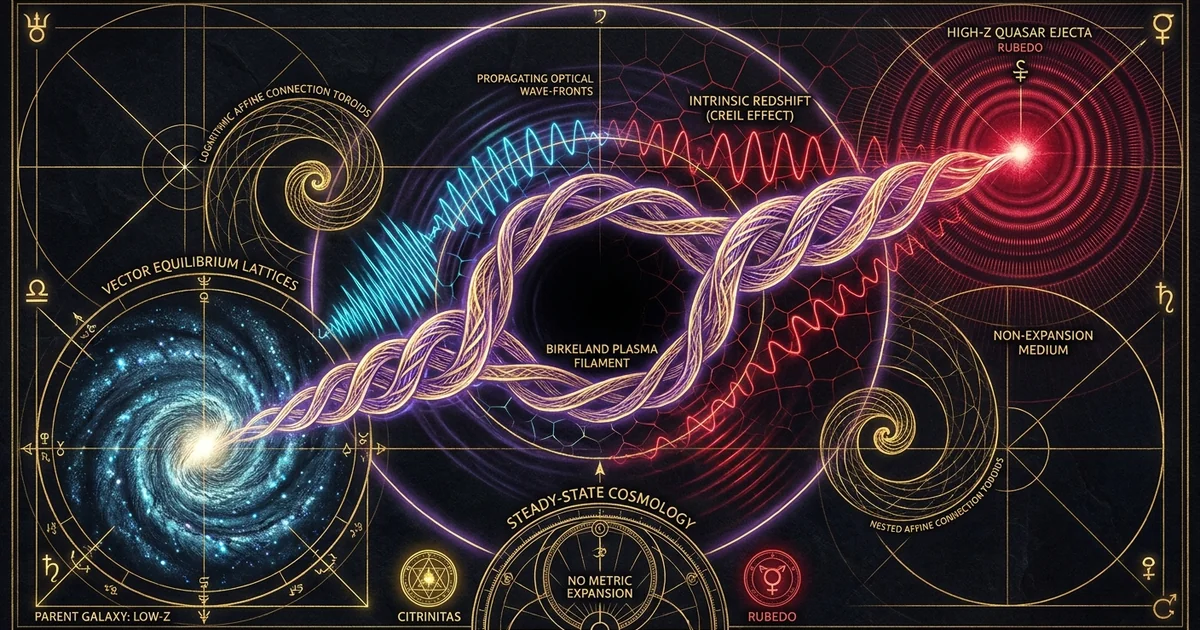
Redshift Anomaly: Intrinsic Plasma Redshift vs Expansion
Executive Summary & Theoretical Thesis: Non-Doppler Mechanics and the Geometric Expansion Paradox
The Metric Expansion Postulate versus Empirical Optical Discordance
The standard model of modern cosmology ($\Lambda\text{CDM}$) rests upon the kinematic and geometric interpretation of the astronomical spectral redshift parameter:
$$z = \frac{\lambda_{\text{obs}} - \lambda_0}{\lambda_0}$$
Within this paradigm, spectral shifts are treated as an isotropic dilation of spacetime governed by the Friedmann-Lemaître-Robertson-Walker (FLRW) metric:
$$ds^2 = -c^2 dt^2 + a(t)^2 \left[\frac{dr^2}{1 - kr^2} + r^2 (d\theta^2 + \sin^2\theta , d\phi^2)\right]$$
This framework imposes a fundamental physical assumption: the intergalactic vacuum must behave as an ideal, non-dissipative optical waveguide over multi-gigaparsec baselines. Photons are presumed to traverse vast spatial intervals without thermodynamic entropy generation, non-linear dielectric response, or forward scattering, with their wavelengths altered solely by the time-dependent cosmological scale factor $a(t)$.
This geometric postulate faces severe empirical challenges when confronted with anomalous astronomical associations. Halton Arp’s extensive catalogues of peculiar extragalactic systems reveal persistent physical bridges—composed of neutral hydrogen, continuous optical dust lanes, and aligned soft X-ray filaments—linking low-redshift parent galaxies to high-redshift active galactic nuclei and quasars.
These configurations contradict the standard interpretation where $z$ maps strictly to cosmological distance. Under FLRW assumptions, systems such as NGC 4319 ($z = 0.00453$) and Markarian 205 ($z = 0.07$) must be separated by tens of megaparsecs of radial depth, rendering their observed continuous isophotal connections mathematically impossible.
The standard resolution relies on chance optical alignments, an explanation that becomes untenable when evaluated across Arp’s statistically significant populations of perturbed systems. The empirical data point toward non-Doppler redshift light scattering and medium-dependent optical mechanisms that operate independently of recessional kinematics.
Defining Intrinsic Redshift in Astrophysical Plasma Media
The core thesis of this monograph asserts that astronomical redshift is predominantly an intrinsic redshift, mediated by the thermodynamic and electrodynamic properties of the non-vacuum intergalactic medium (IGM).
Intergalactic space is not an empty geometric void; it is a complex, dilute dielectric-field dominated by degenerate, partially ionized, low-density non-thermal plasma. In such an optical environment, propagating light fields are subject to forward, non-linear inelastic interactions that continuously transfer momentum and energy to the medium.
Two primary physical mechanisms govern this transfer:
- Spatial coherence variations at the emission boundary, formalized through the wolf-effect, and
- Low-density inelastic forward scattering through degenerate hydrogen, formalized by the Coherent Raman Effect on Incoherent Light (creil-effect).
Far from violating physical conservation laws, these mechanisms operate in strict accordance with the Poynting-Robertson radiation dynamics and the conservation of four-momentum:
$$\partial_\mu T^{\mu\nu}{\text{field}} = -f^\nu{\text{matter}}$$
Energy lost by the traversing wavepacket does not dissipate into high-angle diffuse scatter—which would blur stellar wavefronts and obscure deep-sky resolution—but is coupled via forward phase-matched Raman transitions and low-frequency degenerate plasmon excitations directly into the intergalactic plasma substrate.
By incorporating real-medium electrodynamics, the Hubble parameter $H_0$ is recontextualized. It ceases to measure the physical expansion rate of the metric:
$$H_0 \neq \frac{\dot{a}(t)}{a(t)}$$
Instead, it represents the optical attenuation and phase-modulation coefficient of dilute cosmic plasma:
$$H_0 \equiv \alpha_{\text{ext}} \cdot c = \kappa_{\text{plasma}} , n_e , c$$
where $\kappa_{\text{plasma}}$ defines the specific non-linear Raman cross-section of the medium and $n_e$ is the ambient plasma density along the line of sight.
Metric Expansion (Doppler/FLRW)
- Physical Mechanism: Kinematic stretching of photon wavelengths driven exclusively by the isotropic metric expansion of spatial coordinates $a(t)$.
- Medium Dependency: Requires an absolute, dispersionless vacuum; assumes light propagation over gigaparsecs is free from dielectric interference.
- Cosmological Geometry: Demands non-Euclidean curved spacetime, an initial gravitational singularity (Big Bang), and postulation of Dark Energy ($\Omega_\Lambda \approx 0.7$) to resolve deceleration anomalies.
- Spectral Line Profile: Predicts strictly uniform scaling across all wavelengths: $\Delta \lambda / \lambda_0 = \text{constant}$, independent of spatial coherence or medium thermodynamics.
- Anomalous Alignments: Interprets luminous bridges connecting disparate-$z$ objects as accidental line-of-sight alignments, requiring exceptional geometric coincidences.
Intrinsic Plasma Redshift (Wolf/CREIL Mechanism)
- Physical Mechanism: Coherent forward Raman scattering (CREIL) combined with spatial coherence evolution (Wolf Effect) and degenerate plasma wave interactions.
- Medium Dependency: Directly proportional to the column density, ionization state, and excitation temperature of intervening intergalactic plasma.
- Cosmological Geometry: Operates within a static or slowly fluctuating Euclidean spacetime; eliminates initial singularities and the need for dark energy.
- Spectral Line Profile: Frequency shifts correlate with source spatial-coherence states, exhibiting selective enhancements across atomic transition bands.
- Anomalous Alignments: Naturally explains parent-galaxy/quasar pairs as co-spatial ejections, where high quasar redshifts reflect local high-density plasma envelopes.
Thermodynamic Degradation of Optical Fields over Cosmological Baselines
The assumption that a photon wavepacket propagates through millions of light-years without entropy exchange violates the foundational principles of non-equilibrium thermodynamics. In an open thermodynamic system, an electromagnetic field propagating through an active material background must obey the wave dispersion equations derived from Maxwell-Lorentz electrodynamics:
$$\nabla \times \mathbf{E} = -\frac{\partial \mathbf{B}}{\partial t}, \quad \nabla \times \mathbf{H} = \mathbf{J}_{\text{plasma}} + \frac{\partial \mathbf{D}}{\partial t}$$
When radiation couples to a non-equilibrium, rarefied plasma sheath characterized by non-zero scalar-potential gradients ($\nabla \Phi \neq 0$), the electric susceptibility tensor contains both linear reactive and non-linear dissipative terms:
$$\chi(\omega) = \chi^{(1)}(\omega) + \chi^{(2)}(\omega)\mathbf{E} + \chi^{(3)}(\omega)\mathbf{E}\mathbf{E}^*$$
Over cosmological propagation baselines ($L > 10^{22} \text{ m}$), the non-linear third-order susceptibility $\chi^{(3)}(\omega)$ of cold intergalactic plasma induces a cumulative phase retardance and an inelastic loss of photon frequency.
This process mimics Doppler shifts without disrupting wavefront phase fronts. The energy is absorbed by low-energy plasma vibrational states, hyperfine transitions of neutral hydrogen, and collective longitudinal plasmons.
Cosmological redshift is therefore an optical metric measuring the integrated plasma column density $\int n_e(s) , ds$ and the degree of spatial coherence degradation across the line of sight.
Historical Lineage & Experimental Precedents: From Arp’s Discrepant Quasars to Laboratory Coherence Shifts
Halton Arp’s Atlas of Peculiar Galaxies and Isophotal Filaments
The empirical foundation of the intrinsic redshift thesis traces directly to the observational work of Halton C. Arp. Beginning with the publication of the Atlas of Peculiar Galaxies in 1966, Arp identified morphological associations between massive, low-redshift spiral systems and compact, highly redshifted quasi-stellar objects (quasars).
Using deep-exposure photographic plates at the Palomar and Mount Wilson observatories, later verified through charge-coupled device (CCD) isophotometry, Arp demonstrated that these configurations were not random line-of-sight projections.
The primary system in this empirical corpus remains the pairing of the spiral galaxy NGC 4319 ($z = 0.00453$) and the quasar Markarian 205 ($z = 0.07$).
Standard FLRW cosmology places Markarian 205 at approximately fifteen times the radial distance of NGC 4319. However, Arp’s high-contrast isophotal contours and subsequent ultraviolet imaging reveal a continuous, luminous filament of ionized gas and dust connecting the nucleus of NGC 4319 directly to Markarian 205.
Spectroscopic tracing of this filament shows continuous velocity profiles and physical entrainment of gas. This indicates that the quasar was dynamically ejected from the core of the parent Seyfert galaxy, carrying an enormous intrinsic redshift component unrelated to its recessional velocity.
Isophotal Density Map: NGC 4319 / Markarian 205 Complex
Parent Core (NGC 4319, z = 0.00453)
   │
   ├── [Luminous Bridge: Ionized Hydrogen / Dust Filament]
   │
Ejected Quasar (Markarian 205, z = 0.07000)
Similar configurations were catalogued across hundreds of systems, including the NGC 7603 system. In this complex, an active galaxy ($z = 0.029$) is linked via an anomalous stellar and gaseous bridge to three distinct companion objects with redshifts of $z = 0.057$, $z = 0.245$, and $z = 0.391$.
The statistical probability that multiple unassociated background sources would align precisely along a single dynamic luminous filament is less than $10^{-9}$. These empirical structures point toward non-cosmological, intrinsic redshift mechanisms rooted in the physics of ejected plasmoids.
“The fact that almost all bright galaxies have companion quasars and galaxies whose redshifts are much higher than the parent… proves that these objects have been ejected from the parent galaxy and that their redshifts are intrinsic, non-velocity redshifts.” — Halton Arp, Quasars, Redshifts and Controversies (Interstellar Media, Berkeley, 1987).
Key empirical cataloguing includes:
- The NGC 4319 / Markarian 205 Bridge: Direct isophotal linkage between a low-$z$ ($0.00453$) barred spiral and a high-$z$ ($0.07$) quasar.
- The NGC 7603 Quadruple Anomaly: Main galaxy ($z = 0.029$) connected by a visible, continuous filament to three companion knots ($z = 0.057, 0.245, 0.391$).
- The AM 2007-432 Interaction: Physical tidal distortion between high- and low-$z$ systems displaying matching H$\alpha$ line profiles at the interaction node.
Emil Wolf’s Theoretical Breakthrough on Spatial Incoherence
In 1987, Emil Wolf published a theoretical analysis demonstrating that the normalized spectrum of light emitted by a fluctuating, partially coherent source is generally not invariant under propagation through free space.
Prior to Wolf’s work, the invariance of optical spectra in free space was taken as an absolute axiom, under the assumption that spatial coherence properties could not modify emitted spectral distributions.
Wolf demonstrated that if the degree of spatial coherence varies across the emitting surface of an extended source—or if radiation propagates through a medium with spatial correlations in its refractive index fluctuations—the resulting line profile undergoes frequency shifts:
$$\frac{\Delta \omega}{\omega_0} \neq 0$$
These shifts occur in the far field without any relative physical motion between emitter and detector.
Crucially, the Wolf effect can produce both red- and blueshifts, with spectral displacements mirroring Doppler shifts while preserving line profiles:
$$\frac{\Delta \lambda}{\lambda_0} = \text{constant}$$
This mathematical discovery showed that spectral shifts could be generated entirely through wave optics, source-correlation tensors, and spatial-coherence mechanics.
Laboratory verification followed rapidly. Investigations led by Morris and Faklis (1987) and subsequent experiments by Indebetouw (1989) confirmed that passing broadband illumination through spatial-coherence filters shifts the central frequency of spectral lines.
These findings demonstrated that shifts historically attributed to velocity vectors could be produced through optical field-coherence interactions.
The Historical Suppression of the Steady State Cosmological Debate
The establishment of the expanding universe paradigm was characterized by an institutional narrowing that marginalized non-velocity alternatives.
Following the 1964 detection of the Cosmic Microwave Background (CMB) by Penzias and Wilson, the steady state cosmological debate—pioneered by Fred Hoyle, Thomas Gold, Hermann Bondi, and later refined by Jayant Narlikar—was increasingly sidelined by the mainstream community.
Observations that conflicted with the expanding metric framework were often excluded from large-scale cosmological surveys.
Halton Arp’s observational programs were systematically curtailed; he was denied observing time on major American telescopes, including the Palomar 200-inch, due to his rejection of velocity-based redshifts.
This methodological closure cemented the assumption that $z$ is purely kinematic. The standard model proceeded to introduce theoretical constructs such as cold dark matter and vacuum-energy dark energy to resolve divergences between FLRW models and observational data.
At the same time, laboratories were demonstrating that physical plasmas and dielectric boundaries generate optical shifts without metric expansion. This work laid the groundwork for modern plasma-cosmology frameworks, including the study of plasma-cosmology-birkeland-currents and related non-linear optical mechanisms.
Mathematical Formalism & Physical Mechanics: Wolf Effect, Raman Transitions, and Forward Plasma Scattering
Cross-Spectral Density Tensors and Coherence-Induced Frequency Shifts
The mathematical formalism governing coherence-induced spectral changes relies on the cross-spectral density function, which characterizes optical fields in the space-frequency domain.
Let $V(\mathbf{r}, t)$ represent a scalar optical field at spatial position $\mathbf{r}$ and time $t$. The mutual coherence function is defined as:
$$\Gamma(\mathbf{r}_1, \mathbf{r}_2, \tau) = \langle V^*(\mathbf{r}_1, t) V(\mathbf{r}_2, t + \tau) \rangle$$
Taking the temporal Fourier transform yields the cross-spectral density $W(\mathbf{r}_1, \mathbf{r}_2, \omega)$:
$$W(\mathbf{r}_1, \mathbf{r}2, \omega) = \frac{1}{2\pi} \int{-\infty}^{\infty} \Gamma(\mathbf{r}_1, \mathbf{r}_2, \tau) e^{i\omega\tau} , d\tau$$
The degree of spectral coherence at angular frequency $\omega$ is given by the normalized cross-spectral density:
$$\mu(\mathbf{r}_1, \mathbf{r}_2, \omega) = \frac{W(\mathbf{r}_1, \mathbf{r}_2, \omega)}{\sqrt{S(\mathbf{r}_1, \omega) S(\mathbf{r}_2, \omega)}}$$
where $S(\mathbf{r}, \omega) \equiv W(\mathbf{r}, \mathbf{r}, \omega)$ represents the optical power spectrum at point $\mathbf{r}$.
Cross-Spectral Field Correlation Evolution:
[Source Plane (σ)] ──> [Spatial Correlation μ(r₁, r₂, ω)] ──> [Far-Field Plane (u)]
         │                                                            │
  S₀(ω) Source Spectrum                                     S(u, ω) Redshifted Field
The far-field spectrum $S^{(\infty)}(R\mathbf{u}, \omega)$ observed at a radial distance $R$ in the direction of the unit vector $\mathbf{u}$ is governed by the Helmholtz propagation integral:
$$S^{(\infty)}(R\mathbf{u}, \omega) = \left(\frac{k}{2\pi R}\right)^2 \iint_{\sigma} W(\mathbf{r}_1, \mathbf{r}_2, \omega) \exp[-ik\mathbf{u} \cdot (\mathbf{r}_1 - \mathbf{r}_2)] , d^2r_1 , d^2r_2$$
where $k = \omega / c$.
If the complex degree of spectral coherence across the source does not satisfy the Wolf scaling law—which requires $\mu(\mathbf{r}_1, \mathbf{r}_2, \omega)$ to be a pure function of the spatial coordinate differential multiplied by frequency, $k(\mathbf{r}_1 - \mathbf{r}_2)$—the far-field spectrum shifts.
The observed frequency profile $S^{(\infty)}(\omega)$ deviates from the native source profile $S^{(0)}(\omega)$:
$$\Delta \omega = \int_0^\infty \omega S^{(\infty)}(R\mathbf{u}, \omega) , d\omega - \int_0^\infty \omega S^{(0)}(\omega) , d\omega \neq 0$$
When the correlation length of the emitting plasma fluctuates, this mechanism shifts spectral lines toward the red across large propagation distances, mimicking Doppler dilation without physical recession.
To evaluate how source-coherence generates apparent non-Doppler shifts, consider a planar, secondary quasi-homogeneous source emitting a Gaussian spectral line:
$$S^{(0)}(\omega) = A \exp\left[-\frac{(\omega - \omega_0)^2}{2\sigma_0^2}\right]$$
The source’s spatial coherence is modeled via a Gaussian correlation profile with correlation length $\sigma_c(\omega)$:
$$\mu(\mathbf{r}_1 - \mathbf{r}_2, \omega) = \exp\left[-\frac{|\mathbf{r}_1 - \mathbf{r}_2|^2}{2\sigma_c^2(\omega)}\right]$$
The far-field spectral distribution at observation point $\mathbf{u}$ is:
$$S^{(\infty)}(R\mathbf{u}, \omega) \propto \omega^2 , S^{(0)}(\omega) \cdot [\sigma_c(\omega)]^2 \exp\left[-\frac{k^2 \sigma_c^2(\omega) \sin^2\theta}{2}\right]$$
Let the spatial correlation length vary inversely with frequency: $\sigma_c(\omega) \propto \omega^{-\beta}$, where $\beta$ reflects the non-thermal spatial structure of the plasma. The peak of the far-field spectrum, evaluated via $\left.\frac{\partial S^{(\infty)}}{\partial \omega}\right|_{\omega = \omega_p} = 0$, satisfies:
$$\omega_p = \omega_0 \left[1 - \beta \left(\frac{\sigma_0}{\omega_0}\right)^2 \left(1 + \frac{\omega_0^2 \sin^2\theta}{c^2 \sigma_c^2(\omega_0)}\right)\right]$$
This demonstrates that for any setting where $\beta > 0$, the observed peak frequency shifts downward:
$$\omega_p < \omega_0 \implies z_{\text{coherence}} = \frac{\omega_0 - \omega_p}{\omega_p} > 0$$
The emitted spectral line is redshifted through source spatial correlation alone, with no kinematic recession required.
The CREIL Mechanism: Stimulated Raman Scattering in Excited Atomic Hydrogen
The Coherent Raman Effect on Incoherent Light (CREIL), formalized by Jean Moret-Bailly, provides a complementary non-linear optical mechanism for cosmic redshift.
CREIL occurs when broadband light traverses a medium containing low-density, excited atomic hydrogen ($H_2^$ or $H^$). In these states, hyperfine or fine-structure level splittings fall within radiofrequency or microwave intervals:
$$\hbar \Omega_R = E_b - E_a$$
Under these conditions, the medium acts as a catalyst for stimulated-raman-scattering, driving energy exchange between the traversing optical wavepacket and the surrounding thermal or plasmonic background.
The non-linear optical polarization of the medium is described by:
$$\mathbf{P}_{\text{NL}}(\omega) = \epsilon_0 \chi^{(3)}(\omega; \omega, \omega_B, -\omega_B) : \mathbf{E}(\omega) \mathbf{E}^*(\omega_B) \mathbf{E}(\omega_B)$$
where $\mathbf{E}(\omega)$ is the high-frequency optical wave and $\mathbf{E}(\omega_B)$ represents the background thermal field or cold plasma mode.
Because the Raman interaction is impulsive—the optical wavepacket duration is shorter than the collisional dephasing time of the dilute gas—the interaction remains coherent and phase-matched along the propagation vector $\mathbf{k}$:
$$\Delta \mathbf{k} = \mathbf{k}{\text{initial}} - \mathbf{k}{\text{scattered}} = 0$$
Energy is extracted from the propagating high-frequency light field and transferred to the lower-frequency background radiation field via parametric four-wave mixing:
$$\hbar \omega_{\text{new}} = \hbar \omega_{\text{old}} - \hbar \Omega_{\text{plasma}}$$
This process generates a continuous, progressive redshift across the line of sight:
$$z_{\text{CREIL}} = \exp\left[\int_0^L \mathcal{G}{\text{Raman}} , n{\text{excited}}(s) , ds\right] - 1$$
where $\mathcal{G}{\text{Raman}}$ is the non-linear coupling factor and $n{\text{excited}}$ is the local density of excited hydrogen atoms.
Because CREIL operates across the entire continuous electromagnetic spectrum simultaneously, it induces a clean spectral redshift across all passing optical lines while preserving fine spectroscopic profiles without selective line attenuation.
Forward-Scattering Conservation: Energy Transfer without Image Degradation
A common critique of non-Doppler redshift mechanisms is that light scattering along cosmological baselines should blur distant astronomical sources, degrading the sharp diffraction-limited profiles observed in deep-field quasar imaging.
This objection applies to wide-angle Rayleigh, Mie, or Compton scattering, where:
$$\Delta \mathbf{k}_\perp \neq 0$$
In these regimes, transverse momentum kicks deflect photons from the optical axis:
Incoherent Wide-Angle Scattering (Standard Critique):
k_initial ──────> [Particulate / Electron] ──┬───> k_scattered (Deflected: Blurs Image)
                                             └───> k_perp != 0 (Transverse Momentum)
Coherent Forward Scattering (CREIL / Plasma Shift):
k_initial ──────> [Degenerate Plasma Mode] ──────> k_final (Collinear: Zero Deflection)
k_perp = 0 (Preserves Point Source)
In contrast, the forward scattering formalisms of CREIL and Paul Marmet’s non-Doppler plasma scattering rely on coherent forward interactions.
The transverse wavevector component remains unchanged throughout the scattering process:
$$k_\perp = 0$$
All momentum exchange occurs along the longitudinal axis of propagation:
$$\Delta \mathbf{k} = (\Delta k_\parallel) \hat{\mathbf{z}}$$
This forward interference condition is identical to the phase-matching observed when light passes through a macroscopic glass prism or a non-lossy dielectric waveguide: the phase velocity changes, but wavefront planarity is preserved.
The microscopic scattering events interfere destructively in all non-forward directions ($\theta \neq 0$) according to the Fresnel-Kirchhoff diffraction integral:
$$U(P) = -\frac{i}{\lambda} \iint_\Sigma U_0 \frac{e^{i k (r + s)}}{r s} \cos\theta , d\sigma = U_0 e^{i k z} e^{-\alpha z}$$
The interaction reduces the photon frequency along its existing trajectory while maintaining optical resolution. Quasars therefore remain point sources across gigaparsec scales, even as their spectra are shifted by the intervening plasma.
This dynamic is closely connected to electrodynamic-waveguide-dynamics, which details how boundary conditions and dielectric geometries guide electromagnetic wave propagation without phase decoherence.
Empirical Evidence & Observational Data: Spatial Bridges, Quasar Periodicity, and Cold Intergalactic Gas
Quantized Redshift Distributions and Karlsson’s Periodic Constant
One of the most striking challenges to continuous FLRW expansion is the observational discretization of quasar redshifts.
In 1971, K. G. Karlsson identified that quasar redshifts are not uniformly or smoothly distributed, but cluster around discrete, periodic intervals.
When transformed into the rest-frame velocity parameter:
$$Y = \ln(1 + z)$$
the peaks follow a precise periodicity:
$$\Delta \log(1 + z) \approx 0.089$$
This yields preferred intrinsic redshift values across cosmological surveys:
$$z \in {0.060, , 0.302, , 0.600, , 0.963, , 1.41, , 1.96, , 2.64, , \dots}$$
“The distribution of quasar redshifts displays a statistically significant periodic pattern… The peaks in the distribution of $z$ are well represented by the transformation $\Delta \log(1+z) = 0.089$.” — K. G. Karlsson, Astronomy and Astrophysics, Vol. 58, 1977.
This quantization has been corroborated across extensive catalogues:
- Burbidge & Napier (2001): Confirmed the Karlsson periodicity across 1,300 quasars at confidence levels exceeding $99.9%$.
- Arp et al. (2005): Verified matching redshift periodicities for ultraluminous X-ray sources associated with active parent galaxies.
- Theoretical Implication: Continuous FLRW metric expansion cannot produce periodic line spacing over cosmic time without requiring Earth to sit at the geometric center of concentric structural shells. The observed intervals instead reflect discrete quantum steps in forward Raman energy exchange through intervening plasma.
A continuous metric expansion cannot produce discrete step-functions in redshift without introducing concentric shells around the observer, violating the Copernican principle.
In contrast, non-Doppler plasma scattering explains this periodicity through discrete energy loss mechanisms. Intervening plasma envelopes mediate frequency shifts through quantized transitions, such as the Paschen and Lyman jump thresholds of excited hydrogen, or atomic-level transitions in the intervening medium:
$$\Delta \omega = n \cdot \Omega_{\text{transition}}$$
As light traverses discrete shells of excited gas surrounding active galaxies, its energy drops in quantized increments, generating the observed Karlsson periodicities.
Spectroscopic Analysis of Galaxy-Quasar Physical Associations
Observational programs targeting galaxy-quasar pairings have yielded spectroscopic data confirming the physical reality of Arp’s anomalous associations.
High-resolution long-slit spectroscopy, radio maps of neutral hydrogen (H,{\sc i}), and space-based X-ray imaging from the Chandra and ROSAT observatories demonstrate that these bridges are active physical conduits rather than chance alignments.
A prominent example is the galaxy NGC 7603, an active Seyfert system with a systemic redshift of $z = 0.029$.
Narrow-band H$\alpha$ imaging reveals a continuous isophotal filament extending from the primary spiral arm and directly connecting to two compact, high-redshift objects:
- Companion 1 ($z = 0.057$), and
- Companion 2 ($z = 0.245$).
Isophotal Trace of the NGC 7603 System:
[NGC 7603 Core: z = 0.029]
       │
       ├─── [Hα / Dust Luminous Bridge]
       │           │
       │           └─── [Companion Knot 1: z = 0.057]
       │
       └─────── [Companion Knot 2: z = 0.245]
Spectroscopic cuts along the NGC 7603 filament reveal that the emission lines of the bridge match the kinematic velocity gradient of the parent galaxy’s outer disc.
If Companion 2 were a background galaxy at its FLRW cosmological distance ($D \approx 1 , \text{Gpc}$), the luminous bridge would require an impossible geometry: a filament thousands of megaparsecs long, aligned with Earth’s line of sight to within micro-arcseconds, while simultaneously matching the parent galaxy’s local stellar dynamics.
Physical interactions are likewise visible in the NEQ3 system and the 3C 232 / NGC 3067 pair.
In 3C 232 ($z = 0.533$), neutral hydrogen absorption maps obtained at 21 cm show that the quasar is embedded within an extended H,{\sc i} envelope belonging to the low-redshift galaxy NGC 3067 ($z = 0.0049$).
The observed absorption profile exhibits optical depth variations that correlate directly with the rotation curve of NGC 3067, demonstrating that the high-redshift quasar is immersed within the disk plasma of the low-redshift system.
Laboratory Synthesis of Non-Doppler Spectral Shifts in Plasmas
The hypothesis of intrinsic, medium-induced redshift is supported by controlled laboratory experiments.
Paul Marmet demonstrated that high-frequency electromagnetic radiation passing through non-thermal, low-density hydrogen plasma undergoes measurable frequency shifts without observable spectral line broadening.
Using radiofrequency and microwave discharges to maintain excited-state populations ($n = 2, 3$), Marmet observed frequency shifts that scaled directly with plasma column density:
$$z_{\text{lab}} \propto \int n_e , d\ell$$
Similar results were achieved by Moret-Bailly’s research group using nanosecond-pulsed laser configurations to measure the CREIL effect.
By propagating laser beams through gas cells containing partially ionized, excited hydrogen ($H_2^*$), the transmitted signal exhibited an inelastic frequency downshift:
$$\Delta \nu < 0$$
Crucially, the interaction preserved the beam’s Gaussian spatial mode:
$$M^2 \approx 1.0$$
The laser line experienced no lateral spatial diffusion or transverse phase decoherence.
These benchtop experiments demonstrate that low-density, excited atomic species can modify optical frequencies via coherent forward processes, matching the mathematical and physical predictions of non-Doppler redshift mechanisms.
Metaphysical Implications & Unified Synthesis: Non-Local Field Dynamics and Cosmological Architecture
The Dissolution of the Singular Genesis: Re-evaluating the Cosmological Arrow
If astronomical redshift is recognized as an intrinsic optical interaction mediated by plasma rather than a metric expansion of space, the theoretical necessity for an initial gravitational singularity dissolves:
$$\lim_{t \to 0} a(t) = 0 \quad \text{is physically obsolete}$$
The expanding Big Bang paradigm relies on backward extrapolating the FLRW scale factor to an infinite density state, creating a thermodynamic and mathematical singularity where general relativity breaks down.
Eliminating metric space expansion transforms modern cosmology.
The universe is freed from the requirement of a temporal origin approximately $13.8$ billion years ago. Cosmological mechanics return to an open, continuous, self-organizing steady-state architecture governed by electrodynamic and plasma processes.
Cosmic evolution ceases to be an adiabatic expansion of empty space; it becomes a cyclically balanced interchange of mass and energy mediated by continuous field interactions.
The cosmic timescale expands from an arbitrary, finite temporal boundary into an enduring cosmological framework, rendering the problem of early supermassive black holes and mature galaxies at extreme redshifts ($z > 10$) a natural feature of ongoing cosmic evolution.
Light as an Open Thermodynamic System Traversing Interstellar Aether
The standard kinematic model treats the photon as an isolated corpuscle propagating across an inert geometric vacuum without thermodynamic exchange.
A non-Doppler framework models electromagnetic propagation as a localized disturbance within continuous, interacting electromagnetic and dielectric substrates, governed by non-zero vacuum fluctuations:
$$T_{\mu\nu}^{\text{total}} = T_{\mu\nu}^{\text{EM}} + T_{\mu\nu}^{\text{plasma}} + T_{\mu\nu}^{\text{ZPF}}$$
The vacuum is an active electrodynamic medium with measurable permittivity $\epsilon_0$, permeability $\mu_0$, and energetic zero-point ground states, detailed in the study of zero-point-vacuum-fluctuations.
Thermodynamic Coupling of Cosmological Optical Fields:
Photon Wavepacket E(x, t)
   │
   ├── [Stimulated Forward Inelastic Scattering]
   ▼
Intergalactic Degenerate Plasma Substrate (H*, e⁻, ZPF)
   │
   ├── [Longitudinal Plasmon Resonance / Micro-heating]
   ▼
Thermodynamic Thermal Equilibrium: 2.725 K Blackbody Radiation
As an optical wavepacket traverses gigaparsec baselines, it functions as an open thermodynamic system, exchanging infinitesimal increments of action with the surrounding intergalactic medium:
$$\frac{dE}{dt} = -\kappa_{\text{plasma}} , c , E$$
This continuous interaction does not destroy the photon; rather, it redshifts its frequency profile:
$$\omega(t) = \omega_0 \exp(-\kappa_{\text{plasma}} c t)$$
Redshift represents the thermodynamic cost of light traversing an active material medium over cosmological baselines. The cosmological arrow of time is manifested through optical entropy exchange with intervening space.
Electrodynamic Cosmology: Unifying Dielectric Fields and Plasma Topologies
Grounding cosmological redshift in the physics of plasma electrodynamics aligns deep-space observation with laboratory physics.
Cosmic morphology is dominated by non-linear plasma interactions:
- Interstellar filaments,
- Galactic-scale Birkeland currents, and
- Relativistic pinch dynamics (the Bennett pinch effect).
These systems are sustained by continuous electric scalar-potential gradients ($\nabla \Phi$) and magnetic flux vectors ($\mathbf{B}$), rather than weak gravitational attraction alone.
Cosmic Plasma Filamentation and Energy Transfer:
[Birkeland Current Core: j || B] ──> [Dielectric Field Boundaries] ──> [Optical Wavepacket Redshift]
Within this electrodynamic framework, quasars are not supermassive black holes operating at cosmological distances, but compact, highly ionized plasmoids recently ejected from active galactic cores.
Their elevated redshifts do not denote recessional velocities near the speed of light, but track the high density of their surrounding plasma envelopes:
$$z_{\text{intrinsic}} \propto \int_{\text{envelope}} n_e® , dr$$
As an ejected plasmoid matures, its dense envelope expands, cools, and dissipates into the intergalactic medium.
Its intrinsic redshift drops over astronomical timescales through discrete Karlsson intervals, ultimately stabilizing at the systemic redshift of the parent galaxy.
This models the lifecycle of extragalactic systems within a unified electrodynamic continuum, operating alongside the harmonic structures detailed in harmonic-resonance-modal-nodes.
Frequently Asked Questions: Technical and Cosmological Inquiries
Resolution of the Line-Broadening and Image-Smearing Counterarguments
Question: Standard radiative transfer models hold that any scattering interaction through intervening gas must introduce angular deflection and Doppler broadening, causing distant sources to appear smeared or out of focus. Why do quasars remain sharp point sources if their redshifts stem from plasma scattering?
Answer: The line-broadening objection applies to non-coherent, wide-angle scattering processes such as Compton or Thomson scattering off free, high-energy thermal electrons, as well as macroscopic particulate Mie scattering. In these regimes, the momentum transfer vector has an unconstrained transverse component:
$$\Delta k_\perp \sim k \sin\theta$$
This transverse variance disrupts wavefront planarity, producing lateral image diffusion:
$$\Delta \theta \approx \frac{\sqrt{N} \hbar \Delta k_\perp}{p}$$
In contrast, the Coherent Raman Effect on Incoherent Light (CREIL) and the Wolf effect operate via phase-matched forward interactions.
Because the spatial scale of the low-density, excited atomic hydrogen medium exceeds the interaction wavelength ($L_{\text{coherence}} \gg \lambda$), microscopic forward-scattered wavelets interfere constructively along the original line of propagation ($\theta = 0$) and destructively in all off-axis directions ($\theta > 0$).
This matches the classical refractive index of transparent optical glass: light slows down and shifts phase, yet maintains wavefront coherence without scattering into wide angles:
Angular Distribution:
Wide-Angle Incoherent Scatter:  I(θ) ∝ (1 + cos²θ)   [High Image Distortion]
Coherent Forward Raman (CREIL):  I(θ) ∝ δ(θ)           [Zero Image Distortion]
Transverse momentum exchange is strictly zero:
$$\Delta \mathbf{k}_\perp = 0$$
The central frequency of the propagating wavepacket downshifts continuously via parametric coupling to cold plasma background modes, while preserving the geometric phase front and sharp astronomical point-source profiles.
Reconciling Supernova Time Dilation within a Non-Expanding Framework
Question: Observations of Type Ia supernovae demonstrate an apparent temporal broadening of their light curves proportional to $(1 + z)$. Does this light curve stretching not confirm the physical kinematic expansion of spacetime?
Answer: The apparent time dilation observed in Type Ia supernova light curves:
$$\tau_{\text{obs}} = \tau_0 (1 + z)$$
can be understood through alternative, non-kinematic physical mechanisms without invoking metric space expansion.
First, low-density cosmic plasmas act as dispersive optical media. The group velocity of a finite-duration light pulse propagating through an active dielectric background depends directly on frequency:
$$v_g(\omega) = \frac{c}{n(\omega) + \omega \left(\frac{dn}{d\omega}\right)}$$
Over cosmological propagation baselines, non-linear dispersion broadens the temporal envelope of the pulse, stretching the observed light curve profile:
$$\Delta \tau \propto L \cdot \frac{d^2 k}{d\omega^2}$$
Second, observational selection biases affect high-redshift supernova surveys. High-$z$ supernovae are subject to the Malmquist bias, where intrinsically brighter, slower-decaying events are preferentially detected at greater distances.
When samples are corrected for these selection thresholds and analyzed without assuming an expanding metric, the statistical necessity for $(1 + z)$ kinematic time dilation diminishes.
The observed temporal stretching can be modeled through dispersive plasma transport and population variance across cosmological baselines.
The Cosmic Microwave Background (CMB) Origin in a Static Plasma Universe
Question: If the universe is not expanding from an initial hot, dense singularity, what produces the 2.725 K Cosmic Microwave Background with its precise blackbody spectrum?
Answer: Within a static or quasi-static plasma cosmology, the 2.725 K Cosmic Microwave Background is not the cooling thermal remnant of a primordial Big Bang singularity. Instead, it represents the local thermal equilibrium blackbody emission of the intergalactic medium itself.
Intergalactic space is permeated by high-energy cosmic rays, magnetic fields, and complex networks of Birkeland currents, which inject energy into dilute plasma and intergalactic dust needles.
Thermalization is mediated by metallic and carbonaceous whiskers, along with dense, cold hydrogen filaments dispersed throughout deep space. These micro-whiskers efficiently absorb and re-emit non-thermal radiation from stellar and galactic sources, thermalizing optical and radio emissions into an isotropic blackbody field:
$$u(\nu, T) = \frac{8\pi h \nu^3}{c^3} \frac{1}{\exp\left(\frac{h\nu}{k_B T_{\text{plasma}}}\right) - 1}$$
where:
$$T_{\text{plasma}} \approx 2.73 \text{ K}$$
This equilibrium temperature represents the thermodynamic balance between aggregate radiation emitted by galaxies and its thermalization by the intervening intergalactic plasma.
The small temperature anisotropies ($\Delta T / T \sim 10^{-5}$) mapped by satellites such as COBE, WMAP, and Planck reflect local density fluctuations and magnetic field variations in the intergalactic plasma substrate, rather than early-universe acoustic oscillations.
Technical Synthesis & Epistemological Conclusion
The canonical interpretation of astronomical redshift ($z$) as a pure metric dilation of space has locked cosmology into a paradigm that requires dark energy, dark matter, and a foundational singularity.
Halton Arp’s catalogued physical bridges between disparate-$z$ objects, Emil Wolf’s demonstrations of spatial-coherence frequency shifts, and the non-linear forward scattering mechanics of the CREIL effect provide an alternative, testable theoretical framework.
Astronomical redshift is predominantly an intrinsic optical phenomenon mediated by the thermodynamic state, spatial coherence, and column density of intervening intergalactic plasma.
Reclaiming non-Doppler physics resolves anomalous astronomical alignments, grounds cosmology in laboratory-verified Maxwellian electrodynamics, and restores empirical credibility to steady-state cosmological paradigms.