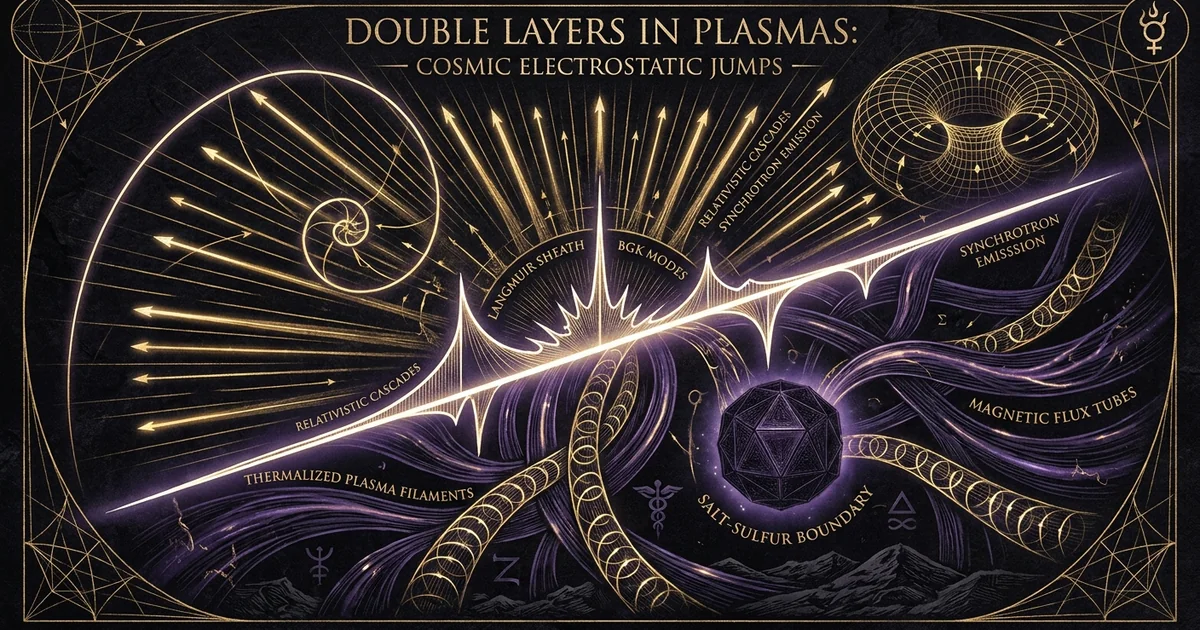
Double Layers in Plasmas: Cosmic Electrostatic Jumps
Executive Summary & Theoretical Thesis: Electrostatic Discontinuities in Non-Neutral Plasmas
Transgression of the Debye Length and Quasi-Neutrality Breakdown
Classical plasma physics predicates its foundational transport equations upon the postulate of macroscopic quasi-neutrality: the condition wherein the electron number density $n_e$ asymptotically balances the ion number density $n_i$ over spatial scales exceeding the electron Debye length, $\lambda_D = \sqrt{\epsilon_0 k_B T_e / (n_e e^2)}$. Under standard thermal equilibrium, any localized perturbation of charge density $\delta \rho = e(n_i - n_e)$ is exponentially attenuated via collective screening currents, restoring the scalar potential $\phi$ to background equipotentiality within a small multiple of $\lambda_D$.
This equilibrium breaks down when a collisionless plasma is subjected to field-aligned drift velocities $v_d$ that exceed the electron thermal velocity, $v_{\text{th},e} = \sqrt{2 k_B T_e / m_e}$. Under these driven, non-equilibrium conditions, collective dielectric polarization fails to maintain isotropic screening. Instead, the plasma self-organizes into an electrostatic double layer: a stable, coherent, non-neutral boundary layer comprising two contiguous, opposing space-charge sheaths—one positive, one negative. This architecture supports a steep macroscopic scalar potential drop, $\Delta \phi$, across a localized spatial domain spanning tens to hundreds of Debye lengths.
Within this boundary sheath, the local dielectric field is dominated by a persistent, unshielded parallel electric field vector, $\mathbf{E}\parallel = -\nabla\parallel \phi \neq 0$. This configuration represents an overt, sustained violation of quasi-neutrality that conventional fluid closures cannot capture.
                  LOW-POTENTIAL PLASMA DOMAIN (φ = 0)
   Free Ions Entering (v_i ≥ c_s)  ───►   Trapped Thermal Electrons
━━━━━━━━━━━━━━━━━━━━━━━━━━━━━━━━━━━━━━━━━━━━━━━━━━━━━━━━━━━━━━━━━━━━
                POSITIVE SPACE-CHARGE SHEATH (ρ > 0)
               [ Net Ion Excess  |  Accelerating Electrons ]
────────────────────────────────────────────────────────────────────
                    STRONG LOCALIZED E_∥ VECTOR
              -dφ/dx >> 0  |  Unscreened Electrostatic Jump
────────────────────────────────────────────────────────────────────
                NEGATIVE SPACE-CHARGE SHEATH (ρ < 0)
               [ Net Electron Excess  |  Reflecting Ions ]
━━━━━━━━━━━━━━━━━━━━━━━━━━━━━━━━━━━━━━━━━━━━━━━━━━━━━━━━━━━━━━━━━━━━
                 HIGH-POTENTIAL PLASMA DOMAIN (φ = Δφ)
   Trapped Thermal Ions   ◄───   Accelerated Electron Beam (v_e >> v_th)
The emergence of this localized charge asymmetry alters the constitutive relation of the local medium. In place of a passive screening dielectric, the double layer operates as an active, dissipative, out-of-equilibrium phase-space vortex.
By decoupling the local plasma volume from the thermodynamic constraints of the surrounding reservoir, the boundary layer establishes a localized non-Maxwellian velocity distribution. This non-Maxwellian state maintains the spatial separation of charge through self-consistent reflection and transmission of distinct kinetic particle classes. The double layer ceases to be a transient microscopic instability; it stabilizes as a stationary cosmic electrostatic jump condition governing macroscopic current transport.
The Macroscopic Uncoupling of Frozen-In Flux Dynamics
In the overarching framework of ideal magnetohydrodynamics (MHD), the assumption of infinite electrical conductivity ($\sigma \to \infty$) enforces Alfvén’s theorem of flux freezing:
$$\mathbf{E} + \mathbf{v} \times \mathbf{B} = 0$$
This relation strictly precludes the existence of electric field components parallel to the ambient magnetic field vector:
$$E_\parallel = \frac{\mathbf{E} \cdot \mathbf{B}}{|\mathbf{B}|} = 0$$
Ideal MHD treats magnetic field lines as perfectly conducting, equipotential entities that mechanically constrain the flow of charged fluids. Consequently, topological reconfiguration and magnetic energy release are traditionally relegated to the localized breakdown of the frozen-in condition within two-dimensional neutral sheets, as modeled by classical magnetic reconnection.
Double layers invalidate this framework by introducing an intense, field-aligned parallel electric field along open or closed magnetic field lines, independent of magnetic null points. When the current density along an astrophysical flux rope—typically mediated by a Birkeland current—exceeds critical kinetic thresholds, the double layer manifests as an anomalous, localized macroscopic impedance.
This drop in field-aligned conductivity isolates the plasma regimes on either side of the layer, breaking the magnetohydrodynamic topological link between connected volumes. The magnetic flux lines become decoupled from the bulk particle advection velocity $\mathbf{v}$. Concurrently, the scalar potential drop $\Delta \phi$ across the sheath establishes a macroscopic slippage of magnetic field lines. This provides an alternative to magnetic reconnection versus electrostatic sheaths as an engine for the dissipation and structural reconfiguration of stored inductive energy.
Kinetic Potentials as the Engine of Cosmic Particle Acceleration
Because the electrostatic potential drop across an astrophysical double layer is oriented parallel to the ambient magnetic field lines, charged particles traversing the sheath undergo non-stochastic, directed ballistic acceleration:
$$\mathcal{E}_k = q \Delta \phi$$
This process operates without the scattering losses characteristic of collisional systems. Unlike diffuse Fermi shock acceleration, which requires repeated, stochastic scattering across converging plasma fronts to progressively increment particle energy, a cosmic electrostatic jump accelerates particles through direct potential drops:
Diffuse Shock Acceleration (Fermi)
- Mechanism: Stochastic phase-space diffusion across supersonic collisionless shock fronts.
- Coherence: Incoherent; requires magnetic turbulence and scattering centers ($\delta B / B \sim 1$).
- Timescale: Protracted acceleration phase ($\tau_{\text{acc}} \sim \kappa / u^2$), bounded by diffusive escape.
- Energy Distribution: Non-thermal power-law spectrum ($dN/dE \propto E^{-\Gamma}$), with energy distributed across a broad continuum.
- Spatial Scale: Macroscopic, requiring vast astronomical scales (kiloparsecs to megaparsecs).
Electrostatic Double Layer Acceleration
- Mechanism: Direct ballistic acceleration across non-neutral, field-aligned potential drops ($\Delta \phi$).
- Coherence: Highly coherent; parallel electric field vector ($E_\parallel = -\nabla_\parallel \phi$) acts unshielded.
- Timescale: Rapid single-pass transit ($\tau_{\text{acc}} \sim \ell_{\text{DL}} / \bar{v}$), escaping before thermalization occurs.
- Energy Distribution: Mono-energetic beam components with high-energy cutoffs governed by $q\Delta\phi$.
- Spatial Scale: Micro-to-mesoscopic sheath thickness ($\ell_{\text{DL}} \sim 10\text{–}100,\lambda_D$) embedded within cosmic circuits.
These electrostatic potential structures emerge naturally within cosmic current circuits, transforming global inductive energy storage into directed kinetic acceleration. This mechanism operates across diverse environments, from the terrestrial auroral acceleration region to the relativistic outflows of blazars and pulsar wind magnetospheres.
Consequently, plasma double layers represent a recognized class of cosmic particle accelerators. In these structures, localized violations of quasi-neutrality convert macroscopic Poynting flux into directed kinetic energy via unshielded electrostatic potential drops.
A stationary, one-dimensional double layer is governed by the steady-state Vlasov equation coupled directly to Poisson’s equation for a collisionless system:
$$v \frac{\partial f_s}{\partial x} - \frac{q_s}{m_s} \frac{d\phi}{dx} \frac{\partial f_s}{\partial v} = 0, \quad \frac{d^2\phi}{dx^2} = -\frac{\rho(\phi)}{\epsilon_0} = -\frac{1}{\epsilon_0} \sum_s q_s \int_{-\infty}^{\infty} f_s(x, v), dv$$
Integration of Poisson’s equation across the sheath yielding real, non-oscillatory electric fields requires that the electric field vanish at both asymptotic boundaries ($x \to \pm \infty$, where $\phi \to 0$ and $\phi \to \Delta \phi$). Multiplying by $d\phi/dx$ and integrating yields the Classical Bohm-Langmuir condition:
$$\frac{1}{2}\epsilon_0 \left(\frac{d\phi}{dx}\right)^2 + V(\phi) = 0 \implies V(\phi) \le 0 \quad \forall , \phi \in [0, \Delta \phi]$$
where $V(\phi) = -\int_0^\phi \rho(\phi’), d\phi’$ represents the Sagdeev pseudopotential. The necessary boundary criteria demand that:
$$\left. \frac{d^2 V}{d\phi^2} \right|{\phi=0} \le 0 \quad \text{and} \quad \left. \frac{d^2 V}{d\phi^2} \right|{\phi=\Delta \phi} \le 0$$
This requires that entering ions satisfy the generalized Bohm criterion, drifting into the low-potential boundary with directed kinetic velocity $v_{d,i} \ge c_s \equiv \sqrt{k_B T_e / m_i}$, while entering electrons satisfy the corresponding Langmuir condition at the high-potential boundary, drifting inward with velocity $v_{d,e} \ge v_{\text{th},e}$.
Historical Lineage & Experimental Precedents: From Langmuir Sheaths to Space Observations
Irving Langmuir and the Cold Cathode Space-Charge Boundary (1929)
The foundational physics of non-neutral electrostatic sheaths originated in the late 1920s through the investigations of Irving Langmuir. While analyzing low-pressure thermionic and cold cathode gas discharges, Langmuir encountered anomalous potential distributions that defied the classical Child-Langmuir space-charge current limits for single-species ballistic flow.
In his 1929 paper, “The Interaction of Electron and Positive Ion Space Charges in Cathode Sheaths,” Langmuir demonstrated that the injection of positive ions from an ambient, highly ionized plasma into the cathode space-charge sheath altered its screening properties.
       CATHODE SURFACE                           PLASMA BOUNDARY
              │                                         │
              │◄─────── SPACE-CHARGE SHEATH ───────────►│
              │                                         │
              │   Electron Current (j_e) ─────────────► │
              │                                         │
              │ ◄───────────── Ion Current (j_i)        │
              │                                         │
     Potential: φ = 0                           Potential: φ = V_0
              │                                         │
              │  n_e >> n_i                 n_i >> n_e  │
              └─────────────────────────────────────────┘
Langmuir observed that when counter-streaming fluxes of electrons and positive ions achieve dynamic equilibrium across a bounded spatial zone, the net space-charge density $\rho(x)$ can develop two localized, spatially contiguous layers of opposite polarity. The positive charge layer shields the negative boundary, while the negative charge layer preserves the interior potential of the discharge. This configuration establishes a stationary potential step:
$$j_e / j_i = \sqrt{m_i / m_e}$$
This relationship, known as the Langmuir condition, proved that a plasma can self-consistently sustain an internal potential step without violating macroscopic boundary constraints. Langmuir demonstrated that these sheaths are not merely passive contact artifacts at metallic electrode interfaces; they are dynamic, self-organizing boundaries governed by the interplay of mutual space charges.
These findings laid the theoretical framework for modern plasma sheath analysis. However, for decades these localized potential jumps were regarded primarily as laboratory artifacts of bounded, low-pressure gas discharges, confined to vacuum tubes and industrial arcs.
Hannes Alfvén’s Cosmical Electrodynamics and the Auroral Voltage Drop
The extrapolation of Langmuir’s space-charge sheaths to astrophysical regimes was initiated by Hannes Alfvén. In his foundational 1958 paper, “On the Theory of Magnetic Storms and Aurorae,” Alfvén proposed that cosmic space was neither a uniform vacuum nor an ideal, infinitely conducting fluid.
Instead, he argued that it is permeated by filamentary electrical currents operating within complex, closed circuits. Alfvén identified the terrestrial auroral zone as an archetype of these cosmic circuits, proposing that the inverted-V electron precipitation profiles observed above the ionosphere were driven by field-aligned electrostatic potential drops:
“Under certain conditions, a plasma cannot remain electrically neutral over macroscopic dimensions. If an electric current flows along the magnetic field lines in a rarefied cosmic plasma, a double layer of charge may develop… In this layer, an intense parallel electric field is sustained, accelerating electrons downward to excite auroral emissions, while positive ions are driven upward into the magnetosphere. The assumption that magnetic lines of force are always equipotential lines is fundamentally flawed.” — Hannes Alfvén, Tellus, 10(1), 104-116 (1958).
Alfvén recognized that when terrestrial Birkeland currents—drawn through the magnetospheric tail down into the resistive polar ionosphere—exceed the density carrying capacity of ambient high-altitude plasma, the system develops an anomalous longitudinal resistance. Rather than producing diffuse ohmic heating across the magnetotail, this resistance concentrates into discrete electrostatic double layers along planetary magnetic flux ropes.
These structures generate stable, field-aligned potential drops of 1 to 10 kV at altitudes between 2,000 and 8,000 kilometers. This theoretical model directly challenged the prevailing paradigm of magnetospheric dynamics, which relied almost exclusively on ideal MHD and treated parallel electric fields ($E_\parallel$) as unphysical artifacts eliminated by plasma screening.
MAGNETOSPHERIC GENERATOR REGION (SOLAR WIND INTERACTION)
                                 │
                                 ▼
                     Field-Aligned Birkeland Current
                                 │
                                 ▼
              [ HIGH-ALTITUDE MAGNETOSPHERIC PLASMA ]
                                 │
                        ┌─────────────────┐
                        │  DOUBLE LAYER   │  Potential Drop:
                        │  E_∥ > 100 mV/m │  Δφ ~ 1 - 10 kV
                        └─────────────────┘
                                 │
                 Accelerated Mono-Energetic Electrons
                                 │
                                 ▼
              [ LOW-ALTITUDE POLAR IONOSPHERE / AURORA ]
In Situ Satellite Validation: S3-3, Viking, and FAST Particle Profiling
The existence of magnetospheric double layers remained controversial until in situ satellite measurements directly resolved their electrostatic and kinetic signatures. The initial experimental detection was achieved in the late 1970s by the polar-orbiting satellite S3-3, which confirmed localized electric field spikes parallel to the geomagnetic field lines at altitudes of roughly one Earth radius ($R_E$).
Instrumentation on S3-3 observed coherent, paired electrostatic shocks characterized by $E_\perp \gg 100\text{ mV/m}$, accompanied by direct signatures of $E_\parallel$ structures sustaining net potential variations.
These observations were expanded during the 1980s and 1990s by the Swedish Viking satellite and the Fast Auroral SnapshoT (FAST) mission. As detailed by Ergun et al. (2002), the high-time-resolution field and particle instruments aboard FAST confirmed that the auroral acceleration region is dominated by laminar and solitary electrostatic double layers. FAST resolved discrete, localized potential steps:
$$E_\parallel \ge 100\text{ mV/m}$$
These steps span spatial thicknesses of several tens of local Debye lengths ($\Delta x \sim 10\text{–}100\text{ m}$ per individual micro-layer), drifting slowly upward along geomagnetic field lines at fractions of the local ion acoustic speed.
The particle spectrometers directly detected the phase-space signatures predicted by kinetic double layer theory: downward-collimated, mono-energetic “inverted-V” electron beams matched with upward-accelerated ion beams and reflected thermal distributions. These in situ measurements settled the theoretical debate, demonstrating that unneutralized, field-aligned electrostatic jumps are fundamental structural components of cosmic plasma regimes.
Mathematical Formalism & Physical Mechanics: The Vlasov-Poisson Framework
BGK Equilibrium States and Phase Space Trapping
The analytical foundation of a stationary, one-dimensional double layer is formulated through the kinetic framework of Bernstein, Greene, and Kruskal (BGK, 1957). In this approach, steady-state double layers represent non-linear electrostatic solutions to the time-independent Vlasov-Poisson system:
$$v \frac{\partial f_s}{\partial x} - \frac{q_s}{m_s} \frac{d\phi}{dx} \frac{\partial f_s}{\partial v} = 0$$
$$\frac{d^2\phi}{dx^2} = -\frac{1}{\epsilon_0} \sum_s q_s \int_{-\infty}^\infty f_s(x, v), dv$$
Because any function of the single-particle constants of motion satisfies the time-independent Vlasov equation, the distribution function $f_s(x, v)$ for each species $s$ (electrons, $e$, and ions, $i$) is expressed in terms of the total energy invariant:
$$\mathcal{H}_s = \frac{1}{2} m_s v^2 + q_s \phi(x)$$
The potential distribution $\phi(x)$ across the double layer is assumed to vary monotonically from $\phi(-\infty) = 0$ at the low-potential boundary to $\phi(+\infty) = \Delta \phi$ at the high-potential boundary.
To sustain this charge distribution, the kinetic phase space $(x, v)$ must be partitioned into four distinct particle populations:
                          KINETIC PHASE SPACE PARTITION

      E_total > qΔφ   ┌─────────────────────────────────────────┐
                      │  FREE (ACCELERATED / DECELERATED) POOL  │
                      │   Transiting species crossing boundary  │
      ────────────────┴─────────────────────────────────────────┴── E = qΔφ
      E_total < qΔφ   ┌─────────────────────────────────────────┐
                      │             TRAPPED POOL                │
                      │  Electrons (Low Side) / Ions (High Side)│
                      └─────────────────────────────────────────┘
- Free Electrons: Originating in the low-potential plasma ($x = -\infty$) with kinetic energies $\mathcal{H}_e > 0$, accelerated through the layer toward $x = +\infty$.
- Trapped Electrons: Bounded on the high-potential side ($x > 0$) with negative energies $\mathcal{H}_e < e\Delta \phi$, kinematically constrained from penetrating the low-potential region.
- Free Ions: Originating in the high-potential plasma ($x = +\infty$) with energies $\mathcal{H}_i > e\Delta \phi$, accelerated down the potential gradient toward $x = -\infty$.
- Trapped Ions: Bounded on the low-potential side with energies $\mathcal{H}_i < 0$, reflected by the rising scalar potential barrier.
The net charge density profile $\rho(\phi)$ is calculated by integrating these compartmentalized distribution functions across their accessible velocity spaces:
$$\rho(\phi) = e \left[ n_{i,\text{free}}(\phi) + n_{i,\text{trapped}}(\phi) - n_{e,\text{free}}(\phi) - n_{e,\text{trapped}}(\phi) \right]$$
To maintain a self-consistent double layer, the trapped distributions must dynamically adapt to cancel the charge imbalance produced by the accelerated free streams, ensuring the overall structure remains stationary.
The Generalized Bohm Criterion and Spatial Stability Thresholds
The integration of Poisson’s equation along the potential coordinate $\phi$ yields the classical quadrature condition:
$$\frac{1}{2} \left( \frac{d\phi}{dx} \right)^2 + V(\phi) = 0, \quad V(\phi) \equiv -\frac{1}{\epsilon_0} \int_0^\phi \rho(\phi’), d\phi’$$
where $V(\phi)$ is the Sagdeev pseudopotential. For a solitary potential step to exist between asymptotic boundaries $\phi = 0$ and $\phi = \Delta \phi$, the electric field must satisfy boundary conditions such that $E = -d\phi/dx = 0$ at both $\phi = 0$ and $\phi = \Delta \phi$. Consequently, $V(0) = 0$, $V(\Delta \phi) = 0$, and the pseudopotential must satisfy:
$$V(\phi) < 0 \quad \forall , \phi \in (0, \Delta \phi)$$
Expanding $V(\phi)$ in a Taylor series about the boundaries yields the generalized Bohm criteria for double layers:
$$\left. \frac{d^2 V}{d\phi^2} \right|{\phi=0} \le 0 \implies \left. \frac{d\rho}{d\phi} \right|{\phi=0} \ge 0$$
$$\left. \frac{d^2 V}{d\phi^2} \right|{\phi=\Delta \phi} \le 0 \implies \left. \frac{d\rho}{d\phi} \right|{\phi=\Delta \phi} \le 0$$
Physically, these criteria require that the charge density becomes positive as $\phi$ increases from zero, and negative as $\phi$ decreases from $\Delta \phi$. For thermal distributions with directed drift velocities, this leads to the requirement that entering ions at the high-potential boundary must drift into the layer with a velocity satisfying:
$$v_{d,i} \ge c_s \equiv \sqrt{\frac{k_B T_e}{m_i}}$$
Similarly, entering electrons at the low-potential boundary must drift inward with a velocity satisfying the Langmuir Bohm-equivalent threshold:
$$v_{d,e} \ge v_{\text{th},e} \equiv \sqrt{\frac{k_B T_e}{m_e}}$$
If the streaming particle velocities drop below these thresholds, the Sagdeev condition $V(\phi) < 0$ is violated. The monotonic potential profile then collapses into spatially oscillating solutions, converting the structure into localized solitary wave packets or low-amplitude ion acoustic waves. This process couples the electrostatic sheath to the broader framework of plasma wave dispersion and acoustic modes.
Relativistic Double Layers: Carlqvist Limiting Currents and Field Inversion
In high-energy astrophysical environments, the electrostatic potential drop across a double layer can satisfy:
$$e \Delta \phi \gg m_e c^2$$
Under these conditions, accelerated particles achieve ultra-relativistic velocities, requiring a relativistic treatment of the double layer’s phase space. As formulated by Per Carlqvist (1982), relativistic mass dilation substantially alters the local charge density distributions:
$$\gamma(x) = 1 + \frac{e\phi(x)}{m_e c^2}$$
$$n_e(x) = \frac{j_e}{e, v_e(x)} = \frac{j_e}{e, c \sqrt{1 - \gamma(x)^{-2}}}$$
As electrons approach the speed of light ($v_e \to c$), their velocity saturates. Consequently, their space-charge density profile ceases to decrease with continued electrostatic acceleration:
$$n_e(x) \to \frac{j_e}{e c} = \text{constant}$$
This velocity saturation suppresses the standard non-relativistic space-charge thinning effect. To maintain the requisite charge balance within Poisson’s equation, the total current density running through the double layer must decouple from classical Child-Langmuir scaling ($j \propto (\Delta \phi)^{3/2}$). Instead, it approaches the relativistic Carlqvist limit:
$$j \approx 1.86, \epsilon_0 c, \frac{\Delta \phi}{d^2}$$
where $d$ denotes the physical thickness of the double layer.
CURRENT DENSITY SCALING:
                      Non-Relativistic (Child-Langmuir):  j ∝ (Δφ)^(3/2)
                      Ultra-Relativistic (Carlqvist):      j ∝ (Δφ) / d^2
In this regime, the electrostatic energy density stored within the parallel electric field layer can exceed the local kinetic energy density of the plasma:
$$\frac{1}{2} \epsilon_0 E_\parallel^2 \gg n_e k_B T_e + n_i k_B T_i$$
Under these conditions, the double layer transitions into a high-impedance, explosive state. If the external circuit fails to sustain the relativistic current density demanded by the Carlqvist limit, the boundary layer becomes structurally unstable.
The structure undergoes explosive inductive collapse, dissipating stored magnetic energy through directed beams of relativistic particles and emitting coherent electromagnetic radiation.
Empirical Evidence & Observational Data: Laboratory Verification and Cosmic Acceleration
Helicon Plasma Source Testing and Laser-Induced Fluorescence (LIF)
The transition of double layer physics from theoretical construct to empirical science was accelerated by experiments conducted in modern linear plasma devices and helicon plasma thrusters. Utilizing geometrically diverging magnetic fields, helicon sources generate steady-state, current-free double layers without the intrusive boundary artifacts introduced by mechanical cathode-anode assemblies.
High-resolution non-invasive diagnostics—specifically Laser-Induced Fluorescence (LIF) and Retarding Field Energy Analyzers (RFEA)—have directly resolved the microphysics of these structures.
                     DIVERGING HELICON SOURCE SCHEMATIC
         Source Chamber                    Expansion Chamber
    ┌──────────────────────┐         :
    │  Helicon Antenna     │         :   Expanding Magnetic
    │  ██████████████████  │         :      Field Lines
    │                      │         :           \
    │  Plasma Generation   │  B-Field:            \
    │  n_e ~ 10^13 cm^-3   │========>:             \  Supersonic Ion Beam
    │                      │         :              ==> v_i > 2*c_s
    │  φ = φ_high          │         :  DOUBLE LAYER \
    └──────────────────────┘         :  Δφ ~ 40 V     \
                                     :  d < 50 λ_D
LIF diagnostics tracking ionized argon and xenon demonstrate that as plasma expands along diverging magnetic field lines, an electrostatic double layer forms over spatial scales:
$$d \le 50, \lambda_D$$
Across this boundary, the plasma potential drops by:
$$\Delta \phi \approx (3\text{–}5) \times \frac{k_B T_e}{e}$$
The LIF data resolve the continuous phase-space acceleration of the ion population: sub-Bohm thermal ions enter the high-potential margin of the sheath and exit the low-potential boundary as collimated, supersonic ion beams with directed velocities:
$$v_{\text{beam}} \ge 2, c_s$$
These controlled laboratory configurations confirm that double layers do not require solid material boundaries to form; they emerge naturally within collisionless plasmas under non-uniform magnetic confinement and expansion.
Planetary Magnetospheres: Auroral Kilometric Radiation (AKR) Linkage
Beyond the near-Earth in situ validation achieved by the FAST and Polar satellites, magnetospheric double layers are observationally linked to the emission of coherent Auroral Kilometric Radiation (AKR).
AKR is an intense, non-thermal, circularly polarized radio emission generated at frequencies between 50 and 800 kHz. It originates within auroral density cavities where the local plasma frequency drops below the electron cyclotron frequency:
$$\omega_{pe} \ll \omega_{ce}$$
Direct correlations establish that the drivers of this coherent planetary radiation are electron distributions accelerated by electrostatic double layers:
        POLAR CAVITY (ω_pe << ω_ce)
                      │
  Electrostatic Double Layer (Δφ ~ 1 - 10 kV)
                      │
  Downward Accelerated Electron Beam
                      │
  Magnetic Mirroring & Phase-Space Trapping
                      │
  Unstable Electron "Horseshoe" Distribution (∂f_e / ∂v_⊥ > 0)
                      │
  Relativistic Cyclotron Maser Instability (CMI)
                      │
                      ▼
         AURORAL KILOMETRIC RADIATION (Coherent Transverse Mode)
As the accelerated electron beams propagate downward into regions of increasing geomagnetic field intensity, magnetic mirroring reflects particles with high pitch angles. The superposition of accelerated free electrons, reflected electrons, and empty loss cones deforms the phase-space distribution into an unstable “horseshoe” or “crescent” configuration characterized by a positive perpendicular velocity gradient:
$$\frac{\partial f_e}{\partial v_\perp} > 0$$
This population inversion drives the relativistic Cyclotron Maser Instability (CMI), converting the directed kinetic energy gained from the double layer into coherent transverse electromagnetic waves.
The planetary double layer thus functions as a two-stage converter: it transforms global magnetospheric current energy into kinetic potential drops via unshielded electrostatic fields, which the cyclotron maser instability subsequently converts into escape-velocity radio emissions.
Extra-Galactic Jets and Pulsar Wind Magnetospheres
Applying relativistic scaling relations suggests that double layers operate across high-energy cosmic particle accelerators, including pulsar magnetospheres and the relativistic jets of Active Galactic Nuclei (AGN).
In pulsar polar cap models, rotational induction generates field-aligned electric potentials:
$$\Delta \Phi \sim 10^{12}\text{–}10^{14}\text{ V}$$
While magnetic pair production cascades ($e^- + \gamma \to e^+ + e^-$) typically shield these potentials through dense secondary pair plasmas, local supply gaps or current instabilities can decouple the plasma from thermodynamic equilibrium. Within these gaps, pair production rates cannot balance the induction current, precipitating relativistic double layers.
       ACTIVE GALACTIC NUCLEI / RELATIVISTIC JET COLUMN
   Parsec-Scale Birkeland Flux Rope (Poloidal & Toroidal Fields)
                          │
                          ▼
            Local Pinched Plasma Constriction
         (Drift Velocity: v_d > v_th,e ; n_e drops)
                          │
                          ▼
        RELATIVISTIC ELECTROSTATIC DOUBLE LAYER
             eΔφ ~ 10^18 - 10^20 eV ; d ~ AU scale
                          │
                          ▼
        Direct Coherent Ballistic Acceleration:
           - Collimated Ultra-Relativistic Synchrotron Knots
           - Direct Non-Thermal Ejection of UHECR Protons
In the parsec-scale jets of active galaxies, current-driven instabilities—such as the relativistic Buneman instability—can trigger localized electrostatic double layers. In these cosmic-scale regimes, potential drops approach:
$$\Delta \phi \sim 10^{18}\text{–}10^{20}\text{ V}$$
These structures offer a potential resolution to the Hillas criterion limitations inherent to diffuse shock acceleration of Ultra-High-Energy Cosmic Rays (UHECRs). Rather than requiring parsec-scale gyro-radii confinement within diffuse magnetic turbulence, a relativistic double layer accelerates heavy ions (such as $\text{Fe}^{56}$) to energies exceeding:
$$E \ge 10^{20}\text{ eV}$$
This acceleration occurs across a single ballistic transit through a compact, field-aligned sheath. The observed discrete, superluminal “knots” along extra-galactic relativistic jets may represent localized electrostatic jumps, where macroscopic inductive energy stored in helical Birkeland currents and cosmic circuits undergoes direct electrostatic discharge.
Metaphysical Implications & Unified Synthesis: Non-Local Circuit Dynamics of the Electric Universe
Plasma Scaling Laws: Microscopic Laboratory Sheaths to Galactic Filaments
The self-similarity of plasma dynamics across disparate spatial orders of magnitude represents an empirical manifestation of non-linear scale invariance. Laboratory discharge tubes ($\ell \sim 10^{-3}\text{ m}$), planetary magnetospheres ($\ell \sim 10^7\text{ m}$), and galactic filamentary networks ($\ell \sim 10^{21}\text{ m}$) are governed by the same underlying equations of electrodynamics.
When normalized via dimensionless parameters—such as the ratio of gyro-radius to Debye length ($\rho_L / \lambda_D$), the plasma beta ($\beta = 2\mu_0 P / B^2$), and the magnetic Reynolds number ($R_m = \mu_0 \sigma v L$)—the kinetic and electrostatic properties of the plasma double layer exhibit consistent scaling behaviors across 24 orders of magnitude.
                           THE SCALE INVARIANCE OF DOUBLE LAYERS

       LABORATORY (10^-3 m)  ──►  MAGNETOSPHERIC (10^7 m)  ──►  GALACTIC (10^21 m)
   ─────────────────────────────────────────────────────────────────────────────
    • Helicon Sheaths          • Auroral Acceleration       • Relativistic Jet Knots
    • LIF-Resolved Potential   • S3-3 / FAST Profiles       • UHECR Acceleration Sites
    • Debye Sheath Physics     • Inverted-V Potentials      • Parsec-Scale Circuits
   ─────────────────────────────────────────────────────────────────────────────
              Unified Formalism: Vlasov-Poisson-Ampère Kinetic Scaling
This invariance challenges the reductionist approach of treating astrophysical systems as isolated, closed thermodynamic cells. Instead, it suggests a hierarchical universe unified by electrodynamic scaling laws.
The double layer acts as a self-similar regulator of charge separation, demonstrating that plasma morphology remains consistent whether operating within a terrestrial gas discharge or along an intergalactic cosmic filament.
Birkeland Currents and the Topology of Morphogenetic Cosmic Circuits
The localized double layer cannot exist as an isolated, self-contained phenomenon; it requires closure through an external, global electrical circuit. A double layer operating along a field-aligned conduit behaves as an active electrical load:
$$\mathcal{P}{\text{diss}} = \int{\mathcal{V}} \mathbf{J} \cdot \mathbf{E}, dV = I, \Delta \phi > 0$$
It continuously dissipates Poynting flux into kinetic particle energy. To sustain this dissipation, the system relies on an external, macroscopic electromotive force (EMF), coupled to the double layer via field-aligned Birkeland currents.
“To understand the physics of an active plasma region—such as an auroral acceleration zone, a solar flare, or a relativistic jet—one must map not only the local parameters within the region itself, but the complete global circuit supplying the driving current. The energy released in a double layer is stored inductively throughout the extended circuit ($W = \frac{1}{2} L I^2$), and is delivered to the non-neutral sheath by Poynting flux running parallel to the current filaments.” — Hannes Alfvén, Cosmic Plasma, D. Reidel Publishing Company (1981); Anthony L. Peratt, Physics of the Plasma Universe, Springer-Verlag (1992).
This circuit architecture requires that the energy released within a double layer is drawn non-locally from the total inductive energy stored within the global circuit:
$$W = \frac{1}{2} L I^2$$
The localized double layer acts as an impedance mismatch point—a cosmic transformer where magnetic flux, gathered across vast astronomical expanses, is channeled inward and released across a compact, non-neutral electrostatic sheath.
Cosmic filaments cease to be passive fluid streams governed solely by mechanical gravitation; they operate as morphogenetic circuits where form, acceleration, and matter segregation are governed by electrodynamic principles.
GLOBAL INDUCTIVE CIRCUIT TOPOLOGY:
  [ COSMIC GENERATOR REGION: EMF INDUCTION ]
      (Kinetic Dynamo / Cross-Field Flow: ∇ × (v × B))
                      │
 Poynting Flux        │         Return Current Path
 S = (E × B) / μ_0    │         Field-Aligned Filament
                      ▼
        [ EXTENDED INDUCTIVE STORAGE ]
             W_ind = (1/2) L * I^2
                      │
                      ▼
       ┌─────────────────────────────┐
       │ ELECTROSTATIC DOUBLE LAYER  │  Local Load:
       │ J · E > 0  |  Unshielded E_∥│  P = I * Δφ
       └─────────────────────────────┘
                      │
                      ▼
  Direct Particle Acceleration: Mono-Energetic Beams
  Electromagnetic Emission: AKR / Synchrotron Knots</code></pre>
The Breakdown of Mechanistic Reductionism: Field Induction as an Organismic Agent
The physical reality of the cosmic double layer reveals the limitations of purely local, mechanistic reductionism in classical astrophysics. In the conventional framework, celestial interactions are governed primarily by isotropic, local force laws—principally Newtonian-Einsteinian gravitation mediated by point-mass interactions, supplemented by local fluid pressures.
In contrast, plasma double layers are driven by global circuit mechanics: their spatial location, lifetime, and acceleration capacity are determined by non-local conditions throughout the entire electromagnetic circuit.
This non-local dynamic aligns with a more organismic view of electrodynamics, reminiscent of the classical concept of the dielectric-field articulated by Maxwell and Heaviside. In this perspective, fields are not merely mathematical abstractions; they are real, energetic physical configurations through which dynamic space coordinates its structural states.
The double layer acts as a regulatory node within the cosmos. It prevents unconstrained current accumulation through localized, self-limiting potential jumps, redistributing stored electromagnetic energy across cosmological scales.
Through this lens, the universe is not a passive assembly of inert matter driven by mechanical decay, but an integrated electrodynamic system operating through self-organizing plasma boundaries, current channels, and cosmic electrostatic jumps.
Frequently Asked Questions
How do plasma double layers evade the Debye shielding effect?
Double layers evade thermal Debye shielding because they operate far from thermodynamic equilibrium. Classical Debye shielding assumes an isotropic, Maxwell-Boltzmann velocity distribution in which thermalized mobile electrons reorganize to cancel any localized potential perturbation over a characteristic screening length:
$$\lambda_D = \sqrt{\frac{\epsilon_0 k_B T_e}{n_e e^2}}$$
In contrast, double layers are driven by field-aligned currents whose drift velocities exceed the local thermal speeds:
$$v_d \ge v_{\text{th},e}$$
This drift condition supplies continuous directed kinetic energy to the boundary. The incoming particles are sorted into distinct, non-Maxwellian classes: free transiting streams and reflected, phase-space-trapped populations.
The spatial separation of these distributions prevents the thermal relaxation required for screening. The system establishes a stable non-linear BGK equilibrium where localized space charge is dynamically sustained by the balance of kinetic particle fluxes, maintaining an unscreened electric field across tens to hundreds of Debye lengths.
What distinguishes an electrostatic double layer from a magnetic reconnection site?
While both double layers and magnetic reconnection sites facilitate the dissipation of stored magnetic energy and the acceleration of cosmic particles, their underlying mechanics, topological requirements, and acceleration modes differ substantially:
                  DOUBLE LAYER vs. MAGNETIC RECONNECTION

     DOUBLE LAYER                              MAGNETIC RECONNECTION
 ───────────────────────────────────────────────────────────────────────────
  • Electrostatic Potential Jump (E_∥)      • Magnetic Field Topology (B_null)
  • No Magnetic Null Required               • Requires Opposing B-Field Lines
  • Aligned with Field Lines                • Perpendicular Inflow / Outflow
  • Direct Ballistic Acceleration           • Stochastic / Shock / Fermi
  • Generates Mono-Energetic Beams          • Generates Broadband Power Laws
 ───────────────────────────────────────────────────────────────────────────
Magnetic reconnection depends on the topological tearing and cross-connection of opposing magnetic field vectors ($\mathbf{B}$) across an localized neutral sheet. It accelerates particles predominantly through induced perpendicular electric fields ($\mathbf{E} = -\mathbf{v} \times \mathbf{B}$), shock formation, and stochastic turbulence, producing broad non-thermal power-law distributions.
In contrast, a double layer is an electrostatic phenomenon: it forms along open or closed magnetic field lines without requiring magnetic null points, opposing field orientations, or topological reconnection.
Its primary acceleration vector is the field-aligned electrostatic field:
$$E_\parallel = -\frac{d\phi}{dx}$$
This field accelerates particles through direct, ballistic, single-pass potential drops, producing coherent, mono-energetic particle beams rather than broadband turbulent distributions.
Can relativistic double layers explain Ultra-High-Energy Cosmic Rays (UHECRs)?
Relativistic double layers offer an alternative to diffuse shock acceleration for explaining the origins of Ultra-High-Energy Cosmic Rays (UHECRs) with energies:
$$E \ge 10^{20}\text{ eV}$$
Classical Fermi acceleration models struggle to explain these ultra-high energies because the Hillas criterion requires astrophysical sites (such as AGN lobes or galaxy cluster shocks) to possess sufficient physical dimensions and magnetic field coherence to confine high-energy ions over millions of gyration cycles without escape.
Relativistic double layers overcome this geometric constraint by accelerating ions through direct, concentrated potential drops:
$$\mathcal{E} = Z e \Delta \phi$$
In the extreme current channels of active galactic nuclei jets or magnetar magnetospheres, the current density exceeds the relativistic Carlqvist threshold:
$$j \approx 1.86, \epsilon_0 c, \frac{\Delta \phi}{d^2}$$
This condition can sustain localized potential drops of $10^{18}\text{–}10^{20}\text{ V}$ across compact astronomical scales.
Heavy, high-$Z$ ions (such as iron nuclei) traversing this field-aligned sheath undergo direct ballistic acceleration to maximum cosmic ray energies in a single pass. This mechanism produces high-energy particles before radiative losses or turbulent scattering can disrupt the beam. :::