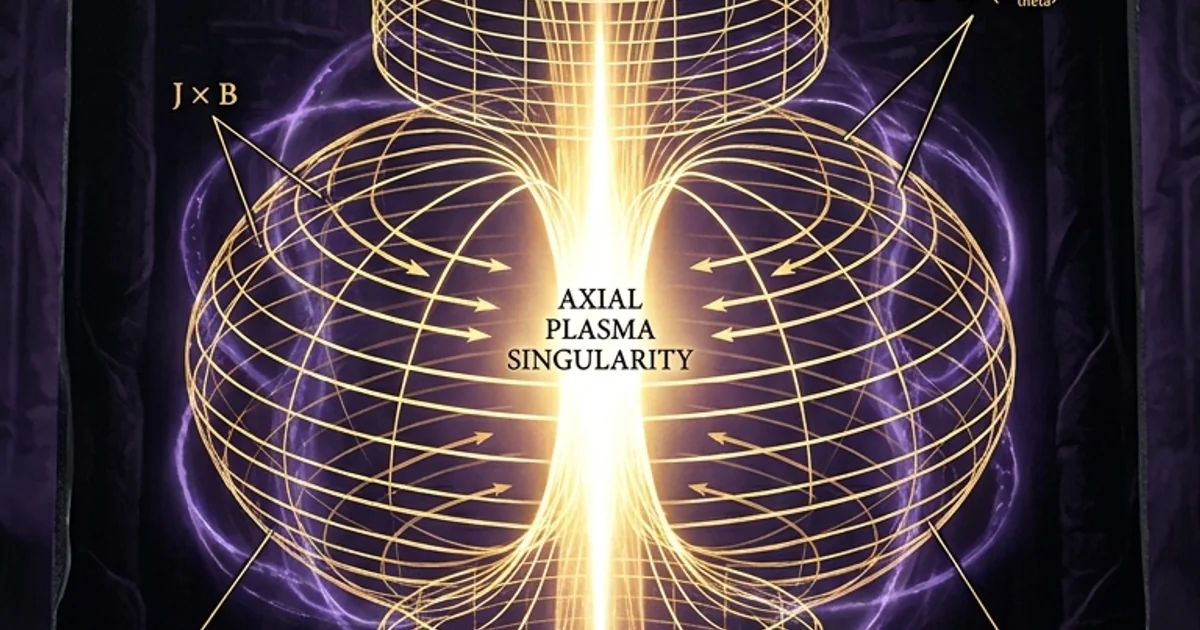
The Z-Pinch Effect: Magnetic Confinement & High Density
Executive Summary & Theoretical Thesis
The Fundamental Lorentz Compression Vector
The Z-pinch configuration represents one of the most elegant, direct, and violently potent manifestations of electrodynamic self-action within plasma physics. At its theoretical core, the architecture relies upon an axial electrical current density, denoted as $\mathbf{J} = J_z \hat{\mathbf{z}}$, driven through a cylindrical conducting medium. In accordance with Ampère’s law, this directed transport of charge intrinsically induces a nested, azimuthal magnetic induction field, $\mathbf{B} = B_\theta® \hat{\boldsymbol{\theta}}$.
The local interaction between this self-generated magnetic vector and the driving current establishes a volumetric Lorentz body force density:
$$\mathbf{f}L = \mathbf{J} \times \mathbf{B} = (J_z \hat{\mathbf{z}}) \times (B\theta \hat{\boldsymbol{\theta}}) = - J_z B_\theta \hat{\mathbf{r}}$$
This force is directed strictly radially inward toward the central geometric coordinate axis ($r = 0$).
Unlike external magnetic confinement topologies such as tokamaks or stellarators—which require complex, externally energized, non-planar magnetic field coils—the Z-pinch generates its own confining envelope via the Maxwell stress tensor. The magnetic pressure $P_{\text{mag}} = B_\theta^2 / (2\mu_0)$ acts upon the outer boundaries of the discharge, while the magnetic tension term $(\mathbf{B} \cdot \nabla)\mathbf{B}/\mu_0 = - (B_\theta^2 / \mu_0 r) \hat{\mathbf{r}}$ exerts an unrelenting hoop stress that attempts to shrink the circumference of the magnetic field lines to an infinitesimal point.
When applied to high-temperature, fully ionized matter, this centripetal force compresses the plasma column, overcoming isotropic kinetic thermal pressures ($P_{\text{kin}} = \sum n_k k_B T_k$) and driving the material into states of extreme energy density characterized by gigabar pressures and keV-scale temperatures.
Current Vector (J_z)
                        ▲
                        │  +-------------------------+
                        │  │ Azimuthal Field (B_θ)   │
                        │  │       ╭─────────╮       │
                        │  │     ╭─╯         ╰─╮     │
    Lorentz Force (f_r) │  │    ╭╯    Plasma   ╰╮    │
          ───►          │  │    │     Column    │    │
                        │  │    ╰╮   (r = 0)   ╭╯    │
                        │  │     ╰─╮         ╭─╯     │
                        │  │       ╰─────────╯       │
                        │  +-------------------------+
                        │
                        ┴  Axis of Cylindrical Symmetry
Thermodynamic Non-Equilibrium and Radiative Collapse
As the plasma column undergoes dynamic contraction, the hydrodynamic evolution transitions through distinct thermodynamic phases governed by the competition between Ohmic heating and radiative dissipation. The electrical power deposited into the column via Joule dissipation scales inversely with the plasma cross-sectional area and depends fundamentally upon the classical Spitzer resistivity:
$$\eta_\parallel \approx 1.03 \times 10^{-4} Z \ln\Lambda , T_e^{-3/2} \quad [\Omega \cdot \text{m}]$$
Simultaneously, the dense, multiply ionized ions undergo non-relativistic electron-ion bremsstrahlung, emitting a volumetric radiative power density:
$$P_{\text{rad}} = C_B Z_{\text{eff}} n_e^2 T_e^{1/2} \quad [\text{W/m}^3]$$
where $C_B \approx 1.57 \times 10^{-40} , \text{W}\cdot\text{m}^3\cdot\text{K}^{-1/2}$.
When the total discharge current is modest, an equilibrium can be established wherein resistive heating balances outward thermal conduction and optical emission. However, because Ohmic heating efficiency decreases with rising temperature as $T_e^{-3/2}$, whereas volumetric bremsstrahlung emission scales positively as $T_e^{1/2}$ and quadratically with density ($n_e^2$), the system exhibits a sharp thermodynamic instability threshold.
If the current surpasses a critical boundary, the radiative emission violently outpaces the internally generated thermal energy. The plasma loses its internal pressure support, precipitating an extreme phenomenon termed radiative collapse. During this collapse, the radius of the plasma column rapidly contracts by multiple orders of magnitude until degenerate quantum pressures or optical opacity limits intervene, terminating the compression at astronomical densities.
The Bennett Confinement Paradigm
The foundational analytical equilibrium of a steady-state, magnetically self-confining plasma column was established by Willard Harrison Bennett. The Bennett relation demonstrates that for a long, stationary, cylindrical plasma thread, the total integrated line energy of the constituent particles is precisely balanced by the self-magnetic energy per unit length.
By integrating the radial magnetostatic force balance equation $\nabla P = \mathbf{J} \times \mathbf{B}$ across the radial coordinate from $r = 0$ to $r = \infty$, the spatial profile of the current density drops out, revealing a direct, macroscopically invariant constraint linking total axial current $I$, linear particle inventory $N$, and total kinetic temperature:
$$\frac{\mu_0 I^2}{4\pi} = 2 N k_B (T_e + T_i)$$
This elegant relationship exposes the dual reality of the Z-pinch. The system offers an exceptionally high energy-density state achievable through a simple geometry, but operating along this equilibrium curve requires navigating dangerous hydrodynamic boundaries.
The plasma column is non-adiabatically coupled to its surrounding dielectric field, where any macroscopic perturbation can trigger spatial disruption. The Z-pinch remains the primary archetype of electromagnetic self-confinement and matter condensation across both laboratory pulsed-power architectures and cosmic Birkeland currents.
Consider a fully ionized, quasi-neutral, stationary hydrogenic plasma cylinder ($Z=1$) in Bennett equilibrium, where the total current $I$ balances uniform plasma pressure. The Ohmic heating power per unit length, $d W_{\text{ohm}} / dz$, is given by:
$$\frac{d W_{\text{ohm}}}{dz} = \int_0^{r_p} \eta_\parallel J_z^2 , 2\pi r , dr$$
Assuming a uniform current density $J_z = I / (\pi r_p^2)$ and Spitzer’s resistivity $\eta_\parallel = \alpha T_e^{-3/2}$, with:
$$\alpha = \frac{\pi e^2 m_e^{1/2} \ln\Lambda}{2 (4\pi \epsilon_0)^2 (2 k_B)^{3/2}}$$
the integrated Ohmic input per unit length evaluates directly to:
$$\frac{d W_{\text{ohm}}}{dz} = \frac{\alpha I^2}{\pi r_p^2 T_e^{3/2}}$$
Conversely, the total power lost per unit length to optically thin bremsstrahlung radiation is:
$$\frac{d W_{\text{rad}}}{dz} = \int_0^{r_p} C_B n_e^2 T_e^{1/2} , 2\pi r , dr = \frac{C_B N^2 T_e^{1/2}}{\pi r_p^2}$$
Equating the input dissipation to the radiative loss, we find:
$$\frac{\alpha I^2}{\pi r_p^2 T_e^{3/2}} = \frac{C_B N^2 T_e^{1/2}}{\pi r_p^2} \implies \alpha I^2 = C_B N^2 T_e^2$$
Substituting the Bennett relation, $N k_B T = \mu_0 I^2 / (8\pi)$ (assuming $T_e = T_i = T$, so $T_e + T_i = 2T$), yields:
$$\alpha I^2 = C_B \left( \frac{\mu_0 I^2}{8\pi k_B} \right)^{!2} = \frac{C_B \mu_0^2 I^4}{64 \pi^2 k_B^2}$$
Solving for the non-zero critical current $I_{PB}$:
$$I_{PB} = \sqrt{\frac{64 \pi^2 k_B^2 \alpha}{\mu_0^2 C_B}} \approx \frac{8\pi e}{\mu_0} \sqrt{\frac{m_e^{1/2} \ln\Lambda}{2 (4\pi\epsilon_0)^2 C_B k_B^{1/2}}}$$
Evaluating this expression using the fundamental constants for a pure hydrogen plasma ($\ln\Lambda \approx 10$) gives the invariant Pease-Braginskii current limit:
$$I_{PB} \approx 1.4 \times 10^6 \text{ Amperes} = 1.4 \text{ MA}$$
When $I > I_{PB}$, radiative energy losses fundamentally exceed the capacity for internal resistive replenishment, driving rapid, unconstrained radiative collapse of the plasma column toward the axial singularity.
Historical Lineage & Experimental Precedents
Early Discharge Tubes and Willard Bennett’s 1934 Formulation
The study of dynamic self-constriction originated in late nineteenth-century electrical discharge physics. In 1897, while observing the behavior of liquid metal conductors undergoing intense currents, early investigators noted structural thinning, structural instability, and sudden pinching of the fluid stream. However, the theoretical mathematical basis was not formalized until Willard Harrison Bennett published his seminal 1934 treatise, Magnetically Self-Focussing Streams.
Bennett analyzed high-velocity streams of relativistic electrons traversing a partially ionized background gas. He demonstrated that the repulsive electrostatic space-charge forces, which naturally tear charged particle beams apart, could be neutralized by an ambient ion column. Once electrostatic repulsion is neutralized, the mutual magnetic attraction between parallel current filaments dominates the stream’s cross-section.
Bennett showed that the steady-state radius of the beam is governed by a fundamental equilibrium between kinetic pressure and magnetic pinch pressures, mapping the radial density distribution of the self-confined fluid. His 1934 formulation provided the baseline criteria for all subsequent magnetic self-compression research, linking Maxwellian electrodynamics directly to non-linear fluid mechanics.
“The condition for the magnetic self-focusing of an electrically neutralized stream of charged particles requires that the magnetic forces arising from the axial flow of charge overcome the transverse thermal dispersion forces. For an axially symmetric stream conducting current $I$ with a line density of carriers $N$ at an invariant transverse kinetic temperature $T$:”
$$\frac{\mu_0 I^2}{4\pi} = 2 N k_B T$$
“If the current exceeds this critical magnitude, the envelope must contract, driving the transverse density toward an axial focus until limited by internal Fermi pressures or high-order collisional interactions.” — Willard H. Bennett, Physical Review, 45(12), 890–897 (1934).
The Mid-Century Fusion Race: From ZETA to Kurchatov Discharges
Following the declassification of controlled thermonuclear research at the 1958 Atoms for Peace Conference in Geneva, the dynamic Z-pinch was widely regarded as the most direct route to laboratory thermonuclear fusion. In the United Kingdom, the Zero Energy Thermonuclear Assembly (ZETA) attempted to confine toroidally linked pinches, while in the Soviet Union, Igor Kurchatov and his colleagues investigated straight, high-voltage pulsed discharges within ceramic tubes.
The appeal of the configuration lay in its simplicity: passing a sufficiently massive electrical current through a column of deuterium gas would simultaneously ionize, compress, and heat the fuel to thermonuclear ignition temperatures without requiring auxiliary radiofrequency or neutral-beam heating systems.
Early optimism dissolved when experimental discharges were analyzed with microsecond-resolved streak photography and magnetic probes. Rather than compressing symmetrically and maintaining confinement at the center of the vessel, the discharges disintegrated almost immediately upon initiation.
The Soviet and British teams repeatedly observed massive bursts of neutrons, but subsequent spectroscopic diagnostics revealed these were not thermonuclear in origin. Instead, they were produced by beam-target interactions: local electric fields, formed during the rapid rupture of the plasma column, accelerated a fraction of the deuterons into the ambient cold gas.
The simple Z-pinch proved incapable of maintaining static equilibrium; it was destroyed within nanoseconds by magnetohydrodynamic (MHD) instabilities. As a result, mainstream fusion research shifted away from dynamic pinches toward complex, externally stabilized geometries—chiefly the Soviet Tokamak and the American Stellarator.
+--------------------------------------------------------------------------+
| CHRONOLOGICAL DRIFT: FROM DISCOVERY TO CONTROLLED COMPRESSION            |
+--------------------------------------------------------------------------+
| 1934: Bennett publishes "Magnetically Self-Focussing Streams"            |
|       - Identifies self-magnetic focus in neutral beams.                 |
|                                                                          |
| 1950s: ZETA (UK) & Kurchatov Experiments (USSR)                          |
|       - First fusion attempts succumb to violent m=0 / m=1 instabilities.|
|       - Fusion effort pivots toward Tokamaks and Stellarators.           |
|                                                                          |
| 1957: Pease & Braginskii independently derive radiative collapse limit   |
|       - Postulates radiative collapse threshold at ~1.4 MA.              |
|                                                                          |
| 1980s-1990s: Fast Wire-Array Revolution (Sandia, Imperial College)       |
|       - Thin metallic arrays tame spatial inhomogeneities.               |
|       - Paves the way for multi-megampere pulsed-power facilities.       |
|                                                                          |
| 2000s+: Z Machine Era & Sheared-Flow Stabilization (ZaP)                 |
|       - X-ray outputs exceed 2 MJ; sheared flow delays MHD modes.        |
+--------------------------------------------------------------------------+
The Pulsed-Power Revolution and Wire-Array Metrology
The Z-pinch was revitalized in the late 1980s and 1990s by the development of multi-stage pulsed-power architectures and thin wire-array liners. Researchers at institutions such as Imperial College London and Sandia National Laboratories recognized that the catastrophic instabilities observed in early experiments stemmed from non-uniform breakdown within low-density gas fills.
By replacing diffuse gas with a cylindrical cage composed of tens or hundreds of sub-micron metallic wires (such as tungsten or aluminum), researchers dramatically altered the breakdown physics. When driven by mega-ampere current pulses with nanosecond rise times, the individual wires vaporize, ionize, and form distinct plasma cores surrounded by lower-density coronal plasma.
       TOP-DOWN CROSS-SECTION: NESTED CYLINDRICAL WIRE-ARRAY

                           Tungsten Wires
                                 *
                           *           *
                        *                 *
                       *   Coronal Plasma  *
                      *       (Pre-fill)    *
                     *          ╭───╮        *
                     *          │   │        *
                     *          ╰───╯        *
                      *        Central      *
                       *       Axis (r=0)  *
                        *                 *
                           *           *
                                 *

           [ Imploding Coronal Plasma Streams toward Central Axis ]
This arrangement enabled continuous ablation of the wire cores. The ablated material streams inward, filling the internal void with high-conductivity plasma and generating a uniform, high-density shell.
When the current pulse reaches its peak, the discrete wire channels merge into a continuous, highly symmetric plasma sheet that implodes as a coherent hollow shell. This method tamed azimuthal inhomogeneities, transforming the Z-pinch from an unpredictable laboratory curiosity into an exceptionally powerful source of soft X-rays, capable of generating peak radiative powers exceeding 200 terawatts.
Mathematical Formalism & Physical Mechanics
Ideal Magnetohydrodynamic (MHD) Equilibrium & the Bennett Relation
The theoretical treatment of the Z-pinch begins with the stationary ideal magnetohydrodynamic equations. Neglecting macroscopic bulk velocities ($\mathbf{v} = 0$) and time-dependent variations ($\partial / \partial t = 0$), the momentum conservation equation reduces to a static balance between the kinetic pressure gradient and the inward Lorentz force:
$$\nabla P = \mathbf{J} \times \mathbf{B}$$
Assuming complete cylindrical symmetry where fields and variables depend solely on the radial coordinate $r$—meaning $\mathbf{J} = J_z®\hat{\mathbf{z}}$, $\mathbf{B} = B_\theta®\hat{\boldsymbol{\theta}}$, and $P = P®$—the radial component of the momentum equation is expressed as:
$$\frac{dP®}{dr} = - J_z® B_\theta®$$
Ampère’s law in differential form relates the axial current density to the spatial evolution of the azimuthal magnetic field:
$$\mu_0 J_z® = \frac{1}{r} \frac{d}{dr} \left( r B_\theta® \right)$$
Substituting this into the force-balance equation yields:
$$\frac{dP}{dr} = -\frac{B_\theta}{\mu_0 r} \frac{d}{dr}(r B_\theta) = -\frac{1}{2\mu_0 r^2} \frac{d}{dr}\left( r^2 B_\theta^2 \right) + \frac{B_\theta^2}{2\mu_0 r}$$
Integrating this relation across the entire cross-section of the cylinder from $r = 0$ to an outer plasma radius $a$ (where $P(a) = 0$), and applying integration by parts:
$$\int_0^a 2\pi r^2 \frac{dP}{dr} dr = \left[ 2\pi r^2 P® \right]_0^a - \int_0^a 4\pi r P® dr = - 2 \int_0^a 2\pi r P® dr$$
The left-hand integral directly equates to $-2 \bar{P} \pi a^2$, where $\bar{P}$ is the volume-averaged kinetic pressure. Expressing this in terms of the magnetic field:
$$\int_0^a 2\pi r^2 \left( - J_z B_\theta \right) dr = -\frac{1}{\mu_0} \int_0^a 2\pi r B_\theta \frac{d}{dr}(r B_\theta) dr = -\frac{\mu_0 I^2}{4\pi}$$
Equating these two expressions recovers the macroscopic radial equilibrium condition:
$$\bar{P} \pi a^2 = \frac{\mu_0 I^2}{8\pi}$$
Invoking the ideal gas approximation for an aggregate multi-species plasma, where total pressure is the sum of electron and ion partial pressures:
$$P® = n_e® k_B T_e + n_i® k_B T_i$$
Integrating over the radial profile gives the total linear inventory of particles per unit axial length, $N = \int_0^a 2\pi r n® dr$. Assuming isothermal conditions across the core radius, the classic Bennett relation emerges:
$$\frac{\mu_0 I^2}{4\pi} = 2 N k_B (T_e + T_i)$$
This equation highlights an important dynamic property: the total current required to confine a plasma column depends strictly on the line density and temperature of that column, regardless of its radial dimension $a$.
Spectral Analysis of Perturbation Modes: Sausage (m=0) and Kink (m=1)
Linear stability analysis reveals why sustaining a classical Bennett equilibrium is exceptionally challenging. By applying small Eulerian perturbations of the form:
$$\boldsymbol{\xi}(\mathbf{r}, t) = \boldsymbol{\xi}® \exp\left[ i(m\theta + k_z z - \omega t) \right]$$
to the linearized ideal MHD equations:
$$\rho_0 \frac{\partial^2 \boldsymbol{\xi}}{\partial t^2} = -\nabla \delta P + \mathbf{J}_0 \times \delta \mathbf{B} + \delta \mathbf{J} \times \mathbf{B}_0$$
one can derive the characteristic dispersion relation $\omega^2(k_z, m)$. A purely azimuthal magnetic field profile exhibits an unfavorable field-line curvature ($\boldsymbol{\kappa} = (\mathbf{b} \cdot \nabla)\mathbf{b} = - \hat{\mathbf{r}} / r$) everywhere across the column boundary. According to the Energy Principle of Bernstein et al., the change in potential energy $\delta W$ can be expressed as:
$$\delta W = \frac{1}{2} \int d^3x \left[ \gamma P (\nabla \cdot \boldsymbol{\xi})^2 + \left| \delta \mathbf{B}\perp \right|^2 + B^2 \left| \nabla \cdot \boldsymbol{\xi}\perp + 2 \boldsymbol{\xi}\perp \cdot \boldsymbol{\kappa} \right|^2 - 2 (\boldsymbol{\xi}\perp \cdot \boldsymbol{\kappa})(\boldsymbol{\xi}_\perp^* \cdot \nabla P) \right]$$
Because $\boldsymbol{\kappa} \cdot \nabla P > 0$ along the boundary, the final term provides a destabilizing contribution, rendering the unmagnetized ideal Z-pinch unstable to two dominant perturbation geometries:
-
The $m=0$ Varicose (“Sausage”) Instability: This mode involves an azimuthally symmetric perturbation of the radius ($r = a_0 + \xi_0 \cos(k_z z)$). In constricted regions (“necks”), the local radius decreases ($r_{\text{neck}} < a_0$). Because the magnetic field scales inversely with radius ($B_\theta \propto 1/r$), the magnetic pressure at the surface increases: $$P_{\text{mag}} \propto \frac{1}{r^2}$$ This drives an even deeper constriction.
Conversely, in the expanded regions, the local magnetic pressure drops, allowing internal thermal pressure to drive outward expansion. This positive feedback loop concentrates current density into micro-constrictions, terminating in local plasma separation, explosive electric fields, and beam-target particle emission.
-
The $m=1$ Helical (“Kink”) Instability: This mode involves a rigid, off-axis displacement of the plasma column along a helical path. As the column bends, the azimuthal magnetic field lines bunch together along the inside of the curvature while spreading apart along the outside.
The resulting gradient in magnetic pressure generates a net transverse force directed outward from the center of curvature: $$\mathbf{F}{\text{kink}} \propto \frac{B\theta^2}{\mu_0 R_{\text{curve}}} \hat{\mathbf{n}}$$ This amplifies the initial displacement. The column deforms into an expanding helix, impacting the chamber walls within a few Alfvén transit times ($\tau_A \approx a_0 / v_A$).
             IDEAL MHD INSTABILITY MORPHOLOGIES

      m = 0 "Sausage" Mode                m = 1 "Kink" Mode

         │           │                         ╭─────╮
         │   Bulge   │                        ╭╯     ╰╮
         │           │                       ╭╯       ╰╮
         ╰─╮       ╭─╯                      ╭╯  Helical ╰╮
           │ Neck  │                       ╭╯  Displace- ╰╮
         ╭─╯       ╰─╮                     │     ment     │
         │           │                      ╰╮           ╭╯
         │   Bulge   │                       ╰╮         ╭╯
         │           │                        ╰╮       ╭╯
                                               ╰─────╯
  [ Localized Magnetic Squeeze ]          [ Asymmetric Magnetic Tension ]
Rayleigh-Taylor Instabilities in Magnetically Accelerated Liners
In dynamic implementations where the Z-pinch operates through an imploding metallic liner, the classical hydrodynamic Rayleigh-Taylor instability emerges in a magnetized form: the Magneto-Rayleigh-Taylor (MRT) instability.
During the run-in phase of the implosion, a low-density, high-pressure magnetic field ($B_\theta$) accelerates a high-density, converging fluid shell ($\rho_{\text{liner}}$) toward the axis. The effective acceleration vector $\mathbf{g}_{\text{eff}} = - \ddot{r} \hat{\mathbf{r}}$ opposes the density gradient $\nabla \rho$.
The linear growth rate $\gamma_{\text{MRT}}$ for an interface perturbed by spatial wavenumber $k$ is given by:
$$\gamma_{\text{MRT}} = \sqrt{A_T g_{\text{eff}} k + \frac{(\mathbf{k} \cdot \mathbf{B})^2}{2\pi(\rho_{\text{heavy}} + \rho_{\text{light}})}}$$
where $A_T = (\rho_{\text{heavy}} - \rho_{\text{light}}) / (\rho_{\text{heavy}} + \rho_{\text{light}}) \to 1$ is the Atwood number. Because the driving magnetic field is purely azimuthal ($B_\theta$), perturbation wavevectors aligned axially ($k = k_z \hat{\mathbf{z}}$) have $\mathbf{k} \cdot \mathbf{B} = 0$. Consequently, magnetic tension provides no restoring force against axial striations.
These interchange perturbations grow rapidly, causing the imploding shell to develop bubble-and-spike structures. Spikes of cold liner material penetrate the core ahead of the main mass, while magnetic bubbles rupture the liner shell, destroying the symmetry required to achieve ignition densities at stagnation.
Empirical Evidence & Observational Data
Sandia National Laboratories Z Machine: Metrology and Yield
The most powerful pulsed-power installation currently operating is the Z Machine, situated at Sandia National Laboratories in Albuquerque, New Mexico. The facility relies on a multi-tier energy-compression sequence: a massive array of Marx generators, housing 60 individual high-voltage capacitors, stores up to 24 megajoules of electrostatic energy within an insulating oil volume.
Upon command, laser-triggered gas switches release this stored energy through a series of intermediate water transmission lines and magnetically insulated transmission lines (MITLs), which converge radially onto a central vacuum target chamber.
The machine delivers a tailored electrical pulse:
$$\text{Peak Current: } I_{\text{peak}} \approx 26-30 \text{ MA}, \quad \tau_{\text{rise}} \approx 100 \text{ ns}$$
This pulse is driven across a target gap spanning only centimeters. At the load, the magnetic induction field exceeds:
$$B_\theta = \frac{\mu_0 I}{2\pi r} \approx 10^3 \text{ Tesla (10 Megagauss)}$$
This field generates inward Lorentz pressures that reach multi-megabar and gigabar regimes, accelerating nested tungsten wire arrays inward at velocities exceeding $10^6 \text{ m/s}$.
SANDIA Z MACHINE: POWER FLOW SCHEMATIC
±-----------------+      ±-------------------+      ±----------------+
|  Marx Generator  | —> | Intermediate Store | —> | Water Pulse-    |
|  Capacitor Bank  |      | Water Capacitors   |      | Forming Lines   |
|  (~24 MJ Stored) |      ±-------------------+      ±----------------+
±-----------------+                                           │
▼
±-----------------+      ±-------------------+      ±----------------+
|  Stagnation Core | <— | Magnetically       | <— | Laser-Triggered |
|  X-Ray Burst     |      | Insulated Lines    |      | Gas Switches    |
|  (>200 TW, 2 MJ) |      | (MITLs)            |      ±----------------+
±-----------------+      ±-------------------+
X-Ray Power Spectrometry and Core Plasma Stagnation
The diagnostic metrology implemented to evaluate Z-pinch stagnation combines sub-nanosecond framing cameras, grazing-incidence flat-field spectrometers, and hard X-ray filtered diamond photoconducting detectors (PCDs).
As the accelerated liner mass converges onto the central axis ($r \to 0$), its vast kinetic energy is thermalized through a sequence of violent, converging shock fronts. This process is known as stagnation.
    STAGNATION DYNAMICS: SPECTRAL ENERGY REDISTRIBUTION

    100 TW ──┐                                         Peak Power: > 200 TW
             │                                         Pulse Width: < 10 ns
             │                     ▲
             │                    ╱ ╲
             │                   ╱   ╲
             │                  ╱     ╲
             │                 ╱       ╲
             │                ╱         ╲
             │               ╱           ╲
             │             ╭─╯            ╰─╮
      0 TW ──┴─────────────┴────────────────┴─────────────► Time (t)
                         [- Stagnation Phase -]
At stagnation, the plasma density peaks at values of $n_e \approx 10^{22} - 10^{23} \text{ cm}^{-3}$, while the local ion and electron temperatures settle into the range of $T_e \sim 1.5 - 3.5 \text{ keV}$ ($1.7 \times 10^7 \text{ to } 4 \times 10^7 \text{ Kelvin}$).
Under these conditions, the kinetic energy of the imploding shell converts directly into an intense burst of soft X-rays. Time-resolved spectrometry demonstrates that the Z Machine outputs up to:
$$E_{\text{rad}} \approx 2.0 - 2.7 \text{ Megajoules}$$
of total radiative energy in an ultra-short pulse lasting less than 10 nanoseconds. This corresponds to peak instantaneous X-ray powers exceeding 200 to 350 Terawatts, briefly exceeding the total electrical generating capacity of the human planet.
“The conversion of stored electrical pulse energy to dynamic kinetic implosion and subsequent thermalized radiation reaches unmatched efficiencies in multi-wire Z-pinch arrays. Experiments on the Z Machine utilizing nested tungsten arrays (up to 300 wires of sub-micron diameters) demonstrated total radiated outputs of $2.0 \pm 0.2\text{ MJ}$ of soft X-rays at peak powers of $230\text{ TW}$, with stagnation energy densities surpassing $10\text{ MJ/cm}^3$. The measured radiation temperatures within secondary hohlraum cavity geometries reached values of $T_r \approx 220\text{ eV}$, validating the dynamic Z-pinch as an effective driver for indirect inertial confinement fusion and extreme high-energy-density stewardship.” — M. K. Matzen et al., Physics of Plasmas, 12(5), 055503 (2005); M. G. Haines, Plasma Physics and Controlled Fusion, 53(9), 093001 (2011).
Thermonuclear Neutron Diagnostics in Deuterium-Tritium Targets
A central challenge in contemporary pulsed-power physics is isolating true, thermalized thermonuclear yield from spurious beam-target nuclear reactions driven by localized $m=0$ micro-pinch acceleration.
Diagnostic methods deployed on modern pinches use time-of-flight neutron detector suites (nTOF) positioned at multiple line-of-sight angles relative to the pinch axis ($\theta = 0^\circ, 45^\circ, 90^\circ, 180^\circ$).
If neutrons originate from beam-target mechanisms—wherein strong axial electric fields from sausage-mode phase singularities accelerate a small population of deuterons into cold background target ions—the resulting energy spectrum shows pronounced Doppler shifting and broadening along the axial directions ($0^\circ$ and $180^\circ$).
Conversely, an authentic thermonuclear population exhibits an isotropic Gaussian distribution centered precisely at:
$$E_n = 2.45 \text{ MeV for the D(d,n)}^3\text{He reaction}$$
$$E_n = 14.1 \text{ MeV for the D(t,n)}^4\text{He reaction}$$
Recent experiments using Magnetized Liner Inertial Fusion (MagLIF) protocols have confirmed isotropic, Doppler-broadened spectra corresponding to stagnation temperatures of $T_{\text{ion}} \sim 2.5 - 3.0 \text{ keV}$. This confirms genuine, bulk thermalized thermonuclear neutron production, with yields scaling past $10^{13}$ neutrons per discharge.
Advanced Stabilization & Confinement Architectures
Sheared Axial Flow Stabilization (ZaP Architecture)
One of the most promising alternatives to massive brute-force inertially accelerated liners is the sheared-flow stabilized Z-pinch, pioneered conceptually by Shumlak and Hartman, and experimentally developed in the University of Washington’s ZaP and ZaP-HD experiments.
Linear MHD stability theory dictates that an unstabilized plasma column is prone to $m=0$ sausage and $m=1$ kink modes, with growth rates scaling inversely with the Alfvén transit time:
$$\gamma \sim \frac{v_A}{a_0} \quad \left( \approx 10^7 - 10^8 \text{ s}^{-1} \right)$$
This causes disruption within fractions of a microsecond.
However, if an axial velocity profile $v_z®$ with continuous radial shear ($\partial v_z / \partial r \neq 0$) is imparted along the column, the wavevectors of the unstable modes are swept along the flow. This disrupts the spatial phase coherence of the perturbation wavepackets:
        SHEARED AXIAL FLOW VELOCITY PROFILE

     Radius (r)
         ▲
     a_0 │          Velocity Vector v_z(r)
         │           ────────────────────────► (Core Flow)
         │          ────────────────►
         │         ─────────►
         │        ─────►
       0 └────────────────────────────────────────► Axial Velocity
                   Radial Gradient: dv_z / dr != 0
The mathematical condition for dynamic shear stabilization requires that the radial velocity shear gradient satisfy:
$$\frac{d v_z}{dr} \ge 0.1 , k_z v_A$$
When this condition is met across the plasma radius, the localized fluid layers slip past one another at super-Alfvénic relative velocities. This prevents perturbations from growing across radial zones.
The ZaP program has demonstrated the longevity of this technique, sustaining quiescent, non-disrupted Z-pinch equilibria for tens of microseconds—thousands of times longer than the classical MHD instability growth time—without relying on external stabilizing coils.
Dynamic Screw Pinches and Applied Axial Fields ($B_z$)
An alternative path toward stabilization involves applying an external axial magnetic field $B_z$, which superimposes upon the self-generated azimuthal field $B_\theta$. This transforms the purely circular field lines into a helical topology:
$$\mathbf{B} = B_\theta®\hat{\boldsymbol{\theta}} + B_z®\hat{\mathbf{z}}$$
This architecture, termed a screw pinch, stabilizes the plasma by introducing magnetic shear and exploiting the tension of the axial field.
            SCREW PINCH HELICAL FIELD TOPOLOGY

                    ╭──────────────────────╮
                   ╭╯                      ╰╮
                  ╭╯   ┌────────────────┐   ╰╮
                 ╭╯    │ Plasma Core    │    ╰╮
                 │     │                │     │
                 │     │  B_z Vector ───┼─►   │
                 │     │                │     │
                 ╰╮    └────────────────┘    ╭╯
                  ╰╮   Helical Field Line   ╭╯
                   ╰╮  Vector: B_θ + B_z   ╭╯
                    ╰──────────────────────╯
Under these conditions, a perturbation must bend the internal $B_z$ field lines as well as the azimuthal field. This bending contributes a positive, stabilizing energy term:
$$\delta W_{\text{mag}} = \frac{1}{2\mu_0} \int d^3x \left| \mathbf{k} \cdot \mathbf{B} \right|^2 |\boldsymbol{\xi}|^2$$
To maintain stability against the dominant $m=1$ kink mode, the configuration must satisfy the Kruskal-Shafranov stability margin:
$$q(a) = \frac{2\pi a B_z}{L B_\theta(a)} > 1$$
where $L$ is the axial length of the discharge and $q(a)$ is the safety factor at the edge.
While satisfying this criterion eliminates catastrophic large-scale kinks, it limits the total self-pinching current $I_z$ that can be driven for a given axial field strength. This reduces the achievable kinetic compression ratio relative to pure Z-pinch configurations.
Staged Z-Pinches and Heavy Liners for Ignition
To reconcile the high-density compression of unstabilized dynamic pinches with the stability required for net-gain fusion, contemporary efforts have advanced the staged Z-pinch architecture.
In this configuration, a high-atomic-number ($Z_{\text{atomic}}$), high-mass outer liner (such as krypton, xenon, or thin silver-doped shells) surrounds a low-atomic-number thermonuclear target core (such as deuterium-tritium gas).
          STAGED Z-PINCH: DENSITY STRATIFICATION

             [ High-Z Heavy Outer Liner (Kr / Xe) ]
           ┌────────────────────────────────────────┐
           │                                        │
           │      [ Target Core: D-T Fuel ]         │
           │              ╭──────────╮              │
           │              │  Low-Z   │              │
           │              │  Target  │              │
           │              ╰──────────╯              │
           │                                        │
           └────────────────────────────────────────┘
                 Inward Magnetosonic Shock Wave
                             ════►
During the initial phase of the current pulse, the current flows primarily through the outer heavy liner. The imploding liner acts as an electromagnetic piston, driving a steady magnetosonic shock wave ahead of the physical interface into the interior fuel.
This shock pre-heats and pre-compresses the inner deuterium-tritium target while confining the destructive Magneto-Rayleigh-Taylor instabilities to the outer edge of the heavy liner.
By tailoring the density gradient between the high-$Z$ liner and the low-$Z$ target, researchers can engineer a deceleration phase where the inner target acts as a hydrodynamic cushion. This cushion mitigates MRT growth during final convergence, enabling the fuel to reach Lawson criterion densities before the outer shell breaks apart.
Classical Dynamic Pinch
- Growth Rate of Instabilities: Fast ideal MHD rates: $\gamma \approx v_A / a_0 \sim 10^7 - 10^8 \text{ s}^{-1}$.
- Confinement Duration: Limited to brief single-transit Alfvén times ($\tau \le 10-100\text{ ns}$).
- Dominant Perturbations: Severe $m=0$ sausage necking and $m=1$ kink disintegration.
- Thermonuclear Viability: Yield is limited by instability-driven non-thermal beam-target ions.
- Physical Boundary Requirements: Requires high-mass imploding liners to achieve brief stagnation.
Sheared-Flow Stabilized Pinch (ZaP)
- Growth Rate of Instabilities: Strongly suppressed: $\gamma \to 0$ when $dv_z/dr \ge 0.1 k_z v_A$.
- Confinement Duration: Extends to thousands of Alfvén transit times ($\tau \ge 20-50\ \mu\text{s}$).
- Dominant Perturbations: $m=0$ and $m=1$ modes are smoothed out by sheared advection.
- Thermonuclear Viability: Maintains a quiescent, thermalized core capable of steady scaling.
- Physical Boundary Requirements: Uses open-ended, continuous coaxial flow geometries.
Metaphysical Implications & Unified Synthesis
Cosmic Birkeland Currents and Macro-Pinch Dynamics
The physics governing laboratory-scale pulsed-power pinches operates across macroscopic astrophysical domains through the behavior of Birkeland currents. In the thin, highly ionized plasmas of interstellar and intergalactic space, currents flow across millions of light-years, organized along cosmic magnetic filaments.
The dynamics of these cosmic conduits are identical to laboratory pinches: longitudinal currents generate azimuthal fields that compress dilute interstellar hydrogen into dense, string-like structures.
Observations from space-based platforms (such as the Herschel and Planck observatories) confirm that star-forming regions are organized along nested filamentary networks. Pre-stellar molecular cores condense predominantly along the intersecting nodes of these cosmic pinches, where self-gravitational attraction is preceded and accelerated by electromagnetic confinement.
Gravitational accretion alone is often insufficient to explain the rapid condensation of diffuse nebular matter. Instead, cosmic magnetic compression acts as an energetic precursor, organizing diffuse gas into coherent geometric filaments.
       COSMIC SCALING: THE BIRKELAND CONVERGENCE PARADIGM

 Interstellar Scale:
 ~10^16 to 10^19 m
  ~~~~~~~~~~~~~~~~~~\                                  /~~~~~~~~~~~~~~~~~~
                     \                                /
                      \   Current Filaments (B_θ)    /
                       \      ╭────────────╮        /
                        ══════╡ Stellar    ╞════════   Node Formation
                       /      │ Core Node  │        \  via Pinching
                      /       ╰────────────╯         \
                     /                                \
  ~~~~~~~~~~~~~~~~~~/                                  \~~~~~~~~~~~~~~~~~~

 Laboratory Scale:
 ~10^-3 to 10^-2 m
                      ─────────►  J_z Pulse ─────────►
                      ▲   ▲   ▲   ▲   ▲   ▲   ▲   ▲   ▲
                      │   │   │   │   │   │   │   │   │  Lorentz
                      ▼   ▼   ▼   ▼   ▼   ▼   ▼   ▼   ▼  Compression (f_r)
                      ─────────► Stagnation ─────────►
Vortical Transduction: The Electrodynamic Axis Mundi
From a philosophical perspective, the Z-pinch embodies a centripetal principle of spatial self-organization. An axial vector—the unidirectional transport of charge—spontaneously generates a closed, rotational form: the circular azimuthal field.
This closed field loops back on its source, directing all constituent matter inward toward an idealized zero-dimensional singularity along the coordinate axis ($r = 0$).
This mechanism mirrors the geometries found in non-linear hydrodynamics and acoustic modal physics, where opposing pressure waves organize chaotic systems into precise cymatic modal nodes.
In the Z-pinch, the inward-pointing Lorentz vectors behave like acoustic standing waves, creating a dynamic nodal trap that compresses ambient entropy into high-density coherent states. It represents an electrodynamic realization of an archetypal axis mundi: a vertical energy stream that organizes its surrounding environment into concentrated, concentric orders of matter.
CENTRIPETAL FORCE CONVERGENCE
                              │ J_z
                              │ (Longitudinal Vector)
                         ┌────┴────┐
                         ▼         ▼
                   ╭─────────────╮
               ───►│  B_θ Field  │◄───
               ───►│  (Rotation) │◄───
                   ╰─────────────╯
                         ▲         ▲
                         └────┬────┘
                              │
                              ▼
                   (r = 0) Nodal Convergence
                [High-Density Core Singular Point]</code></pre>
Topological Invariance of Magnetic Pinching Across Scales
The spatial behavior of the Z-pinch highlights the structural self-similarity of electromagnetic confinement across extreme scales. The equations governing the phenomenon contain no intrinsic length scale.
The balance between the Maxwell stress tensor and kinetic pressure operates identically whether applied to a sub-millimeter plasma column in a laboratory or to an intergalactic Birkeland current spanning megaparsecs.
By examining the non-dimensionalized magnetohydrodynamic equations, one discovers that the structural behavior of the pinch is governed entirely by scale-invariant parameters: the plasma beta ($\beta = 2\mu_0 P / B^2$), the magnetic Reynolds number ($R_m = \mu_0 \sigma v L$), and the Alfvén Mach number ($M_A = v / v_A$).
The electromagnetic contraction of matter follows an identical geometric pathway across all energy regimes: it is a universal mechanic by which diffuse kinetic energy is condensed into localized, high-density structures throughout the cosmos.
The scale invariance of the steady-state Z-pinch equilibrium is demonstrated by evaluating the generalized Bennett condition across disparate physical domains:
$$\frac{\mu_0 I^2}{4\pi} = 2 N k_B T$$
Consider the transformation from laboratory to cosmic astrophysical scales:
-
Laboratory Scale (Pulsed-Power Wire-Array Core):
- Characteristic Radius: $r_{\text{lab}} \sim 10^{-3} \text{ m}$
- Axial Current: $I_{\text{lab}} \sim 10^7 \text{ A}$ (Sandia Z Machine)
- Line Density: $N_{\text{lab}} \sim 10^{21} \text{ m}^{-1}$
- Typical Magnetic Induction: $B_{\text{lab}} \sim 10^3 \text{ T}$
-
Astrophysical Scale (Interstellar Molecular Cloud Filament):
- Characteristic Radius: $r_{\text{astro}} \sim 10^{14} - 10^{16} \text{ m}$ (Parsec scale)
- Axial Current: $I_{\text{astro}} \sim 10^{19} \text{ A}$ (Galactic circuit Birkeland current)
- Line Density: $N_{\text{astro}} \sim 10^{43} \text{ m}^{-1}$
- Typical Magnetic Induction: $B_{\text{astro}} \sim 10^{-9} \text{ T}$ (Nanotesla scale)
Normalizing the radial force equilibrium:
$$\left[ \frac{B_\theta^2}{2\mu_0} \right]{\text{boundary}} = \langle P{\text{kin}} \rangle = \frac{N k_B T}{\pi a^2}$$
shows that the ratio of self-magnetic energy density to internal kinetic energy density remains identically unity:
$$\beta_{\text{equil}} = \frac{2\mu_0 \langle P \rangle}{B_\theta(a)^2} = 1$$
The pinch mechanism operates as a scale-free geometric archetype. Across 14 orders of magnitude in spatial dimensions and 12 orders of magnitude in current density, the self-generated magnetic field continues to direct charge transport inward, condensing diffuse matter toward axial nodal geometries.
Frequently Asked Questions
Physical Boundary Conditions and Instability Regimes
How does the Bennett relation predict the final equilibrium radius of a dynamic plasma column?
The macroscopic Bennett relation:
$$\frac{\mu_0 I^2}{4\pi} = 2 N k_B (T_e + T_i)$$
does not explicitly define the absolute outer radius $a$; it constrains only the total current, particle line inventory $N$, and temperature. The equilibrium radius is determined by combining the Bennett condition with the equation of state, conservation of total thermal energy, and radiative transport dynamics.
In a steady-state discharge where Ohmic heating balances heat conduction to the boundaries, the equilibrium radius is fixed by the radial temperature profile:
$$T® = T_0 \left( 1 - \frac{r^2}{a^2} \right)^\alpha$$
which determines the pressure balance.
In dynamic, fast pinches, the minimum stagnation radius is set by the initial mass of the liner, the kinetic energy acquired during the implosion phase, and the onset of magnetic flux compression within the core. This compression halts the imploding mass once internal pressure equals the dynamic ram-pressure of the shell ($\rho v^2$).
Why are classical dynamic Z-pinches universally susceptible to $m=0$ and $m=1$ instabilities?
The fundamental vulnerability of the classical Z-pinch to varicose ($m=0$) and helical kink ($m=1$) modes stems from the adverse curvature of its confining magnetic field. Because the magnetic field lines form concentric circles around the current path, the magnetic induction vector bends entirely convex toward the plasma core:
$$\boldsymbol{\kappa} = (\mathbf{b} \cdot \nabla)\mathbf{b} = -\frac{\hat{\mathbf{r}}}{r}$$
According to the ideal MHD Energy Principle, any radial outward displacement of the plasma boundary into a region of lower magnetic field strength reduces the potential energy of the magnetic field ($\delta W < 0$). This releases free energy that feeds perturbation growth.
For the $m=0$ sausage mode, any localized constriction increases local magnetic pressure ($B_\theta^2 / 2\mu_0 \propto 1/r^2$), which accelerates the constriction.
For the $m=1$ kink mode, bending the column concentrates field lines on the concave side of the bend while spreading them on the convex side. This imbalance generates a net lateral force that pulls the column further off-center.
                  THE DESTABILIZING ENERGY BALANCE

                Displacement of Boundary: δr > 0
                                │
                                ▼
         Magnetic Field Outside Column Drops: B_θ ~ 1/r
                                │
                                ▼
         Magnetic Energy Decreases: δW_mag < 0 (Unstable!)
                                │
                                ▼
              Free Energy Feeds Perturbation Growth:
                 - m=0 grows via localized constriction
                 - m=1 grows via asymmetric curvature
Energy Scaling and Breakeven Potential
What is the significance of the Pease-Braginskii limit for achieving breakeven in pure Z-pinch configurations?
The Pease-Braginskii limit:
$$I_{PB} \approx 1.4 \times 10^6 \text{ Amperes (for hydrogen)}$$
marks the operational boundary where bremsstrahlung radiation power equals Ohmic heating power.
If a Z-pinch operates below $I_{PB}$, Ohmic heating can balance radiative losses, allowing the plasma column to sustain an equilibrium radius.
However, because achieving thermonuclear fusion requires temperatures exceeding $10 \text{ keV}$, the total current must reach multi-megampere regimes ($I \gg I_{PB}$) to satisfy the Bennett relation for sufficient line densities ($N$).
Operating in this region causes radiative losses to dominate Ohmic heating:
$$\frac{d W_{\text{rad}}}{dz} \propto I^4 \quad \gg \quad \frac{d W_{\text{ohm}}}{dz} \propto I^{1/2}$$
This triggers rapid radiative collapse, shrinking the column’s cross-sectional area until the plasma becomes optically thick to its own radiation, or until external inductive driving voltages fail. Consequently, reaching breakeven via a steady-state Z-pinch is exceptionally difficult; the architecture must either rely on transient, dynamic inertial stagnation (as in MagLIF) or implement non-equilibrium shear stabilization to avoid premature disruption.
Can sheared axial flows stabilize a Z-pinch indefinitely to achieve net energy gain?
Sheared axial flows can significantly extend the stability of a Z-pinch, but they cannot sustain it indefinitely. Experiments on the ZaP device demonstrate that an axial velocity shear:
$$\frac{d v_z}{dr} \ge 0.1 , k_z v_A$$
can suppress both $m=0$ and $m=1$ modes for thousands of Alfvén times, extending the quiescent lifetime of the pinch from nanoseconds to tens of microseconds.
However, maintaining this shear layer requires continuous plasma injection and persistent momentum input from coaxial accelerators.
Over time, classical viscous dissipation and viscous drag damp the radial velocity gradient:
$$\nu \nabla^2 v_z$$
smoothing the velocity profile toward a uniform, unsheared flow ($dv_z/dr \to 0$). Once the velocity gradient falls below the critical threshold, MHD instabilities return and disrupt the column.
For sheared-flow stabilization to support a net-gain reactor, continuous mass recirculation and persistent profile control must be sustained against viscous dissipation and core turbulence.
       SHEAR DISSIPATION OVER PROLONGED CONFINEMENT

  Sheared Flow Injected (dv/dr > 0.1 k v_A)
               │
               ▼
  MHD Perturbations Suppressed  ──►  [ Quiescent Fusion State ]
               │
               ▼
  Viscous Momentum Diffusion (ν ∇² v_z)
               │
               ▼
  Velocity Gradient Flattens (dv/dr → 0)
               │
               ▼
  Instabilities Re-emerge (m=0, m=1) ──►  [ Column Disruption ]
Laboratory Diagnostics and Practical Implementations
How do diagnosticians differentiate between thermonuclear fusion neutrons and beam-target neutrons in high-current discharges?
Differentiating between authentic thermonuclear neutrons and non-thermal beam-target neutrons relies on neutron Time-Of-Flight (nTOF) spectroscopy and multi-channel activation arrays positioned at multiple angles relative to the pinch axis.
Non-thermal beam-target reactions occur when local electric fields—induced by the rapid inductive changes ($V = -L \cdot dI/dt - I \cdot dL/dt$) of a developing sausage neck—accelerate a population of ions to high energies. These directed ions collide with background thermal ions, producing anisotropic neutron emissions:
  BEAM-TARGET ACCELERATION vs. THERMONUCLEAR ISOTROPY

  Beam-Target Mechanism (Anisotropic):
  ────────────────────────────────────
  Local E-field Necking ──► Ion Beam Accelerated ──► Stationary Ions
                                                      │
              Neutron Spectrum shifted axially:       ▼
              E_n(0°) > 2.45 MeV,  E_n(180°) < 2.45 MeV

  Thermalized Stagnation Core (Isotropic):
  ────────────────────────────────────────
  High Density + Uniform T_i ──► Center-of-Mass Thermal Collisions
                                  │
              Isotropic Gaussian Peak across all angles:
              E_n(0°) = E_n(90°) = E_n(180°) = 2.45 MeV
If the neutrons are beam-target in origin, detectors placed parallel to the current axis ($0^\circ$ and $180^\circ$) measure shifted and broadened energy spectra, along with strong directional asymmetries in total yield ($Y_n(0^\circ) \gg Y_n(90^\circ)$).
Conversely, genuine thermonuclear fusion produces an isotropic neutron emission profile: the energy spectra across all viewing angles ($0^\circ$, $45^\circ$, $90^\circ$, $180^\circ$) display identical Gaussian profiles centered at 2.45 MeV (for D-D) or 14.1 MeV (for D-T). The thermal ion temperature can then be calculated directly from the Doppler spectral width:
$$\Delta E_{\text{FWHM}} \approx 82.5 \sqrt{T_i \text{ [keV]}}$$
What engineering constraints dictate the use of nested wire arrays instead of single cylindrical foils in pulsed-power facilities?
Using thin cylindrical metallic foils as liners in fast Z-pinch architectures is limited by the electrothermal instability (ETI) and early-phase non-uniform vaporization. When a massive current pulse ($dI/dt > 10^{14} \text{ A/s}$) enters a solid metallic foil, the current initially flows through an outer skin depth:
$$\delta = \sqrt{\frac{2}{\mu_0 \sigma \omega}}$$
Surface non-uniformities produce local variations in resistivity. Because the temperature coefficient of resistivity for metals ($\partial \eta / \partial T$) is typically positive in the solid and liquid states, regions with slightly higher resistance heat up faster.
This focuses the current and triggers localized, explosive vaporization. The resulting striations act as spatial seeds that trigger the Magneto-Rayleigh-Taylor (MRT) instability during the subsequent implosion phase.
Nested wire arrays overcome this problem by physically separating the mass into distinct filaments. Distributing the mass across an outer and inner concentric ring of hundreds of thin wires ensures that:
- Each individual wire experiences symmetric Ohmic heating, generating a local coronal plasma shell that bridges the gaps between adjacent wires.
- The outer wire array implodes inward, colliding with and sweeping up the inner array.
- This impact smooths out spatial perturbations and suppresses MRT growth via dynamic mass accretion, delivering a uniform, highly symmetric shell to the stagnation axis.
       NESTED ARRAY DYNAMIC ACCRETION DAMPING

  Outer Wire Array Implosion
            │
            ▼
  [ High-Velocity Coronal Plasma Shell ]
            │
            ▼  Impacts Inner Array
  [ Momentum-Transfer Stagnation Shock ]
            │
            ▼
  MRT Instability Perturbations Smoothed Out
            │
            ▼
  Symmetric Core Compression at Axis (r = 0)
Through this staged mass distribution, pulsed-power systems tame early-phase electrothermal and hydrodynamic instabilities, concentrating megajoules of electrical energy into a coherent, high-density stagnation core.