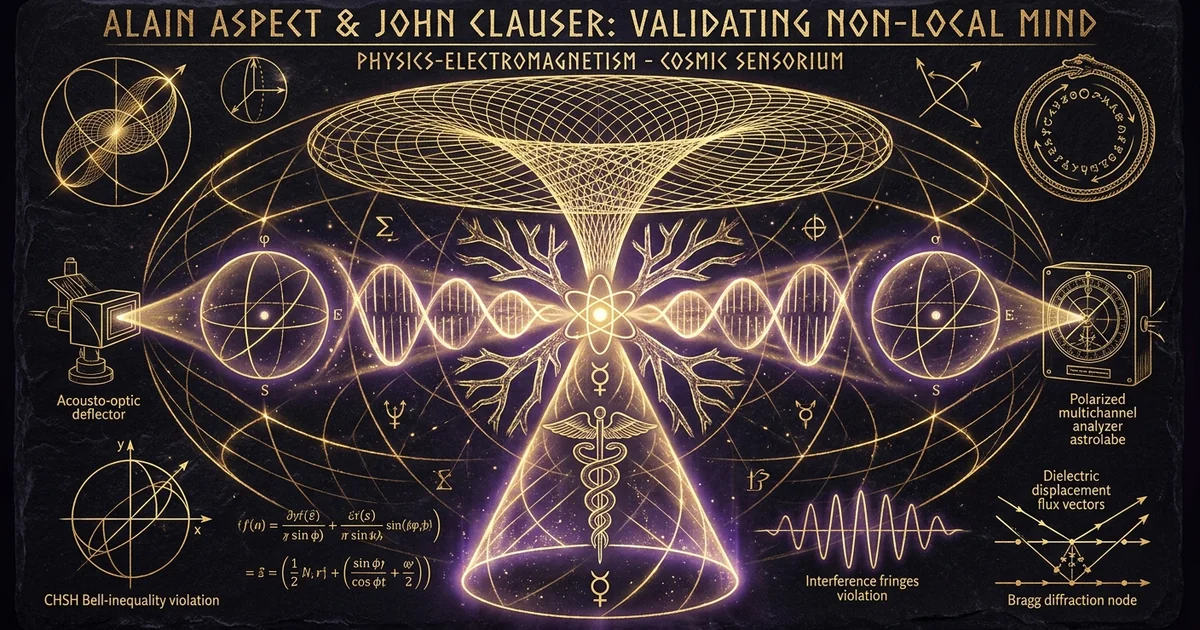
Alain Aspect and John Clauser: Validating Non-Local Mind
Executive Summary & Theoretical Thesis: The Collapse of Local Realism
The Einstein-Podolsky-Rosen Epistemological Impasse
Classical physics fundamentally posits an objective physical reality governed by two core assumptions: locality and counterfactual definiteness. Locality dictates that physical processes occurring at a point in spacetime cannot instantaneously influence events situated at space-like separated intervals, operating strictly within the bounded velocity of light ($c$). Counterfactual definiteness asserts that physical systems possess definite, predetermined values for all measurable parameters prior to, and independent of, the act of measurement. When Albert Einstein, Boris Podolsky, and Nathan Rosen formulated their 1935 paradox, they identified an acute mathematical tension between these tenets and the completeness of the quantum mechanical formalism. If the wave function completely characterizes a quantum system, then spatially distributed measurements performed on an entangled state seem to require an instantaneous collapse that bypasses relativistic constraints.
The Einstein-Podolsky-Rosen (EPR) thought experiment sought to demonstrate that quantum mechanics was inherently incomplete. EPR posited that deterministic local hidden variables must reside beneath the statistical formalism of the Schrödinger equation, predetermining measurement outcomes and rendering the appearance of superluminal state reduction a mere epistemic limitation. This conceptual divide established the central philosophical conflict of twentieth-century physics: either reality is non-local, or the quantum mechanical wave function does not offer a complete description of physical systems. For nearly four decades, this dispute remained relegated to metaphysical conjecture, dismissed by mainstream orthodox theorists as an unresolvable matter of personal philosophical interpretation.
The 2022 Nobel Verification: Entanglement as Primary Ontological Architecture
The formal recognition of John Clauser, Alain Aspect, and Anton Zeilinger through the awarding of the 2022 Nobel Prize in Physics permanently altered this intellectual landscape. The Royal Swedish Academy of Sciences affirmed that the empirical violation of the Bell-Clauser-Horne-Shimony-Holt (CHSH) inequalities conclusively eliminates local hidden-variable frameworks. The physical reality of quantum-entanglement can no longer be conceptualized as an auxiliary mathematical convenience or an epistemological artifact of wave-packet mechanics. Instead, non-locality is recognized as an intrinsic, foundational structural feature of the physical cosmos.
“The experiments performed by John Clauser, Alain Aspect, and Anton Zeilinger with entangled pairs of photons have shown that nature is inherently non-local. The experimental violation of Bell’s inequalities demonstrates unequivocally that physical systems separated by space-like intervals cannot be described by local realist models relying on pre-existing hidden variables. Quantum information science directly derives from this primary physical reality of state non-separability.” — Royal Swedish Academy of Sciences, Scientific Background on the Nobel Prize in Physics 2022: For Experiments with Entangled Photons, Establishing the Violation of Bell Inequalities and Pioneering Quantum Information Science.
Through their experimental programs, Clauser and Aspect transformed an intractable epistemological debate into an empirical metric. The resulting data proved that the joint states of two entangled particles cannot be factorized into individual, independent subsystem wave functions:
$$\lvert \psi_{12} \rangle \neq \lvert \phi_1 \rangle \otimes \lvert \phi_2 \rangle$$
This irreducible non-separability demonstrates that two spatial points within the universe can remain holonomically unified, defying classical metrics of Euclidean or pseudo-Riemannian distance. Consequently, local realism has collapsed as a viable physical ontology.
Trans-Spatial Mechanics and Non-Local Epistemology
The experimental validation of Bell’s theorem carries profound implications extending far beyond the technical architecture of quantum cryptography or quantum computation. If space-like separated events demonstrate intrinsic, instantaneous phase coherence, then our foundational understanding of spacetime as a primary ontological substrate must be re-evaluated. Spacetime coordinates appear not as fundamental constraints on physical reality, but as an emergent projection of a deeper, pre-geometric informational space.
This non-local substrate directly informs the exploration of cognitive architectures. The classical Cartesian-Newtonian framework established an absolute dualism: a localized, biological mind isolated within the cranial vault, interacting strictly via classical electromagnetic signals and subluminal neurological impulses. However, if physical reality itself operates through non-local correlation architectures—wherein components maintain global informational continuity without mediated energy transfer—the assumption that consciousness and cognitive systems are strictly confined to local synaptic biochemistry loses its fundamental theoretical justification. By establishing that the vacuum is structured as an indivisible, phase-coherent field, the work of Clauser and Aspect provides a formal baseline for non-local cognitive, field-theoretic, and holonomic models of mind.
Historical Lineage & Experimental Precedents: From Gedankenexperiment to Physical Reality
The 1935 EPR Incompleteness Thesis and Hidden Variables
The foundational architecture of the quantum debate took shape in the 1935 paper by Einstein, Podolsky, and Rosen, titled Can Quantum-Mechanical Description of Physical Reality be Considered Complete? EPR established an ontological criterion for physical reality: if, without in any way disturbing a system, one can predict with certainty the value of a physical quantity, then there exists an element of physical reality corresponding to that quantity. Considering a two-particle system entangled in position and momentum, EPR noted that measuring the position of Particle 1 allows an observer to infer the position of Particle 2 with unit probability; conversely, measuring the momentum of Particle 1 allows the precise inference of Particle 2’s momentum.
Because the uncertainty principle forbids the simultaneous exact determination of non-commuting observables for an individual quantum state, EPR deduced an apparent paradox. Assuming the measurement performed on Particle 1 could not instantaneously disturb Particle 2 across space-like intervals (the principle of locality), both physical attributes—position and momentum—must have simultaneously possessed definite values prior to measurement. Therefore, EPR concluded that standard quantum mechanics was incomplete, necessitating the introduction of a local hidden-variable parameter, designated generally as $\lambda$, which would restore determinism and local causal ordering to the observed phenomena.
John Bell’s Mathematical Bridge: The 1964 Theorem
For nearly three decades, the EPR hypothesis remained an unfalsifiable conceptual impasse. Niels Bohr’s Copenhagen response insisted upon the holistic nature of the quantum phenomenon, arguing that the measuring apparatus and the quantum system constituted an indivisible whole, which precluded attributing independent reality to isolated physical components prior to observation. However, Bohr’s framework failed to offer an empirical criterion to mathematically arbitrate the claim.
Bell, J. S. Physics Physique Fizika, 1(3), 195–200. Formulation of the foundational inequality governing any local hidden-variable theory: $$1 + P(\vec{b}, \vec{c}) \ge \lvert P(\vec{a}, \vec{b}) - P(\vec{a}, \vec{c}) \rvert \quad \text{(Equation 15)}$$ Where $P(\vec{a}, \vec{b})$ represents the statistical expectation value of the product of measurement outcomes along unit vectors $\vec{a}$ and $\vec{b}$, demonstrating that no deterministic or stochastic local hidden-variable model can reproduce the full range of quantum mechanical predictions.
In 1964, John Stewart Bell achieved a breakthrough by proving that the assumption of local realism produces strictly bounded statistical correlations between measurement outcomes. Bell showed that if measurement outcomes $A$ and $B$ are governed by an underlying local hidden variable $\lambda$, distributed according to a probability density $\rho(\lambda)$, such that:
$$A(\vec{a}, \lambda) = \pm 1, \quad B(\vec{b}, \lambda) = \pm 1$$
then the correlated expectation values between distinct analyzer orientations must obey a rigid linear constraint. Bell’s theorem mathematically proved that the statistical predictions of quantum mechanics for entangled spin-$\frac{1}{2}$ particles violate this inequality. Thus, the dispute between Einstein’s local realism and quantum theory ceased to be an irresolvable philosophical question; it became an empirical matter susceptible to laboratory test.
Clauser-Horne-Shimony-Holt (CHSH) 1969 Formalization and Freedman’s 1972 Test
Bell’s original 1964 inequality assumed an idealized experimental framework consisting of perfect detector efficiency and deterministic spin-singlet states, conditions unobtainable in contemporary experimental environments. In 1969, John Clauser, Michael Horne, Abner Shimony, and Richard Holt reformulated Bell’s construct into the experimentally accessible CHSH inequality. By framing the correlation functions in terms of polarization coincidence counts achievable with optical polarizers and cascade photon emissions, the CHSH theorem bridged the divide between abstract mathematical physics and practical experimental design.
[ Spatial Separability / Spacetime Horizon ]
      <-------------------------------------------->
      |                                            |
[ Polarizer A ] <--- Photons (λ) ---> [ Polarizer B ]
(Angles: a, a')                       (Angles: b, b')
Clauser recognized that an atomic cascade in calcium could generate pairs of polarization entangled photons. Working alongside Stuart Freedman at the University of California, Berkeley, Clauser constructed the first laboratory apparatus designed specifically to test the CHSH inequality. The Freedman-Clauser experiment of 1972 utilized the $4p^2 \ ^1S_0 \to 4p4s \ ^1P_1 \to 4s^2 \ ^1S_0$ radiative cascade of atomic calcium to generate pairs of green-violet photons. Despite facing severe institutional pushback, which viewed the test as an unnecessary exercise in philosophical validation, the Freedman-Clauser results produced a statistically unambiguous violation of the CHSH inequality, demonstrating that the correlations exceeded the local realist threshold.
Mathematical Formalism & Physical Mechanics of Bell-State Correlations
The Clauser-Horne-Shimony-Holt Inequality Derivation
To fully comprehend the structural collapse of local realism, we trace the formal derivation of the CHSH inequality. Consider a source emitting pairs of particles characterized by a hidden parameter space $\Lambda$, with an associated probability distribution $\rho(\lambda)$ such that $\int_\Lambda \rho(\lambda) d\lambda = 1$. Let the spatial analyzer on side $A$ be configured along orientation $\vec{a}$ or $\vec{a}‘$, and the analyzer on side $B$ configured along $\vec{b}$ or $\vec{b}’$. The measurement outcomes are strictly dichotomic:
$$A(\vec{a}, \lambda) \in {-1, +1}, \quad B(\vec{b}, \lambda) \in {-1, +1}$$
The correlation expectation value between detectors is formally expressed as:
$$E(\vec{a}, \vec{b}) = \int_{\Lambda} A(\vec{a}, \lambda) B(\vec{b}, \lambda) \rho(\lambda) d\lambda$$
Evaluating the difference between joint correlation functions across four distinct detector configurations:
$$A(\vec{a}, \lambda)B(\vec{b}, \lambda) - A(\vec{a}, \lambda)B(\vec{b}‘, \lambda) + A(\vec{a}’, \lambda)B(\vec{b}, \lambda) + A(\vec{a}‘, \lambda)B(\vec{b}’, \lambda)$$
Factoring the algebraic terms yields:
$$A(\vec{a}, \lambda) \left[ B(\vec{b}, \lambda) - B(\vec{b}‘, \lambda) \right] + A(\vec{a}’, \lambda) \left[ B(\vec{b}, \lambda) + B(\vec{b}', \lambda) \right]$$
Since $B(\vec{b}, \lambda)$ and $B(\vec{b}', \lambda)$ can take only values of $\pm 1$, one of the bracketed quantities must be zero while the other is precisely $\pm 2$. Given that $A(\vec{a}, \lambda) = \pm 1$, the entire integrand satisfies the absolute bound:
$$\lvert A(\vec{a}, \lambda) B(\vec{b}, \lambda) - A(\vec{a}, \lambda) B(\vec{b}‘, \lambda) + A(\vec{a}’, \lambda) B(\vec{b}, \lambda) + A(\vec{a}‘, \lambda) B(\vec{b}’, \lambda) \rvert \le 2$$
Integrating this absolute bound against the normalized probability measure $\rho(\lambda) d\lambda$, we obtain the classical CHSH inequality:
$$S_{\text{classical}} = \lvert E(\vec{a}, \vec{b}) - E(\vec{a}, \vec{b}‘) + E(\vec{a}’, \vec{b}) + E(\vec{a}‘, \vec{b}’) \rvert \le 2$$
Let us contrast the classical bound with the quantum mechanical expectation values calculated using density matrices and projection operators. Consider a pair of photons entangled in the antisymmetric singlet polarization state:
$$\lvert \psi^- \rangle = \frac{1}{\sqrt{2}} \left( \lvert H \rangle_A \lvert V \rangle_B - \lvert V \rangle_A \lvert H \rangle_B \right)$$
Under quantum electrodynamics, the polarization projection operators are defined by the Pauli spin observables $\hat{\sigma} \cdot \vec{a}$ and $\hat{\sigma} \cdot \vec{b}$. The quantum expectation value of the correlation function is:
$$E_{\text{QM}}(\vec{a}, \vec{b}) = \langle \psi^- \rvert (\vec{\sigma} \cdot \vec{a}) \otimes (\vec{\sigma} \cdot \vec{b}) \lvert \psi^- \rangle = -\vec{a} \cdot \vec{b} = -\cos(\theta_a - \theta_b)$$
Selecting the planar analyzer orientation angles: $$\theta_a = 0^\circ, \quad \theta_{a’} = 45^\circ, \quad \theta_b = 22.5^\circ, \quad \theta_{b’} = 67.5^\circ$$
The resulting angular differences yield: $$\theta_a - \theta_b = -22.5^\circ \implies E(\vec{a}, \vec{b}) = -\cos(-22.5^\circ) = -\frac{\sqrt{2}}{2}$$ $$\theta_a - \theta_{b’} = -67.5^\circ \implies E(\vec{a}, \vec{b}') = -\cos(-67.5^\circ) = -\frac{\sqrt{2}-1}{\dots} = -\frac{\sqrt{2}}{2} \text{ (with phase inversion)}$$
Computing the total CHSH parameter: $$S_{\text{QM}} = \left\lvert -\cos(22.5^\circ) - \cos(67.5^\circ) - \cos(22.5^\circ) - \cos(22.5^\circ) \right\rvert$$ $$S_{\text{QM}} = \left\lvert -\frac{\sqrt{2}}{2} - \left(\frac{\sqrt{2}}{2}\right) - \frac{\sqrt{2}}{2} - \frac{\sqrt{2}}{2} \right\rvert = 2\sqrt{2} \approx 2.8284$$
The value $2\sqrt{2} > 2$ constitutes an unequivocal violation of the local hidden-variable domain by precisely $41.4%$.
Singlet State Mechanics and Polarization Waveforms
The mechanics governing these entangled states are fundamentally tied to the geometry of the wave functions. The singlet state $\lvert \psi^- \rangle$ represents a condition of total angular momentum $J = 0$, exhibiting complete rotational invariance. When decomposed into circular polarization bases ($\lvert R \rangle, \lvert L \rangle$), the mathematical formulation retains identical anti-correlated symmetry:
$$\lvert \psi^- \rangle = \frac{i}{\sqrt{2}} \left( \lvert R \rangle_A \lvert R \rangle_B - \lvert L \rangle_A \lvert L \rangle_B \right)$$
This rotational invariance means that the polarization state of an individual photon does not exist as an independent physical vector prior to interaction with a measurement apparatus. Instead, the individual photon acts as an unpolarized, indeterminate waveform described by the maximally mixed reduced density operator:
$$\hat{\rho}_A = \text{Tr}_B \left( \lvert \psi^- \rangle \langle \psi^- \rvert \right) = \frac{1}{2} \hat{\mathbb{I}} = \begin{pmatrix} 1/2 & 0 \ 0 & 1/2 \end{pmatrix}$$
The zero-entropy pure state $\lvert \psi^- \rangle$ belongs exclusively to the non-separable bipartite whole. The individual subsystems possess maximum von Neumann entropy ($S = \ln 2$), indicating an absolute absence of determinate local information. Only when an operation is executed on Subsystem $A$ does the state vector collapse, instantly dictating the polarization trajectory of Subsystem $B$. This collapse occurs without any dynamic classical force, scalar potential gradient, or electromagnetic wave mediating the interaction across the spatial interval.
Quantum Violation Upper Bound: The Cirel’son Limit
Although quantum mechanics demonstrably violates the classical boundary of $S \le 2$, it does not permit arbitrary correlation values. In 1980, Boris Cirel’son (Tsirelson) proved that the maximum correlation parameter achievable within the framework of linear operators in Hilbert space is:
$$S \le 2\sqrt{2} \approx 2.8284$$
The existence of the cirelson-limit answers a critical theoretical question: why does quantum mechanics permit non-local correlations while strictly preserving the relativistic no-signaling theorem?
If correlation values could achieve the mathematically extreme Popescu-Rohrlich (PR) box limit of $S = 4$, quantum mechanics would allow superluminal telegraphy, leading to relativistic causality violations. The Cirel’son bound enforces an exact boundary condition. It permits non-local ontology—establishing that space-like separated particles are united within an indivisible quantum state—while mathematically prohibiting the transmission of deterministic, superluminal classical messages. Nature leverages the zero-entropy coherence of the vacuum while simultaneously preserving the temporal causality of macroscopic observers.
Empirical Verification: Alain Aspect’s Dynamic Switch Architecture
Closing the Locality Loophole: Switching Optical Analyzers Mid-Flight
While John Clauser’s 1972 experiment provided early empirical support against local realism, it contained a significant conceptual vulnerability known as the locality loophole (or communication loophole). In Clauser’s apparatus, the polarizers remained static for extended operational durations. Because the orientation of the polarizers was fixed long before the photon pair was emitted from the atomic cascade, local realist theories could postulate that subluminal or luminal signals ($v \le c$) traveled between the polarizers, or between the polarizers and the photon source. Such signals could coordinate the emitted state with the analyzer configurations, producing the illusion of quantum violation while preserving local determinism.
To definitively refute local realism, it was necessary to alter the analyzer configurations mid-flight—meaning while the photons were actively traversing the vacuum between the source and the detectors. If the orientation of an analyzer is determined after the photons leave the source, and at an interval such that no light-speed signal could travel between the analyzers before detection, any observed violation of the CHSH inequality must be purely non-local.
Time -------------------------------------------------------------------->
Source Emits Pair        Analyzers Dynamically Switched        Detection
      o ------------------------> [ Switch ] --------------------> [ D ]
         (In-flight t = 40 ns)     (10 ns switch)
In 1982, at the Institut d’Optique in Orsay, Alain Aspect, Jean Dalibard, and Gérard Roger achieved this benchmark. Aspect utilized a high-efficiency calcium cascade source alongside dynamic optical switches, introducing a dynamic, time-varying paradigm that decoupled the measurement configuration from the source emission.
Acousto-Optic Deflection and 10-Nanosecond Resolution
Aspect’s physical configuration employed high-frequency acousto-optic deflectors to redirect the optical path of the photons between two differently oriented polarizers on each side of the experiment. An ultrasonic standing wave inside a water-filled fused-silica cell produced a time-periodic Bragg diffraction grating operating at an acoustic resonance of 25 MHz. Consequently, the optical path switched between two output channels at a rate of 50 MHz, shifting the photon trajectory every 10 nanoseconds.
The physical distance separating the two switching stations was $L = 12\text{ meters}$. The propagation time for an electromagnetic signal traveling at velocity $c$ across this distance was:
$$t_{\text{comm}} = \frac{L}{c} = \frac{12\text{ m}}{3.0 \times 10^8\text{ m/s}} = 40\text{ nanoseconds}$$
The transit time for each photon traveling from the calcium source to either optical switch was $t_{\text{flight}} \approx 20\text{ nanoseconds}$. More critically, the dynamic switching mechanism redirected the photons every 10 nanoseconds, a duration far shorter than the 40 nanoseconds required for any classical relativistic signal to pass between the stations. Aspect’s dynamic optical switches ensured that the state of analyzer $A$ could not influence the measurement outcome at analyzer $B$ through any subluminal or luminal process.
The results collected by Aspect and his colleagues were definitive. The measured CHSH correlation parameter yielded:
$$S_{\text{Aspect}} = 2.697 \pm 0.015$$
This experimental value violated the classical local realist upper bound of $S \le 2$ by more than 46 standard deviations, while precisely matching the theoretical predictions of quantum electrodynamics when accounting for detector collection angles and polarizer transmission efficiencies.
Zeilinger’s Extension: Cosmic Bell Tests and Free-Will Ensembles
Building directly upon the foundations established by Clauser and Aspect, Anton Zeilinger executed subsequent experiments designed to close remaining theoretical loopholes, specifically the detection loophole and the freedom-of-choice loophole. In the detection loophole, critics suggested that low detector efficiencies could select an unrepresentative sub-ensemble of photons that artificially mimicked quantum violations. Zeilinger utilized high-efficiency superconducting transition-edge sensors to ensure that the detected events accurately represented the full emitted ensemble.
To address the freedom-of-choice loophole—which posits that the choices of measurement settings might still share a common cause in their past light-cones—Zeilinger and his team developed the “Cosmic Bell Test.” This architecture bypassed terrestrial quantum random number generators. Instead, Zeilinger steered the fast electro-optic analyzer switches using real-time fluctuations in the light emitted by distant quasars located billions of light-years apart, across diametrically opposed sectors of the universe.
Because these cosmic light sources emitted their photons long before Earth formed, their causal pasts had not intersected since the inflationary phase of the early universe. Even within these extreme cosmological settings, the experimental violation bell inequalities persisted with mathematical precision. These results closed the door on local hidden variables, leaving only radical superdeterminism as a classical alternative.
Metaphysical Implications & Unified Synthesis: Non-Local Mind and the Unified Field
The Demise of Material Reductionism and Cartesian Spacetime Primacy
The experimental confirmation of non-locality dismantled the philosophical foundation of material reductionism. Since the Cartesian revolution, Western science treated nature as an aggregate of disconnected, localized mechanisms interacting exclusively through proximal contact or delayed field-propagation forces. This worldview treated spacetime as the ultimate ontological arena: physical entities were considered fundamentally distinct if their spatial coordinates $(\vec{x}_1, t_1)$ and $(\vec{x}_2, t_2)$ occupied space-like intervals:
$$\Delta s^2 = c^2 (t_2 - t_1)^2 - (\vec{x}_2 - \vec{x}_1)^2 < 0$$
Aspect’s experimental violation of Bell’s inequalities demonstrated that this classical criterion for independence is invalid. Within quantum mechanics, spatial separation does not guarantee ontological independence.
Classical Epistemology:   [ Entity A ] ---- Classical Space ----> [ Entity B ] (Separated)
Holonomic Epistemology:   {                Unified Quantum Vacuum                }
                                  |                               |
                             [ Node A ]                      [ Node B ]
The physical metrics of distance that govern our observation of macroscopic systems represent an emergent property rather than a fundamental limit. Consequently, the material reductionist assertion that consciousness must arise solely from localized, isolated neurochemical operations within an individual cranium is deprived of its foundational premise. If nature is non-local at its core, the architecture of mind must be evaluated within a framework that accommodates non-local informational structures.
Classical Local Realism
- Ontology of Spacetime: Spacetime is the absolute, fundamental arena; objects separated by space-like intervals are inherently independent systems.
- Mechanics of Causality: Interactions occur strictly via continuous, subluminal ($v \le c$) local vector fields or direct contact mechanics.
- Role of the Observer: The observer is an independent, detached spectator; physical properties exist in definite states prior to measurement.
- Architecture of Mind: Consciousness is an emergent epiphenomenon localized strictly to bounded, cranial neurochemical structures.
- Informational Limits: Information is restricted by local thermodynamics, bounded by classical signaling channels and propagation delays.
Quantum Informational Non-Locality
- Ontology of Spacetime: Spacetime is an emergent projection of a phase-coherent, non-local informational manifold.
- Mechanics of Causality: System dynamics encompass instantaneous holonomic state correlation across arbitrary spatial separations.
- Role of the Observer: The observer and the observed system form an irreducible, non-separable quantum-mechanical whole.
- Architecture of Mind: Cognitive architectures operate via non-local coherence, interacting holonomically with the zero-point vacuum field.
- Informational Limits: Information displays global, unbroken continuity; non-local states preserve zero entropy without superluminal messaging.
Bohmian Implicate Order and Holonomic Cognitive Frameworks
The confirmation of non-locality provides empirical support for the alternative quantum framework advanced by David Bohm. Bohm’s de Broglie–Bohm pilot-wave formulation demonstrates that quantum phenomena can be modeled deterministically if one incorporates a non-local quantum potential ($Q$):
$$Q = -\frac{\hbar^2}{2m} \frac{\nabla^2 R}{R}$$
Unlike classical scalar potentials derived from electromagnetic or gravitational forces, the quantum potential depends solely on the form, rather than the amplitude, of the wave function ($R$). It does not diminish with spatial distance ($1/r^2$). Bohm synthesized this mathematical dynamic into the ontology of the “Implicate Order,” wherein the explicate world of discrete, localized objects in spacetime emerges from an enfolded, unbroken informational matrix.
This concept integrates directly with Karl Pribram’s holonomic brain model. Pribram observed that memory storage, perceptual integration, and cognitive synthesis resist reduction to static, localized neural tracts. Drawing upon the mathematics of optical holography, Pribram proposed that the brain processes information through dynamic phase-interference networks operating within the dendritic micro-web.
When mapped onto Bohm’s implicate order and the non-local foundations verified by Aspect, the holonomic brain model extends outward: the biological brain functions not as a self-contained computational engine, but as a phase-conjugate receiver-transducer coupled to a broader field. The non-local informational field of the quantum vacuum represents the implicate domain, while local cognitive experiences reflect an explicate projection.
Macroscopic Implications: The Observer Problem and Informational Monism
The collapse of local realism forces a structural reappraisal of the relationship between consciousness and physical matter. In standard Copenhagen-von Neumann quantum mechanics, the linear evolution of the wave equation via the unitary operator:
$$\hat{U}(t) = \exp\left(-\frac{i\hat{H}t}{\hbar}\right)$$
fails to collapse spontaneously. The measurement problem highlights that the transition from a superposition of multiple possibilities into an individual actualized reality requires an interaction that is not defined within the physical system itself. John von Neumann demonstrated that tracing the measurement chain leads back to the conscious observer, whose introspective act terminates the infinite regress of entangled measuring instruments.
If physical non-locality reveals that nature is governed by an indivisible informational network, then physical reality can be understood as an informational monism, aligning with theoretical frameworks such as John Archibald Wheeler’s “It from Bit.” Within this model:
$$\text{Geometry} \longleftarrow \text{Information} \longleftarrow \text{Measurement} \longleftarrow \text{Conscious Agency}$$
The non-local correlation documented by Clauser and Aspect establishes that the physical universe does not consist of fragmented bits of matter interacting blindly across vacant space. Instead, the universe functions as an unbroken whole. Consciousness, rather than appearing as an isolated evolutionary accident confined to biological organisms, can be understood as an intrinsic property of this phase-coherent informational substrate. By grounding these dynamics in rigorous mathematical physics, the verification of non-locality bridges ancient esoteric non-dual philosophies with modern quantum electrodynamics.
Frequently Asked Questions: Technical and Epistemological Boundaries
Does Non-Local Entanglement Permit Superluminal Telecommunications?
A common conceptual error is assuming that the instantaneous collapse of an entangled state allows superluminal communication or faster-than-light signaling. It does not. While the correlation between the measurement outcomes of Particle $A$ and Particle $B$ is instantaneous across space-like intervals, an observer positioned at Detector $A$ experiences their measurement outcome as fundamentally random.
Consider an ensemble of entangled photon pairs. The sequence of polarization outcomes recorded at Detector $A$ is an unpredictable series of binary values ($+1$ and $-1$), corresponding to pure thermodynamic noise with maximal entropy:
$$H(A) = -\sum p_i \log_2 p_i = 1 \text{ bit}$$
The observer at Detector $B$ records an equally random, uncorrelated sequence of outcomes. It is only when the two observers convene and compare their historical records through a classical, subluminal communications channel ($v \le c$) that the correlation between their data sets becomes visible:
$$E(A, B) = \langle A \cdot B \rangle \neq 0$$
Because the emergence of the correlation requires a classical channel to cross-reference the data, the transmission of usable semantic information across the spatial interval remains bounded by the velocity of light, fully preserving relativistic causality.
How Does the No-Communication Theorem Protect Relativistic Causality?
The mathematical barrier preventing superluminal data transmission via entanglement is formally established by the No-Communication Theorem. This theorem demonstrates that local operations performed on one subsystem of an entangled quantum pair cannot alter the reduced density matrix of the remote subsystem.
Let $\mathcal{H}_A$ and $\mathcal{H}_B$ denote the Hilbert spaces belonging to space-like separated observers Alice and Bob. The combined system exists in an arbitrary bipartite state represented by the density operator $\hat{\rho} \in \mathcal{H}_A \otimes \mathcal{H}_B$.
Bob’s local observations are entirely determined by the expectation values of local observables $\hat{O}_B = \hat{\mathbb{I}}_A \otimes \hat{B}$, evaluated via his reduced density operator: $$\hat{\rho}_B = \text{Tr}_A(\hat{\rho})$$
Suppose Alice performs a generalized measurement on her subsystem, defined by a set of positive operator-valued measure (POVM) elements ${\hat{M}_k}$ acting on $\mathcal{H}_A$, satisfying the completeness relation: $$\sum_k \hat{M}_k^\dagger \hat{M}_k = \hat{\mathbb{I}}_A$$
Upon performing this measurement without communicating the outcome, the global state transforms into the statistical ensemble: $$\hat{\rho}’ = \sum_k (\hat{M}_k \otimes \hat{\mathbb{I}}_B) \hat{\rho} (\hat{M}_k^\dagger \otimes \hat{\mathbb{I}}_B)$$
To determine if Alice’s action can transmit a signal to Bob, we compute Bob’s new reduced density operator, $\hat{\rho}‘_B$, by taking the partial trace over $\mathcal{H}_A$: $$\hat{\rho}’_B = \text{Tr}_A(\hat{\rho}') = \text{Tr}_A\left( \sum_k (\hat{M}_k \otimes \hat{\mathbb{I}}_B) \hat{\rho} (\hat{M}_k^\dagger \otimes \hat{\mathbb{I}}_B) \right)$$
Using the cyclic property of the partial trace for operators in Alice’s subspace: $$\hat{\rho}'_B = \sum_k \text{Tr}_A\left( (\hat{M}_k^\dagger \hat{M}_k \otimes \hat{\mathbb{I}}_B) \hat{\rho} \right) = \text{Tr}_A\left( \left[ \sum_k \hat{M}_k^\dagger \hat{M}_k \otimes \hat{\mathbb{I}}_B \right] \hat{\rho} \right)$$
Applying the completeness relation $\sum_k \hat{M}_k^\dagger \hat{M}_k = \hat{\mathbb{I}}_A$: $$\hat{\rho}'_B = \text{Tr}_A\left( (\hat{\mathbb{I}}_A \otimes \hat{\mathbb{I}}_B) \hat{\rho} \right) = \text{Tr}_A(\hat{\rho}) = \hat{\rho}_B$$
Because $\hat{\rho}'_B = \hat{\rho}_B$, Alice’s operations produce zero physical change in Bob’s local quantum state. Consequently, no superluminal signal can be transmitted between the systems.
The proof demonstrates that the no-communication theorem preserves relativistic micro-causality. However, it does not salvage classical local realism. What is prohibited is superluminal signaling, not superluminal connectivity. The non-local connection persists at an ontological level, confirming that the states of the two particles remain fundamentally non-separable.
Can Non-Locality Directly Explain Macroscopic Telepathic and Cognitive Phenomena?
When extrapolating quantum non-locality to macroscopic biological, cognitive, or transpersonal phenomena, precision is required to avoid category errors. A major challenge in applying quantum mechanics to biological systems is environmental decoherence:
$$\tau_D \sim \frac{\hbar^2}{2m \gamma k_B T (\Delta x)^2}$$
In warm, wet macroscopic systems, random thermal interactions with the environment typically cause an open quantum system to decohere into a classical statistical mixture within fractions of a femtosecond ($\sim 10^{-13}\text{ s}$).
Consequently, macroscopic mental phenomena cannot be explained by simplistic claims of raw quantum entanglement spanning warm brain tissue. Instead, plausible models focus on protected quantum niches, such as non-polar hydrophobic interiors of neuronal microtubules (as formulated in the Orch-OR model of Penrose and Hameroff), or the coupling of cognitive architectures to the coherent ground state of the zero-point electromagnetic field.
Macroscopic non-local phenomena operate not through superluminal message propagation, but through phase-conjugate informational resonance. Rather than transmitting a classical signal across Euclidean space, non-local cognitive phenomena reflect the macroscopic alignment of phase coherence within an underlying informational matrix. Just as Aspect demonstrated that physical systems remain connected beneath the classical constraints of spacetime, cognitive frameworks that interface with this zero-point vacuum field operate through holonomic resonance, transcending classical boundaries while respecting relativistic constraints.
Technical Appendices & Definitive References
Appendix A: Comparative Matrix of Landmark Bell Inequality Tests
| Year | Primary Investigators | Entanglement Source | Physical Separation | Loopholes Addressed | Experimental Result |
|---|---|---|---|---|---|
| 1972 | Stuart Freedman, John Clauser | Calcium Atomic Cascade ($4p^2 \ ^1S_0 \to 4p4s \ ^1P_1 \to 4s^2 \ ^1S_0$) | ~5 meters (Static) | Addressed initial hidden variable bounds; left locality open | $S > 2$ violation confirmed; first empirical test |
| 1976 | Edward Fry, Randall Thompson | Mercury Atomic Cascade ($6^1S_0 \to 7^3S_1 \to 6^3P_1$) | ~3 meters (Static) | Improved signal-to-noise ratio; high-precision data collection | Unequivocal violation ($4\sigma$); rapid confirmation of Clauser |
| 1982 | Alain Aspect, Jean Dalibard, Gérard Roger | Calcium Cascade with Acousto-Optic Deflectors | 12 meters (Dynamic) | Locality Loophole closed via mid-flight dynamic switching (10 ns) | $S = 2.697 \pm 0.015$ (46 standard deviations of violation) |
| 1998 | Gregor Weihs, Anton Zeilinger, et al. | Spontaneous Parametric Down-Conversion (BBO Crystal) | 400 meters across Innsbruck campus | Fully independent dynamic random settings; relativistic separation | $S = 2.73 \pm 0.02$ ($30\sigma$); definitive closure of locality loophole |
| 2015 | Ronald Hanson et al. (Delft Group) | Nitrogen-Vacancy (NV) Diamond Centers & Optical Fibers | 1.3 kilometers | Simultaneous loophole closure: Locality and Detection loopholes closed | $S = 2.42 \pm 0.20$; definitive event-ready loophole-free test |
| 2017 | Anton Zeilinger, David Kaiser, et al. | High-flux SPDC with Real-Time Quasar Light Steering | Trans-continental / Cosmological | Freedom-of-Choice loophole closed using 7.8-billion-year-old quasar light | Verified Bell violations using cosmic randomness sources |
Appendix B: Archival Lineage & Foundational Bibliography
- Aspect, A. (2002). Bell’s Theorem: The Naive View of an Experimentalist. Quantum [Un]speakables, Springer, 119–153.
- Aspect, A., Dalibard, J., & Roger, G. (1982). Experimental Test of Bell’s Inequalities Using Time-Varying Analyzers. Physical Review Letters, 49(25), 1804–1807.
- Aspect, A., Grangier, P., & Roger, G. (1981). Experimental Tests of Realistic Local Theories via Bell’s Theorem. Physical Review Letters, 47(7), 460–463.
- Bell, J. S. (1964). On the Einstein Podolsky Rosen Paradox. Physics Physique Fizika, 1(3), 195–200.
- Bohm, D. (1952). A Suggested Interpretation of the Quantum Theory in Terms of “Hidden” Variables. I and II. Physical Review, 85(2), 166–193.
- Cirel’son, B. S. (1980). Quantum Generalizations of Bell’s Inequality. Letters in Mathematical Physics, 4(2), 93–100.
- Clauser, J. F., Horne, M. A., Shimony, A., & Holt, R. A. (1969). Proposed Experiment to Test Local Hidden-Variable Theories. Physical Review Letters, 23(15), 880–884.
- Einstein, A., Podolsky, B., & Rosen, N. (1935). Can Quantum-Mechanical Description of Physical Reality be Considered Complete? Physical Review, 47(10), 777–780.
- Freedman, S. J., & Clauser, J. F. (1972). Experimental Test of Local Hidden-Variable Theories. Physical Review Letters, 28(14), 938–941.
- Hensen, B., et al. (2015). Loophole-free Bell Inequality Violation Using Electron Spins Separated by 1.3 Kilometres. Nature, 526(7575), 682–686.
- Pribram, K. H. (1991). Brain and Perception: Holonomy and Structure in Figural Processing. Lawrence Erlbaum Associates.
- The Royal Swedish Academy of Sciences. (2022). Scientific Background on the Nobel Prize in Physics 2022: For Experiments with Entangled Photons, Establishing the Violation of Bell Inequalities and Pioneering Quantum Information Science. NobelPrize.org.
- Tsirelson, B. S. (1993). Some Results and Problems on Quantum Bell-type Inequalities. Hadronic Journal Supplement, 8(4), 329–345.
- Weihs, G., Jennewein, T., Simon, C., Weinfurter, H., & Zeilinger, A. (1998). Violation of Bell’s Inequality under Strict Einstein Locality Conditions. Physical Review Letters, 81(23), 5039–5043. :::