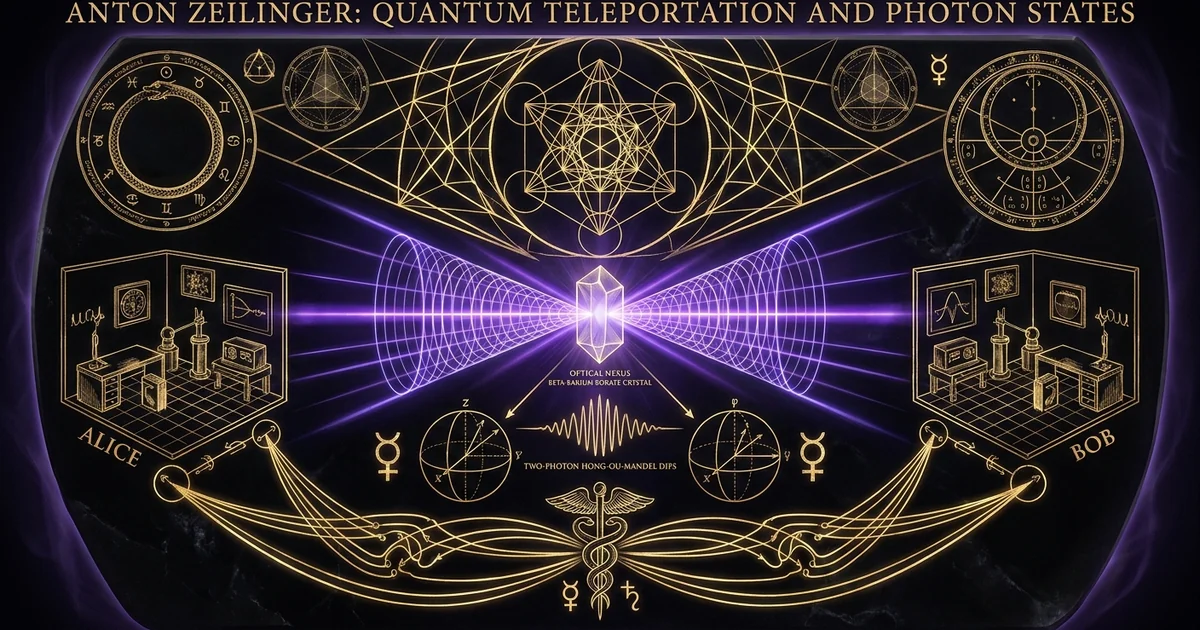
Anton Zeilinger: Quantum Teleportation and Photon States
Executive Summary & Theoretical Thesis: Quantum Non-Locality and State Transfer
The Invalidation of Classical Local Realism
The foundational premise of classical physics rests upon local realism: the philosophical synthesis asserting that physical entities possess definite, objective properties prior to measurement (realism), and that physical interactions cannot propagate faster than the invariant speed of light in vacuum (locality). Anton Zeilinger’s experimental oeuvre dismantles this classical paradigm. By developing experimental architectures capable of generating, manipulating, and detecting hyper-entangled and multi-partite photonic states, Zeilinger established that the physical universe rejects local hidden-variable descriptions. This rejection does not stem from statistical artifacts or detection inefficiencies, but from the intrinsic non-local structure of quantum state space itself.
Through rigorous empirical testing of quantum mechanics at the macroscopic limit, the Innsbruck and Vienna experimental groups led by Zeilinger systematically closed operational loopholes that had historically protected local realism from definitive falsification. The conceptual bridge between theoretical formalism and experimental verification required moving beyond bipartite quantum correlations to multi-particle architectures. Zeilinger demonstrated that quantum states are not localized classical waves or point particles tracing continuous trajectories through spacetime. Instead, they constitute informational structures whose non-local correlations persist across arbitrary spacelike separations, defying spatial containment.
The invalidation of local realism permanently alters our comprehension of the electromagnetic field. Photons, treated classically as localized transverse excitations of the Maxwellian field tensors $F^{\mu\nu}$, must instead be recognized as field quanta whose phase, polarization, and orbital angular momentum degrees of freedom can be entangled across spatially disconnected regions. This non-separability implies that the measurement of a polarization state at an analyzer in one laboratory instantly delineates the quantum state vector of an entangled counterpart at an arbitrarily distant location, without mediated electromagnetic stress-energy tensors traversing the intermediate spatial continuum.
Projective Mechanics of Multi-Photon Systems
The mathematical and physical foundation of Zeilinger’s work rests upon the projective mechanics of multi-photon Hilbert spaces. In bipartite configurations, entanglement demonstrates non-classical correlations, but multi-photon systems—specifically Greenberger-Horne-Zeilinger (GHZ) states—enable a fundamentally more devastating refutation of classical physics. The projection of a multi-photon wavepacket onto an entangled basis does not merely collapse an isolated physical variable; it realigns the holistic quantum state of the system across disparate optical modes.
The realization of these multi-photon configurations requires ultra-precise manipulation of the creation and annihilation operators describing the quantized electromagnetic field. Zeilinger introduced optical geometries where non-linear optical processes produce discrete multi-mode Fock states. By routing distinct photons into linear optical interferometers, the spatial, temporal, and spectral profiles of the incoming wavepackets are aligned to achieve indistinguishability. This physical indistinguishability allows quantum interference to wash out classical distinguishability tags, enabling unitary projective measurements over composite tensor product spaces.
The transformation of multi-photon states through projective measurement forms the operative core of quantum state manipulation. When a multi-photon system undergoes a projective measurement, the density matrix $\rho$ describing the composite ensemble is mapped into a specific sub-space via the projection operator $\hat{P} = |\Psi\rangle\langle\Psi|$. This projection instantly reconfigures the non-local multi-particle correlation coefficients. Zeilinger demonstrated that this projective operation allows the deterministic selection of distinct entangled topologies, providing the experimental engine necessary to execute the canonical protocols of quantum teleportation, entanglement swapping, and multi-partite GHZ-state synthesis.
Informational Teleportation Versus Physical Translation
A persistent misconception outside specialized physics literature equates quantum teleportation with the dematerialization and spatial translation of mass-energy. In precise terms, quantum teleportation is the disembodied transfer of an unknown quantum state vector across macroscopic distances using the dual resources of prior distributed entanglement and classical feed-forward communication. Mass and energy are not transported across the quantum channel; rather, the underlying informational configuration defining the state is extracted from a source photon, completely obliterated at the transmission locus, and reconstructed with fidelity upon an ancillary target photon.
This process is fundamentally governed by the quantum no-cloning-theorem, which strictly forbids the creation of an identical copy of an arbitrary unknown quantum state. Zeilinger’s realization of the protocol preserves the unitarity of quantum mechanics precisely because the source state undergoes a destructive joint measurement—a bell-state-measurement—rendering the initial state completely indeterminate at the sender’s origin. The information is not copied; it is transferred.
The non-classical transmission channel is established via an ancillary pair of entangled photons previously shared between the sender (Alice) and the receiver (Bob). The non-local channel, however, cannot convey superluminal signals. The complete teleportation protocol mandates an active-feed-forward stage, wherein Alice transmits the discrete outcome of her Bell-state measurement through a classical communication channel bounded by the speed of light $c$. Upon receiving this classical outcome, Bob executes a specific unitary transformation upon his ancillary photon, thereby completing the quantum state reconstruction. Zeilinger’s experiments proved that informational teleportation operates as an exact isomorphism of quantum states, confirming that information, rather than physical matter, constitutes the irreducible bedrock of quantum physical systems.
Bouwmeester, D., Pan, J. W., Mattle, K., Eibl, M., Weinfurter, H., & Zeilinger, A. (1997). Experimental quantum teleportation. Nature, 390(6660), 575–579. This foundational paper reported the first experimental realization of quantum teleportation using linear optical elements and spontaneous parametric down-conversion to transfer an arbitrary polarization state between two independent photons across macroscopic laboratory coordinates.
Historical Lineage & Experimental Precedents: From the EPR Paradox to Innsbruck
The EPR-Bohm Thought Experiment and Bell’s Analytical Inequality
The conceptual origins of Zeilinger’s experimental paradigm trace directly to the 1935 critique of quantum mechanics advanced by Albert Einstein, Boris Podolsky, and Nathan Rosen (EPR). The EPR thought experiment posited that if the spatial position and momentum of a two-particle system could be predicted with certainty without mechanically perturbing the system, these physical variables must correspond to “elements of physical reality.” Because the standard Copenhagen interpretation of the Schrödinger wave equation prohibited the simultaneous objective existence of non-commuting observables, EPR deduced that quantum mechanics, despite its empirical successes, had to be fundamentally incomplete. They envisioned a deeper, underlying theoretical architecture governed by local hidden variables ($\lambda$) that deterministic laws would ultimately describe.
In 1951, David Bohm reformulated the continuous-variable EPR paradox into the discrete polarization and spin states of a pair of spin-1/2 particles, providing a tractable analytical framework. For three decades, the EPR-Bohm paradox remained largely confined to philosophical debates. The transition from metaphysical disagreement to quantitative physics occurred in 1964, when John Stewart Bell derived an analytical inequality demonstrating that any physical theory rooted in local realism imposes strict mathematical boundaries on the correlation coefficients of measurement outcomes obtained at spacelike separations.
Bell considered a set of hidden variables $\lambda$ distributed according to a probability density $\rho(\lambda)$, where measurement outcomes $A(a, \lambda) = \pm 1$ and $B(b, \lambda) = \pm 1$ depend strictly upon local measurement settings $a$ and $b$. He proved that the correlation function $E(a,b) = \int A(a,\lambda)B(b,\lambda)\rho(\lambda)d\lambda$ must obey:
$$|E(a,b) - E(a,c)| \le 1 + E(b,c)$$
Subsequent reformulations, such as the Clauser-Horne-Shimony-Holt (CHSH) inequality, established experimental parameters wherein the quantum mechanical expectation values calculated from the state vector $|\psi\rangle$ violate these statistical boundaries, reaching the Tsirelson bound of $2\sqrt{2} \approx 2.828$, well beyond the classical limit of $2$. Initial tests by Stuart Freedman, John Clauser, and Alain Aspect provided early evidence against local realism. However, these early experiments remained fundamentally statistical, requiring large ensembles of measurements, and were vulnerable to critical experimental loopholes—such as the locality loophole and the detection loophole—which allowed local hidden-variable proponents to sustain counter-arguments. Detailed treatments of these loopholes are evaluated in the study of CHSH inequality tests and operational closures.
The Conceptual Shift from Bipartite to Tripartite Entanglement
Recognizing the limitations of statistical inequalities in bipartite systems, Anton Zeilinger, working in close collaboration with Daniel Greenberger, Michael Horne, and later Abner Shimony, formulated a radical alternative in 1989 and 1990: the Greenberger-Horne-Zeilinger (GHZ) theorem. The GHZ theorem established that for multi-particle entangled systems ($N \ge 3$), the contradiction between local realism and quantum mechanics occurs not through the statistical accumulation of probabilities, but at the deterministic level of single-event predictions.
Greenberger, D. M., Horne, M. A., Shimony, A., & Zeilinger, A. (1990). Bell’s theorem without inequalities. American Journal of Physics, 58(12), 1131–1143. This theoretical landmark derived the “all-versus-nothing” refutation of local realism, proving that local hidden-variable assignments are mathematically impossible for multi-partite entangled states, bypassing the statistical bounds of Bell’s original inequality.
The theoretical beauty of the greenberger-horne-zeilinger-state lies in its “all-versus-nothing” character. Consider a tripartite entangled state polarized in the horizontal ($|H\rangle$) and vertical ($|V\rangle$) basis:
$$|\text{GHZ}\rangle = \frac{1}{\sqrt{2}} \left( |H\rangle_1 |H\rangle_2 |H\rangle_3 + |V\rangle_1 |V\rangle_2 |V\rangle_3 \right)$$
If one measures the Pauli operators $\sigma_x$ and $\sigma_y$ across the three photons, quantum mechanics dictates the following eigenvalue relations:
$$\sigma_x^{(1)} \sigma_y^{(2)} \sigma_y^{(3)} = -1$$
$$\sigma_y^{(1)} \sigma_x^{(2)} \sigma_y^{(3)} = -1$$
$$\sigma_y^{(1)} \sigma_y^{(2)} \sigma_x^{(3)} = -1$$
Under a local realist assumption, each photon $i$ possesses predetermined, objective values for its measurement outcomes $m_x^{(i)}, m_y^{(i)} \in {+1, -1}$. Multiplying the three theoretical equations yields:
$$(m_x^{(1)} m_y^{(2)} m_y^{(3)}) (m_y^{(1)} m_x^{(2)} m_y^{(3)}) (m_y^{(1)} m_y^{(2)} m_x^{(3)}) = (-1)(-1)(-1) = -1$$
Because each variable $m_y^{(i)}$ appears exactly twice, their squares evaluate identically to $(m_y^{(i)})^2 = +1$. The product simplifies strictly to:
$$m_x^{(1)} m_x^{(2)} m_x^{(3)} = -1$$
However, direct application of the quantum mechanical operators to the state vector yields:
$$\hat{\sigma}_x^{(1)} \hat{\sigma}_x^{(2)} \hat{\sigma}_x^{(3)} |\text{GHZ}\rangle = +1 |\text{GHZ}\rangle$$
Quantum mechanics predicts with certainty an outcome of $+1$, whereas local realism requires with equal certainty an outcome of $-1$. This direct, non-statistical contradiction eradicated the need for infinite statistical sampling, setting the experimental stage for Zeilinger’s laboratory implementation of multi-photon networks.
Zeilinger’s Innsbruck Apparatus and Type-II Down-Conversion Breakthroughs
Translating the GHZ formulation and quantum teleportation protocols into physical realities demanded a transformational leap in optical engineering. In the mid-1990s at the University of Innsbruck, Anton Zeilinger, alongside key colleagues including Dik Bouwmeester, Jian-Wei Pan, and Harald Weinfurter, engineered an optical platform that revolutionized experimental quantum optics. The decisive technical catalyst was the deployment of Type-II spontaneous-parametric-down-conversion (SPDC) inside non-linear beta-barium borate ($\beta\text{-BaB}_2\text{O}_4$ or BBO) crystals.
Prior down-conversion configurations (Type-I) produced pairs of identically polarized photons emitted along concentric cones, which required clumsy spatial splitting and phase-delay compensations that degraded multi-photon coherence. In Type-II down-conversion, a high-intensity ultraviolet pump laser beam—such as a pulsed titanium-sapphire laser doubled in frequency via second-harmonic generation to an ultraviolet wavelength ($\lambda \approx 390\text{ nm}$)—pumps a BBO crystal cut at a specific phase-matching angle. The down-converted signal and idler photons emerge with mutually orthogonal polarizations (one extraordinary, one ordinary) along two spatially distinct emission cones.
At the spatial intersections of these emission cones, the polarization of the photon becomes completely indeterminate; it is simultaneously ordinary and extraordinary. By intercepting these intersection paths with precision spatial apertures and introducing dynamic birefringent quartz plates to compensate for longitudinal and transverse walk-off effects, the Innsbruck apparatus reliably produced pure polarization-entangled Bell pairs:
$$|\Psi^-\rangle = \frac{1}{\sqrt{2}} \left( |H\rangle |V\rangle - |V\rangle |H\rangle \right)$$
This platform attained ultra-high spatial-temporal indistinguishability. Achieving multi-photon interference required that independent photons arrive at a beam splitter within a temporal window far shorter than their coherence time:
$$\Delta \tau \ll \tau_c \approx \frac{1}{\Delta \omega}$$
By implementing sub-picosecond pulsed excitation lasers and sub-nanometer spectral narrow-bandpass interference filters, Zeilinger’s team mastered the spatial-temporal mode overlap. This technical mastery enabled the multi-photon interference effects necessary to conduct both the first experimental quantum teleportation in 1997 and the first multi-photon GHZ entanglement tests.
Mathematical Formalism & Physical Mechanics: Bell-State Measurements and SPDC
Density Matrix Representation of Initial and Entangled States
To trace the quantum teleportation protocol with mathematical rigor, consider an arbitrary quantum state vector carried by Photon 1, whose polarization is completely unknown to both Alice and Bob:
$$|\psi\rangle_1 = \alpha |H\rangle_1 + \beta |V\rangle_1 \quad \text{where} \quad |\alpha|^2 + |\beta|^2 = 1$$
In the language of statistical ensembles, this pure state is characterized by the density operator $\rho_1 = |\psi\rangle_1\langle\psi|_1$. The ancillary entanglement resource consists of an entangled pair of photons, labeled 2 and 3, prepared in the canonical antisymmetric Bell singlet state:
$$|\Psi^-\rangle_{23} = \frac{1}{\sqrt{2}} \left( |H\rangle_2 |V\rangle_3 - |V\rangle_2 |H\rangle_3 \right)$$
The density operator describing this ancillary pair is $\rho_{23} = |\Psi^-\rangle_{23}\langle\Psi^-|_{23}$. The total state space of the three-photon ensemble exists in the tensor product Hilbert space $\mathcal{H}_1 \otimes \mathcal{H}_2 \otimes \mathcal{H}_3$. The combined state vector is represented as:
$$|\Psi_{123}\rangle = |\psi\rangle_1 \otimes |\Psi^-\rangle_{23} = \frac{1}{\sqrt{2}} \left( \alpha |H\rangle_1 + \beta |V\rangle_1 \right) \otimes \left( |H\rangle_2 |V\rangle_3 - |V\rangle_2 |H\rangle_3 \right)$$
Expanding this tensor product yields four orthogonal terms:
$$|\Psi_{123}\rangle = \frac{1}{\sqrt{2}} \left[ \alpha |H\rangle_1 |H\rangle_2 |V\rangle_3 - \alpha |H\rangle_1 |V\rangle_2 |H\rangle_3 + \beta |V\rangle_1 |H\rangle_2 |V\rangle_3 - \beta |V\rangle_1 |V\rangle_2 |H\rangle_3 \right]$$
To execute the protocol, the composite Hilbert space of Photons 1 and 2, $\mathcal{H}_1 \otimes \mathcal{H}_2$, must be decomposed and projected onto the complete, orthonormal Bell basis:
$$|\Phi^\pm\rangle = \frac{1}{\sqrt{2}} \left( |H\rangle |H\rangle \pm |V\rangle |V\rangle \right)$$
$$|\Psi^\pm\rangle = \frac{1}{\sqrt{2}} \left( |H\rangle |V\rangle \pm |V\rangle |H\rangle \right)$$
Rewriting $|\Psi_{123}\rangle$ in terms of these four Bell states reveals the exact mathematical structure of quantum non-locality:
$$|\Psi_{123}\rangle = \frac{1}{2} \left[ -|\Psi^-\rangle_{12} \begin{pmatrix} \alpha \ \beta \end{pmatrix}3 - |\Psi^+\rangle{12} \begin{pmatrix} \alpha \ -\beta \end{pmatrix}3 + |\Phi^-\rangle{12} \begin{pmatrix} \beta \ \alpha \end{pmatrix}3 + |\Phi^+\rangle{12} \begin{pmatrix} -\beta \ \alpha \end{pmatrix}_3 \right]$$
Expressed via the standard Pauli operators:
$$|\Psi_{123}\rangle = \frac{1}{2} \left[ -|\Psi^-\rangle_{12} \hat{I}|\psi\rangle_3 - |\Psi^+\rangle_{12} \hat{\sigma}z |\psi\rangle_3 + |\Phi^-\rangle{12} \hat{\sigma}x |\psi\rangle_3 + |\Phi^+\rangle{12} (i\hat{\sigma}_y) |\psi\rangle_3 \right]$$
This mathematical derivation demonstrates that before any physical measurement occurs, the state of Photon 3 is already correlated with the initial state $|\psi\rangle$ up to an explicit unitary Pauli rotation, conditionally tied to the Bell state of Photons 1 and 2.
The algebraic decomposition of $|\Psi_{123}\rangle = |\psi\rangle_1 \otimes |\Psi^-\rangle_{23}$ demonstrates that the detection of the singlet state $|\Psi^-\rangle_{12}$ projects Photon 3 into the exact state of Photon 1 without requiring any active unitary phase rotation: $$\hat{P}{12}^{(-)} |\Psi{123}\rangle = \left(|\Psi^-\rangle_{12}\langle\Psi^-|{12} \otimes \hat{I}3\right) |\Psi{123}\rangle = -\frac{1}{2} |\Psi^-\rangle{12} \otimes |\psi\rangle_3$$ Because the state vector is globally normalized, finding Photons 1 and 2 in the $|\Psi^-\rangle_{12}$ configuration collapses the density matrix of Photon 3 to $\rho_3 = |\psi\rangle_3\langle\psi|_3$, which is identical to the input state $\rho_1$.
Unitary Beam Splitter Dynamics and Hong-Ou-Mandel Interference
The critical experimental challenge in executing the protocol is the bell-state-measurement (BSM). Measuring independent photons in an entangled basis requires converting spatial and polarization parameters into observable quantum interference. Zeilinger implemented this using a symmetric 50:50 non-polarizing beam splitter (BS).
The physical operation of a linear beam splitter is governed by a unitary transformation that maps the input spatial modes ($a, b$) to output spatial modes ($c, d$):
$$\hat{a}^\dagger \to \frac{1}{\sqrt{2}} \left( \hat{c}^\dagger + i\hat{d}^\dagger \right), \quad \hat{b}^\dagger \to \frac{1}{\sqrt{2}} \left( i\hat{c}^\dagger + \hat{d}^\dagger \right)$$
When two indistinguishable photons enter the beam splitter simultaneously—one at input mode $a$ and one at input mode $b$—the two-photon input state $\hat{a}^\dagger \hat{b}^\dagger |0\rangle$ undergoes transformation. This dynamic constitutes the hong-ou-mandel-interference effect. The spatial evolution of the state vector is expressed as:
$$\hat{a}^\dagger \hat{b}^\dagger |0\rangle \to \frac{1}{2} \left( \hat{c}^\dagger + i\hat{d}^\dagger \right) \left( i\hat{c}^\dagger + \hat{d}^\dagger \right) |0\rangle = \frac{i}{2} (\hat{c}^\dagger)^2 |0\rangle + \frac{i}{2} (\hat{d}^\dagger)^2 |0\rangle + \frac{1}{2} (1 - 1)\hat{c}^\dagger \hat{d}^\dagger |0\rangle$$
The cross terms cancel destructively because the photon trajectories are fundamentally indistinguishable. As a result, both photons coalesce and emerge together into the same spatial output port (either mode $c$ or mode $d$) as a bunched pair. No coincidence detections occur between the distinct output spatial modes.
In Zeilinger’s Bell-state analyzer, Photons 1 and 2 arrive at the input ports of the 50:50 beam splitter. Because photons are bosons, their total wavepacket must be symmetric under particle exchange:
$$\Psi_{\text{total}} = \psi_{\text{spatial}} \otimes \psi_{\text{polarization}}$$
The four Bell states exhibit distinct spatial-polarization symmetries:
- The singlet state $|\Psi^-\rangle_{12}$ is antisymmetric under polarization exchange ($\psi_{\text{polarization}} = -\psi_{\text{polarization}}$). Consequently, its spatial wavepacket must also be antisymmetric ($\psi_{\text{spatial}} = -\psi_{\text{spatial}}$). This prevents the photons from bunching into the same mode, forcing them to emerge in separate output ports ($c$ and $d$) with orthogonal polarizations.
- The triplet states ($|\Psi^+\rangle_{12}, |\Phi^+\rangle_{12}, |\Phi^-\rangle_{12}$) are symmetric under polarization exchange. Consequently, their spatial wavepackets must be symmetric, causing the photons to bunch into the same output port.
Thus, a standard 50:50 non-polarizing beam splitter identifies the singlet state $|\Psi^-\rangle_{12}$ with certainty when two single-photon detectors situated at opposite output ports register a coincidence click. Linear optical elements alone cannot distinguish all four Bell states simultaneously; as proven by Norbert Lütkenhaus, linear optics can identify at most two of the four Bell states, reaching a maximum operational efficiency of 50%. Despite this fundamental limit, the unambiguous detection of the $|\Psi^-\rangle_{12}$ state was fully sufficient for Zeilinger’s team to execute the first experimental verification of quantum teleportation.
       Photon 1 (Unknown: |ψ⟩) ───┐
                                  ├──> [ 50:50 Beam Splitter ] ───> Single-Photon Coincidence
       Photon 2 (from SPDC)    ───┘      (HOM Interference)          Detection (|Ψ⁻⟩ State)
Projective Measurements and Active Feed-Forward Transformations
The detection of the $|\Psi^-\rangle_{12}$ coincidence at Alice’s Bell-state analyzer projects Photon 3 into the exact polarization state originally possessed by Photon 1:
$$|\psi\rangle_3 = \alpha |H\rangle_3 + \beta |V\rangle_3$$
When this specific projection occurs, the unitary transformation that Bob must execute upon his target photon is merely the identity operator $\hat{I}$. No phase or polarization modification is required.
However, a deterministic and complete quantum teleportation protocol must account for all four possible Bell-state measurement outcomes. If Alice’s analyzer is upgraded to detect the symmetric Bell states, Bob must apply an active-feed-forward transformation. Depending on Alice’s classical feed-forward signal, Bob applies one of the four discrete Pauli operators:
$$\text{If } |\Psi^-\rangle_{12} \implies \hat{U}_B = \hat{I} = \begin{pmatrix} 1 & 0 \ 0 & 1 \end{pmatrix} \implies |\psi\rangle_3 \to |\psi\rangle$$
$$\text{If } |\Psi^+\rangle_{12} \implies \hat{U}_B = \hat{\sigma}_z = \begin{pmatrix} 1 & 0 \ 0 & -1 \end{pmatrix} \implies |\psi\rangle_3 \to |\psi\rangle$$
$$\text{If } |\Phi^-\rangle_{12} \implies \hat{U}_B = \hat{\sigma}_x = \begin{pmatrix} 0 & 1 \ 1 & 0 \end{pmatrix} \implies |\psi\rangle_3 \to |\psi\rangle$$
$$\text{If } |\Phi^+\rangle_{12} \implies \hat{U}_B = -i\hat{\sigma}_y = \hat{\sigma}_x \hat{\sigma}_z = \begin{pmatrix} 0 & 1 \ -1 & 0 \end{pmatrix} \implies |\psi\rangle_3 \to |\psi\rangle$$
To implement these transformations in real time, Bob routes Photon 3 through an electro-optic modulator (EOM). The EOM acts as an ultra-fast Pockels cell. Driven by high-voltage pulse generators triggered by classical radio-frequency or optical signals from Alice’s detectors, the crystal’s refractive index shifts instantaneously. This introduces the precise birefringent phase retardations ($0$ or $\pi$) and polarization flips necessary to rotate the target photon’s state vector into alignment with the original input state. Because this feed-forward signal travels over classical channels limited by $c$, the protocol never violates relativistic causality.
Empirical Evidence & Observational Data: Multi-Photon GHZ Verification and Canary Islands Teleportation
Laboratory Multi-Photon Entanglement: Four- and Eight-Photon Architectures
Following the initial Innsbruck breakthrough, Zeilinger’s Vienna laboratory advanced multi-photon state synthesis into increasingly complex Hilbert spaces. In 2000, Jian-Wei Pan, Dik Bouwmeester, Matthew Daniell, Harald Weinfurter, and Anton Zeilinger published the first experimental observation of three-photon GHZ entanglement. They directed two independent pairs of down-converted photons through pulsed laser excitation to combine distinct spatial modes on polarizing beam splitters (PBS), producing high-fidelity tripartite entangled states.
Pan, J. W., Bouwmeester, D., Daniell, M., Weinfurter, H., & Zeilinger, A. (2000). Experimental test of quantum nonlocality in three-photon Greenberger–Horne–Zeilinger entanglement. Nature, 403(6769), 515–519. This work provided the initial experimental refutation of local realism using three-photon GHZ states, demonstrating deterministic non-classical correlations in laboratory settings.
Over the next decade, Zeilinger systematically scaled this architecture. By compounding non-linear BBO crystals and enhancing collection efficiencies with single-mode optical fibers, his team synthesized four-photon, six-photon, and eventually eight-photon entangled states. In these advanced configurations, the multi-particle density matrix $\rho$ was comprehensively reconstructed using quantum state tomography:
$$\rho = \frac{1}{2^N} \sum_{i_1, i_2, \dots, i_N = 0}^{3} T_{i_1 i_2 \dots i_N} \left( \hat{\sigma}{i_1} \otimes \hat{\sigma}{i_2} \otimes \dots \otimes \hat{\sigma}_{i_N} \right)$$
where $T_{i_1 i_2 \dots i_N}$ denotes the experimentally measured Stokes parameters. The experimental fidelities achieved in these multi-photon architectures ($F = \langle\text{GHZ}|\rho_{\text{exp}}|\text{GHZ}\rangle > 0.70$) consistently exceeded the classical threshold ($F \le 0.5$). This confirmed the presence of genuine multi-partite entanglement, demonstrating that quantum coherence survives linear scaling in complex optical networks.
The 143-km Canary Islands Optical Link: Experimental Topography
To test whether quantum entanglement and teleportation remain coherent over macroscopic, real-world distances, Zeilinger’s group moved outside the laboratory. They established a free-space optical link in the Canary Islands, spanning $143\text{ kilometers}$ of open atmosphere between the Jacobus Kapteyn Telescope (JKT) on La Palma and the European Space Agency’s (ESA) Optical Ground Station (OGS) on Tenerife.
Ma, X. S., Herbst, T., Scheidl, T., Wang, D., Kropatschek, S., Naylor, W., … & Zeilinger, A. (2012). Quantum teleportation over 143 kilometres using active feed-forward. Nature, 489(7415), 269–273. This paper documented the definitive execution of real-time quantum teleportation across a 143-km free-space channel using active classical feed-forward, achieving an empirical state fidelity of 86.3%.
The physical geography of the Canary Islands link introduced severe experimental challenges. The $143\text{-km}$ optical path spanned a marine boundary layer subject to strong atmospheric turbulence, dynamic refractive index fluctuations, and severe optical beam divergence:
$$C_n^2 \approx 10^{-15} \text{ m}^{-2/3}$$
The transmitter at La Palma deployed a high-power, femtosecond pulsed laser pumping a pair of Type-II BBO crystals to generate polarization-entangled photon pairs (Photons 2 and 3) alongside an independent input state (Photon 1). Alice performed her Bell-state measurement on La Palma. Photon 3 was transmitted through a large-aperture transmitter telescope targeting the $1\text{-meter}$ optical receiver telescope at the Tenerife ground station.
Simultaneously, the classical outcomes of Alice’s Bell-state measurement were broadcast using a high-bandwidth classical radio-frequency (RF) channel operating at $5.07\text{ GHz}$. The classical RF signal arrived at Tenerife roughly $30\text{ nanoseconds}$ before Photon 3, because the photon was delayed on La Palma using a $3\text{-kilometer}$ single-mode optical fiber delay spool. This time difference allowed the real-time triggering of an active feed-forward Pockels cell at the Tenerife receiver station.
Coincidence Windows, Atmospheric Turbulence, and State Fidelity Metrics
At the Tenerife station, Photon 3 passed through the active electro-optic modulator, where it was dynamically rotated based on the incoming RF trigger. The state vector was then characterized using quantum state tomography consisting of rotatable quarter-wave plates, half-wave plates, polarizing beam splitters, and Silicon Single-Photon Avalanche Diodes (SPADs).
To isolate the teleported photons from ambient light, the detection system implemented coincidence windows with sub-nanosecond gating:
$$\Delta t_{\text{coinc}} \approx 1.2 \text{ ns}$$
These precise coincidence windows, coupled with global satellite GPS timing clocks, allowed the system to extract entangled signal states from channel losses exceeding $35\text{ to }40\text{ dB}$.
The quality of the teleported state was verified across multiple, mutually unbiased polarization bases:
$$|H\rangle, \quad |V\rangle, \quad |D\rangle = \frac{1}{\sqrt{2}}(|H\rangle+|V\rangle), \quad |R\rangle = \frac{1}{\sqrt{2}}(|H\rangle+i|V\rangle)$$
State reconstruction quality was quantified via the quantum state fidelity:
$$F = \langle\psi_{\text{in}}|\rho_{\text{out}}|\psi_{\text{in}}\rangle$$
In classical mechanics, the transmission of a polarization state via classical measurement and reproduction without entanglement is strictly bounded by the mass-measurement classical threshold:
$$F_{\text{classical}} \le \frac{2}{3} \approx 66.7%$$
Any empirical fidelity exceeding $66.7%$ confirms non-classical state transfer. The Canary Islands experiment achieved an average empirical quantum state fidelity of:
$$F_{\text{exp}} = (86.3 \pm 3.8)%$$
This result definitively proved that quantum teleportation functions outside shielded laboratory cleanrooms. It can operate across turbulent, macroscopic atmospheric baselines, demonstrating the feasibility of global, satellite-based quantum communications networks.
Metaphysical Implications & Unified Synthesis: Quantum Contextuality and the Structure of Spacetime
Ontic States Versus Epistemic Information: Zeilinger’s Informational Foundationalism
Anton Zeilinger’s empirical discoveries extend beyond technical instrumentation, informing the modern philosophy of physics. Central to Zeilinger’s interpretation is the re-evaluation of the ontological foundation of quantum mechanics: informational foundationalism. Drawing inspiration from John Archibald Wheeler’s “it from bit” conjecture, Zeilinger posits that information is not merely a subjective mathematical tool used to describe an external classical reality; rather, information is the fundamental physical substance from which material phenomena emerge.
Zeilinger’s foundational principle asserts that an elementary quantum system—such as a single spin-1/2 particle or single photon—carries precisely one bit of information. This principle explains the ubiquity of quantum superposition and complementary measurement pairs:
$$\Delta A \cdot \Delta B \ge \frac{1}{2} |\langle [A, B] \rangle|$$
If a quantum system carries only a single bit of information, specifying the state in one measurement basis (e.g., horizontal versus vertical polarization) consumes the system’s entire informational capacity. Any subsequent observation in a mutually unbiased, conjugate basis (such as diagonal versus anti-diagonal) must be completely random. Indeterminism is not an artifact of hidden variables or laboratory noise; it is an unavoidable consequence of the finite informational capacity of elementary physical systems. The state vector $|\psi\rangle$ does not describe a material entity moving through continuous coordinates; it represents an informational boundary condition governing observable physical interactions.
Spacetime as an Emergent Network of Multi-Partite Entanglement
The demonstration of deterministic non-locality in GHZ states and long-range quantum teleportation forces a re-examination of the relationship between quantum correlations and the metric structure of spacetime. In classical physics, spacetime serves as a fixed background arena ($M, g_{\mu\nu}$) upon which physical fields propagate according to differential equations:
$$\nabla_\mu T^{\mu\nu} = 0$$
Entangled quantum systems, however, ignore spatial separation. The correlation between two entangled photons emitted across a $143\text{-km}$ channel does not diminish with spatial distance, nor does it require a physical delay proportional to spatial separation.
These properties suggest that the metric geometry of spacetime may be secondary. Instead of quantum states existing within a pre-existing spacetime, spacetime itself may emerge from underlying networks of quantum entanglement—an insight central to the AdS/CFT correspondence and the $ER=EPR$ conjecture. In this view, spacelike separation is an emergent property arising from non-entangled degrees of freedom. Two particles are “adjacent” not because they share spatial coordinates, but because they are entangled; conversely, they are spatially separated when their quantum mutual information approaches zero:
$$I(A:B) = S(\rho_A) + S(\rho_B) - S(\rho_{AB}) \to 0$$
Zeilinger’s experimental demonstrations confirm that quantum teleportation circumvents spatial distance by utilizing pre-established entangled channels. This operational circumvention supports the thesis that multi-partite entanglement constitutes the foundational connective fabric from which spatial geometries are derived.
Non-Local Contextuality and the Dismantling of Naive Materialism
Beyond standard non-locality, Zeilinger’s experiments with multi-photon states provide empirical proof of quantum-contextuality. First articulated by Simon Kochen and Ernst Specker in 1967, quantum contextuality asserts that the outcome of a physical measurement depends fundamentally upon the other compatible measurements co-performed within the same experimental configuration. Multi-photon GHZ states provide a definitive proof of contextuality: assigning pre-existing, context-independent values to physical observables generates mathematical contradictions.
The refutation of local realism, accelerated by the experimental protocols designed by Zeilinger, invalidates naive materialism. Physical systems do not possess predetermined properties waiting to be registered by an external, passive observer. Instead, the experimental apparatus and the observed quantum system form an indivisible, contextual whole. The measurement choice co-determines the physical reality that is actualized:
Newtonian/EPR Local Realism
- Definite Properties: Physical observables exist as objective values before measurement occurs.
- Separability: Spatially separated physical systems possess independent, non-overlapping state spaces ($\mathcal{H} = \mathcal{H}_A \oplus \mathcal{H}_B$).
- Fixed Spacetime: Spacetime operates as a static, flat Minkowski or curved Riemannian background ($g_{\mu\nu}$).
- Classical Reductionism: The universe is composed of localized, microscopic mass-energy elements interacting via local forces.
Zeilinger Informational-Contextual Model
- Contextual Observables: Observable outcomes are actualized through the specific experimental framework used to measure them.
- Holistic Entanglement: The state vector cannot be decomposed into independent sub-systems ($\mathcal{H} = \mathcal{H}_A \otimes \mathcal{H}_B$).
- Emergent Geometry: Spacetime coordinates emerge from underlying topological networks of multi-partite quantum information.
- Informational Foundationalism: Elementary quantum systems are fundamentally informational, defined by finite capacities and non-local boundary conditions.
This shift replaces the Newtonian paradigm of a deterministic, clockwork universe with a participatory, non-local quantum cosmos. In this framework, informational coherence, multi-particle entanglement, and contextual measurement represent the foundational architecture of physical reality.
Frequently Asked Questions
Does Quantum Teleportation Violate the Relativistic Speed of Light?
Quantum teleportation strictly respects the relativistic speed limit established by special relativity ($v \le c$). Although the projective Bell-state measurement executed by Alice instantly determines the quantum state vector of Bob’s distant photon, this instantaneous projection does not allow superluminal communication. Bob’s local reduced density matrix, obtained by tracing out Alice’s degrees of freedom, remains completely indeterminate:
$$\rho_B = \text{Tr}{12}(\rho{123}) = \frac{1}{2} \hat{I} = \begin{pmatrix} 1/2 & 0 \ 0 & 1/2 \end{pmatrix}$$
This state is a completely mixed ensemble that reveals zero information regarding the input state $|\psi\rangle$. To extract any coherent information, Bob must apply the correct unitary transformation ($\hat{I}, \hat{\sigma}_x, \hat{\sigma}_z, -i\hat{\sigma}_y$), which requires the classical measurement outcome from Alice. Because Alice’s classical feed-forward signal travels over conventional electromagnetic channels limited by the speed of light in vacuum, the teleported quantum state cannot be reconstructed faster than light. Relativistic causality remains completely intact.
How Does a GHZ State Differ Fundamentally from Standard Bipartite Bell Pairs?
The distinction between bipartite Bell pairs and multi-partite Greenberger-Horne-Zeilinger states is foundational. A standard Bell pair consists of two entangled qubits:
$$|\Phi^+\rangle = \frac{1}{\sqrt{2}}(|00\rangle + |11\rangle)$$
Demonstrating non-locality in bipartite systems requires testing statistical inequalities, such as the Clauser-Horne-Shimony-Holt (CHSH) inequality. Experimenters must accumulate thousands of coincidence events across multiple analyzer angles to show that correlation metrics exceed the classical limit of $2$.
In contrast, a GHZ state involves three or more entangled particles:
$$|\text{GHZ}\rangle = \frac{1}{\sqrt{2}}(|000\rangle + |111\rangle)$$
GHZ states yield non-statistical, deterministic non-locality. The contradiction between local realism and quantum mechanics occurs within single-event configurations, showing that:
$$\hat{\sigma}_x^{(1)} \hat{\sigma}_x^{(2)} \hat{\sigma}_x^{(3)} |\text{GHZ}\rangle = +1 |\text{GHZ}\rangle$$
whereas local realism requires that same operator product to equal $-1$. This direct mathematical conflict invalidates local hidden-variable theories at the single-event level, removing the need for statistical inequalities.
What Prevents Quantum Teleportation from Copying Arbitrary Quantum States (No-Cloning Theorem)?
The no-cloning-theorem, formulated by William Wootters, Wojciech Zurek, and Dennis Dieks in 1982, proves that the linearity of quantum mechanics prohibits the creation of an identical copy of an arbitrary unknown quantum state:
$$\hat{U} |\psi\rangle |0\rangle \ne |\psi\rangle |\psi\rangle$$
Quantum teleportation complies with this theorem because it is a destructive state transfer rather than a cloning process. During the Bell-state measurement, Alice measures Photons 1 and 2 jointly, projecting them onto an entangled basis. This projective measurement destroys the original state vector:
$$|\psi\rangle_1 = \alpha |H\rangle_1 + \beta |V\rangle_1$$
The measurement obliterates any trace of the original polarization on Photon 1, converting it into a mixed component of an entangled pair. The original state vanishes from Alice’s station at the exact moment it is reconstructed at Bob’s station, preserving the non-cloning theorem.